


 Скачать презентацию Assessing impacts of climate change in forested landscape
b3b94a57abfa9657345f797ecb21cafa.ppt
- Количество слайдов: 1
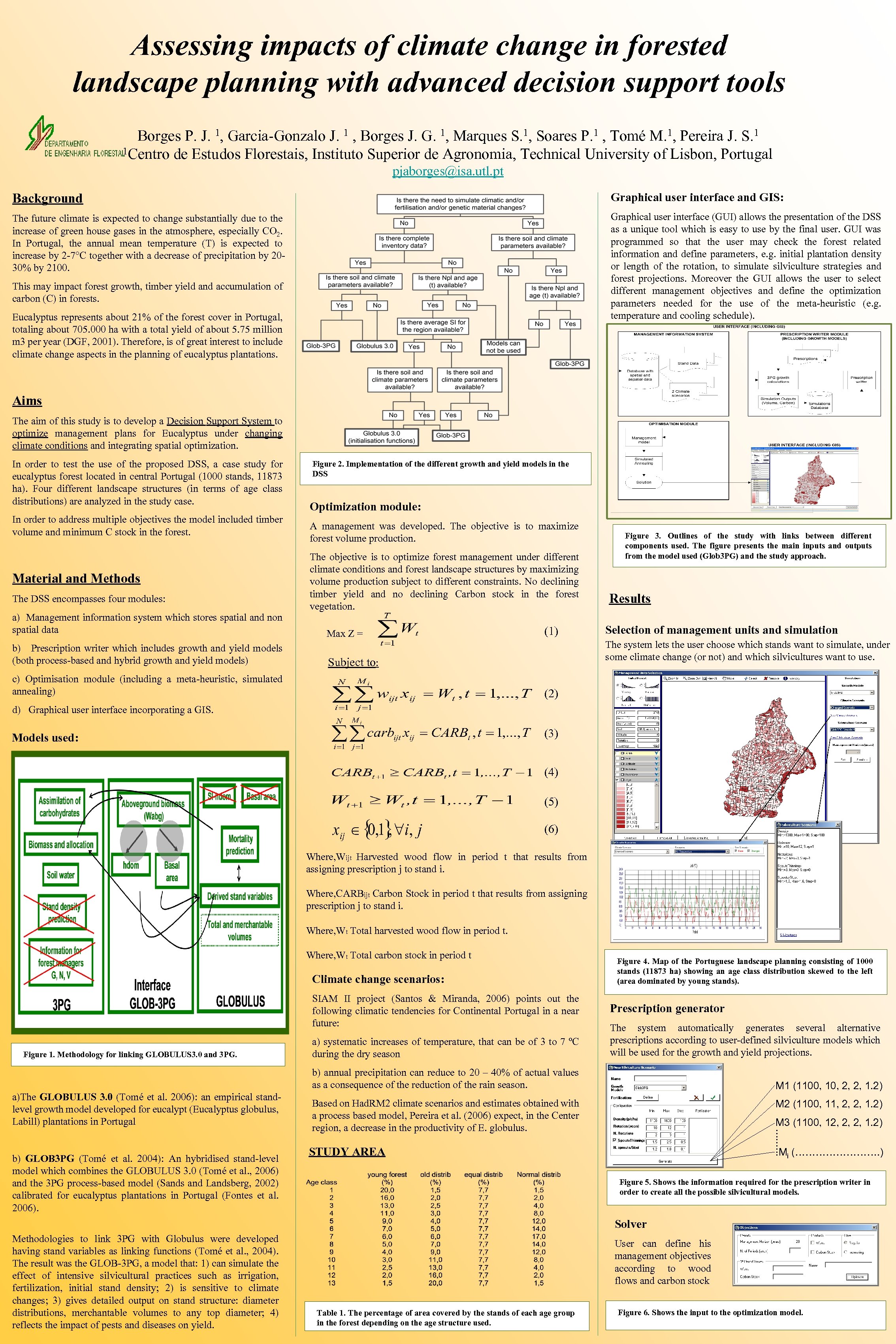 Assessing impacts of climate change in forested landscape planning with advanced decision support tools Borges P. J. 1, Garcia-Gonzalo J. 1 , Borges J. G. 1, Marques S. 1, Soares P. 1 , Tomé M. 1, Pereira J. S. 1 1 Centro de Estudos Florestais, Instituto Superior de Agronomia, Technical University of Lisbon, Portugal pjaborges@isa. utl. pt Background Graphical user interface and GIS: The future climate is expected to change substantially due to the increase of green house gases in the atmosphere, especially CO 2. In Portugal, the annual mean temperature (T) is expected to increase by 2 -7°C together with a decrease of precipitation by 2030% by 2100. Graphical user interface (GUI) allows the presentation of the DSS as a unique tool which is easy to use by the final user. GUI was programmed so that the user may check the forest related information and define parameters, e. g. initial plantation density or length of the rotation, to simulate silviculture strategies and forest projections. Moreover the GUI allows the user to select different management objectives and define the optimization parameters needed for the use of the meta-heuristic (e. g. temperature and cooling schedule). This may impact forest growth, timber yield and accumulation of carbon (C) in forests. Eucalyptus represents about 21% of the forest cover in Portugal, totaling about 705. 000 ha with a total yield of about 5. 75 million m 3 per year (DGF, 2001). Therefore, is of great interest to include climate change aspects in the planning of eucalyptus plantations. Aims The aim of this study is to develop a Decision Support System to optimize management plans for Eucalyptus under changing climate conditions and integrating spatial optimization. In order to test the use of the proposed DSS, a case study for eucalyptus forest located in central Portugal (1000 stands, 11873 ha). Four different landscape structures (in terms of age class distributions) are analyzed in the study case. In order to address multiple objectives the model included timber volume and minimum C stock in the forest. Material and Methods The DSS encompasses four modules: a) Management information system which stores spatial and non spatial data b) Prescription writer which includes growth and yield models (both process-based and hybrid growth and yield models) Figure 2. Implementation of the different growth and yield models in the DSS Optimization module: A management was developed. The objective is to maximize forest volume production. The objective is to optimize forest management under different climate conditions and forest landscape structures by maximizing volume production subject to different constraints. No declining timber yield and no declining Carbon stock in the forest vegetation. Max Z = (1) Results Selection of management units and simulation The system lets the user choose which stands want to simulate, under some climate change (or not) and which silvicultures want to use. Subject to: c) Optimisation module (including a meta-heuristic, simulated annealing) Figure 3. Outlines of the study with links between different components used. The figure presents the main inputs and outputs from the model used (Glob 3 PG) and the study approach. (2) d) Graphical user interface incorporating a GIS. (3) Models used: (4) (5) (6) Where, Wijt Harvested wood flow in period t that results from assigning prescription j to stand i. Where, CARBijt Carbon Stock in period t that results from assigning prescription j to stand i. Where, Wt Total harvested wood flow in period t. Where, Wt Total carbon stock in period t Climate change scenarios: SIAM II project (Santos & Miranda, 2006) points out the following climatic tendencies for Continental Portugal in a near future: Figure 4. Map of the Portuguese landscape planning consisting of 1000 stands (11873 ha) showing an age class distribution skewed to the left (area dominated by young stands). Prescription generator b) annual precipitation can reduce to 20 – 40% of actual values as a consequence of the reduction of the rain season. Figure 1. Methodology for linking GLOBULUS 3. 0 and 3 PG. a)The GLOBULUS 3. 0 (Tomé et al. 2006): an empirical standlevel growth model developed for eucalypt (Eucalyptus globulus, Labill) plantations in Portugal b) GLOB 3 PG (Tomé et al. 2004): An hybridised stand-level model which combines the GLOBULUS 3. 0 (Tomé et al. , 2006) and the 3 PG process-based model (Sands and Landsberg, 2002) calibrated for eucalyptus plantations in Portugal (Fontes et al. 2006). a) systematic increases of temperature, that can be of 3 to 7 ºC during the dry season The system automatically generates several alternative prescriptions according to user-defined silviculture models which will be used for the growth and yield projections. M 1 (1100, 10, 2, 2, 1. 2) Based on Had. RM 2 climate scenarios and estimates obtained with a process based model, Pereira et al. (2006) expect, in the Center region, a decrease in the productivity of E. globulus. M 2 (1100, 11, 2, 2, 1. 2) M 3 (1100, 12, 2, 2, 1. 2). . . . (…………. ). Mi STUDY AREA Figure 5. Shows the information required for the prescription writer in order to create all the possible silvicultural models. Solver Methodologies to link 3 PG with Globulus were developed having stand variables as linking functions (Tomé et al. , 2004). The result was the GLOB-3 PG, a model that: 1) can simulate the effect of intensive silvicultural practices such as irrigation, fertilization, initial stand density; 2) is sensitive to climate changes; 3) gives detailed output on stand structure: diameter distributions, merchantable volumes to any top diameter; 4) reflects the impact of pests and diseases on yield. User can define his management objectives according to wood flows and carbon stock Table 1. The percentage of area covered by the stands of each age group in the forest depending on the age structure used. Figure 6. Shows the input to the optimization model.