 Скачать презентацию Assessing Health Information Needs Globally and Locally HIPNet
5be28c15c90267eb0697d377d3649719.ppt
- Количество слайдов: 46



Assessing Health Information Needs: Globally and Locally HIPNet Meeting June 17, 2009 Tara Sullivan Saori Ohkubo Elizabeth Frazee Adrienne Kols 1
K 4 Health Project • USAID-supported 5 year Associate Award • Implemented by: – Johns Hopkins Bloomberg School of Public Health Center for Communication Programs (JHU/CCP) • In partnership with: – Family Health International (FHI) and Management Sciences for Health (MSH) 2
K 4 Health Mission • Quality health information captured, synthesized, and made easy to find and easy to use for policy makers, program managers, and service providers. 3
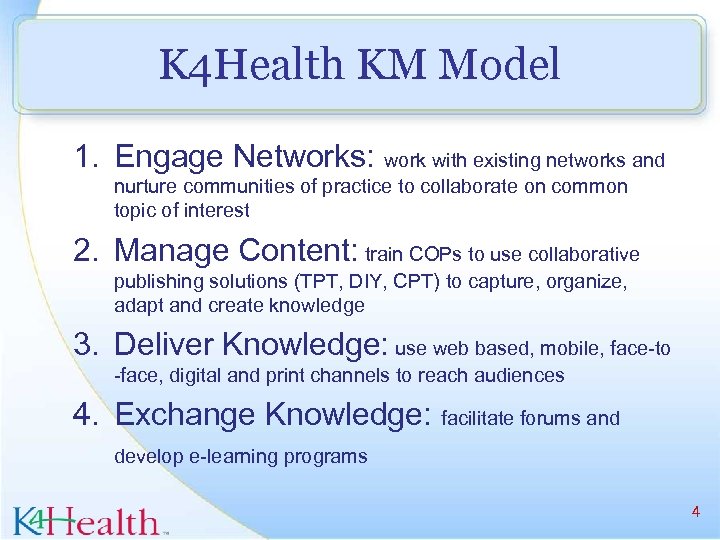
K 4 Health KM Model 1. Engage Networks: work with existing networks and nurture communities of practice to collaborate on common topic of interest 2. Manage Content: train COPs to use collaborative publishing solutions (TPT, DIY, CPT) to capture, organize, adapt and create knowledge 3. Deliver Knowledge: use web based, mobile, face-to -face, digital and print channels to reach audiences 4. Exchange Knowledge: facilitate forums and develop e-learning programs 4
K 4 Health Needs Assessment Purpose To provide research and analysis of health information needs, networks, technology and tools, infrastructure, and key stakeholders, globally and in multiple regions and countries. 5
Research Questions (1) What are the health information needs of USAID health officers, program managers, healthcare providers and community health workers? (2) What infrastructure exists to support information and communication technologies (ICTs)? (3) What are the most promising technologies and tools? tools (4) What health information networks exist and how can they extend reach and use of health information? (5) Who are the key health information stakeholders? stakeholders (6) What are the challenges to accessing and using upto-date health information? 6
Methods (1) Environment Scan (2) Online survey (3) Multi-country qualitative study 7
Methods: Environment Scan • March 2 – May 8, 2009 • Search of published literature using Pub. Med and online databases and bibliographies • Internet search for grey literature, relevant projects, and health information networks • Interviews with knowledge managers at 17 organization that are active members of HIPNet 8
Methods: Online Survey • March 25 to April 24, 2009 • 39 questions addressed demand for health topics, resources and tools of interest, information delivery and sharing preferences • Dissemination using a targeted e-mail announcement to: – USAID, WHO, UNFPA, CAs (headquarters and field offices) – Relevant listservs/discussion groups (HIFA 2015, IBP, HIPNet) • 808 responses: English=540 (67%), French=88 (11%), Spanish=180 (22%) 9
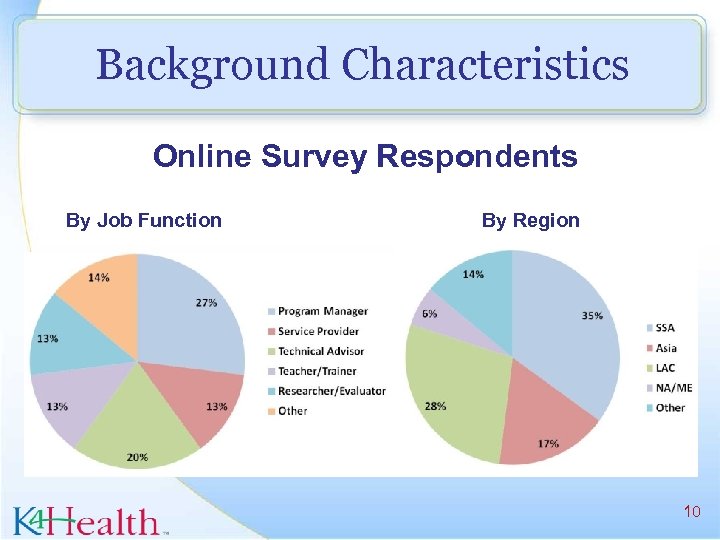
Background Characteristics Online Survey Respondents By Job Function By Region 10
Methods: Multi-Country Qualitative Study • • June – September 2009 Countries Africa: Ethiopia, Malawi, South Africa, Uganda Asia: India LAC: Peru • • • In-depth Interviews Network stakeholder interviews Focus group discussions 11
Results: Needs Providers need information that is: • • • Trustworthy Up-to-date Relevant to the local setting Practical Easy to digest Convenient and accessible 12 Source: Environment Scan
Results: Needs For Information, Health Workers in Developing Countries Rely on: – Workshops and meetings sponsored by the facility or health care system – Official materials, such as guidelines, manuals, and hospital protocols – Discussions with colleagues – Textbooks – Internet, if available 13 Source: Environment Scan
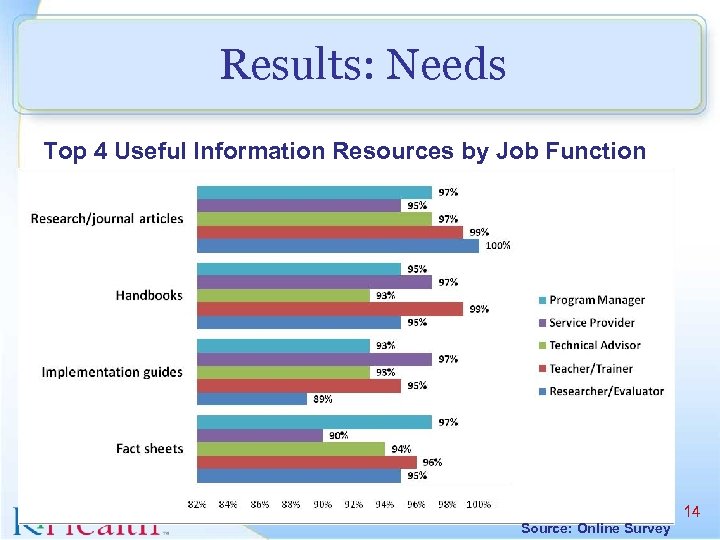
Results: Needs Top 4 Useful Information Resources by Job Function Source: Online Survey 14
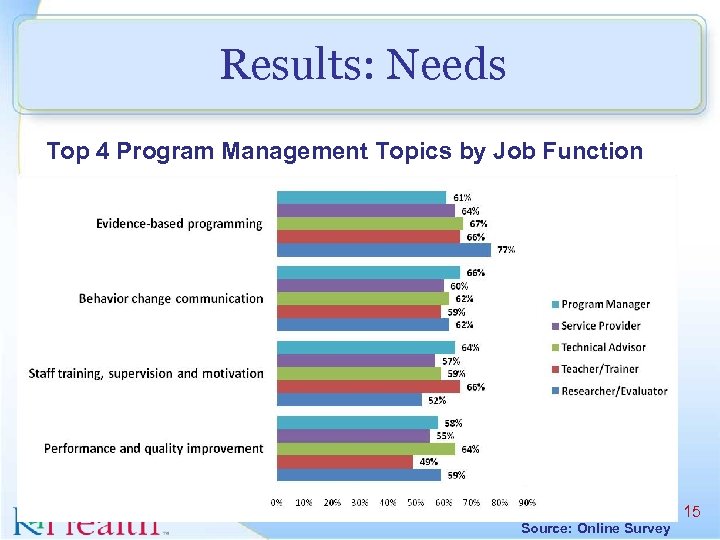
Results: Needs Top 4 Program Management Topics by Job Function Source: Online Survey 15
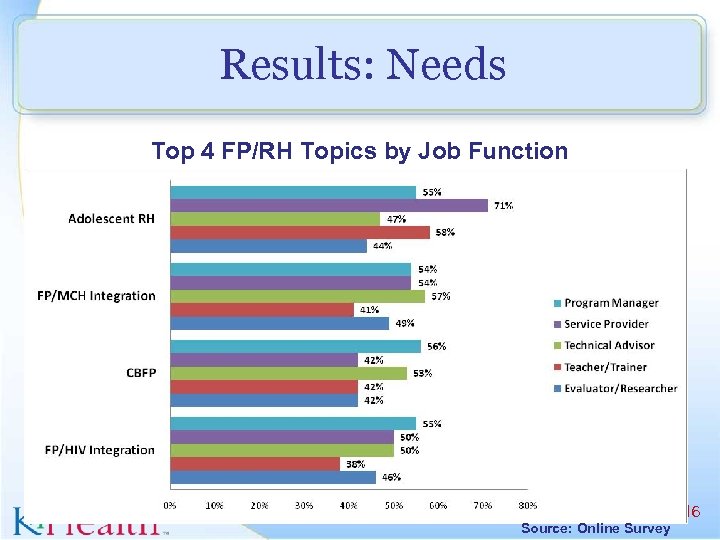
Results: Needs Top 4 FP/RH Topics by Job Function Source: Online Survey 16
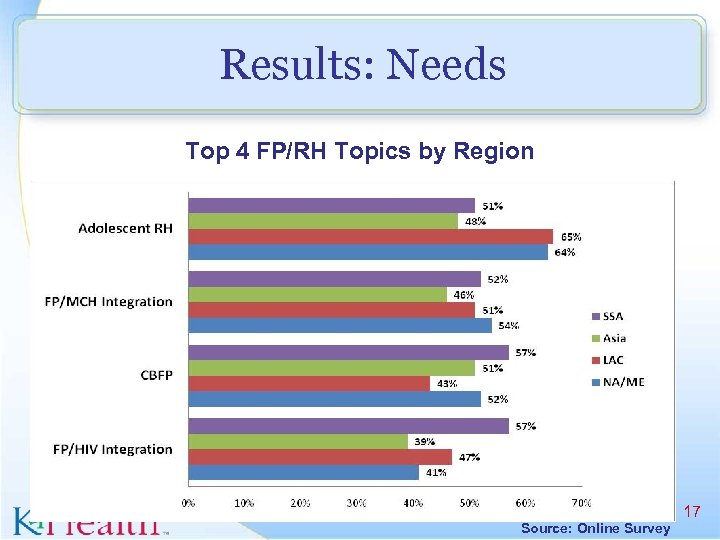
Results: Needs Top 4 FP/RH Topics by Region Sorce: Online Survey Source: Online Survey 17
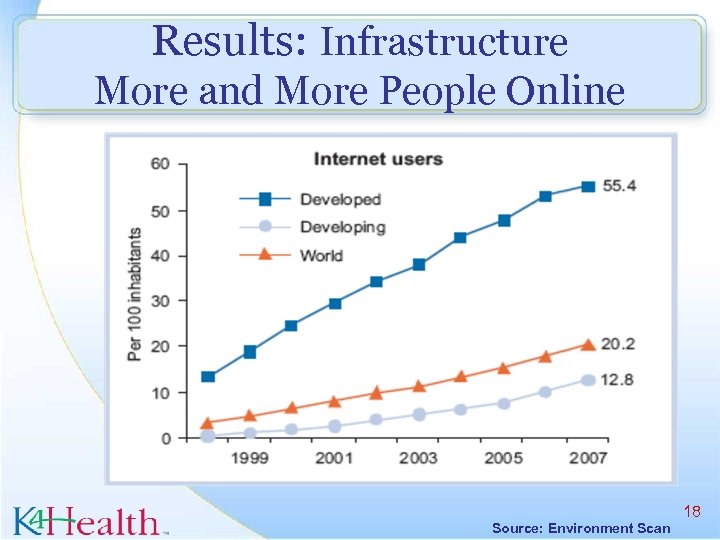
Results: Infrastructure More and More People Online 18 Source: Environment Scan
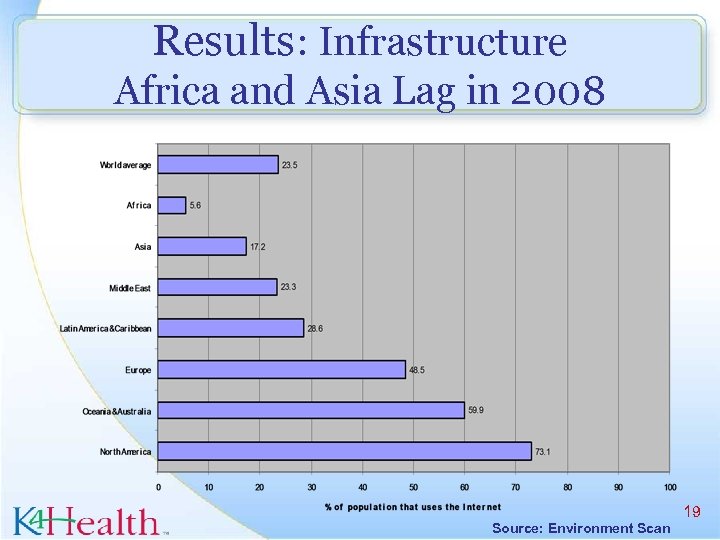
Results: Infrastructure Africa and Asia Lag in 2008 19 Source: Environment Scan
Results: Infrastructure Obstacles to Internet Access in Developing Countries • Poor infrastructure: lack of electricity, phone lines, ISPs, bandwidth • High costs: of hardware, software, and connections • Lack of human capacity: limited computer literacy and skilled IT professionals • Inappropriate content: mostly in English, requires high literacy and Internet savvy, little content is created in and relevant to the South 20 Source: Environment Scan
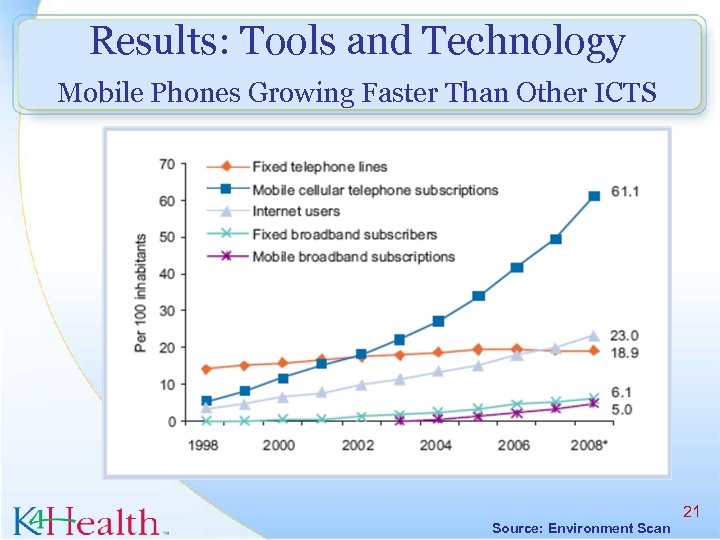
Results: Tools and Technology Mobile Phones Growing Faster Than Other ICTS 21 Source: Environment Scan
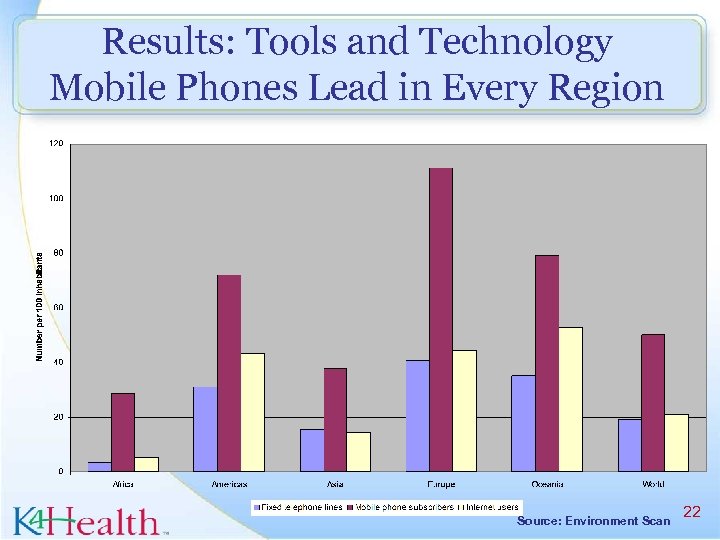
Results: Tools and Technology Mobile Phones Lead in Every Region Source: Environment Scan 22
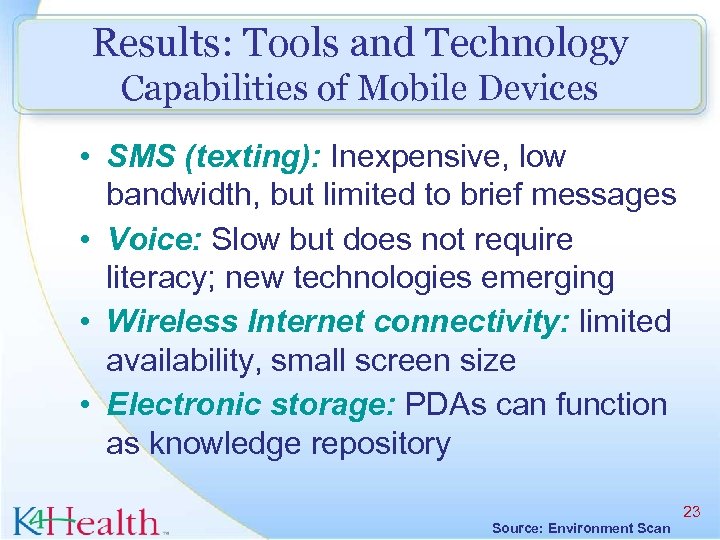
Results: Tools and Technology Capabilities of Mobile Devices • SMS (texting): Inexpensive, low bandwidth, but limited to brief messages • Voice: Slow but does not require literacy; new technologies emerging • Wireless Internet connectivity: limited availability, small screen size • Electronic storage: PDAs can function as knowledge repository 23 Source: Environment Scan
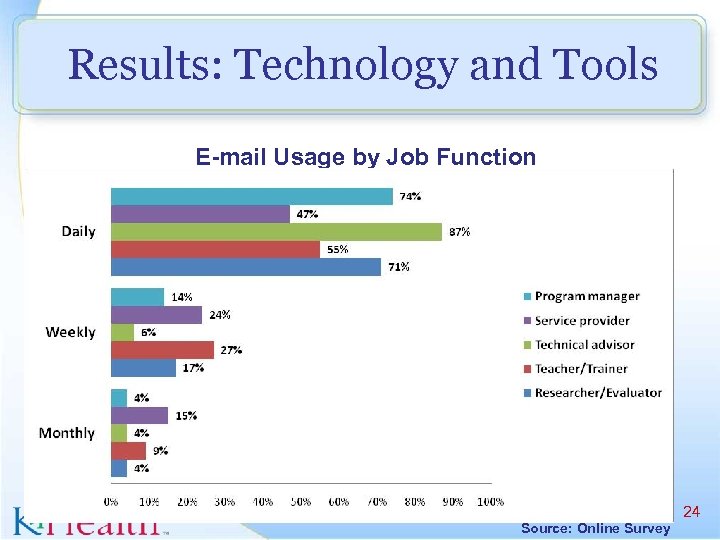
Results: Technology and Tools E-mail Usage by Job Function Source: Online Survey 24
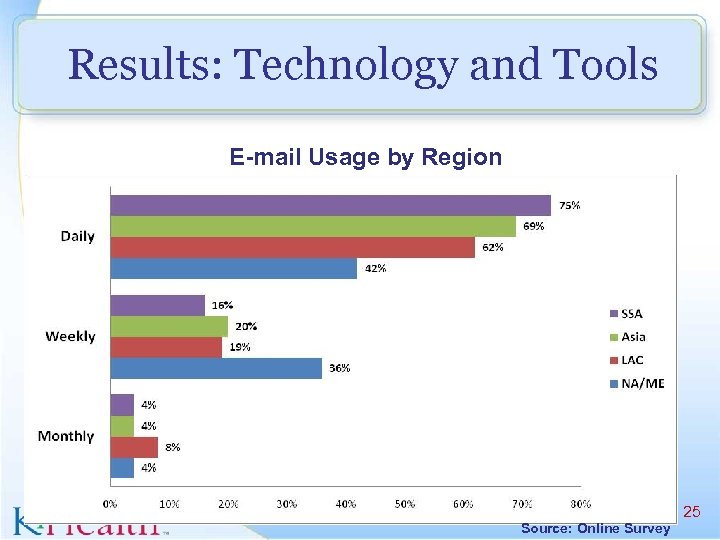
Results: Technology and Tools E-mail Usage by Region Source: Online Survey 25
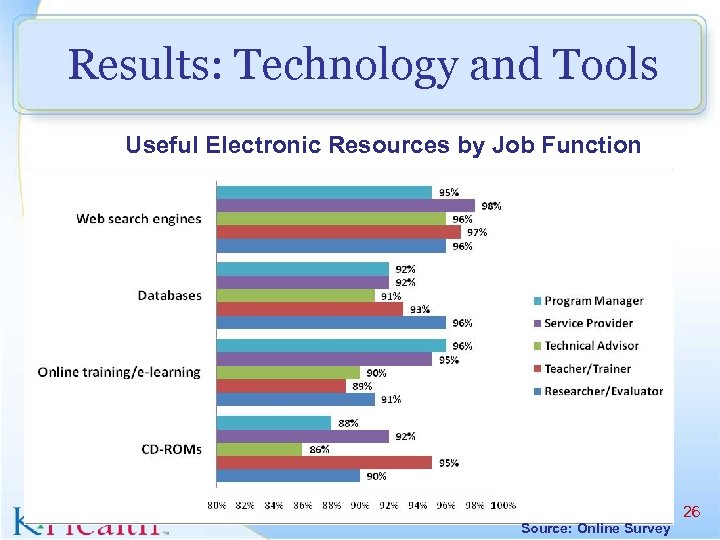
Results: Technology and Tools Useful Electronic Resources by Job Function Source: Online Survey 26
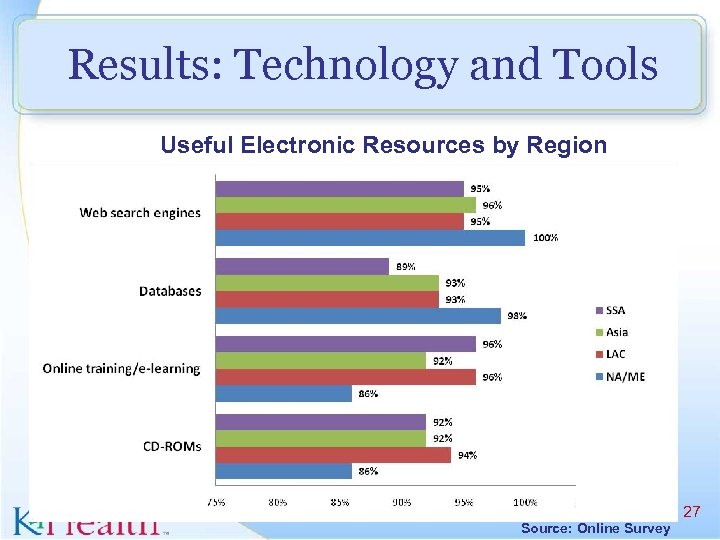
Results: Technology and Tools Useful Electronic Resources by Region Source: Online Survey 27
Results: Technology and Tools Routine Access to IT Devices • 90% Computer with a CD-ROM drive • Over 85% – Computer with the Internet – Mobile phone – Printer • 80% DVD player • 30% i. Pod/MP 3 player • 15% PDA 28
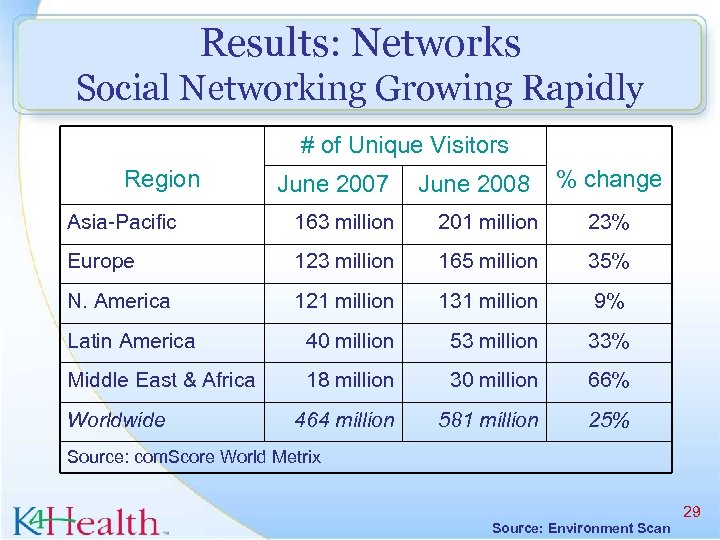
Results: Networks Social Networking Growing Rapidly # of Unique Visitors Region June 2007 June 2008 % change Asia-Pacific 163 million 201 million 23% Europe 123 million 165 million 35% N. America 121 million 131 million 9% Latin America 40 million 53 million 33% Middle East & Africa 18 million 30 million 66% 464 million 581 million 25% Worldwide Source: com. Score World Metrix 29 Source: Environment Scan
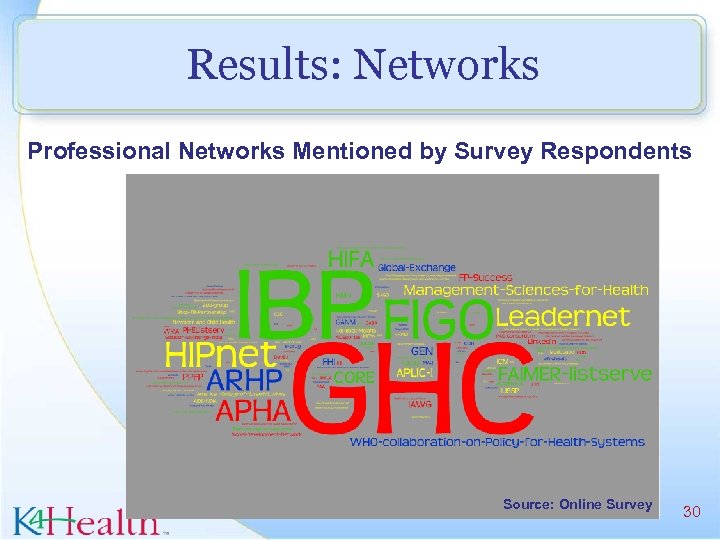
Results: Networks Professional Networks Mentioned by Survey Respondents Source: Online Survey 30
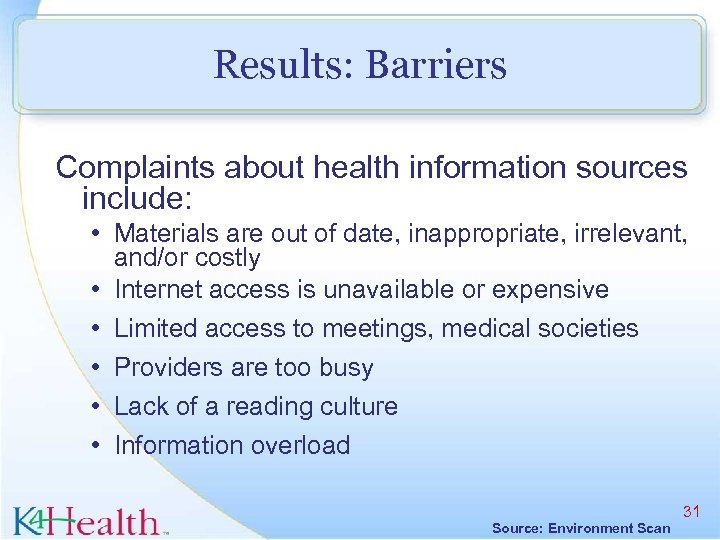
Results: Barriers Complaints about health information sources include: • Materials are out of date, inappropriate, irrelevant, and/or costly • Internet access is unavailable or expensive • Limited access to meetings, medical societies • Providers are too busy • Lack of a reading culture • Information overload 31 Source: Environment Scan
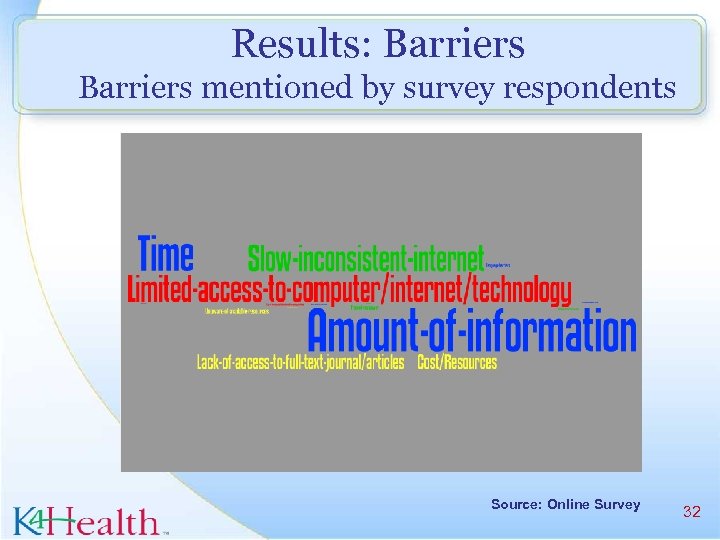
Results: Barriers mentioned by survey respondents Source: Online Survey 32
Key Findings from HIPNET Member Organizations • Knowledge sharing activities rarely extend as far as frontline providers and managers • Heavy reliance on informal feedback to assess information needs of audience and to judge success of products • Most rely on email to communicate with staff and outsiders and on the web to disseminate materials • Internal COPs have proven extremely useful 33 Source: Environment Scan
HIPNET on new technologies • Positive experiences with wikis and web-conferencing • Great interest in mobile devices and new video technologies, but not clear how to exploit them • Generational divide in opinions of and enthusiasm for Web 2. 0 tools • Recognize that social networking is young people’s preferred mode of communication, but struggling to figure out how to use Facebook effectively 34
HIPNET on knowledge networks • Tend to rely on a few trusted websites and listservs; prefer networks with narrow technical focus • Few networks mentioned more than one person: IBP, Core Group, and HIPNET • Staff at field offices promote knowledge sharing by joining local taskforces, working groups, and professional groups; local networking relies almost exclusively on faceto-face communication. 35
Implications: Select Appropriate Technologies • Do not migrate too quickly from “old” to “new” technologies • Anticipate and address bandwidth issues • Explore mobile devices: consider voice, texting, and web-based applications • Take advantage of new voice and video technologies • Embrace social networking sites as a model, if not a platform 36 Source: Environment Scan
Implications: Use Multiple Channels & Technologies • Use face-to-face and virtual interaction to reinforce one another • Seek out and work with local intermediaries to extend the reach of the Internet, including radio and cybercafés • Package the same content in multiple formats • Collaborate with local partners to move information the last mile 37 Source: Environment Scan
Implications: Meet the need for local content Goals • • Translation into local languages Solutions for low-literate audiences Content tailored to local settings Content repackaged for specific health cadres Methods • • Adapt global materials Help local people create their own content Promote knowledge sharing between countries Recruit information specialists to help 38 Source: Environment Scan
Implications: Conduct needs assessments and M&E • Rely on “pull” models that respond to the information needs of the audience • Assess both perceived and real information needs of audiences • Systematically evaluate the use of key information products 39 Source: Environment Scan
Recommendations for K 4 Health: Engage Networks • Formalize feedback mechanism to/from audience members • Create Co. Ps focused on specific technical and geographic areas • Partner with in-country intermediaries who can serve as community access points 40
Recommendations for K 4 Health: Manage Content • Collaborate with network members to gather materials and to review and field test knowledge toolkits • Actively promote toolkits as authoritative, trustworthy, up-to-date, practical and easy-to -find and easy-to-use • Train in-country partners to adapt materials in toolkits and create new materials 41
Recommendations for K 4 Health: Deliver Content • Enable users to add content and participate in forums on the Website through email • Use popular applications such as You. Tube for hosting video content to make it more accessible • Provide a link to CD-ROM version of toolkits to be downloaded and burned locally 42
Recommendations for K 4 Health: Exchange Knowledge • Develop user forums centered around topic preferences and K 4 Health publishing toolkits • Provide podcasts of e-learning courses • Link e-Learning course and Co. Ps for continued training and discussion 43
Next Steps • Disseminate preliminary results widely • Complete multi-country qualitative study – Disseminate results and develop recommendations locally – Disseminate results and develop recommendations globally 44
For more information • K 4 Health Environment Scan – Currently available – Contact: Tara Sullivan (tsulliva@jhsph. edu) • Results of online survey – Available mid-July – Contact: Saori Ohkubo (sohkubo@jhsph. edu) • Complete report – Available early November – Contact: Tara Sullivan (tsulliva@jhsph. edu) 45
Johns Hopkins Bloomberg School of Public Health Center for Communication Programs 111 Market Place, Suite 310 Baltimore, MD 21202 Tel: 410 -659 -6300 Fax: 410 -659 -6266 Contact: Earle Lawrence, Project Director (elawrenc@jhuccp. org) 46
Скачать презентацию Assessing Health Information Needs Globally and Locally HIPNet
5be28c15c90267eb0697d377d3649719.ppt