 Скачать презентацию ASSAL XVII Annual Meeting Lisbon 26 th April
8c3f743dfee0d6c311284a8ab1607737.ppt
- Количество слайдов: 24



ASSAL XVII Annual Meeting Lisbon, 26 th April 2006 Hurricanes and hydro-meteorology David Crichton Visiting Professor, Benfield Hazard Research Centre, University College London Visiting Professor, Middlesex University Flood Hazard Research Centre Hon Research Fellow, University of Dundee Fellow of the Chartered Insurance Institute david@crichton. sol. co. uk The information contained in this document is strictly proprietary and confidential ©Benfield Hazard Research Centre 2003
Impact of hurricane Katrina • Very large death toll—nearly 1500 people (the deadliest U. S. hurricane in 80 years and the third deadliest in U. S. history) • Approximately $75 billion in damage, the costliest disaster in U. S. history. • Approximately $75 billion in other economic impacts, especially business interruption. Source: Michael K. Lindell and Carla S. Prater Hazard Reduction & Recovery Center Texas A&M University The information contained in this document is strictly proprietary and confidential ©Benfield Hazard Research Centre 2003
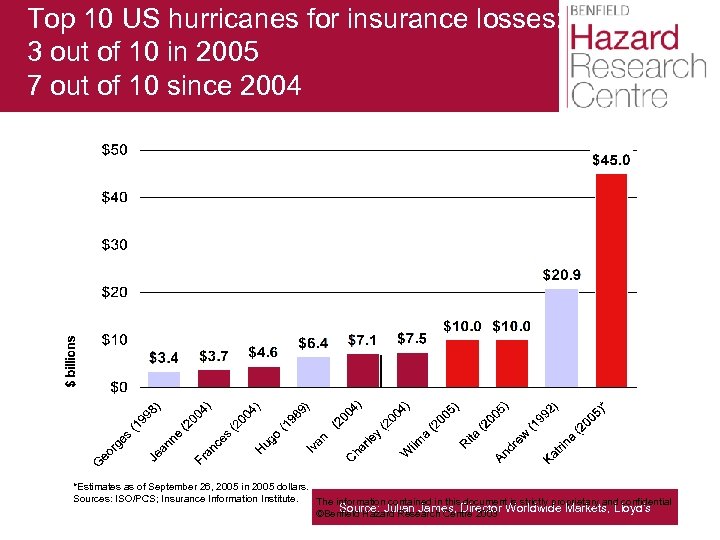
Top 10 US hurricanes for insurance losses: 3 out of 10 in 2005 7 out of 10 since 2004 *Estimates as of September 26, 2005 in 2005 dollars. Sources: ISO/PCS; Insurance Information Institute. The information contained in this document is strictly proprietary and confidential Source: Julian James, Director Worldwide Markets, Lloyd’s ©Benfield Hazard Research Centre 2003
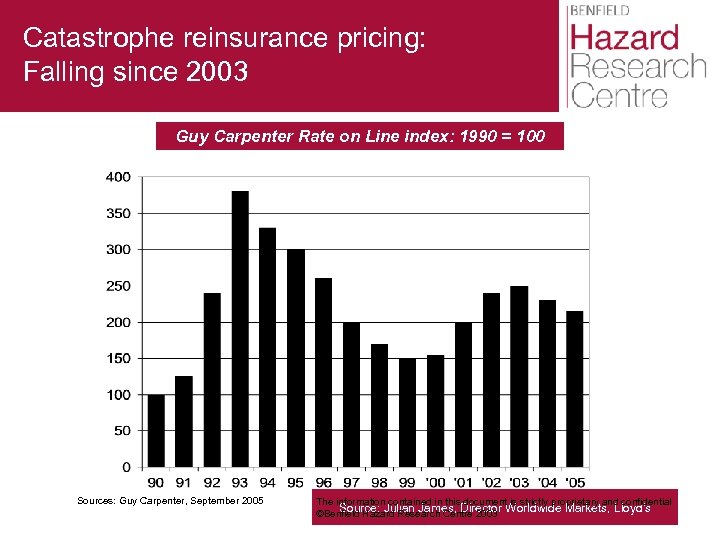
Catastrophe reinsurance pricing: Falling since 2003 Guy Carpenter Rate on Line index: 1990 = 100 Sources: Guy Carpenter, September 2005 The information contained in this document is strictly proprietary and confidential Source: Julian James, Director Worldwide Markets, Lloyd’s ©Benfield Hazard Research Centre 2003
Why insurance? • Forces external risk assessment • Financial incentives for loss reduction • Spreads the cost globally • Micro insurance and weather hedges • Less dependence on aid The greater the government regulation, the less insurance can help. The information contained in this document is strictly proprietary and confidential ©Benfield Hazard Research Centre 2003
Private insurance needs “BASIC MUD” B Big enough “book” of business, i. e. a large enough collection of risks for a statistical spread A Adverse selection minimised through good knowledge of each risk. S Sustainable over a number of years for various future scenarios so the risks can be spread over time and reserves built up. I Information readily available from reliable sources about hazard, vulnerability, exposure and claims triggers. C Cultural issues. - systems, customs and law. M Moral and political hazard low and manageable. U Uncertainty about the potential loss. D Demand for insurance must exist (or have potential to be created) The information contained in this document is strictly proprietary and confidential ©Benfield Hazard Research Centre 2003
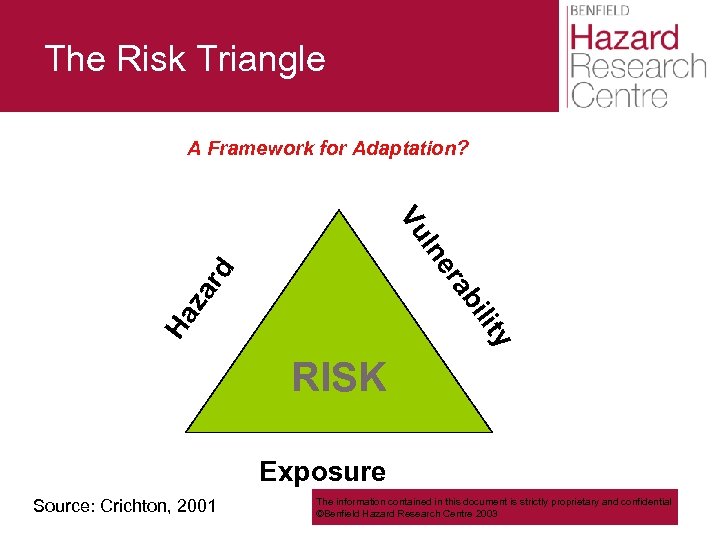
The Risk Triangle A Framework for Adaptation? ty Ha za ili ab rd er ln Vu RISK Exposure Source: Crichton, 2001 The information contained in this document is strictly proprietary and confidential ©Benfield Hazard Research Centre 2003
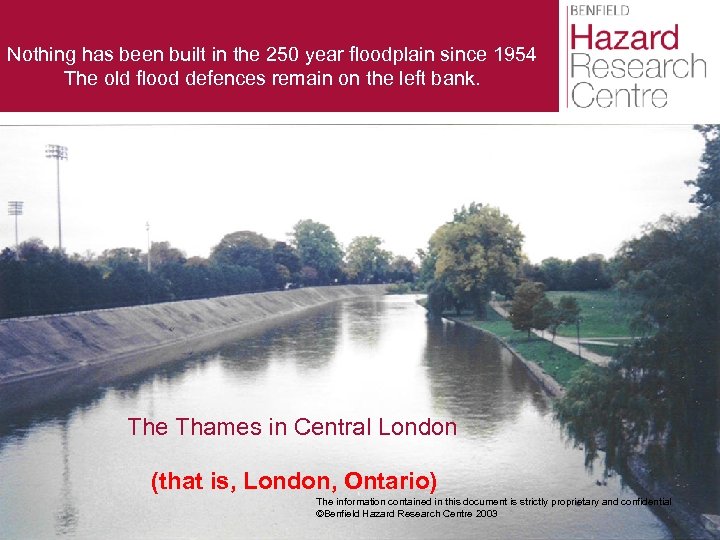
Nothing has been built in the 250 year floodplain since 1954 The old flood defences remain on the left bank. The Thames in Central London (that is, London, Ontario) The information contained in this document is strictly proprietary and confidential ©Benfield Hazard Research Centre 2003
Vulnerability is growing… • • More old people Lightweight building construction More dependence on electricity More underground transport and parking The information contained in this document is strictly proprietary and confidential ©Benfield Hazard Research Centre 2003
Exposure is growing… • More people living near the coast or rivers The information contained in this document is strictly proprietary and confidential ©Benfield Hazard Research Centre 2003
Hazards are growing… • • • Increase in severe rainfall events Rising sea levels Higher storm surges More droughts and subsidence Changing storm tracks The information contained in this document is strictly proprietary and confidential ©Benfield Hazard Research Centre 2003
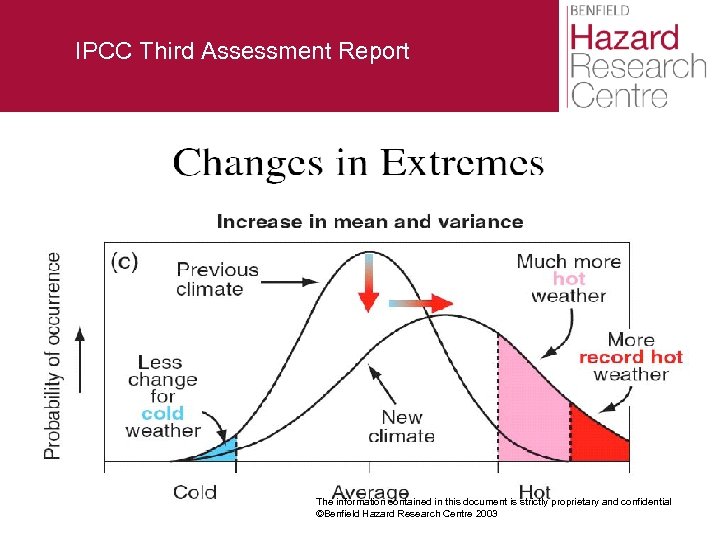
IPCC Third Assessment Report The information contained in this document is strictly proprietary and confidential ©Benfield Hazard Research Centre 2003
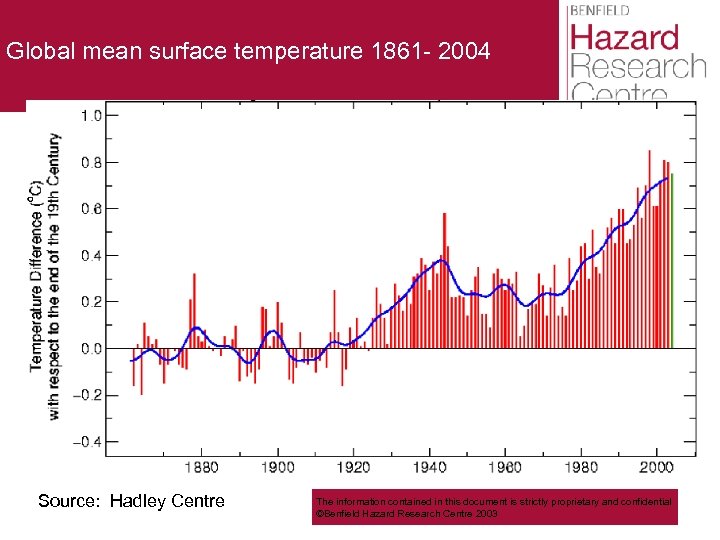
Global mean surface temperature 1861 - 2004 Source: Hadley Centre The information contained in this document is strictly proprietary and confidential ©Benfield Hazard Research Centre 2003
Storm Surges will become worse with rise in sea level and SST • 3 metres (1953, England Holland) • 5 metres (1999, “Anatole”, Denmark) • 8. 8 metres (2005, “Katrina”, USA) The information contained in this document is strictly proprietary and confidential ©Benfield Hazard Research Centre 2003
New approaches will be needed… • Mitigation – Reducing the carbon emissions which cause climate change by avoiding use of fossil fuels. • Adaptation – Making our buildings and cities more resilient • Stopping “Maladaptation” – Rethinking what we are doing right now The information contained in this document is strictly proprietary and confidential ©Benfield Hazard Research Centre 2003
Big European Flooding events. . . • • • 1993, 1994, 1995, 1997, 1998, 1999, 2000, 2001, 2002, 2003, 2004, 2005 Rhine, Tay Strathclyde Rhine Oder (Germany/Poland) England/Wales, Central Europe Danube, Denmark 5 m storm surge UK, Switzerland, Italy Wisla (Poland) UK, Dublin, Central Europe Rhone, France Conwy, North Wales. Conwy (again), Carlisle, Central Europe The information contained in this document is strictly proprietary and confidential ©Benfield Hazard Research Centre 2003
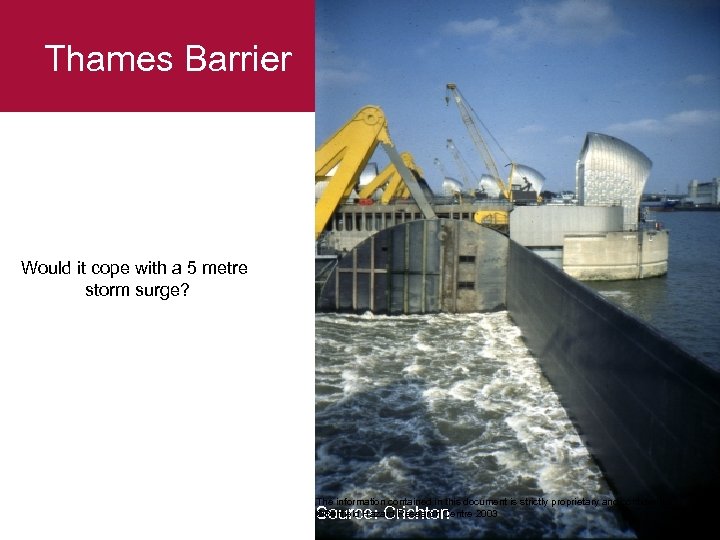
Thames Barrier Would it cope with a 5 metre storm surge? The information contained in this document is strictly proprietary and confidential ©Benfield Hazard Research Centre Source: Crichton 2003
Managing risk • Hazard, the event – Frequency and severity • Exposure, the value of life and property in area affected – Land use planning controls • Vulnerability, the extent to which life and property are affected – British Flood Insurance Claims Database The information contained in this document is strictly proprietary and confidential ©Benfield Hazard Research Centre 2003
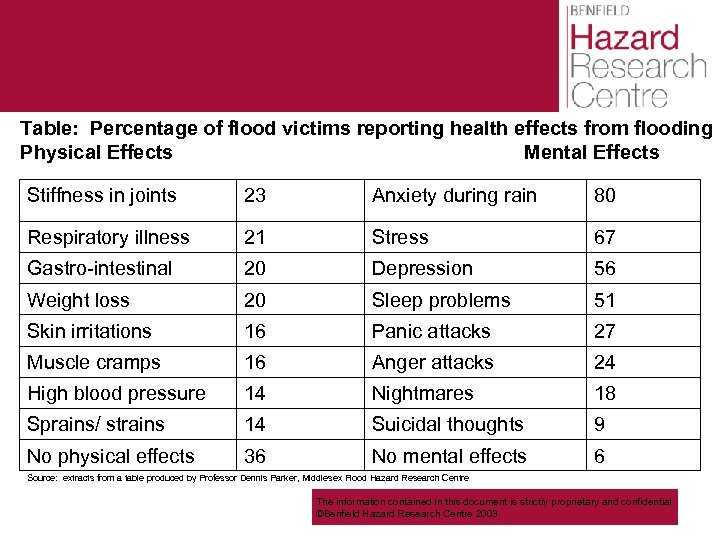
Table: Percentage of flood victims reporting health effects from flooding Physical Effects Mental Effects Stiffness in joints 23 Anxiety during rain 80 Respiratory illness 21 Stress 67 Gastro-intestinal 20 Depression 56 Weight loss 20 Sleep problems 51 Skin irritations 16 Panic attacks 27 Muscle cramps 16 Anger attacks 24 High blood pressure 14 Nightmares 18 Sprains/ strains 14 Suicidal thoughts 9 No physical effects 36 No mental effects 6 Source: extracts from a table produced by Professor Dennis Parker, Middlesex Flood Hazard Research Centre The information contained in this document is strictly proprietary and confidential ©Benfield Hazard Research Centre 2003
Non Structural Solutions • • Sustainable drainage methods (SUDS) Warning schemes Insurance Manage development in flood hazard areas. Water resource management Educate public and raise awareness Agricultural practices Resistance, resilience, and recovery “SWIMWEAR” The information contained in this document is strictly proprietary and confidential ©Benfield Hazard Research Centre 2003 *
Cheap flood insurance used to be widely available to all UK households • But this has increasingly enabled flood plain development – people could insure houses in flood hazard areas and get mortgages to buy them. • People in flood hazard areas were subsidised by people in safer areas • Only the property developers benefited. • An increasing number of properties were built in the floodplain without adequate defences. The information contained in this document is strictly proprietary and confidential ©Benfield Hazard Research Centre 2003
Insurance is now changing In 2002, the ABI warned that insurance would be withdrawn from flood hazard areas unless government acted to: – control floodplain development – spend more on flood defences • Government has failed to act in England. • The ABI announced that from 2006 insurance might no longer be available in high risk areas. The information contained in this document is strictly proprietary and confidential ©Benfield Hazard Research Centre 2003
But Scotland follows the “Insurance Template” Maximum exposure for insurers to write flood risk at normal terms. • • • Sheltered Housing Hotels, hostels etc Basements Bungalows without skylights Near “Flashy” rivers All other residential 1, 000 year 750 year 500 year 200 year Where the risk is higher than 1 in 200 years the Statement of Principles applies Source: Crichton The information contained in this document is strictly proprietary and confidential ©Benfield Hazard Research Centre 2003
Adaptation One message: Architects, Planners and Insurers should work together to help society to adapt to climate change david@crichton. sol. co. uk The information contained in this document is strictly proprietary and confidential ©Benfield Hazard Research Centre 2003
Скачать презентацию ASSAL XVII Annual Meeting Lisbon 26 th April
8c3f743dfee0d6c311284a8ab1607737.ppt