


 Скачать презентацию Aspiring Leaders for Teaching and Learning Session 1
e19dd52456102a3d50b1013234f29f92.ppt
- Количество слайдов: 60
 Aspiring Leaders for Teaching and Learning Session 1: Launch Day 2014 -15 Cohort Jacky King October 20 th 2014 1
 Welcome • Welcome to the programme and the venue • House keeping • Lunch arrangements • Fire and Evacuation procedures 2
 Getting to know each other • Please choose a pebble that in some way represents why you are here today. . . • Choose carefully as it will be yours for the rest of the programme – unless you choose to trade it in. • • • Please then be prepared to say: Who you are The school you are from Your role in school Why you chose the pebble you did Why you are here today 3
 How do you feel about being called a leader? • As you start this Aspiring Leaders programme – please take a moment to reflect on how you feel about being called a leader. • • Please write how you are feeling on a Post-it. • We will then share our thoughts. Please write your name on the post-it or have some way of recognising it as your own. 4
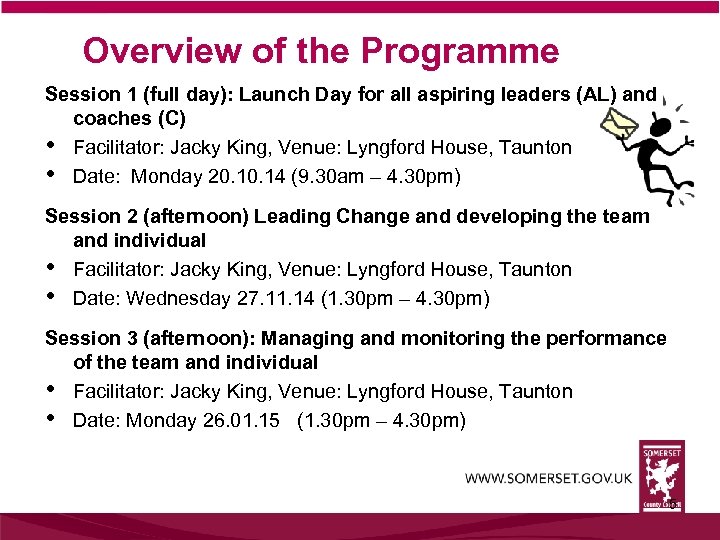 Overview of the Programme Session 1 (full day): Launch Day for all aspiring leaders (AL) and coaches (C) • Facilitator: Jacky King, Venue: Lyngford House, Taunton • Date: Monday 20. 14 (9. 30 am – 4. 30 pm) Session 2 (afternoon) Leading Change and developing the team and individual • Facilitator: Jacky King, Venue: Lyngford House, Taunton • Date: Wednesday 27. 11. 14 (1. 30 pm – 4. 30 pm) Session 3 (afternoon): Managing and monitoring the performance of the team and individual • Facilitator: Jacky King, Venue: Lyngford House, Taunton • Date: Monday 26. 01. 15 (1. 30 pm – 4. 30 pm) 5
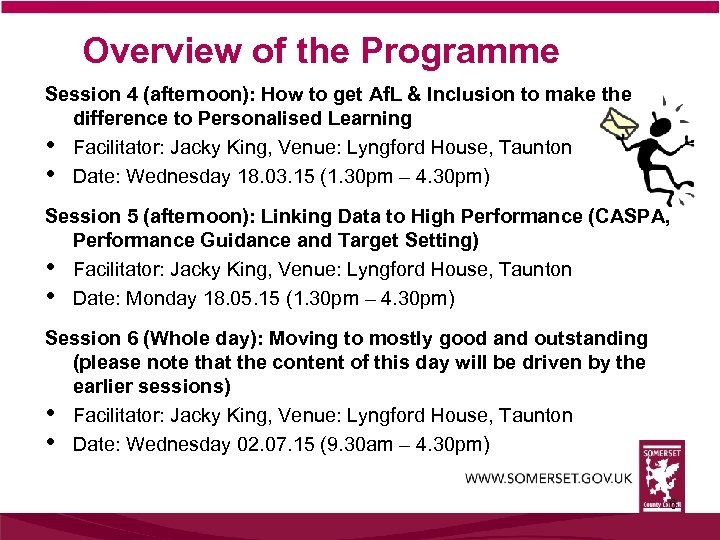 Overview of the Programme Session 4 (afternoon): How to get Af. L & Inclusion to make the difference to Personalised Learning • Facilitator: Jacky King, Venue: Lyngford House, Taunton • Date: Wednesday 18. 03. 15 (1. 30 pm – 4. 30 pm) Session 5 (afternoon): Linking Data to High Performance (CASPA, Performance Guidance and Target Setting) • Facilitator: Jacky King, Venue: Lyngford House, Taunton • Date: Monday 18. 05. 15 (1. 30 pm – 4. 30 pm) Session 6 (Whole day): Moving to mostly good and outstanding (please note that the content of this day will be driven by the earlier sessions) • Facilitator: Jacky King, Venue: Lyngford House, Taunton • Date: Wednesday 02. 07. 15 (9. 30 am – 4. 30 pm) 6
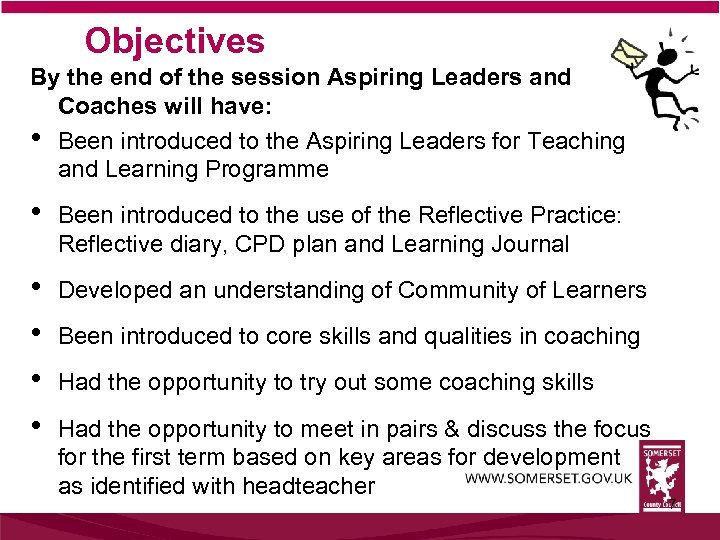 Objectives By the end of the session Aspiring Leaders and Coaches will have: • Been introduced to the Aspiring Leaders for Teaching and Learning Programme • Been introduced to the use of the Reflective Practice: Reflective diary, CPD plan and Learning Journal • • Developed an understanding of Community of Learners Been introduced to core skills and qualities in coaching Had the opportunity to try out some coaching skills Had the opportunity to meet in pairs & discuss the focus for the first term based on key areas for development as identified with headteacher 7
 Contract for Professional Learning • You have a copy of the Contract for Professional Learning. • • There are some highlighters available. • Then have a conversation with your coach or the person next to you about the list. • We'll then share any comments that people might want to make. On your own – please read through the list and highlight those you feel about to sign up to right now. 8
 The Reflective Journal: Documents your Personal, Professional and Academic development as you reflect upon the learning journey that you make. • To do this effectively you reflect on your original intentions, your achievements, the impact of your achievements and you set yourself Targets for the future. • Reflective practice as supported by The Reflective Journal is key to Personal, Professional and Career development. 9
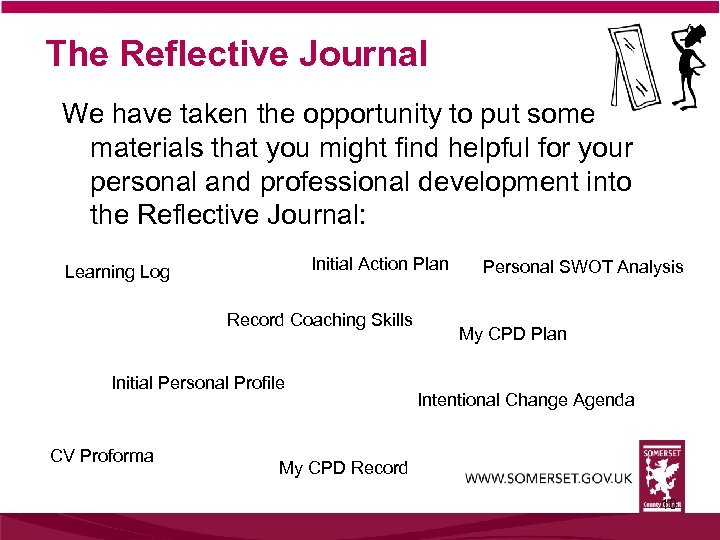 The Reflective Journal We have taken the opportunity to put some materials that you might find helpful for your personal and professional development into the Reflective Journal: Initial Action Plan Learning Log Record Coaching Skills Initial Personal Profile CV Proforma Personal SWOT Analysis My CPD Plan Intentional Change Agenda My CPD Record 10
 The Reflective Diary • The Reflective Diary: This is your individual and private account of the personal challenges that you might be presented with as a result working with this programme. We need to be aware of the assumptions that frame how we think and act. We need to know ourselves well and be honest with ourselves! • You can record your thoughts, feelings and emotions in your Reflective Diary at any time. Keep it with you always. 11
 The Art of Reflection “We do not learn from experience… We learn from reflecting on experience. ” Dewey (1933) Please take 2 minutes now to record in your reflective diary how you are feeling right now about this programme… 12 12
 How do you feel about being called a leader? • Please now retrieve your Post-it and put it in your Reflective diary. • A glue stick is available! 13
 Reflection and its role in Learning Moon (2004) describes a model: 1. Noticing 2. Making sense 3. Making meaning 4. Working with meaning 5. Transformative learning This is real ‘experiential learning’ – real activity with real consequences. 14
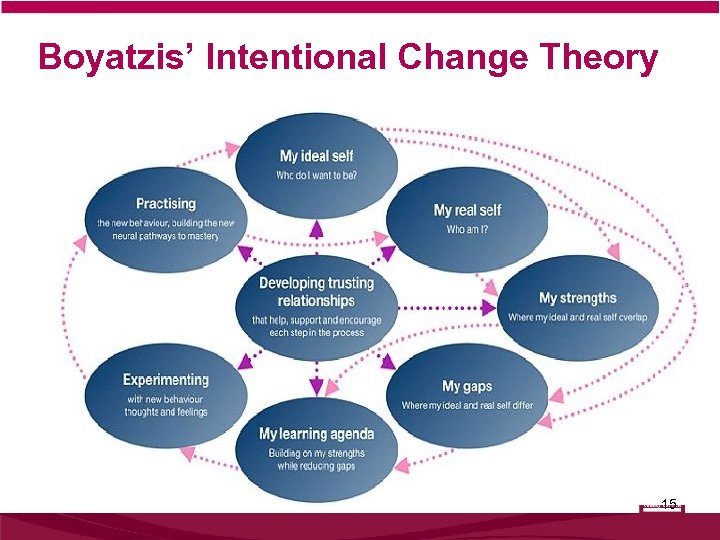 Boyatzis’ Intentional Change Theory 15
 Only one person likes change. . . 16
 http: //www. boilingfrogstory. com/ The Boiling Frog 17
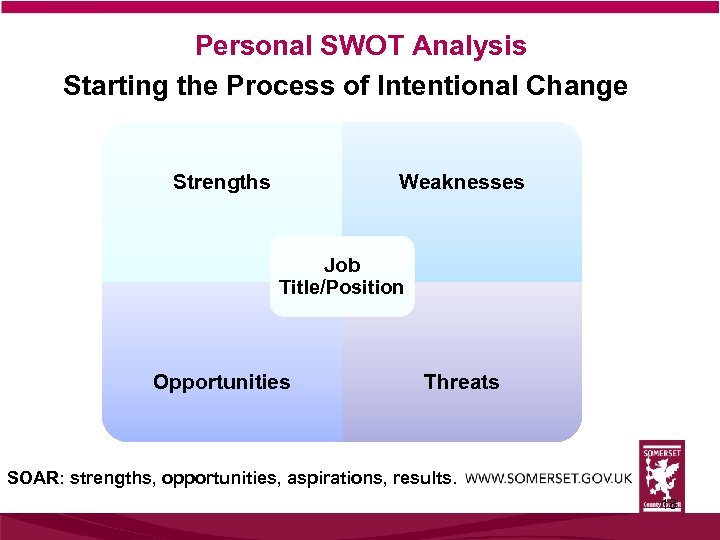 Personal SWOT Analysis Starting the Process of Intentional Change Strengths Weaknesses Job Title/Position Opportunities Threats SOAR: strengths, opportunities, aspirations, results. 18
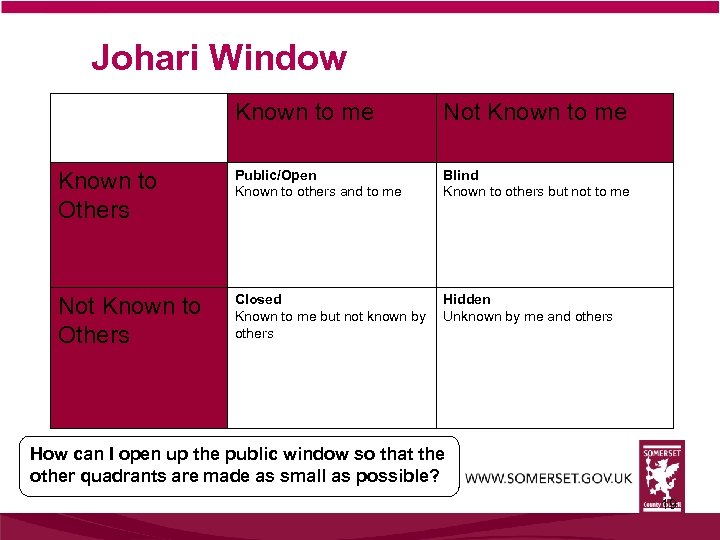 Johari Window Known to me Not Known to me Known to Others Public/Open Known to others and to me Blind Known to others but not to me Not Known to Others Closed Hidden Known to me but not known by Unknown by me and others How can I open up the public window so that the other quadrants are made as small as possible? 19
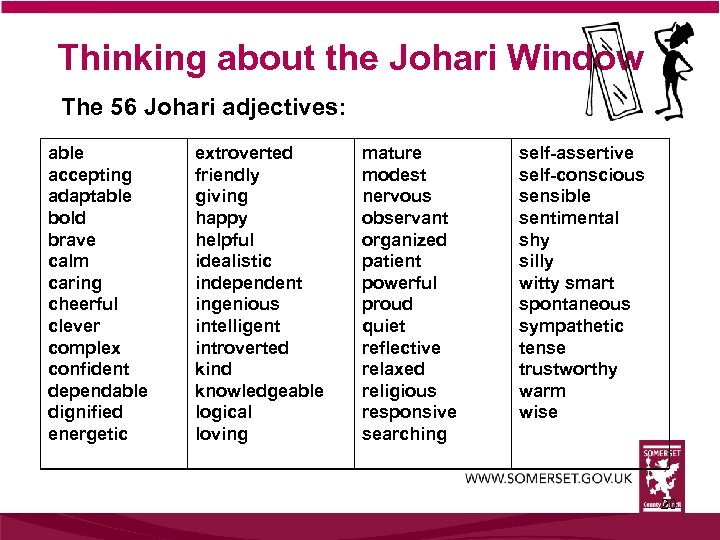 Thinking about the Johari Window The 56 Johari adjectives: able accepting adaptable bold brave calm caring cheerful clever complex confident dependable dignified energetic extroverted friendly giving happy helpful idealistic independent ingenious intelligent introverted kind knowledgeable logical loving mature modest nervous observant organized patient powerful proud quiet reflective relaxed religious responsive searching self-assertive self-conscious sensible sentimental shy silly witty smart spontaneous sympathetic tense trustworthy warm wise 20
 Thinking about the Johari Window Please take some time to reflect on the Johari window. You have a page in your Reflective Journal that you may choose to use. Please write down anything that comes to mind. We will then share any thoughts that people may want to with the group. 21
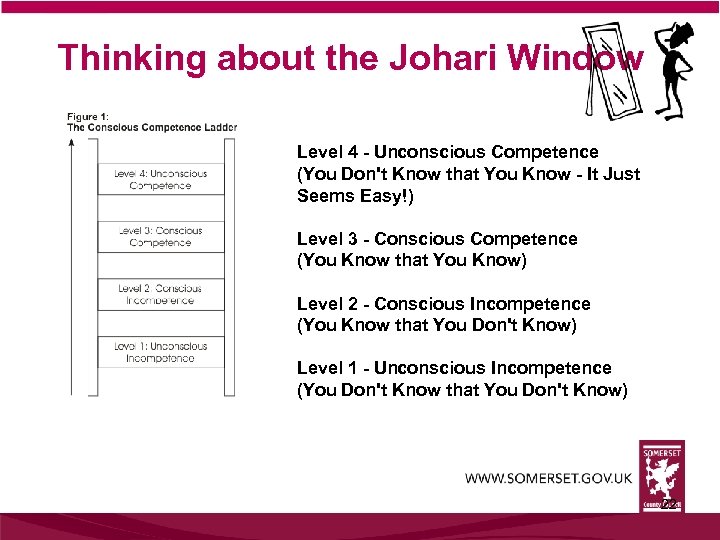 Thinking about the Johari Window Level 4 - Unconscious Competence (You Don't Know that You Know - It Just Seems Easy!) Level 3 - Conscious Competence (You Know that You Know) Level 2 - Conscious Incompetence (You Know that You Don't Know) Level 1 - Unconscious Incompetence (You Don't Know that You Don't Know) 22
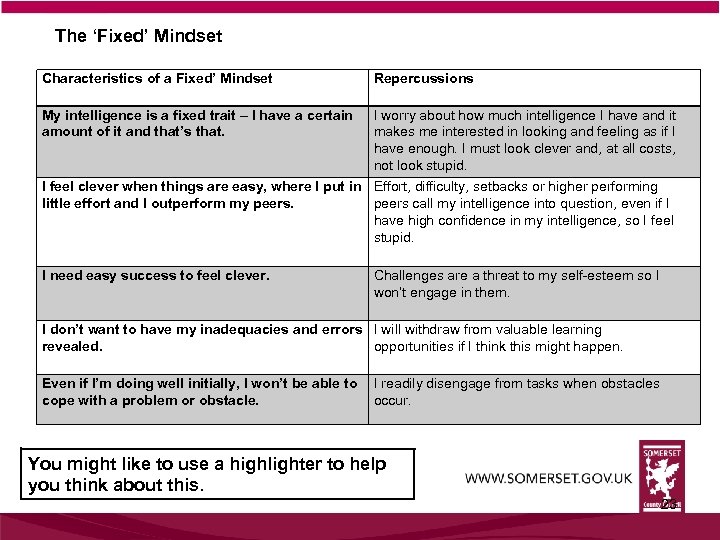 The ‘Fixed’ Mindset Characteristics of a Fixed’ Mindset Repercussions My intelligence is a fixed trait – I have a certain amount of it and that’s that. I worry about how much intelligence I have and it makes me interested in looking and feeling as if I have enough. I must look clever and, at all costs, not look stupid. I feel clever when things are easy, where I put in Effort, difficulty, setbacks or higher performing little effort and I outperform my peers call my intelligence into question, even if I have high confidence in my intelligence, so I feel stupid. I need easy success to feel clever. Challenges are a threat to my self-esteem so I won’t engage in them. I don’t want to have my inadequacies and errors I will withdraw from valuable learning revealed. opportunities if I think this might happen. Even if I’m doing well initially, I won’t be able to I readily disengage from tasks when obstacles cope with a problem or obstacle. occur. You might like to use a highlighter to help you think about this. 23
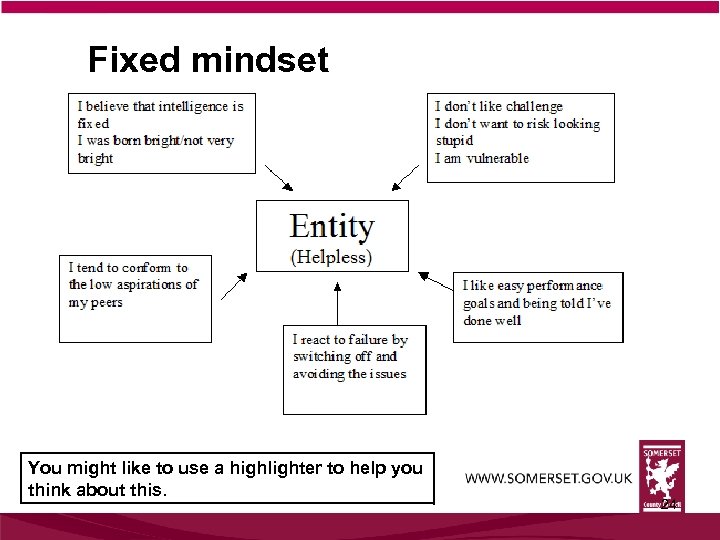 Fixed mindset You might like to use a highlighter to help you think about this. 24
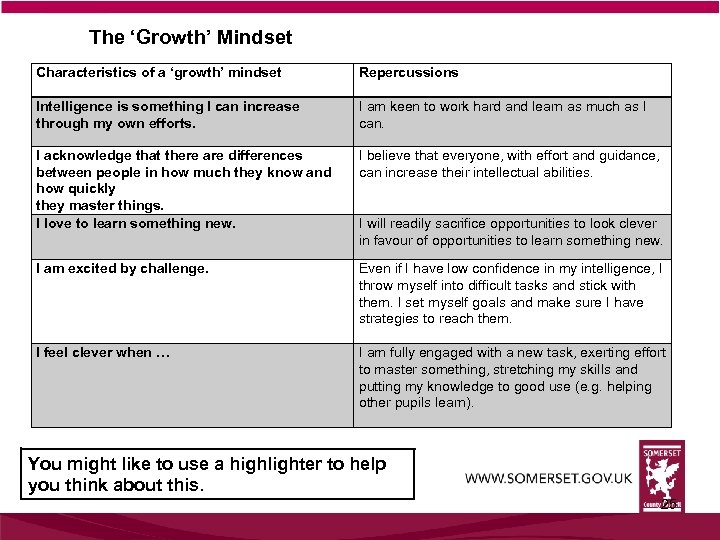 The ‘Growth’ Mindset Characteristics of a ‘growth’ mindset Repercussions Intelligence is something I can increase through my own efforts. I am keen to work hard and learn as much as I can. I acknowledge that there are differences between people in how much they know and how quickly they master things. I love to learn something new. I believe that everyone, with effort and guidance, can increase their intellectual abilities. I am excited by challenge. Even if I have low confidence in my intelligence, I throw myself into difficult tasks and stick with them. I set myself goals and make sure I have strategies to reach them. I am fully engaged with a new task, exerting effort to master something, stretching my skills and putting my knowledge to good use (e. g. helping other pupils learn). I feel clever when … I will readily sacrifice opportunities to look clever in favour of opportunities to learn something new. You might like to use a highlighter to help you think about this. 25
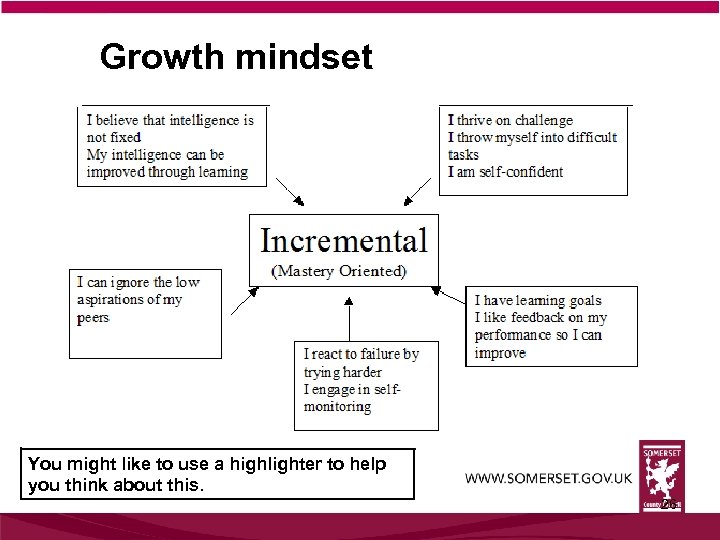 Growth mindset You might like to use a highlighter to help you think about this. 26
 Reframing Questions to Challenge Beliefs are ideas we no longer question. They are thought programs running in the background of our minds, moving between our conscious and unconscious. Each belief summarises an experience from our past, a generalisation in a given situation, a way of achieving something or avoiding it. Each belief provides a shorthand instruction for how to behave. Some of our beliefs move us forward in ways we want to go. Do your beliefs hold you back in what you learn and achieve? How can you re-frame these un-resourceful beliefs? I can’t do this I am totally confused I’ll never get my target met by the deadline My work and family are too demanding 27
 Irrational Beliefs Albert Ellis and his colleagues identified 10 common irrational beliefs. If held too rigidly, these may lead to emotional distress. These beliefs are learned early in life and become the bedrock from which our thinking patterns spring. Individually, please rate how strongly you hold any of these beliefs. You may use the cards to help you. Please then share your thoughts with the person next to you. We will then share any ideas that you will able to share. 28
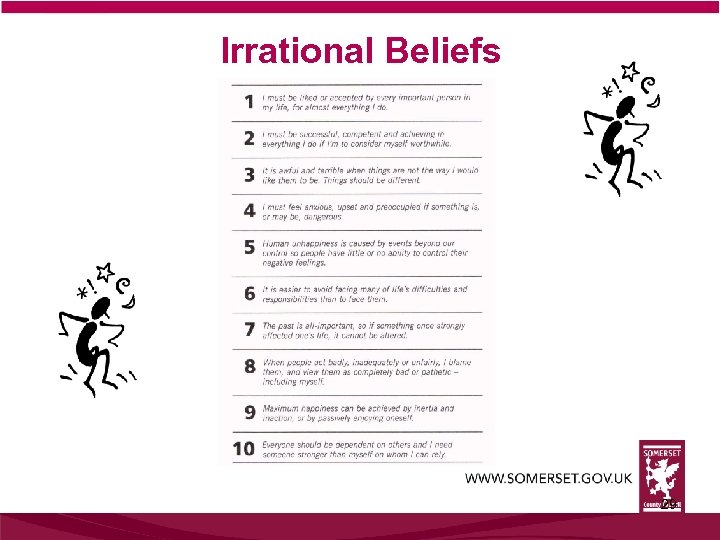 Irrational Beliefs 29
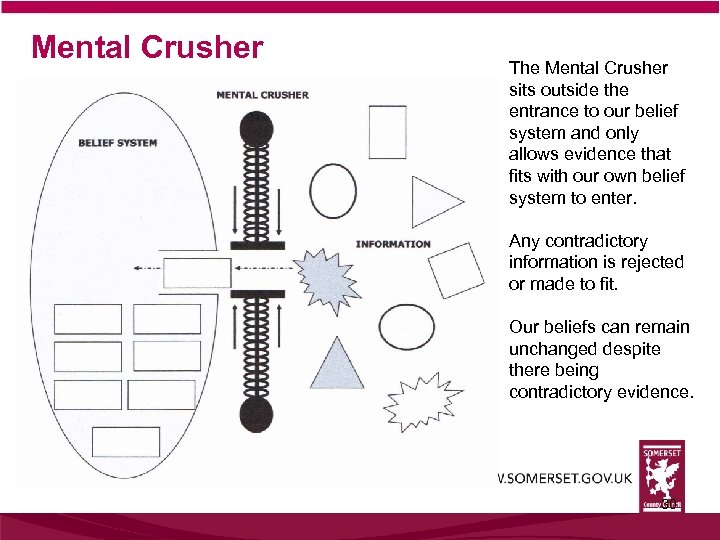 Mental Crusher The Mental Crusher sits outside the entrance to our belief system and only allows evidence that fits with our own belief system to enter. Any contradictory information is rejected or made to fit. Our beliefs can remain unchanged despite there being contradictory evidence. 30
 Unhelpful Thinking Habits Over the years we tend to get into unhelpful thinking habits. Once you an notice them, then that can help you to challenge or distance yourself from those thoughts and see the situation in a different and more helpful way. Please choose your top 3 Unhelpful Thinking Habits and stick them on the Flip chart when you are ready. We’ll then see what our collated ideas look like. You are welcome to retrieve your pictures and put them in your Reflective diary. 31
 Initial Personal Profile You now have some time to start to complete the Initial Personal Profile in your Reflective Journal These may cover some areas that you might want to follow up with your Coach or Mentor 32
 What do we mean by. . . ? Freethink: What do we mean by. . . • Community of Learners • Community of Practice • Learning Communities? 33
 Community of Learners / Community of Practice / Learning Communities A Learning Community is a group of people who share common values and beliefs, are actively engaged in learning together from each other. The foundation of a collaborative learning community is collaboration - working together for common goals, partnership, shared leadership, co-evolving and co-learning - rather than competition and power given to only a few. 34
 Five attributes underpin how Learning Communities work: • • • supportive and shared leadership, collective creativity, shared values and vision, supportive conditions, and shared personal practice. Leading to… Positive Impact on our own and Student’s Learning 35
 Top Tips What would your Top tip be to enable Peers to Help Peers – Teachers to help Teachers – Students to help Teachers? Please write one Top Tip on a Post-it and then we’ll collect any ideas to the Flip Chart. 36
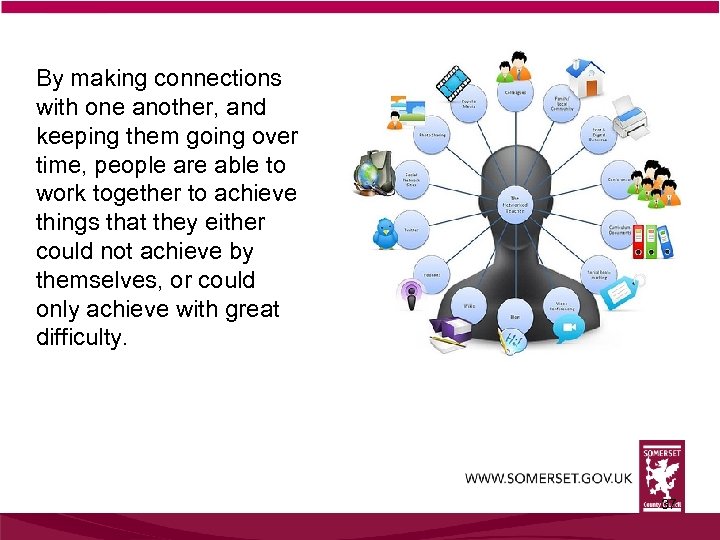 By making connections with one another, and keeping them going over time, people are able to work together to achieve things that they either could not achieve by themselves, or could only achieve with great difficulty. 37
 Honey and Mumford - Learning Style Questionnaire (LSQ) • This questionnaire will help to determine your preferred learning style or styles – whether you are an Activist, Reflector, Theorist or Pragmatist. • Answer the questions as quickly as you can – go with your immediate response. • • • Please just tick the appropriate box. Total the number of ticks at the bottom of each column. Then have a look at what this says about your Learning Preferences/Styles 38
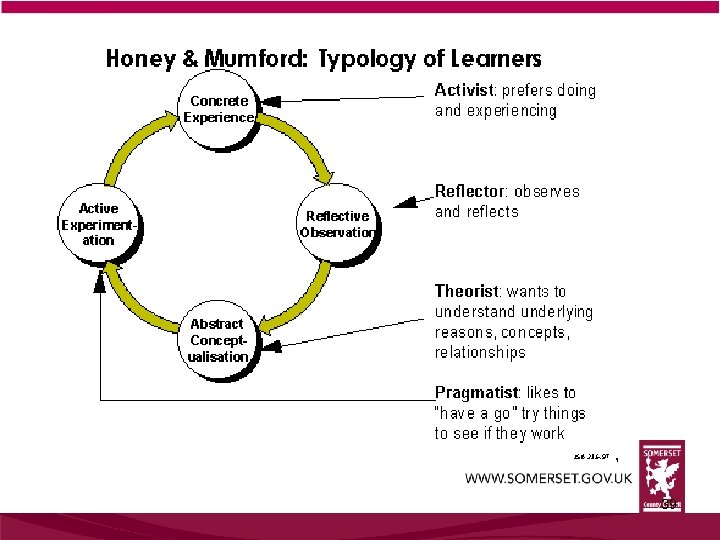 39
39
 Any comments or Observations? What does the Honey & Mumford Typology Mean for: • • • You and the Teachers you work with You and the Teaching Assistants you work with You and the children and young people you teach You and your family? ? 40
 Honey & Mumford Typology • Knowing your learning differences can accelerate your learning as you undertake activities that best fit your preferred style. • Knowing your learning differences can also help avoid repeating mistakes by undertaking activities that strengthen other styles. • For example, if you tend to “jump in at the deep end”, consider spending time reflecting on experiences before taking action. 41
 • Leadership or Management You have two sheets that describe either Leadership or Management Functions. • Please work with someone you haven’t worked with so far to put these into two groups. • You have a suggested answers sheet available. • Shall we do this against the clock? 42
 What’s your Leadership Style • You have an opportunity to take some time to think about what your leadership style might be. • There are 3 main leadership styles: ØDirective / Autocratic ØDemocratic / Shared ØNon-Directive / Delegative / Laissez-faire • • • You have a questionnaire that considers 3 main leadership styles. Please answers the questions as quickly as you can. Then use the scoring sheet to work out your style. We’ll then reflect as to whether your leadership style is what you thought or not. 43
 Management and leadership features • You have a jigsaw that consider the Management and Leadership functions within 5 Domains: • • • Direction Alignment Relationships Personal Qualities Outcomes • • In pairs please assemble the jigsaw. Observations? 44
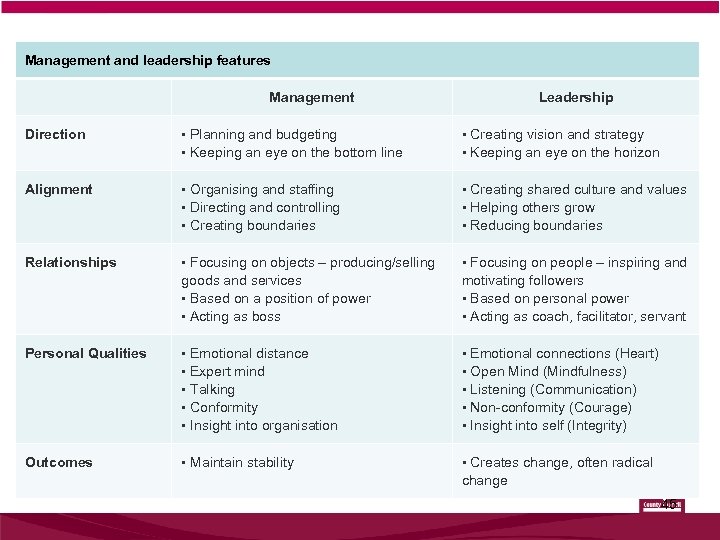 Management and leadership features Management Leadership Direction • Planning and budgeting • Keeping an eye on the bottom line • Creating vision and strategy • Keeping an eye on the horizon Alignment • Organising and staffing • Directing and controlling • Creating boundaries • Creating shared culture and values • Helping others grow • Reducing boundaries Relationships • Focusing on objects – producing/selling goods and services • Based on a position of power • Acting as boss • Focusing on people – inspiring and motivating followers • Based on personal power • Acting as coach, facilitator, servant Personal Qualities • Emotional distance • Expert mind • Talking • Conformity • Insight into organisation • Emotional connections (Heart) • Open Mind (Mindfulness) • Listening (Communication) • Non-conformity (Courage) • Insight into self (Integrity) Outcomes • Maintain stability • Creates change, often radical change 45
 What are our Experiences of Coaching? • • In pairs share each other’s experiences of coaching. • • We will check back with your partner for accuracy. You will be asked to relate back to the group what experience of coaching the other half of your pair has. Please try to avoid taking notes – let’s take the opportunity to practice our auditory skills. 46
 So why adopt a Coaching Style? Freethink: Why adopt a Coaching Style In a Freethink everyone’s contribution is valid 47
 So why adopt a Coaching Style? ‘Coaching promotes learning and builds capacity for change in schools. It is Transformative’. Coaching practice in schools is built on four essential qualities: • a desire to make a difference to student learning • a commitment to professional learning • a belief in the abilities of colleagues • a commitment to developing emotional intelligence Centre for the Use of Research and Evidence in Education (CUREE) The Evidence for Policy and Practice Information and Co-ordinating Centre (EPPI-Centre) 48
 What does a coach do? First and foremost, a coach will have the ability to form and sustain learning relationships. Leadership development is rooted in such relationships. To achieve these, coaches need to: • • • establish high levels of trust be consistent over time offer genuine respect be honest, frank and open provide support via skilful questioning challenge without threat 49
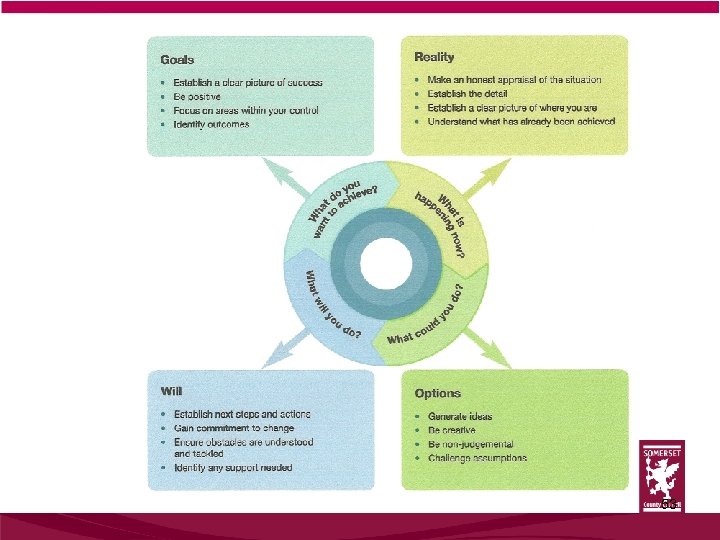
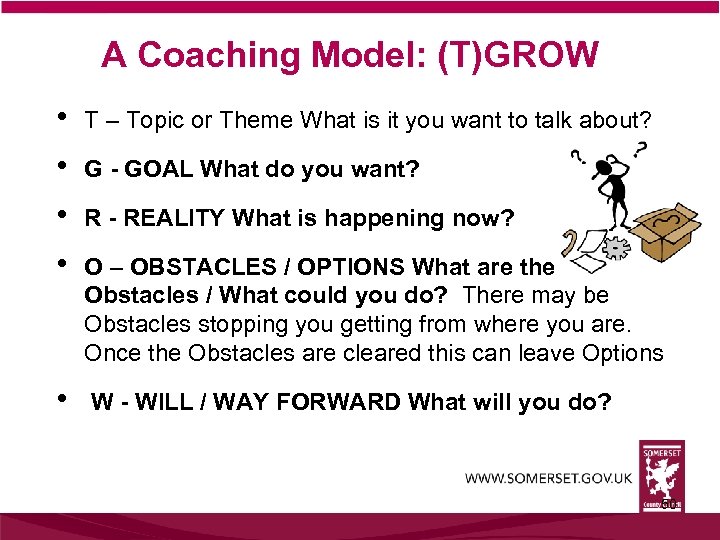 A Coaching Model: (T)GROW • • T – Topic or Theme What is it you want to talk about? • W - WILL / WAY FORWARD What will you do? G - GOAL What do you want? R - REALITY What is happening now? O – OBSTACLES / OPTIONS What are the Obstacles / What could you do? There may be Obstacles stopping you getting from where you are. Once the Obstacles are cleared this can leave Options 50
 Coaching is grounded in five key skills: • • • establishing rapport and trust listening for meaning questioning for understanding prompting action, reflection and learning developing confidence and celebrating success 51
 Coaching Conversation – Skills Practise Please work in a triad Person A: The Coach • Practise skills and listen to feedback Person B: The Learner • Discuss a real topic • Be aware of your own reactions and be ready to help with feedback Person C: The Observer • Look for behaviour that evidences skills • Be supportive of the coach and learner • Be the timekeeper – 10 minutes coaching and 5 minutes feedback 52
 53
53
 Coaching Conversation – Skills Reflection: • What does this mean for me in terms of a Personal Action Plan? Please take the opportunity to make a note of anything in your Learning Log or Reflective Diary 54
 Discussing the Focus for Development There is now some time for the Aspiring Leader and Coach to meet and agree the focus for the first term based on key area for development as identified with headteacher. Try to have a coaching conversation - Aim to focus on the Key Skills: • • • establishing rapport and trust listening for meaning questioning for understanding prompting action, reflection and learning developing confidence and celebrating success 55
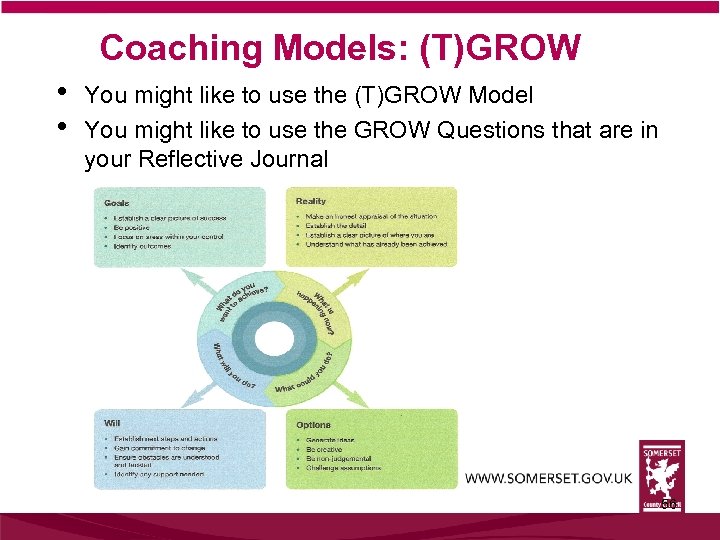 Coaching Models: (T)GROW • • You might like to use the (T)GROW Model You might like to use the GROW Questions that are in your Reflective Journal 56
 Objectives By the end of the session Aspiring Leaders and Coaches will have: • Been introduced to the Aspiring Leaders for Teaching and Learning Programme • Been introduced to the use of the Reflective Practice: Reflective diary, CPD plan and Learning Journal • • Developed an understanding of Community of Learners Been introduced to core skills and qualities in coaching Had the opportunity to try out some coaching skills Had the opportunity to meet in pairs & discuss the focus for the first term based on key areas for development as identified with headteacher 57
 Contact Details Jacky King The Jacky King Partnership Fairness and Equality jkpartnership@dutchone. co. uk Mobile: 07786 288 659 Home: 01963 34409 Skype. Me!: jacky. king 1 58
 The Reflective Journal • The Learning Log: This is a record of what you have learnt during a session You might like to extend it to the work you do with your coach or mentor or your project at school. There are 3 key questions in the Learning Journal: • The main points I have learnt from this session are… • How I can develop my skills as a result of this session • How I could develop my knowledge and understanding as a result of this session • My Individual Learning Point • Please take some time now to complete your Learning Journal for today’s session. • Please remember to complete the questions after each of the programme sessions so that you have some time to reflect on your learning. 59
 www/ebi www – what went well ebi – even better if ilp – individual learning point Please write a www an ebi and an ilp on separate post-its and leave them on the flip charts on your way out. 60