 Скачать презентацию ASPERGER SYNDROME Presented By Maranda L Porter MSP
96076c78fec40ce6396d796e95e0ae27.ppt
- Количество слайдов: 46



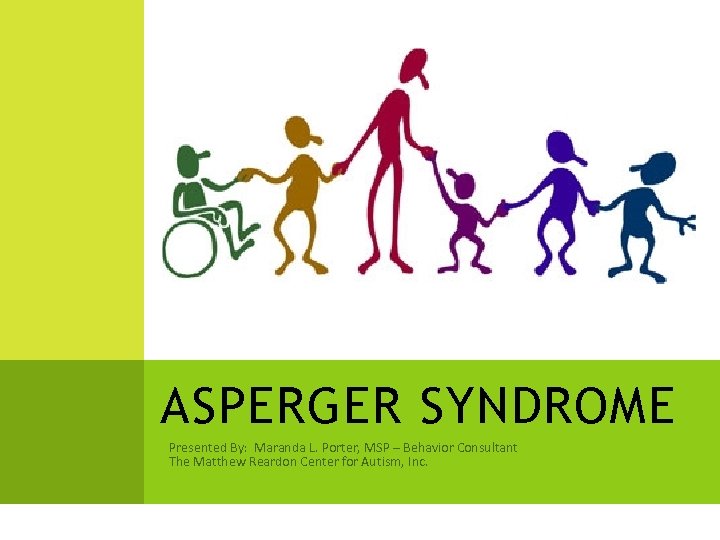
ASPERGER SYNDROME Presented By: Maranda L. Porter, MSP – Behavior Consultant The Matthew Reardon Center for Autism, Inc.
WHAT IS ASPERGER SYNDROME?
DEFINITION Asperger syndrome is a form of autism and a developmental disorder. Here are some of the characteristics: Social Impairments. Uncoordinated motor movements. Limited interests. Repetitive routines & rituals. http: //www. medterms. com/script/main/art. asp? articlekey=9675
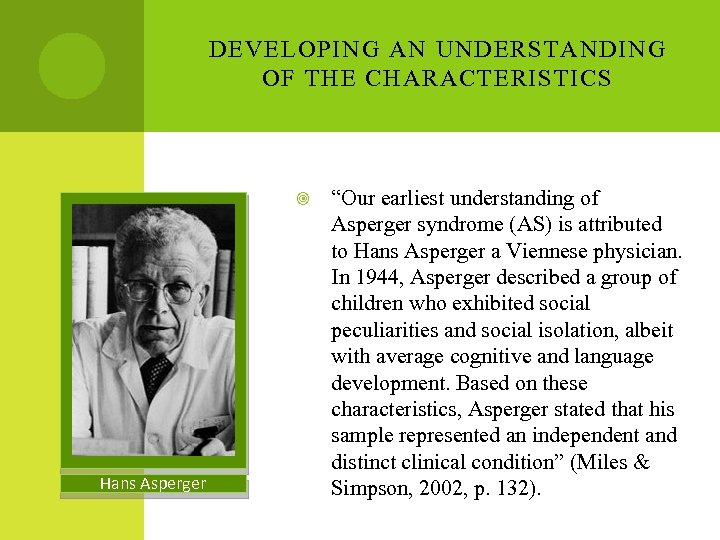
DEVELOPING AN UNDERSTANDING OF THE CHARACTERISTICS Hans Asperger “Our earliest understanding of Asperger syndrome (AS) is attributed to Hans Asperger a Viennese physician. In 1944, Asperger described a group of children who exhibited social peculiarities and social isolation, albeit with average cognitive and language development. Based on these characteristics, Asperger stated that his sample represented an independent and distinct clinical condition” (Miles & Simpson, 2002, p. 132).
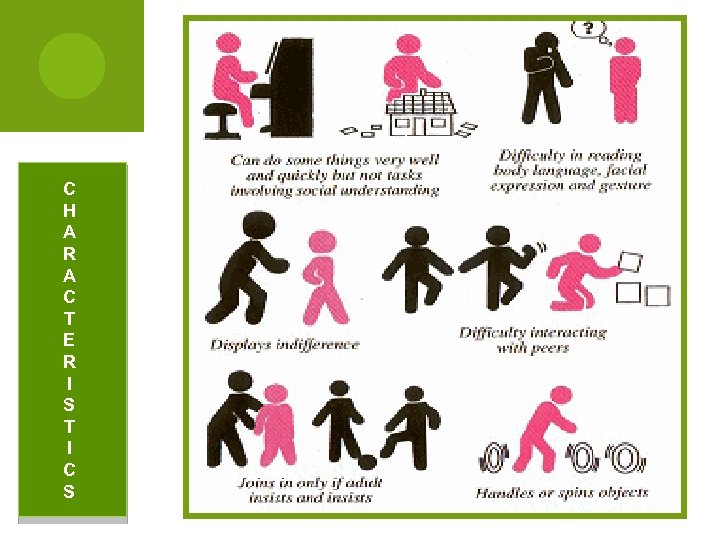
C H A R A C T E R I S T I C S
SOCIAL CHARACTERISTICS In Children K-12
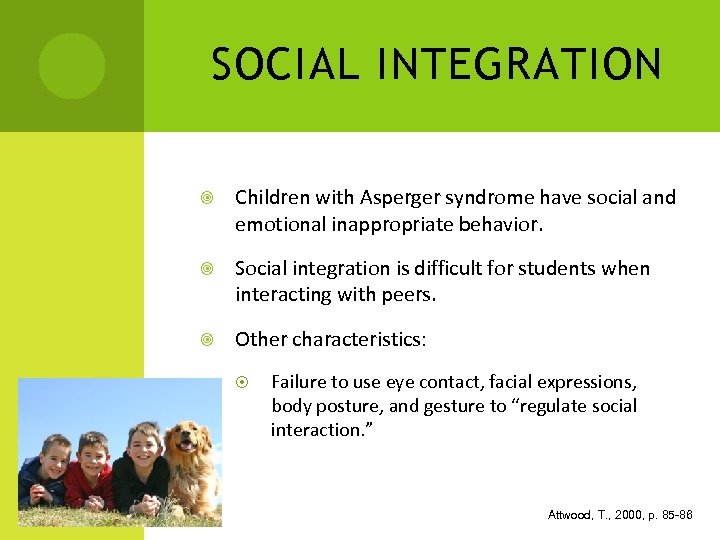
SOCIAL INTEGRATION Children with Asperger syndrome have social and emotional inappropriate behavior. Social integration is difficult for students when interacting with peers. Other characteristics: Failure to use eye contact, facial expressions, body posture, and gesture to “regulate social interaction. ” Attwood, T. , 2000, p. 85 -86
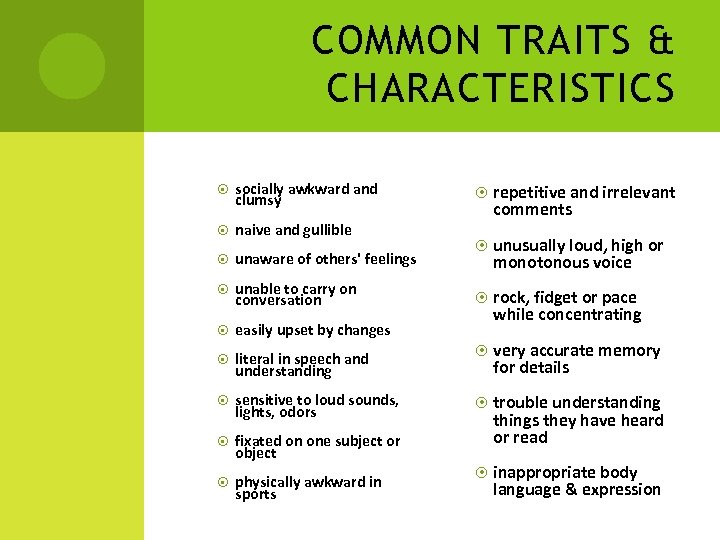
COMMON TRAITS & CHARACTERISTICS socially awkward and clumsy naive and gullible unaware of others' feelings unable to carry on conversation easily upset by changes repetitive and irrelevant comments unusually loud, high or monotonous voice rock, fidget or pace while concentrating literal in speech and understanding very accurate memory for details sensitive to loud sounds, lights, odors fixated on one subject or object trouble understanding things they have heard or read physically awkward in sports inappropriate body language & expression
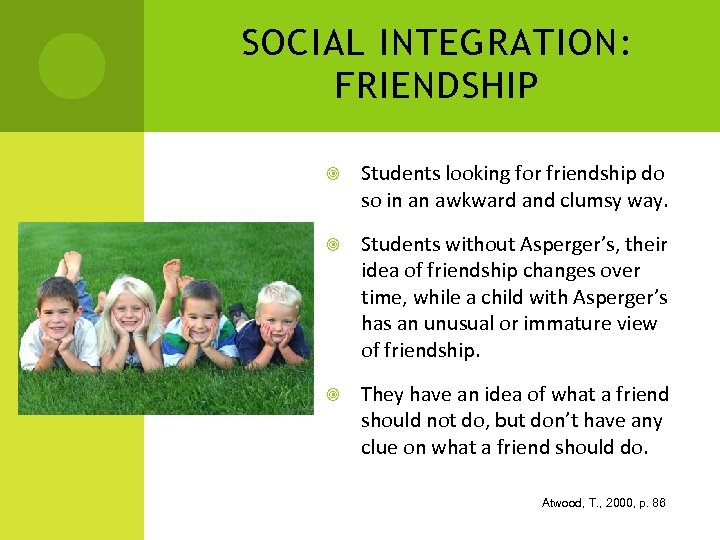
SOCIAL INTEGRATION: FRIENDSHIP Students looking for friendship do so in an awkward and clumsy way. Students without Asperger’s, their idea of friendship changes over time, while a child with Asperger’s has an unusual or immature view of friendship. They have an idea of what a friend should not do, but don’t have any clue on what a friend should do. Atwood, T. , 2000, p. 86
EVALUATION STUDIES There a lack of evaluation studies done to see what strategies work to integrate and improve social skills in students with Asperger’s. However, there are several strategies teachers can use to improve social skills of students: Give opportunities for them to observe and interact with other students. Provide social stories (what happens in social situations). Comic Strip conversations. Attwood, T. , 2000, p. 86 -96
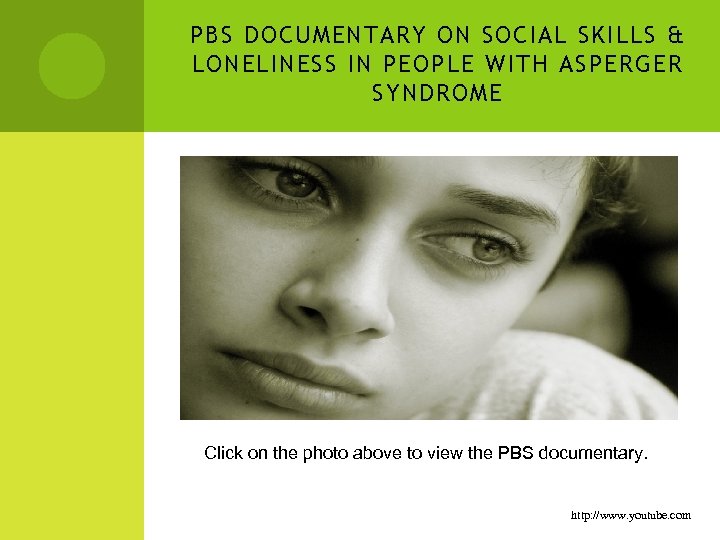
PBS DOCUMENTARY ON SOCIAL SKILLS & LONELINESS IN PEOPLE WITH ASPERGER SYNDROME Click on the photo above to view the PBS documentary. http: //www. youtube. com
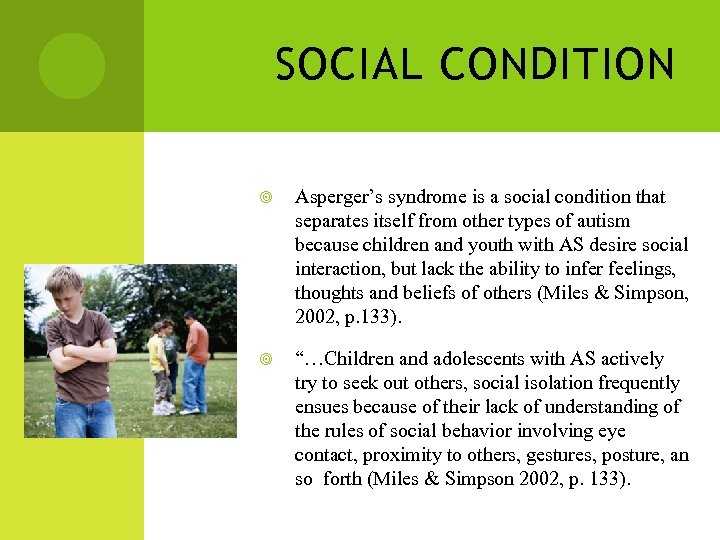
SOCIAL CONDITION Asperger’s syndrome is a social condition that separates itself from other types of autism because children and youth with AS desire social interaction, but lack the ability to infer feelings, thoughts and beliefs of others (Miles & Simpson, 2002, p. 133). “…Children and adolescents with AS actively try to seek out others, social isolation frequently ensues because of their lack of understanding of the rules of social behavior involving eye contact, proximity to others, gestures, posture, an so forth (Miles & Simpson 2002, p. 133).
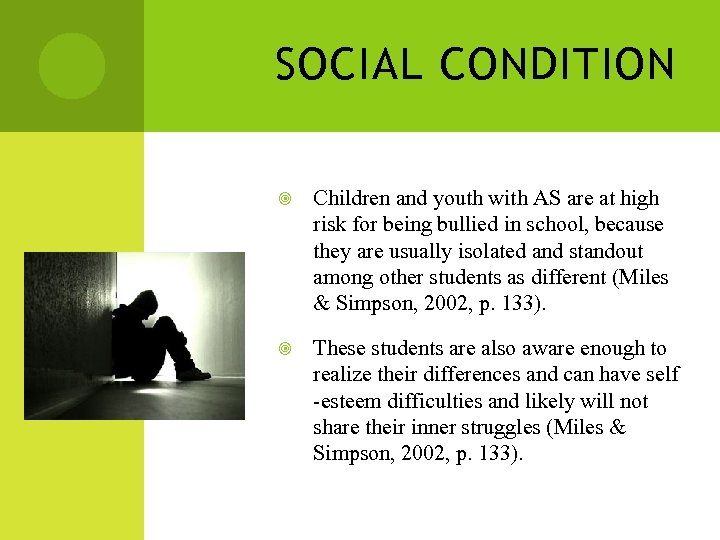
SOCIAL CONDITION Children and youth with AS are at high risk for being bullied in school, because they are usually isolated and standout among other students as different (Miles & Simpson, 2002, p. 133). These students are also aware enough to realize their differences and can have self -esteem difficulties and likely will not share their inner struggles (Miles & Simpson, 2002, p. 133).
BEHAVIORAL & EMOTIONAL CHARACTERISTICS In Children K-12
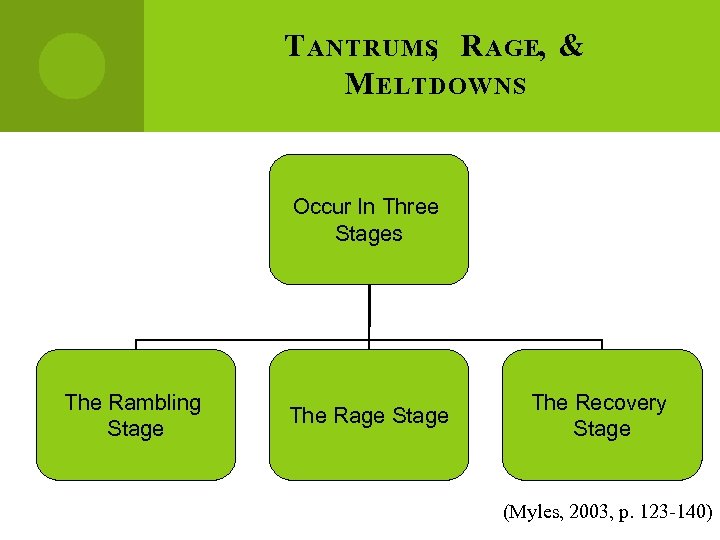
T ANTRUMS R AGE, & , M ELTDOWNS Occur In Three Stages The Rambling Stage The Rage Stage The Recovery Stage (Myles, 2003, p. 123 -140)
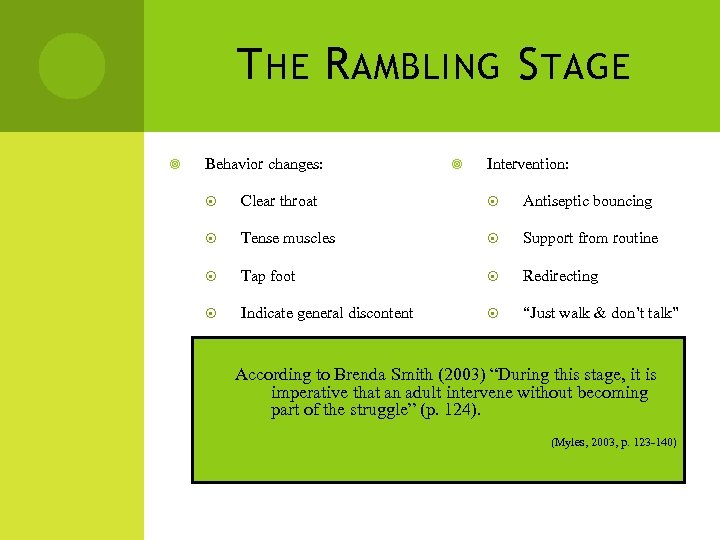
T HE R AMBLING S TAGE Behavior changes: Intervention: Clear throat Antiseptic bouncing Tense muscles Support from routine Tap foot Redirecting Indicate general discontent “Just walk & don’t talk” According to Brenda Smith (2003) “During this stage, it is imperative that an adult intervene without becoming part of the struggle” (p. 124). (Myles, 2003, p. 123 -140)
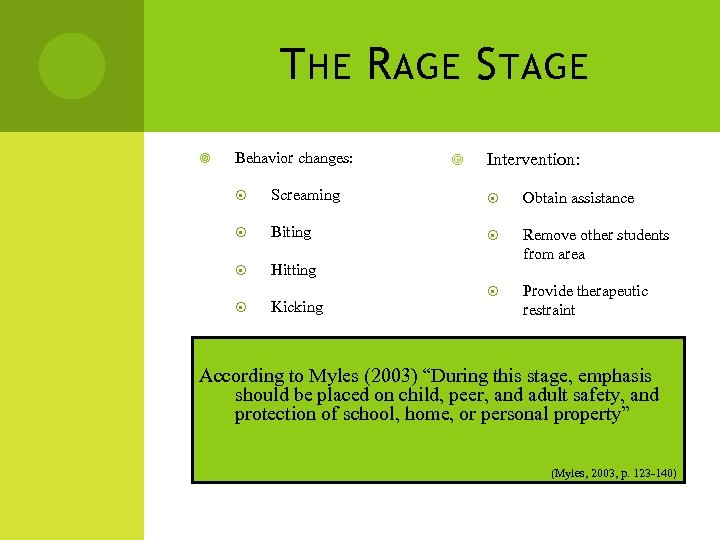
T HE R AGE S TAGE Behavior changes: Intervention: Screaming Obtain assistance Biting Hitting Remove other students from area Kicking Provide therapeutic restraint According to Myles (2003) “During this stage, emphasis should be placed on child, peer, and adult safety, and protection of school, home, or personal property” (Myles, 2003, p. 123 -140)
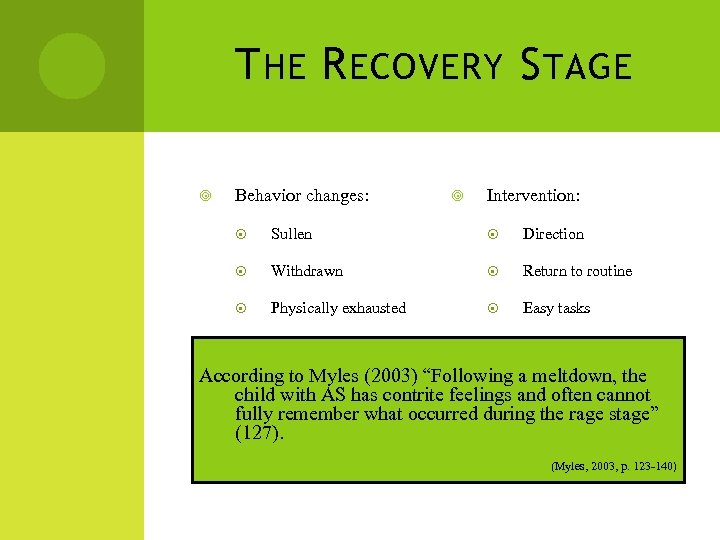
T HE R ECOVERY S TAGE Behavior changes: Intervention: Sullen Direction Withdrawn Return to routine Physically exhausted Easy tasks According to Myles (2003) “Following a meltdown, the child with AS has contrite feelings and often cannot fully remember what occurred during the rage stage” (127). (Myles, 2003, p. 123 -140)
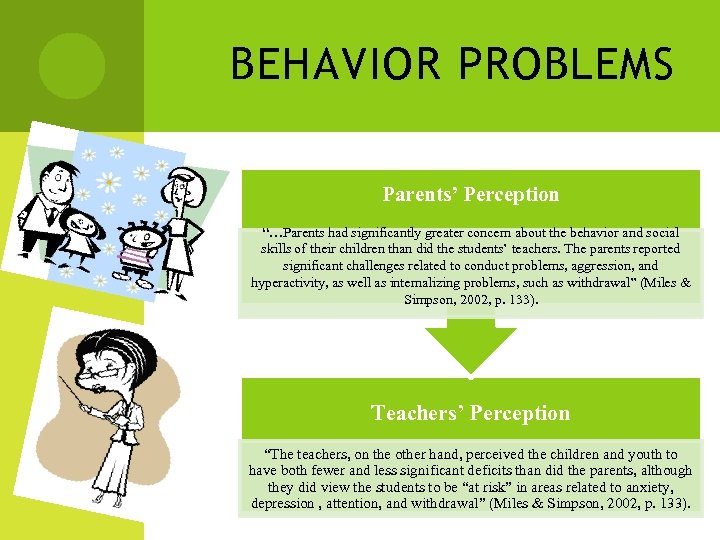
BEHAVIOR PROBLEMS Parents’ Perception “…Parents had significantly greater concern about the behavior and social skills of their children than did the students’ teachers. The parents reported significant challenges related to conduct problems, aggression, and hyperactivity, as well as internalizing problems, such as withdrawal” (Miles & Simpson, 2002, p. 133). Teachers’ Perception “The teachers, on the other hand, perceived the children and youth to have both fewer and less significant deficits than did the parents, although they did view the students to be “at risk” in areas related to anxiety, depression , attention, and withdrawal” (Miles & Simpson, 2002, p. 133).
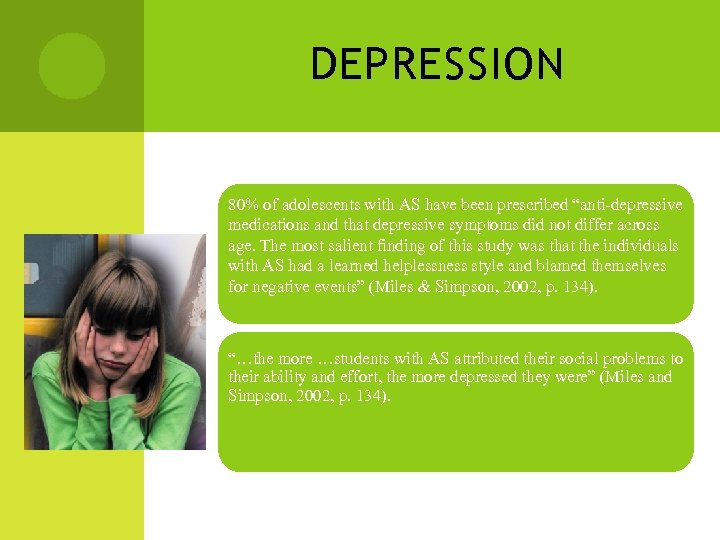
DEPRESSION 80% of adolescents with AS have been prescribed “anti-depressive medications and that depressive symptoms did not differ across age. The most salient finding of this study was that the individuals with AS had a learned helplessness style and blamed themselves for negative events” (Miles & Simpson, 2002, p. 134). “…the more …students with AS attributed their social problems to their ability and effort, the more depressed they were” (Miles and Simpson, 2002, p. 134).
RESTRICTED RANGE OF INTERESTS
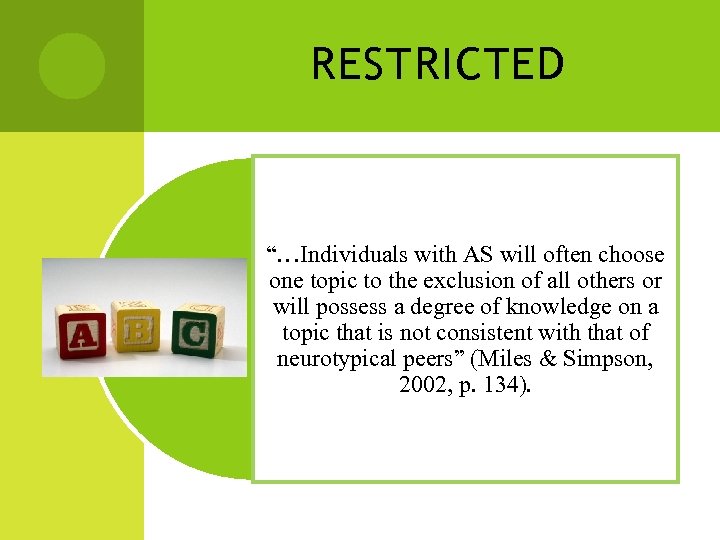
RESTRICTED “…Individuals with AS will often choose one topic to the exclusion of all others or will possess a degree of knowledge on a topic that is not consistent with that of neurotypical peers” (Miles & Simpson, 2002, p. 134).

INTELLECTUAL & COGNITIVE CHARACTERISTICS
INTELLIGENCE AND LANGUAGE DEVELOPMENT “The SM-IV-TR clearly states that for a diagnosis of AS to be rendered, an individual must present with normal intellectual and language development” (American Psychiatric Association, 2000). “According to their [AS youth] performance on IQ tests, students with highfunctioning autism and AS have relative strengths on nonverbal concept formation tasks, specifically those that require perceptual organization and spatial visualization” (Ehlers et al. , 1997).
SENSORY & MOTOR CHARACTERISTICS In Children K-12
SENSORY ISSUES “…The vast majority of children and youth with AS who participated in their study had impairments in (a) endurance/ tone, (b) oral sensory sensitivity, (c) attention, and (d) registration” (Miles & Simpson, 2002, p. 135). “Over 75% of the individuals with AS studied demonstrated behavioral problems when sensory issues were violated” (Mile & Simpson, 2002, p. 135).
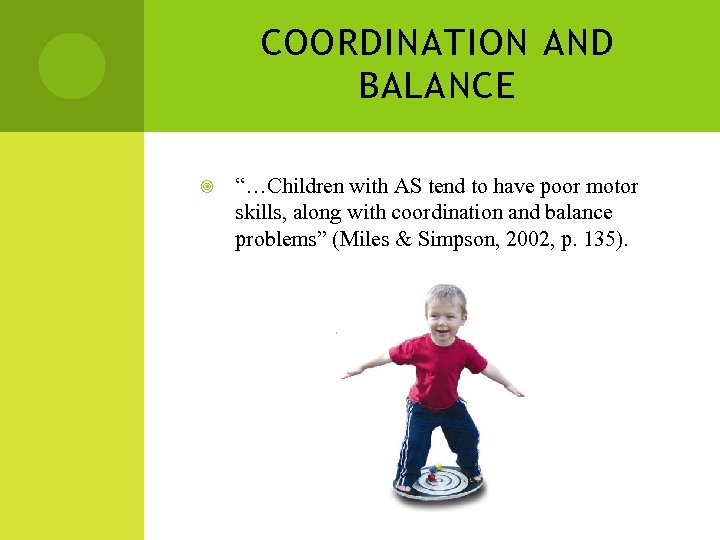
COORDINATION AND BALANCE “…Children with AS tend to have poor motor skills, along with coordination and balance problems” (Miles & Simpson, 2002, p. 135).

DIAGNOSIS
A SSESSMENT Assessment involves: - A thorough delepmental & health history - Phychological & Communication assessment - Diagnostic examination According to Ami Klin (2003) “Effective educational and treatment programs can only be devised on the basis of such a profile, given the need to address specific deficits while capitalizing on the person’s various resources and struggles” (p. 4). (Klin, 2003, p. 1 -13)

TEACHING STRATEGIES
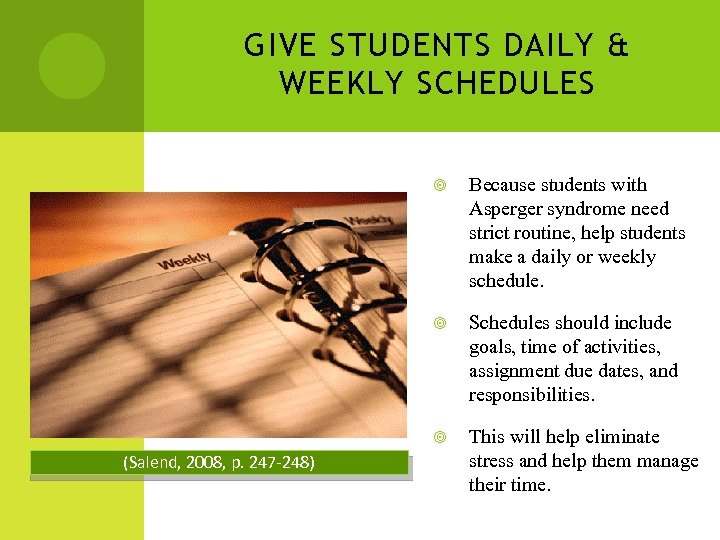
GIVE STUDENTS DAILY & WEEKLY SCHEDULES Schedules should include goals, time of activities, assignment due dates, and responsibilities. (Salend, 2008, p. 247 -248) Because students with Asperger syndrome need strict routine, help students make a daily or weekly schedule. This will help eliminate stress and help them manage their time.
A G UIDE FOR T EACHERS Be positive & patient. Give warnings before a change in the schedule. Break down & repeat directions. Provide guidance. Allow the child to get up & move when needed. (Tucker, 2010, p. 1 -2)
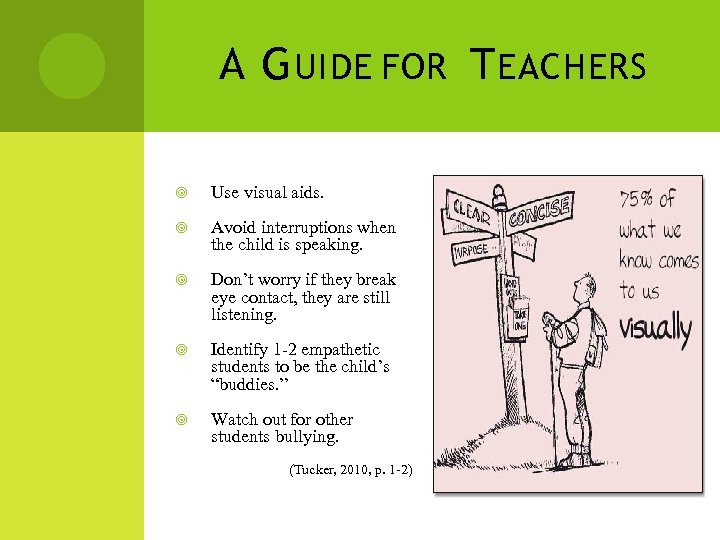
A G UIDE FOR T EACHERS Use visual aids. Avoid interruptions when the child is speaking. Don’t worry if they break eye contact, they are still listening. Identify 1 -2 empathetic students to be the child’s “buddies. ” Watch out for other students bullying. (Tucker, 2010, p. 1 -2)
INSTRUCTIONAL IDEAS Be careful in classroom seating assignments Use the “peer buddy” system Avoid self-selection in group work Carefully consider the maturity of the group members involved Provide “safe haven” or quiet area Explain metaphor and sarcasm use concretely Use “social stories” for providing directions Vigorously but respectfully maintain class rules and other boundaries
OTHER TREATMENTS Parent education and training Social skills training Language therapy Sensory integration training for younger children, usually performed by an occupational therapist, in which a child is desensitized to stimuli to which he is overly sensitive Psychotherapy or behavioral/cognitive therapy for older children
PARENTING STRATEGIES
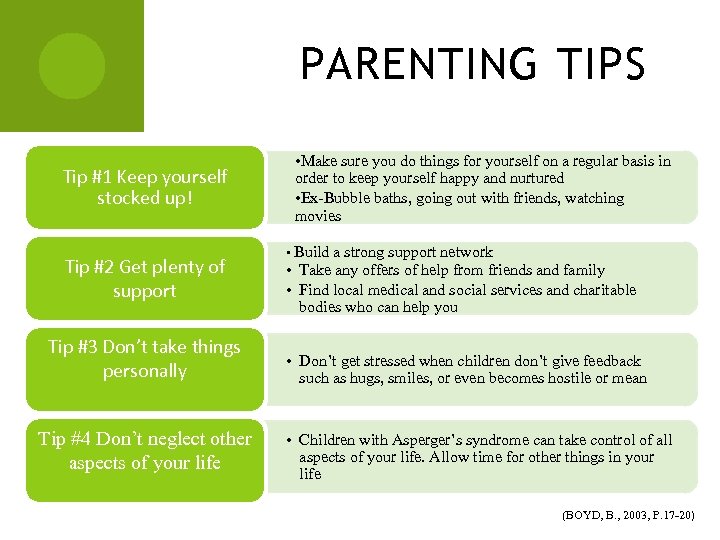
PARENTING TIPS Tip #1 Keep yourself stocked up! Tip #2 Get plenty of support Tip #3 Don’t take things personally Tip #4 Don’t neglect other aspects of your life • Make sure you do things for yourself on a regular basis in order to keep yourself happy and nurtured • Ex-Bubble baths, going out with friends, watching movies • Build a strong support network • Take any offers of help from friends and family • Find local medical and social services and charitable bodies who can help you • Don’t get stressed when children don’t give feedback such as hugs, smiles, or even becomes hostile or mean • Children with Asperger’s syndrome can take control of all aspects of your life. Allow time for other things in your life (BOYD, B. , 2003, P. 17 -20)
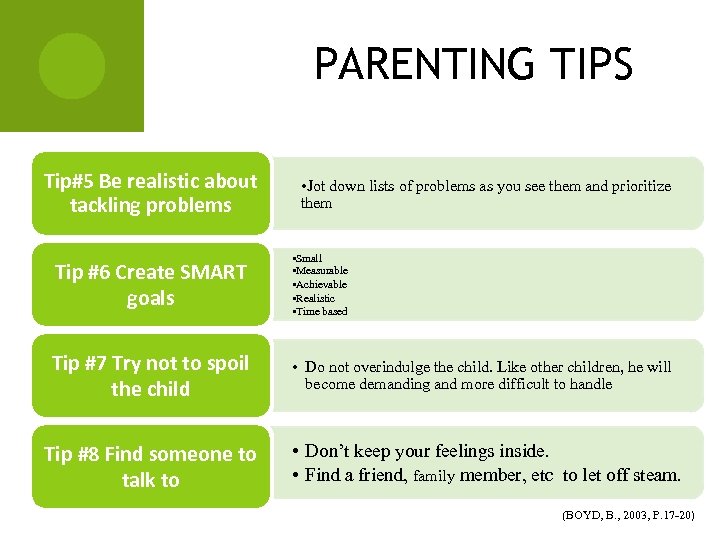
PARENTING TIPS Tip#5 Be realistic about tackling problems • Jot down lists of problems as you see them and prioritize them Tip #6 Create SMART goals • Small • Measurable • Achievable • Realistic • Time based Tip #7 Try not to spoil the child • Do not overindulge the child. Like other children, he will become demanding and more difficult to handle Tip #8 Find someone to talk to • Don’t keep your feelings inside. • Find a friend, family member, etc to let off steam. (BOYD, B. , 2003, P. 17 -20)
ASPERGER SYNDROME IN THE MEDIA

ASPERGER SYNDROME IN NONFICTION Look Me in the Eye: My Life with Asperger’s, by John Elder Robison, is an autobiography of Robison’s life growing up with Asperger’s. It shows the humanity and humor in growing up with Asperger’s. http: //www. amazon. com/
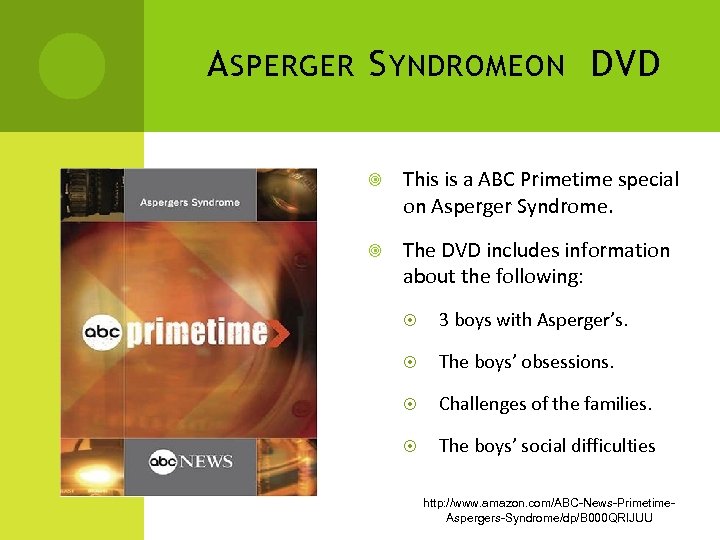
A SPERGER S YNDROME ON DVD This is a ABC Primetime special on Asperger Syndrome. The DVD includes information about the following: 3 boys with Asperger’s. The boys’ obsessions. Challenges of the families. The boys’ social difficulties http: //www. amazon. com/ABC-News-Primetime. Aspergers-Syndrome/dp/B 000 QRIJUU

REFERENCES
REFERENCES Attwood, T. (2000). Strategies for improving the social integration of children with Asperger syndrome. Autism. 4(1), 85 -100. Retrieved from http: //aut. sagepub. com/cgi/reprint/4/1/85 Autism Asperger Publishing Company. (2009). AAPC. Retrieved May 14, 2010, from http: //www. asperger. net Baron-Cohen, S. (2000). Is Asperger’s syndrome/high-functioning Autism necessarily a Disability? Development and Psychopathology. 12(3), 489 -500. Retrieved from http: //www. larryarnold. net/Neurodiversity/Mission/disability. htm
REFERENCES Boyd, B. (2003). Parenting a child with Asperger syndrome. United Kingdom: Jessica Kingsley Publishers Ltd. Glennon, T. J. (2001). The stress of the university experience for students with Asperger syndrome. Work: A Journal of Prevention, Assessment and Rehabilitation. 17(3), 183 -190. Retrieved from http: //iospress. metapress. com/content/lde 42 nn 5 tajej 0 ty Klin, A. & Volkmar, F. R. (2003). Asperger syndrome: diagnosis and external validity. Child And Adolescent Psychiatric Clinics. 12(1), 1 -13. Retrieved from http: //psycnet. apa. org/index. cfm? fa=search. display. Record&uid=200208657 -005
REFERENCES Myles, B. (2003). Behavioral Forms of stress management for individuals with Asperger syndrome. Child and Adolescent Psychiatric Clinics. 12(1), 123 -141. Retrieved from http: //www. ncbi. nlm. nih. gov/pubmed/12512402 Myles, B. & Simpson, R. (2002). Asperger syndrome: An overview of characteristics. Focus on Autism and Other Developmental Disabilities. 17(3), 132 -137. Retrieved from http: //foa. sagepub. com/cgi/reprint/17/3/132 OASIS Asperger Syndrome Forum. (2010). Asperger’s syndrome guide for teachers. Retrieved May 7, 2010, from http: //aspergersyndrome. org/Articles/Aspergers-Syndrome-Guide. For-Teachers. aspx
REFERENCES Public Broadcasting Station (Producer). (2009, November 4). The emotional life: Asperger’s Syndrome/ loneliness PBS. Youtube. com. Video retrieved from http: //www. youtube. com/watch? v=QWY 3 ntr 3 sd. I Salend, S. J. (2008). Creating inclusive classrooms: Effective and reflective practices. (6 th ed. ). Upper Saddle River, NJ: Pearson Education. Simon. Schuster. Videos (Producer). (2010, February 10). Jodi Picoult reveals her 2010 novel HOUSE RULES. Youtube. com. Video retrieved from http: //www. youtube. com/watch? v=U 8 jml 1 p. N 0 yc Whitehouse, J. O. , Durkin, K. , Jaquet, E. , & Ziatas, K. (2008). Friendship, loneliness and depression in adolescents with Asperger’s syndrome. Journal of Adolescence, 32(2), 309322. Retrieved from http: //sciencedirect. com
Скачать презентацию ASPERGER SYNDROME Presented By Maranda L Porter MSP
96076c78fec40ce6396d796e95e0ae27.ppt