 Скачать презентацию Asper School of Business University of Manitoba Systems
96baa2d3fffa54b6f8da69cbdeec280a.ppt
- Количество слайдов: 17



Asper School of Business University of Manitoba Systems Analysis & Design Instructor: Bob Travica Fundamental System Concepts Updated: September 2017
Outline Different views of information system n Analysis task and design task n Systems analyst n Types of Information Systems (recall) n MIS 3510 Systems Analysis & Design * Bob Travica 2 of 17
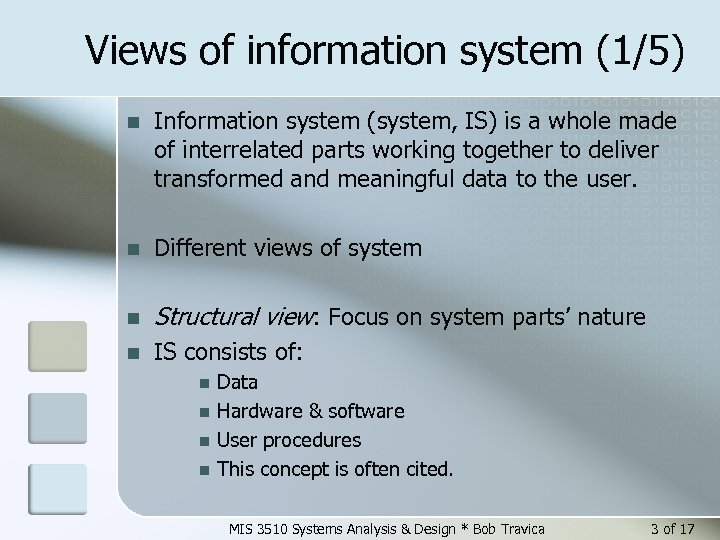
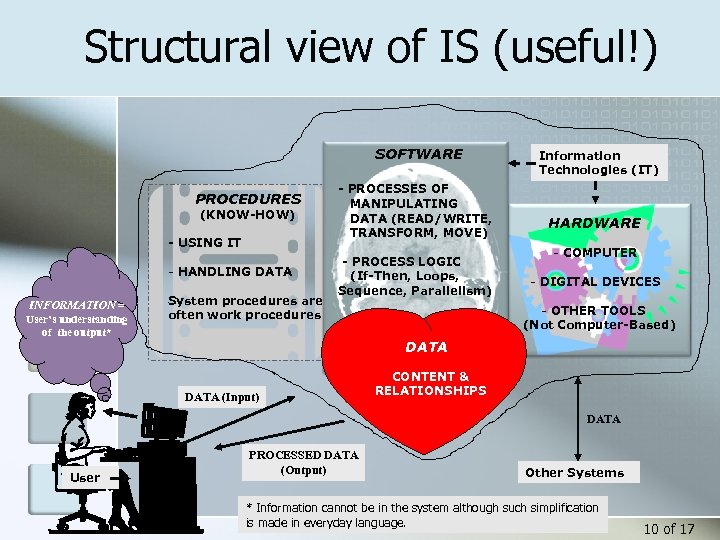
Views of information system (1/5) n Information system (system, IS) is a whole made of interrelated parts working together to deliver transformed and meaningful data to the user. n Different views of system n Structural view: Focus on system parts’ nature n IS consists of: n n Data Hardware & software User procedures This concept is often cited. MIS 3510 Systems Analysis & Design * Bob Travica 3 of 17
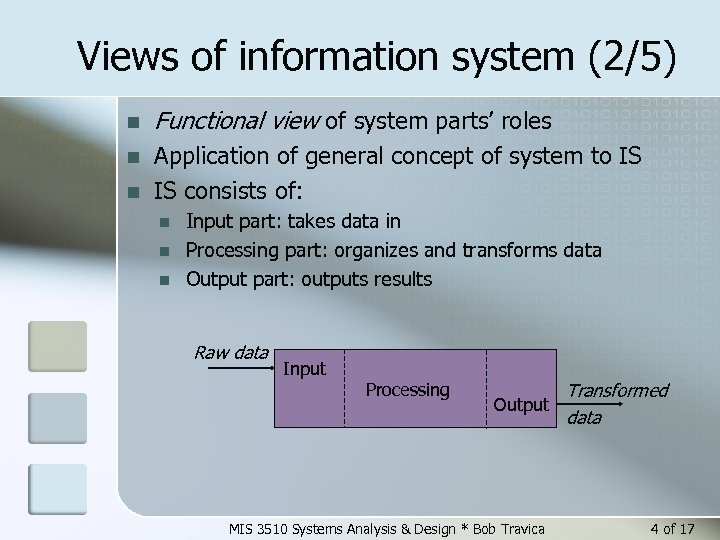
Views of information system (2/5) n Functional view of system parts’ roles n Application of general concept of system to IS IS consists of: n n Input part: takes data in Processing part: organizes and transforms data Output part: outputs results Raw data Input Processing Output MIS 3510 Systems Analysis & Design * Bob Travica Transformed data 4 of 17
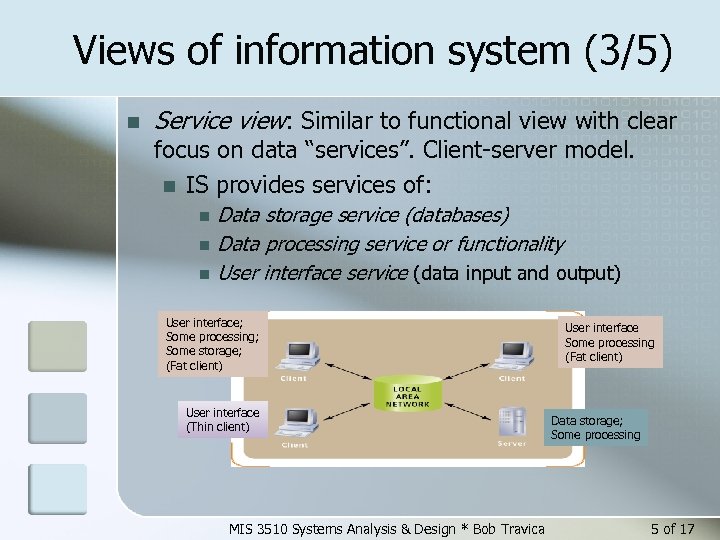
Views of information system (3/5) n Service view: Similar to functional view with clear focus on data “services”. Client-server model. n IS provides services of: n n n Data storage service (databases) Data processing service or functionality User interface service (data input and output) User interface; Some processing; Some storage; (Fat client) User interface (Thin client) MIS 3510 Systems Analysis & Design * Bob Travica User interface Some processing (Fat client) Data storage; Some processing 5 of 17
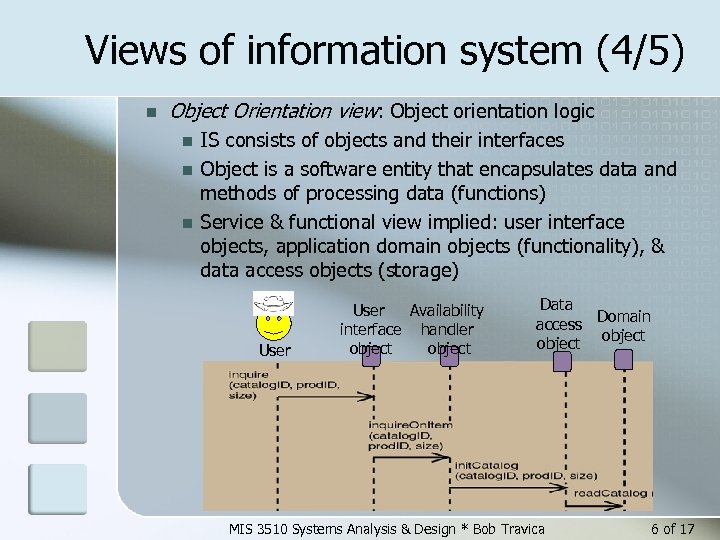
Views of information system (4/5) n Object Orientation view: Object orientation logic n n n IS consists of objects and their interfaces Object is a software entity that encapsulates data and methods of processing data (functions) Service & functional view implied: user interface objects, application domain objects (functionality), & data access objects (storage) User Availability interface handler object Data access Domain object MIS 3510 Systems Analysis & Design * Bob Travica 6 of 17
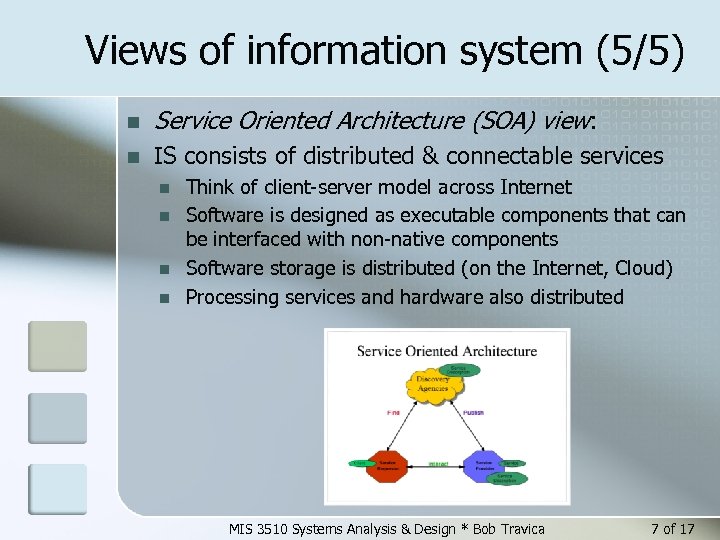
Views of information system (5/5) n Service Oriented Architecture (SOA) view: n IS consists of distributed & connectable services n n Think of client-server model across Internet Software is designed as executable components that can be interfaced with non-native components Software storage is distributed (on the Internet, Cloud) Processing services and hardware also distributed MIS 3510 Systems Analysis & Design * Bob Travica 7 of 17
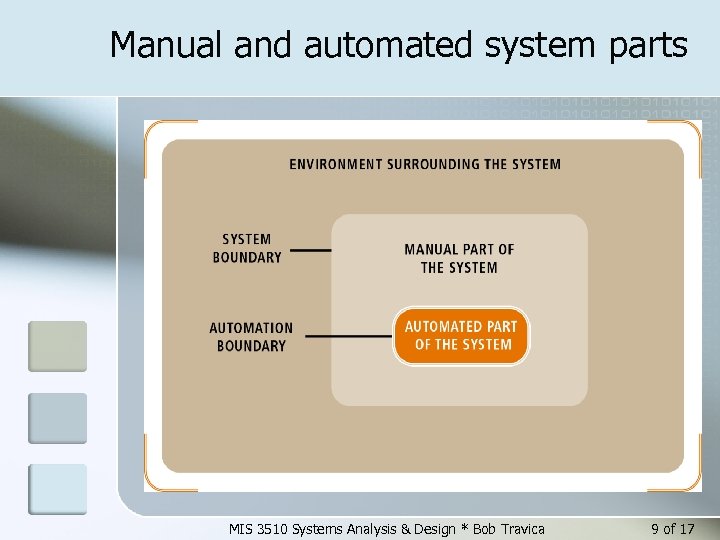
System user n n From the business perspective, thinking about IS starts with user User is outside the system, but the notion of procedure sets boundary conditions: a) The lower the level of IT used, the more manual procedures carried by people are included in the system. n Manual data entry vs. automatic read (e. g. , RFI*) n Office filing systems (manual procedures combined with electronic) b) The more complex task (knowledge-intensive), the higher human involvement. n Decision making by people vs. If-Then processing, Decision Support Systems n Group Decision Support System (human facilitation procedures are a crucial part of the system) MIS 3510 Systems Analysis & Design * Bob Travica 8 of 17
Manual and automated system parts MIS 3510 Systems Analysis & Design * Bob Travica 9 of 17
Structural view of IS (useful!) SOFTWARE PROCEDURES (KNOW-HOW) - USING IT - HANDLING DATA INFORMATION = User’s understanding of the output* System procedures are often work procedures - PROCESSES OF MANIPULATING DATA (READ/WRITE, TRANSFORM, MOVE) - PROCESS LOGIC (If-Then, Loops, Sequence, Parallelism) Information Technologies (IT) HARDWARE - COMPUTER - DIGITAL DEVICES - OTHER TOOLS (Not Computer-Based) DATA (Input) CONTENT & RELATIONSHIPS DATA User PROCESSED DATA (Output) Other Systems * Information cannot be in the system although such simplification is made in everyday language. 10 of 17
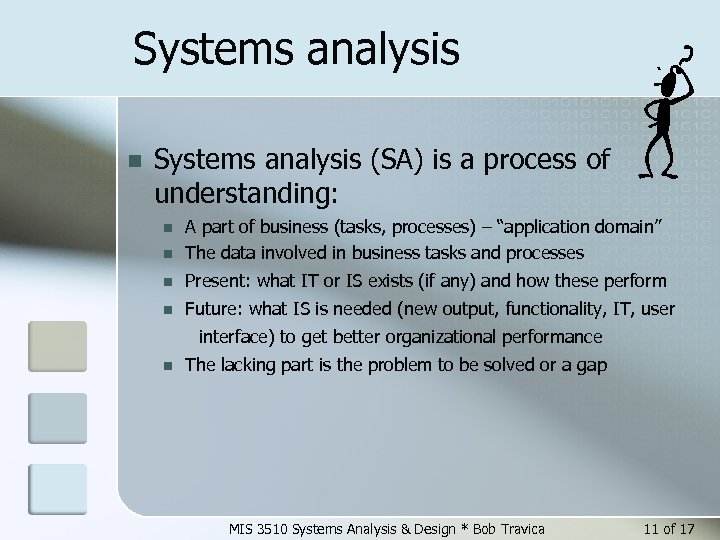
Systems analysis n Systems analysis (SA) is a process of understanding: n A part of business (tasks, processes) – “application domain” The data involved in business tasks and processes n Present: what IT or IS exists (if any) and how these perform n Future: what IS is needed (new output, functionality, IT, user n interface) to get better organizational performance n The lacking part is the problem to be solved or a gap MIS 3510 Systems Analysis & Design * Bob Travica 11 of 17
Systems analysis n SA determines whether an existing system be upgraded or a new system has to be built n Final result of SA: System requirements – what IS needs to do and to be like: n a) Functional (which functions and outputs are needed) n b) Non-functional (user interface, speed, storage size) MIS 3510 Systems Analysis & Design * Bob Travica 12 of 17
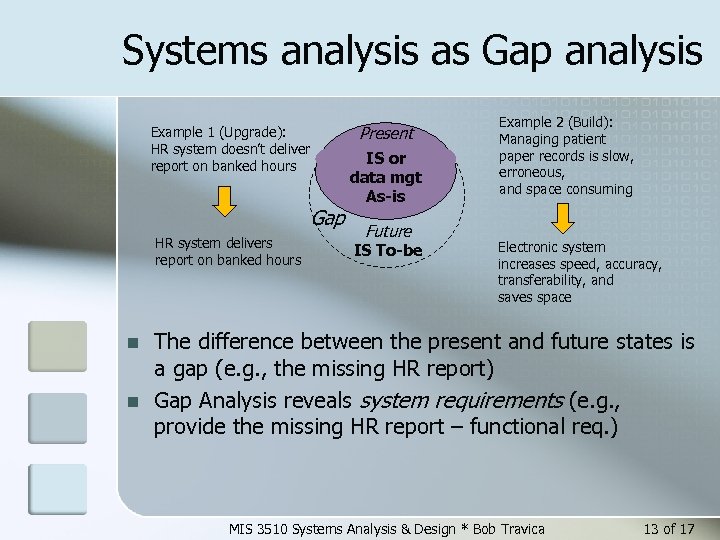
Systems analysis as Gap analysis Example 1 (Upgrade): HR system doesn’t deliver report on banked hours Gap HR system delivers report on banked hours n n Present IS or data mgt As-is Future IS To-be Example 2 (Build): Managing patient paper records is slow, erroneous, and space consuming Electronic system increases speed, accuracy, transferability, and saves space The difference between the present and future states is a gap (e. g. , the missing HR report) Gap Analysis reveals system requirements (e. g. , provide the missing HR report – functional req. ) MIS 3510 Systems Analysis & Design * Bob Travica 13 of 17
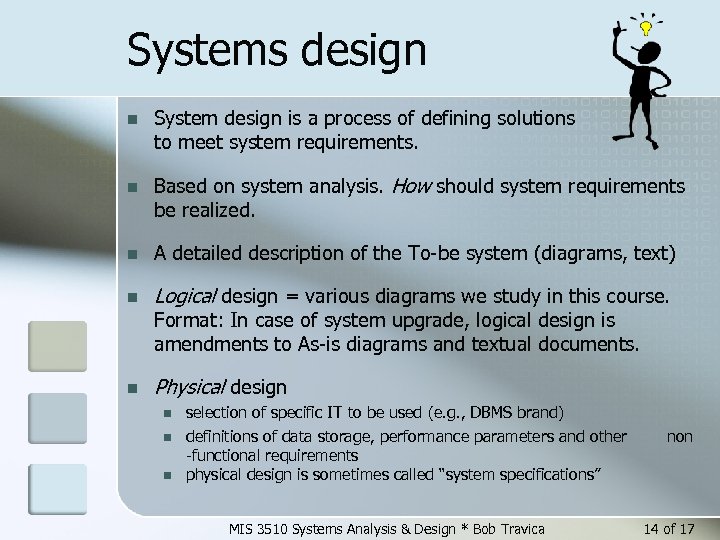
Systems design n System design is a process of defining solutions to meet system requirements. n Based on system analysis. How should system requirements be realized. n A detailed description of the To-be system (diagrams, text) n Logical design = various diagrams we study in this course. Format: In case of system upgrade, logical design is amendments to As-is diagrams and textual documents. n Physical design n selection of specific IT to be used (e. g. , DBMS brand) definitions of data storage, performance parameters and other -functional requirements physical design is sometimes called “system specifications” MIS 3510 Systems Analysis & Design * Bob Travica non 14 of 17
Systems analyst n Job: Performing systems analysis and design n Competences: development methodologies, understanding business and IT, analysis/synthesis skills (process and data analysis), social skills n Chief task: n helping in defining business/IS problems and creating solutions n solving business problems with IS MIS 3510 Systems Analysis & Design * Bob Travica 15 of 17
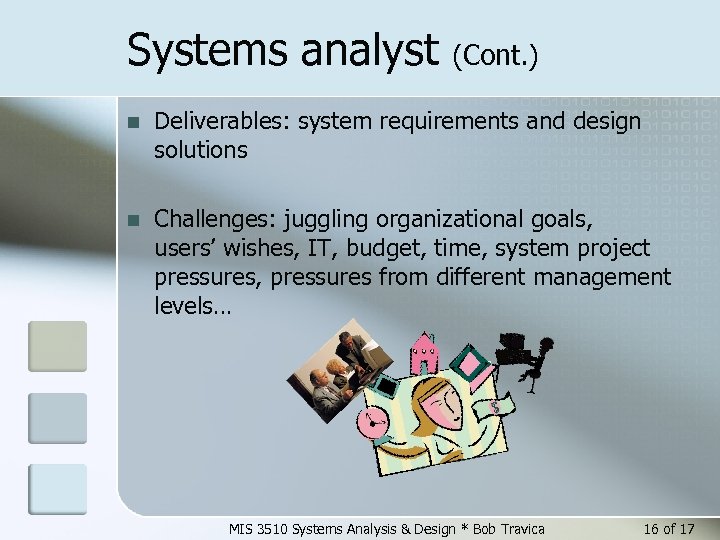
Systems analyst (Cont. ) n Deliverables: system requirements and design solutions n Challenges: juggling organizational goals, users’ wishes, IT, budget, time, system project pressures, pressures from different management levels… MIS 3510 Systems Analysis & Design * Bob Travica 16 of 17
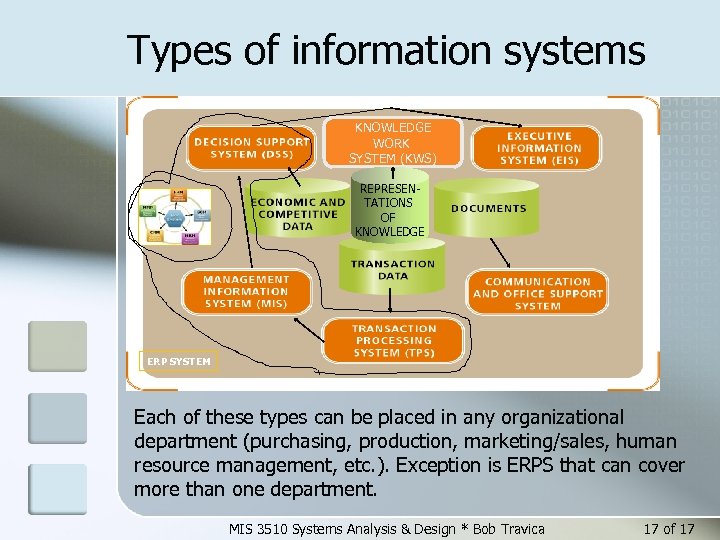
Types of information systems KNOWLEDGE WORK SYSTEM (KWS) REPRESENTATIONS OF KNOWLEDGE ERP SYSTEM Each of these types can be placed in any organizational department (purchasing, production, marketing/sales, human resource management, etc. ). Exception is ERPS that can cover more than one department. MIS 3510 Systems Analysis & Design * Bob Travica 17 of 17
Скачать презентацию Asper School of Business University of Manitoba Systems
96baa2d3fffa54b6f8da69cbdeec280a.ppt