


 Скачать презентацию ASN RD A Cost Issues Group presented at DODCAS 2009
14589e21d15e725501e6da8ade3dffac.ppt
- Количество слайдов: 12
 ASN(RD&A) Cost Issues Group presented at DODCAS 2009 DON Session CAPT Jim Baratta Deputy Director, NCCA
 Background • Called by ASN(RD&A) to address “cost estimating” issues – SECNAV/CNO: stop being surprised by 300% increases in program costs – The “easy target”: fix • the cost estimates 1 -star, 2 -star, SES-level attention from all stakeholders – Cost Estimating – Budgeting/Programming – Requirements – Engineering/Technical – Acquisition/Program Management • Initiated group 23 Jan, met several times since • Overarching issue is really “cost growth” 2
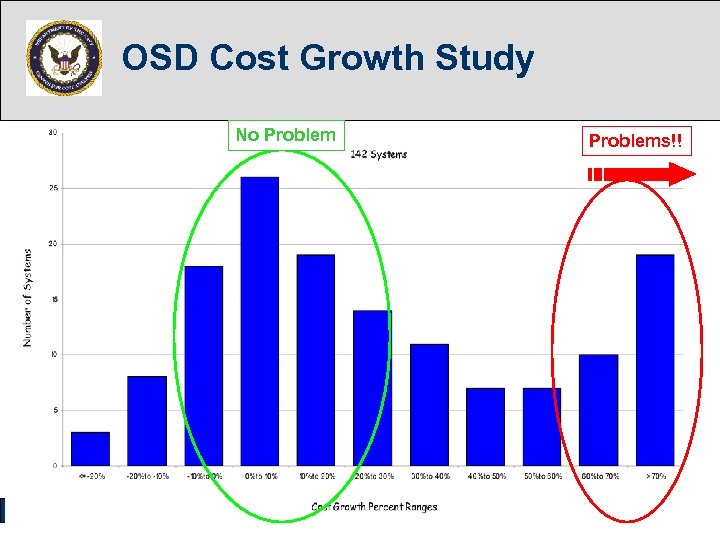 OSD Cost Growth Study No Problem 3 Problems!!
 Cost Community Highlighted Program Cost Problem Areas • POPS criteria for Cost Estimating is ineffective – Does not reflect validity of a cost estimate, misleading presentation of “confidence” – Cost estimate info is scattered throughout other POPS indicators – Provides no insight for decision makers; will always be red or yellow • Cost uncertainty at early program phases is a result of unreliable inputs – Technical and programmatic descriptions of programs – Technical, programmatic and requirements maturity, variation issues • Cost growth was more a function of non-estimating issues – Studies showed Cost Estimates accounting for 20%-40% of growth – Schedule, technical and programmatic accounted for 60%-80% of growth • Mismatch between budgeting, programming and estimating processes • Gave examples from NAVAIR, NAVSEA experience and metrics • “Cost estimating” is a small part of a very large issue! 4
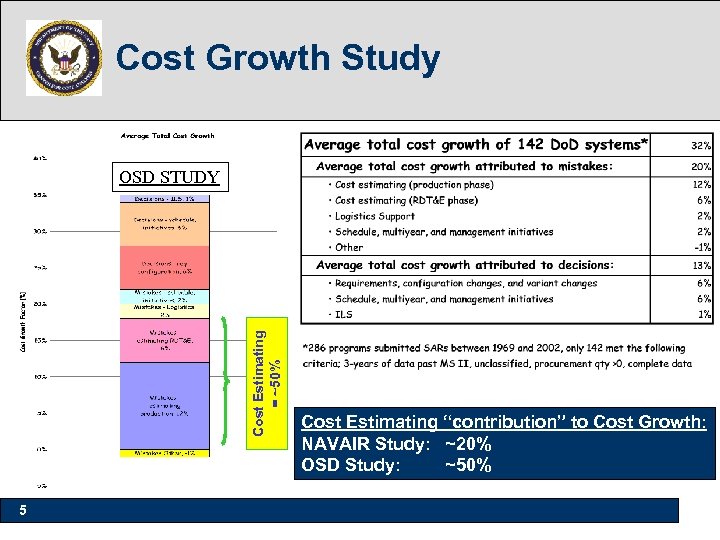 Cost Growth Study Cost Estimating = ~50% OSD STUDY 5 Cost Estimating “contribution” to Cost Growth: NAVAIR Study: ~20% OSD Study: ~50%
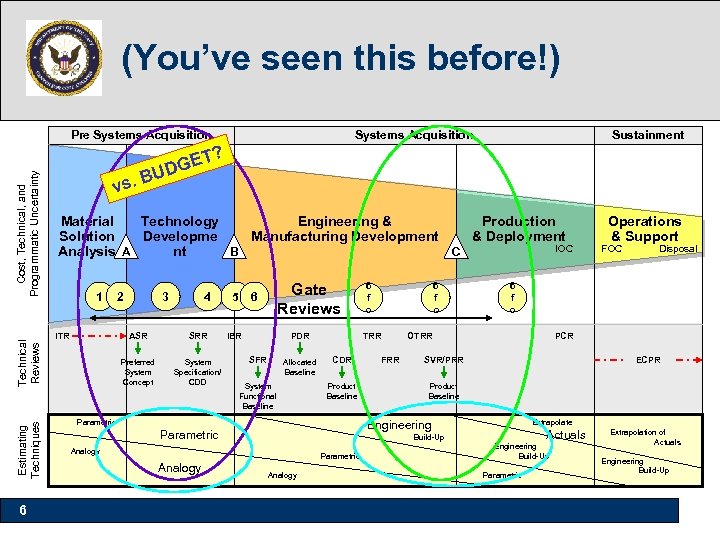 (You’ve seen this before!) Pre Systems Acquisition Sustainment Estimating Techniques Technical Reviews Cost, Technical, and Programmatic Uncertainty T? 6 vs. E UDG B Material Technology Engineering & Production Solution Developme Manufacturing Development & Deployment IOC Analysis A nt B C 1 ITR 2 3 4 ASR SRR Preferred System Concept System Specification/ CDD 5 Gate Reviews 6 IBR PDR SFR Allocated Baseline System Functional Baseline 6 f o TRR CDR Product Baseline Parametric FRR OTRR Parametric Analogy Disposal PCR SVR/PRR ECPR Product Baseline Extrapolate Actuals Build-Up Analogy FOC 6 f o Engineering Parametric Analogy 6 f o Operations & Support Engineering Build-Up Parametric Extrapolation of Actuals Engineering Build-Up
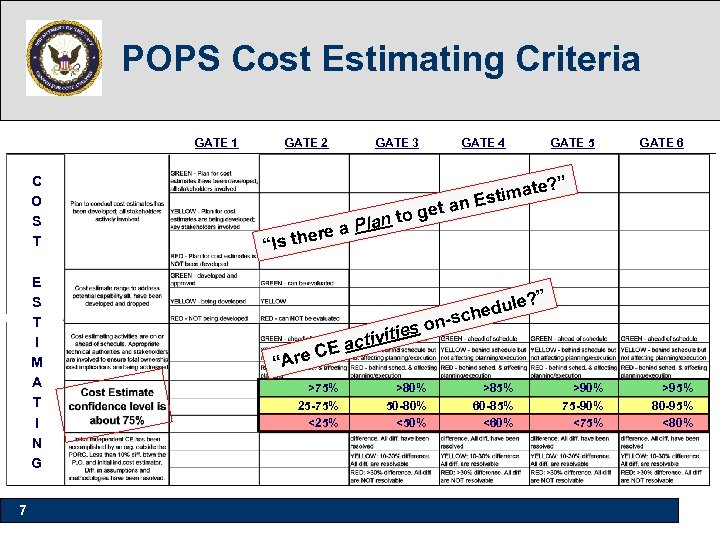 POPS Cost Estimating Criteria GATE 1 C O S T E S T I M A T I N G 7 GATE 2 GATE 3 GATE 4 GATE 5 GATE 6 ? ” et n to g a e a Pl ate Estim an er “Is th ” dule? che on-s s tivitie ac re CE “A >75% 25 -75% <25% >80% 50 -80% <50% >85% 60 -85% <60% >90% 75 -90% <75% >95% 80 -95% <80%
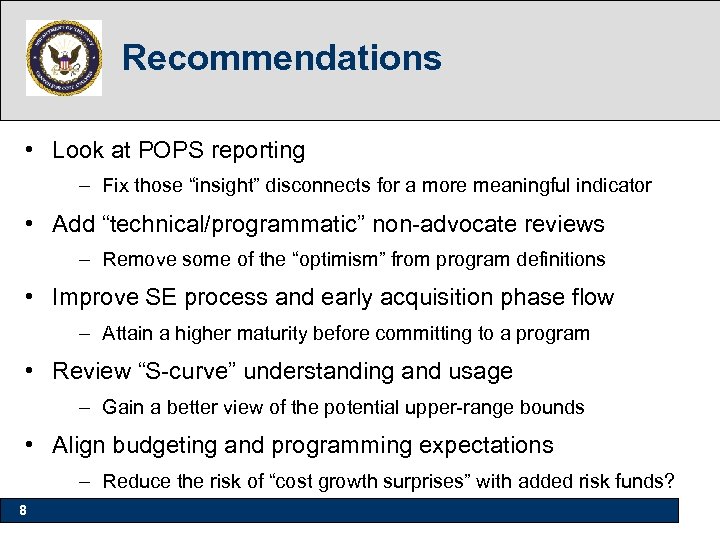 Recommendations • Look at POPS reporting – Fix those “insight” disconnects for a more meaningful indicator • Add “technical/programmatic” non-advocate reviews – Remove some of the “optimism” from program definitions • Improve SE process and early acquisition phase flow – Attain a higher maturity before committing to a program • Review “S-curve” understanding and usage – Gain a better view of the potential upper-range bounds • Align budgeting and programming expectations – Reduce the risk of “cost growth surprises” with added risk funds? 8
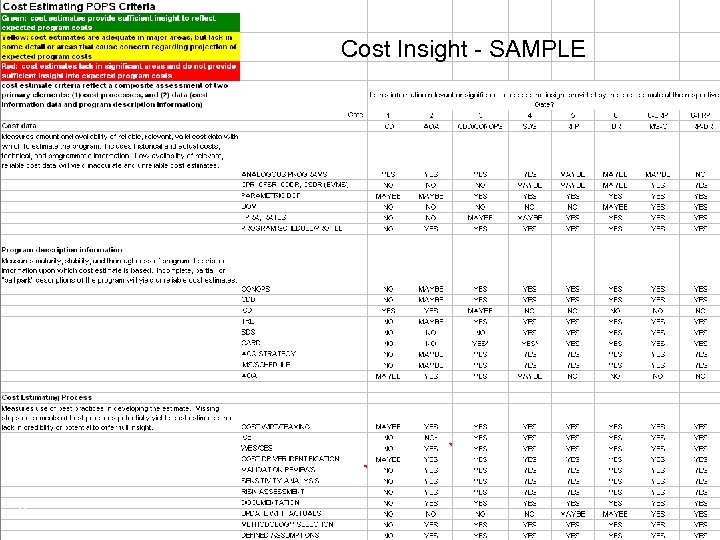 Cost Insight - SAMPLE 9
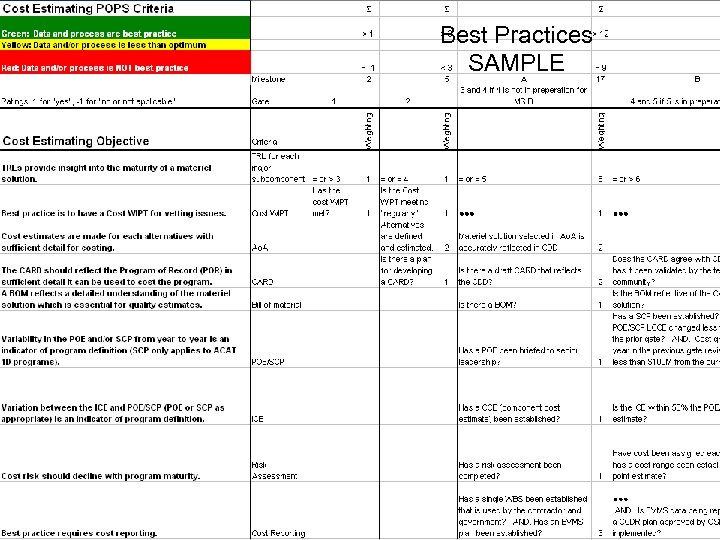 Best Practices SAMPLE 10
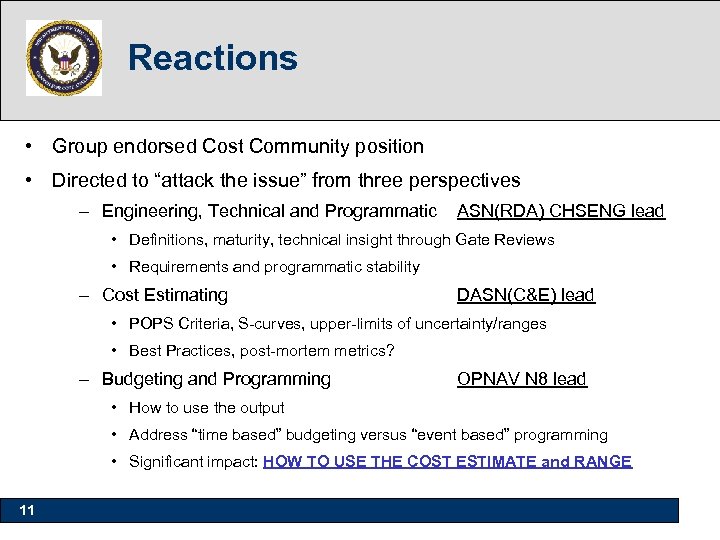 Reactions • Group endorsed Cost Community position • Directed to “attack the issue” from three perspectives – Engineering, Technical and Programmatic ASN(RDA) CHSENG lead • Definitions, maturity, technical insight through Gate Reviews • Requirements and programmatic stability – Cost Estimating DASN(C&E) lead • POPS Criteria, S-curves, upper-limits of uncertainty/ranges • Best Practices, post-mortem metrics? – Budgeting and Programming OPNAV N 8 lead • How to use the output • Address “time based” budgeting versus “event based” programming • Significant impact: HOW TO USE THE COST ESTIMATE and RANGE 11
 Questions? IS ALYS COST AN , urses co Golf. Buy kers. . an ase T le Fly Air Force! 12