 Скачать презентацию ASIAN REGIONAL PANEL Singapore 15 October 2002 Peter
1d3cc71bd2a5195555ce386e59523aaa.ppt
- Количество слайдов: 15



ASIAN REGIONAL PANEL Singapore 15 October 2002 Peter M. Swift
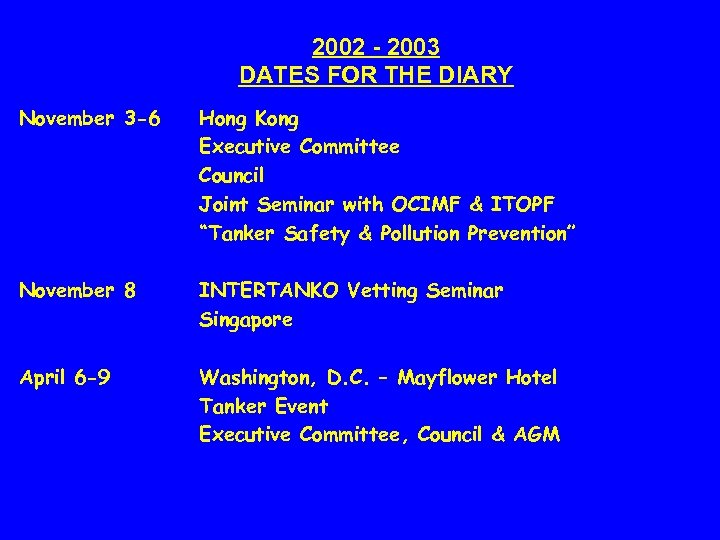
2002 - 2003 DATES FOR THE DIARY November 3 -6 Hong Kong Executive Committee Council Joint Seminar with OCIMF & ITOPF “Tanker Safety & Pollution Prevention” November 8 INTERTANKO Vetting Seminar Singapore April 6 -9 Washington, D. C. – Mayflower Hotel Tanker Event Executive Committee, Council & AGM
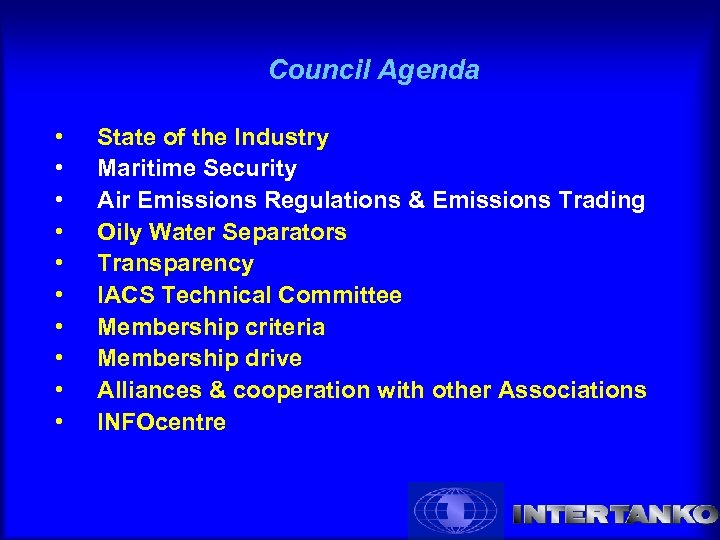
Council Agenda • • • State of the Industry Maritime Security Air Emissions Regulations & Emissions Trading Oily Water Separators Transparency IACS Technical Committee Membership criteria Membership drive Alliances & cooperation with other Associations INFOcentre

www. intertanko. com
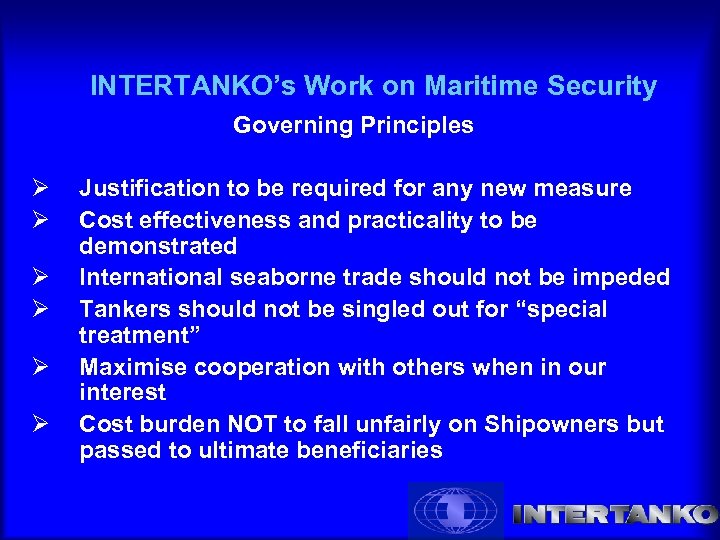
INTERTANKO’s Work on Maritime Security Governing Principles Ø Ø Ø Justification to be required for any new measure Cost effectiveness and practicality to be demonstrated International seaborne trade should not be impeded Tankers should not be singled out for “special treatment” Maximise cooperation with others when in our interest Cost burden NOT to fall unfairly on Shipowners but passed to ultimate beneficiaries
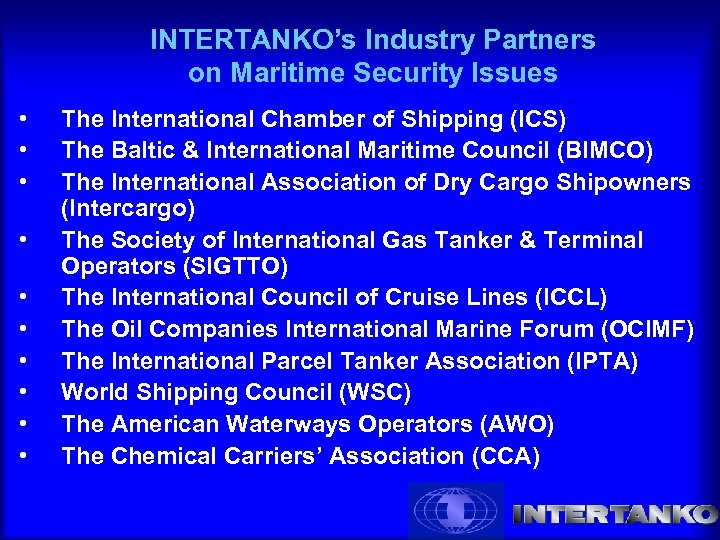
INTERTANKO’s Industry Partners on Maritime Security Issues • • • The International Chamber of Shipping (ICS) The Baltic & International Maritime Council (BIMCO) The International Association of Dry Cargo Shipowners (Intercargo) The Society of International Gas Tanker & Terminal Operators (SIGTTO) The International Council of Cruise Lines (ICCL) The Oil Companies International Marine Forum (OCIMF) The International Parcel Tanker Association (IPTA) World Shipping Council (WSC) The American Waterways Operators (AWO) The Chemical Carriers’ Association (CCA)
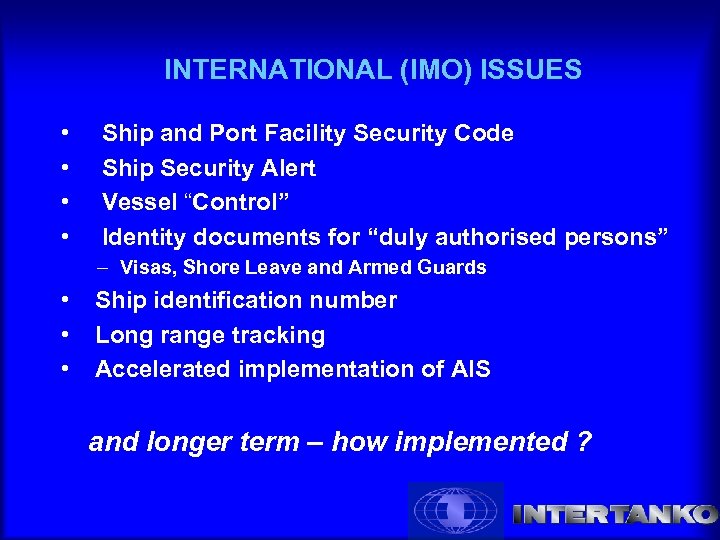
INTERNATIONAL (IMO) ISSUES • • Ship and Port Facility Security Code Ship Security Alert Vessel “Control” Identity documents for “duly authorised persons” – Visas, Shore Leave and Armed Guards • Ship identification number • Long range tracking • Accelerated implementation of AIS and longer term – how implemented ?
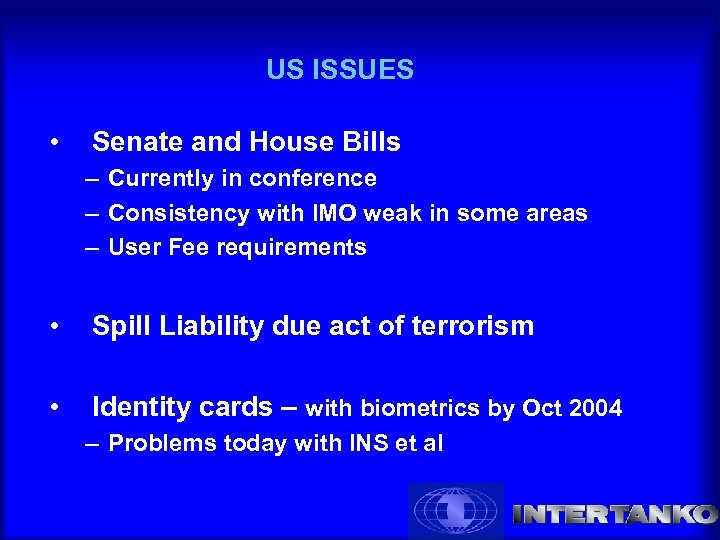
US ISSUES • Senate and House Bills – Currently in conference – Consistency with IMO weak in some areas – User Fee requirements • Spill Liability due act of terrorism • Identity cards – with biometrics by Oct 2004 – Problems today with INS et al
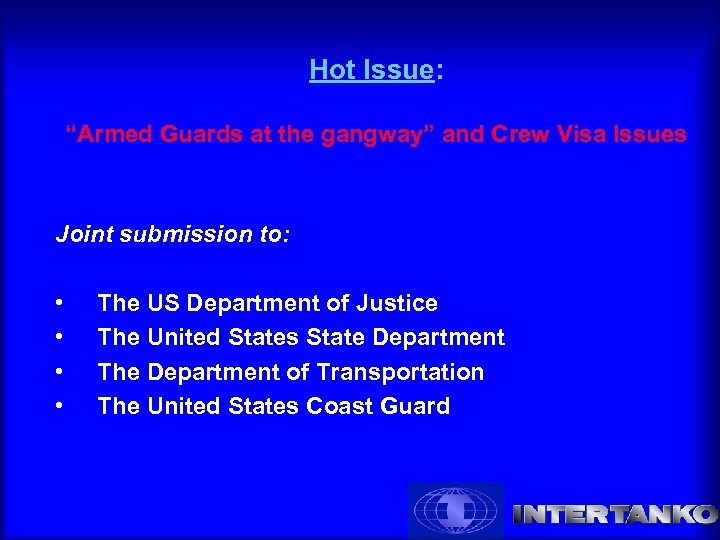
Hot Issue: “Armed Guards at the gangway” and Crew Visa Issues Joint submission to: • • The US Department of Justice The United States State Department The Department of Transportation The United States Coast Guard
Lobbying for: STAGE 1 • No detention onboard and access to shore leave for seafarers with valid visa to US • No Armed Guards unless bona fide threats identified • Cost (and liabilities) of enhanced security not to be placed on shipowners • Consistency of approach, with clear guidelines STAGE 2 • Efficient and predictable visa policy - Issuance/affordability, validity, flexibility STAGE 3 • Universally acceptable ID cards
AIR EMISSIONS – THE PROBLEM Air Pollution from Ships: Sources – – – Engine emissions (SOx, NOx, HC, CO) VOC during loading (tankers) VOC during transportation (tankers)
ASSESSING THE PROBLEM • Marine Engines contribute with 1. 5% of NOx emissions (EPA, NPRM Support Document) • Shipping is contributing in EU with some 15% of the SOx and NOx emissions (UNFCCC data) • Shipping is already adopting measures to limit these emissions and its contributions will likely decrease
AIR EMISSIONS – UNILATERAL LEGISLATION • EU Directive 1999/32 – to Sulphur Cap all grades of Fuels within Table I of ISO 8217 (1996) to contain max 0. 2% (Sulphur Cap will reduce to 0. 1% by 1 Jan 2008) – to make a Sulphur Cap proposal for HFO 1% • US Clean Air Act (EPA) Annex VI – test bed before installation and re-tests after overhauls with use of MDO (as by ISO 8217) EPA NPRM intent – test & monitoring onboard the ship and use of HFO
AIR EMISSIONS – UNILATERAL LEGISLATION • THE SOLUTION ? INTERNATIONAL LEGISLATION - HOPEFULLY ANNEX VI RATIFICATION AND ENTRY IN TO FORCE • THE PROSPECTS ? - LOOKING BETTER – by mid 2004 ?
INTERTANKO and EMISSIONS TRADING Ø Not new for many land-based industries Ø Complements rather than substitutes for regulations or measures limiting emissions Ø Participation on Exchanges may be voluntary or compulsory Ø Why shipping - Why tankers ? Ø Many issues still to be addressed Ø Watching brief – not advocating or promoting particular schemes
Скачать презентацию ASIAN REGIONAL PANEL Singapore 15 October 2002 Peter
1d3cc71bd2a5195555ce386e59523aaa.ppt