


 Скачать презентацию Asian Regional Panel 6 March 2008 Singapore Peter
5ae203964109bc20de286d66fd5ed65b.ppt
- Количество слайдов: 47
 Asian Regional Panel 6 March 2008 Singapore Peter M. Swift
 MD report INTERTANKO International Association of Independent Tanker Owners
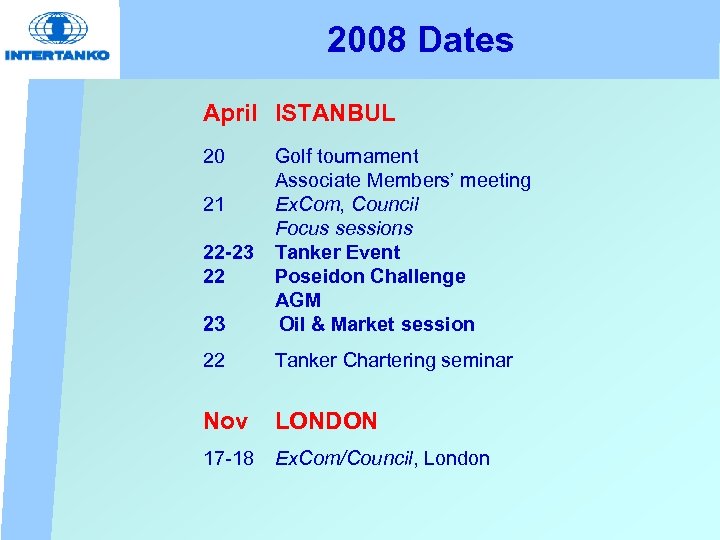 2008 Dates April ISTANBUL 20 23 Golf tournament Associate Members’ meeting Ex. Com, Council Focus sessions Tanker Event Poseidon Challenge AGM Oil & Market session 22 Tanker Chartering seminar Nov LONDON 17 -18 Ex. Com/Council, London 21 22 -23 22
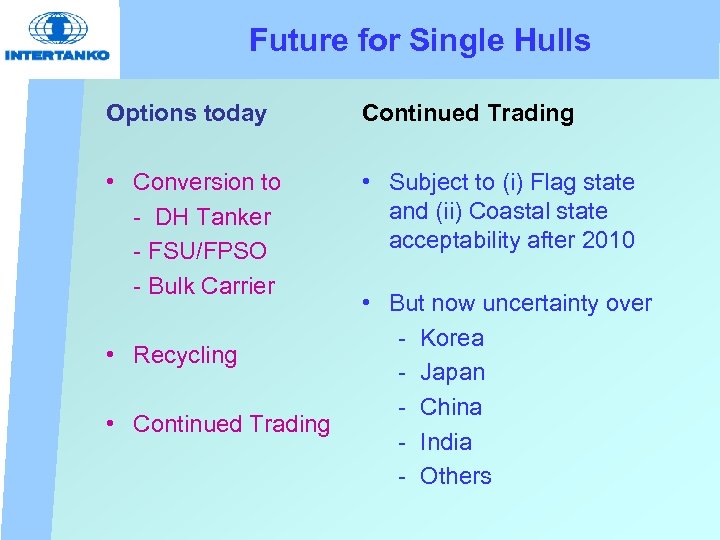 Future for Single Hulls Options today Continued Trading • Conversion to - DH Tanker - FSU/FPSO - Bulk Carrier • Subject to (i) Flag state and (ii) Coastal state acceptability after 2010 • Recycling • Continued Trading • But now uncertainty over - Korea - Japan - China - India - Others
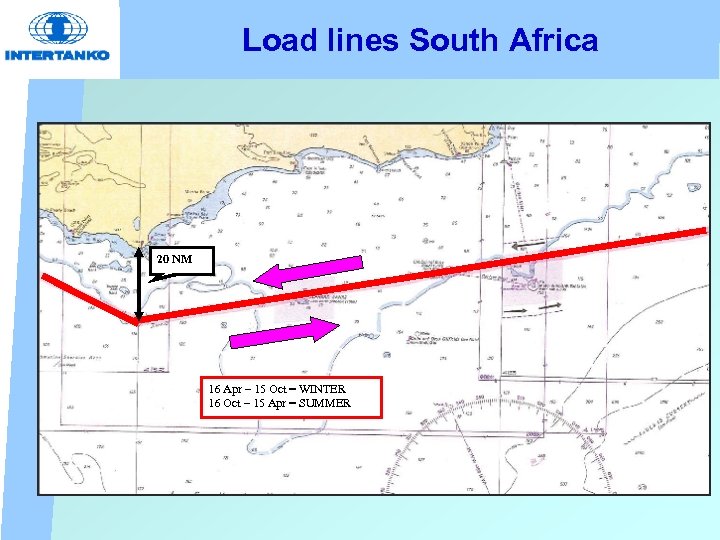 Load lines South Africa 20 NM 16 Apr – 15 Oct = WINTER 16 Oct – 15 Apr = SUMMER
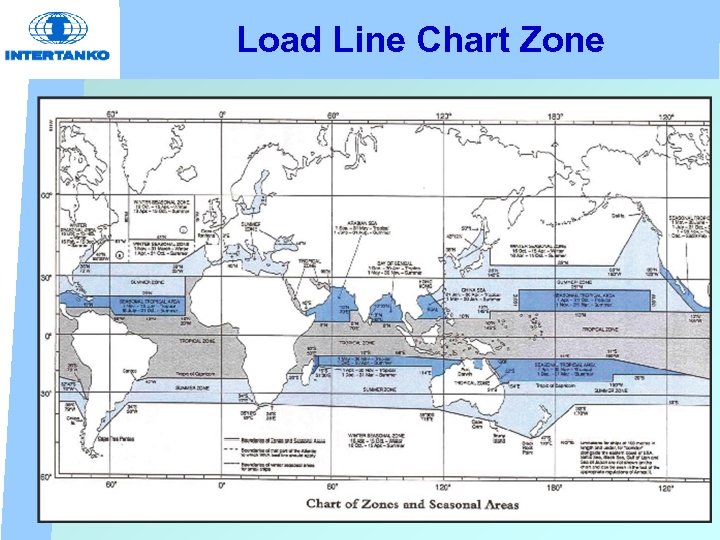 Load Line Chart Zone
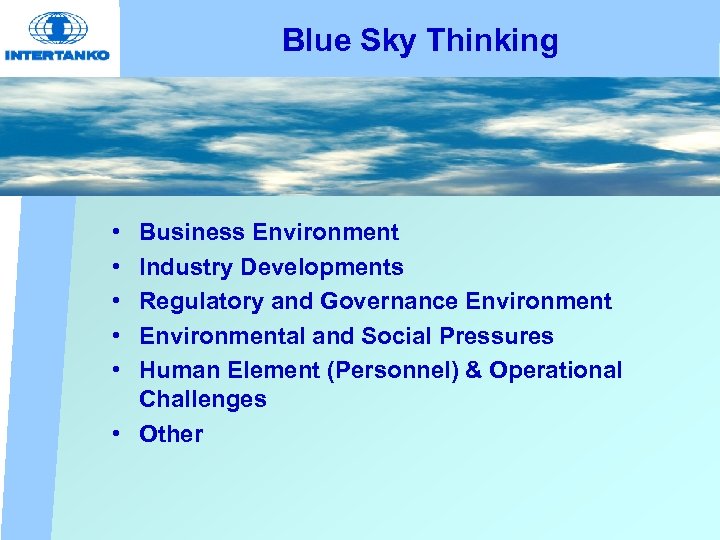 Blue Sky Thinking • • • Business Environment Industry Developments Regulatory and Governance Environmental and Social Pressures Human Element (Personnel) & Operational Challenges • Other
 Blue Sky Thinking Business Environment • Cyclical business • Rising costs • Tanker accident • …………….
 Blue Sky Thinking Industry Developments • Consolidation • New business opportunities • ……………
 Blue Sky Thinking Regulatory and Governance Environment • Weaker/stronger IMO • More/less regional pressures/legislation • Role of flag states • Role of class • Higher standards set by… ? • Challenges to Limitation of Liability • …………….
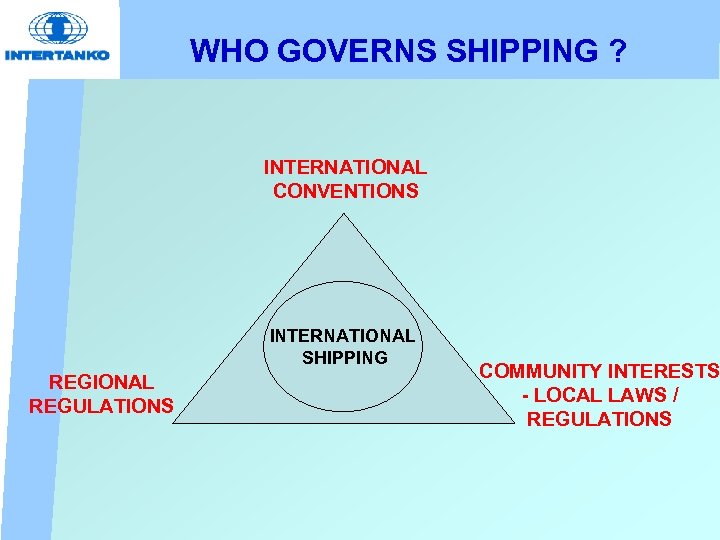 WHO GOVERNS SHIPPING ? INTERNATIONAL CONVENTIONS INTERNATIONAL SHIPPING REGIONAL REGULATIONS COMMUNITY INTERESTS - LOCAL LAWS / REGULATIONS
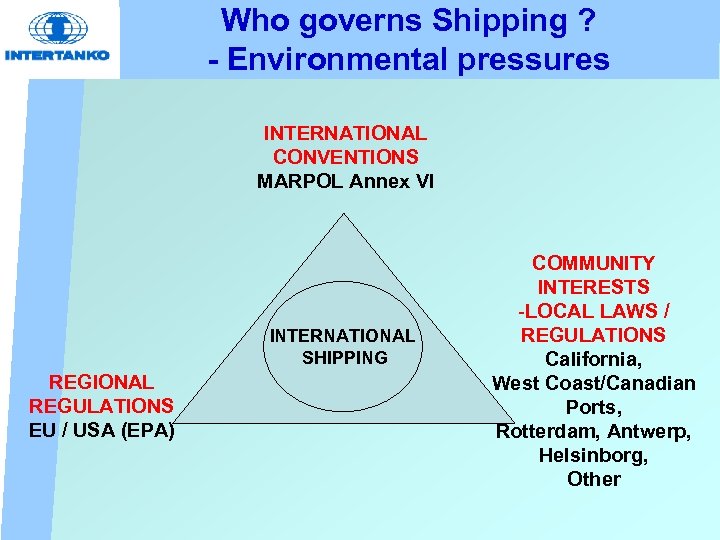 Who governs Shipping ? - Environmental pressures INTERNATIONAL CONVENTIONS MARPOL Annex VI INTERNATIONAL SHIPPING REGIONAL REGULATIONS EU / USA (EPA) COMMUNITY INTERESTS -LOCAL LAWS / REGULATIONS California, West Coast/Canadian Ports, Rotterdam, Antwerp, Helsinborg, Other
 Blue Sky Thinking Environmental and Social Pressures • Climate change / global warming and air pollution pressures on shipping industries • Development of (zero emission) eco-ships • Tankers singled out – not cold ironing, large ballast water transporters, difficult recycling • “Green legislation” grows – higher entry barriers, knowledge and experience more valued • Corporate Social Responsibility practices and programmes are the “norm” • ……………. .
 Blue Sky Thinking Human Element (Personnel) & Operational Challenges • Availability and quality of officer pool will get worse before it gets better • Solutions will be - through regulatory changes and/or market mechanisms - at both macro and micro level ? • Sourcing will be even more from “new” Asian countries • Greater participation of women • Tanker industry could lose out to other sectors • Standards in some sectors will slide • More activity by management companies • ……………
 Blue Sky Thinking Other ?
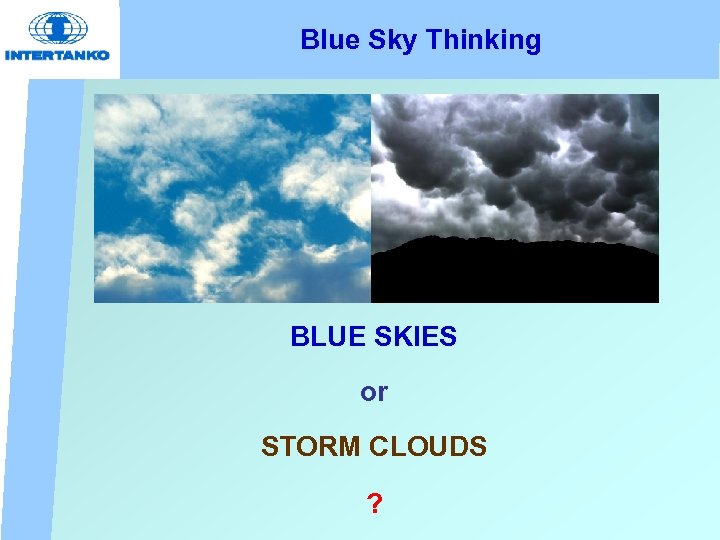 Blue Sky Thinking BLUE SKIES or STORM CLOUDS ?
 Update on the revision of MARPOL ANNEX VI & GHG reduction Asian Regional Panel 6 March 2008 Singapore
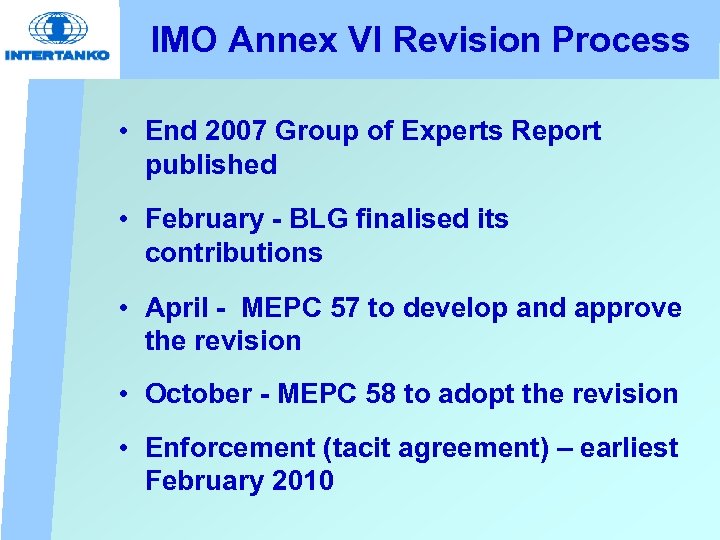 IMO Annex VI Revision Process • End 2007 Group of Experts Report published • February - BLG finalised its contributions • April - MEPC 57 to develop and approve the revision • October - MEPC 58 to adopt the revision • Enforcement (tacit agreement) – earliest February 2010
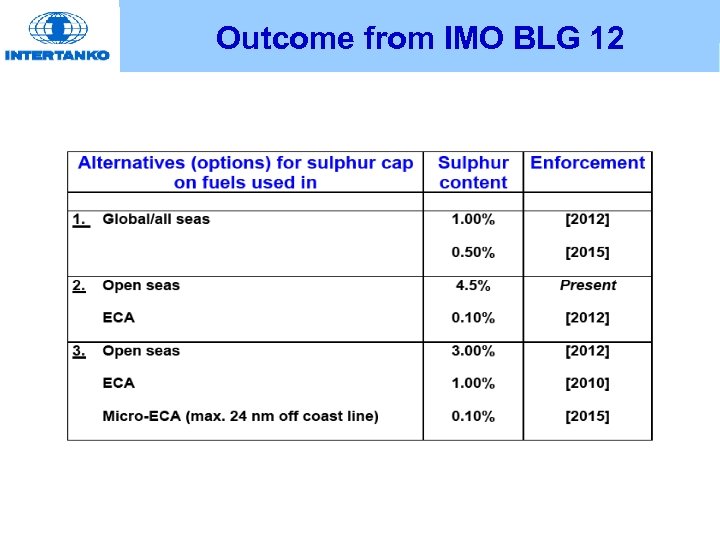 Outcome from IMO BLG 12
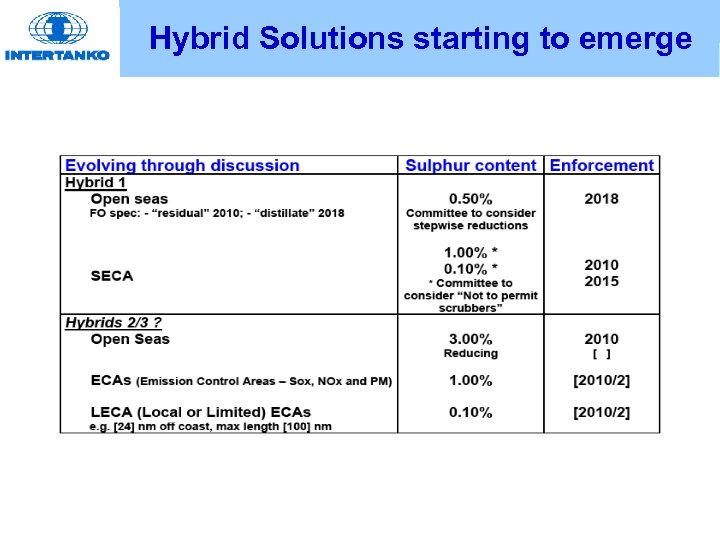 Hybrid Solutions starting to emerge
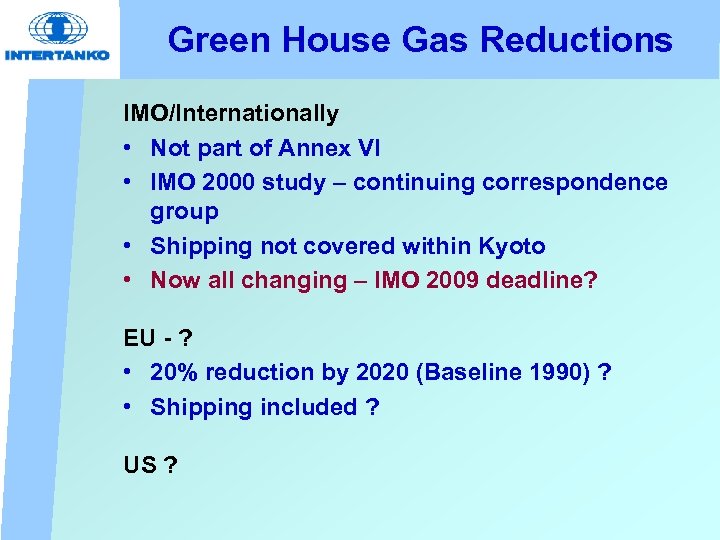 Green House Gas Reductions IMO/Internationally • Not part of Annex VI • IMO 2000 study – continuing correspondence group • Shipping not covered within Kyoto • Now all changing – IMO 2009 deadline? EU - ? • 20% reduction by 2020 (Baseline 1990) ? • Shipping included ? US ?
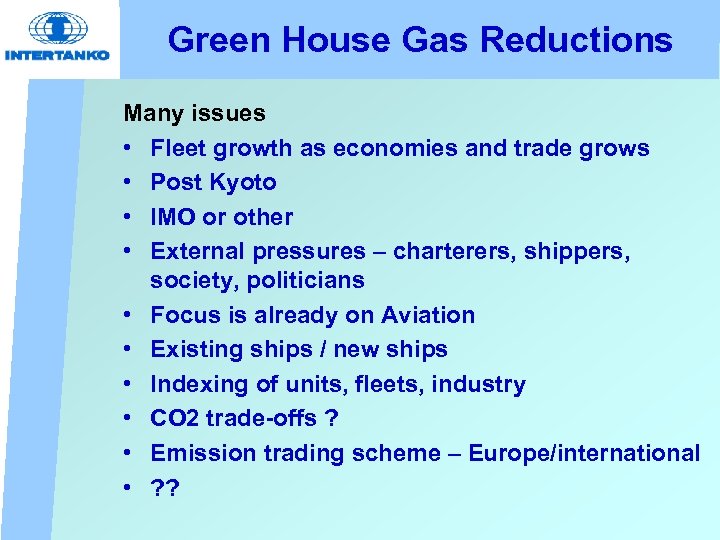 Green House Gas Reductions Many issues • Fleet growth as economies and trade grows • Post Kyoto • IMO or other • External pressures – charterers, shippers, society, politicians • Focus is already on Aviation • Existing ships / new ships • Indexing of units, fleets, industry • CO 2 trade-offs ? • Emission trading scheme – Europe/international • ? ?
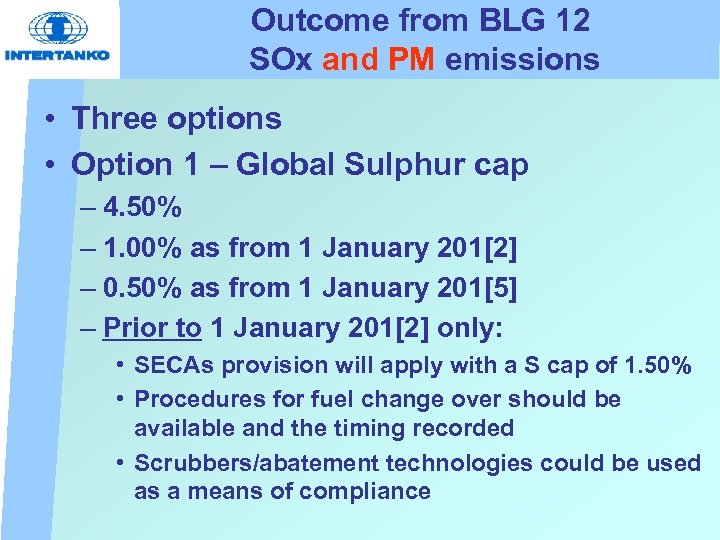 Outcome from BLG 12 SOx and PM emissions • Three options • Option 1 – Global Sulphur cap – 4. 50% – 1. 00% as from 1 January 201[2] – 0. 50% as from 1 January 201[5] – Prior to 1 January 201[2] only: • SECAs provision will apply with a S cap of 1. 50% • Procedures for fuel change over should be available and the timing recorded • Scrubbers/abatement technologies could be used as a means of compliance
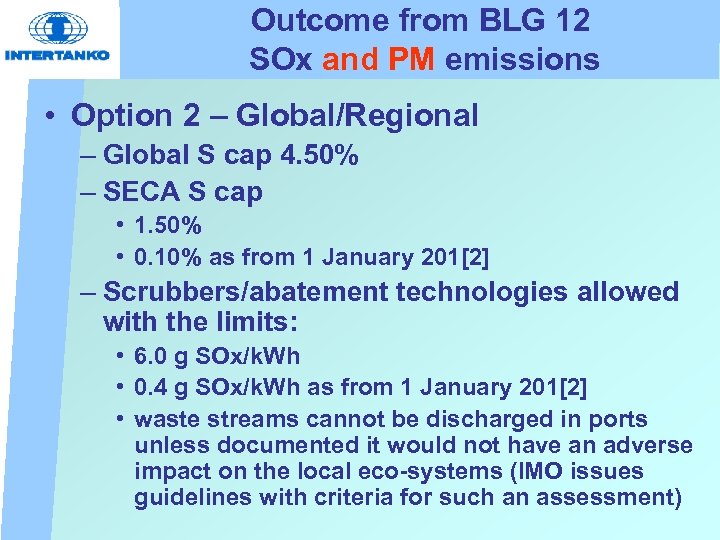 Outcome from BLG 12 SOx and PM emissions • Option 2 – Global/Regional – Global S cap 4. 50% – SECA S cap • 1. 50% • 0. 10% as from 1 January 201[2] – Scrubbers/abatement technologies allowed with the limits: • 6. 0 g SOx/k. Wh • 0. 4 g SOx/k. Wh as from 1 January 201[2] • waste streams cannot be discharged in ports unless documented it would not have an adverse impact on the local eco-systems (IMO issues guidelines with criteria for such an assessment)
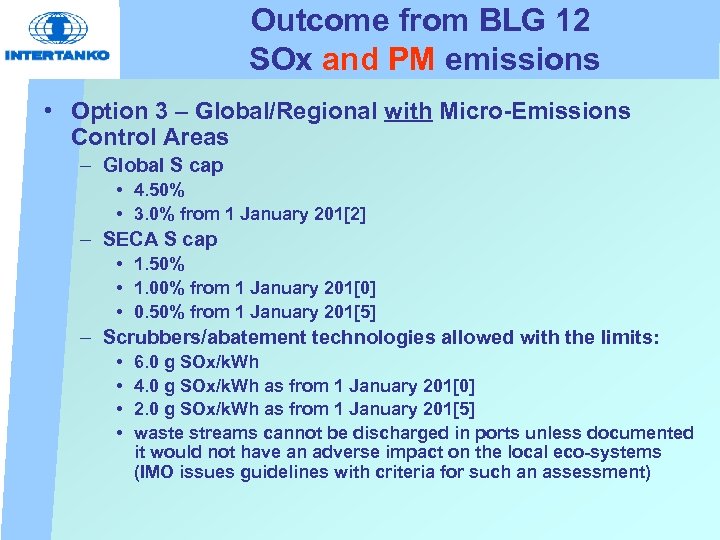 Outcome from BLG 12 SOx and PM emissions • Option 3 – Global/Regional with Micro-Emissions Control Areas – Global S cap • 4. 50% • 3. 0% from 1 January 201[2] – SECA S cap • 1. 50% • 1. 00% from 1 January 201[0] • 0. 50% from 1 January 201[5] – Scrubbers/abatement technologies allowed with the limits: • • 6. 0 g SOx/k. Wh 4. 0 g SOx/k. Wh as from 1 January 201[0] 2. 0 g SOx/k. Wh as from 1 January 201[5] waste streams cannot be discharged in ports unless documented it would not have an adverse impact on the local eco-systems (IMO issues guidelines with criteria for such an assessment)
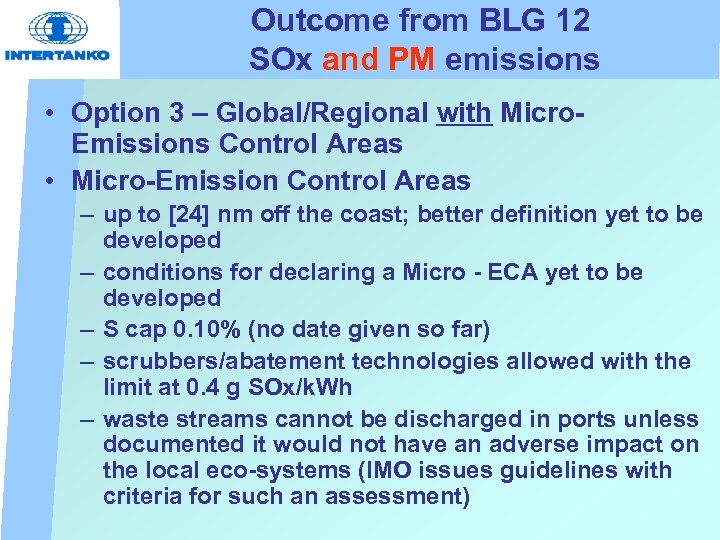 Outcome from BLG 12 SOx and PM emissions • Option 3 – Global/Regional with Micro. Emissions Control Areas • Micro-Emission Control Areas – up to [24] nm off the coast; better definition yet to be developed – conditions for declaring a Micro - ECA yet to be developed – S cap 0. 10% (no date given so far) – scrubbers/abatement technologies allowed with the limit at 0. 4 g SOx/k. Wh – waste streams cannot be discharged in ports unless documented it would not have an adverse impact on the local eco-systems (IMO issues guidelines with criteria for such an assessment)
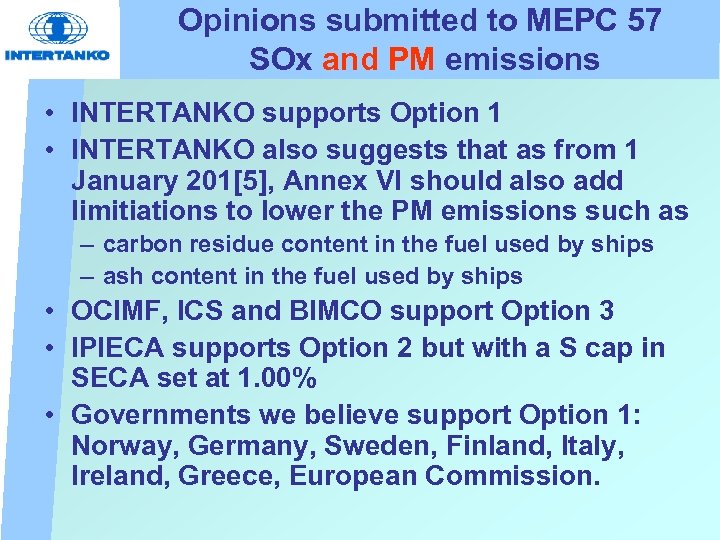 Opinions submitted to MEPC 57 SOx and PM emissions • INTERTANKO supports Option 1 • INTERTANKO also suggests that as from 1 January 201[5], Annex VI should also add limitiations to lower the PM emissions such as – carbon residue content in the fuel used by ships – ash content in the fuel used by ships • OCIMF, ICS and BIMCO support Option 3 • IPIECA supports Option 2 but with a S cap in SECA set at 1. 00% • Governments we believe support Option 1: Norway, Germany, Sweden, Finland, Italy, Ireland, Greece, European Commission.
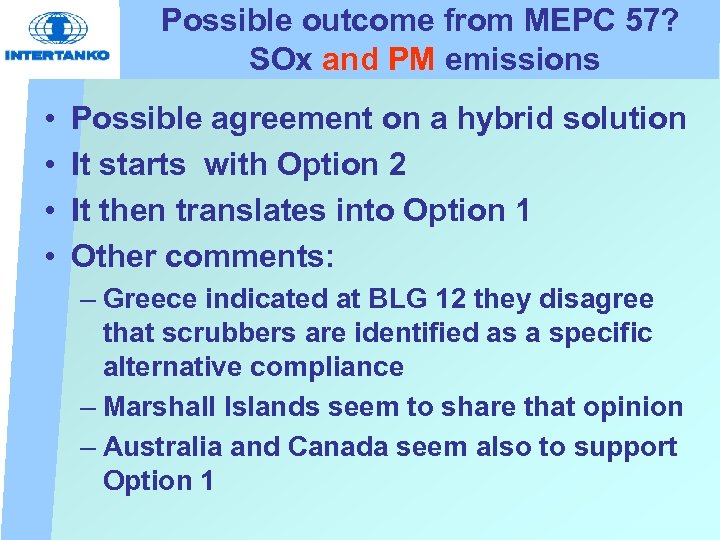 Possible outcome from MEPC 57? SOx and PM emissions • • Possible agreement on a hybrid solution It starts with Option 2 It then translates into Option 1 Other comments: – Greece indicated at BLG 12 they disagree that scrubbers are identified as a specific alternative compliance – Marshall Islands seem to share that opinion – Australia and Canada seem also to support Option 1
 Outcome from BLG 12 NOx emissions – Pre-2000 engines • Measures on engines installed onboard ships constructed between 1 January 1990 and 31 December 1999 • The NOx emissions at Tier I level • Applicaton date – at the first intermediate or renewal survey; or – [1 January 2010], which one occurs later • Compliance through: – in engine modification (MEPC 57 has to choose between two options); or – abatement technologies
 Outcome from BLG 12 NOx emissions – Pre-2000 engines • Option 1 – applies to all (i. e. 1990 – 1999) engines – if compliance through in-engine modifications not possible, a Port State could: • require the ship to use distillate fuel; or • deny port entry • Option 2 – applies to larger (1990 – 1999) engines only ([displacement of and over [30/60/90] liters] or [power output of > 5000 k. W]) – use of a certified ”upgrade kit”
 Outcome from BLG 12 NOx emissions – Tier II (new engines) • Tier II standards (emission reductions related to Tier I limits): – 15. 5% reduction (engines with n<130 rpm) (i. e. 14. 36 g/k. Wh) – reductions between 15. 5% and 21. 8% depending on the engine’s rpm (engines with 130 rpm < n < 2000 rpm) – 21. 8% reduction (engines n > 2000 rpm) (i. e. 7. 66 g/k. Wh) • Applies to engines installed on ships constructed on and after 1 January 2011
 Outcome from BLG 12 NOx emissions-Tier III (new engines) • Tier III standards – 80% emission reductions from Tier I limits • Tier III limits apply ONLY to engines installed on ships constructed on & after 1 January 2016 • (a Party to Annex VI can apply the above limits to new engines of 130 k. W and above) • Tier III limits in ECAs only • Outside ECAs - Tier II limits • Emission levels for Tier III are as follows: – 3. 40 g/k. Wh (engines with n<130 rpm) – 9*n(-0. 2) g/k. Wh (engines with 130 rpm < n < 2000 rpm) – 1. 96 g/k. Wh (engines n > 2000 rpm
 Outcome from BLG 12 Fuel Oil Quality • Small but important changes and pending discusions • The fuels required to be ”fit for purpose” • MEPC 57 to clarify the meaning of ”fit for purpose” from a quality point of view • IMO to invite ISO to revise marine fuels specifications in ISO 8217 • Define fuel specification for a Global solution • Possible inclusion of limitations of other parameters to reduce PM emissions • BLG developed a standard procedure to interpret the actual test results of the sulphur content of the MARPOL sample
 CONCLUSIONS • Possible hybrid solution for SOx and PM emissions – starting with Option 2 (with a higher S cap in SECAs, say 1. 00% from say 201[2]) – followed by Option 1
 CONCLUSIONS • NOx limits for existing engines - not an easy task • Use of MDO would give an easy NOx reduction by 10% to 15%. BUT without a global use of MDO, the penalty on old ships would be too high • NOx Tier II - possible and rests with manufacturers • NOx Tier III implies use of SCRs/abatement technologies • Prudent that new ships consider compliance with Tier III and install SCRs/abatement technology prior to 2016 • Still to be assessed – SCRs - the only technology to give an 80% reduction; . . . BUT – existing SCR technology not efficient at low engine loads – can compliance be achieved in ECAs irrespective the engine load (close to port, through estuaries and straits ships slow down)?
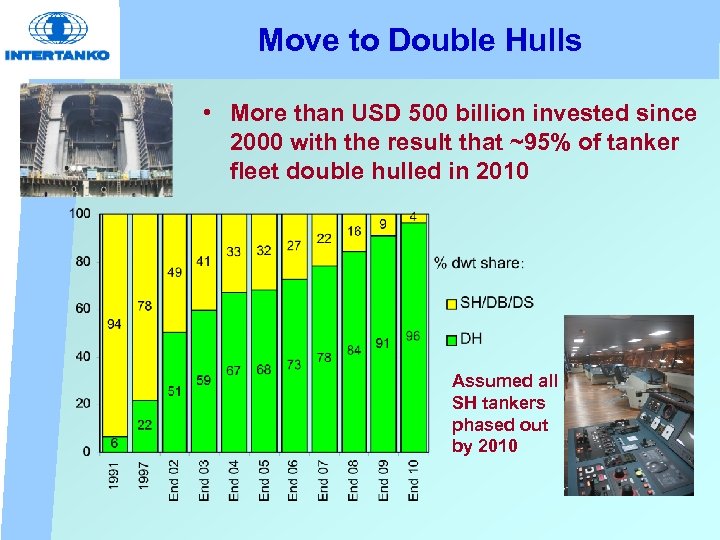 Move to Double Hulls • More than USD 500 billion invested since 2000 with the result that ~95% of tanker fleet double hulled in 2010 Assumed all SH tankers phased out by 2010
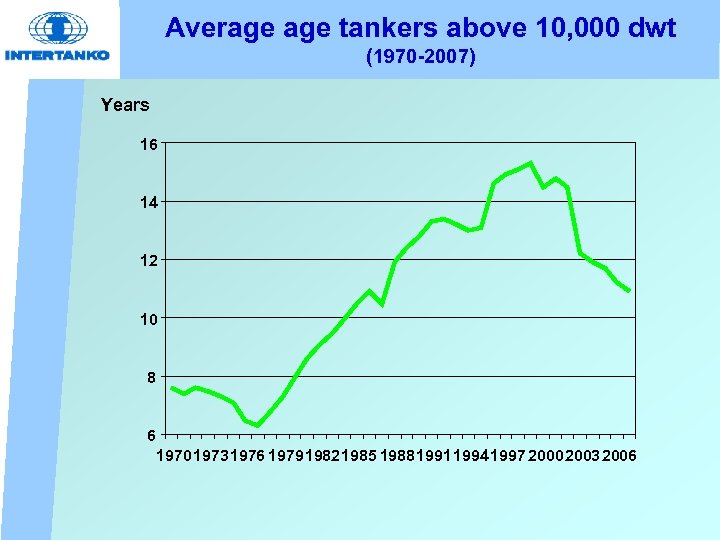 Average tankers above 10, 000 dwt (1970 -2007) Years 16 14 12 10 8 6 197019731976 197919821985 1988199119941997 200020032006
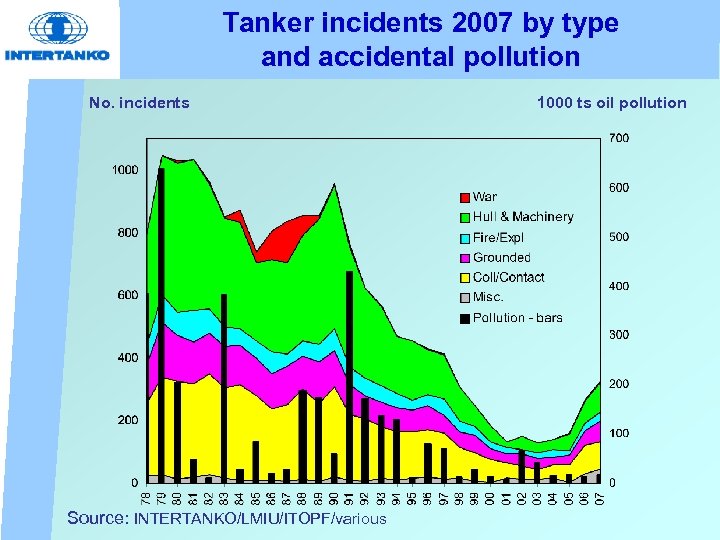 Tanker incidents 2007 by type and accidental pollution No. incidents Source: INTERTANKO/LMIU/ITOPF/various 1000 ts oil pollution
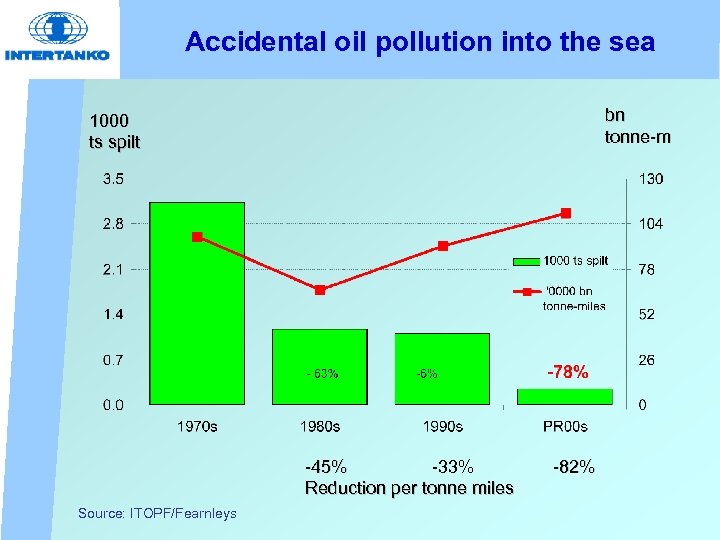 Accidental oil pollution into the sea bn tonne-m 1000 ts spilt -45% -33% Reduction per tonne miles Source: ITOPF/Fearnleys -82%
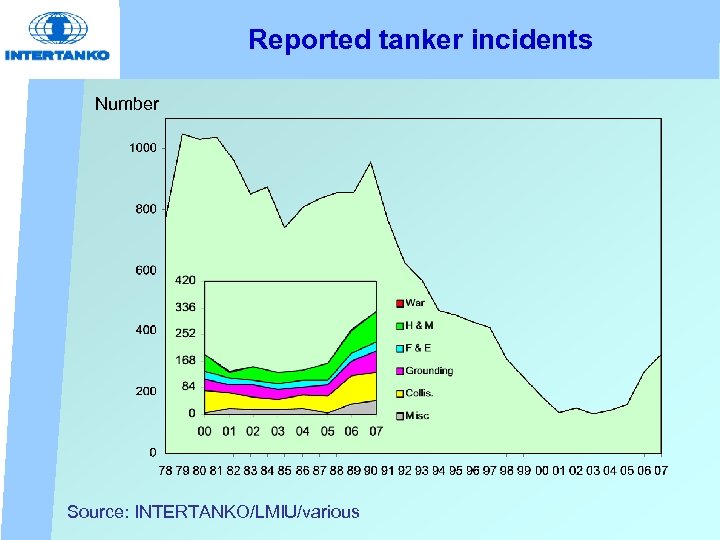 Reported tanker incidents Number Source: INTERTANKO/LMIU/various
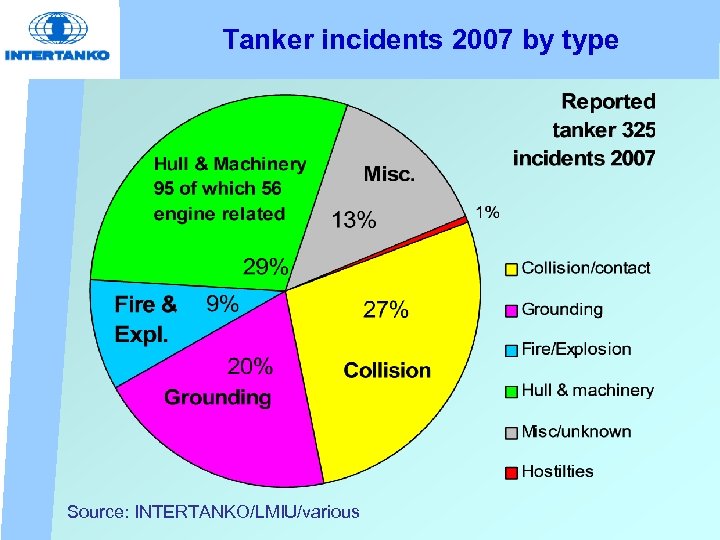 Tanker incidents 2007 by type Source: INTERTANKO/LMIU/various
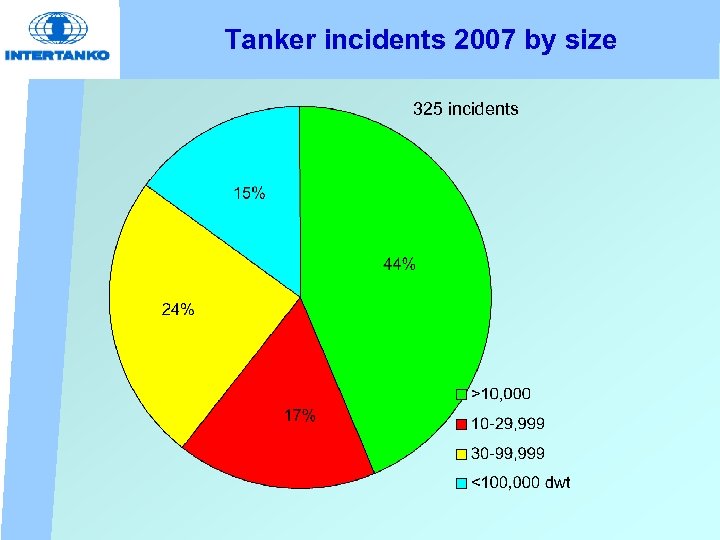 Tanker incidents 2007 by size 325 incidents
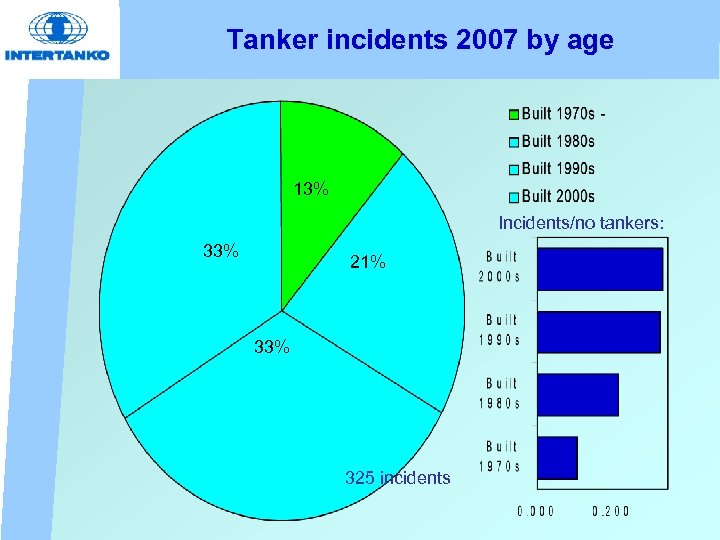 Tanker incidents 2007 by age 13% Incidents/no tankers: 33% 21% 33% 325 incidents
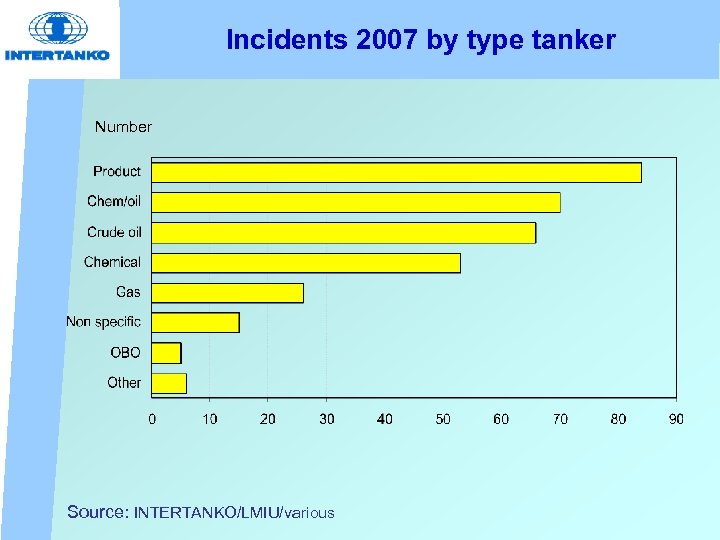 Incidents 2007 by type tanker Number Source: INTERTANKO/LMIU/various
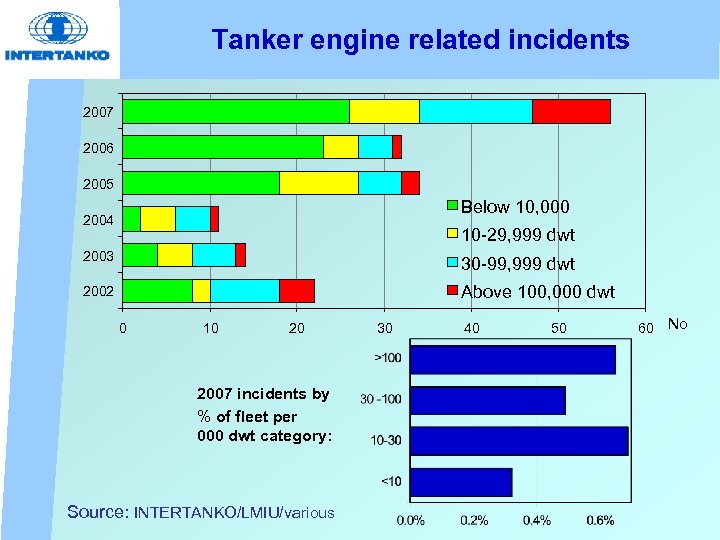 Tanker engine related incidents 2007 2006 2005 Below 10, 000 2004 10 -29, 999 dwt 2003 30 -99, 999 dwt 2002 Above 100, 000 dwt 0 10 20 2007 incidents by % of fleet per 000 dwt category: Source: INTERTANKO/LMIU/various 30 40 50 60 No
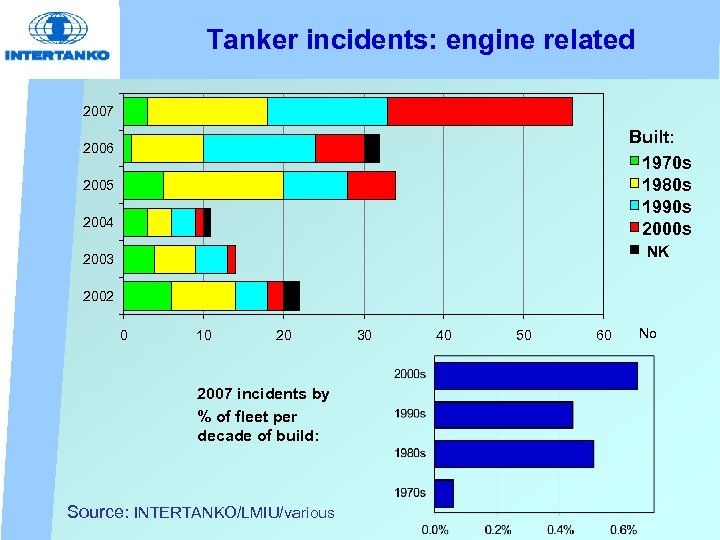 Tanker incidents: engine related 2007 Built: 1970 s 1980 s 1990 s 2006 2005 2004 NK 2003 2002 0 10 20 2007 incidents by % of fleet per decade of build: Source: INTERTANKO/LMIU/various 30 40 50 60 No
 THANK YOU For more information, please visit: www. intertanko. com www. shippingfacts. com www. maritimefoundation. com