 Скачать презентацию Asia Pacific Peering Guidebook v 1 6 William
39b8f80091c9c050049e9d8688d01c55.ppt
- Количество слайдов: 45



Asia Pacific Peering Guidebook (v 1. 6) William B. Norton Co-Founder & Chief Technical Liaison
Internet Researcher • • 90% externally focused Many documents on Protocols Lack of Operations documents Research: Peering – How does Peering work? – What are the definitions? – What are the “Tricks of the Trade? ” White paper process. .
Community Operations Research 1. “Ground Truth” w/dozens of experts 2. Write White Paper v 0. 1 3. Walk community through WP for comments 4. Revise White Paper into new version 5. Present White Paper at conferences 6. Solicit comments over lunches and dinners White papers so far…
Internet Operations White Papers 1) 2) 3) 4) 5) 6) “Interconnection Strategies for ISPs” “Internet Service Providers and Peering” “A Business Case for Peering” “The Art of Peering: The Peering Playbook” “The Peering Simulation Game” “Do ATM-based Internet Exchanges Make Sense Anymore? ” 7) “Evolution of the U. S. Peering Ecosystem” 8) “Asia Pacific Peering Guidebook” Freely available. See Web site or send e-mail to wbn@equinix. com Or Google for “William B. Norton”
Research Topic: Peering in Asia • Goals of this 12 month research – Document how the Internet Peering Ecosystems in Asia are different from the rest of the world – What did Peering Coordinators find counter-intuitive? – What surprises did they run into as they expanded their networks into and within Asia? • Result: “The Asia Pacific Internet Peering Ecosystem” (v 1. 6) – Value of IX, Peering Policies, Biz cases for Peering in AP Ecosystems, etc.
What is this “Peering Ecosystem? ” • Global Internet Peering Ecosystem: A system of autonomous but interconnected Internet Regions, each with players that provide connectivity and content to the Internet.
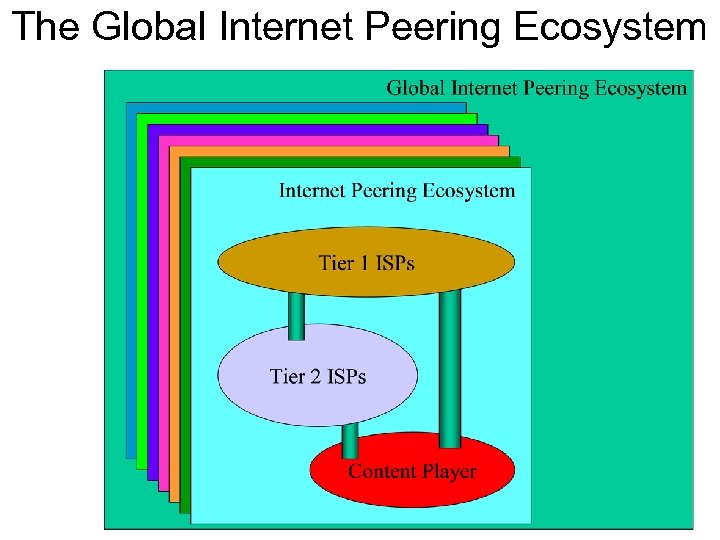
The Global Internet Peering Ecosystem
Ecosystem Players • Tier 1 ISPs (ISPs that have access to all the Internet Peering Ecosystem routes solely through free peering relationships), • Tier 2 ISPs (that must buy transit from someone to reach routes within the Internet Peering Ecosystem), and • Content Providers who don’t sell access to the Internet but offer content.
Motivations: Peering Policy • Def: A Restrictive Peering Policy is an articulation of an inclination not to peer. • Def: A Selective Peering Policy is an articulation of an inclination to peer, but with some conditions • Def: An Open Peering Policy is an articulation of an inclination to peer with anyone.
Japan Peering Ecosystem In Japan, the set of Tier 1 ISPs include • Japan Telecom (JT Open Data Network (ODN)), • NTT (and Internet Initiative Japan (IIJ)), • KDDI, and • POWEREDCOM,
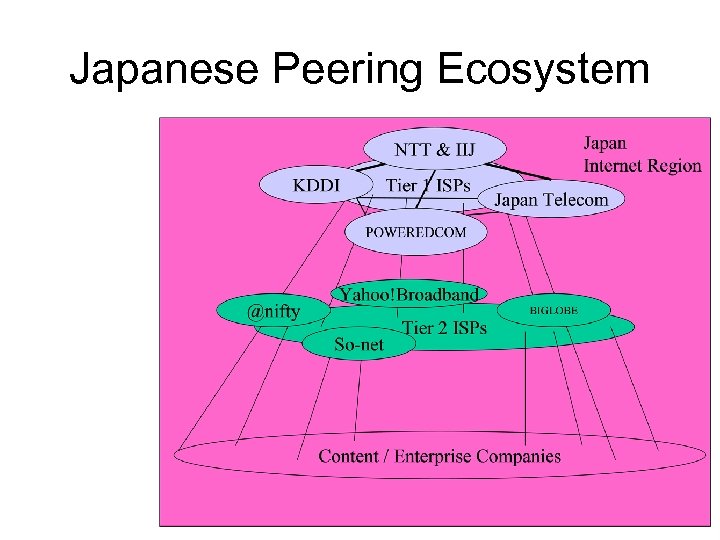
Japanese Peering Ecosystem
Japanese Peering Ecosystem • • • 80% JP Traffic stays in JP Tier 1 ISPs own infrastructure Major Disruption: Yahoo!BB (48 Gbps) 40+Mbps DSL for <$50 USD/mo FTTH for $100/mo 1 Mbps streaming TV
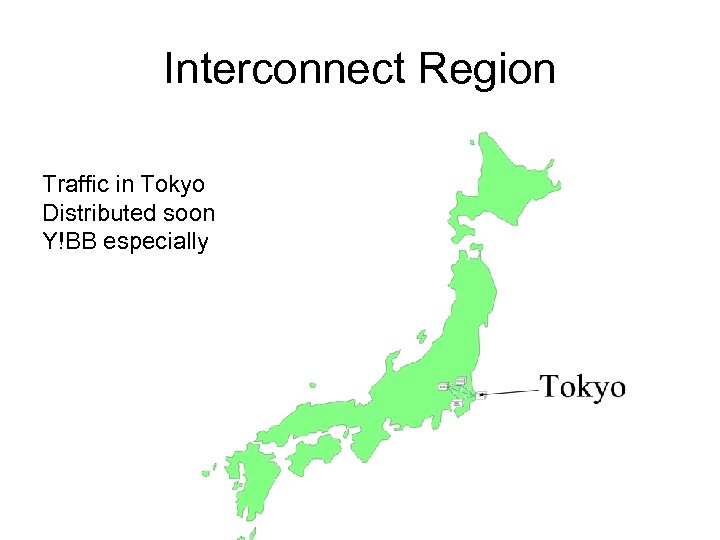
Interconnect Region Traffic in Tokyo Distributed soon Y!BB especially
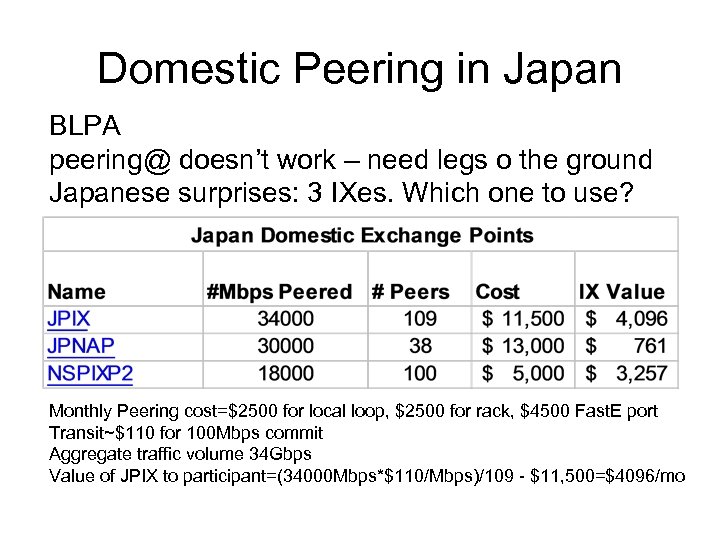
Domestic Peering in Japan BLPA peering@ doesn’t work – need legs o the ground Japanese surprises: 3 IXes. Which one to use? Monthly Peering cost=$2500 for local loop, $2500 for rack, $4500 Fast. E port Transit~$110 for 100 Mbps commit Aggregate traffic volume 34 Gbps Value of JPIX to participant=(34000 Mbps*$110/Mbps)/109 - $11, 500=$4096/mo
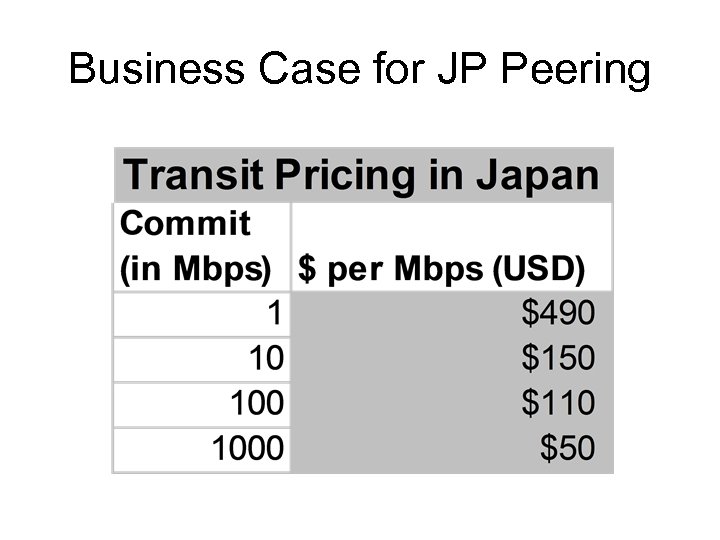
Business Case for JP Peering
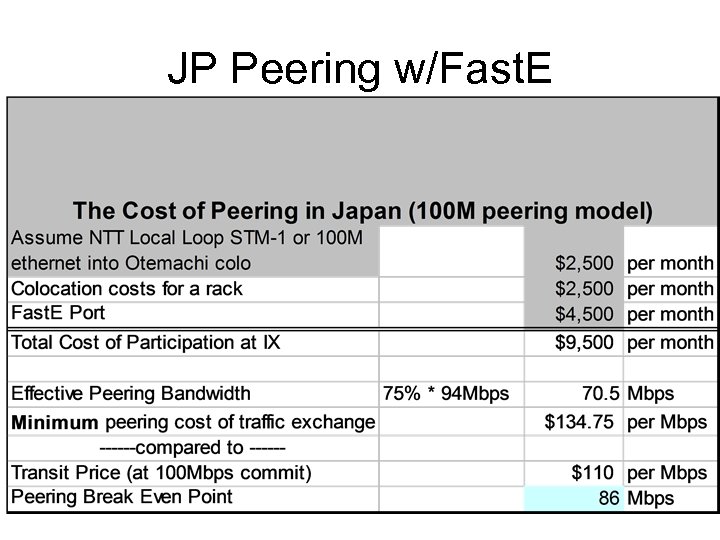
JP Peering w/Fast. E
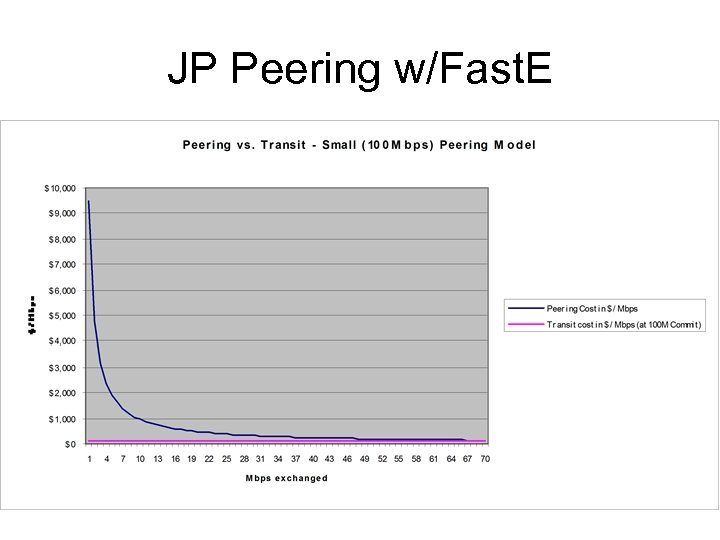
JP Peering w/Fast. E
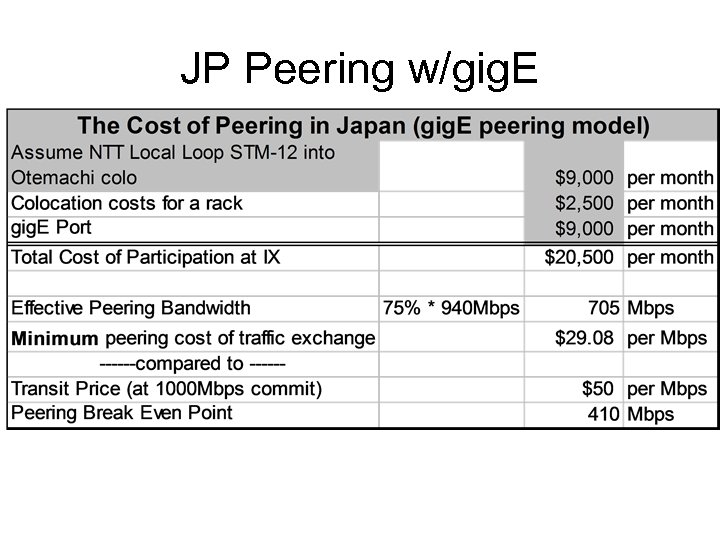
JP Peering w/gig. E
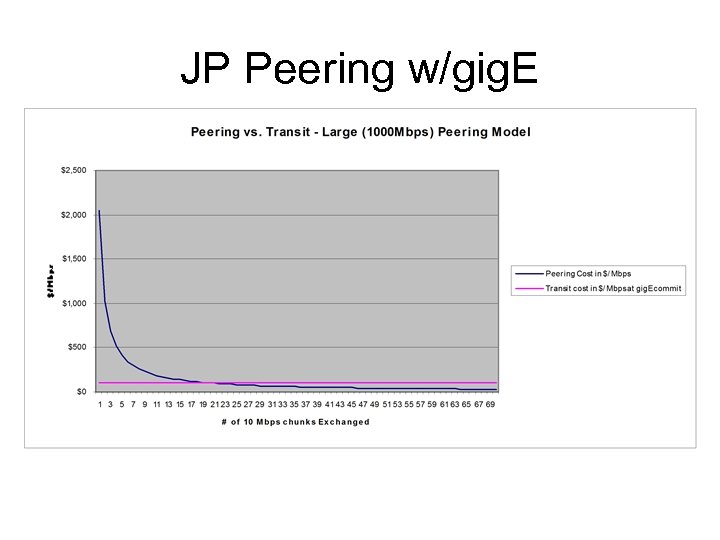
JP Peering w/gig. E
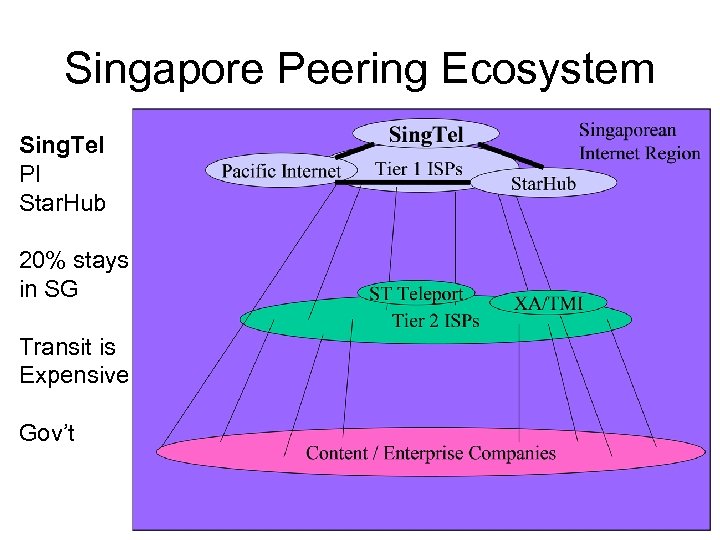
Singapore Peering Ecosystem Sing. Tel PI Star. Hub 20% stays in SG Transit is Expensive Gov’t
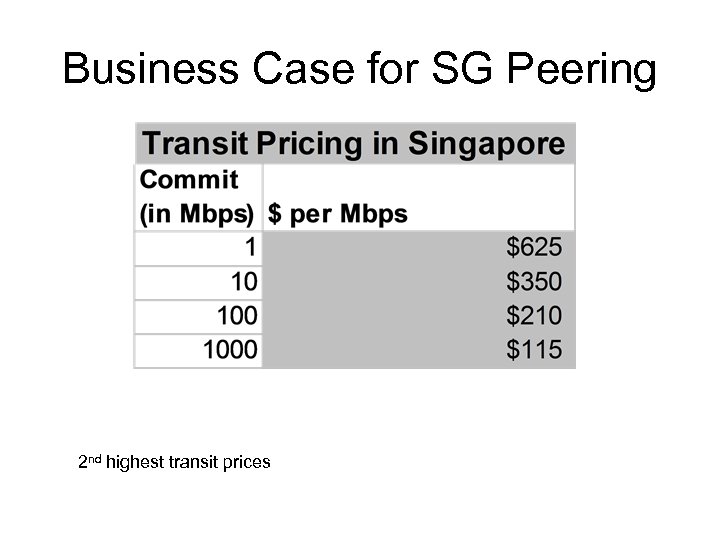
Business Case for SG Peering 2 nd highest transit prices
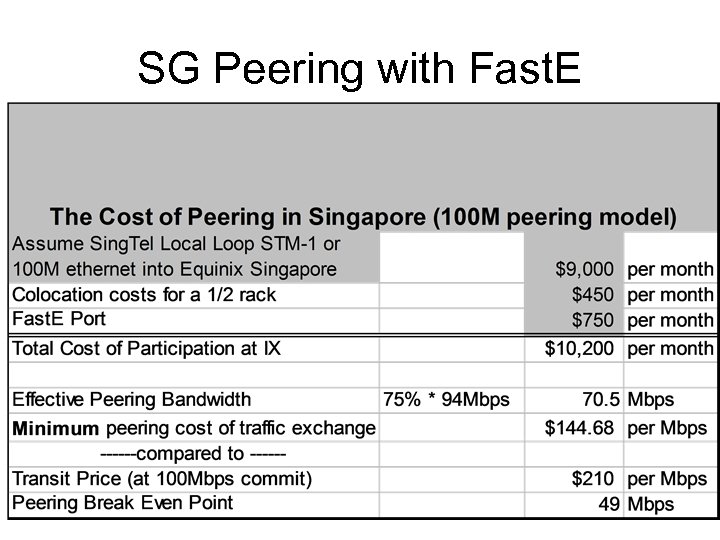
SG Peering with Fast. E
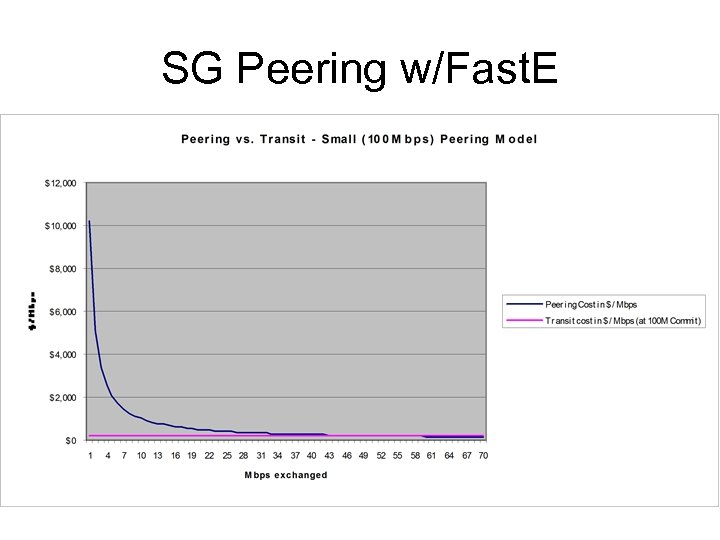
SG Peering w/Fast. E
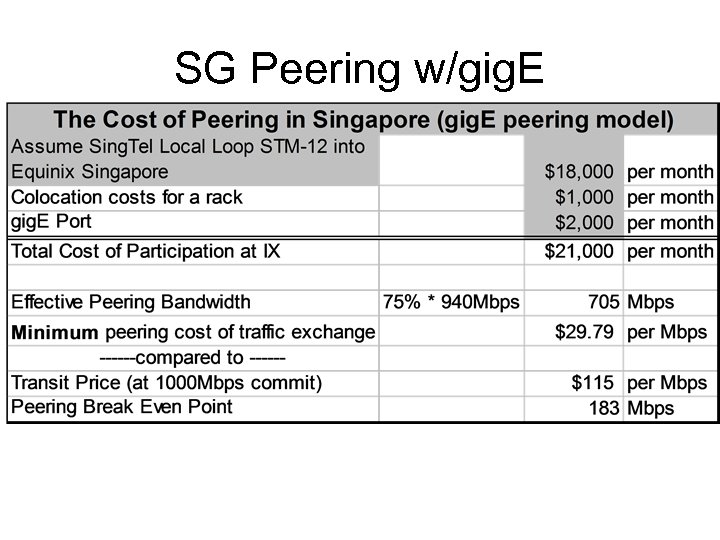
SG Peering w/gig. E
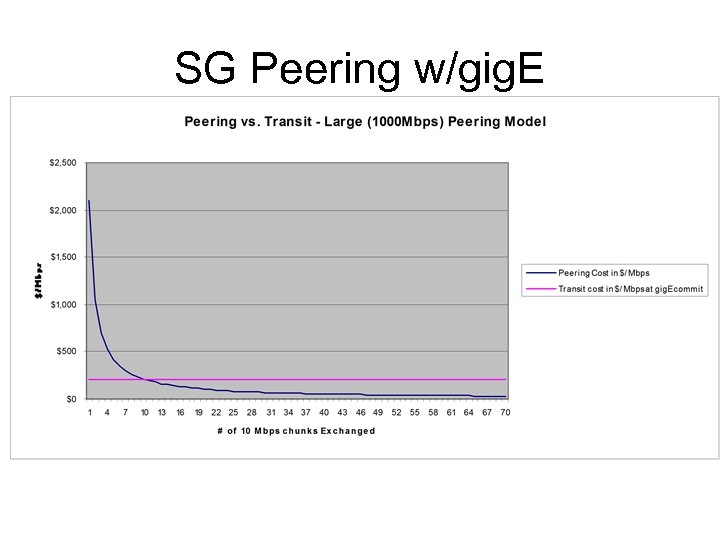
SG Peering w/gig. E
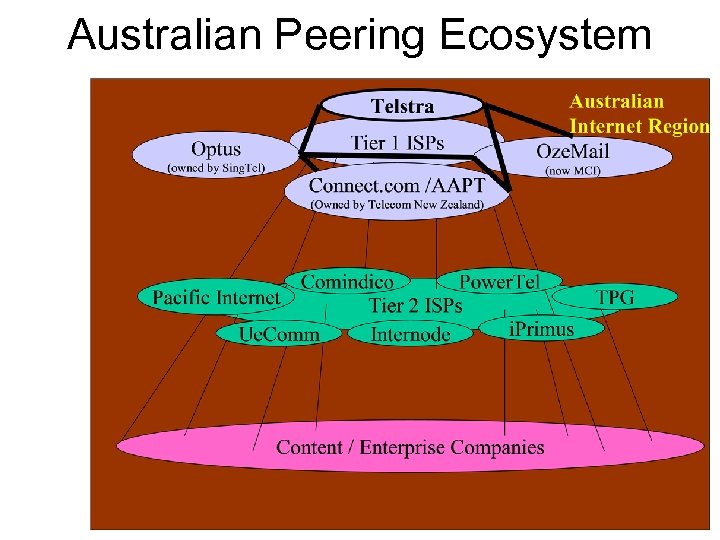
Australian Peering Ecosystem
Australian Peering Ecosystem • Only country to Regulate Peering • Restrictive Peering – Comindico Story • Local Loops Expensive in AU – Retail STM-1 (155 M) in Hong Kong $3000/mo – Retail 4 M Ethernet in Australia $3000/mo ternet • Relatively low traffic volume – 200 Mbps traffic between T 1 and T 2 • “Content that transcends the language barrier” disallowed
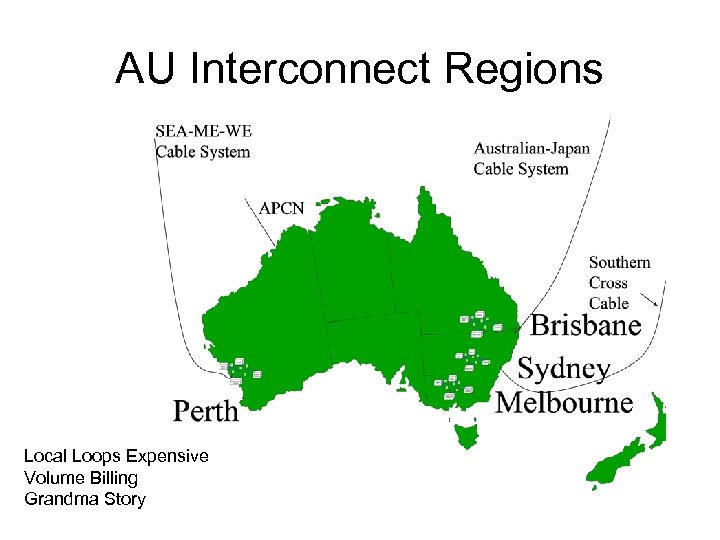
AU Interconnect Regions Local Loops Expensive Volume Billing Grandma Story
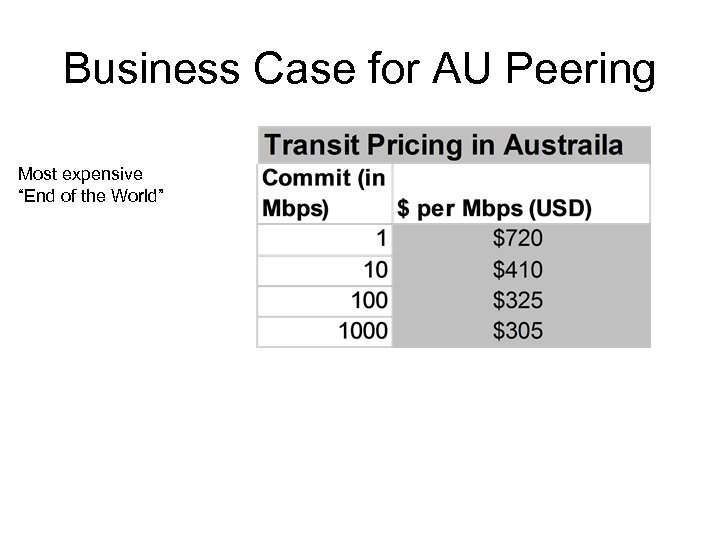
Business Case for AU Peering Most expensive “End of the World”
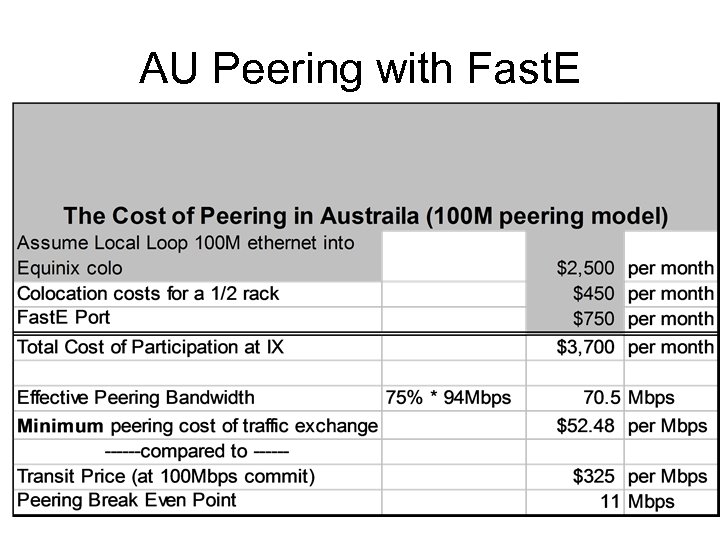
AU Peering with Fast. E
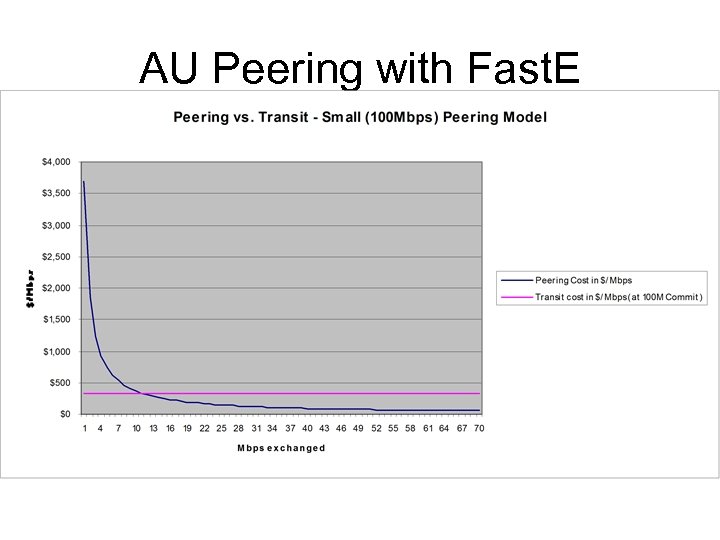
AU Peering with Fast. E
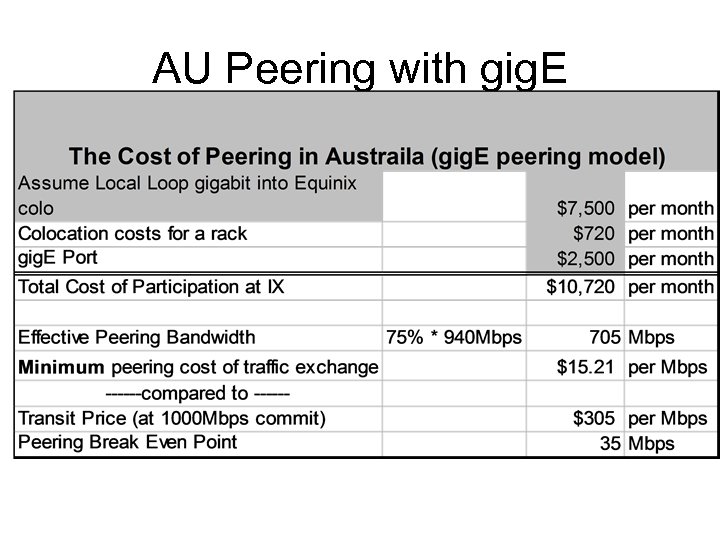
AU Peering with gig. E
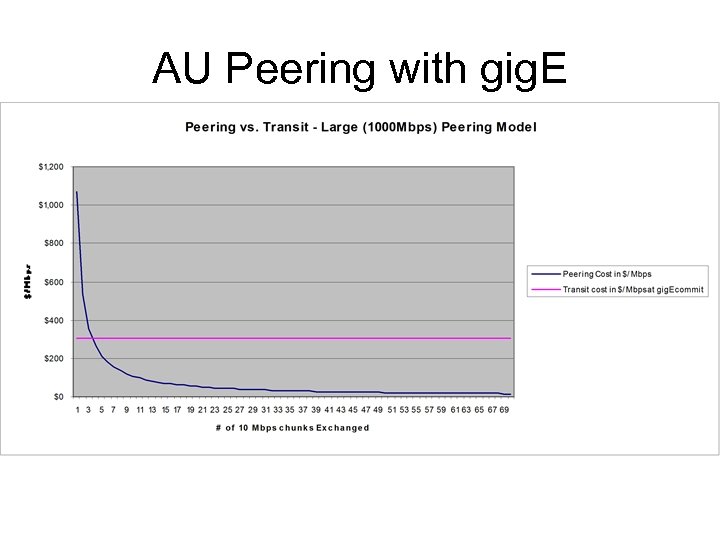
AU Peering with gig. E
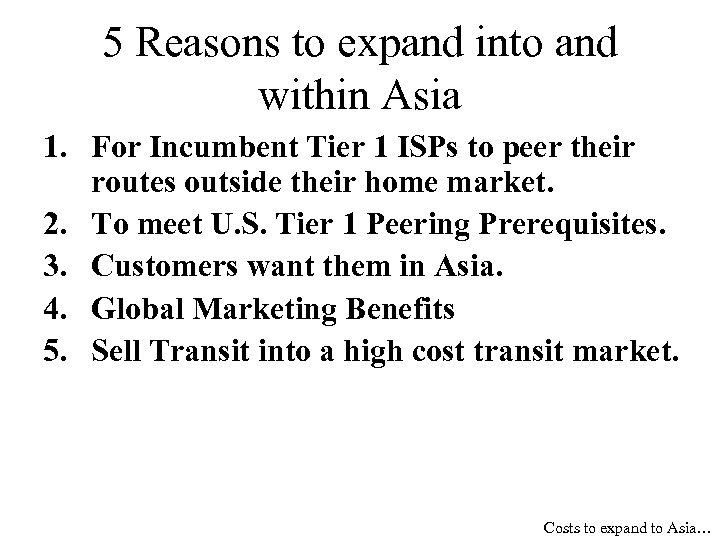
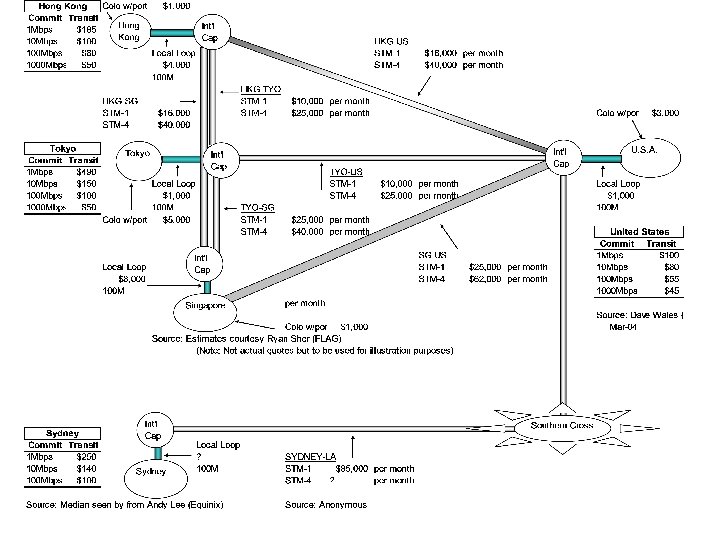
5 Reasons to expand into and within Asia 1. For Incumbent Tier 1 ISPs to peer their routes outside their home market. 2. To meet U. S. Tier 1 Peering Prerequisites. 3. Customers want them in Asia. 4. Global Marketing Benefits 5. Sell Transit into a high cost transit market. Costs to expand to Asia…
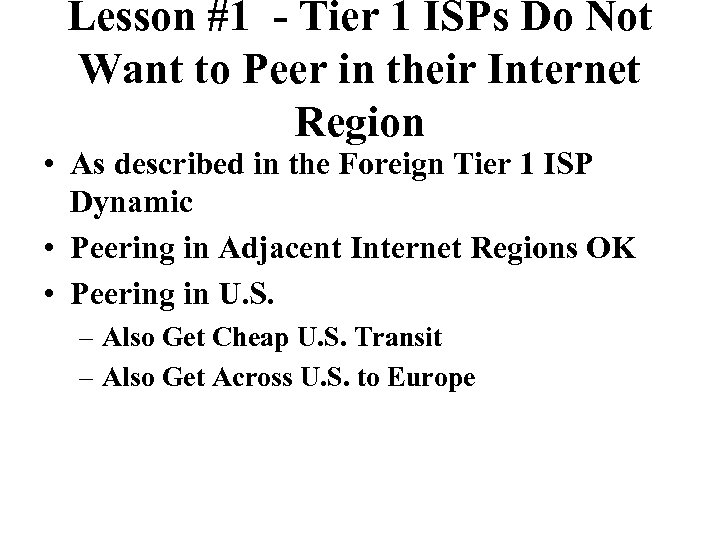
Lesson #1 - Tier 1 ISPs Do Not Want to Peer in their Internet Region • As described in the Foreign Tier 1 ISP Dynamic • Peering in Adjacent Internet Regions OK • Peering in U. S. – Also Get Cheap U. S. Transit – Also Get Across U. S. to Europe
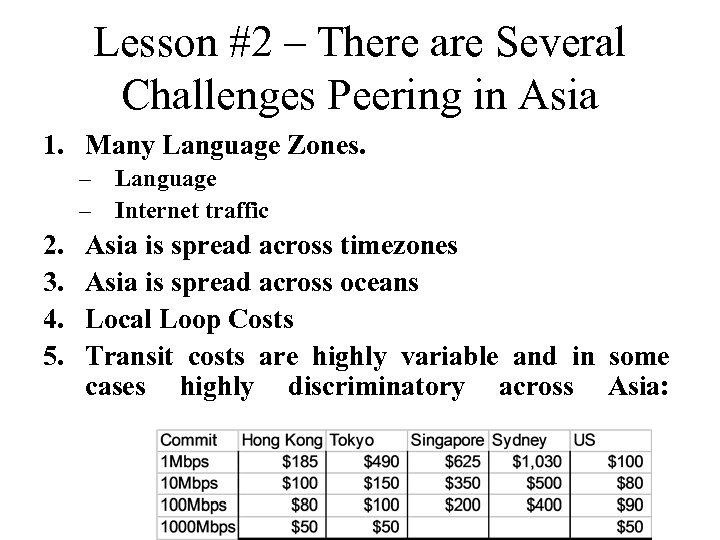
Lesson #2 – There are Several Challenges Peering in Asia 1. Many Language Zones. – Language – Internet traffic 2. 3. 4. 5. Asia is spread across timezones Asia is spread across oceans Local Loop Costs Transit costs are highly variable and in some cases highly discriminatory across Asia:
Lesson #3 – Some Creative Peering Deals • “…Peering iff Transport provided to HK where we will peer out-of-country…” • Peering w/transit purchase common • Peered traffic can not be announced back in to country • Can not peer with my customers
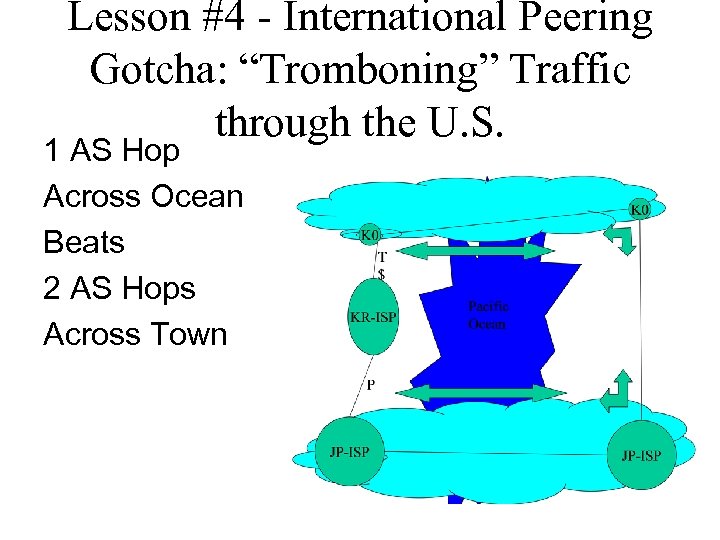
Lesson #4 - International Peering Gotcha: “Tromboning” Traffic through the U. S. 1 AS Hop Across Ocean Beats 2 AS Hops Across Town
Lesson #5 - Local Presence Required • • • Right Person Right Time Manage Time Zone Diff Manage Peering Socializing Like old England “Intermediary” Source: Nigel Titley (FLAG) And Erasmus Ng (T-Systems)
Lesson #6 - Separation of International and Domestic Peering • New Zealand – Separate pipes for Transit & Domestic Traffic • Transpacific VERY expensive • 80% traffic to/from U. S. • In Japan & Australia as well? Source: Joe Abley (ISC)
Lesson #7 – “Content that Transcends the Language Barrier” • Hosted content not allowed in many parts of Asia • Hosted overseas • Large volume of traffic • Affects peering and Int’l BW planning
Lesson #8 – No True Regional Content in Asia • Like South America • Few Asian countries host regional content • Contiguous language zones: – Hong Kong, Taiwan, China • Mostly, local eyeballs want local content • Japan: 80% traffic stays in Japan • Singapore: 80% traffic leaves Singapore
Lesson #9 – Content Peering in Asia Works • Microsoft – 100 M XP Updates – Only delivered over Peering links – Otherwise, overseas transit – Increases your 95 th percentile billables • Yahoo! – Motivated first by best customer experience – Deployed content locally – Peering broadly
Summary • • • Early Research International Peering Ecosystem Internet Regions Foreign Tier 1 ISP Peering Dynamic Capture Peering Coordinator Data Asia Vibrant and Leap Frogging U. S. in some ways • White Paper Available: Send e-mail to wbn@equinix. com
Скачать презентацию Asia Pacific Peering Guidebook v 1 6 William
39b8f80091c9c050049e9d8688d01c55.ppt