


 Скачать презентацию Asia Pacific Energy Research Centre Climate Change History
0fcee5cae72da40609b9516b3eacd6c5.ppt
- Количество слайдов: 33
 Asia Pacific Energy Research Centre Climate Change: History and Negotiation Lecture Series at Stanford University 24 January, 2005 Yonghun JUNG Ph. D Vice President Asia Pacific Energy Research Centre
 Contents Global warming Climate change Pros and cons of global warming History of negotiation Prospect for Kyoto Protocol
 What is Global Warming?
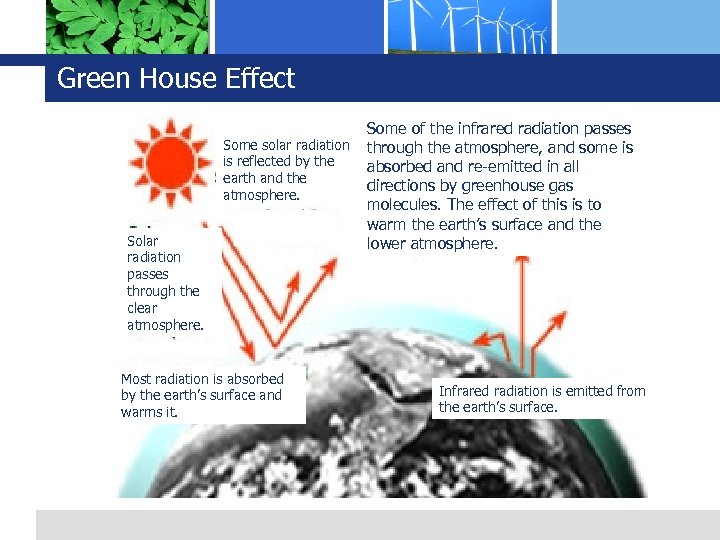 Green House Effect Solar radiation passes through the clear atmosphere. Some of the infrared radiation passes Some solar radiation through the atmosphere, and some is is reflected by the absorbed and re-emitted in all earth and the directions by greenhouse gas atmosphere. molecules. The effect of this is to warm the earth’s surface and the lower atmosphere. Most radiation is absorbed by the earth’s surface and warms it. Infrared radiation is emitted from the earth’s surface.
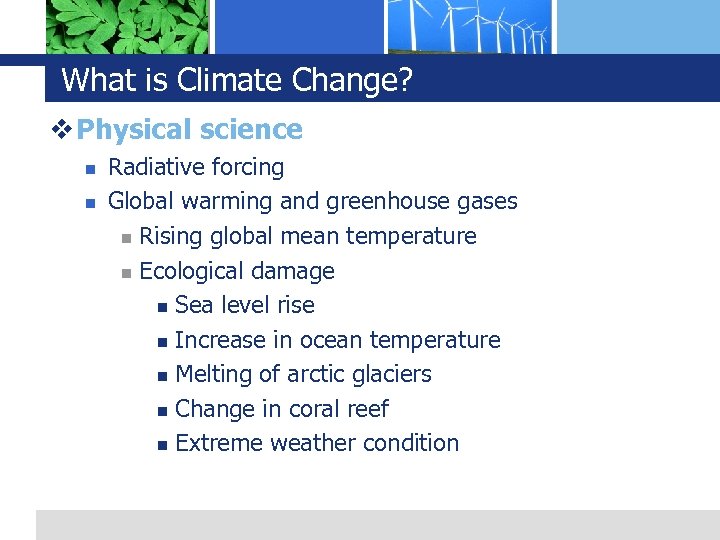 What is Climate Change? v Physical science n n Radiative forcing Global warming and greenhouse gases n Rising global mean temperature n Ecological damage n Sea level rise n Increase in ocean temperature n Melting of arctic glaciers n Change in coral reef n Extreme weather condition
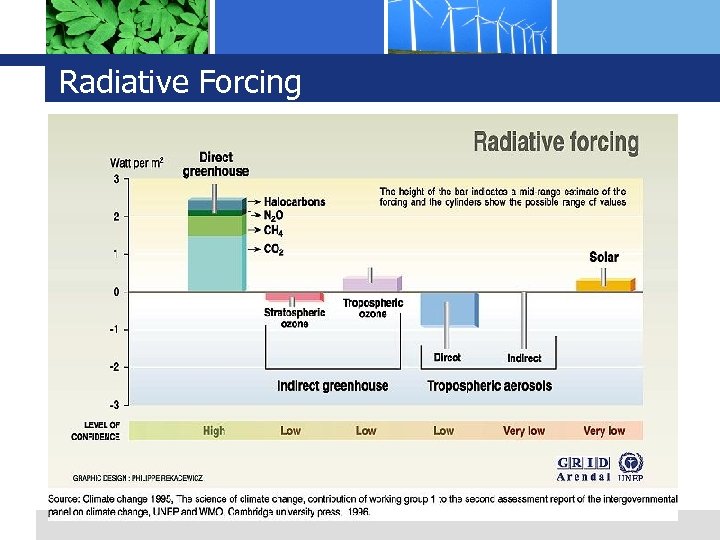 Radiative Forcing
 Global Mean Temperature
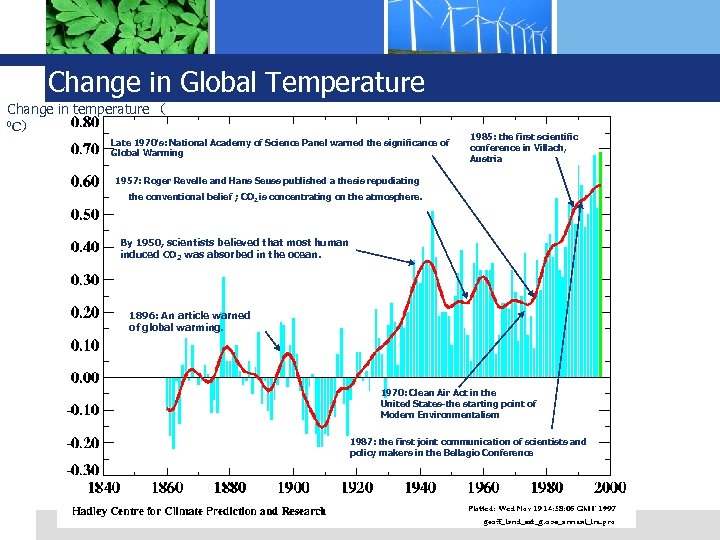 Change in Global Temperature Change in temperature ( 0 C) Late 1970’s: National Academy of Science Panel warned the significance of Global Warming 1985: the first scientific conference in Villach, Austria 1957: Roger Revelle and Hans Seuss published a thesis repudiating the conventional belief ; CO 2 is concentrating on the atmosphere. By 1950, scientists believed that most human induced CO 2 was absorbed in the ocean. 1896: An article warned of global warming. 1970: Clean Air Act in the United States-the starting point of Modern Environmentalism 1987: the first joint communication of scientists and policy makers in the Bellagio Conference
 On Climate Change science
 Some negative views on climate change science v There is no credible scientific evidence that the earth is warming. The temperature record from weather stations is misleading because the record is influenced by local conditions rather than global. n Sea level measurements are biased. Stations for measuring sea levels are located close to ports, for which local factors give a greater impact. n IPCC’s future projections are “scenarios”, which is based on experts’ judgment and knowledge, rather than scientific evidence. n Gray (2002) says that no model has ever predicted future climate sequence. n IPCC reports have not assessed increased GHG emissions and their effects on climate. n
 Origin of the problem v Economic development/growth n n Derived demand for energy consumption Changes in lifestyle – political and social issues v “Tragedy of Commons” If property rights are well defined there will be no problem with production externalities, but otherwise the outcome of economic interaction will undoubtedly involve inefficiency n
 History of International Negotiations
 History 1987: Toronto conference (The World Commission on Environment and Development) - Reduce CO 2 emission 20% below the 1988 level in 2005 1988: Worst drought and record high temperature in the US 1988: Establishment of IPCC (WMO and UNEP) 1989: Norwijk Conference: No regret policy, soft target, CO 2 equivalent concept. 1990: IPCC First Assessment Report - the global mean temperature would rise by 0. 3 C every 10 years. Bergen Declaration: Stablization at 2000 UN resolution 45/212 - Establishment of INC (Intergovernmental Negotiating Committee) 1992: Rio Summit: UN Framework Convention on Climate Change adopted 1995: COP 1 at Berlin, Germany - Berlin Mandate - strictly for the North 1997: COP 3 at Kyoto - Kyoto Protocol 1998: COP 4 at Buenos Aires - Buenos Aires Plan of Action adopted 1999: COP 5 at Bonn 2000: COP 6 at the Hague – No agreement was made 2001: COP 6 bis at Bonn – Bonn Agreement 2001: COP 7 at Marrakech – Marrakech Accord 2002: COP 8 at New Delhi – Dehli Declaration adopted 2003: COP 9 at Milan 2004: COP 10 at Buenos Aires
 UNFCCC v Rio Summit in 1992 n n n Objective: “Stabilization of GHG concentration” Principles n 1)“Common but differentiated responsibility with respective capabilities” n 2)”Precautionary measures” n 3)”sustainable development” Commitment: n “aim of returning , …. . , to 1990 levels”, ”by the end of the present decade” - soft target for Annex 1 parties n Inventory and reporting: National communication for All parties
 Country Positions at AGBM 8
 COP 3: Kyoto Meeting v Emission reduction targets for Annex B Parties n Annex B Parties agreed to commitments to reduce overall remissions of 6 GHG gasses by at least 5 percent below 1990 levels during the first commitment period (2008 -2012) v Kyoto Protocol n Commitment on emissions n Rules governing compliance n Procedural rules
 Marrakech Accord: Major Outcomes from COP 7 v Kyoto Mechanisms: Decisions were made on the operational details of the Mechanisms. Eligibility on the use of the Mechanisms n Fungibility n Details of banking n Conditions for issuing ERU under Joint Implementation n Operational details of CDM project implementation such as CER, Operational Entities, Additionality n v Compliance: Members of COP agreed that legal form relating to compliance will be decided at the COP/MOP. v Capacity Building: Decisions were made on the funding scheme for assisting the countries vulnerable to the impacts from climate change.
 World Summit on Sustainable Development (WSSD) in Johannesburg v The Summit produced a declaration reaffirming the principles of the Rio Declaration and action oriented plan of implementation. Over 220 partnerships (with $235 million in resources) were identified in advance of the Summit and around 60 partnerships were announced during the Summit by a variety of countries. n v On energy, following items were identified as important areas to be improved. Renewable energy Diversify energy supply and substantially increase the global share of renewable energy sources in order to increase its contribution to total energy supply. n Access to Energy Improve access to reliable, affordable, economically viable, socially acceptable and environmentally sound energy services and resources, sufficient to achieve the Millennium Development Goals, including the goal of halving the proportion of people in poverty by 2015. n Energy Markets Remove market distortions including the restructuring of taxes and the phasing out of harmful subsidies. n Support efforts to improve the functioning, transparency and information about energy markets with respect to both supply and demand, with the aim of achieving greater stability and to ensure consumer access to energy services. n Energy efficiency Establish domestic programs for energy efficiency with the support of the international community. Accelerate the development and dissemination of energy efficiency and energy conservation technologies, including the promotion of research and development. n
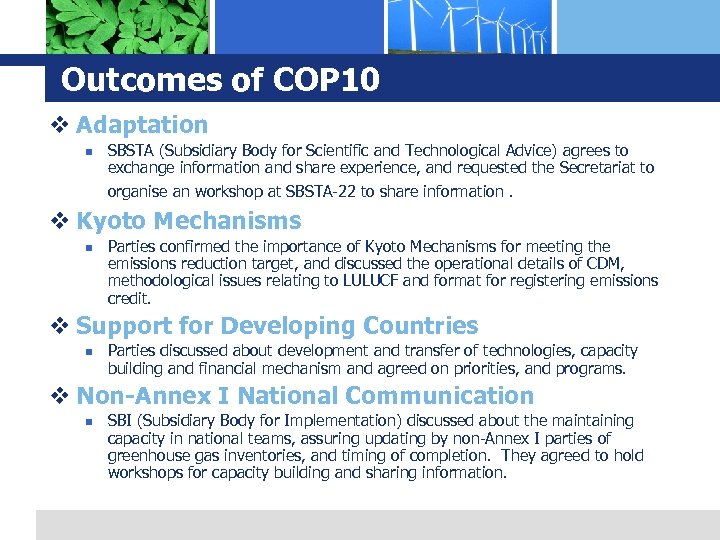 Outcomes of COP 10 v Adaptation n SBSTA (Subsidiary Body for Scientific and Technological Advice) agrees to exchange information and share experience, and requested the Secretariat to organise an workshop at SBSTA-22 to share information. v Kyoto Mechanisms n Parties confirmed the importance of Kyoto Mechanisms for meeting the emissions reduction target, and discussed the operational details of CDM, methodological issues relating to LULUCF and format for registering emissions credit. v Support for Developing Countries n Parties discussed about development and transfer of technologies, capacity building and financial mechanism and agreed on priorities, and programs. v Non-Annex I National Communication n SBI (Subsidiary Body for Implementation) discussed about the maintaining capacity in national teams, assuring updating by non-Annex I parties of greenhouse gas inventories, and timing of completion. They agreed to hold workshops for capacity building and sharing information.
 Prospect for Kyoto Protocol
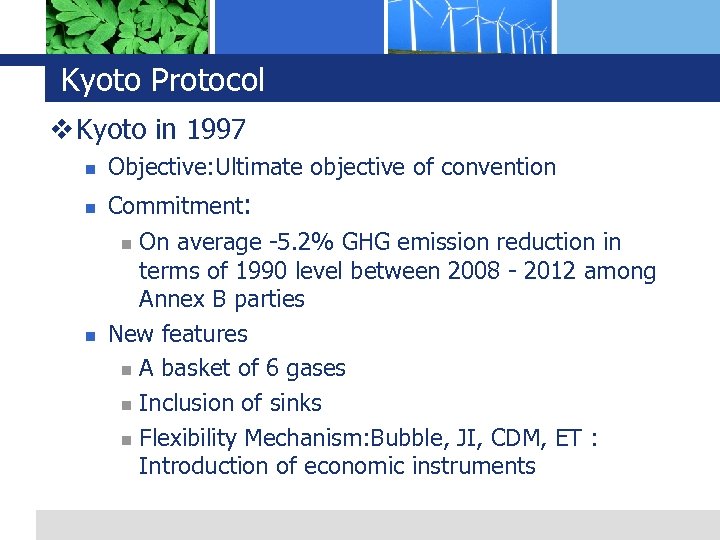 Kyoto Protocol v Kyoto in 1997 n n n Objective: Ultimate objective of convention Commitment: n On average -5. 2% GHG emission reduction in terms of 1990 level between 2008 - 2012 among Annex B parties New features n A basket of 6 gases n Inclusion of sinks n Flexibility Mechanism: Bubble, JI, CDM, ET : Introduction of economic instruments
 Required Reduction to meet the target
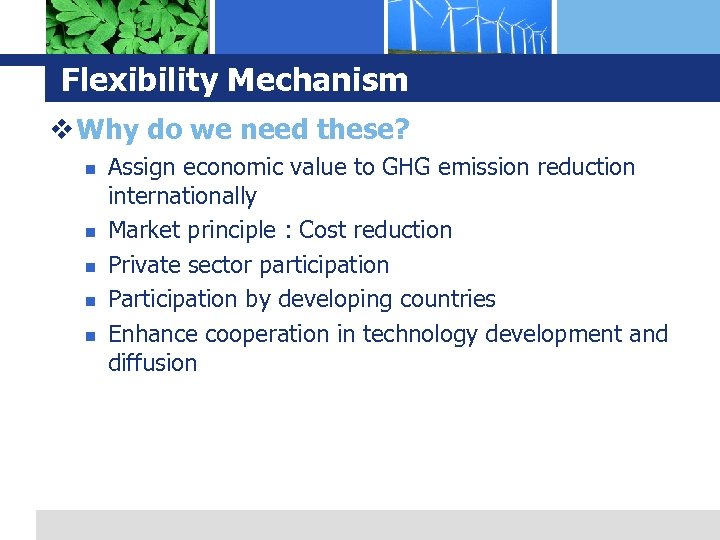 Flexibility Mechanism v Why do we need these? n n n Assign economic value to GHG emission reduction internationally Market principle : Cost reduction Private sector participation Participation by developing countries Enhance cooperation in technology development and diffusion
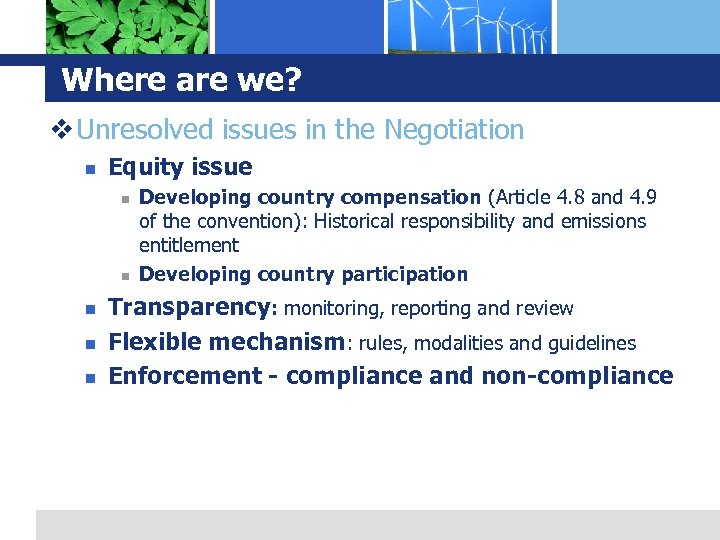 Where are we? v Unresolved issues in the Negotiation n Equity issue n n n Developing country compensation (Article 4. 8 and 4. 9 of the convention): Historical responsibility and emissions entitlement Developing country participation Transparency: monitoring, reporting and review Flexible mechanism: rules, modalities and guidelines Enforcement - compliance and non-compliance
 Prospect for Kyoto Protocol v Negotiation is not easy: there is no “rule of procedure” Only consensus is available v Too many issues are at stake - Long list of work plan with conflicting issues n n Bleak Future of Meeting the Target Flexibility Mechanisms n n Joseph F. Coates Developing Country Issues n n n “Nothing happens unless the issue becomes institutionalized” Evolution Voluntary Commitment Absence of US n Trading partner
 CO 2 Emissions from Energy Consumption: Selected Annex B countries (Source) APEC data is from APERC (2002), “APEC Energy Demand Supply Outlook 2002”, France, Germany and UK data is from EIA (2004), “International Energy Outlook 2004” and EU data is from IEA (2003), “World Energy Outlook”.
 Bleak Future of Meeting the Target (Source) APEC data is from APERC (2002), “APEC Energy Demand Supply Outlook 2002”, France, Germany and UK data is from EIA (2004), “International Energy Outlook 2004” and EU data is from IEA (2003), “World Energy Outlook”.
 Will “Hot Air” be Available? (Source) Russian Energy Ministry, IEA, APERC
 Implementation CDM Project in Developing Countries (A Summary from Dr. Sathye’s Paper) v Impact of climate change can be mitigated through cost effective options such as energy efficiency and fossil fuel substitution options in the energy sector. Greater potential for GHG emissions reduction for improving energy efficiency project for coal-fired power plants. n v However, many market barriers prevent adoption of cost effective options. Project Level: High first cost of equipment, lack of capability to monitor project. n Sector Level: Presence of subsidies. n Macro Level: Barrier foreign investment in energy sector, High tariffs on import of energy technology. n v Removal of barriers will improve developing countries’ access to financing and advanced technology.
 Impact of Kyoto Protocol: Japan v APERC’s projection on CO 2 emissions from Japan’s energy sector in 2010 v Assuming that price of carbon will be USD 20/ton n APERC estimates that Japan would have to pay 1. 4 billion USD (or 3. 8 million USD/day) in 2010 for their carbon emissions reduction. v Due to the rise in oil price, Japan pays roughly extra 90 million USD/day for their crude oil imports. n Price of crude oil: 30$/bbl → 48$/bbl: difference 18$/bbl v A question is raised. n Carbon price vs Fuel Price Differential
 US Perspective v Multilateral Negotiation vs Bilateral Negotiation US prefers bilateral negotiation n US has not ratified some international environmental conventions that had entered into force. n Basel Convention on the Control of Transboundary Movements of Hazardous Wastes and Their Disposal n Convention on Biological Diversity n Kyoto Protocol to the United Nations Framework Convention on Climate Change n v US initiatives on environment n Alternative to the Kyoto Protocol v US is not “one country”. n Coordination among the states would be impossible.
 US Initiatives: Alternative to the Kyoto Protocol v Climate Change Research Initiative in 2001 Promotes a vision focused on the effective use of scientific knowledge in policy and management decisions and evaluation of management strategies and choices. n v National Climate Change Technology Initiative in 2001 Develops a science based climate change policy and fund research on “breakthrough technologies” that would help meet the long-run climate change challenges n v Clear Skies Initiative in February 2002 The Initiative calls for significant reductions in emissions of various pollutants (mercury, nitrogen oxide, sulfur dioxide) and the reduction of the greenhouse gas intensity of the US economy by 18 percent between 2002 and 2012. n
 Contact information Jung@aperc. ieej. or. jp www. ieej. or. jp/aperc