


 Скачать презентацию Aseptic Non-Union Aseptic Non Union AOE AO
1fa5dfa9939b646b0f1d415a87442742.ppt
- Количество слайдов: 129
 Aseptic Non-Union Aseptic Non Union AOE
 AO Principles Course Dr. Enrique Queipo de Llano Hospital Universitario de Málaga Aseptic Non Union AOE
 Definition l No bone healing in the normal time l Usually 6 a 8 months Aseptic Non Union AOE
 Etiology l Do not blame the osteoblasts (Watson Jones). l Fractures have a spontaneous tendency to heal. (Merle D’Aubigne). l Delayed or non-union is often multifactorial in nature. Aseptic Non Union AOE
 Etiology l Disturbed vascularity and instability are the most important factors leading to a non-union. Aseptic Non Union AOE
 Etiology (Vascularisation) l Biological âCarpal scaphoid âNeck of the femur âTalus âDevitalized fragments Aseptic Non Union AOE
 Etiology (Instability) l Iatrogenic âInsufficient orthopaedic treatment âIncorrect osteosynthesis (unstable) Aseptic Non Union AOE
 Conditions for a normal bone healing Orthopaedic treatment Good reduction l Contact between fragments l Strict immobilization l Aseptic Non Union AOE
 Conditions for a normal bone healing Surgical treatment Anatomic reduction of articular fractures l Good alignment of diaphyseal fractures l Stable osteosynthesis l Absolute asepsis l Aseptic Non Union AOE
 Non compliant patient l The care plan has to be compatible with the patient’s personality and life style. l Have to be controlled: â Inappropriate weight bearing â Smoking habit â Improper diet â Other shortcomings in behaviour Aseptic Non Union AOE
 Symptoms Abnormal mobility l Abnormal mobility cannot be seen: âWhen there is an Internal Fixation âIntramedullary nail âDense fibrous callus l Pain and Limp l âA healed fracture does not hurt Aseptic Non Union AOE
 Radiology l Sometimes difficult to see on the X-Rays l Reactive callus = Mechanical instability Slight instability can be positive Aseptic Non Union AOE
 Delayed union l In delayed union there are clinical and radiological signs of prolonged fracture healing l It is important to establish the diagnosis â Fracture instability â Implant mobilization l To act to achieve a rapid bone healing Aseptic Non Union AOE
 Judet-Weber classification A. Vital (Hypervascular) â B. With biological reaction capacity Avital (Avascular) â Without biological reaction capacity Aseptic Non Union AOE
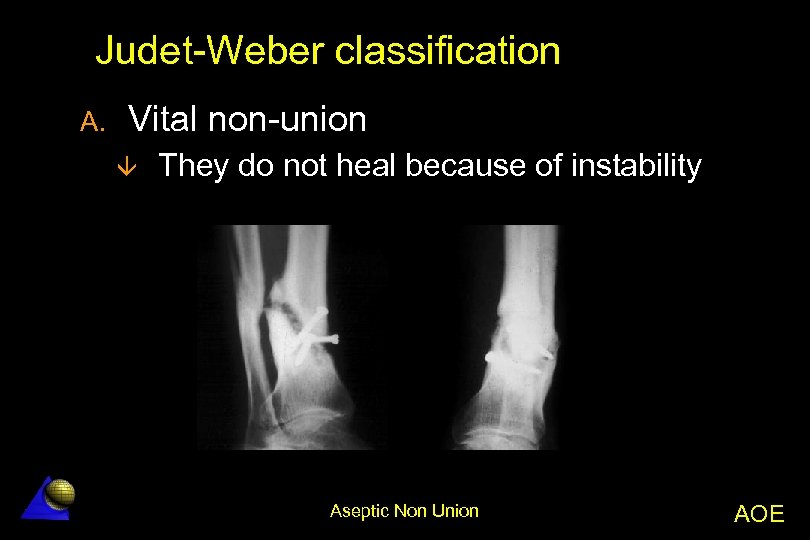 Judet-Weber classification A. Vital non-union â They do not heal because of instability Aseptic Non Union AOE
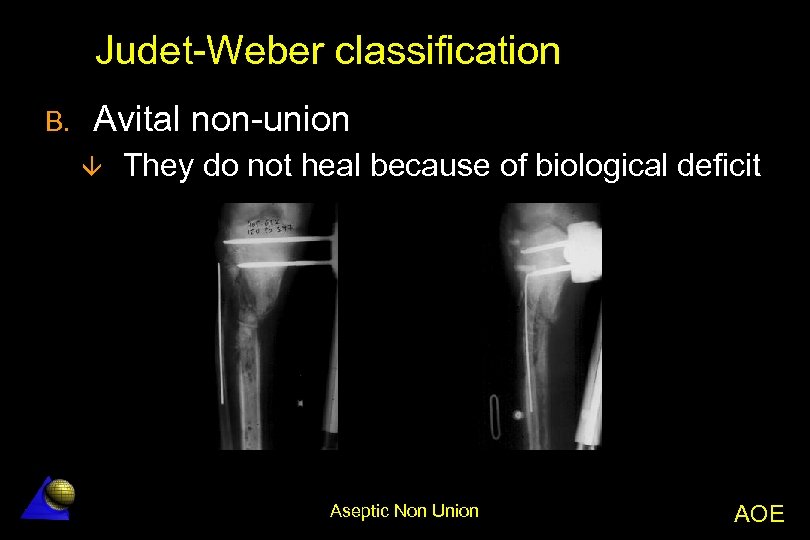 Judet-Weber classification B. Avital non-union â They do not heal because of biological deficit Aseptic Non Union AOE
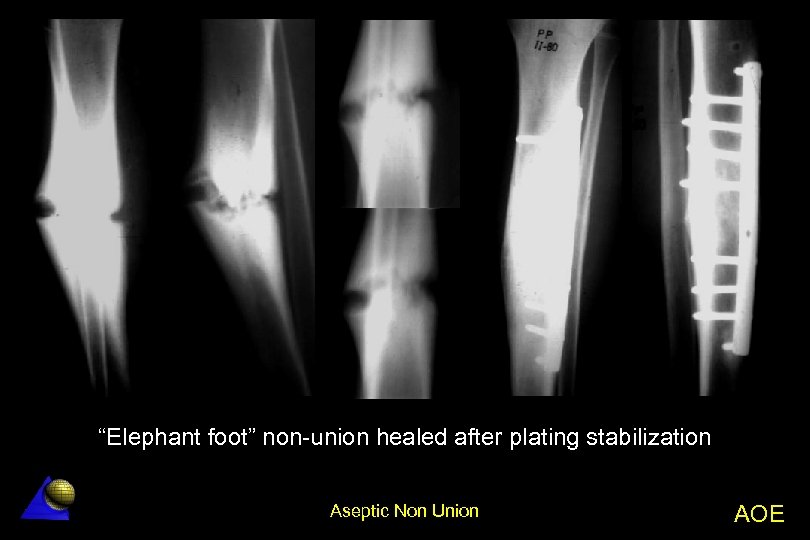
 Weber classification A. Vital I. Hypertrophic non-union (elephant foot) II. Hypertrophic non-union (horse hoof) III. Atrophic non-union (without callus) Aseptic Non Union AOE
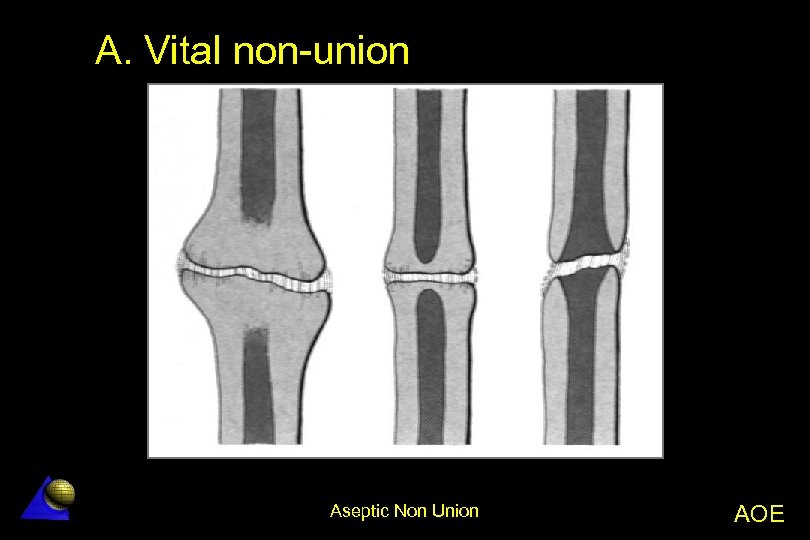 A. Vital non-union Aseptic Non Union AOE
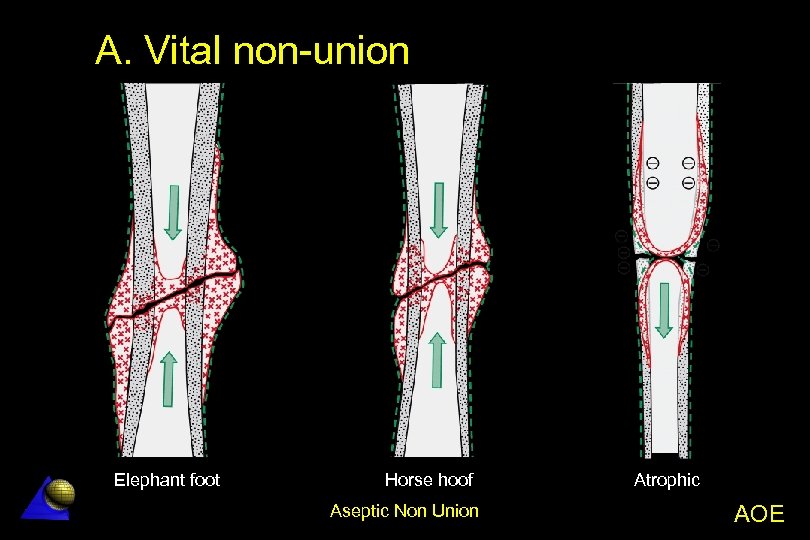 A. Vital non-union Elephant foot Horse hoof Aseptic Non Union Atrophic AOE
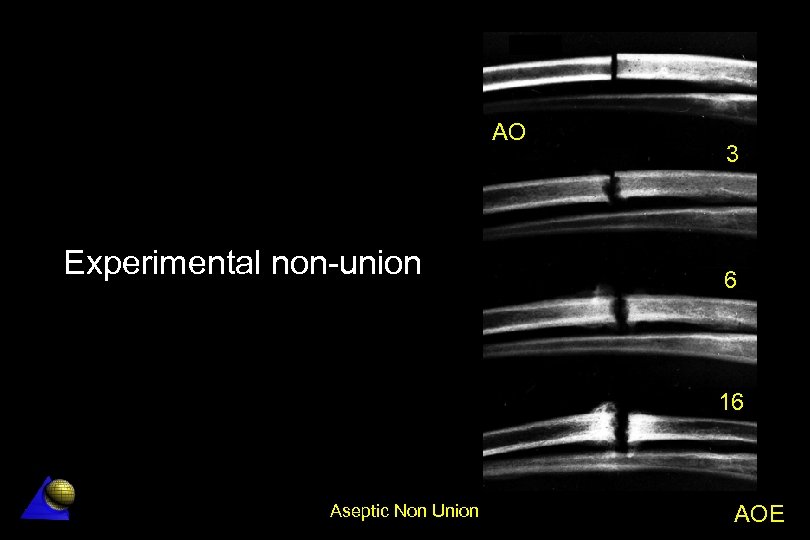
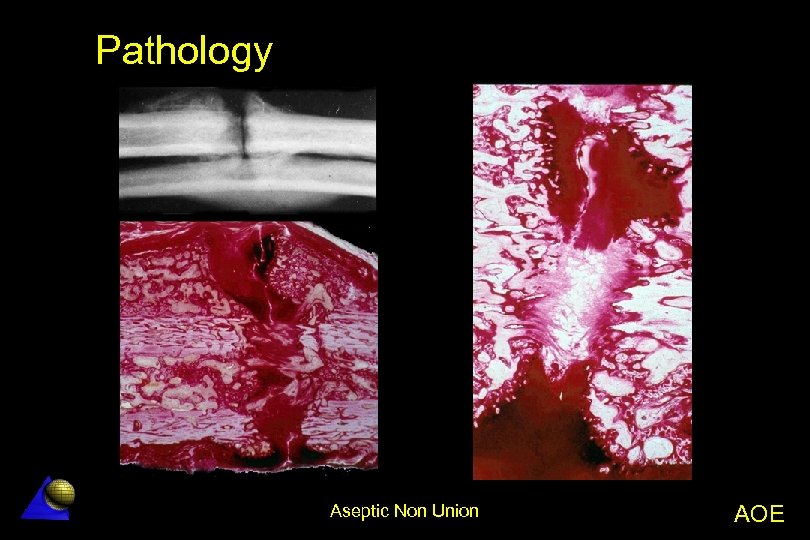
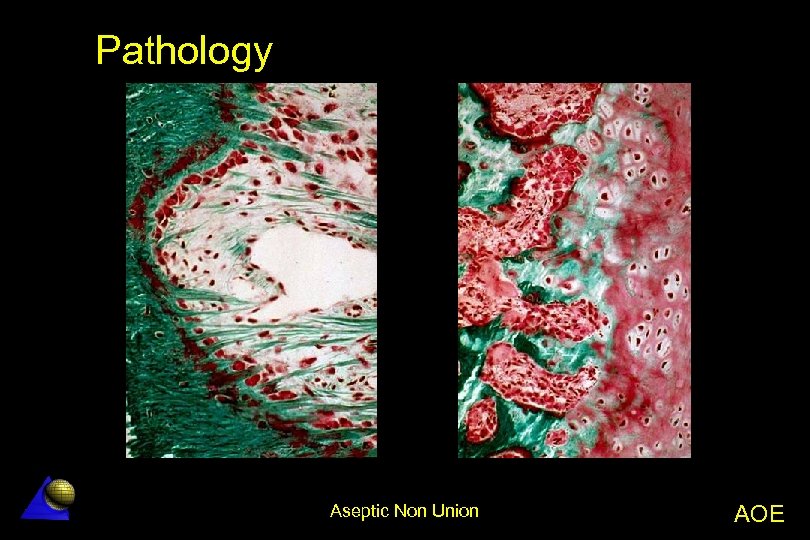
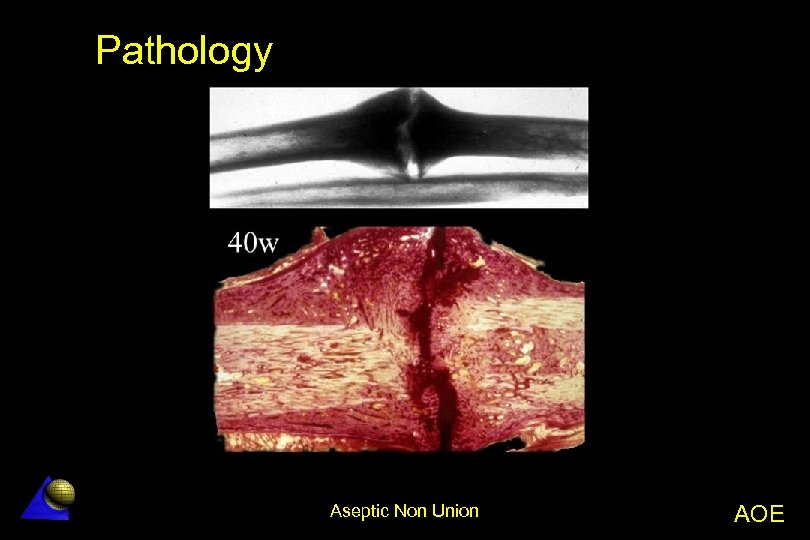
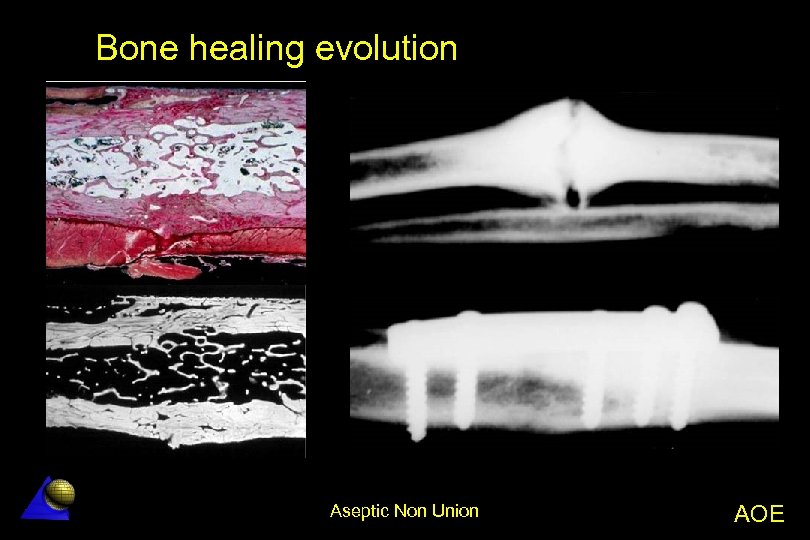
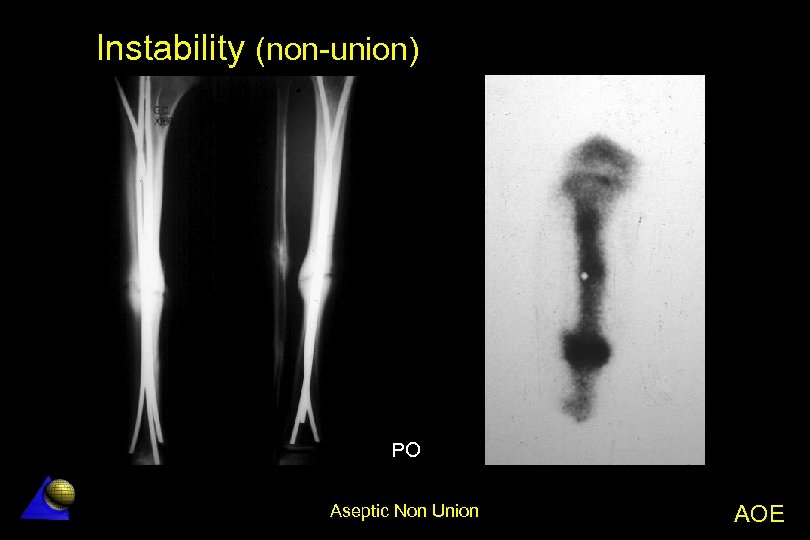
 Hypertrophic non-union l Hypertrophic non-union is frequently localized in the lower extremities. l Its development largely depends on an impaired mechanical stability. Aseptic Non Union AOE
 AO Experimental non-union 3 6 16 Aseptic Non Union AOE
 Pathology Aseptic Non Union AOE
 Pathology Aseptic Non Union AOE
 Pathology Aseptic Non Union AOE
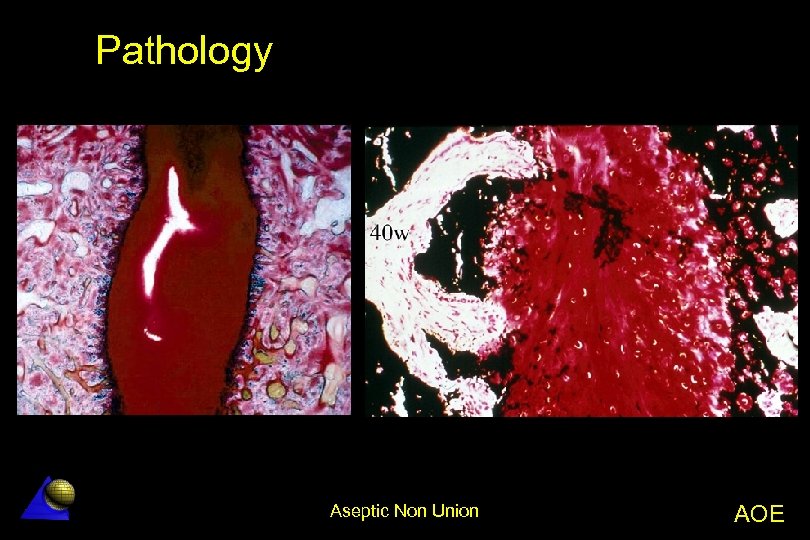 Pathology Aseptic Non Union AOE
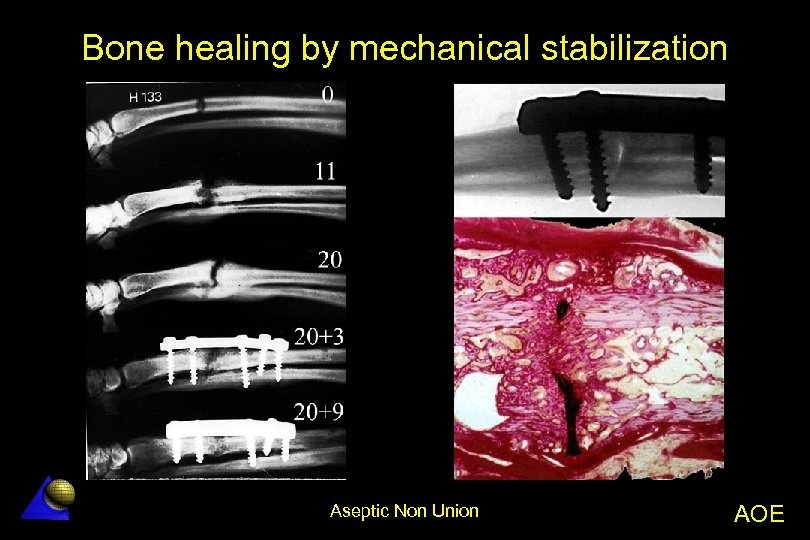 Bone healing by mechanical stabilization Aseptic Non Union AOE
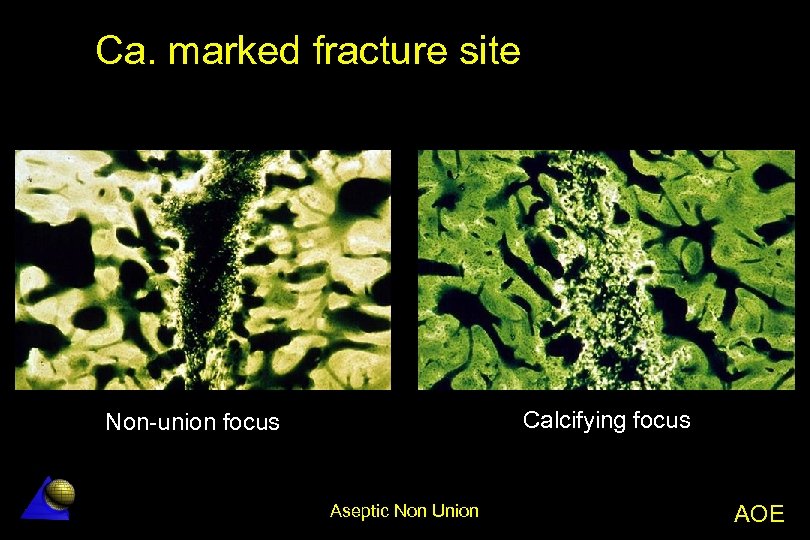 Ca. marked fracture site Calcifying focus Non-union focus Aseptic Non Union AOE
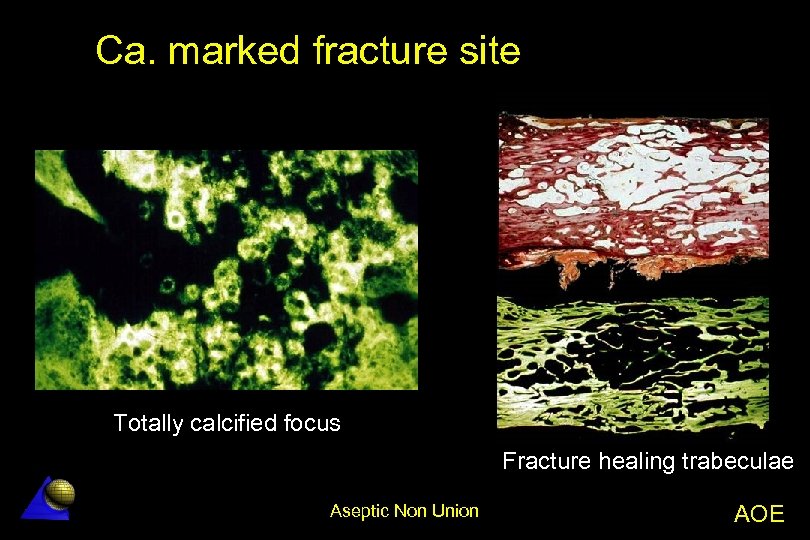 Ca. marked fracture site Totally calcified focus Fracture healing trabeculae Aseptic Non Union AOE
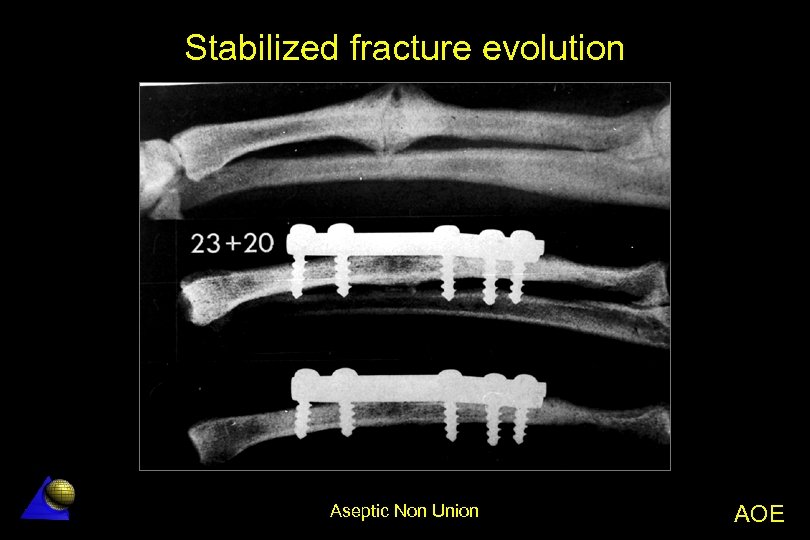
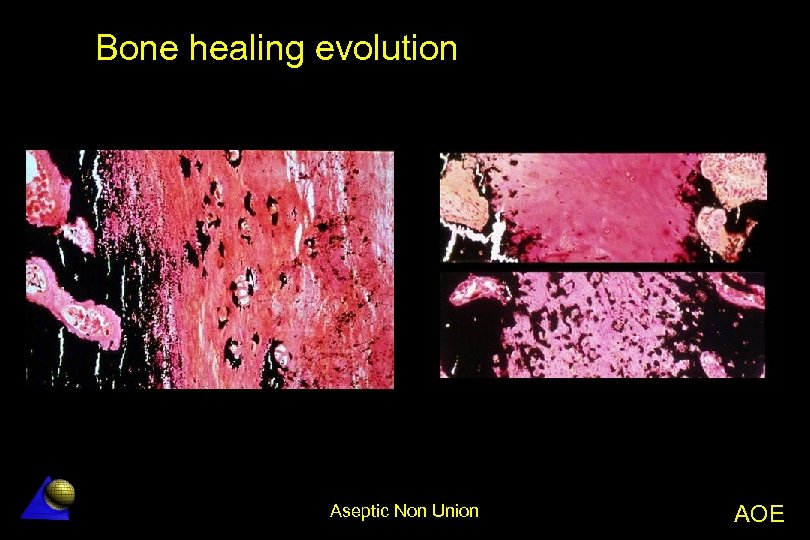
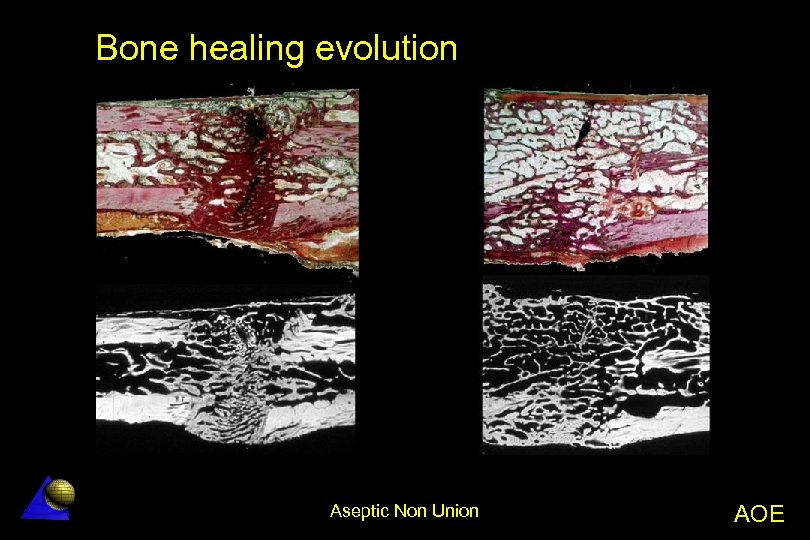
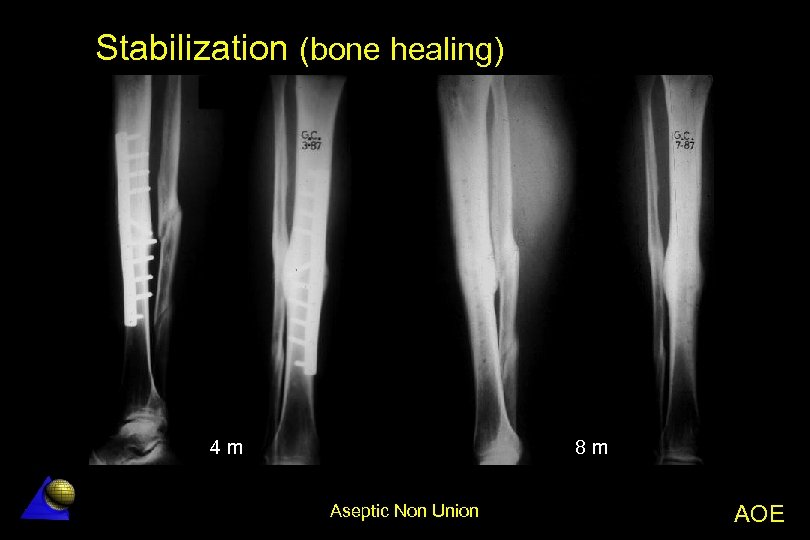
 Stabilized fracture evolution l Mechanical stability allows the fibrous cartilage to calcify and finally ossify after vascular penetration. l Resection of an hypertrophic non-union must be regarded as an error. Aseptic Non Union AOE
 Stabilized fracture evolution Aseptic Non Union AOE
 Bone healing evolution Aseptic Non Union AOE
 Bone healing evolution Aseptic Non Union AOE
 Bone healing evolution Aseptic Non Union AOE
 Instability (non-union) PO Aseptic Non Union AOE
 Stabilization (bone healing) 8 m 4 m Aseptic Non Union AOE
 “Elephant foot” non-union healed after plating stabilization Aseptic Non Union AOE
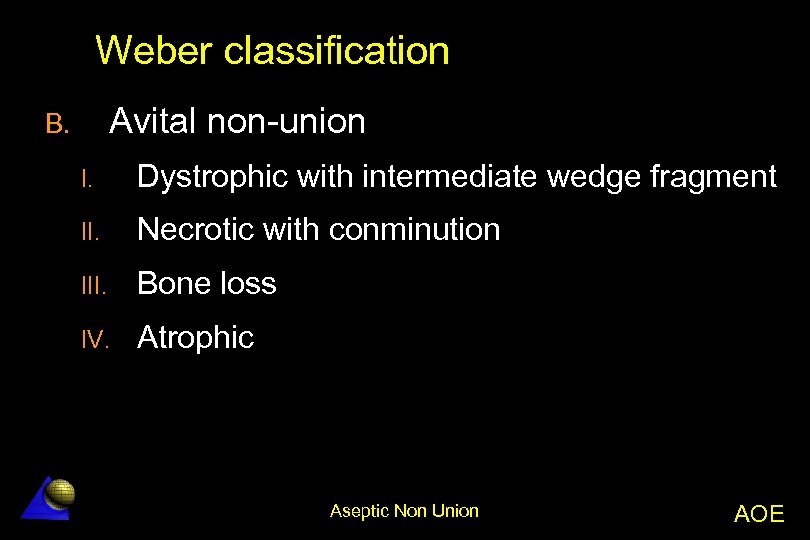 Weber classification Avital non-union B. I. Dystrophic with intermediate wedge fragment II. Necrotic with conminution III. Bone loss IV. Atrophic Aseptic Non Union AOE
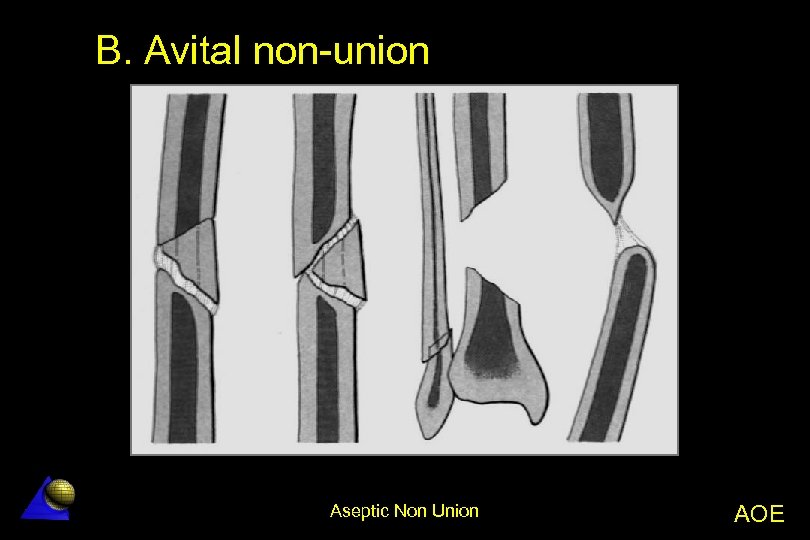 B. Avital non-union Aseptic Non Union AOE
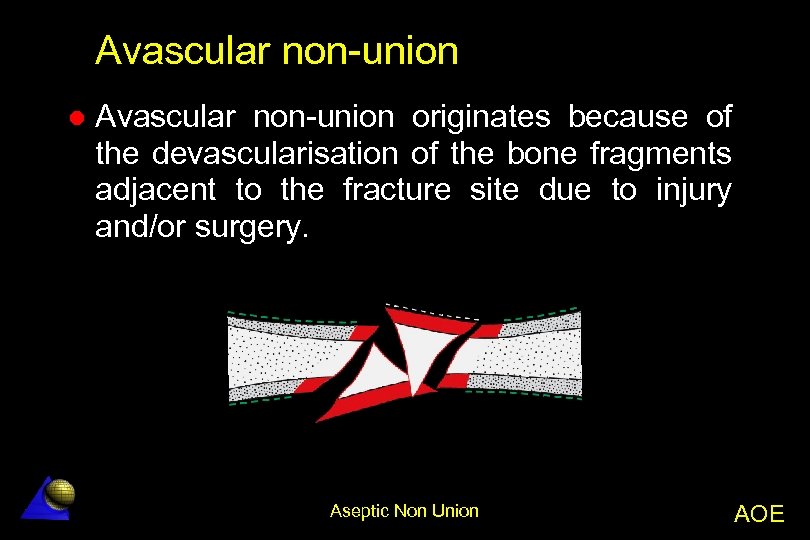 Avascular non-union l Avascular non-union originates because of the devascularisation of the bone fragments adjacent to the fracture site due to injury and/or surgery. Aseptic Non Union AOE
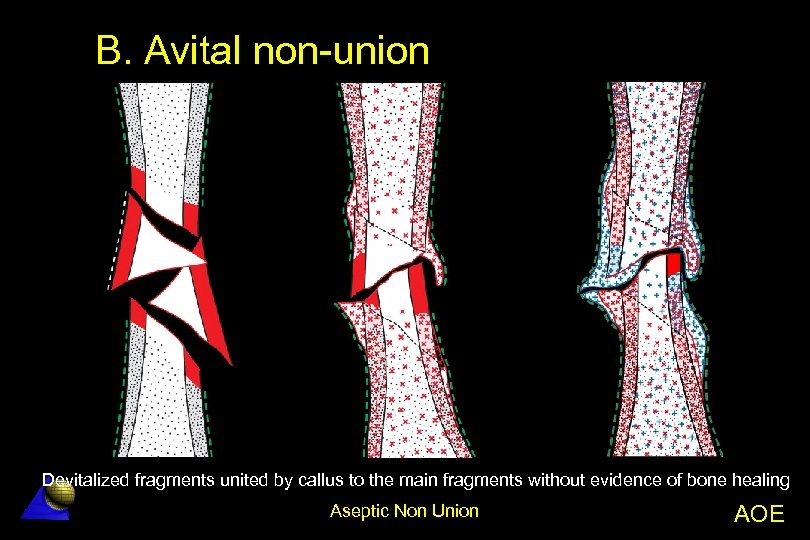 B. Avital non-union Devitalized fragments united by callus to the main fragments without evidence of bone healing Aseptic Non Union AOE
 Treatment of aseptic non-union Aseptic Non Union AOE
 Goal of the treatment To achieve a rapid bone healing with complete recovery of articular and muscular function. l Aseptic Non Union AOE
 Active treatment l To âIf l To restore bone continuity possible anatomically restore articular and muscular function In the less possible time Aseptic Non Union AOE
 Treatment according to the type 1. Vital â Mechanical stabilization (osteosynthesis) â Stable osteosynthesis 2. Avital â Mechanical stabilization (osteosynthesis) â Biological stimulation (autologous bone grafting) Aseptic Non Union AOE
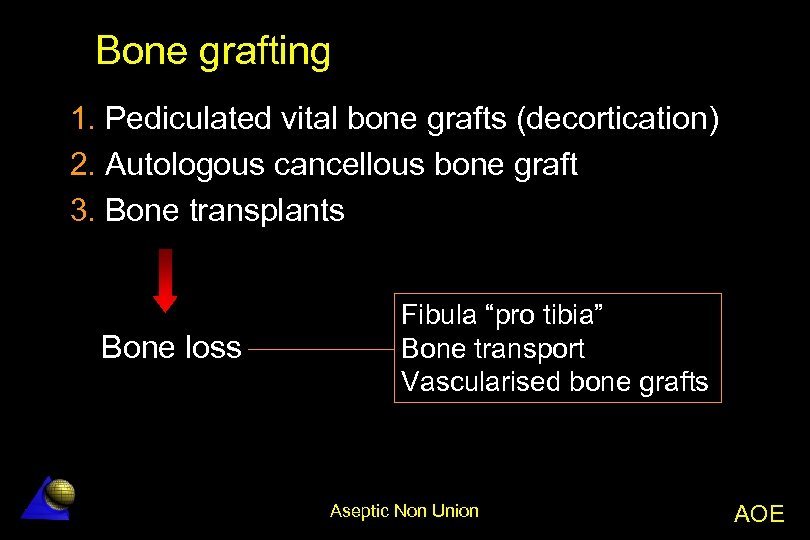 Bone grafting 1. Pediculated vital bone grafts (decortication) 2. Autologous cancellous bone graft 3. Bone transplants Bone loss Fibula “pro tibia” Bone transport Vascularised bone grafts Aseptic Non Union AOE
 Diaphyseal non-union Techniques for bone reconstruction Aseptic Non Union AOE
 Judet osteoperiosteal decortication l It is the simplest and most effective way to expose a non union without producing a substantial devascularization. l This technique is used to enhance the healing response, creating a well vascularised that at the same time stimulates the bone healing process. Aseptic Non Union AOE
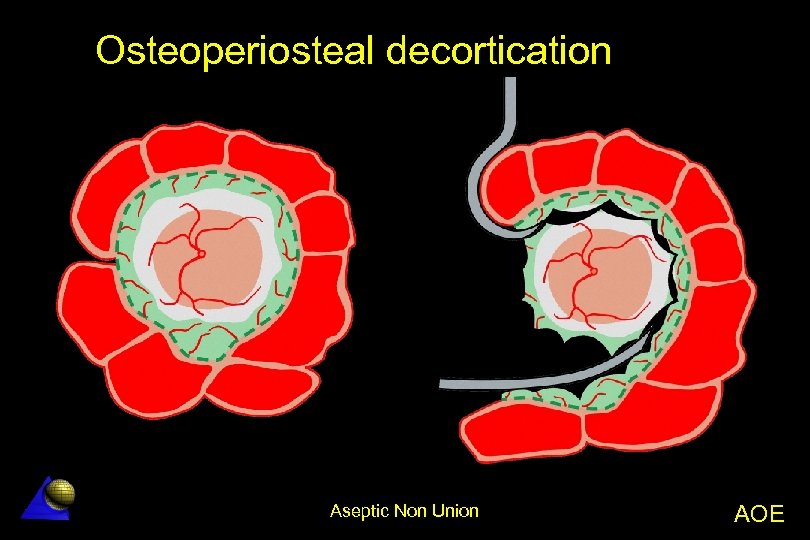 Osteoperiosteal decortication Aseptic Non Union AOE
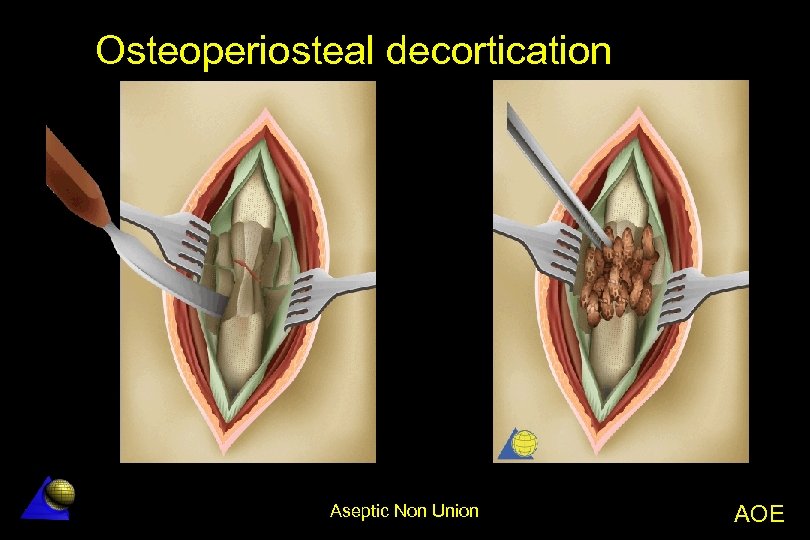 Osteoperiosteal decortication Aseptic Non Union AOE
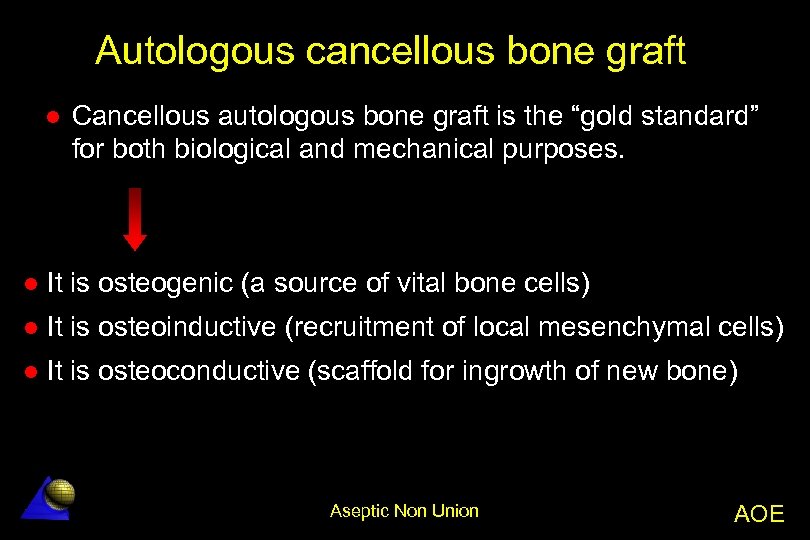 Autologous cancellous bone graft l Cancellous autologous bone graft is the “gold standard” for both biological and mechanical purposes. l It is osteogenic (a source of vital bone cells) l It is osteoinductive (recruitment of local mesenchymal cells) l It is osteoconductive (scaffold for ingrowth of new bone) Aseptic Non Union AOE
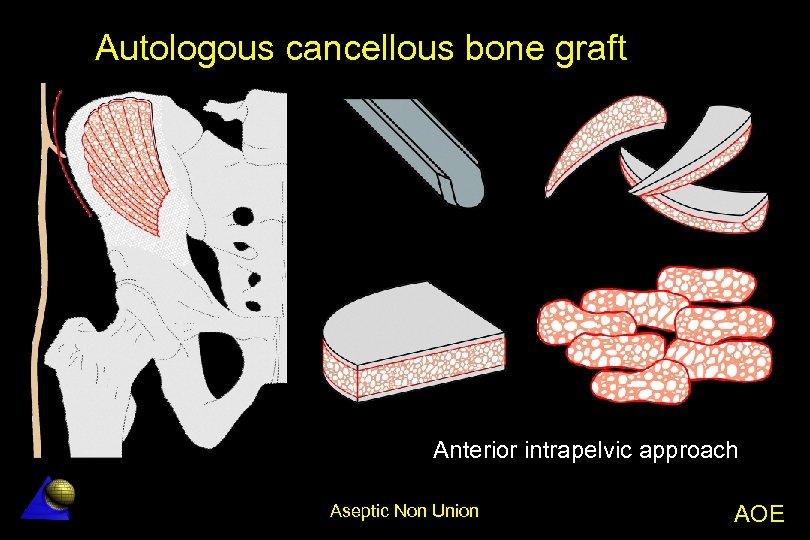 Autologous cancellous bone graft Anterior intrapelvic approach Aseptic Non Union AOE
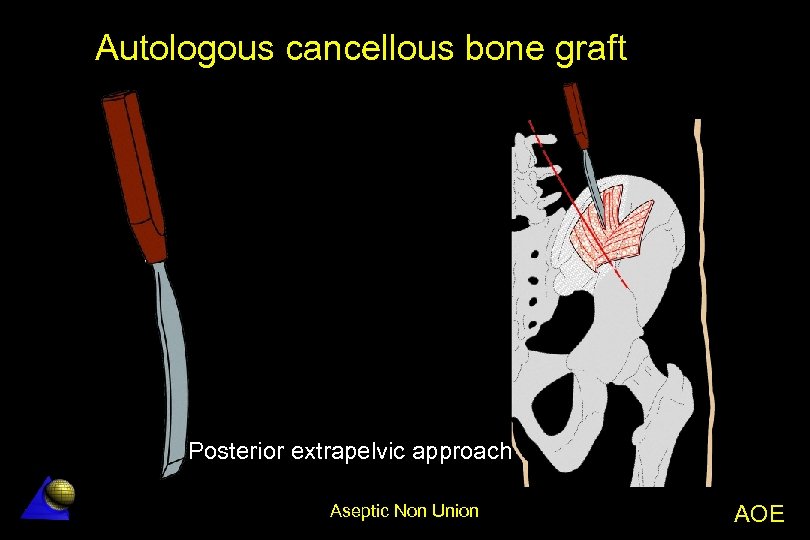 Autologous cancellous bone graft Posterior extrapelvic approach Aseptic Non Union AOE
 Bone grafting indications l Poor vascularization l Minimal callus formation l Atrophic non-union Cancellous autologous bone graft is: Osteogenic, osteoinductive and osteoconductive Aseptic Non Union AOE
 Allografts and bone graft substitutes l Allografts and bone substitutes such as demineralized bone matrix, hidroxyapatite, tricalcium-phosphate, as welll as osteoinductive substances such as growth factors, bone morphogenetic proteins (BMPs), etc. , are currently being intensively explored both experimentally and clinically, but have not yet proved to be significantly superior. Aseptic Non Union AOE
 Allografts and bone graft substitutes All these substances require a vital environment in order to be effective. l In the absence of living cellular elements and blood supply there is no possibility of any healing. l Nothing is superior to autologous bone graft Aseptic Non Union AOE
 Callus distraction Free vascularized bone grafts l Osteogenesis by callus distraction (Ilizarov) and free vascularized bone graft should be taken into consideration when dealing with large (>4 -6 cm) segmental bone defects. Aseptic Non Union AOE
 ¡Mechanical stabilization is essential! Aseptic Non Union AOE
 Stabilization l Stabilization of a non-union provides the essential mechanical component to allow calcification of the fibrous cartilage within the non-union. l This prepares the field for development of a first bony bridge. Aseptic Non Union AOE
 Types of stabilization l Plating l Intramedullary l External nailing Fixation Aseptic Non Union AOE
 Plating l The plate is probably the most adequate and versatile tool for the stabilization of an aseptic non-union. l It allows in a single procedure : â Interfragmentary compression â Correction of any malposition â Reconstructive measures (grafting etc. ) Aseptic Non Union AOE
 Plating techniques Tension band plating (on the convexity) l Axial compression plating l Buttress plate l Lag screws and neutralization plate l Bridge plate in segmental bone loss l Aseptic Non Union AOE
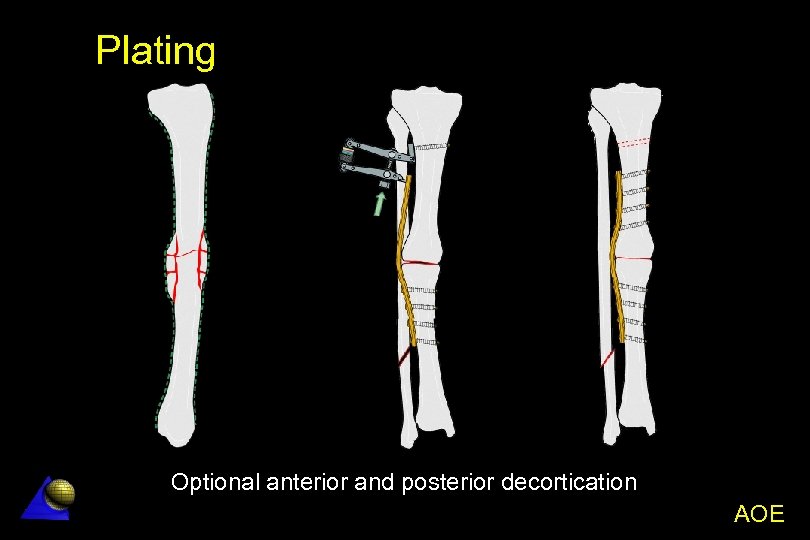 Plating Optional anterior and posterior decortication Aseptic Non Union AOE
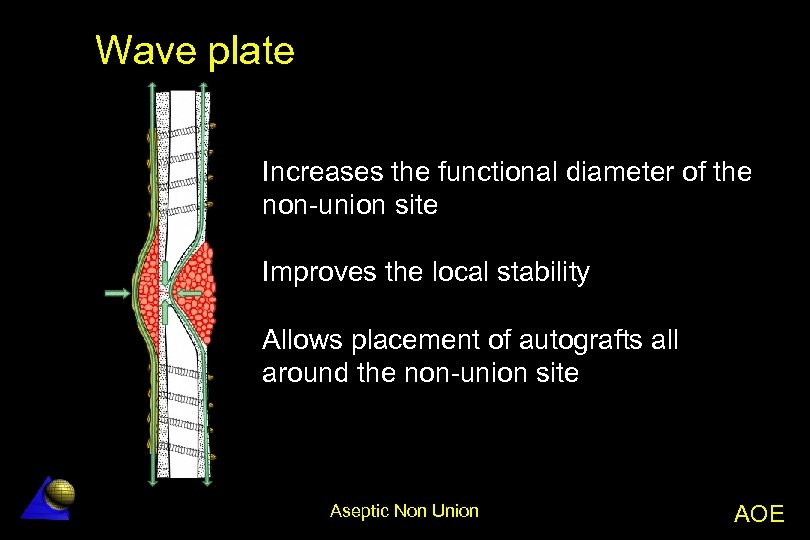 Wave plate Increases the functional diameter of the non-union site Improves the local stability Allows placement of autografts all around the non-union site Aseptic Non Union AOE
 Intramedullary nailing l It is mainly indicated in diaphyseal non-unions of the lower extremity l Nailing has few advantages in the upper extremity and thin unreamed nails are not suitable, as they provide insufficient stability. Aseptic Non Union AOE
 Indications of intramedullary nailing l Non displaced mid third femur and tibia non-union l Loose or broken nail â Over-ream not exposing the non-union site â Introduction of a thicker and longer nail â Dynamic interlocking (rotational stability) â Increase of periosteal bone flow promotes union Aseptic Non Union AOE
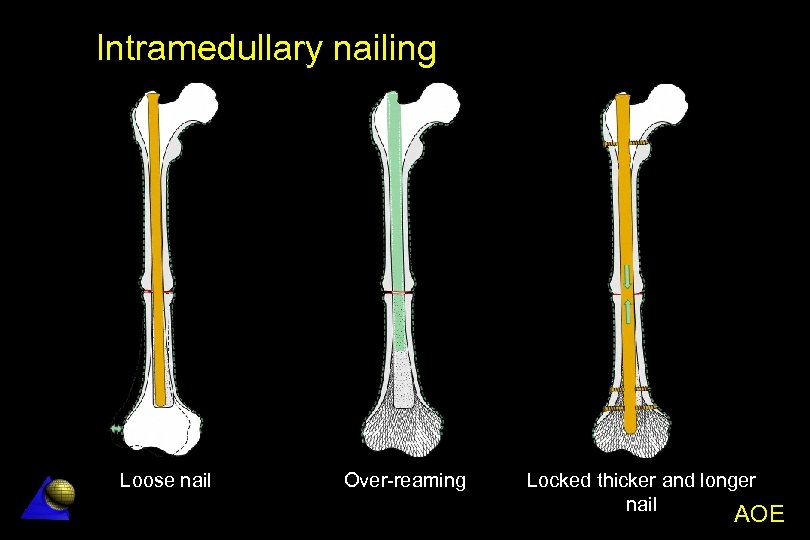 Intramedullary nailing Loose nail Over-reaming Aseptic Non Union Locked thicker and longer nail AOE
 External Fixation l In most aseptic non-unions external fixation brings little advantage. l It may be applied in the presence of poor soft-tissue conditions or in complex multiplanar deformities near joints where a single-stage correction appears difficult and hazardous. Aseptic Non Union AOE
 Indications of External Fixation l Tibia non-union â Poor skin coverage â Suspicion of latent infection l Shortening with bone loss â Callus l distraction technique Arthrodesis non-union â Failed knee and ankle arthrodesis Aseptic Non Union AOE
 Methaphyseal non-union Bone reconstruction techniques Aseptic Non Union AOE
 Metaphyseal non-union l Limited local decortication avoiding devascularization of the joint fragment, correction of the deformities and mechanical adaptation of the main fragments with fixation by interfragmentary compression. l Usually one or two plates are used. l Bone grafting may be necessary. Aseptic Non Union AOE
 Indications Correct alignment of the articular surfaces l Articular fragment stable fixation l â Angle plate â Buttress plate Active mobilization of a stiff joint l Avoid forced mobilization before bone healing l Aseptic Non Union AOE
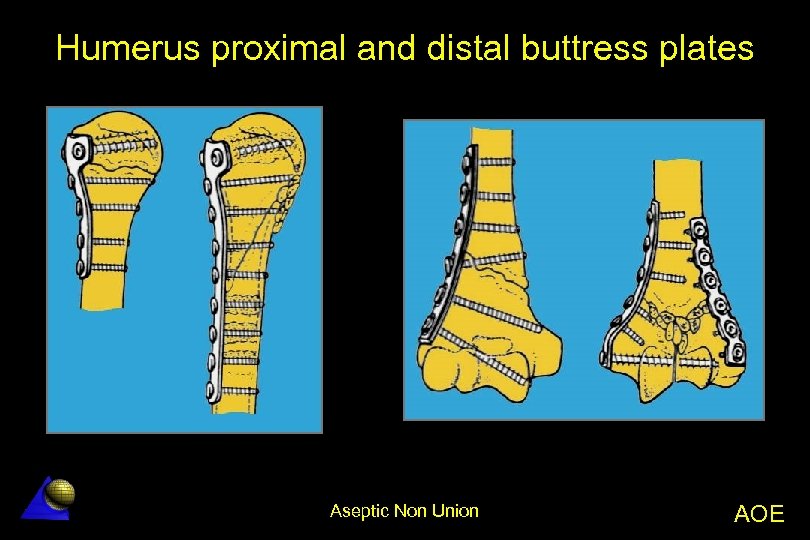 Humerus proximal and distal buttress plates Aseptic Non Union AOE
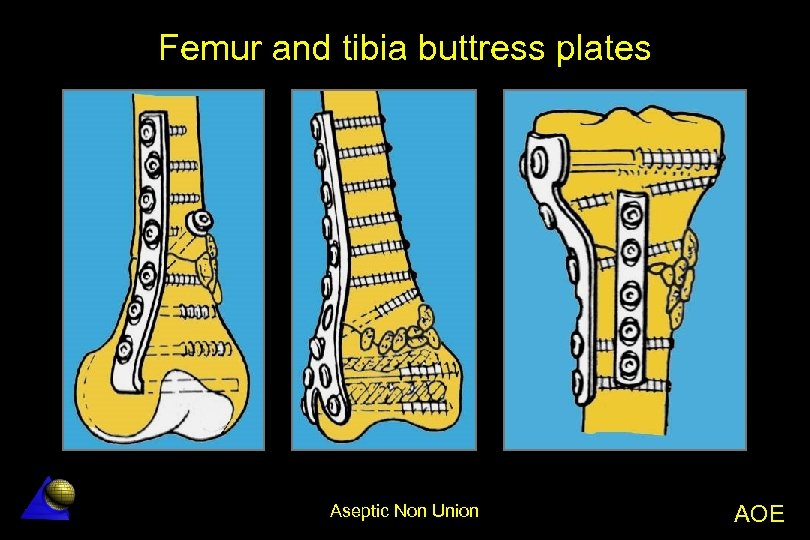 Femur and tibia buttress plates Aseptic Non Union AOE
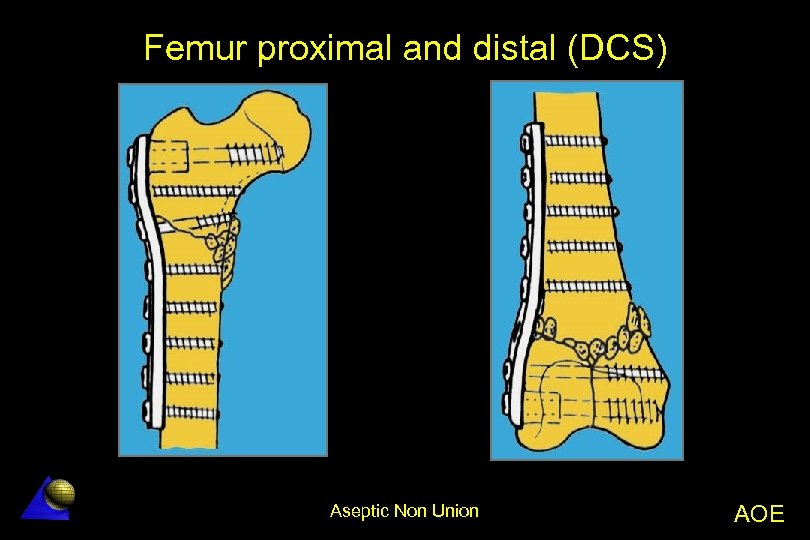 Femur proximal and distal (DCS) Aseptic Non Union AOE
 Adjuvant treatment Aseptic Non Union AOE
 Aseptic non-union l Electromagnetic stimulation and, more recently, ultrasound, have been applied and advocated to stimulate bone healing. l They do appear to generate a certain physical (thermal) effect at the non-union site, but the final outcome is still questionable and real evidence is lacking. Aseptic Non Union AOE
 Bone losses Aseptic Non Union AOE
 Bone transplant 1. Fibula “pro tibia” 2. Bone transport 3. Free vascularized bone grafts Aseptic Non Union AOE
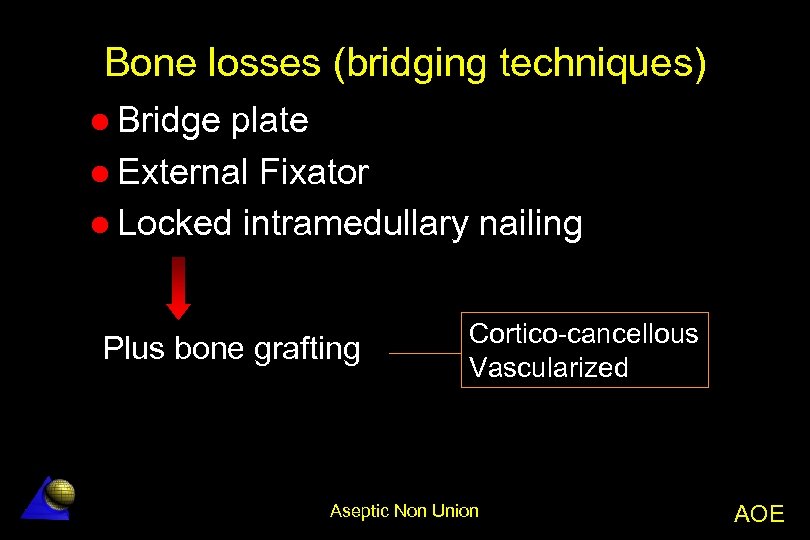 Bone losses (bridging techniques) l Bridge plate l External Fixator l Locked intramedullary nailing Plus bone grafting Cortico-cancellous Vascularized Aseptic Non Union AOE
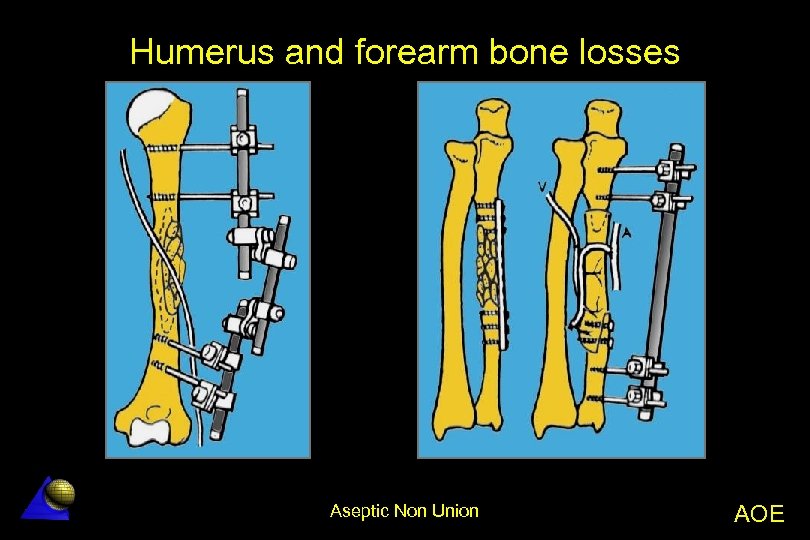 Humerus and forearm bone losses Aseptic Non Union AOE
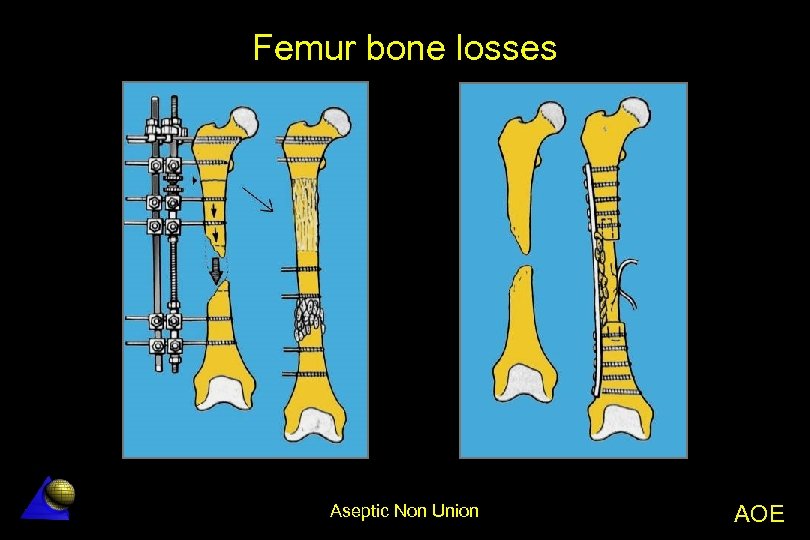 Femur bone losses Aseptic Non Union AOE
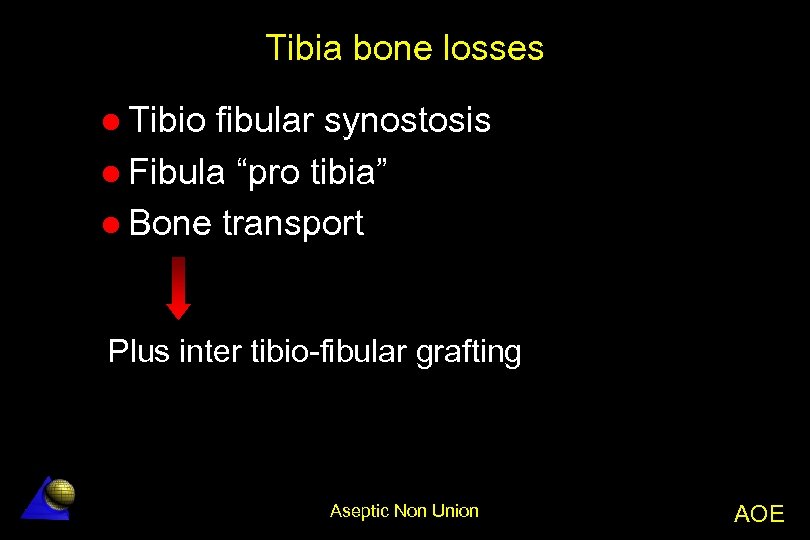 Tibia bone losses l Tibio fibular synostosis l Fibula “pro tibia” l Bone transport Plus inter tibio-fibular grafting Aseptic Non Union AOE
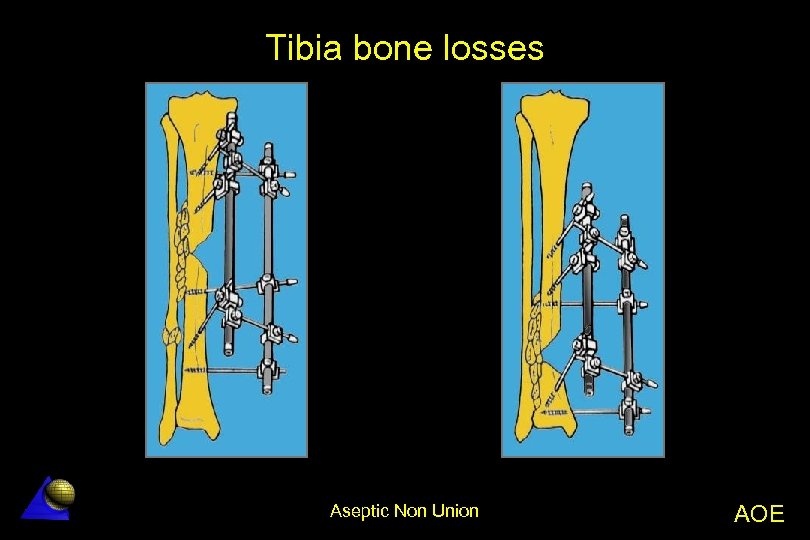 Tibia bone losses Aseptic Non Union AOE
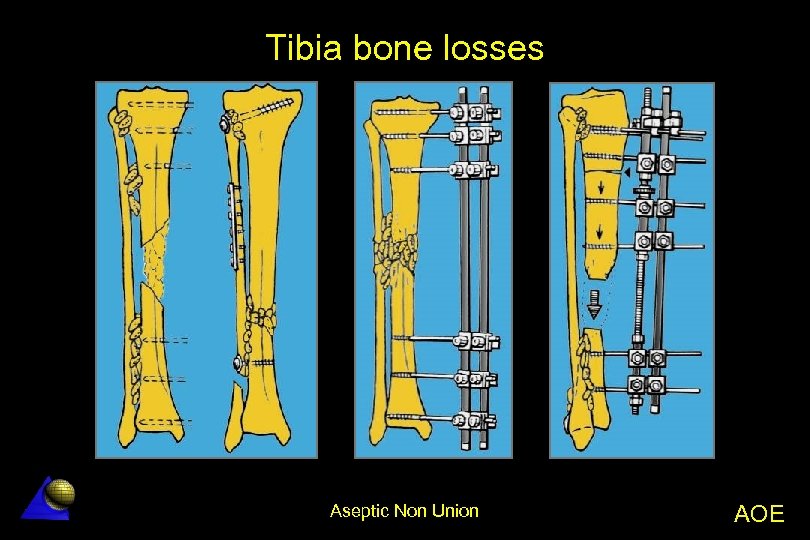 Tibia bone losses Aseptic Non Union AOE
 Aseptic Non-union Clinical Examples Aseptic Non Union AOE
 AO Principles Course Dr. Enrique Queipo de Llano Hospital Universitario de Málaga Aseptic Non Union AOE
 V. G. C. - 60 year old - Female Distal tibia non-union - 10 -74 Distal tibia fracture no-union l The fracture was treated in other Hospital l â Simple screw fixation without IF compression â No neutralization plate Lag screw and DCP plating with deformity correction l Bone healing in 2 months l Aseptic Non Union AOE
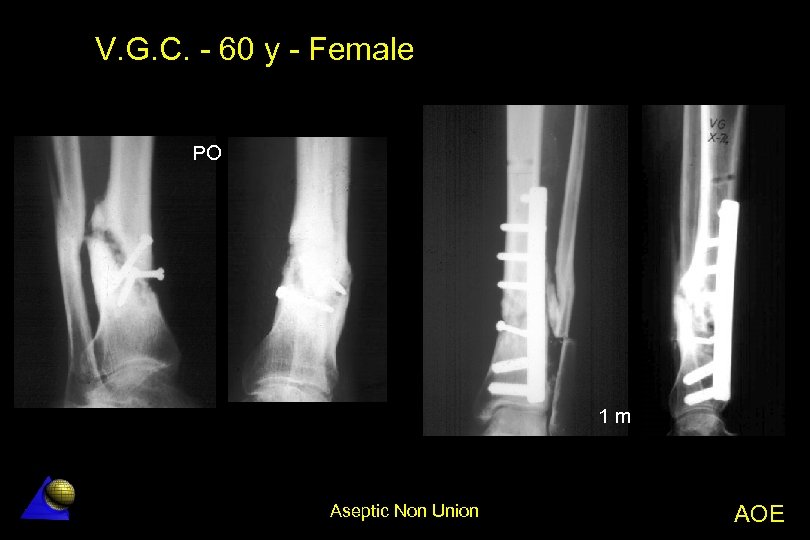 V. G. C. - 60 y - Female PO 1 m Aseptic Non Union AOE
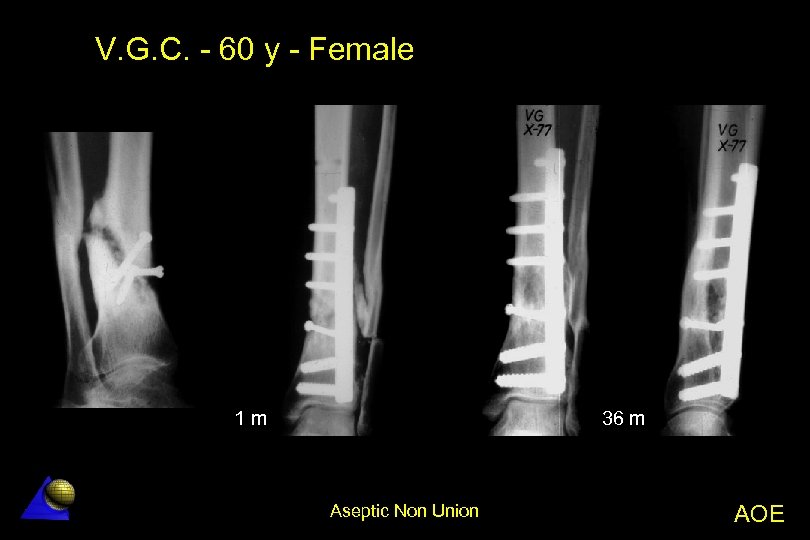 V. G. C. - 60 y - Female 1 m 36 m Aseptic Non Union AOE
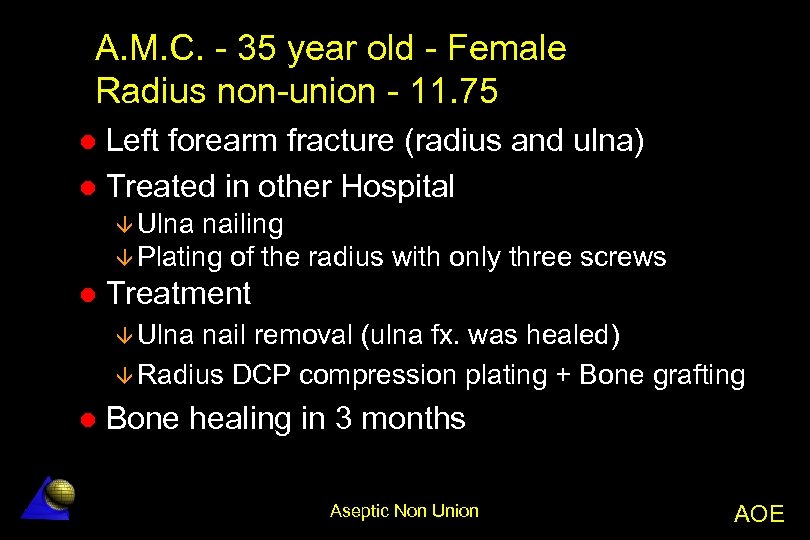 A. M. C. - 35 year old - Female Radius non-union - 11. 75 Left forearm fracture (radius and ulna) l Treated in other Hospital l â Ulna nailing â Plating of the radius with only three screws l Treatment â Ulna nail removal (ulna fx. was healed) â Radius DCP compression plating + Bone grafting l Bone healing in 3 months Aseptic Non Union AOE
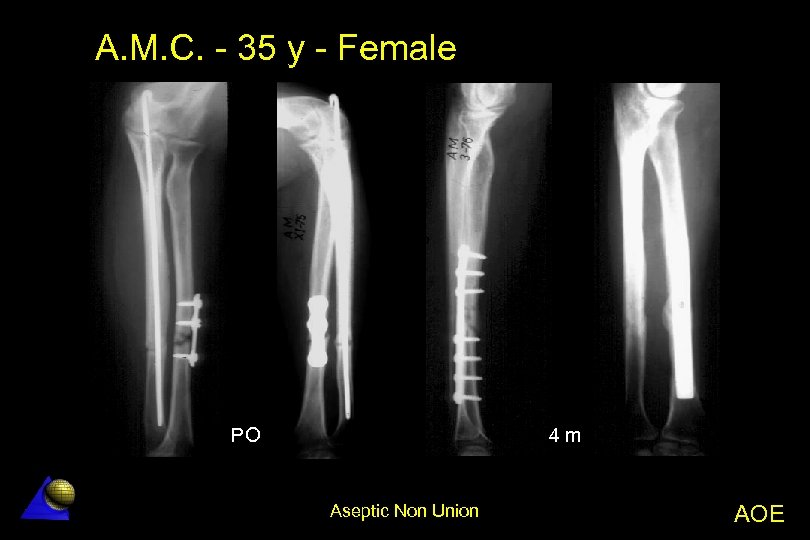 A. M. C. - 35 y - Female 4 m PO Aseptic Non Union AOE
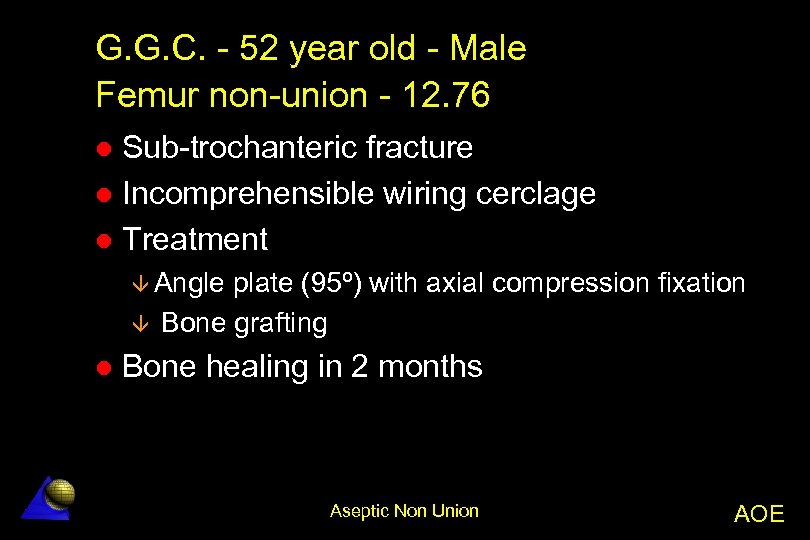 G. G. C. - 52 year old - Male Femur non-union - 12. 76 Sub-trochanteric fracture l Incomprehensible wiring cerclage l Treatment l â Angle â l plate (95º) with axial compression fixation Bone grafting Bone healing in 2 months Aseptic Non Union AOE
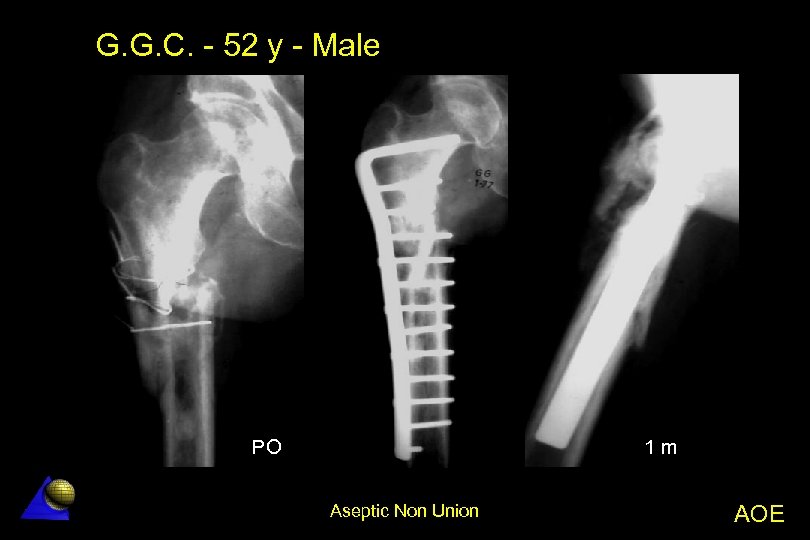 G. G. C. - 52 y - Male PO 1 m Aseptic Non Union AOE
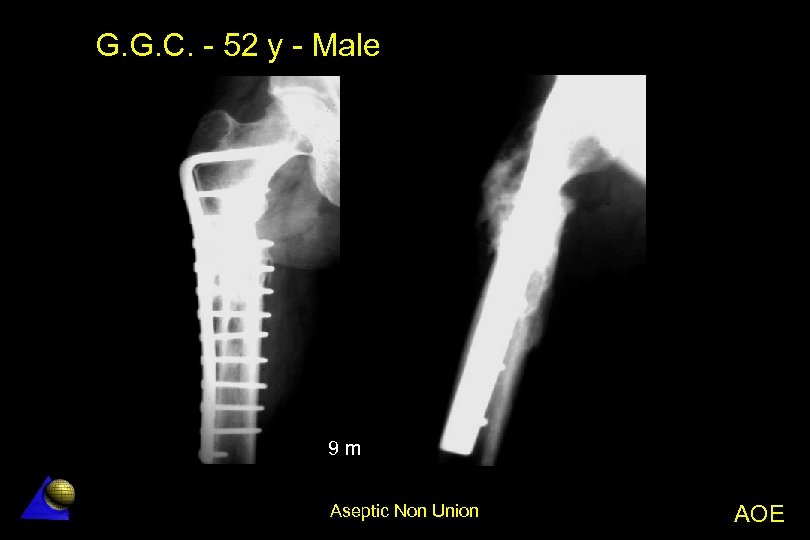 G. G. C. - 52 y - Male 9 m Aseptic Non Union AOE
 D. O. J. - 43 year old - Male Distal femur non-union - 1. 78 Distal femur metaphyseal non-union l Previous orthopaedic treatment in traction l Angle plate (95º) fixation l Bone healing in 3 months l Aseptic Non Union AOE
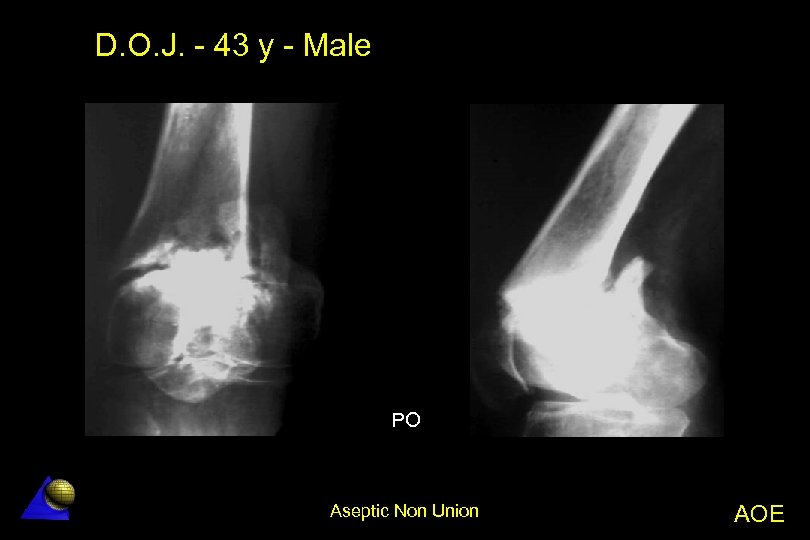 D. O. J. - 43 y - Male PO Aseptic Non Union AOE
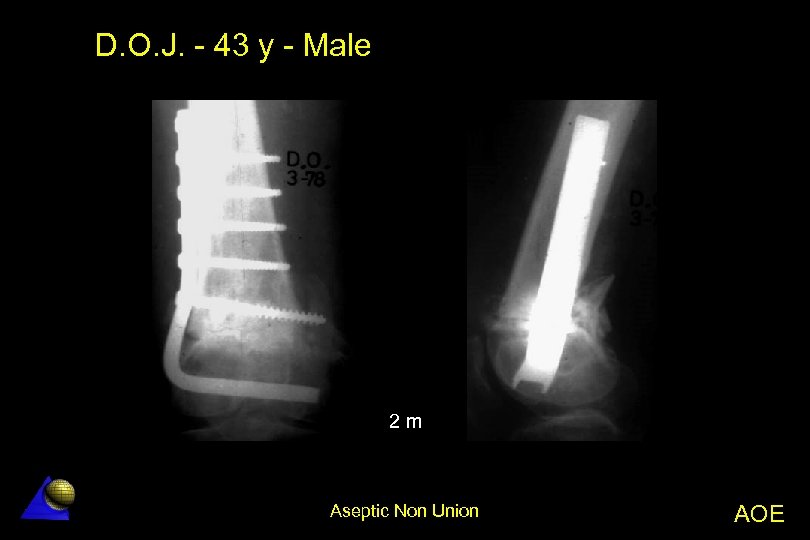 D. O. J. - 43 y - Male 2 m Aseptic Non Union AOE
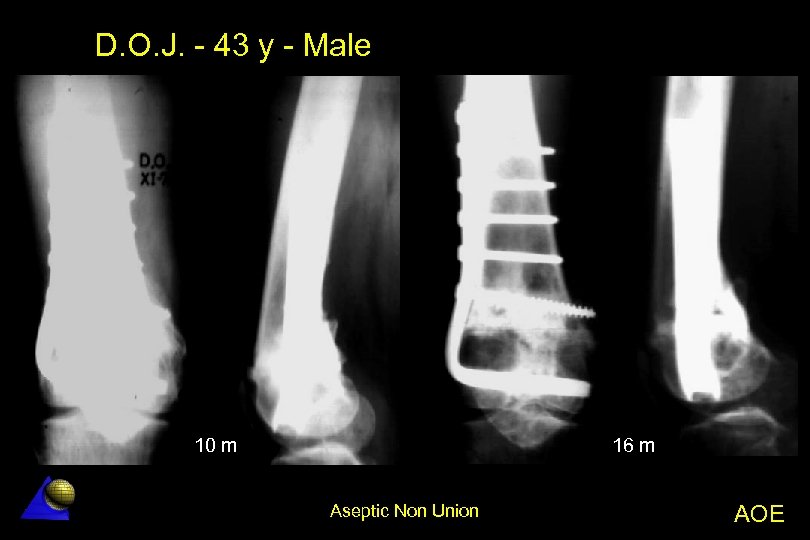 D. O. J. - 43 y - Male 10 m 16 m Aseptic Non Union AOE
 P. T. M. – 27 year old – Male Distal de tibia non-union - 5. 97 l Distal de tibia fx. treated in another Hospital â UTN nailing â Technical defect (only one distal bolt) Non-union with angular deformity l Treatment l â Decortication + Osteotomy â LC-DCP tibia and fibula plate fixation l Excellent result Aseptic Non Union AOE
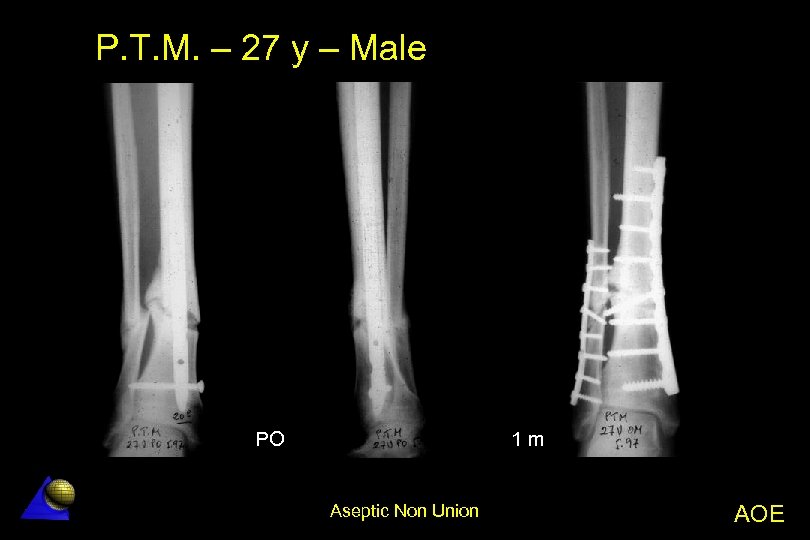 P. T. M. – 27 y – Male PO 1 m Aseptic Non Union AOE
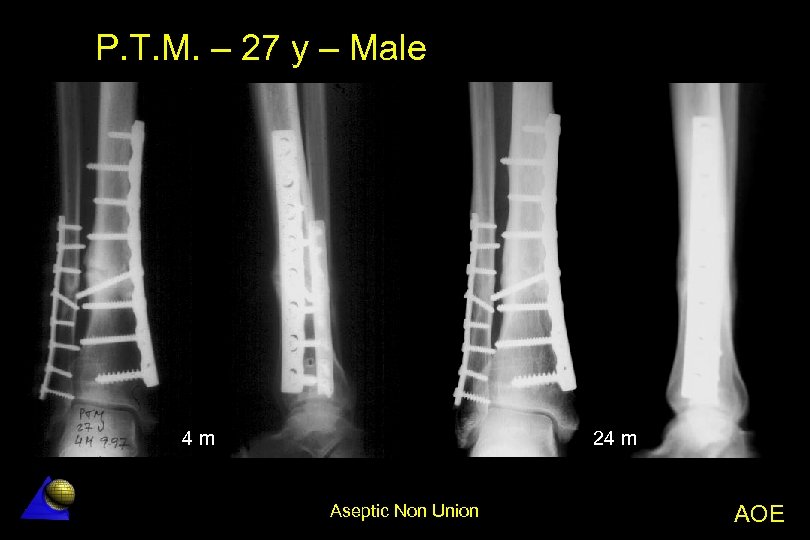 P. T. M. – 27 y – Male 4 m 24 m Aseptic Non Union AOE
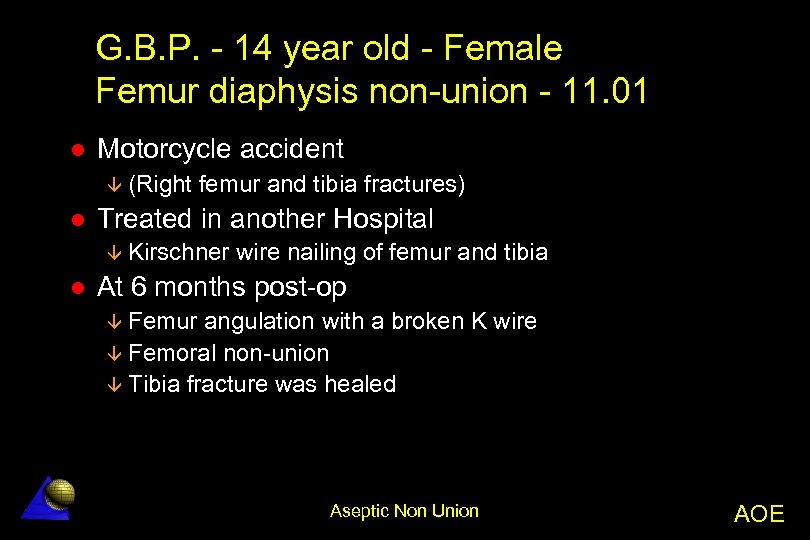 G. B. P. - 14 year old - Female Femur diaphysis non-union - 11. 01 l Motorcycle accident â l Treated in another Hospital â l (Right femur and tibia fractures) Kirschner wire nailing of femur and tibia At 6 months post-op Femur angulation with a broken K wire â Femoral non-union â Tibia fracture was healed â Aseptic Non Union AOE
 G. B. P. - 14 year old - Female Femur diaphysis non-union - 11. 01 l Surgical treatment â Femur and tibia nails removal â Decortication + LC-DCP axial compression plating â Cancellous bone screws were used (osteoporosis) â Autologouu bone grafting l Excellent result at 12 and 24 months Aseptic Non Union AOE
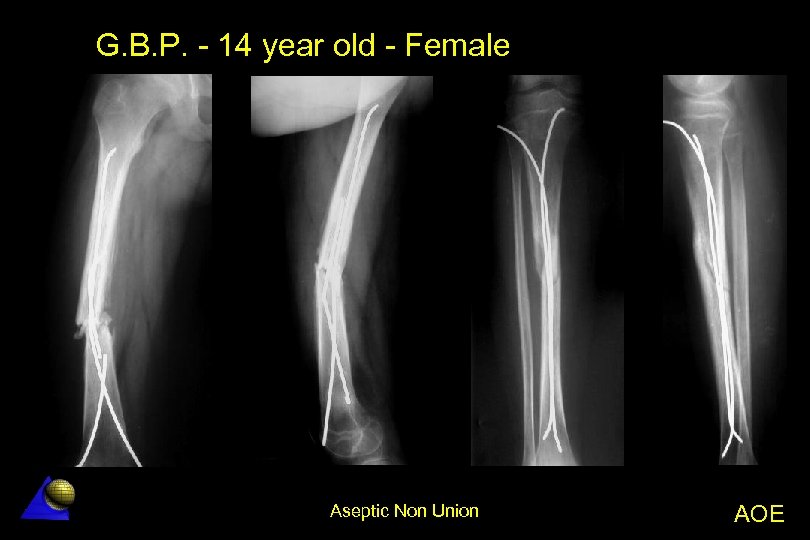 G. B. P. - 14 year old - Female Aseptic Non Union AOE
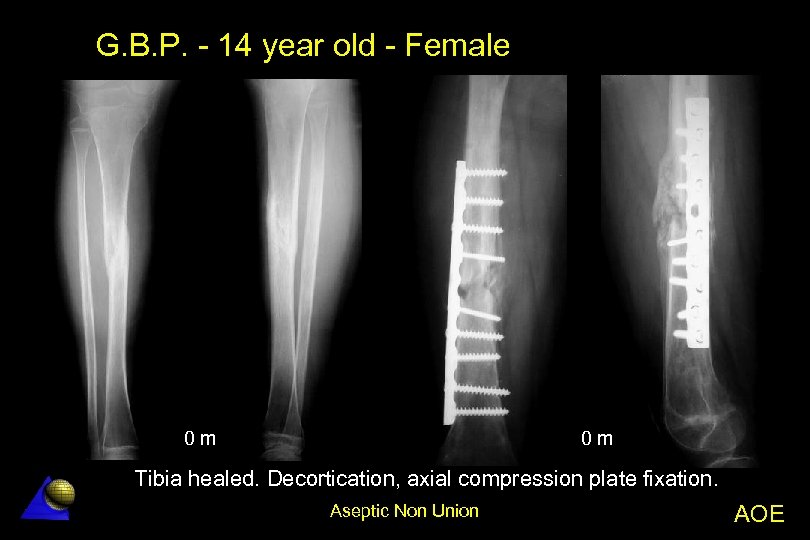 G. B. P. - 14 year old - Female 0 m 0 m Tibia healed. Decortication, axial compression plate fixation. Aseptic Non Union AOE
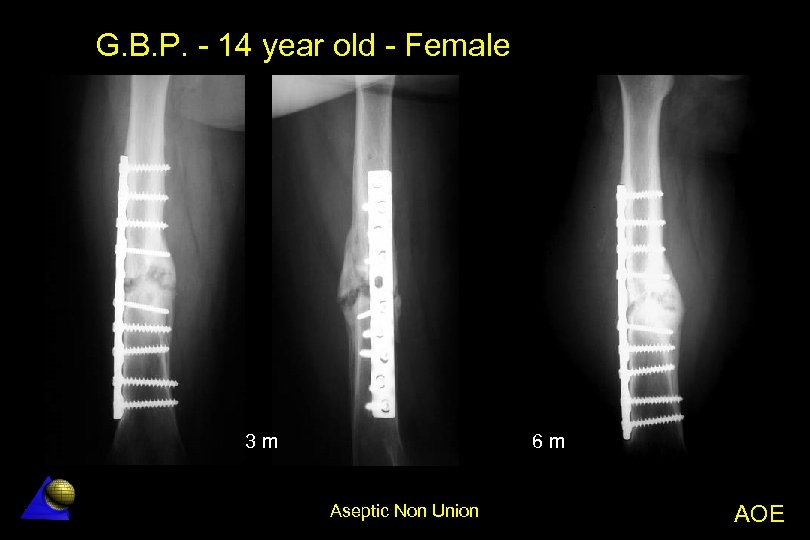 G. B. P. - 14 year old - Female 3 m 6 m Aseptic Non Union AOE
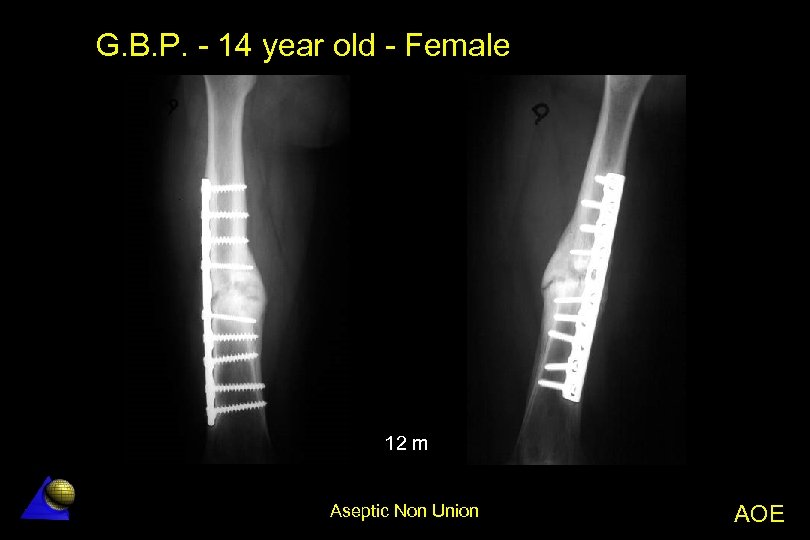 G. B. P. - 14 year old - Female 12 m Aseptic Non Union AOE
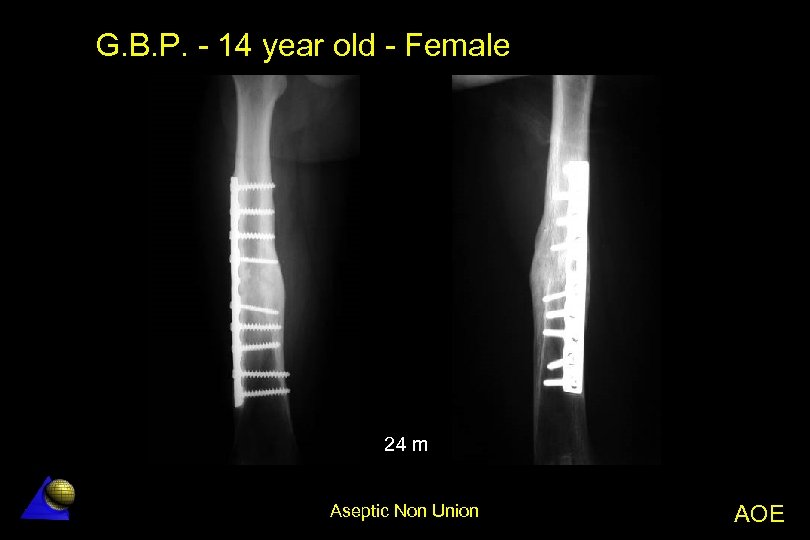 G. B. P. - 14 year old - Female 24 m Aseptic Non Union AOE
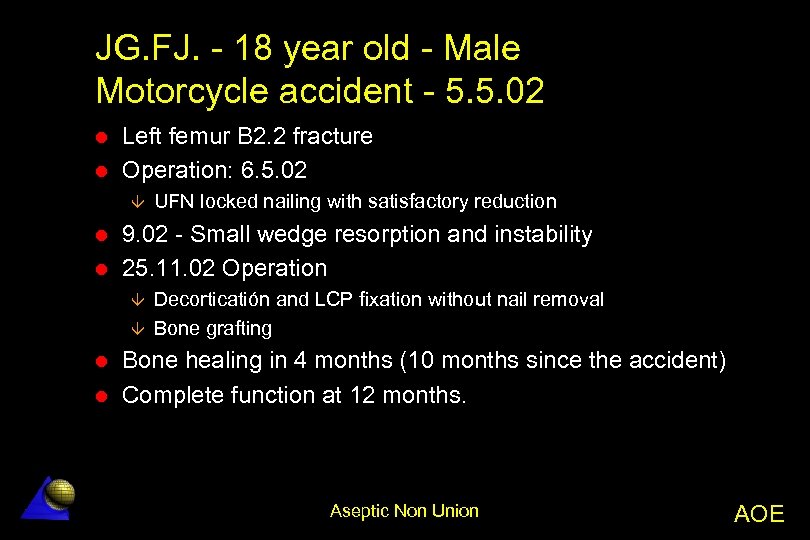 JG. FJ. - 18 year old - Male Motorcycle accident - 5. 5. 02 l l Left femur B 2. 2 fracture Operation: 6. 5. 02 â l l 9. 02 - Small wedge resorption and instability 25. 11. 02 Operation â â l l UFN locked nailing with satisfactory reduction Decorticatión and LCP fixation without nail removal Bone grafting Bone healing in 4 months (10 months since the accident) Complete function at 12 months. Aseptic Non Union AOE
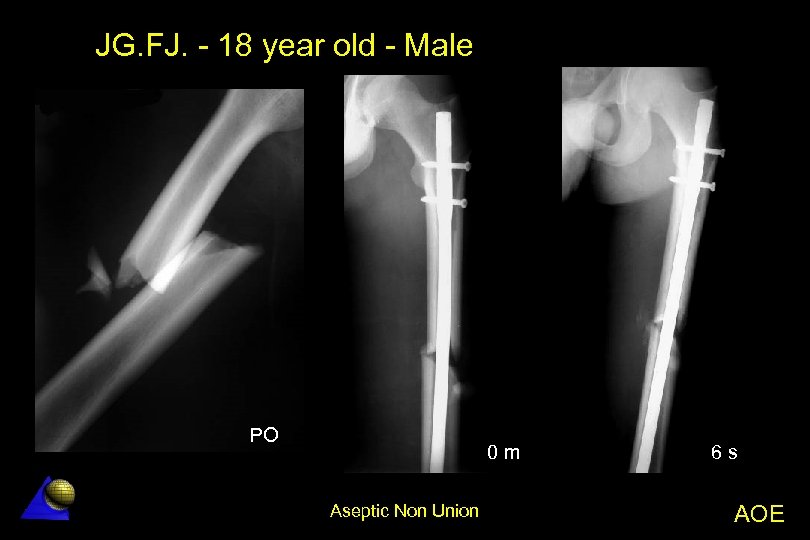 JG. FJ. - 18 year old - Male PO 0 m Aseptic Non Union 6 s AOE
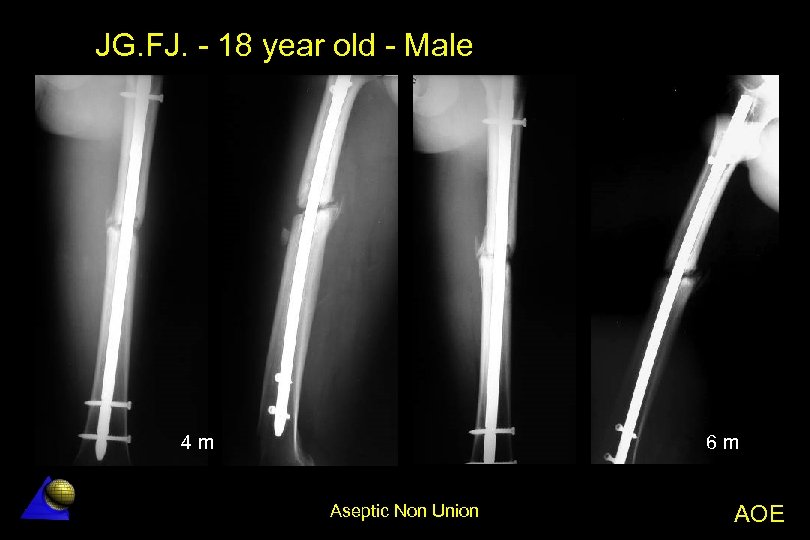 JG. FJ. - 18 year old - Male 4 m 6 m Aseptic Non Union AOE
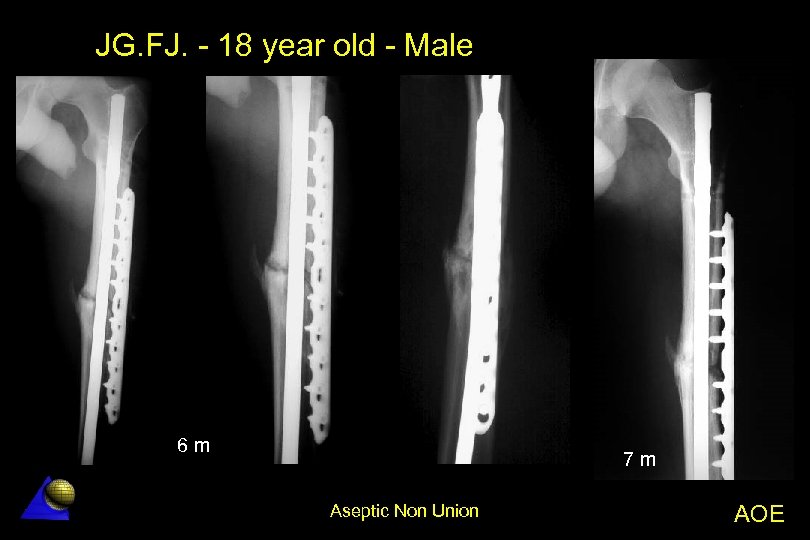 JG. FJ. - 18 year old - Male 6 m 7 m Aseptic Non Union AOE
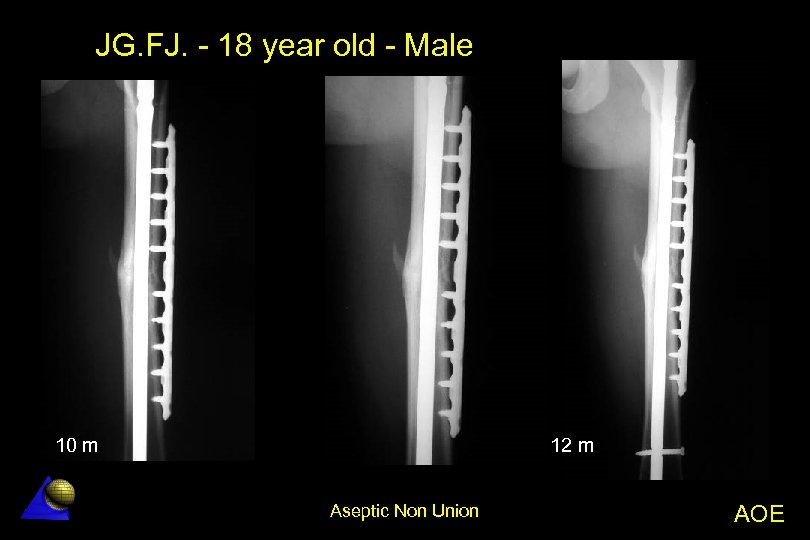 JG. FJ. - 18 year old - Male 10 m 12 m Aseptic Non Union AOE
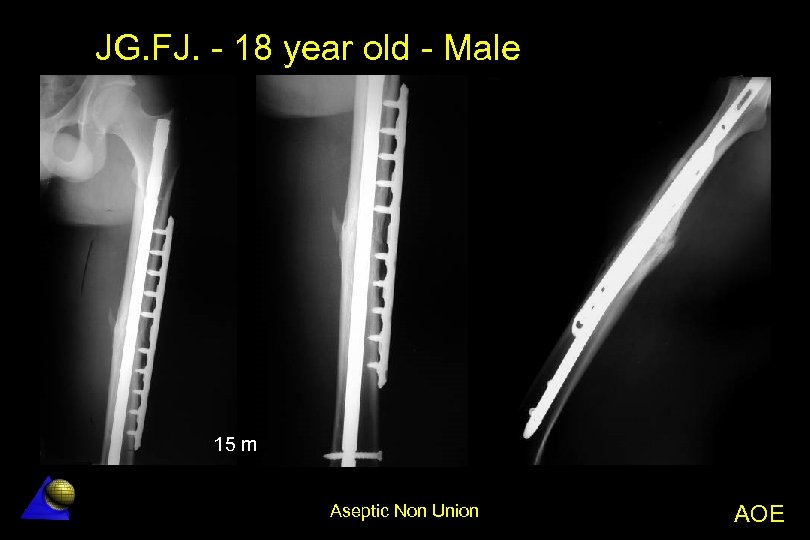 JG. FJ. - 18 year old - Male 15 m Aseptic Non Union AOE
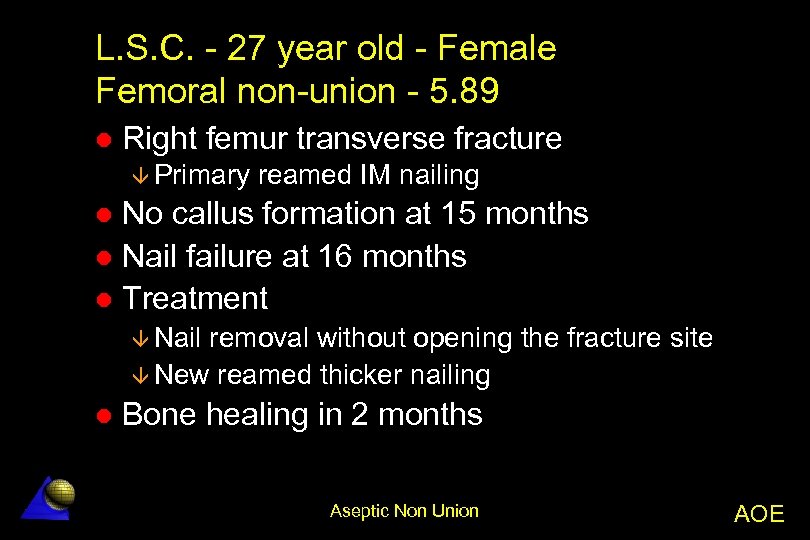 L. S. C. - 27 year old - Female Femoral non-union - 5. 89 l Right femur transverse fracture â Primary reamed IM nailing No callus formation at 15 months l Nail failure at 16 months l Treatment l â Nail removal without opening the fracture site â New reamed thicker nailing l Bone healing in 2 months Aseptic Non Union AOE
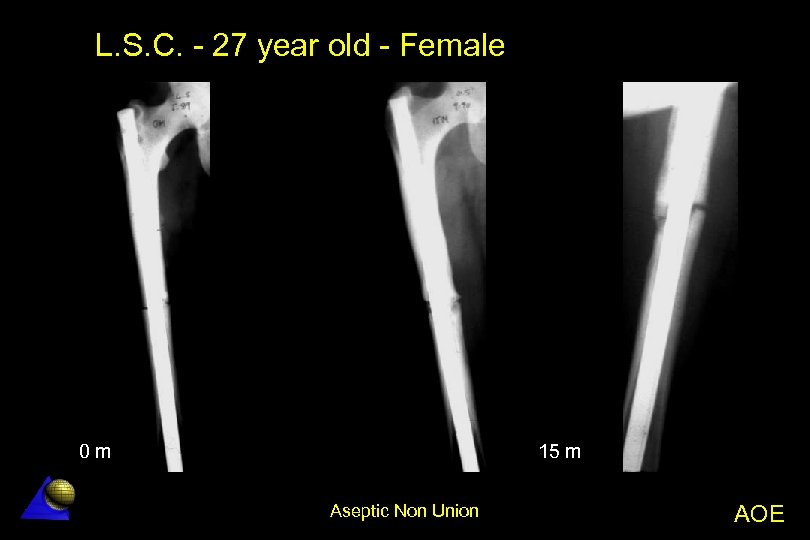 L. S. C. - 27 year old - Female 0 m 15 m Aseptic Non Union AOE
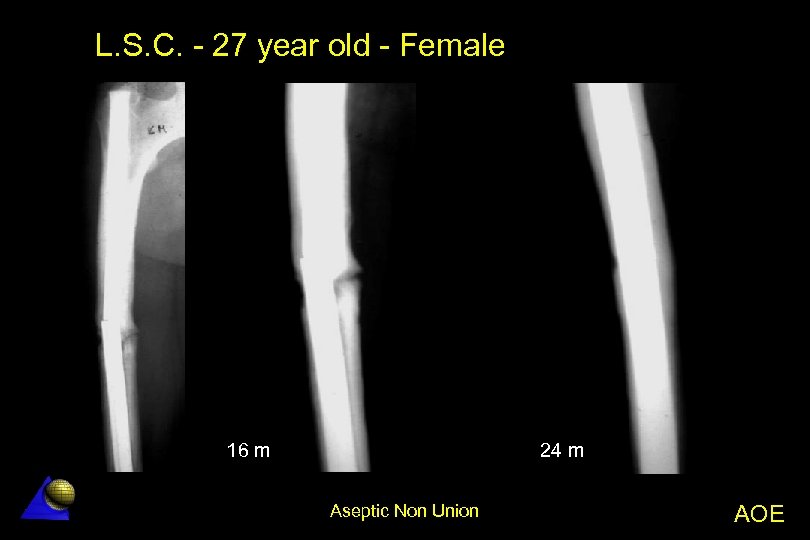 L. S. C. - 27 year old - Female 16 m 24 m Aseptic Non Union AOE
 Fibula “pro tibia” Aseptic Non Union AOE
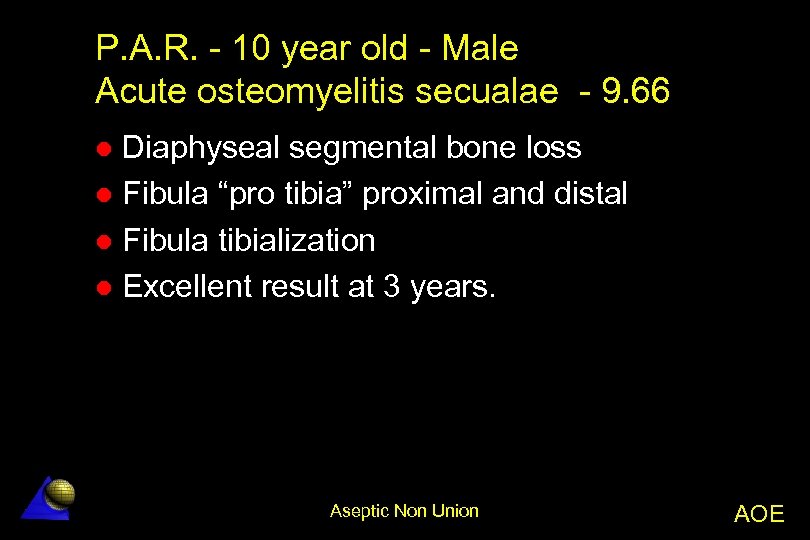 P. A. R. - 10 year old - Male Acute osteomyelitis secualae - 9. 66 Diaphyseal segmental bone loss l Fibula “pro tibia” proximal and distal l Fibula tibialization l Excellent result at 3 years. l Aseptic Non Union AOE
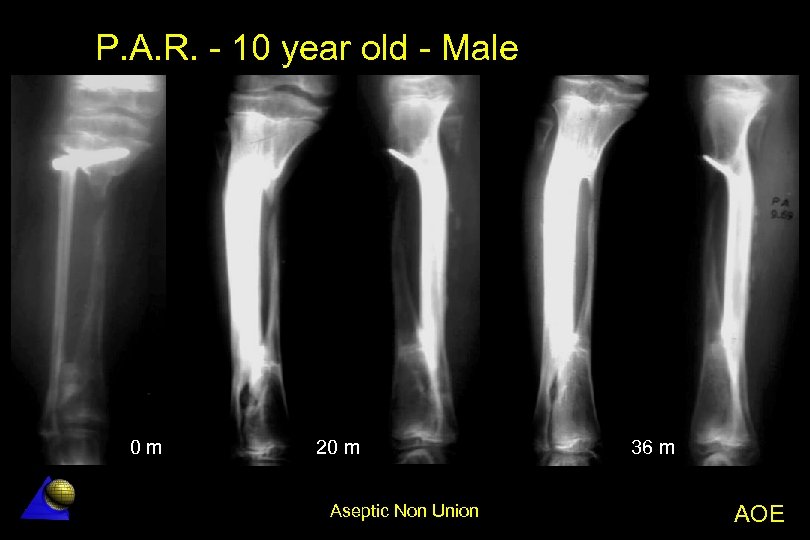 P. A. R. - 10 year old - Male 0 m 20 m Aseptic Non Union 36 m AOE
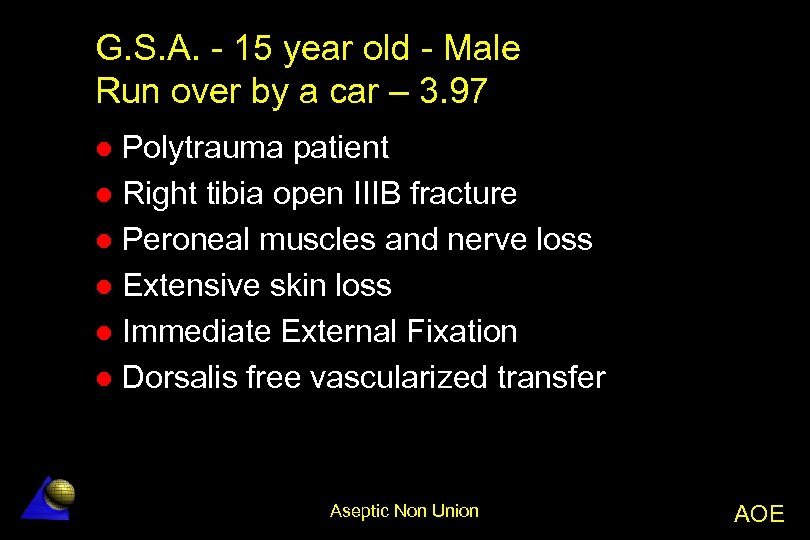 G. S. A. - 15 year old - Male Run over by a car – 3. 97 Polytrauma patient l Right tibia open IIIB fracture l Peroneal muscles and nerve loss l Extensive skin loss l Immediate External Fixation l Dorsalis free vascularized transfer l Aseptic Non Union AOE
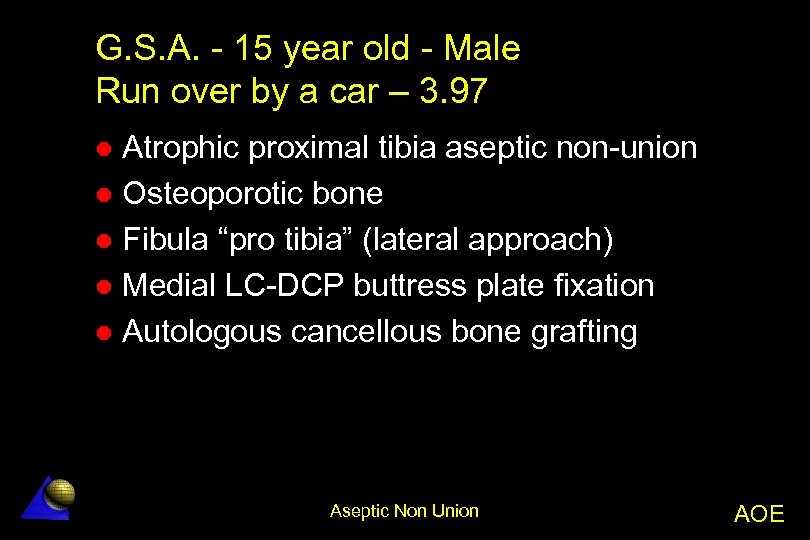 G. S. A. - 15 year old - Male Run over by a car – 3. 97 Atrophic proximal tibia aseptic non-union l Osteoporotic bone l Fibula “pro tibia” (lateral approach) l Medial LC-DCP buttress plate fixation l Autologous cancellous bone grafting l Aseptic Non Union AOE
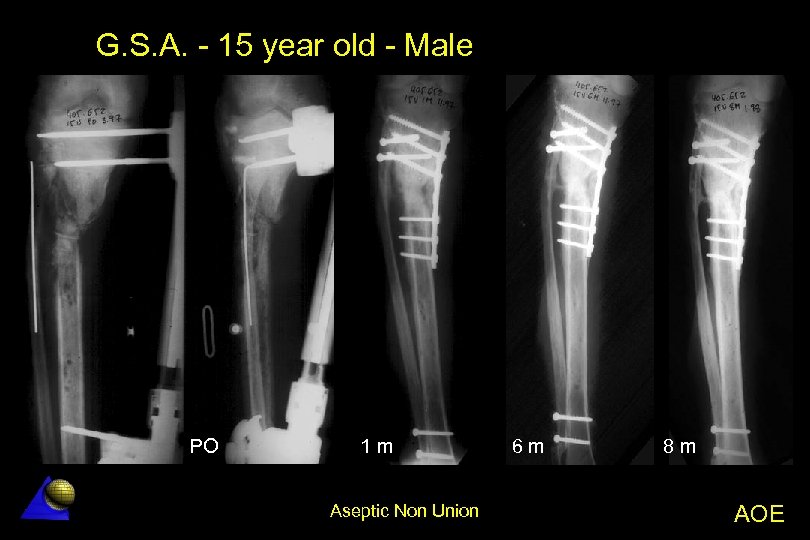 G. S. A. - 15 year old - Male PO 1 m Aseptic Non Union 6 m 8 m AOE
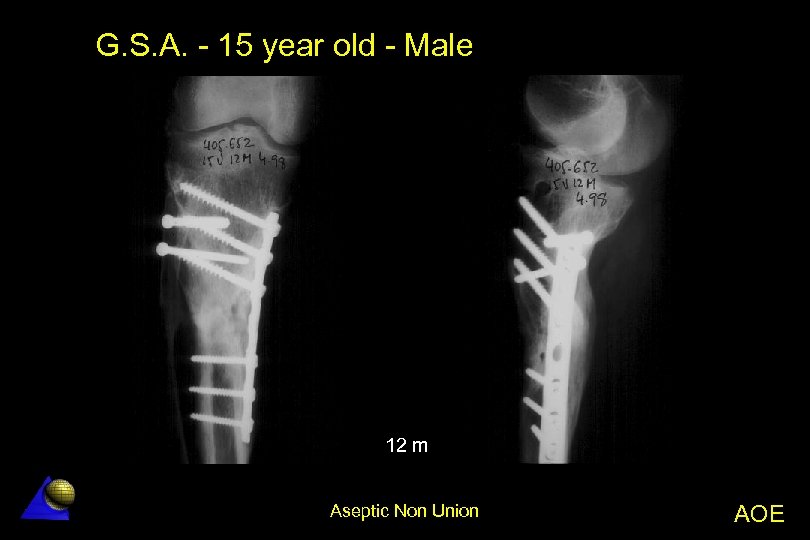 G. S. A. - 15 year old - Male 12 m Aseptic Non Union AOE
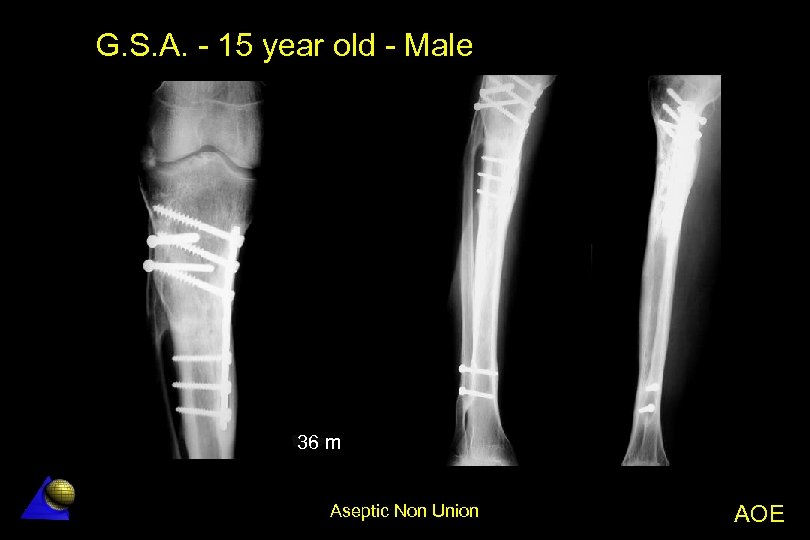 G. S. A. - 15 year old - Male 36 m Aseptic Non Union AOE
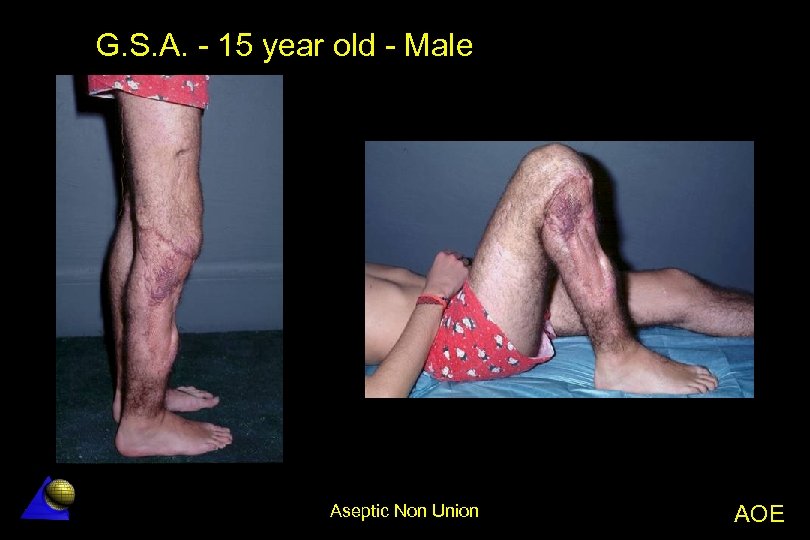 G. S. A. - 15 year old - Male Aseptic Non Union AOE
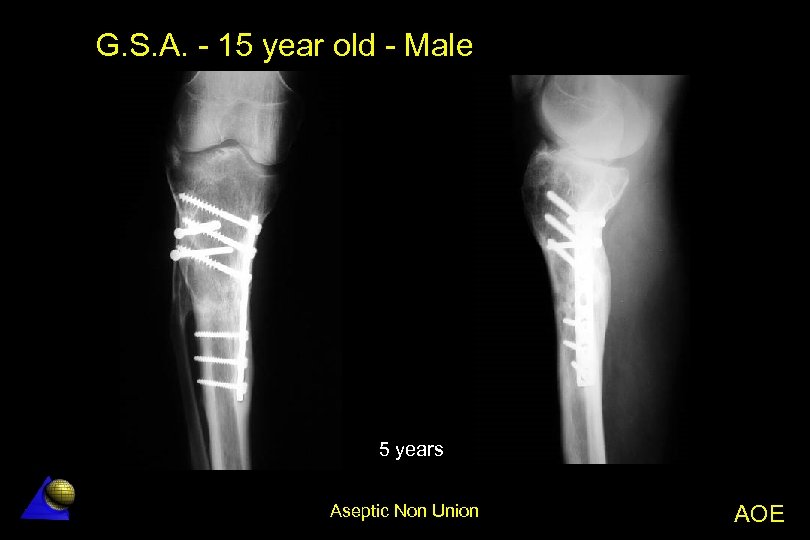 G. S. A. - 15 year old - Male 5 years Aseptic Non Union AOE
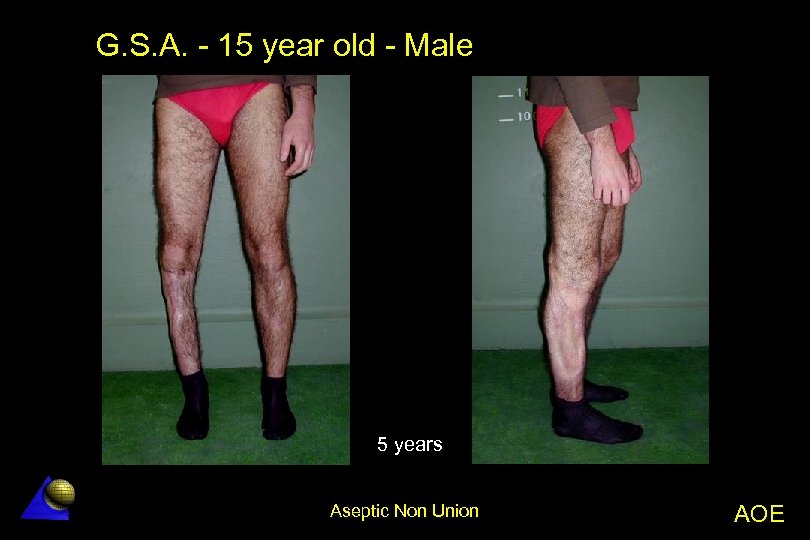 G. S. A. - 15 year old - Male 5 years Aseptic Non Union AOE
 Aseptic Non Union AOE