 Скачать презентацию ASCCC Noncredit Spring Accountability Telling the Noncredit Story
820add51c0f1313e31fd4be3d1ce87b7.ppt
- Количество слайдов: 60



ASCCC Noncredit Spring Accountability Telling the Noncredit Story through Accountability Reporting
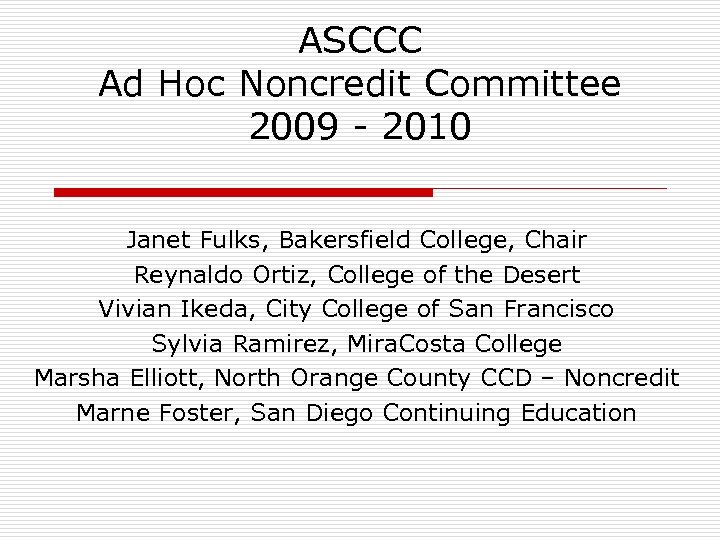
ASCCC Ad Hoc Noncredit Committee 2009 - 2010 Janet Fulks, Bakersfield College, Chair Reynaldo Ortiz, College of the Desert Vivian Ikeda, City College of San Francisco Sylvia Ramirez, Mira. Costa College Marsha Elliott, North Orange County CCD – Noncredit Marne Foster, San Diego Continuing Education
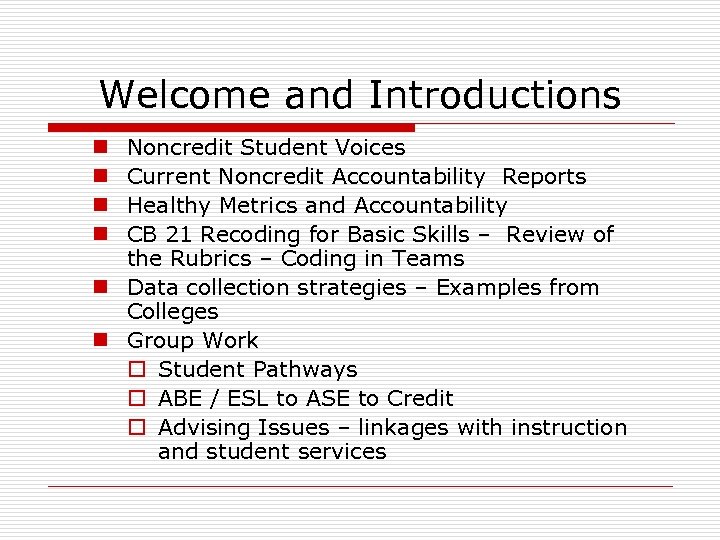
Welcome and Introductions Noncredit Student Voices Current Noncredit Accountability Reports Healthy Metrics and Accountability CB 21 Recoding for Basic Skills – Review of the Rubrics – Coding in Teams n Data collection strategies – Examples from Colleges n Group Work o Student Pathways o ABE / ESL to ASE to Credit o Advising Issues – linkages with instruction and student services n n
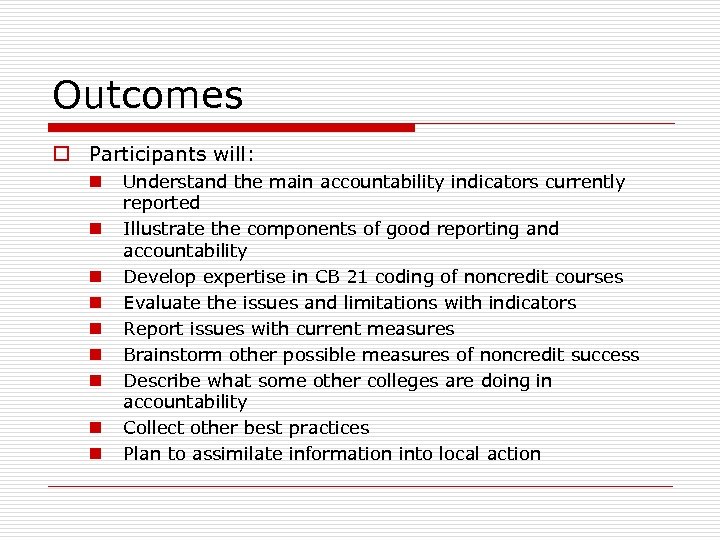
Outcomes o Participants will: n n n n n Understand the main accountability indicators currently reported Illustrate the components of good reporting and accountability Develop expertise in CB 21 coding of noncredit courses Evaluate the issues and limitations with indicators Report issues with current measures Brainstorm other possible measures of noncredit success Describe what some other colleges are doing in accountability Collect other best practices Plan to assimilate information into local action
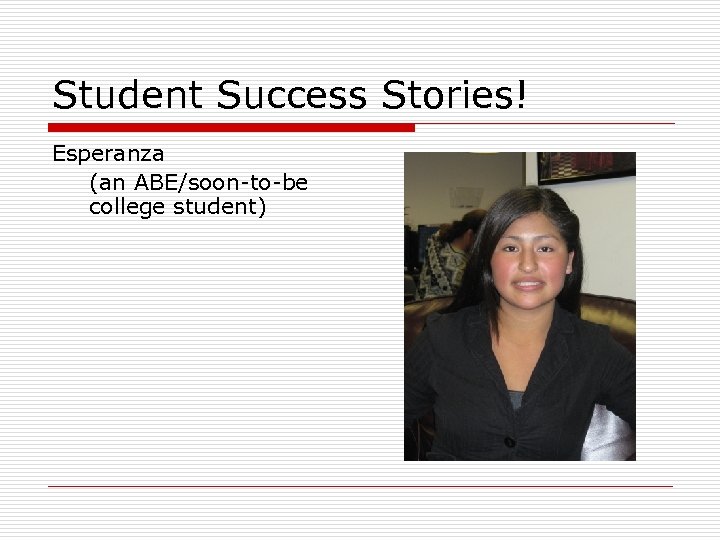
Student Success Stories! Esperanza (an ABE/soon-to-be college student)
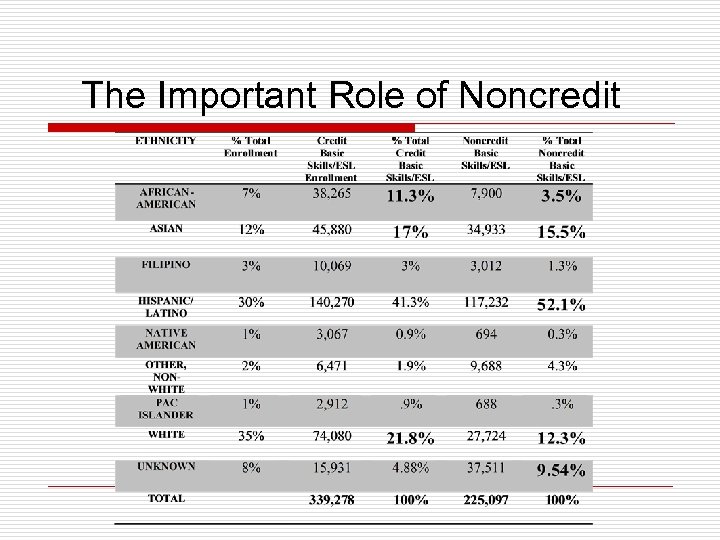
The Important Role of Noncredit
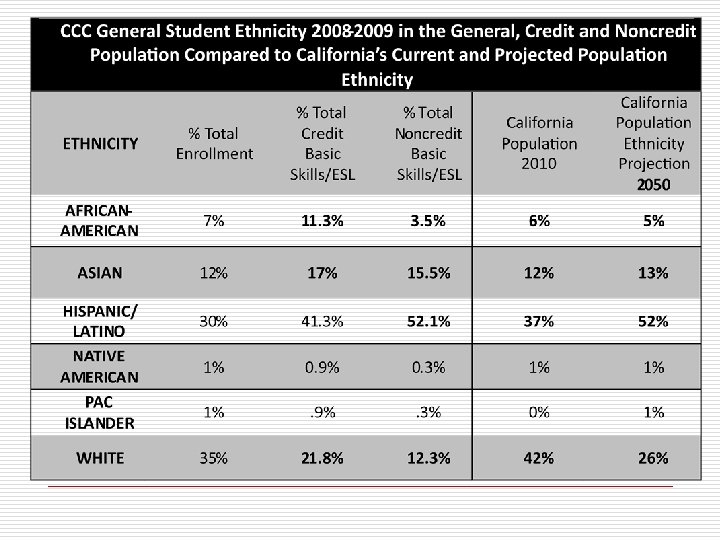
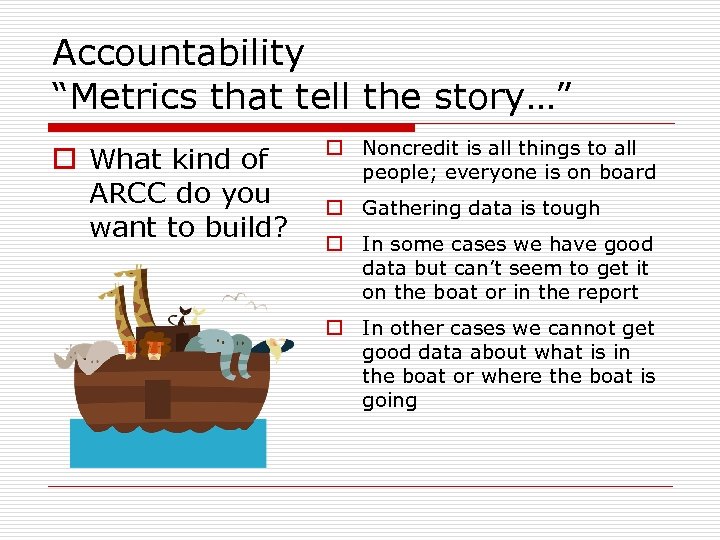
Accountability “Metrics that tell the story…” o What kind of ARCC do you want to build? o Noncredit is all things to all people; everyone is on board o Gathering data is tough o In some cases we have good data but can’t seem to get it on the boat or in the report o In other cases we cannot get good data about what is in the boat or where the boat is going
Considering Accountability Healthy accountability should: o Address higher level learning outcomes o Report on authentic student proficiencies o Indicate potential interventions and improvement o Target improved practice not just reporting
In Credit Education How Have We Defined Accountability? Previously o Credit attached to units o Grades o Degrees, certificates Now – What are students able to do? o Student learning outcomes
The Puzzle of Accountability Current statewide data o only 2. 3 – 5. 1% of noncredit students transition to credit o All noncredit courses without grades report zero success. Is this the noncredit story?
The Puzzle of Accountability Noncredit needs to: o Describe noncredit work for funding and accountability o Explain how and why noncredit is different from credit o Identify metrics that reflect the work of noncredit o Go beyond reporting numbers n Numbers may measure what you want – or may not n Numbers without context are misleading n Numbers don’t correct problems n Qualitative data is essential n Most noncredit programs have no researcher
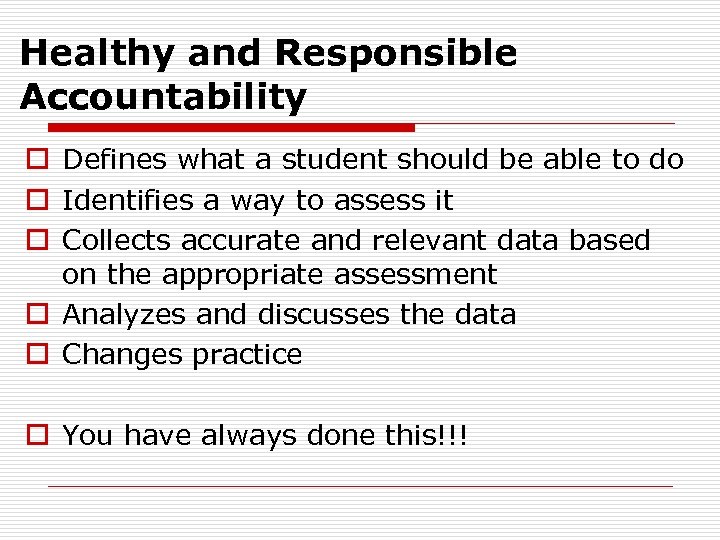
Healthy and Responsible Accountability o Defines what a student should be able to do o Identifies a way to assess it o Collects accurate and relevant data based on the appropriate assessment o Analyzes and discusses the data o Changes practice o You have always done this!!!
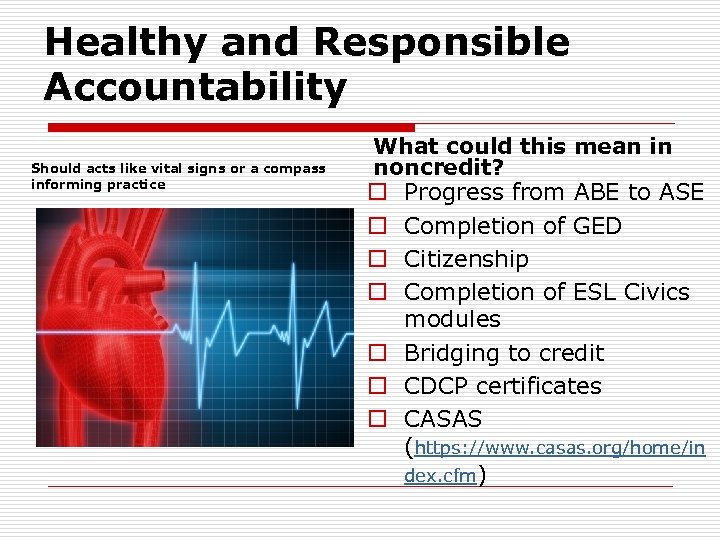
Healthy and Responsible Accountability Should acts like vital signs or a compass informing practice What could this mean in noncredit? o Progress from ABE to ASE o Completion of GED o Citizenship o Completion of ESL Civics modules o Bridging to credit o CDCP certificates o CASAS (https: //www. casas. org/home/in dex. cfm)
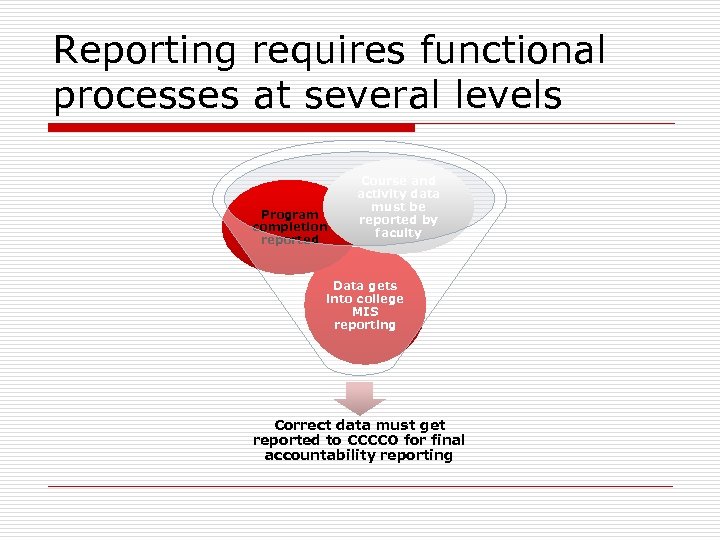
Reporting requires functional processes at several levels Program completion reported Course and activity data must be reported by faculty Data gets into college MIS reporting Correct data must get reported to CCCCO for final accountability reporting
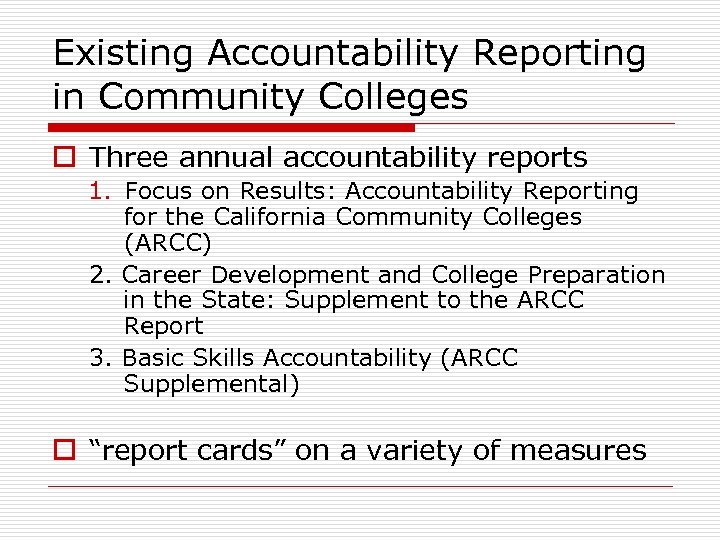
Existing Accountability Reporting in Community Colleges o Three annual accountability reports 1. Focus on Results: Accountability Reporting for the California Community Colleges (ARCC) 2. Career Development and College Preparation in the State: Supplement to the ARCC Report 3. Basic Skills Accountability (ARCC Supplemental) o “report cards” on a variety of measures
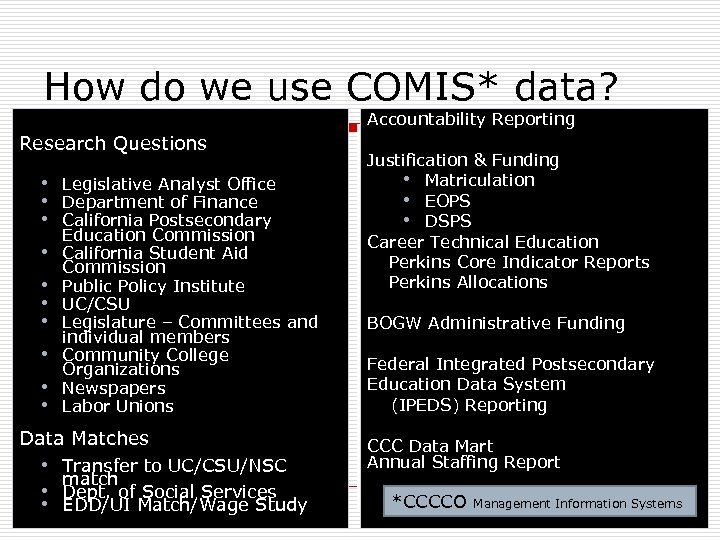
How do we use COMIS* data? Accountability Reporting Research Questions Mandated Reporting • • o • • Legislative Analyst Office Department of Finance Accountability Reporting California Postsecondary (ARCC, ARCC Education Commission supplemental, etc) California Student Aid Commission Career Technical Education Public Policy Institute (CTE) UC/CSU n Perkins Core Indicator Legislature – Committees and Reports individual members Community College n Perkins Allocations Organizations Justification & Funding Newspapers n Matriculation Labor Unions n EOPS Data Matches n DSPS • BOGW Administrative o Transfer to UC/CSU/NSC match • Dept. of Social Services Funding • EDD/UI Match/Wage Study * Chancellor’s Office MIS Data Other Reporting Justification & Funding • Matriculation EOPS • Federal • DSPS Integrated Postsecondary Career Technical Education Data System Perkins Core Indicator Reports (IPEDS) Reporting Perkins Allocations BOGW Administrative Funding CCC Data Mart Federal Integrated Postsecondary Annual Staffing Report Education Data System (IPEDS) Reporting CCC Data Mart Annual Staffing Report 17 *CCCCO Management Information Systems
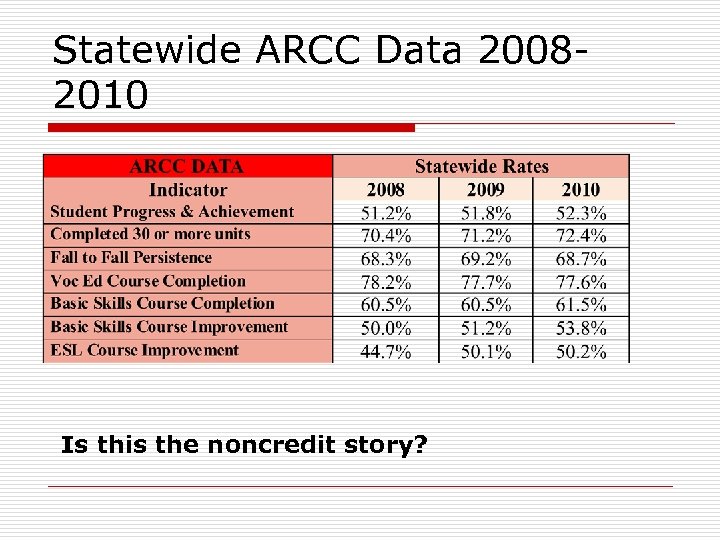
Statewide ARCC Data 20082010 Is this the noncredit story?
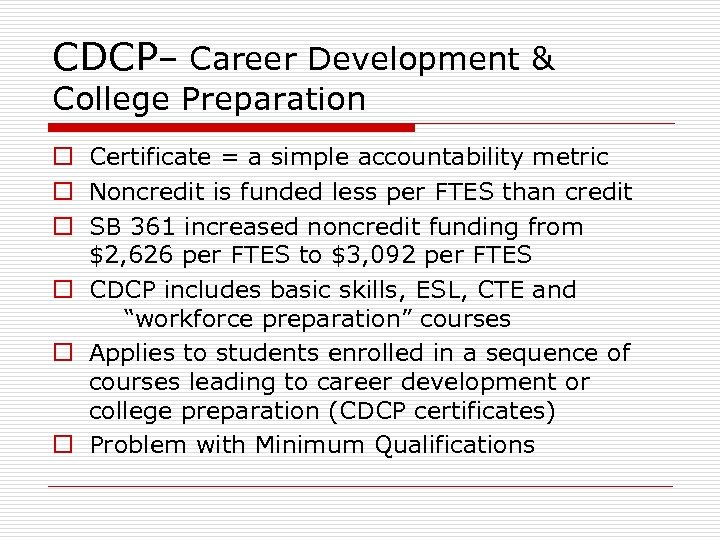
CDCP– Career Development & College Preparation o Certificate = a simple accountability metric o Noncredit is funded less per FTES than credit o SB 361 increased noncredit funding from $2, 626 per FTES to $3, 092 per FTES o CDCP includes basic skills, ESL, CTE and “workforce preparation” courses o Applies to students enrolled in a sequence of courses leading to career development or college preparation (CDCP certificates) o Problem with Minimum Qualifications
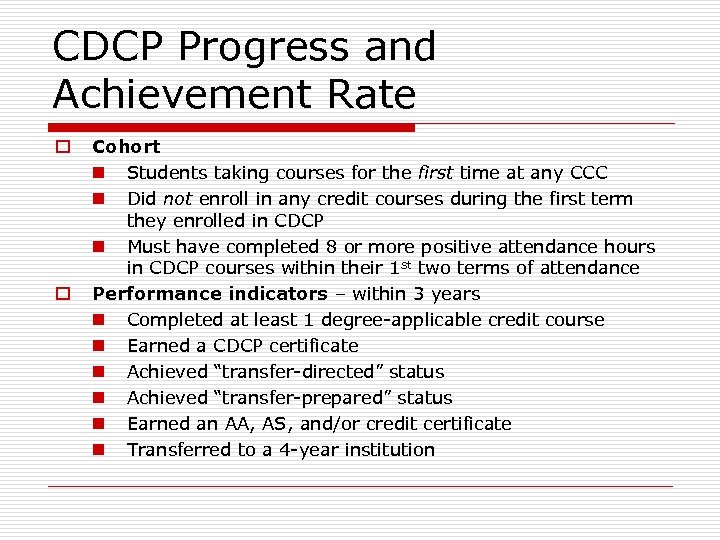
CDCP Progress and Achievement Rate o o Cohort n Students taking courses for the first time at any CCC n Did not enroll in any credit courses during the first term they enrolled in CDCP n Must have completed 8 or more positive attendance hours in CDCP courses within their 1 st two terms of attendance Performance indicators – within 3 years n Completed at least 1 degree-applicable credit course n Earned a CDCP certificate n Achieved “transfer-directed” status n Achieved “transfer-prepared” status n Earned an AA, AS, and/or credit certificate n Transferred to a 4 -year institution
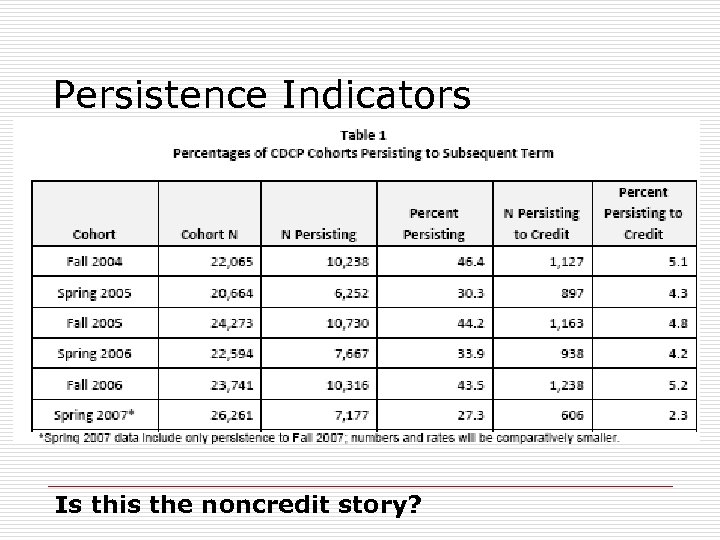
Persistence Indicators Is this the noncredit story?
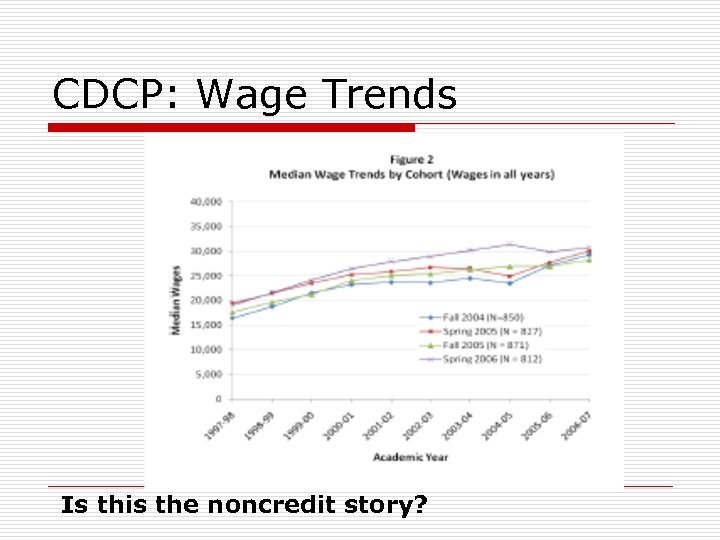
CDCP: Wage Trends Is this the noncredit story?
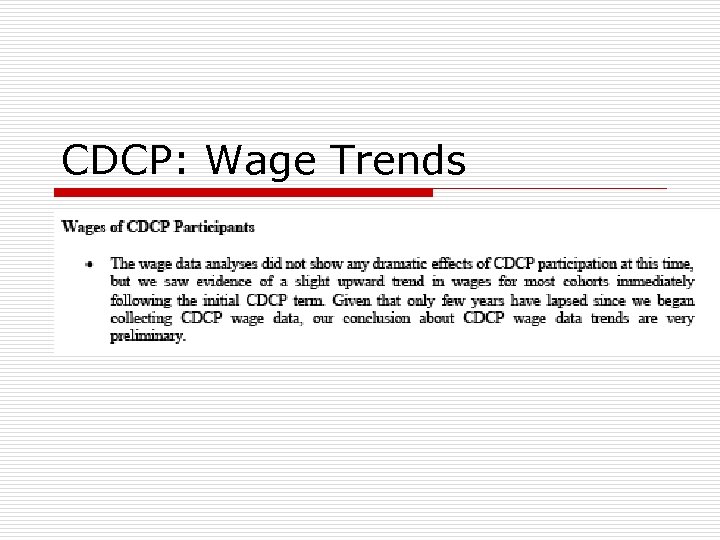
CDCP: Wage Trends
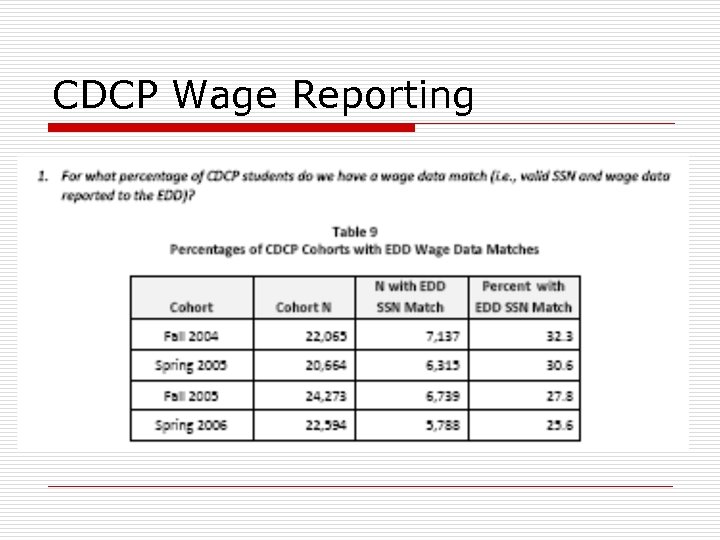
CDCP Wage Reporting
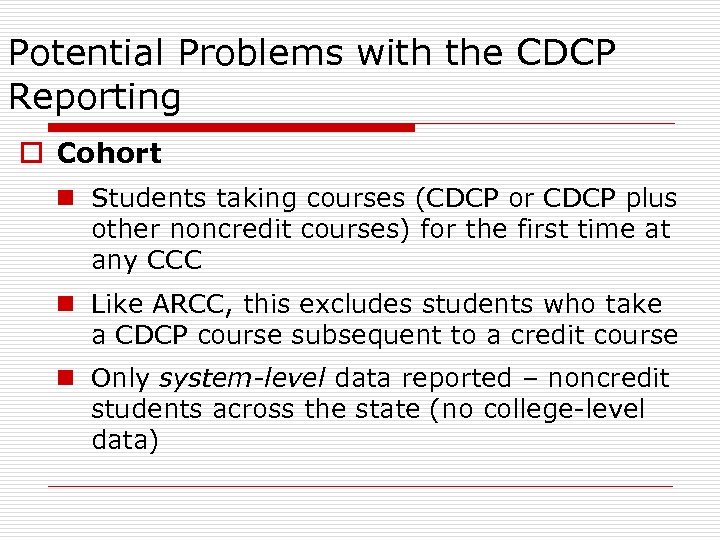
Potential Problems with the CDCP Reporting o Cohort n Students taking courses (CDCP or CDCP plus other noncredit courses) for the first time at any CCC n Like ARCC, this excludes students who take a CDCP course subsequent to a credit course n Only system-level data reported – noncredit students across the state (no college-level data)
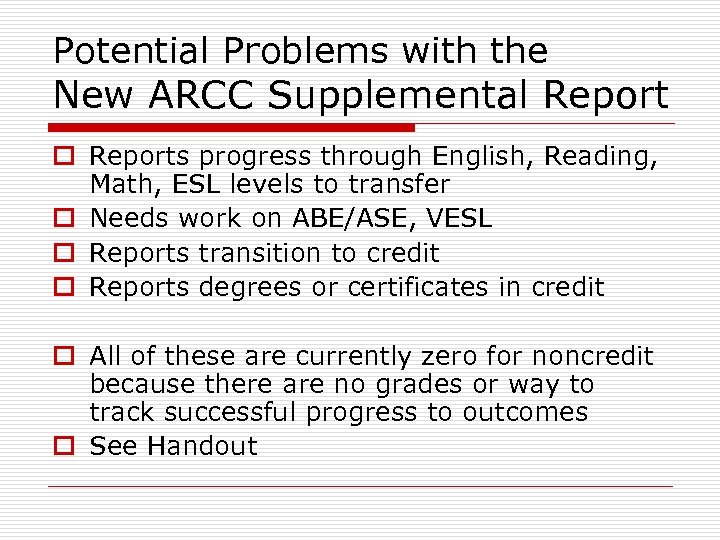
Potential Problems with the New ARCC Supplemental Report o Reports progress through English, Reading, Math, ESL levels to transfer o Needs work on ABE/ASE, VESL o Reports transition to credit o Reports degrees or certificates in credit o All of these are currently zero for noncredit because there are no grades or way to track successful progress to outcomes o See Handout
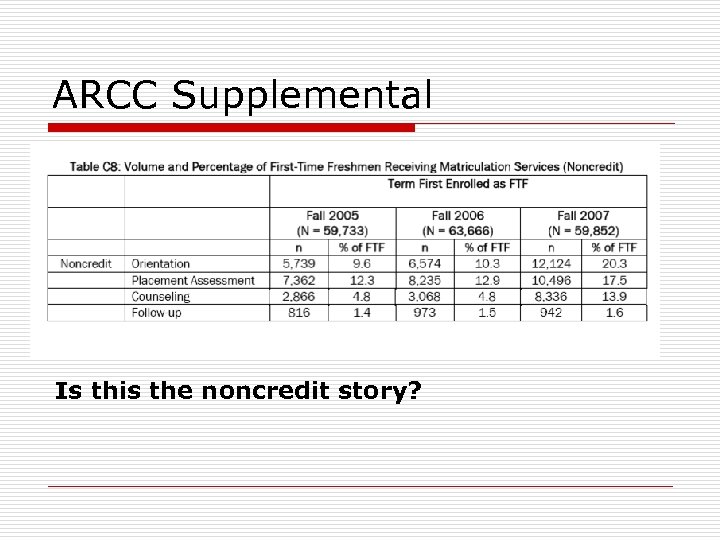
ARCC Supplemental Is this the noncredit story?
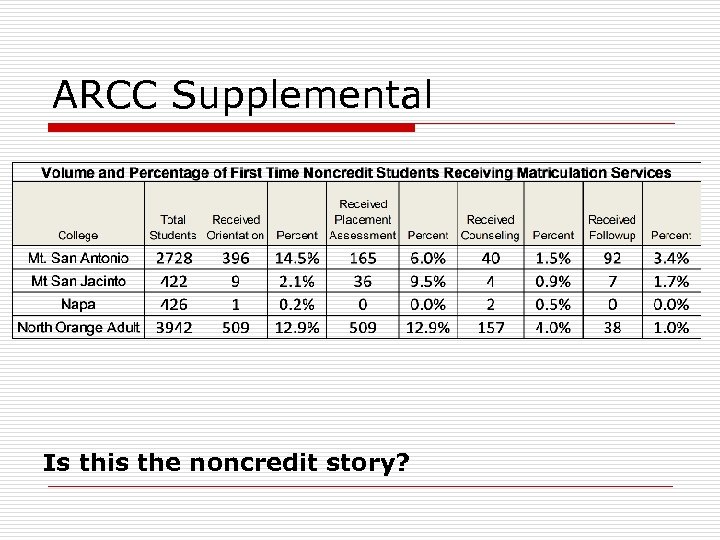
ARCC Supplemental Is this the noncredit story?
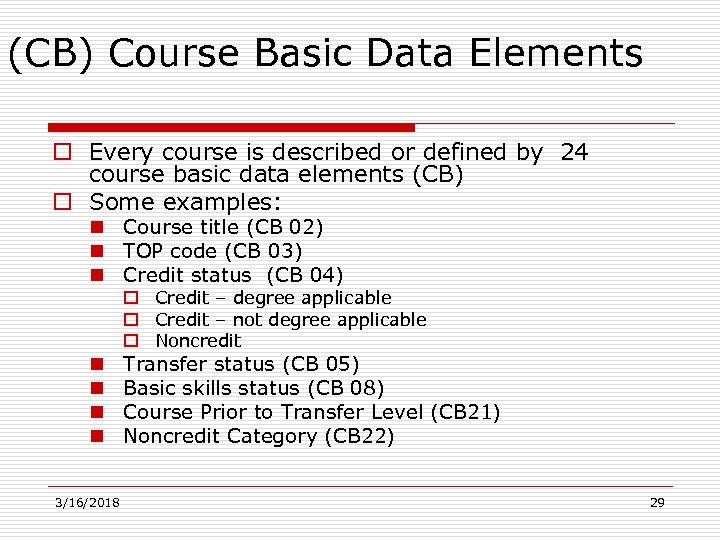
(CB) Course Basic Data Elements o Every course is described or defined by 24 course basic data elements (CB) o Some examples: n Course title (CB 02) n TOP code (CB 03) n Credit status (CB 04) o Credit – degree applicable o Credit – not degree applicable o Noncredit n n 3/16/2018 Transfer status (CB 05) Basic skills status (CB 08) Course Prior to Transfer Level (CB 21) Noncredit Category (CB 22) 29
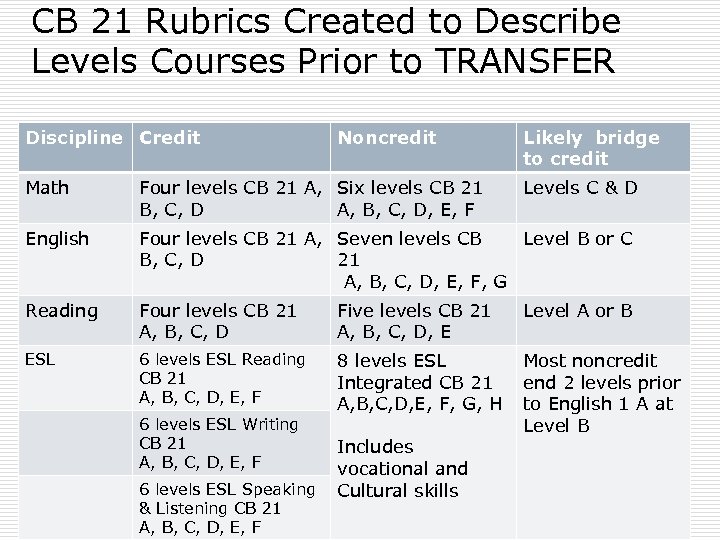
CB 21 Rubrics Created to Describe Levels Courses Prior to TRANSFER Discipline Credit Noncredit Likely bridge to credit Math Four levels CB 21 A, Six levels CB 21 B, C, D A, B, C, D, E, F English Four levels CB 21 A, Seven levels CB Level B or C B, C, D 21 A, B, C, D, E, F, G Reading Four levels CB 21 A, B, C, D Five levels CB 21 A, B, C, D, E Level A or B ESL 6 levels ESL Reading CB 21 A, B, C, D, E, F 8 levels ESL Integrated CB 21 A, B, C, D, E, F, G, H Most noncredit end 2 levels prior to English 1 A at Level B 6 levels ESL Writing CB 21 A, B, C, D, E, F Includes vocational and 6 levels ESL Speaking Cultural skills Student Success Conference 2009 & Listening CB 21 A, B, C, D, E, F Levels C & D 30
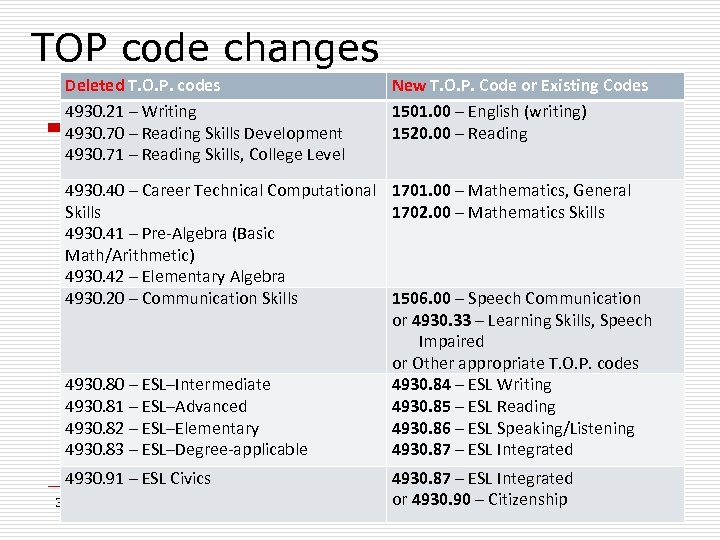
TOP code changes Deleted T. O. P. codes 4930. 21 – Writing 4930. 70 – Reading Skills Development 4930. 71 – Reading Skills, College Level New T. O. P. Code or Existing Codes 1501. 00 – English (writing) 1520. 00 – Reading 4930. 40 – Career Technical Computational 1701. 00 – Mathematics, General Skills 1702. 00 – Mathematics Skills 4930. 41 – Pre-Algebra (Basic Math/Arithmetic) 4930. 42 – Elementary Algebra 4930. 20 – Communication Skills 1506. 00 – Speech Communication or 4930. 33 – Learning Skills, Speech Impaired or Other appropriate T. O. P. codes 4930. 80 – ESL–Intermediate 4930. 84 – ESL Writing 4930. 81 – ESL–Advanced 4930. 85 – ESL Reading 4930. 82 – ESL–Elementary 4930. 86 – ESL Speaking/Listening 4930. 83 – ESL–Degree-applicable 4930. 87 – ESL Integrated 4930. 91 – ESL Civics 3/16/2018 4930. 87 – ESL Integrated or 4930. 90 – Citizenship 31
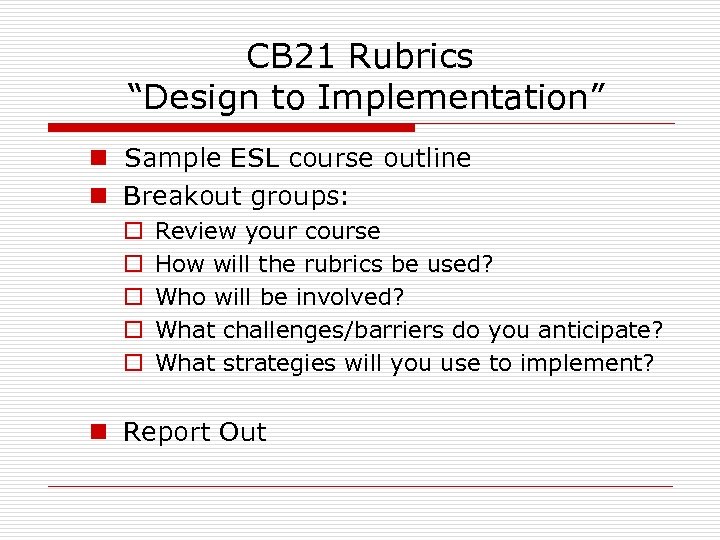
CB 21 Rubrics “Design to Implementation” n Sample ESL course outline n Breakout groups: o o o Review your course How will the rubrics be used? Who will be involved? What challenges/barriers do you anticipate? What strategies will you use to implement? n Report Out
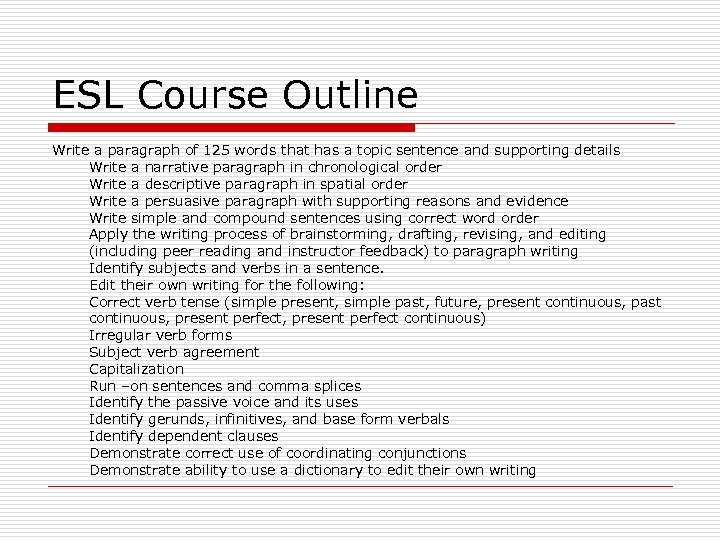
ESL Course Outline Write a paragraph of 125 words that has a topic sentence and supporting details Write a narrative paragraph in chronological order Write a descriptive paragraph in spatial order Write a persuasive paragraph with supporting reasons and evidence Write simple and compound sentences using correct word order Apply the writing process of brainstorming, drafting, revising, and editing (including peer reading and instructor feedback) to paragraph writing Identify subjects and verbs in a sentence. Edit their own writing for the following: Correct verb tense (simple present, simple past, future, present continuous, past continuous, present perfect continuous) Irregular verb forms Subject verb agreement Capitalization Run –on sentences and comma splices Identify the passive voice and its uses Identify gerunds, infinitives, and base form verbals Identify dependent clauses Demonstrate correct use of coordinating conjunctions Demonstrate ability to use a dictionary to edit their own writing
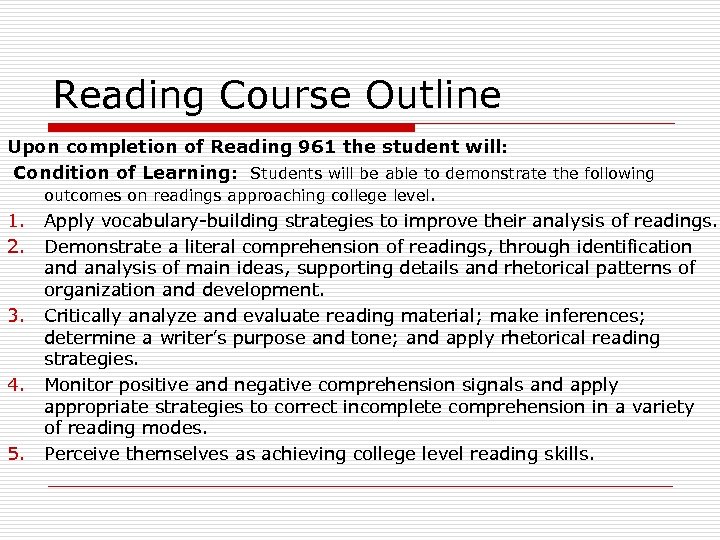
Reading Course Outline Upon completion of Reading 961 the student will: Condition of Learning: Students will be able to demonstrate the following outcomes on readings approaching college level. 1. Apply vocabulary-building strategies to improve their analysis of readings. 2. Demonstrate a literal comprehension of readings, through identification and analysis of main ideas, supporting details and rhetorical patterns of organization and development. 3. Critically analyze and evaluate reading material; make inferences; determine a writer’s purpose and tone; and apply rhetorical reading strategies. 4. Monitor positive and negative comprehension signals and apply appropriate strategies to correct incomplete comprehension in a variety of reading modes. 5. Perceive themselves as achieving college level reading skills.
CB 21 o Coding the CB 21 information o Problems o Feedback on rubrics
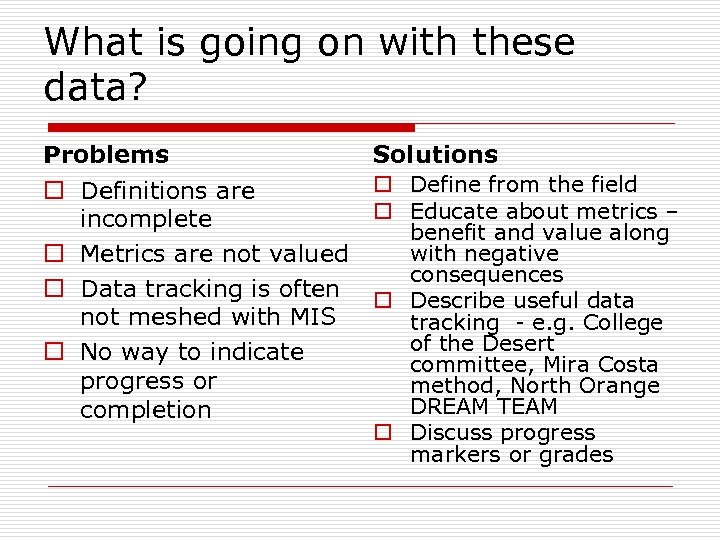
What is going on with these data? Problems Solutions o Define from the field o Definitions are o Educate about metrics – incomplete benefit and value along with negative o Metrics are not valued consequences o Data tracking is often o Describe useful data not meshed with MIS tracking - e. g. College of the Desert o No way to indicate committee, Mira Costa progress or method, North Orange DREAM TEAM completion o Discuss progress markers or grades
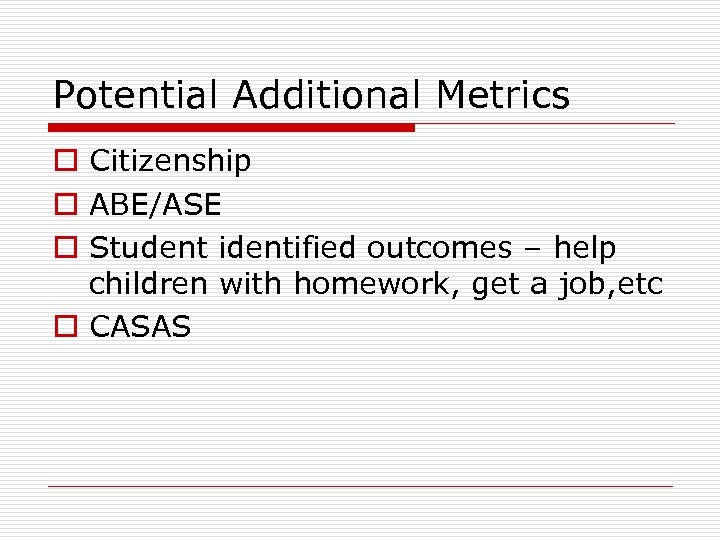
Potential Additional Metrics o Citizenship o ABE/ASE o Student identified outcomes – help children with homework, get a job, etc o CASAS
Examples of Solutions to these Accountability Problems Is this REALLY the NONCREDIT Story? College of the Desert San Diego Continuing Education School of Continuing Education NOCCCD o Mira. Costa Lunch 12 -12: 30 and come back for the solutions and local college work o o
Is This Really. Our Story? o College of the Desert
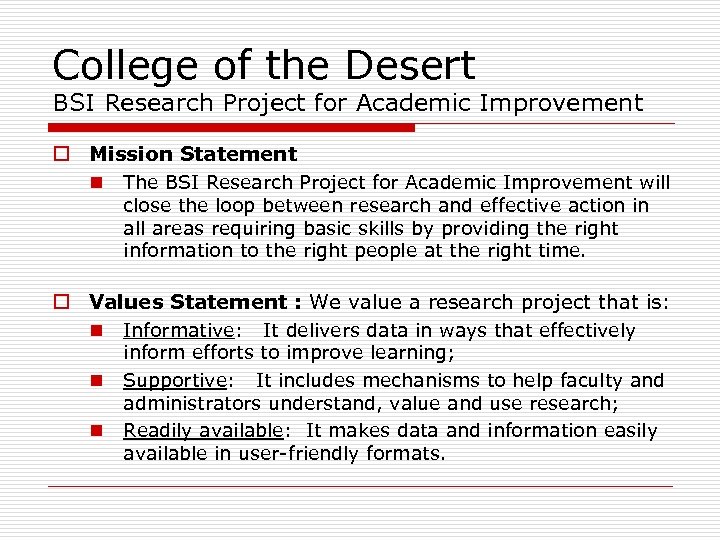
College of the Desert BSI Research Project for Academic Improvement o Mission Statement n The BSI Research Project for Academic Improvement will close the loop between research and effective action in all areas requiring basic skills by providing the right information to the right people at the right time. o Values Statement : We value a research project that is: n Informative: It delivers data in ways that effectively n n inform efforts to improve learning; Supportive: It includes mechanisms to help faculty and administrators understand, value and use research; Readily available: It makes data and information easily available in user-friendly formats.
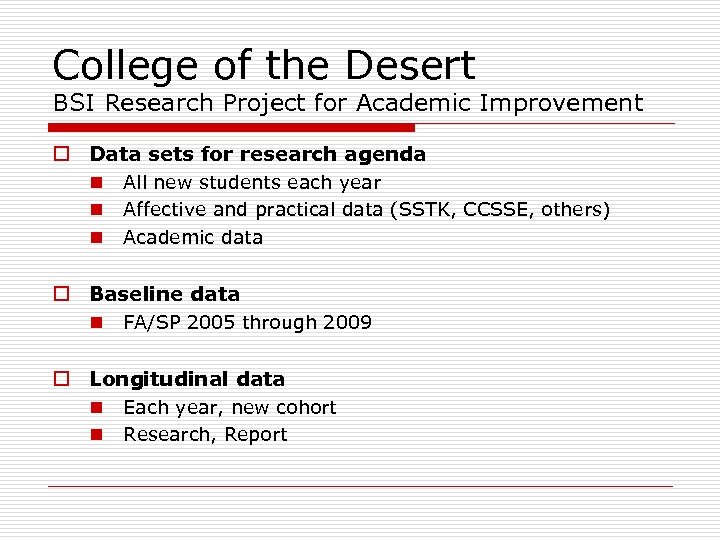
College of the Desert BSI Research Project for Academic Improvement o Data sets for research agenda n All new students each year n Affective and practical data (SSTK, CCSSE, others) n Academic data o Baseline data n FA/SP 2005 through 2009 o Longitudinal data n Each year, new cohort n Research, Report
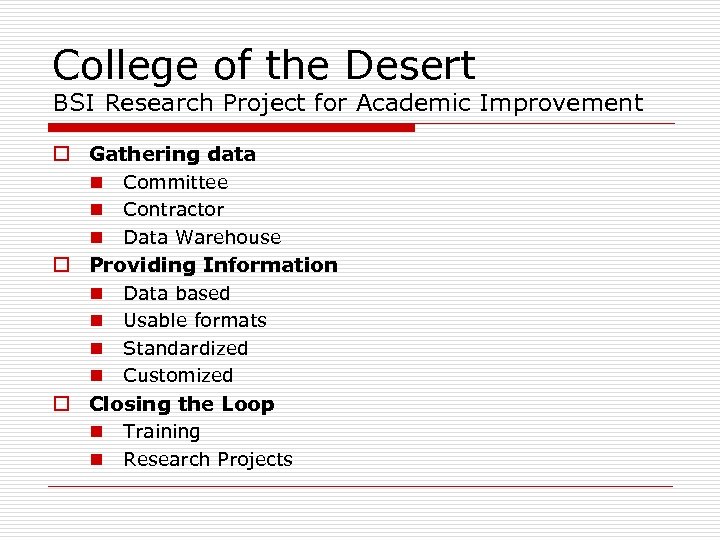
College of the Desert BSI Research Project for Academic Improvement o Gathering data n Committee n Contractor n Data Warehouse o Providing Information n Data based n Usable formats n Standardized n Customized o Closing the Loop n Training n Research Projects
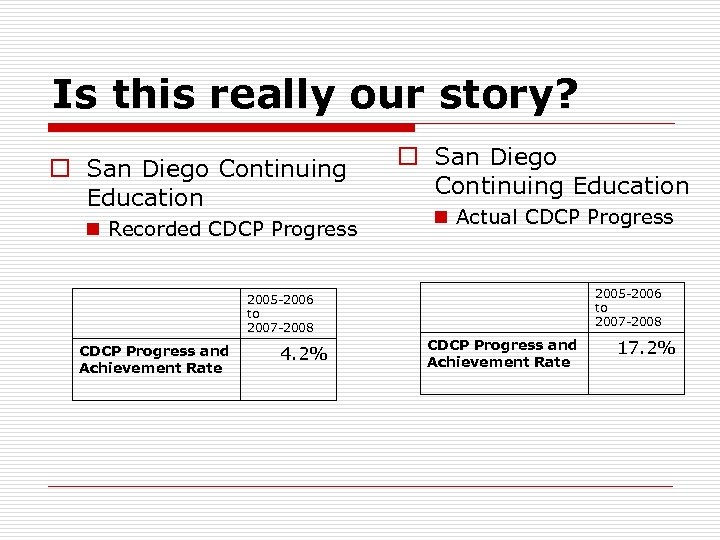
Is this really our story? o San Diego Continuing Education n Recorded CDCP Progress o San Diego Continuing Education n Actual CDCP Progress 2005 -2006 to 2007 -2008 CDCP Progress and Achievement Rate 4. 2% CDCP Progress and Achievement Rate 17. 2%
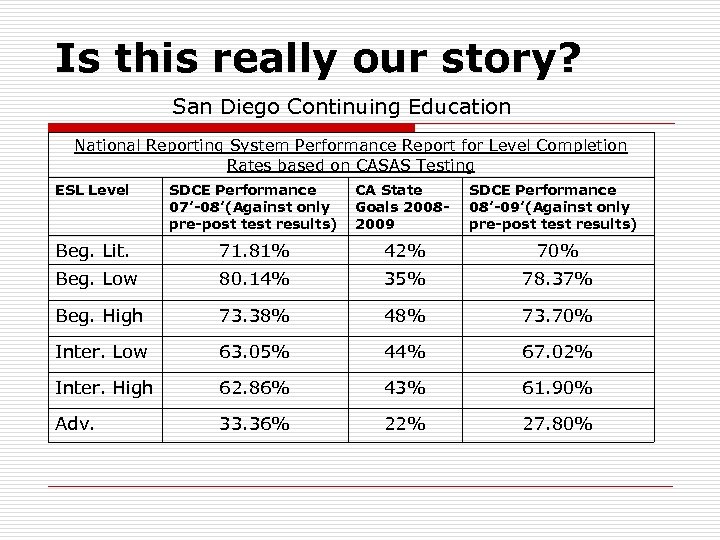
Is this really our story? San Diego Continuing Education National Reporting System Performance Report for Level Completion Rates based on CASAS Testing ESL Level SDCE Performance 07’-08’(Against only pre-post test results) CA State Goals 20082009 SDCE Performance 08’-09’(Against only pre-post test results) Beg. Lit. 71. 81% 42% 70% Beg. Low 80. 14% 35% 78. 37% Beg. High 73. 38% 48% 73. 70% Inter. Low 63. 05% 44% 67. 02% Inter. High 62. 86% 43% 61. 90% Adv. 33. 36% 22% 27. 80%
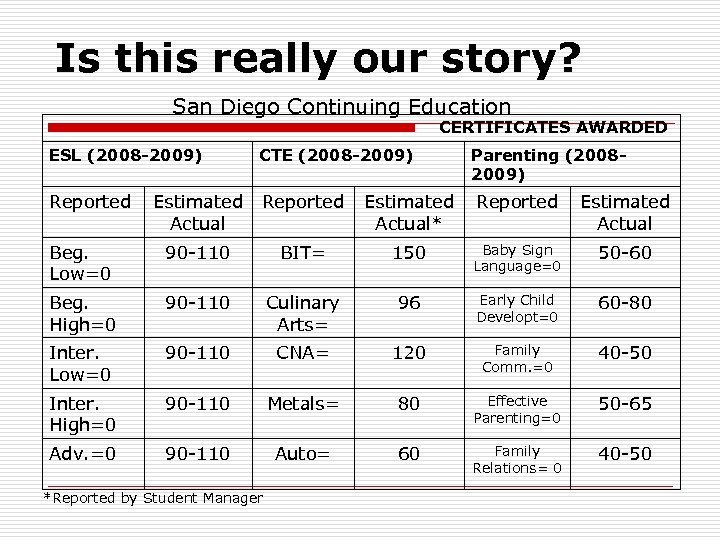
Is this really our story? San Diego Continuing Education CERTIFICATES AWARDED ESL (2008 -2009) Reported CTE (2008 -2009) Estimated Reported Actual Parenting (20082009) Estimated Reported Actual* Estimated Actual Beg. Low=0 90 -110 BIT= 150 Baby Sign Language=0 50 -60 Beg. High=0 90 -110 Culinary Arts= 96 Early Child Developt=0 60 -80 Inter. Low=0 90 -110 CNA= 120 Family Comm. =0 40 -50 Inter. High=0 90 -110 Metals= 80 Effective Parenting=0 50 -65 Adv. =0 90 -110 Auto= 60 Family Relations= 0 40 -50 *Reported by Student Manager
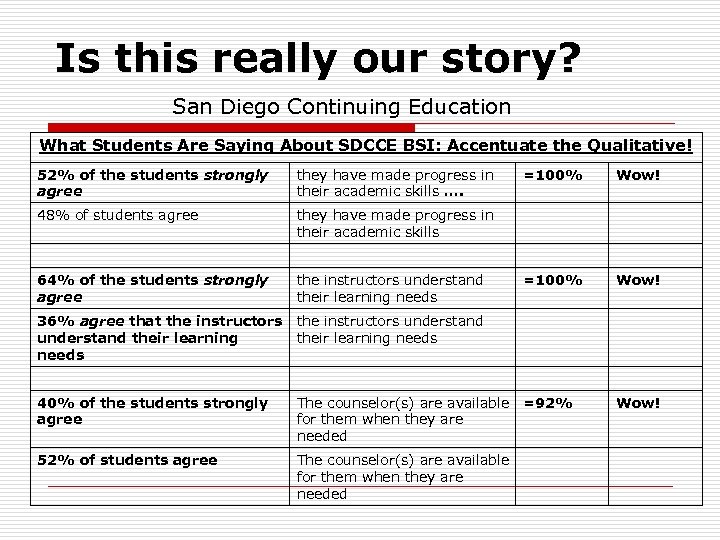
Is this really our story? San Diego Continuing Education What Students Are Saying About SDCCE BSI: Accentuate the Qualitative! 52% of the students strongly agree they have made progress in their academic skills …. 48% of students agree they have made progress in their academic skills 64% of the students strongly agree the instructors understand their learning needs =100% Wow! 36% agree that the instructors understand their learning needs 40% of the students strongly agree The counselor(s) are available =92% for them when they are needed 52% of students agree The counselor(s) are available for them when they are needed Wow!
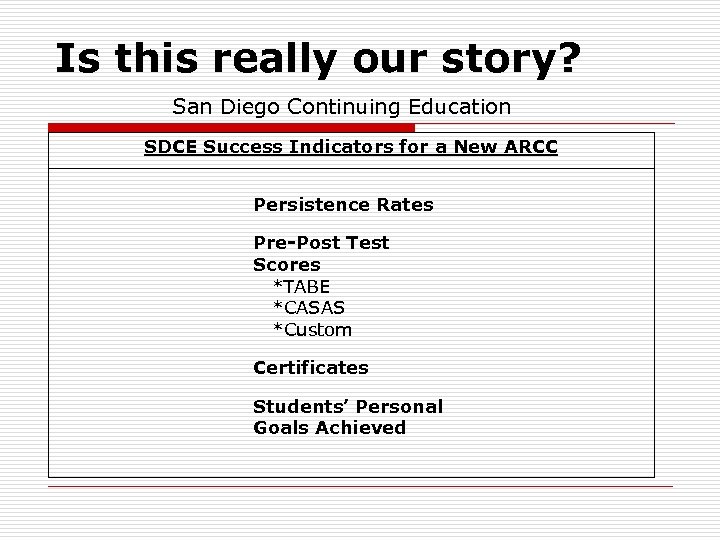
Is this really our story? San Diego Continuing Education SDCE Success Indicators for a New ARCC Persistence Rates Pre-Post Test Scores *TABE *CASAS *Custom Certificates Students’ Personal Goals Achieved
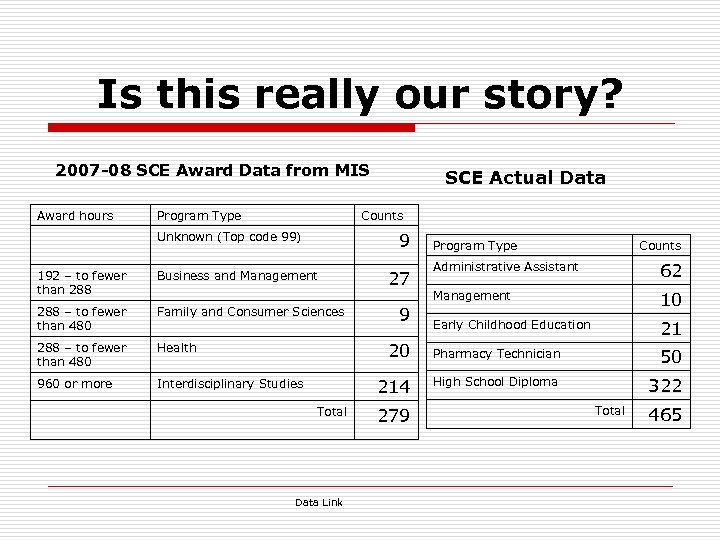
Is this really our story? 2007 -08 SCE Award Data from MIS Award hours Program Type SCE Actual Data Counts 9 Unknown (Top code 99) Program Type Counts 288 – to fewer than 480 Family and Consumer Sciences 288 – to fewer than 480 Health 960 or more Interdisciplinary Studies Total Data Link 62 Management 10 Early Childhood Education 21 Pharmacy Technician 50 214 Business and Management Administrative Assistant 20 192 – to fewer than 288 High School Diploma 322 27 9 279 Total 465
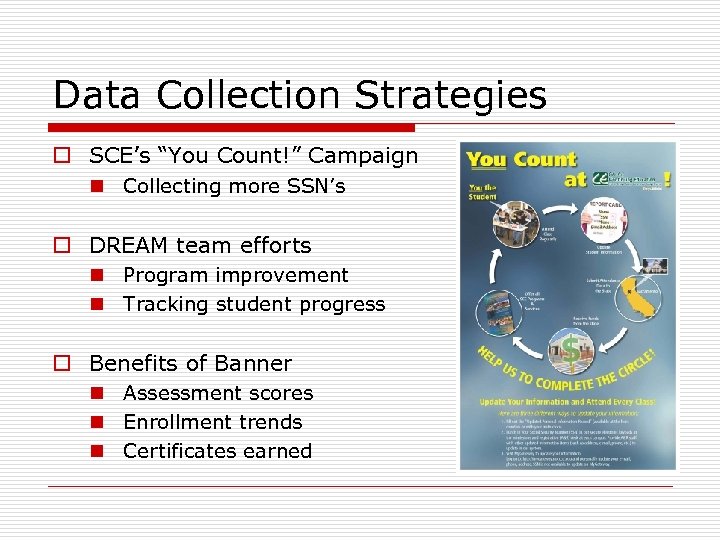
Data Collection Strategies o SCE’s “You Count!” Campaign n Collecting more SSN’s o DREAM team efforts n Program improvement n Tracking student progress o Benefits of Banner n Assessment scores n Enrollment trends n Certificates earned
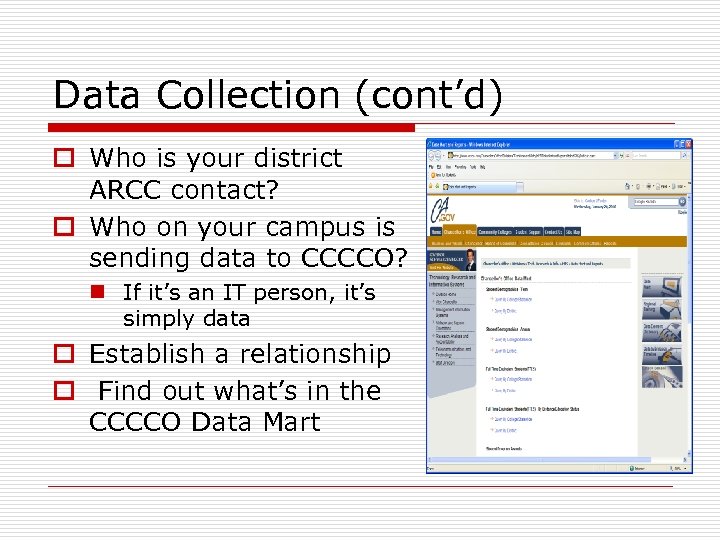
Data Collection (cont’d) o Who is your district ARCC contact? o Who on your campus is sending data to CCCCO? n If it’s an IT person, it’s simply data o Establish a relationship o Find out what’s in the CCCCO Data Mart
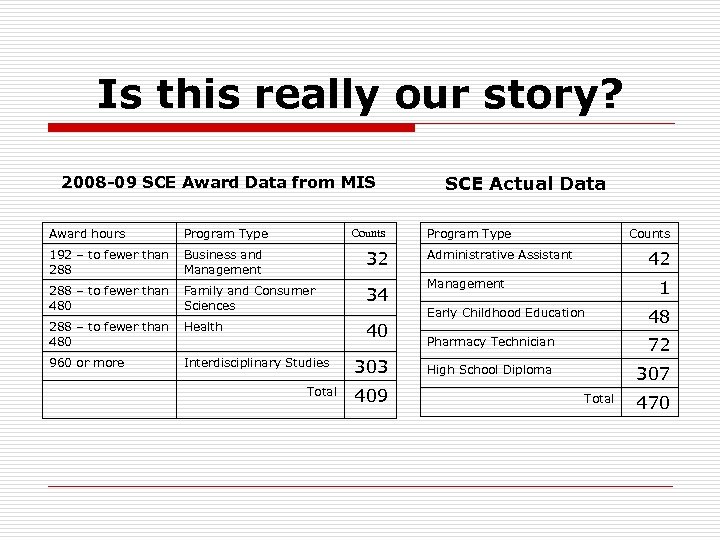
Is this really our story? 2008 -09 SCE Award Data from MIS Award hours Program Type Counts 192 – to fewer than Business and 288 Management 32 288 – to fewer than Family and Consumer 480 Sciences 34 288 – to fewer than Health 480 40 960 or more Interdisciplinary Studies Total 303 409 SCE Actual Data Program Type Counts 42 Administrative Assistant 1 Management Early Childhood Education 48 Pharmacy Technician 72 High School Diploma 307 Total 470
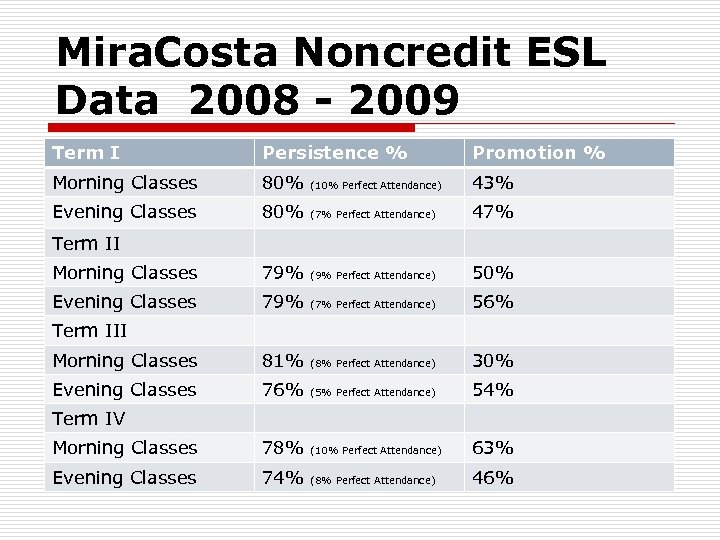
Mira. Costa Noncredit ESL Data 2008 - 2009 Term I Persistence % Promotion % Morning Classes 80% (10% Perfect Attendance) 43% Evening Classes 80% (7% Perfect Attendance) 47% Morning Classes 79% (9% Perfect Attendance) 50% Evening Classes 79% (7% Perfect Attendance) 56% Morning Classes 81% (8% Perfect Attendance) 30% Evening Classes 76% (5% Perfect Attendance) 54% Morning Classes 78% (10% Perfect Attendance) 63% Evening Classes 74% (8% Perfect Attendance) 46% Term III Term IV
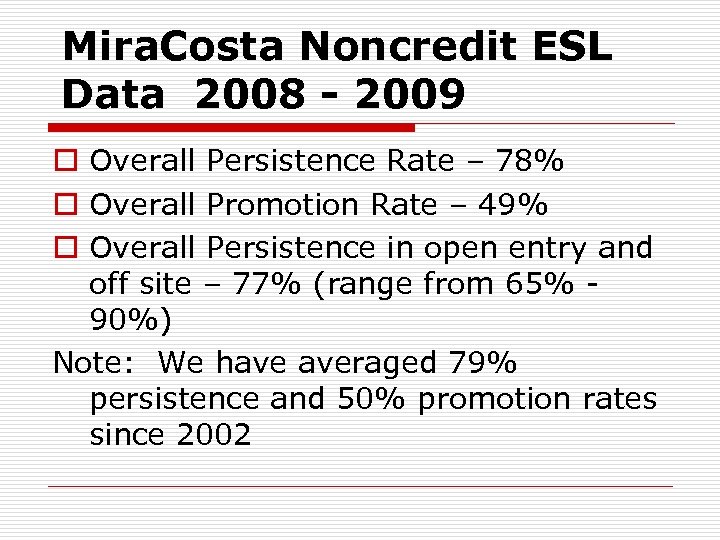
Mira. Costa Noncredit ESL Data 2008 - 2009 o Overall Persistence Rate – 78% o Overall Promotion Rate – 49% o Overall Persistence in open entry and off site – 77% (range from 65% - 90%) Note: We have averaged 79% persistence and 50% promotion rates since 2002
Mira. Costa Noncredit ESL Data 2008 - 2009 We also report: 1) FTES and CASAS Benchmarks https: //www. casas. org/home/index. cfm 1) Statewide Performance Goals and our actual performance 2) Drop out/Stop out reasons 3) Demographics 4) Student Learning Outcome Data (SLOs)
Mira. Costa Noncredit ESL Data Does it make a difference? The Superintendent/President of our college wrote, “This is an outstanding newsletter highlighting the outstanding work of our ESL colleagues. Congratulations and please extend my thanks to our folks in ESL. ” We think it does!
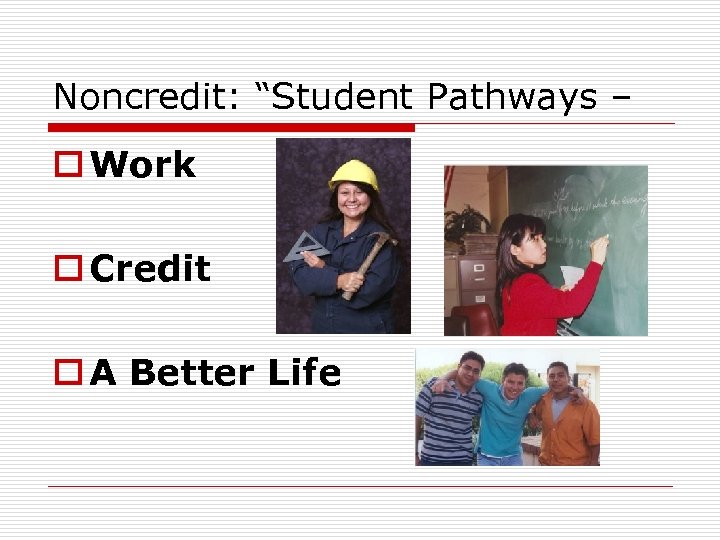
Noncredit: “Student Pathways – o Work o Credit o A Better Life
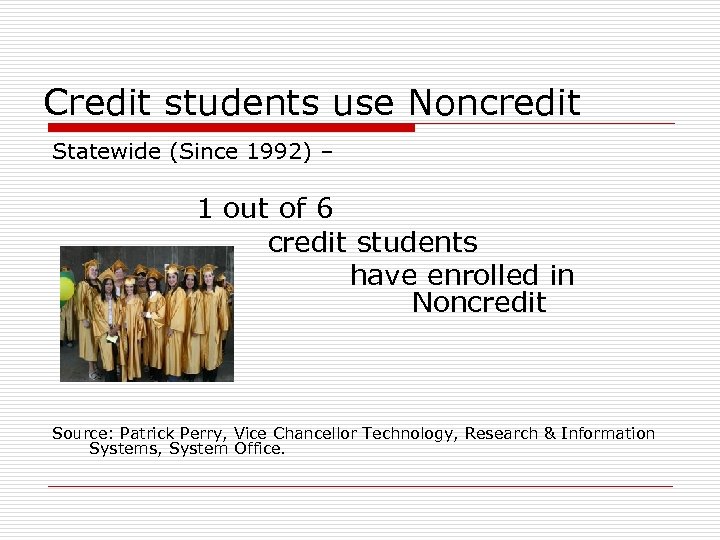
Credit students use Noncredit Statewide (Since 1992) – 1 out of 6 credit students have enrolled in Noncredit Source: Patrick Perry, Vice Chancellor Technology, Research & Information Systems, System Office.
Linking Noncredit to Credit Instruction o o o Individual Quick Write: Three Guiding Questions What are the critical skills my noncredit students require to successfully transition to credit academic and vocational courses? What has my college done to establish pathways for students to transition from noncredit to credit academic and vocational courses? What are the obstacles? What has worked well? How do I define my role in assisting students in my program transition to credit academic and vocational courses? Panel Presentation of current projects that promote the successful transitions from noncredit to credit academic and vocational courses. Discussion Groups Small group discussion, having participants share/discuss the Three Guiding Questions from Quick Write. Convene whole group. Share summary of responses from each group Close with research statements about the importance of the transition process and a discussion of next steps.
Linking Noncredit to Credit Instruction o Matriculation Services: Career Awareness, Career Assessment, Educational planning, AB 540 implications Educational Opportunities: Basic Skills, Work enhancement, Certificates, Degrees, Transfer, Enrichment Issues: Foreign Transcript Evaluation, Navigating the community college process, Support Programs and Services, English and Math Flow - non-credit to credit Prerequisite skills and knowledge: Computer skills, Form completion, Time management
Statewide Efforts o Noncredit Paper and Recommendations o Adjunct o PCAH o Title 5 o MQs o Noncredit Pilot Progress Indicators Taskforce
Скачать презентацию ASCCC Noncredit Spring Accountability Telling the Noncredit Story
820add51c0f1313e31fd4be3d1ce87b7.ppt