 Скачать презентацию ASABE PE Review Session Circuits Controls and Sensors
498e627ddfc0acccf59905aca1d053f2.ppt
- Количество слайдов: 66




ASABE PE Review Session Circuits, Controls, and Sensors Robert J. Gustafson, P. E. , Ph. D Director Emeritus, Engineering Education Innovation Center Professor Emeritus, Food, Agricultural and Biological Engineering Ohio State University Gustafson. 4@osu. edu 614 595 1009
Topics to be Addressed: • Review of Some Basic Terms and Concepts • Wire Sizing and Selection • Service Entrance • Sizing a Farm Service • Motor Control and Protection • Lighting Levels and Selection • Power Factor Correction Process - I will introduce topic, do example, ask you to do a similar example in some cases.
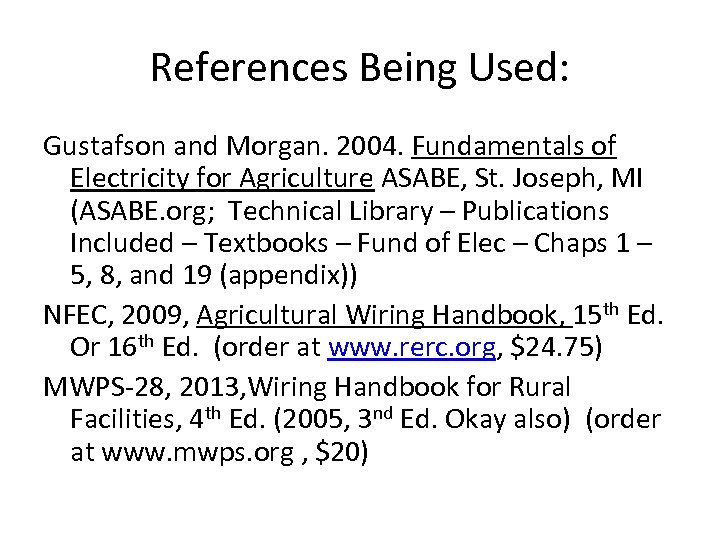
References Being Used: Gustafson and Morgan. 2004. Fundamentals of Electricity for Agriculture ASABE, St. Joseph, MI (ASABE. org; Technical Library – Publications Included – Textbooks – Fund of Elec – Chaps 1 – 5, 8, and 19 (appendix)) NFEC, 2009, Agricultural Wiring Handbook, 15 th Ed. Or 16 th Ed. (order at www. rerc. org, $24. 75) MWPS-28, 2013, Wiring Handbook for Rural Facilities, 4 th Ed. (2005, 3 nd Ed. Okay also) (order at www. mwps. org , $20)
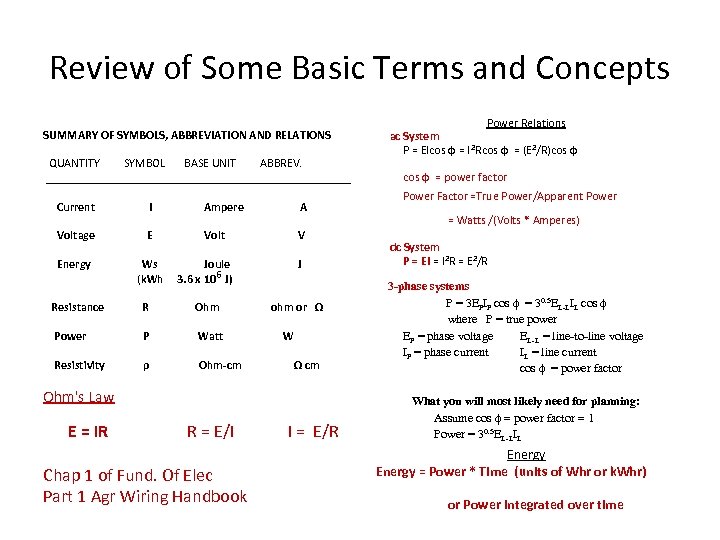
Review of Some Basic Terms and Concepts SUMMARY OF SYMBOLS, ABBREVIATION AND RELATIONS QUANTITY SYMBOL BASE UNIT ABBREV. __________________________ Current I Ampere A Voltage E Volt V Energy Ws (k. Wh Joule 3. 6 x 10 6 J) J ohm or Ω Resistance R Ohm Power P Watt Resistivity ρ Ohm-cm W Ω cm Ohm's Law E = IR R = E/I Chap 1 of Fund. Of Elec Part 1 Agr Wiring Handbook I = E/R Power Relations ac System P = EIcos ɸ = I 2 Rcos ɸ = (E 2/R)cos ɸ = power factor Power Factor =True Power/Apparent Power = Watts /(Volts * Amperes) dc System P = EI = I 2 R = E 2/R 3 -phase systems P = 3 EPIP cos f = 30. 5 EL-LIL cos f where P = true power EP = phase voltage EL-L = line-to-line voltage IP = phase current IL = line current cos f = power factor What you will most likely need for planning: Assume cos f = power factor = 1 Power = 30. 5 EL-LIL Energy = Power * Time (units of Whr or k. Whr) or Power integrated over time
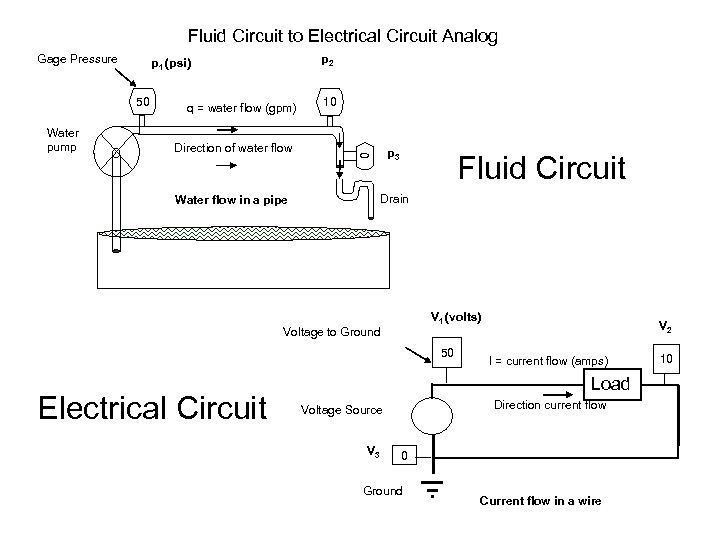
Fluid Circuit to Electrical Circuit Analog Gage Pressure 50 q = water flow (gpm) Direction of water flow 10 p 3 0 Water pump p 2 p 1 (psi) Fluid Circuit Drain Water flow in a pipe V 1 (volts) Voltage to Ground 50 I = current flow (amps) Load Direction current flow Voltage Source V 3 0 Electrical Circuit V 2 Ground Current flow in a wire 10
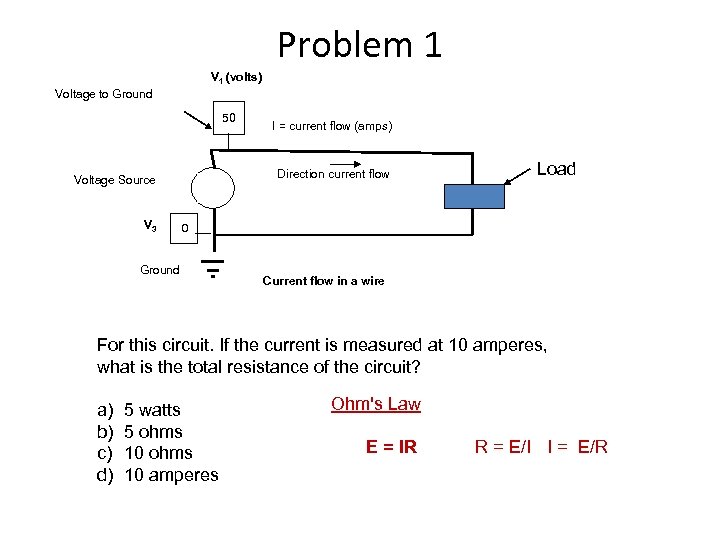
Problem 1 V 1 (volts) Voltage to Ground 50 Direction current flow Voltage Source Load 0 V 3 I = current flow (amps) Ground Current flow in a wire For this circuit. If the current is measured at 10 amperes, what is the total resistance of the circuit? a) b) c) d) 5 watts 5 ohms 10 amperes Ohm's Law E = IR R = E/I I = E/R
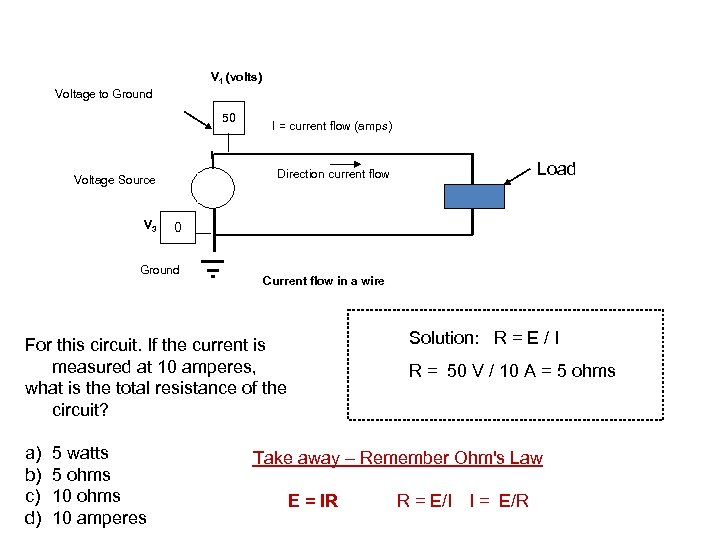
V 1 (volts) Voltage to Ground 50 0 Ground Current flow in a wire Solution: R = E / I For this circuit. If the current is measured at 10 amperes, what is the total resistance of the circuit? a) b) c) d) 5 watts 5 ohms 10 amperes Load Direction current flow Voltage Source V 3 I = current flow (amps) R = 50 V / 10 A = 5 ohms Take away – Remember Ohm's Law E = IR R = E/I I = E/R
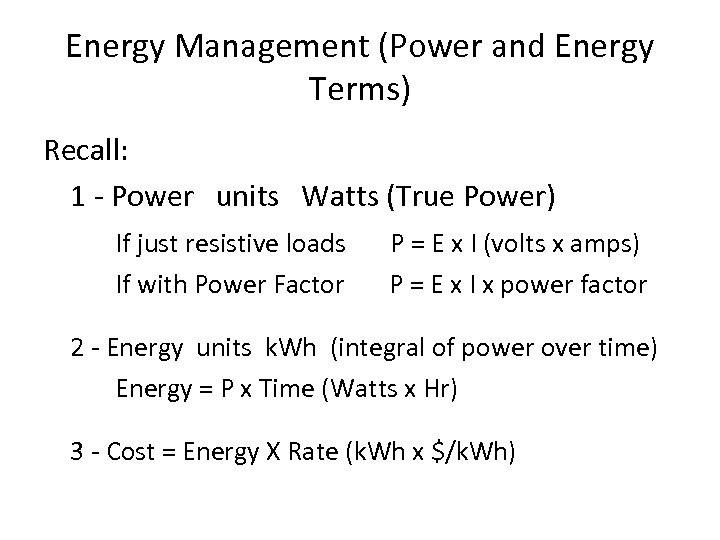
Energy Management (Power and Energy Terms) Recall: 1 - Power units Watts (True Power) If just resistive loads If with Power Factor P = E x I (volts x amps) P = E x I x power factor 2 - Energy units k. Wh (integral of power over time) Energy = P x Time (Watts x Hr) 3 - Cost = Energy X Rate (k. Wh x $/k. Wh)
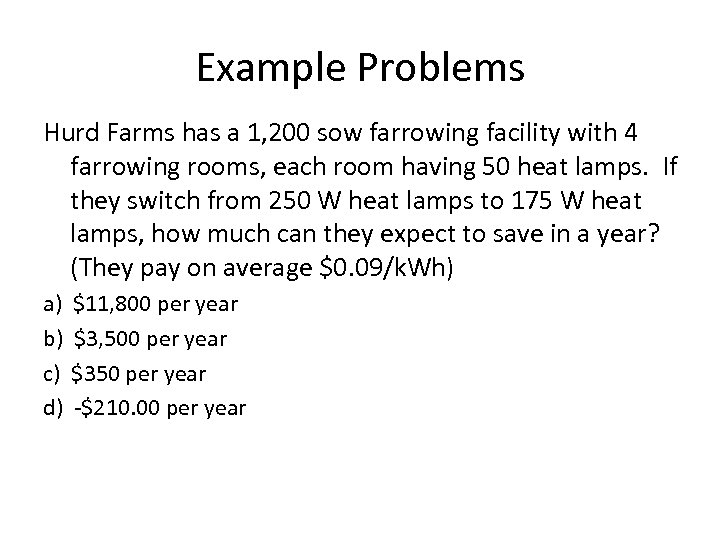
Example Problems Hurd Farms has a 1, 200 sow farrowing facility with 4 farrowing rooms, each room having 50 heat lamps. If they switch from 250 W heat lamps to 175 W heat lamps, how much can they expect to save in a year? (They pay on average $0. 09/k. Wh) a) b) c) d) $11, 800 per year $3, 500 per year $350 per year -$210. 00 per year
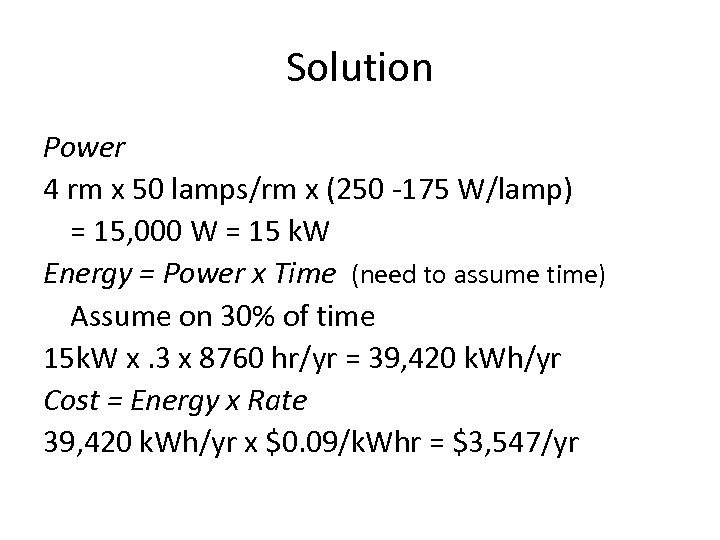
Solution Power 4 rm x 50 lamps/rm x (250 -175 W/lamp) = 15, 000 W = 15 k. W Energy = Power x Time (need to assume time) Assume on 30% of time 15 k. W x. 3 x 8760 hr/yr = 39, 420 k. Wh/yr Cost = Energy x Rate 39, 420 k. Wh/yr x $0. 09/k. Whr = $3, 547/yr
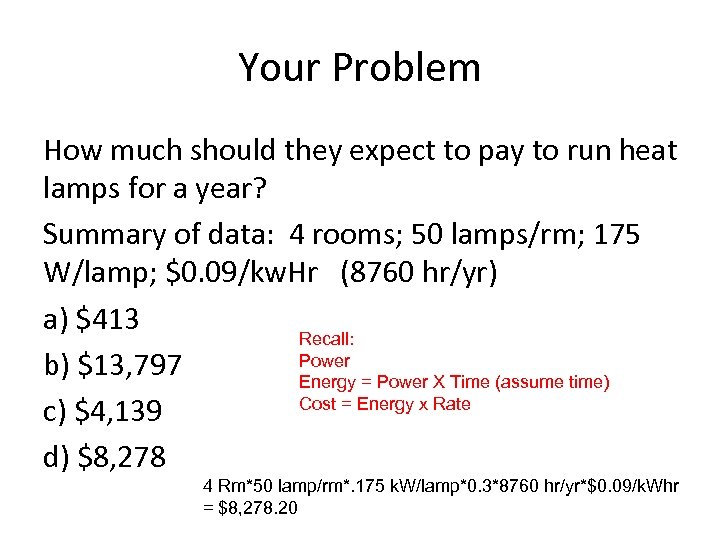
Your Problem How much should they expect to pay to run heat lamps for a year? Summary of data: 4 rooms; 50 lamps/rm; 175 W/lamp; $0. 09/kw. Hr (8760 hr/yr) a) $413 Recall: Power b) $13, 797 Energy = Power X Time (assume time) Cost = Energy x Rate c) $4, 139 d) $8, 278 4 Rm*50 lamp/rm*. 175 k. W/lamp*0. 3*8760 hr/yr*$0. 09/k. Whr = $8, 278. 20
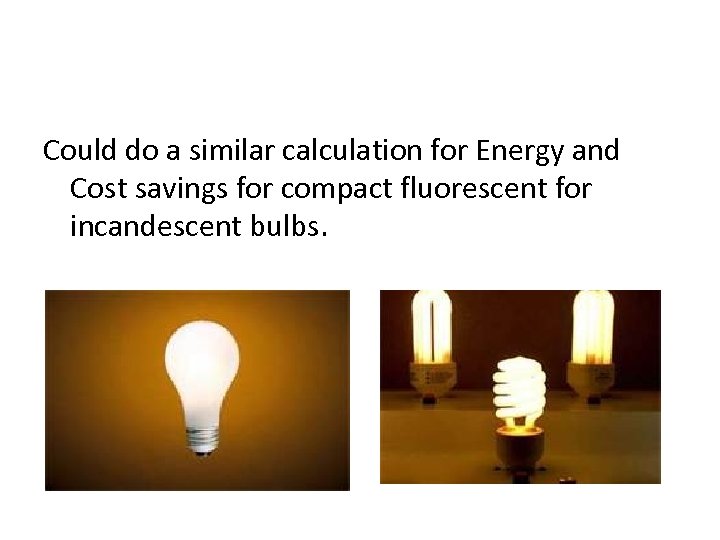
Could do a similar calculation for Energy and Cost savings for compact fluorescent for incandescent bulbs.
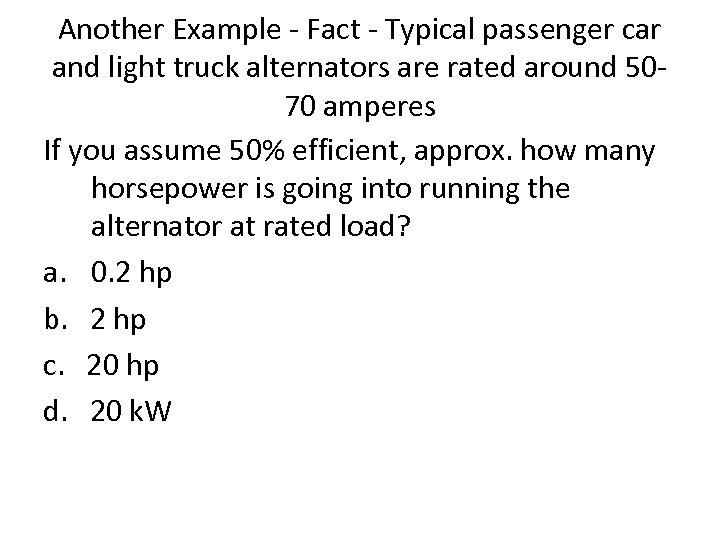
Another Example - Fact - Typical passenger car and light truck alternators are rated around 5070 amperes If you assume 50% efficient, approx. how many horsepower is going into running the alternator at rated load? a. 0. 2 hp b. 2 hp c. 20 hp d. 20 k. W
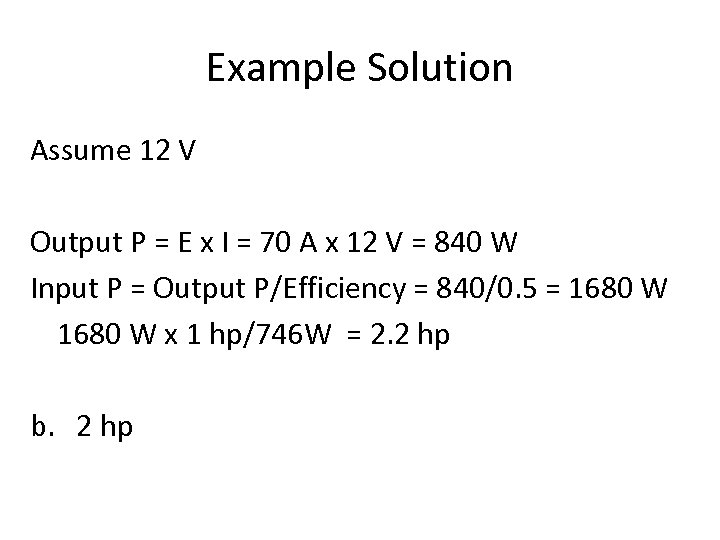
Example Solution Assume 12 V Output P = E x I = 70 A x 12 V = 840 W Input P = Output P/Efficiency = 840/0. 5 = 1680 W x 1 hp/746 W = 2. 2 hp b. 2 hp
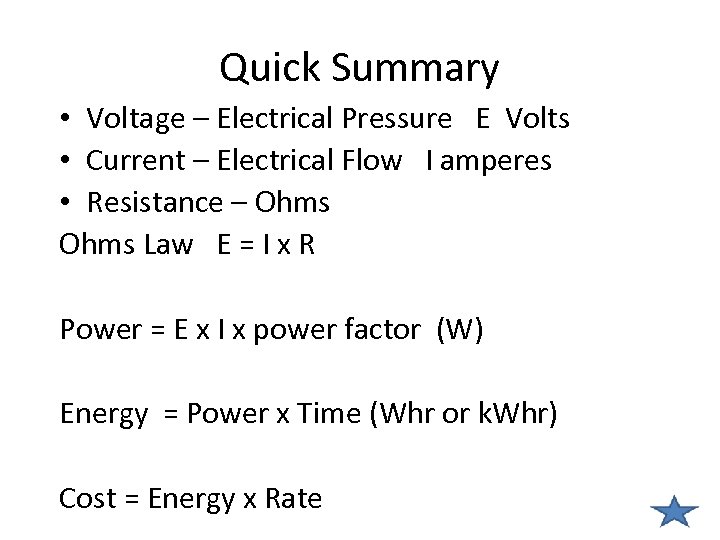
Quick Summary • Voltage – Electrical Pressure E Volts • Current – Electrical Flow I amperes • Resistance – Ohms Law E = I x R Power = E x I x power factor (W) Energy = Power x Time (Whr or k. Whr) Cost = Energy x Rate
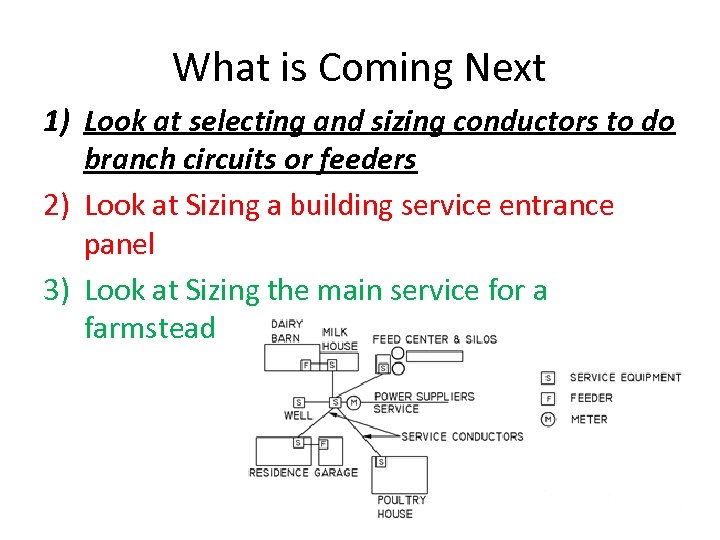
What is Coming Next 1) Look at selecting and sizing conductors to do branch circuits or feeders 2) Look at Sizing a building service entrance panel 3) Look at Sizing the main service for a farmstead
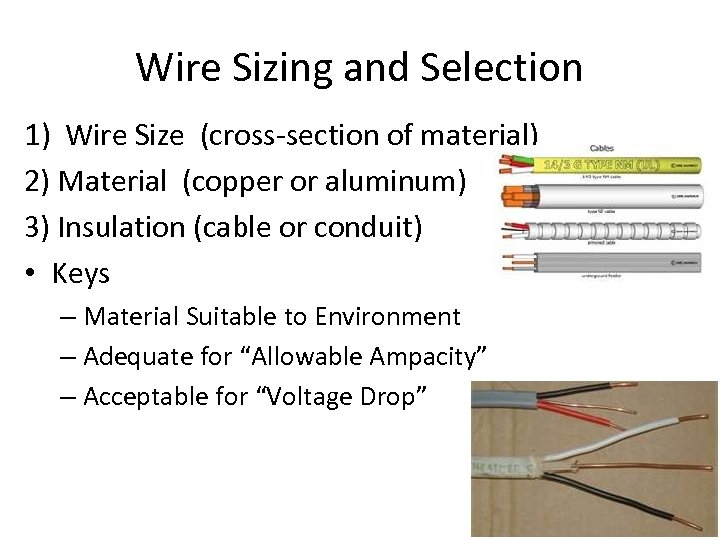
Wire Sizing and Selection 1) Wire Size (cross-section of material) 2) Material (copper or aluminum) 3) Insulation (cable or conduit) • Keys – Material Suitable to Environment – Adequate for “Allowable Ampacity” – Acceptable for “Voltage Drop”
Meeting Criteria • Allowable Ampacity - Limit to Not Overheat the Wire and Insulation - From Tables • Allowable Voltages Drop – Voltage drop due to resistance of conductors – Usually use 2% for Branch Circuits and 3% for Feeders (Total should not exceed 5%) • Must meet both Criteria – Short run Allowable Ampacity – Long Run Voltage Drop
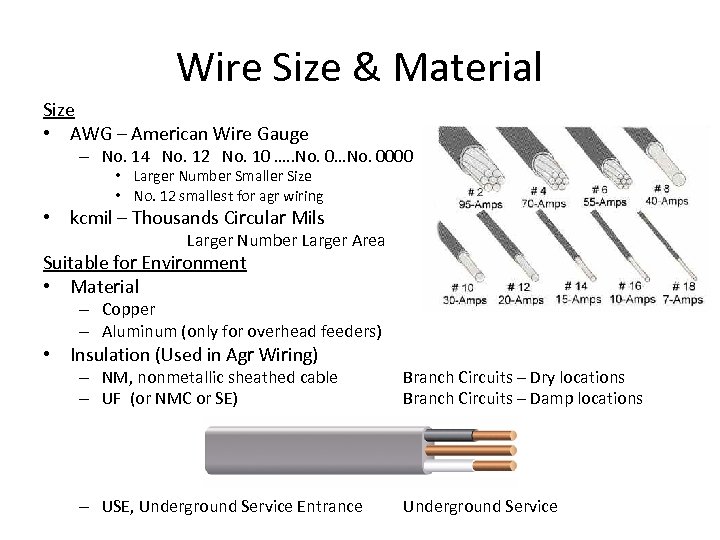
Wire Size & Material Size • AWG – American Wire Gauge – No. 14 No. 12 No. 10 …. . No. 0…No. 0000 • Larger Number Smaller Size • No. 12 smallest for agr wiring • kcmil – Thousands Circular Mils Larger Number Larger Area Suitable for Environment • Material – Copper – Aluminum (only for overhead feeders) • Insulation (Used in Agr Wiring) – NM, nonmetallic sheathed cable – UF (or NMC or SE) Branch Circuits – Dry locations Branch Circuits – Damp locations – USE, Underground Service Entrance Underground Service
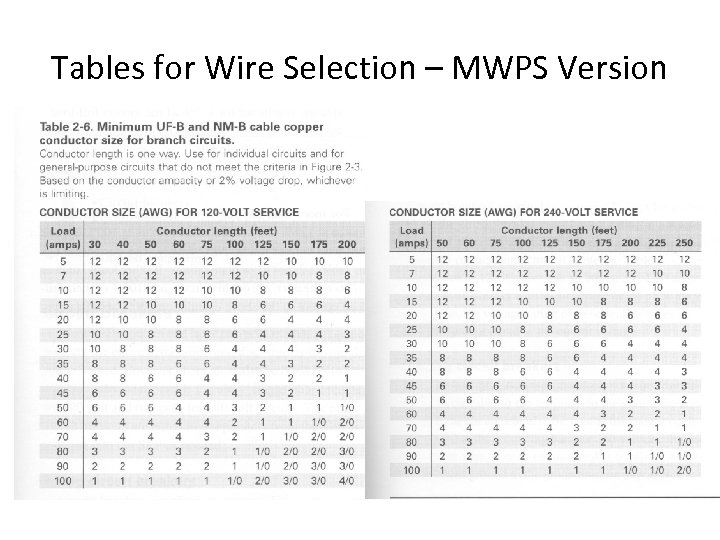
Tables for Wire Selection – MWPS Version
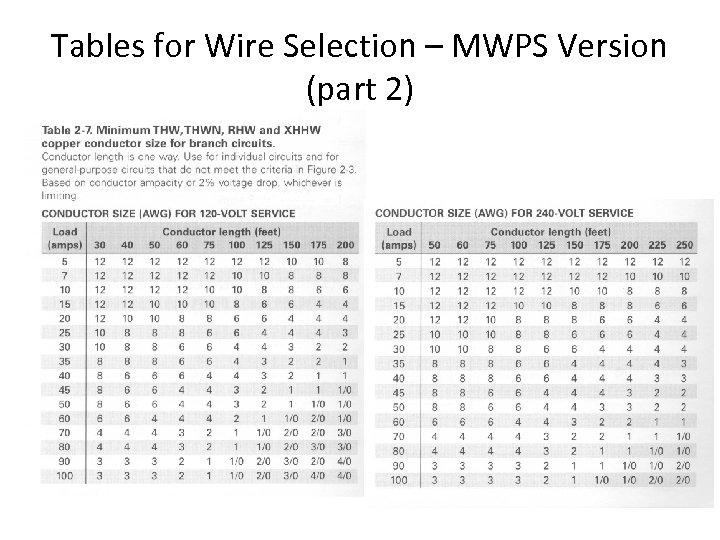
Tables for Wire Selection – MWPS Version (part 2)
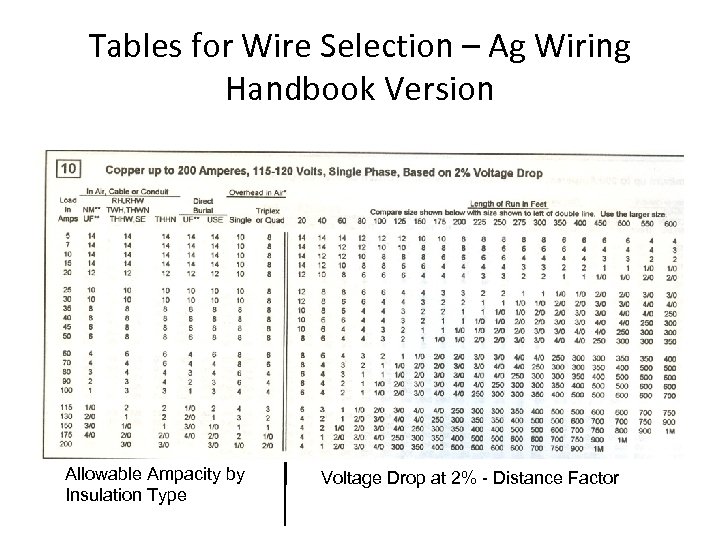
Tables for Wire Selection – Ag Wiring Handbook Version Allowable Ampacity by Insulation Type Voltage Drop at 2% - Distance Factor
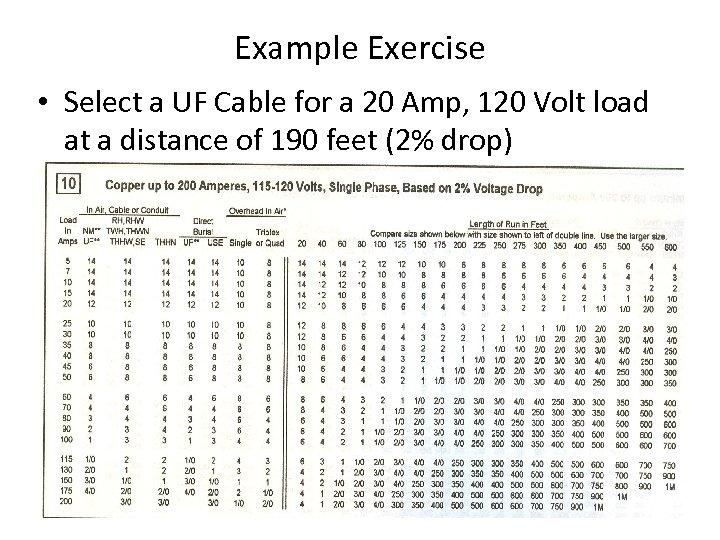
Example Exercise • Select a UF Cable for a 20 Amp, 120 Volt load at a distance of 190 feet (2% drop)
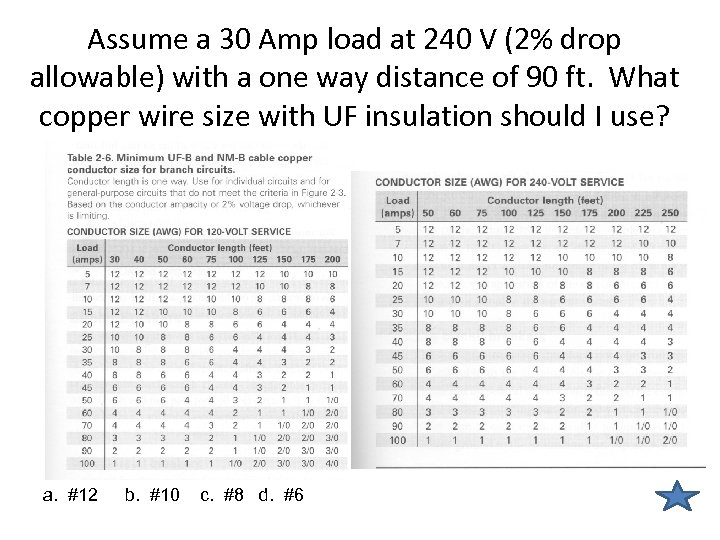
Assume a 30 Amp load at 240 V (2% drop allowable) with a one way distance of 90 ft. What copper wire size with UF insulation should I use? a. #12 b. #10 c. #8 d. #6
What is Coming Next 1) Look at selecting and sizing conductors to do branch circuits or feeders 2) Look at Sizing a building service entrance panel 3) Look at Sizing the main service for a farmstead
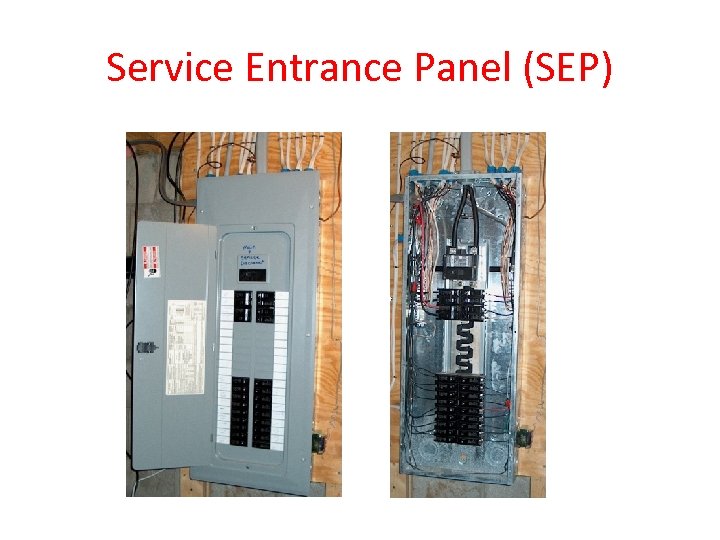
Service Entrance Panel (SEP)
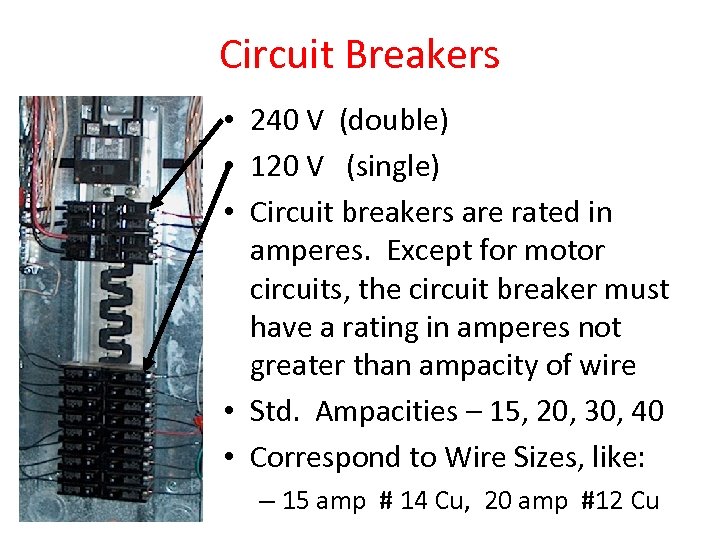
Circuit Breakers • 240 V (double) • 120 V (single) • Circuit breakers are rated in amperes. Except for motor circuits, the circuit breaker must have a rating in amperes not greater than ampacity of wire • Std. Ampacities – 15, 20, 30, 40 • Correspond to Wire Sizes, like: – 15 amp # 14 Cu, 20 amp #12 Cu
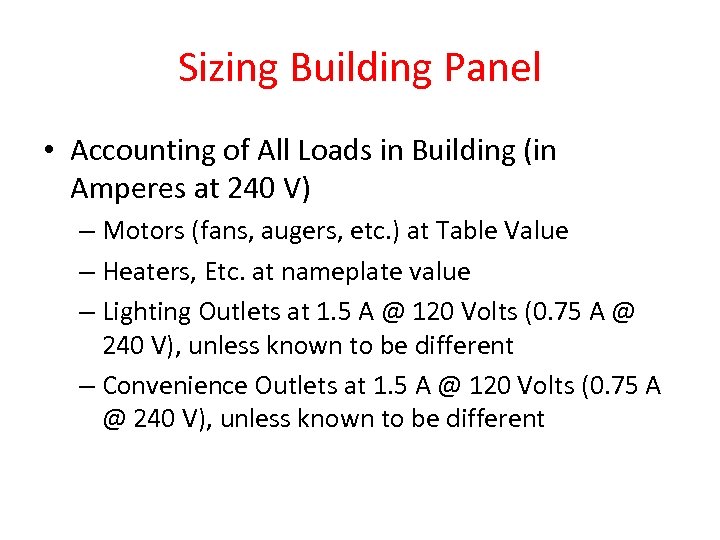
Sizing Building Panel • Accounting of All Loads in Building (in Amperes at 240 V) – Motors (fans, augers, etc. ) at Table Value – Heaters, Etc. at nameplate value – Lighting Outlets at 1. 5 A @ 120 Volts (0. 75 A @ 240 V), unless known to be different – Convenience Outlets at 1. 5 A @ 120 Volts (0. 75 A @ 240 V), unless known to be different
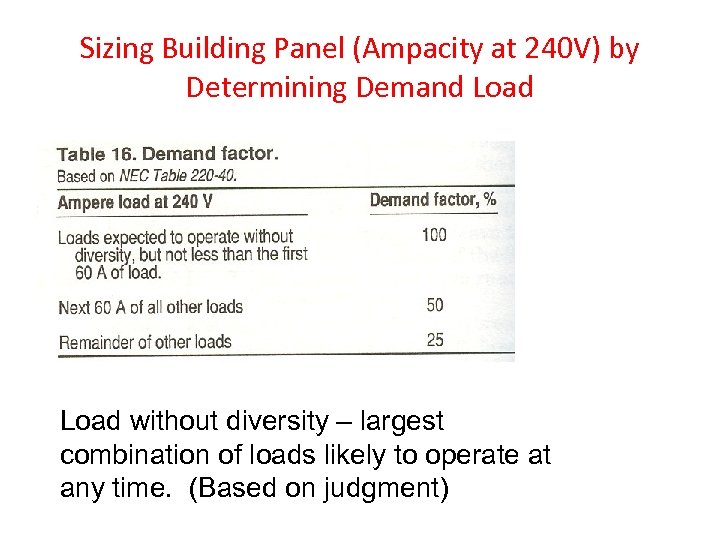
Sizing Building Panel (Ampacity at 240 V) by Determining Demand Load without diversity – largest combination of loads likely to operate at any time. (Based on judgment)
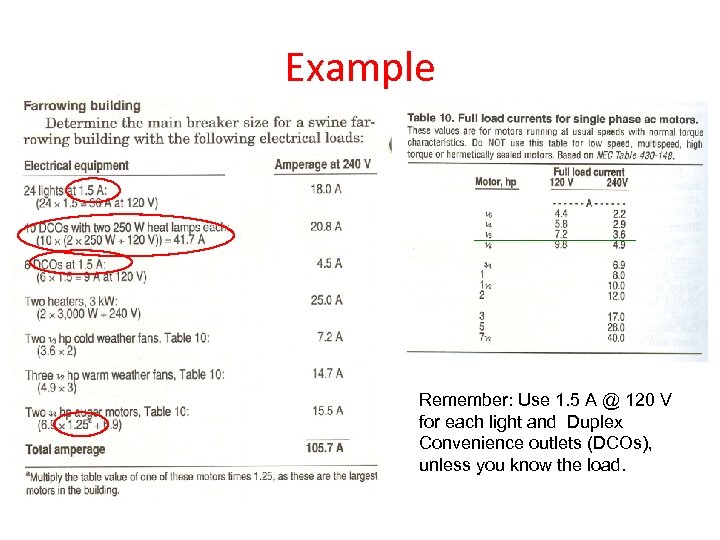
Example Remember: Use 1. 5 A @ 120 V for each light and Duplex Convenience outlets (DCOs), unless you know the load.
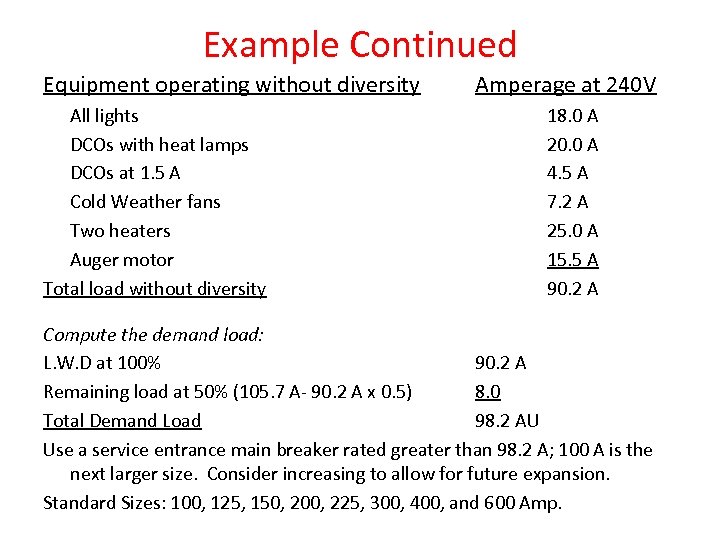
Example Continued Equipment operating without diversity All lights DCOs with heat lamps DCOs at 1. 5 A Cold Weather fans Two heaters Auger motor Total load without diversity Amperage at 240 V 18. 0 A 20. 0 A 4. 5 A 7. 2 A 25. 0 A 15. 5 A 90. 2 A Compute the demand load: L. W. D at 100% 90. 2 A Remaining load at 50% (105. 7 A- 90. 2 A x 0. 5) 8. 0 Total Demand Load 98. 2 AU Use a service entrance main breaker rated greater than 98. 2 A; 100 A is the next larger size. Consider increasing to allow for future expansion. Standard Sizes: 100, 125, 150, 200, 225, 300, 400, and 600 Amp.
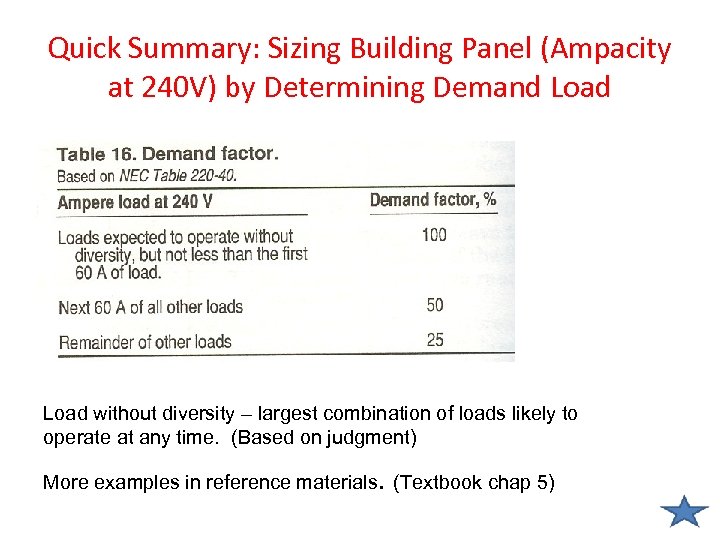
Quick Summary: Sizing Building Panel (Ampacity at 240 V) by Determining Demand Load without diversity – largest combination of loads likely to operate at any time. (Based on judgment) More examples in reference materials. (Textbook chap 5)
What is Coming Next 1) Look at selecting and sizing conductors to do branch circuits or feeders 2) Look at Sizing a building service entrance panel 3) Look at Sizing the main service for a farmstead
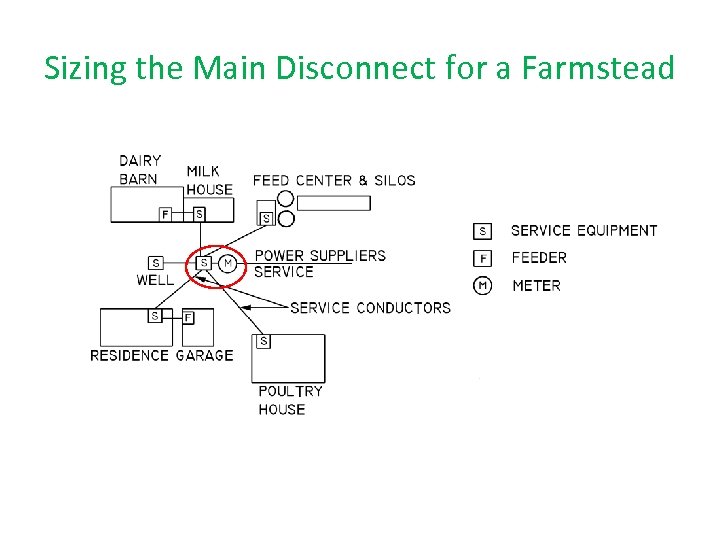
Sizing the Main Disconnect for a Farmstead
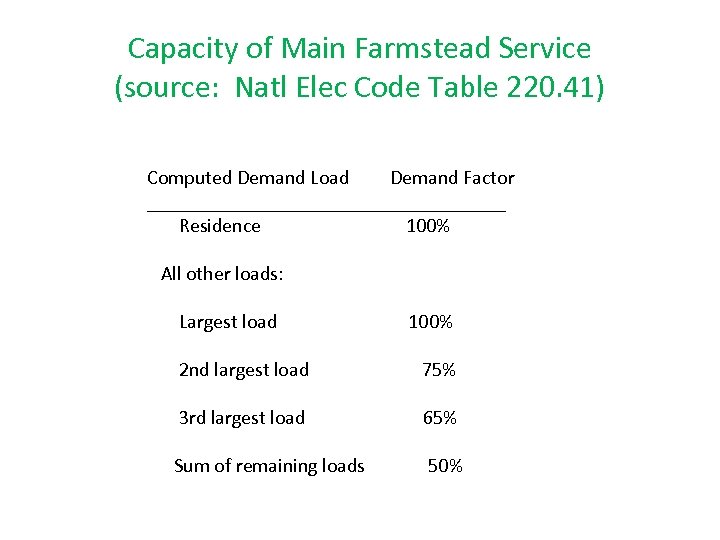
Capacity of Main Farmstead Service (source: Natl Elec Code Table 220. 41) Computed Demand Load Demand Factor __________________ Residence 100% All other loads: Largest load 100% 2 nd largest load 75% 3 rd largest load 65% Sum of remaining loads 50%
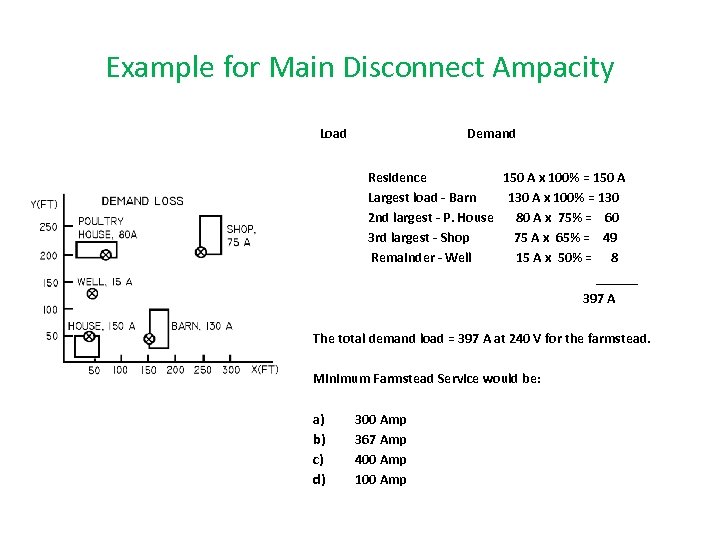
Example for Main Disconnect Ampacity Load Demand Residence 150 A x 100% = 150 A Largest load - Barn 130 A x 100% = 130 2 nd largest - P. House 80 A x 75% = 60 3 rd largest - Shop 75 A x 65% = 49 Remainder - Well 15 A x 50% = 8 ______ 397 A The total demand load = 397 A at 240 V for the farmstead. Minimum Farmstead Service would be: a) b) c) d) 300 Amp 367 Amp 400 Amp 100 Amp
Quick Summary 2 • Wire Selection Keys – Ampacity – Line Loss – Insulation and wire materials • Service Entrance Ampacity – Based on Demand Load System • Full Farmstead Ampacity – Based on Demand Load System
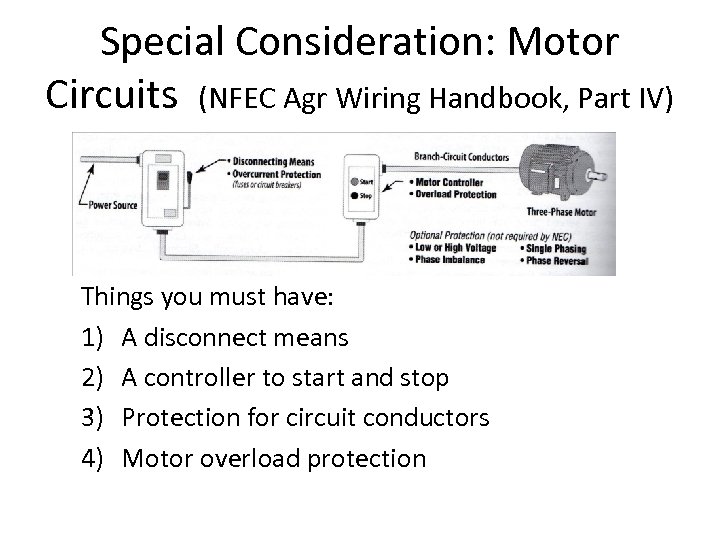
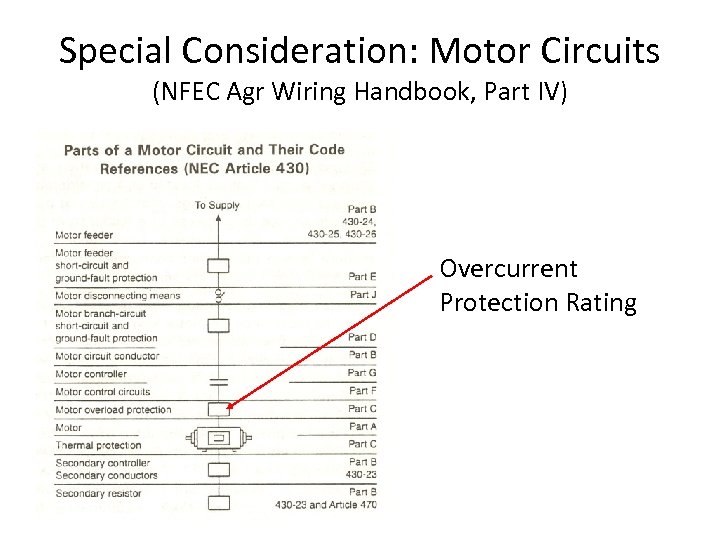
Special Consideration: Motor Circuits (NFEC Agr Wiring Handbook, Part IV) Things you must have: 1) A disconnect means 2) A controller to start and stop 3) Protection for circuit conductors 4) Motor overload protection
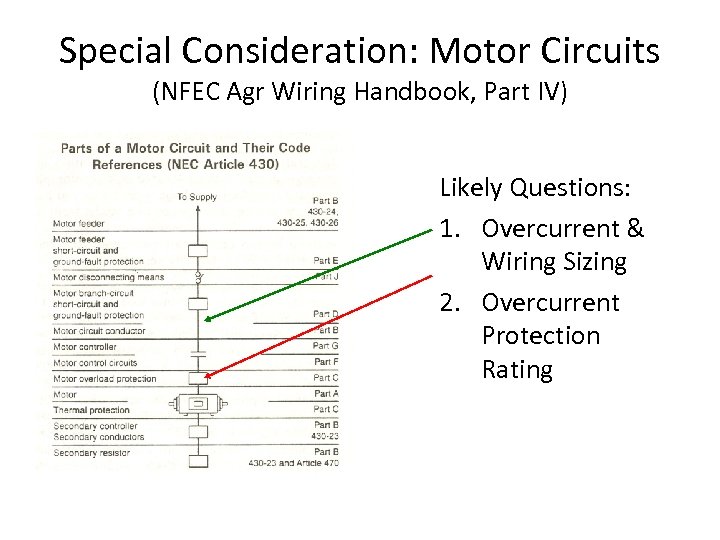
Special Consideration: Motor Circuits (NFEC Agr Wiring Handbook, Part IV) Likely Questions: 1. Overcurrent & Wiring Sizing 2. Overcurrent Protection Rating
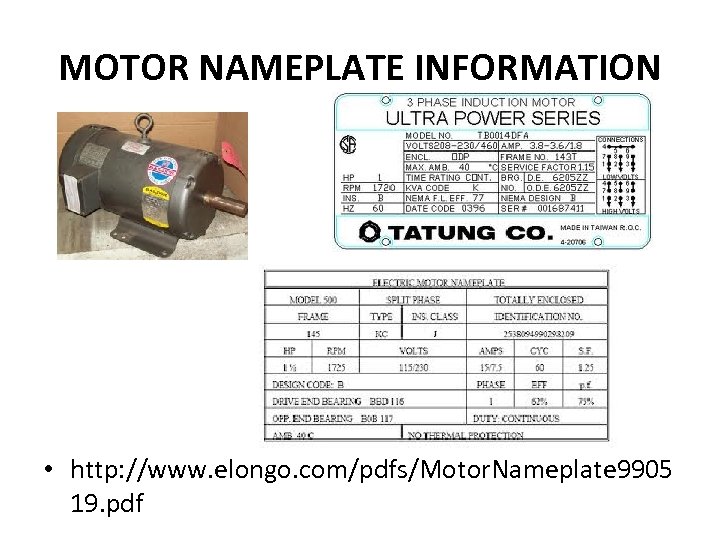
MOTOR NAMEPLATE INFORMATION • http: //www. elongo. com/pdfs/Motor. Nameplate 9905 19. pdf
MOTOR NAMEPLATE INFORMATION Design and rating standards developed by the National Electrical Manufacturer's Association (NEMA) permit the comparison of motors from different manufacturers. Information on the nameplate may include any or all of the following: VOLTS , the properating voltage, may be either a single value or, for dual-voltage motors, a dual value. AMPS is the full-load current draw in amperes with the proper voltage supply. When a dual number is listed, the motor will draw the smaller amperage when connected to the higher voltage source. RPM is the rotor speed when the motor runs at the full-load point on the torque-speed curve (Figure 3. 12). HZ is the design operating frequency of the electrical supply. In the United States, it is 60 cycles per second. A standard frequency of 50 cycles per second is used in some counties. FR is one of the standard frame numbers used by manufacturers to insure interchangeability. For motors with power ratings below 0. 75 k. W (1. 0 hp), common frame numbers are 42, 48, and 56. The frame number divided by 6. 3 (16) gives the height in cm (inches) from the bottom of the mounting to the shaft centerline. Letters may be added to specify the type of mounting, for example, T-frame or the heavier U-frame. A replacement motor with the same frame number as the original motor will fit on the same mounting. DUTY indicates whether the motor is rated for continuous or intermittent; HOURS may be used to indicate the length of time the motor can be safely operated during intermittent duty. TEMPERATURE RISE ( �C) may be stated as the allowable temperature rise above a 40 �C (104 �F) ambient temperature while the motor is operating at full load. Often, a motor can be operated at 10% to 15% overload without damage, but the motor temperature should never exceed 55 �C (131 �F). If, while operating, a motor is not too hot to touch, it is not overheated. As an alternative to temperature rise, the allowable AMBIENT TEMPERATURE may be listed. Then the motor can be operated at full load in environments with temperatures below the stated ambient temperature.
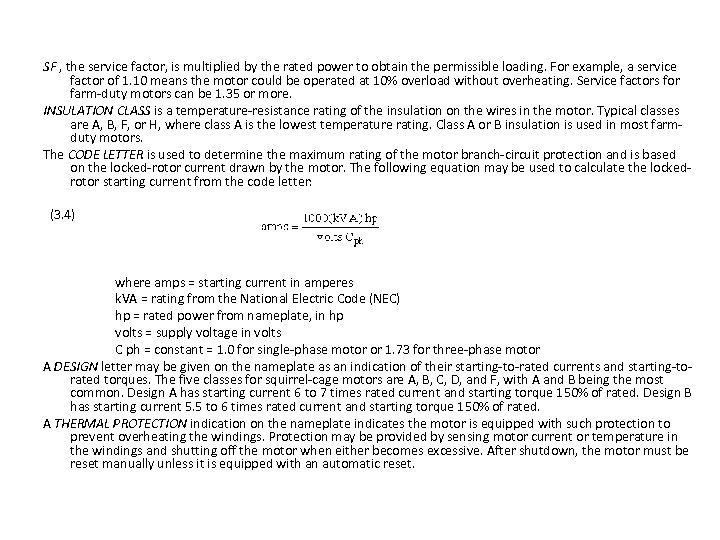
SF , the service factor, is multiplied by the rated power to obtain the permissible loading. For example, a service factor of 1. 10 means the motor could be operated at 10% overload without overheating. Service factors for farm-duty motors can be 1. 35 or more. INSULATION CLASS is a temperature-resistance rating of the insulation on the wires in the motor. Typical classes are A, B, F, or H, where class A is the lowest temperature rating. Class A or B insulation is used in most farmduty motors. The CODE LETTER is used to determine the maximum rating of the motor branch-circuit protection and is based on the locked-rotor current drawn by the motor. The following equation may be used to calculate the lockedrotor starting current from the code letter: (3. 4) where amps = starting current in amperes k. VA = rating from the National Electric Code (NEC) hp = rated power from nameplate, in hp volts = supply voltage in volts C ph = constant = 1. 0 for single-phase motor or 1. 73 for three-phase motor A DESIGN letter may be given on the nameplate as an indication of their starting-to-rated currents and starting-torated torques. The five classes for squirrel-cage motors are A, B, C, D, and F, with A and B being the most common. Design A has starting current 6 to 7 times rated current and starting torque 150% of rated. Design B has starting current 5. 5 to 6 times rated current and starting torque 150% of rated. A THERMAL PROTECTION indication on the nameplate indicates the motor is equipped with such protection to prevent overheating the windings. Protection may be provided by sensing motor current or temperature in the windings and shutting off the motor when either becomes excessive. After shutdown, the motor must be reset manually unless it is equipped with an automatic reset.
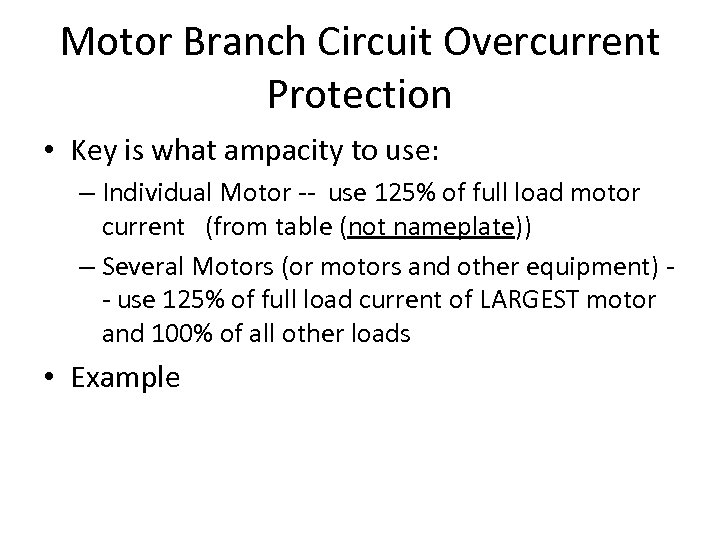
Motor Branch Circuit Overcurrent Protection • Key is what ampacity to use: – Individual Motor -- use 125% of full load motor current (from table (not nameplate)) – Several Motors (or motors and other equipment) - use 125% of full load current of LARGEST motor and 100% of all other loads • Example
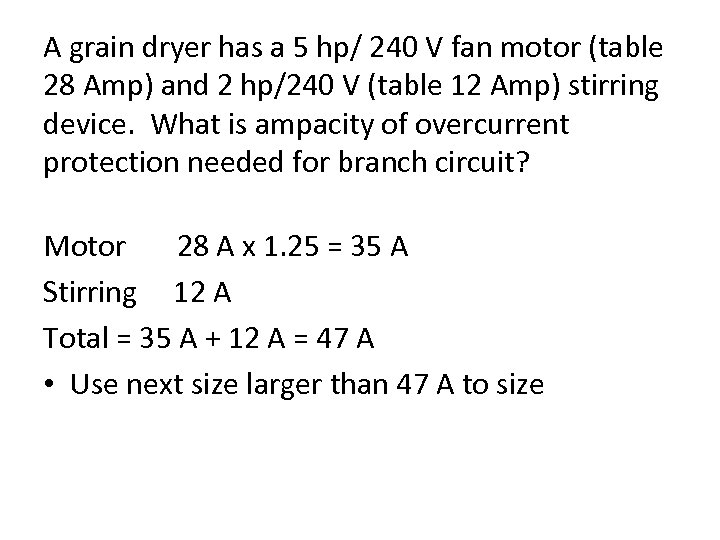
A grain dryer has a 5 hp/ 240 V fan motor (table 28 Amp) and 2 hp/240 V (table 12 Amp) stirring device. What is ampacity of overcurrent protection needed for branch circuit? Motor 28 A x 1. 25 = 35 A Stirring 12 A Total = 35 A + 12 A = 47 A • Use next size larger than 47 A to size
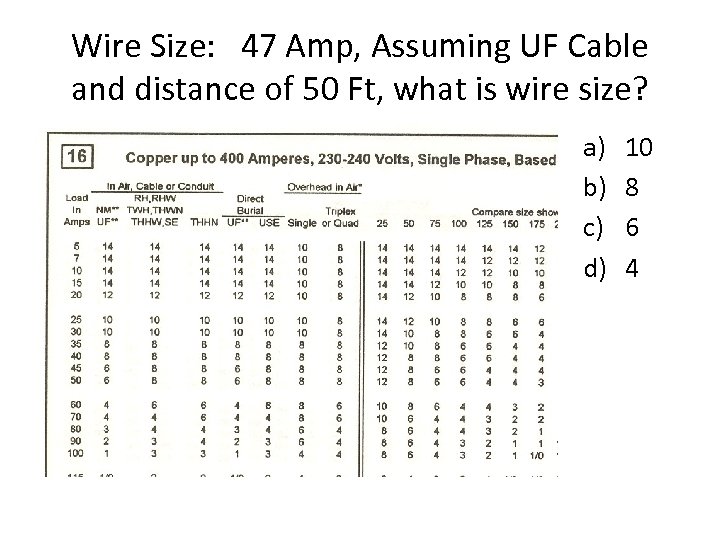
Wire Size: 47 Amp, Assuming UF Cable and distance of 50 Ft, what is wire size? a) b) c) d) 10 8 6 4
Special Consideration: Motor Circuits (NFEC Agr Wiring Handbook, Part IV) Overcurrent Protection Rating
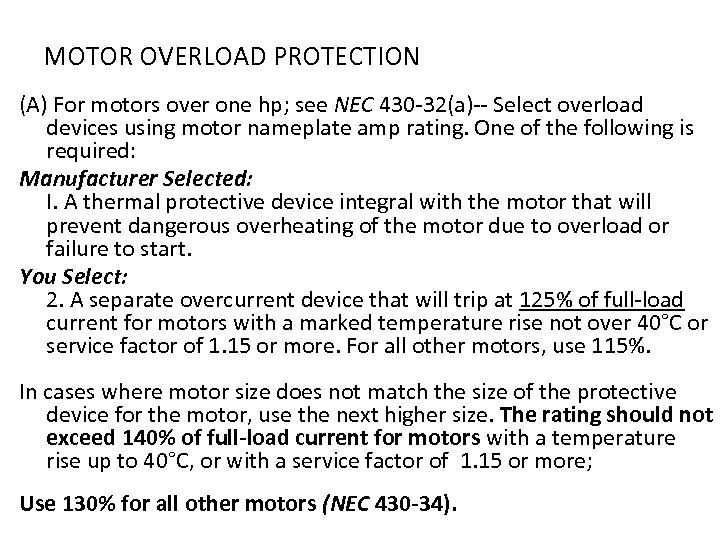
MOTOR OVERLOAD PROTECTION (A) For motors over one hp; see NEC 430 -32(a)-- Select overload devices using motor nameplate amp rating. One of the following is required: Manufacturer Selected: I. A thermal protective device integral with the motor that will prevent dangerous overheating of the motor due to overload or failure to start. You Select: 2. A separate overcurrent device that will trip at 125% of full-load current for motors with a marked temperature rise not over 40°C or service factor of 1. 15 or more. For all other motors, use 115%. In cases where motor size does not match the size of the protective device for the motor, use the next higher size. The rating should not exceed 140% of full-load current for motors with a temperature rise up to 40°C, or with a service factor of 1. 15 or more; Use 130% for all other motors (NEC 430 -34).
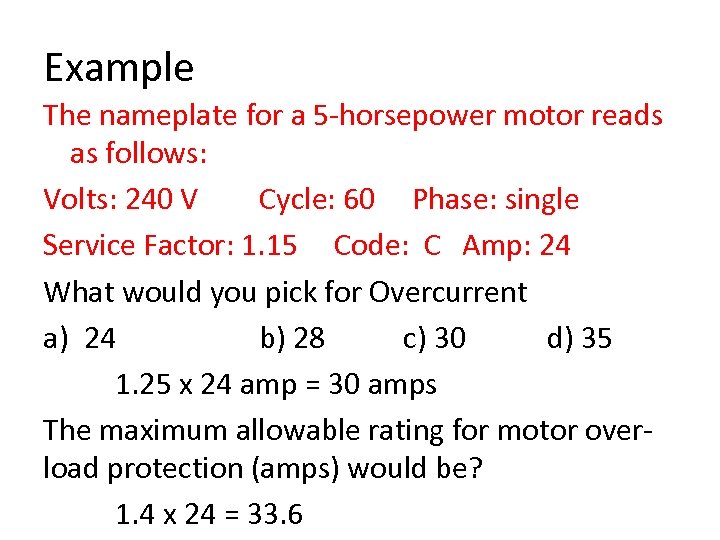
Example The nameplate for a 5 -horsepower motor reads as follows: Volts: 240 V Cycle: 60 Phase: single Service Factor: 1. 15 Code: C Amp: 24 What would you pick for Overcurrent a) 24 b) 28 c) 30 d) 35 1. 25 x 24 amp = 30 amps The maximum allowable rating for motor overload protection (amps) would be? 1. 4 x 24 = 33. 6
Suggested Reference for Motor Circuits Building Approach: Section 26 and 27 of NFEC Agr. Wiring Handbook Section 8. 8 of Fundamentals of Electricity for Agriculture Machinery Systems Approach: Chapter 3 Electrical Power for Agricultural Machines Ajit K. Srivastava, Carroll E. Goering, Roger P. Rohrbach, Dennis R. Buckmaster Published in Engineering Principles of Agricultural Machines, 2 nd Edition Chapter 3, pp. 45 -64 ASABE Chapter 7 Electrical Systems Published in Engine and Tractor Power Chapter 7, pp. 143 -182 ( 2004 ASABE).
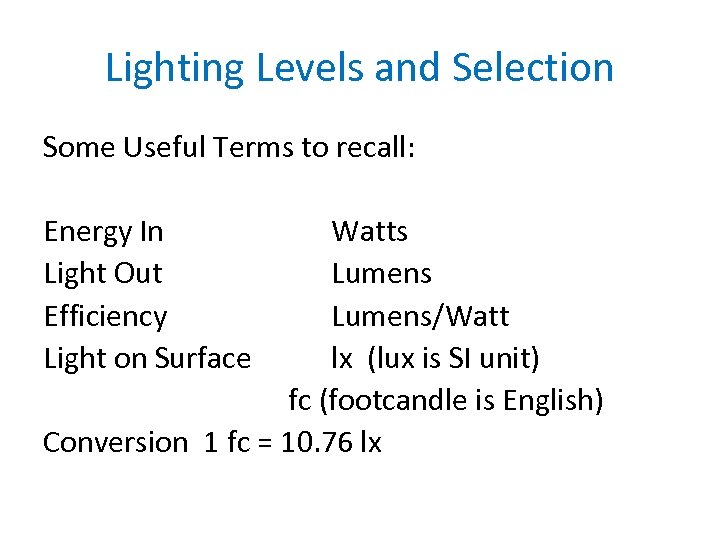
Lighting Levels and Selection Some Useful Terms to recall: Energy In Light Out Efficiency Light on Surface Watts Lumens/Watt lx (lux is SI unit) fc (footcandle is English) Conversion 1 fc = 10. 76 lx
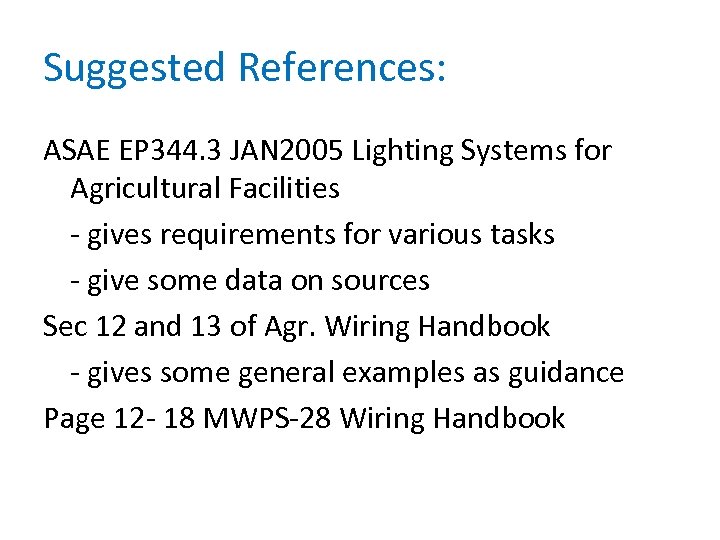
Suggested References: ASAE EP 344. 3 JAN 2005 Lighting Systems for Agricultural Facilities - gives requirements for various tasks - give some data on sources Sec 12 and 13 of Agr. Wiring Handbook - gives some general examples as guidance Page 12 - 18 MWPS-28 Wiring Handbook
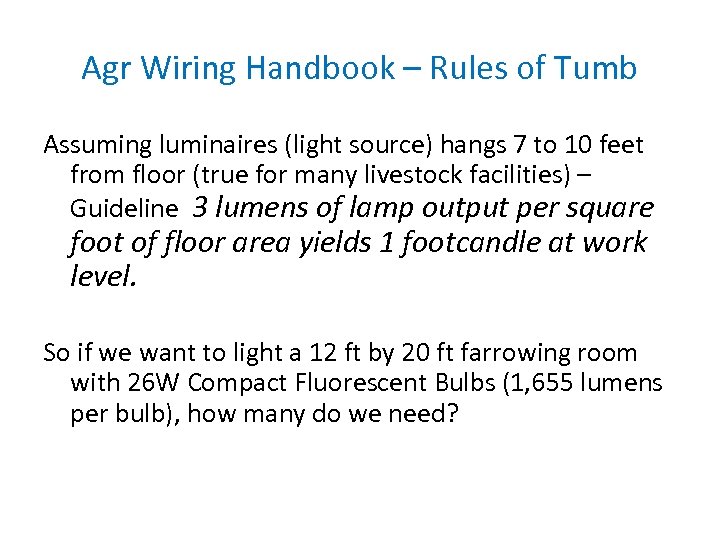
Agr Wiring Handbook – Rules of Tumb Assuming luminaires (light source) hangs 7 to 10 feet from floor (true for many livestock facilities) – Guideline 3 lumens of lamp output per square foot of floor area yields 1 footcandle at work level. So if we want to light a 12 ft by 20 ft farrowing room with 26 W Compact Fluorescent Bulbs (1, 655 lumens per bulb), how many do we need?
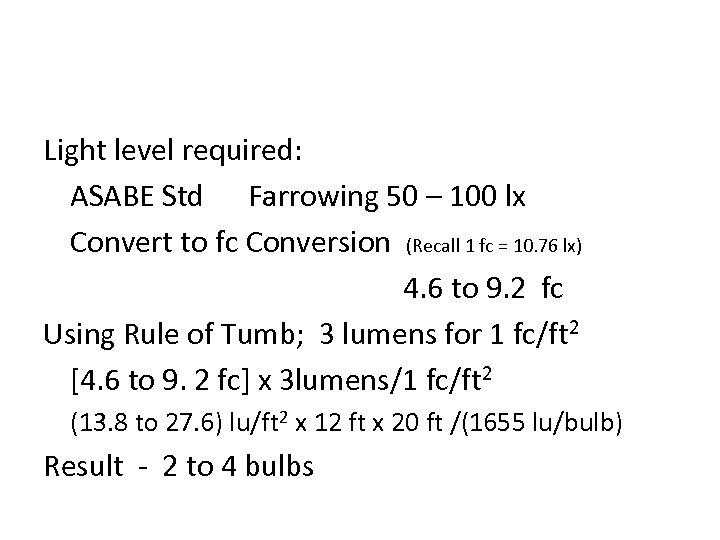
Light level required: ASABE Std Farrowing 50 – 100 lx Convert to fc Conversion (Recall 1 fc = 10. 76 lx) 4. 6 to 9. 2 fc Using Rule of Tumb; 3 lumens for 1 fc/ft 2 [4. 6 to 9. 2 fc] x 3 lumens/1 fc/ft 2 (13. 8 to 27. 6) lu/ft 2 x 12 ft x 20 ft /(1655 lu/bulb) Result - 2 to 4 bulbs
Rules of Thumb on Spacing • Spaced 1 to 1. 5 times mounting height if desired illumination 5 to 10 fc. • Greater than 10 fc limit to 1 times height
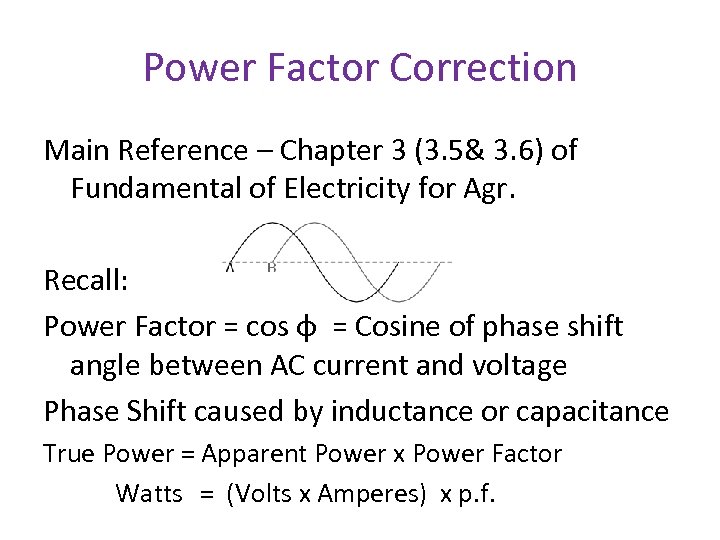
Power Factor Correction Main Reference – Chapter 3 (3. 5& 3. 6) of Fundamental of Electricity for Agr. Recall: Power Factor = cos ɸ = Cosine of phase shift angle between AC current and voltage Phase Shift caused by inductance or capacitance True Power = Apparent Power x Power Factor Watts = (Volts x Amperes) x p. f.
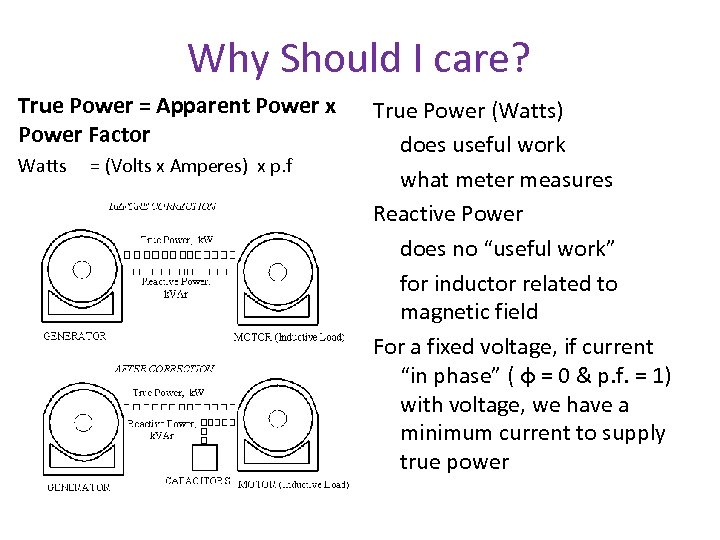
Why Should I care? True Power = Apparent Power x Power Factor Watts = (Volts x Amperes) x p. f True Power (Watts) does useful work what meter measures Reactive Power does no “useful work” for inductor related to magnetic field For a fixed voltage, if current “in phase” ( ɸ = 0 & p. f. = 1) with voltage, we have a minimum current to supply true power
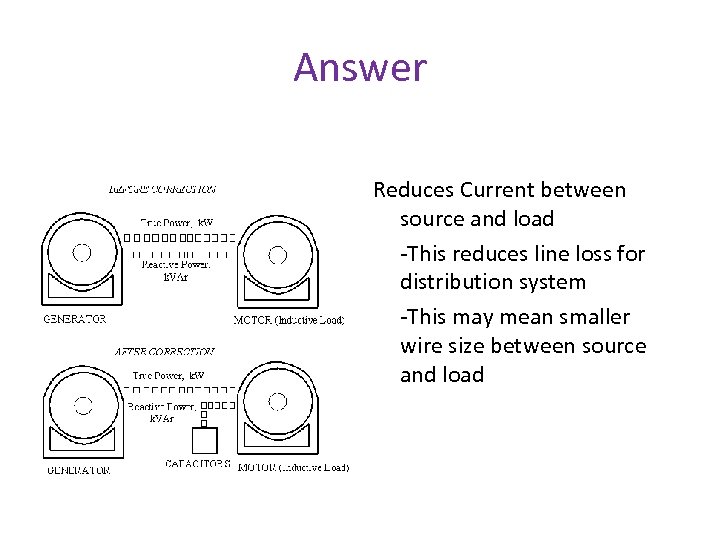
Answer Reduces Current between source and load -This reduces line loss for distribution system -This may mean smaller wire size between source and load
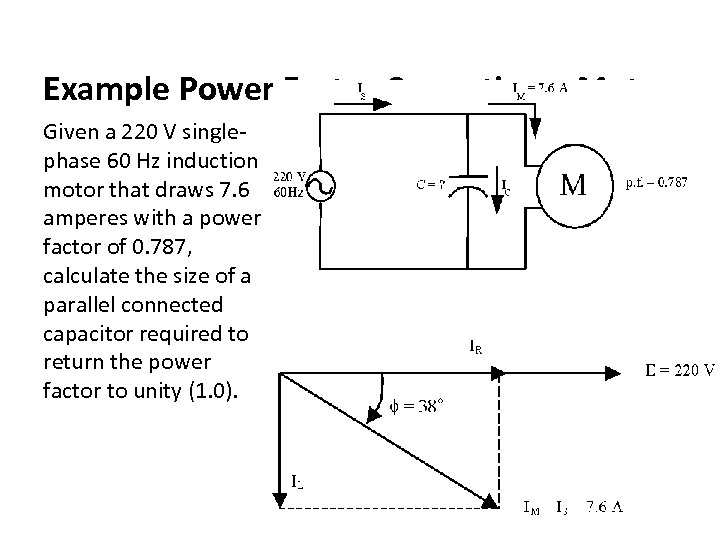
Example Power Factor Correction – Motor Given a 220 V singlephase 60 Hz induction motor that draws 7. 6 amperes with a power factor of 0. 787, calculate the size of a parallel connected capacitor required to return the power factor to unity (1. 0).
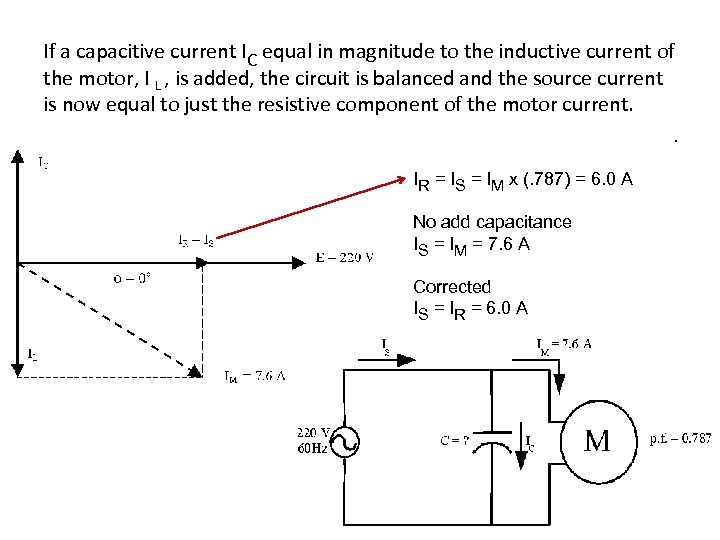
If a capacitive current IC equal in magnitude to the inductive current of the motor, I L , is added, the circuit is balanced and the source current is now equal to just the resistive component of the motor current. • IR = IS = IM x (. 787) = 6. 0 A No add capacitance IS = IM = 7. 6 A Corrected IS = IR = 6. 0 A
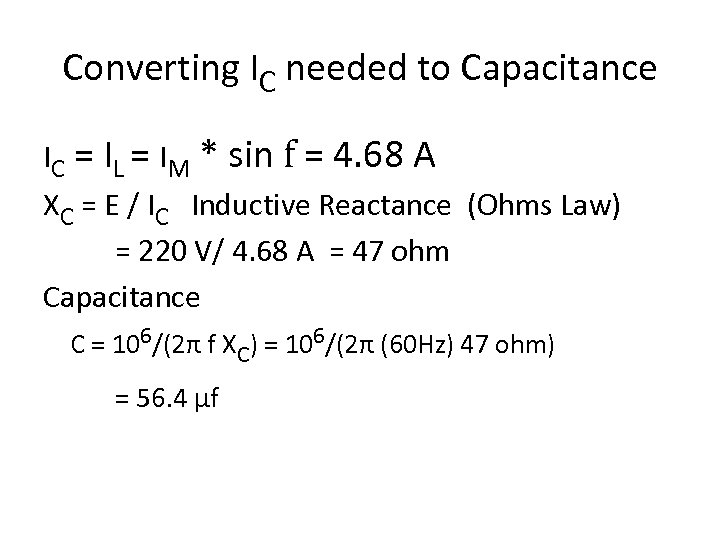
Converting IC needed to Capacitance IC = IL = IM * sin f = 4. 68 A XC = E / IC Inductive Reactance (Ohms Law) = 220 V/ 4. 68 A = 47 ohm Capacitance C = 106/(2π f XC) = 106/(2π (60 Hz) 47 ohm) = 56. 4 μf
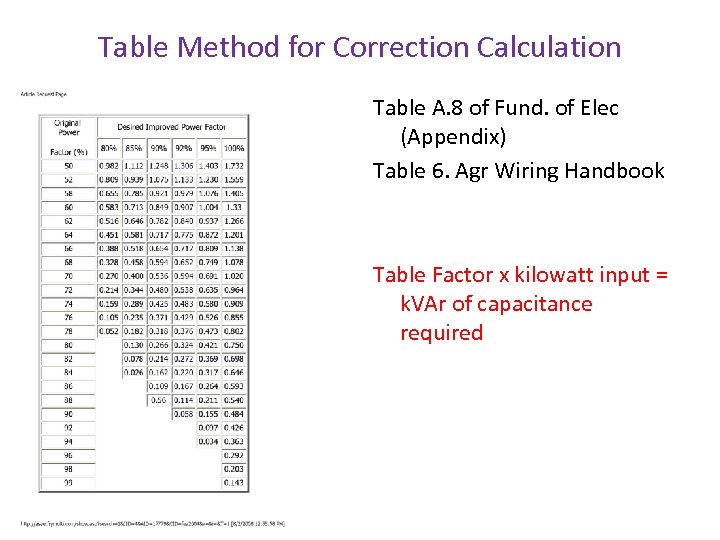
Table Method for Correction Calculation Table A. 8 of Fund. of Elec (Appendix) Table 6. Agr Wiring Handbook Table Factor x kilowatt input = k. VAr of capacitance required
Example Assume a 500 k. VA load with a power factor of 0. 6. What size capacitor would be required to raise the power factor to 0. 9? Note: May not want to correct back to 1. 0! The capacitor rating in k. VAr is found by multiplying the true power of the load (k. W of load) by the factor taken from the table.
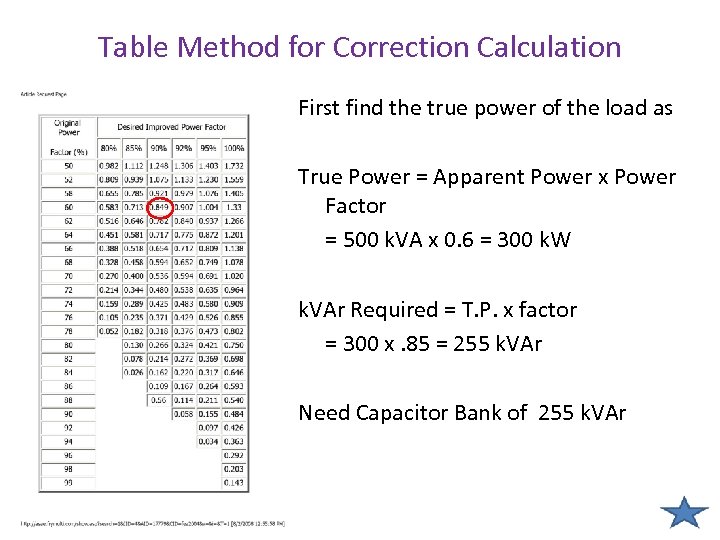
Table Method for Correction Calculation First find the true power of the load as True Power = Apparent Power x Power Factor = 500 k. VA x 0. 6 = 300 k. W k. VAr Required = T. P. x factor = 300 x. 85 = 255 k. VAr Need Capacitor Bank of 255 k. VAr
A Couple More Recommended Chapters from Textbook Chapter 7 Direct Electrical Controls and Devices Relay-Based Control Systems • Remember – Controls in Series means AND – Controls in Parallel means OR – Small control system current controls a relay coil that then controls the load current – Ladder logic is your friend
Topics to be Addressed: • Review of Some Basic Terms and Concepts – Voltage, current, resistance, power and energy • Wire Sizing and Selection – Ampacity, allowable voltage drop, environment • Service Entrance – Sizing using demand system • Sizing a Farm Service – Sizing using demand system • Motor Control and Protection – Size wire and overload protection (125%) • Lighting Levels and Selection – Lighting level and number of sources • Power Factor Correction

ASABE PE Review Session What Questions do you have?
Скачать презентацию ASABE PE Review Session Circuits Controls and Sensors
498e627ddfc0acccf59905aca1d053f2.ppt