


 Скачать презентацию As of 03 1010 W Mar 08 Multinational
9d8be5af2e6011ce853301d6be15966a.ppt
- Количество слайдов: 19
 As of 03 1010 W Mar 08 Multinational Planning Augmentation Team (MPAT) Governments and Crises: Roles & Responsibilities 04 March 2008 Mr. Scott A. Weidie, J 722 UNCLASSIFIED
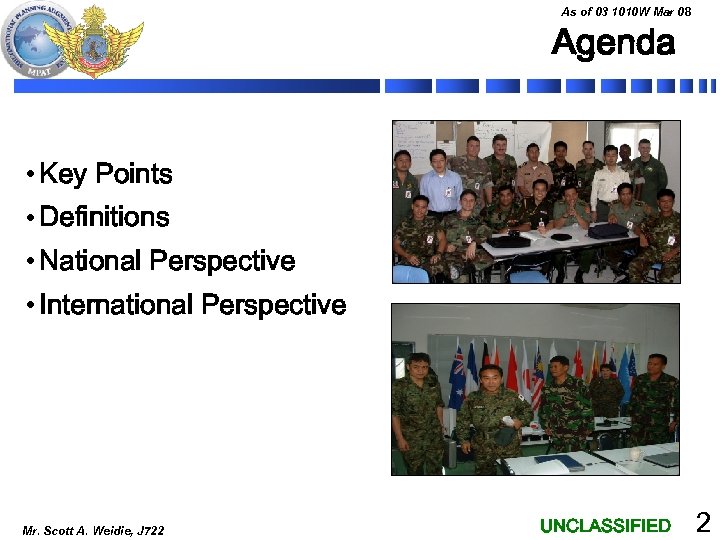 As of 03 1010 W Mar 08 Agenda • Key Points • Definitions • National Perspective • International Perspective Mr. Scott A. Weidie, J 722 UNCLASSIFIED 2
 As of 03 1010 W Mar 08 Key Points • Roles and responsibilities guided by: –Domestic law, policies and procedures –International agreements and guidelines • From a national perspective: –“National Disaster Management Organization” &/or “Local emergency management authority” • From an international perspective: –“Affected States” have the primary responsibility…. . Mr. Scott A. Weidie, J 722 UNCLASSIFIED 3
 As of 03 1010 W Mar 08 Definitions • “Disaster” means a serious disruption of the functioning of society, which poses a significant, widespread threat to human life, health, property or the environment, whether arising from accident, nature or human activity, whether developing suddenly or as the result of long-term processes, but excluding armed conflict. Mr. Scott A. Weidie, J 722 UNCLASSIFIED 4
 As of 03 1010 W Mar 08 Definitions • “Disaster relief” means goods and services provided to meet the immediate needs of disaster -affected communities. • “Initial recovery assistance” means goods and services intended to restore or improve the predisaster living conditions of disaster-affected communities, including initiatives to increase resilience and reduce risk, provided for an initial period of time, as determined by the affected State, after the immediate needs of disasteraffected communities have been met. Mr. Scott A. Weidie, J 722 UNCLASSIFIED 5
 As of 03 1010 W Mar 08 Definitions • “Affected State” means the State upon whose territory persons or property are affected by a disaster. • “Assisting State” means a State providing disaster relief or initial recovery assistance, whether through civil or military components. Mr. Scott A. Weidie, J 722 UNCLASSIFIED 6
 As of 03 1010 W Mar 08 Definitions • “Assisting humanitarian organization” means a foreign, regional, intergovernmental or international non-profit entity whose mandate and activities are primarily focused on humanitarian relief, recovery or development. • “Assisting actor” means any assisting humanitarian organization, assisting State, foreign individual, foreign private company providing charitable relief or other foreign entity responding to a disaster on the territory of the affected State or sending in-kind or cash donations. Mr. Scott A. Weidie, J 722 UNCLASSIFIED 7
 As of 03 1010 W Mar 08 Definitions • “Originating State” means the State from which disaster relief and initial recovery personnel, goods and equipment begin travel to the affected State. • “Transit State” means the State through whose territorial jurisdiction disaster relief or initial recovery assistance has received permission to pass on its way to or from the affected State in connection with disaster relief or initial recovery assistance. Mr. Scott A. Weidie, J 722 UNCLASSIFIED 8
 As of 03 1010 W Mar 08 National Perspective • States should adopt comprehensive legal, policy, and institutional frameworks and planning for disaster prevention, mitigation, preparedness, relief and recovery which take full account of the auxiliary role of their National Red Cross or Red Crescent Society, are inclusive of domestic civil society, and empower communities to enhance their own safety and resilience. • States, with the support, as appropriate, of relevant regional and international organizations, should devote adequate resources to ensure the effectiveness of these frameworks. – IDRL Guidelines Mr. Scott A. Weidie, J 722 UNCLASSIFIED 9
 As of 03 1010 W Mar 08 National Perspective • … address the initiation, facilitation, transit and regulation of international disaster relief and initial recovery assistance. . . • …allow for effective coordination of international disaster relief and initial recovery assistance, taking into account the role of the United Nations Emergency Relief Coordinator …. . and assisting humanitarian organizations • …clearly designate domestic governmental entities with responsibility and authority in these areas. Consideration should be given to establishing a national focal point to liaise between international and government actors at all levels to ensure the effectiveness of these frameworks. – IDRL Guidelines Mr. Scott A. Weidie, J 722 UNCLASSIFIED 10
 As of 03 1010 W Mar 08 National Perspective • Where necessary and appropriate, national governments should encourage other domestic actors with authority over areas of law or policy pertinent to international disaster relief or initial recovery assistance, such as provincial or local governments and private regulatory bodies, to take the necessary steps at their level to implement the Guidelines. –IDRL Guidelines Local authorities generally have primary response authority Mr. Scott A. Weidie, J 722 UNCLASSIFIED 11
 As of 03 1010 W Mar 08 International Perspective • Affected States have the primary responsibility to ensure disaster risk reduction, relief and recovery assistance in their territory. National Red Cross and Red Crescent Societies, as auxiliaries to the public authorities in the humanitarian field, and domestic civil society actors play a key supporting role at the domestic level. Mr. Scott A. Weidie, J 722 UNCLASSIFIED 12
 As of 03 1010 W Mar 08 International Perspective • If an affected State determines that a disaster situation exceeds national coping capacities, it should seek international and/or regional assistance to address the needs of affected persons. • Affected States have the sovereign right to coordinate, regulate and monitor, disaster relief and recovery assistance provided by assisting actors on their territory, consistent with international law. Mr. Scott A. Weidie, J 722 UNCLASSIFIED 13
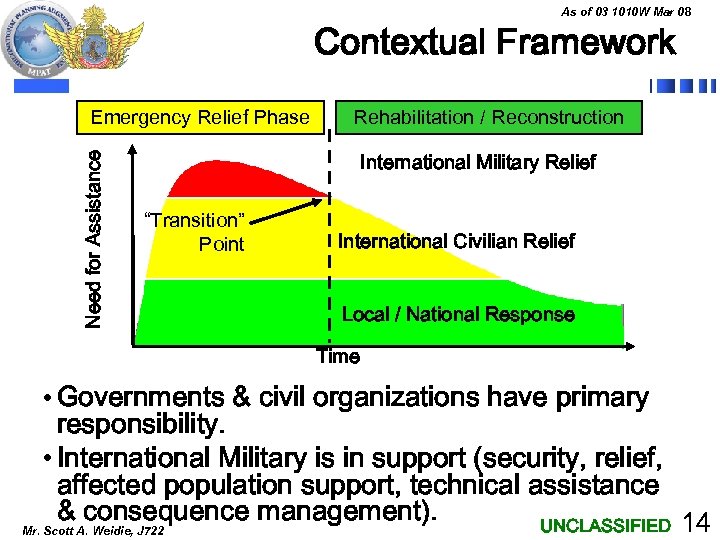 As of 03 1010 W Mar 08 Contextual Framework Need for Assistance Emergency Relief Phase Rehabilitation / Reconstruction International Military Relief “Transition” Point International Civilian Relief Local / National Response Time • Governments & civil organizations have primary responsibility. • International Military is in support (security, relief, affected population support, technical assistance & consequence management). UNCLASSIFIED 14 Mr. Scott A. Weidie, J 722
 As of 03 1010 W Mar 08 Contextual Framework • Diverse responsibilities of – Governments – International Organizations – Non-Governmental Organizations – Military • Two cultures in conflict – Military – National instrument – Civilian – humanitarian principles Mr. Scott A. Weidie, J 722 UNCLASSIFIED 15
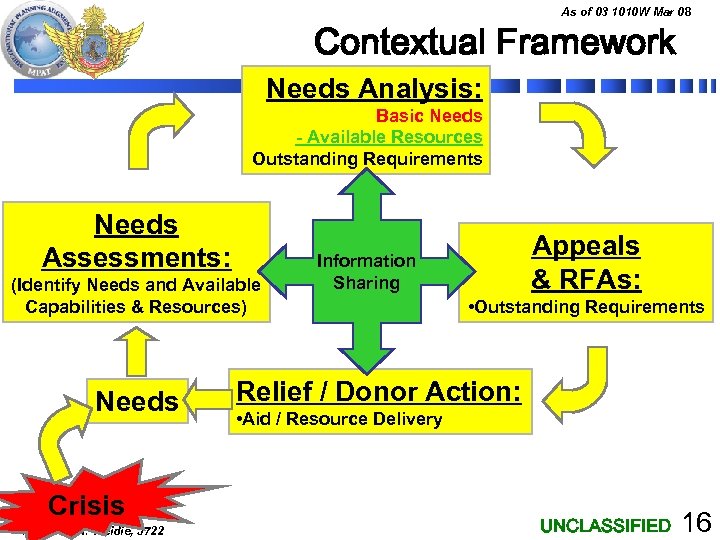 As of 03 1010 W Mar 08 Contextual Framework Needs Analysis: Basic Needs - Available Resources Outstanding Requirements Needs Assessments: (Identify Needs and Available Capabilities & Resources) Needs Crisis Mr. Scott A. Weidie, J 722 Appeals & RFAs: Information Sharing • Outstanding Requirements Relief / Donor Action: • Aid / Resource Delivery UNCLASSIFIED 16
 As of 03 1010 W Mar 08 Contextual Framework • Immediate Tasks –Search & Rescue –Evacuation of stranded victims –Delivery of food & water, medical supplies –Establish / provide communications –Transportation of civilian relief agencies –Security for relief agency personnel Mr. Scott A. Weidie, J 722 UNCLASSIFIED 17
 As of 03 1010 W Mar 08 Summary • The Affected State has primary responsibility • National Disaster Management Organization or Local Emergency Management Authority – Examples: National Committee for Disaster Management (Cambodia); National Disaster Coordinating Committee (Philippines); Federal Emergency Management Agency (US), etc. • Local authority generally has primary responsibility Mr. Scott A. Weidie, J 722 UNCLASSIFIED 18
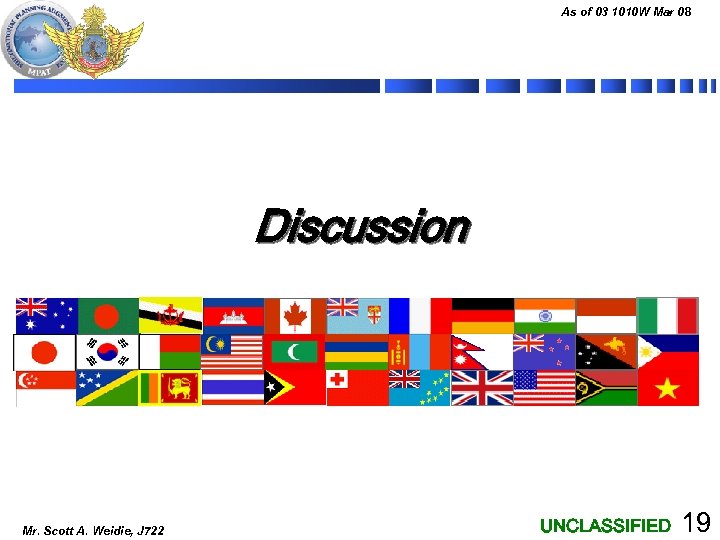 As of 03 1010 W Mar 08 Discussion Mr. Scott A. Weidie, J 722 UNCLASSIFIED 19