


 Скачать презентацию Arts and Humanities Citation Index and other resources
279f8737c39b01262cf43f76c6ada330.ppt
- Количество слайдов: 18
 Arts and Humanities Citation Index and other resources for Modern Languages Nick Hearn nick. hearn@bodleian. ox. ac. uk Friday, 28 th May 2010
 Session outline • What is ‘Arts and Humanities citation database’? • Three ways for using A&HCI in ML study • To find articles buy author, title, subject • To explore a subject area • To explore research and publishing in your subject area • Types of search • Basic search • Advanced search General Searches • Citation search • Citing references • Cited reference Citation Searches • Related records search • Comparison with other citation indexes – pros and cons Google Scholar, Scopus, JSTOR (JSTOR has only some features)
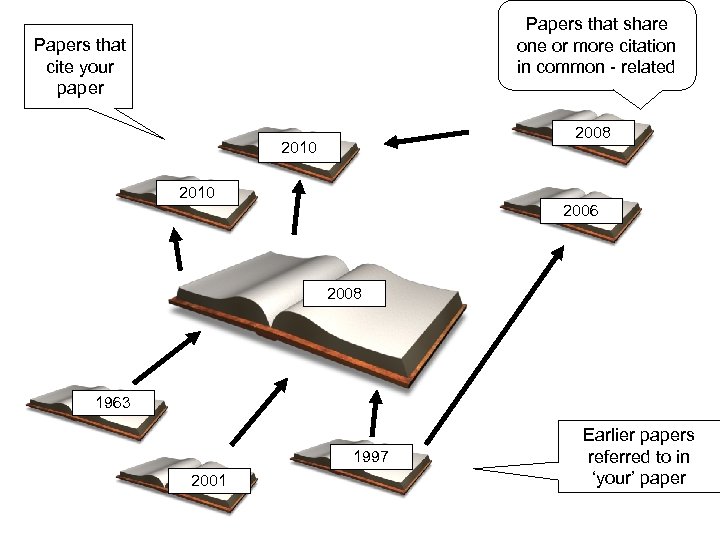 Papers that share one or more citation in common - related Papers that cite your paper 2008 2010 2006 2008 1963 1997 2001 Earlier papers referred to in ‘your’ paper
 Three uses of A&HCI in ML • Use as another bibliographical database for searching like MLA (or in combination with MLA and other databases: cross-searching) • Use to trace development of the subject or to explore a new subject area • Use to see impact of your publications or place your next publication in the journal with the most impact
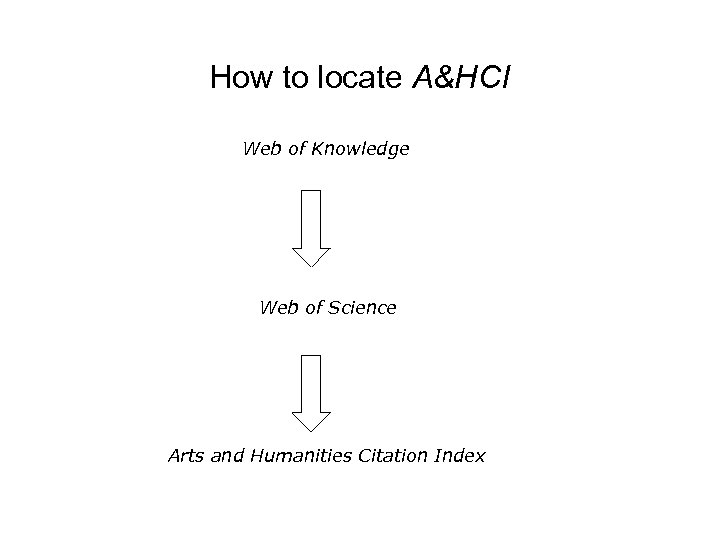 How to locate A&HCI Web of Knowledge Web of Science Arts and Humanities Citation Index
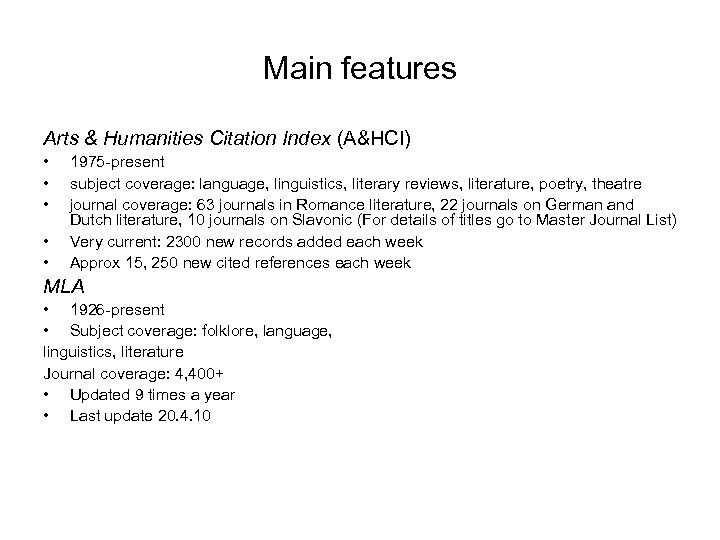 Main features Arts & Humanities Citation Index (A&HCI) • • • 1975 -present subject coverage: language, linguistics, literary reviews, literature, poetry, theatre journal coverage: 63 journals in Romance literature, 22 journals on German and Dutch literature, 10 journals on Slavonic (For details of titles go to Master Journal List) Very current: 2300 new records added each week Approx 15, 250 new cited references each week MLA • 1926 -present • Subject coverage: folklore, language, linguistics, literature Journal coverage: 4, 400+ • Updated 9 times a year • Last update 20. 4. 10
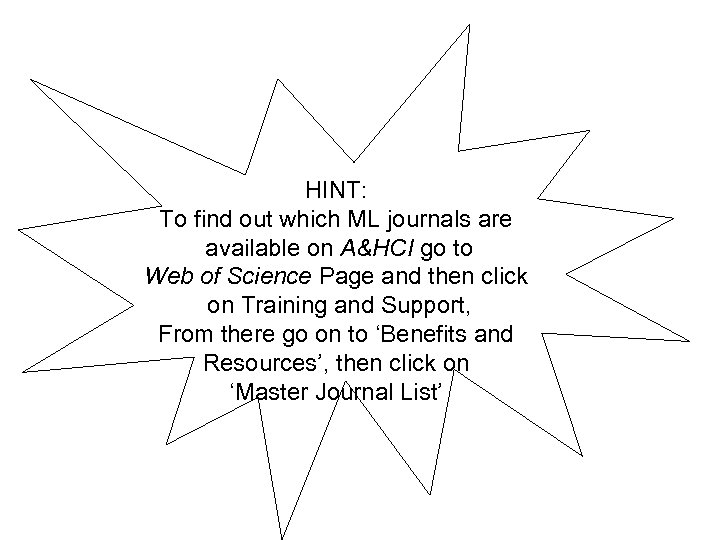 HINT: To find out which ML journals are available on A&HCI go to Web of Science Page and then click on Training and Support, From there go on to ‘Benefits and Resources’, then click on ‘Master Journal List’
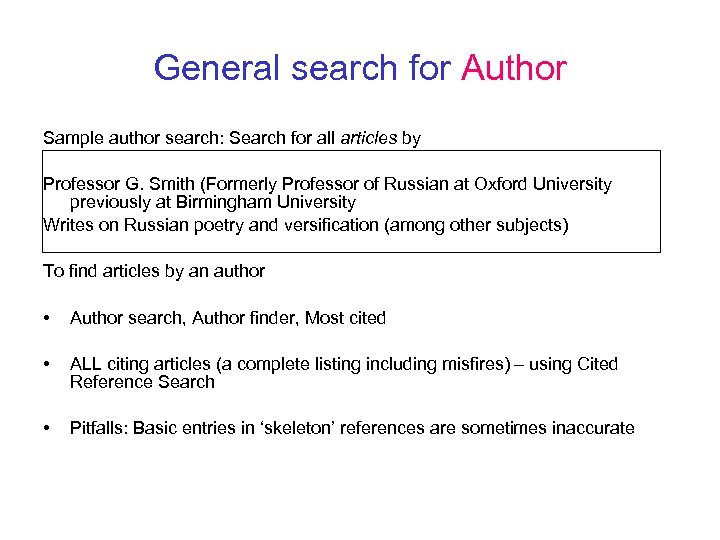 General search for Author Sample author search: Search for all articles by Professor G. Smith (Formerly Professor of Russian at Oxford University previously at Birmingham University Writes on Russian poetry and versification (among other subjects) To find articles by an author • Author search, Author finder, Most cited • ALL citing articles (a complete listing including misfires) – using Cited Reference Search • Pitfalls: Basic entries in ‘skeleton’ references are sometimes inaccurate
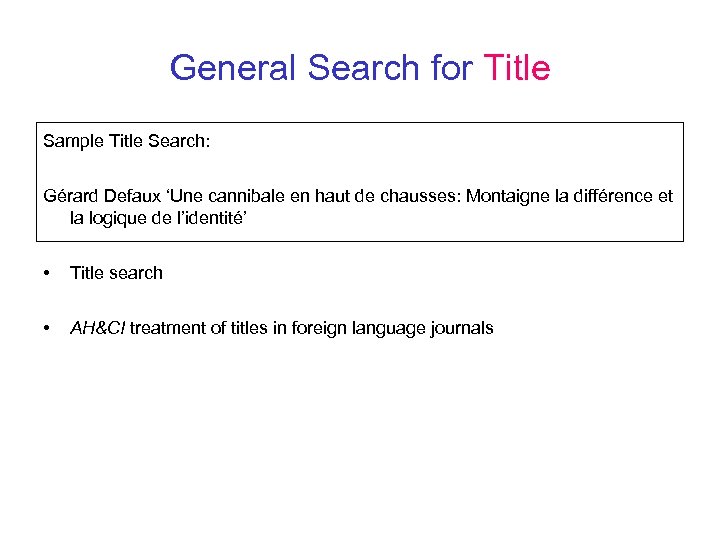 General Search for Title Sample Title Search: Gérard Defaux ‘Une cannibale en haut de chausses: Montaigne la différence et la logique de l’identité’ • Title search • AH&CI treatment of titles in foreign language journals
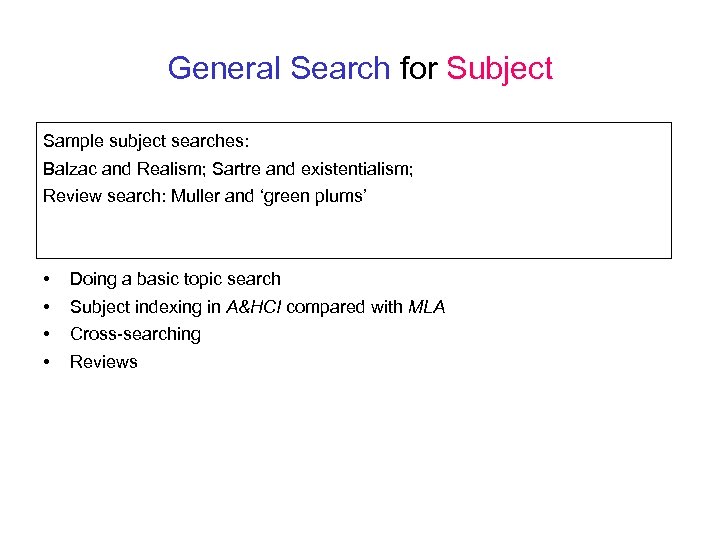 General Search for Subject Sample subject searches: Balzac and Realism; Sartre and existentialism; Review search: Muller and ‘green plums’ • • Doing a basic topic search Subject indexing in A&HCI compared with MLA Cross-searching Reviews
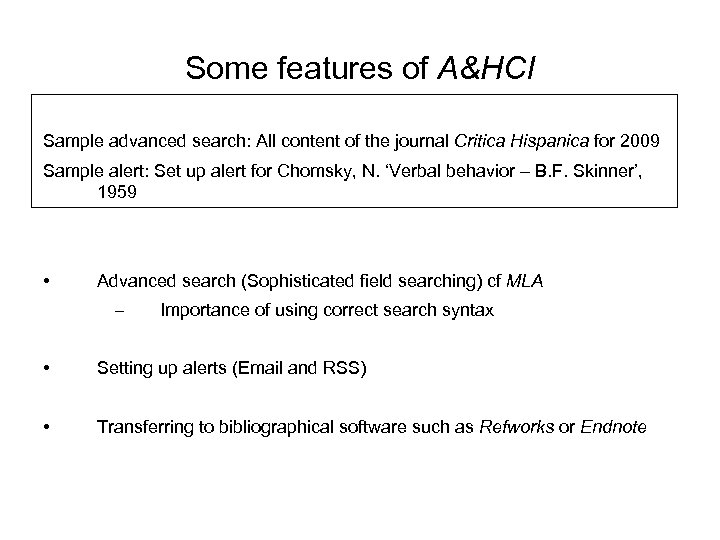 Some features of A&HCI Sample advanced search: All content of the journal Critica Hispanica for 2009 Sample alert: Set up alert for Chomsky, N. ‘Verbal behavior – B. F. Skinner’, 1959 • Advanced search (Sophisticated field searching) cf MLA – Importance of using correct search syntax • Setting up alerts (Email and RSS) • Transferring to bibliographical software such as Refworks or Endnote
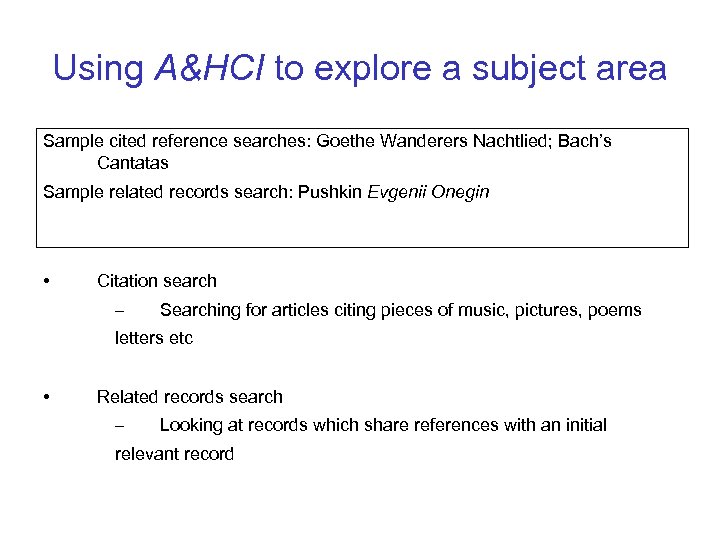 Using A&HCI to explore a subject area Sample cited reference searches: Goethe Wanderers Nachtlied; Bach’s Cantatas Sample related records search: Pushkin Evgenii Onegin • Citation search – Searching for articles citing pieces of music, pictures, poems letters etc • Related records search – Looking at records which share references with an initial relevant record
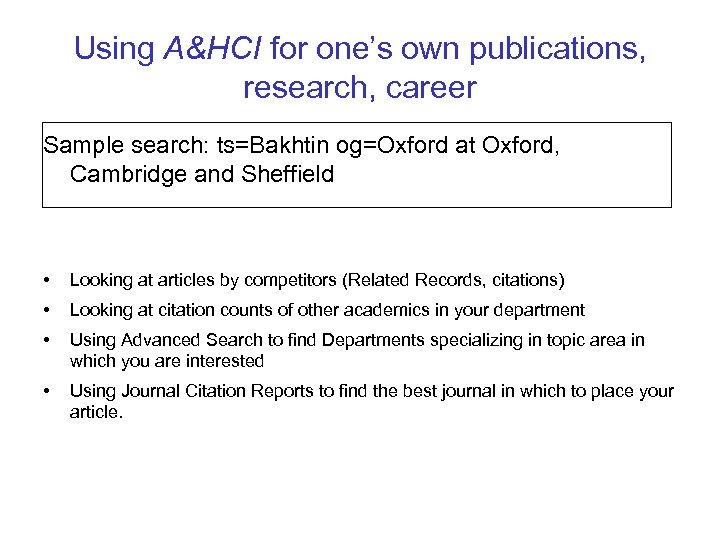 Using A&HCI for one’s own publications, research, career Sample search: ts=Bakhtin og=Oxford at Oxford, Cambridge and Sheffield • Looking at articles by competitors (Related Records, citations) • Looking at citation counts of other academics in your department • Using Advanced Search to find Departments specializing in topic area in which you are interested • Using Journal Citation Reports to find the best journal in which to place your article.
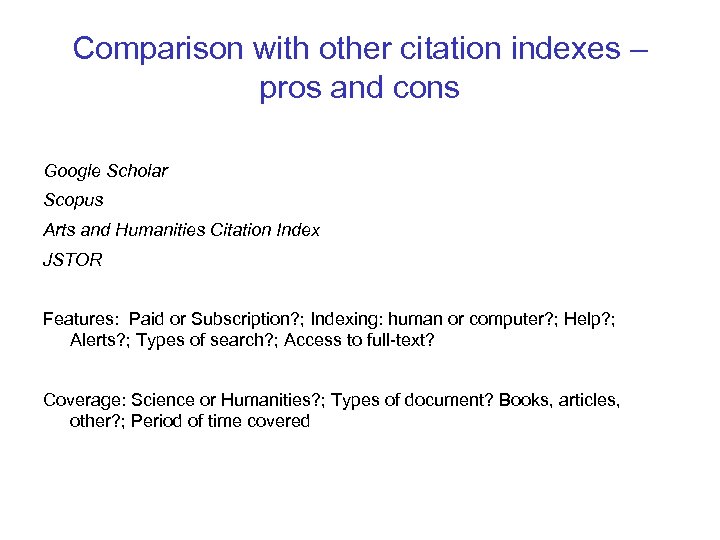 Comparison with other citation indexes – pros and cons Google Scholar Scopus Arts and Humanities Citation Index JSTOR Features: Paid or Subscription? ; Indexing: human or computer? ; Help? ; Alerts? ; Types of search? ; Access to full-text? Coverage: Science or Humanities? ; Types of document? Books, articles, other? ; Period of time covered
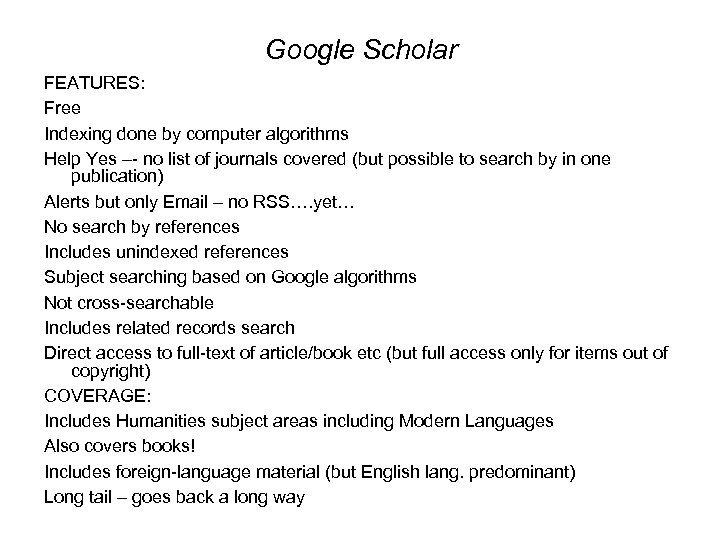 Google Scholar FEATURES: Free Indexing done by computer algorithms Help Yes –- no list of journals covered (but possible to search by in one publication) Alerts but only Email – no RSS…. yet… No search by references Includes unindexed references Subject searching based on Google algorithms Not cross-searchable Includes related records search Direct access to full-text of article/book etc (but full access only for items out of copyright) COVERAGE: Includes Humanities subject areas including Modern Languages Also covers books! Includes foreign-language material (but English lang. predominant) Long tail – goes back a long way
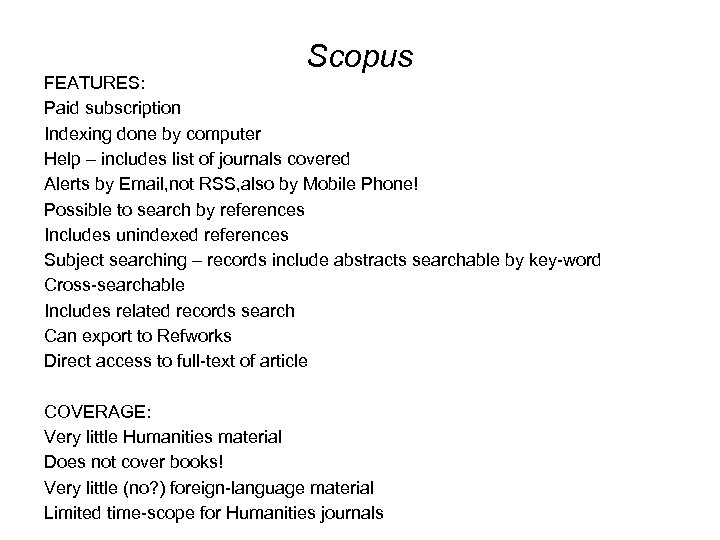 Scopus FEATURES: Paid subscription Indexing done by computer Help – includes list of journals covered Alerts by Email, not RSS, also by Mobile Phone! Possible to search by references Includes unindexed references Subject searching – records include abstracts searchable by key-word Cross-searchable Includes related records search Can export to Refworks Direct access to full-text of article COVERAGE: Very little Humanities material Does not cover books! Very little (no? ) foreign-language material Limited time-scope for Humanities journals
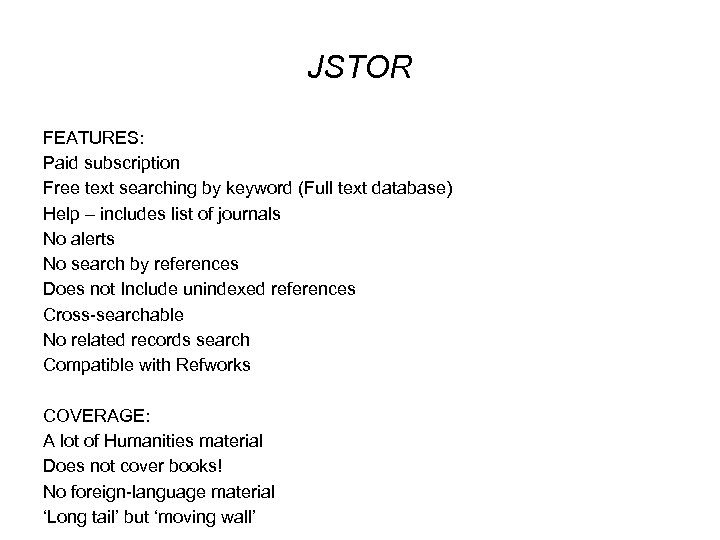 JSTOR FEATURES: Paid subscription Free text searching by keyword (Full text database) Help – includes list of journals No alerts No search by references Does not Include unindexed references Cross-searchable No related records search Compatible with Refworks COVERAGE: A lot of Humanities material Does not cover books! No foreign-language material ‘Long tail’ but ‘moving wall’
 Over to you Do your own search on A&HCI, Google Scholar, Scopus or JSTOR Do an Arts and Humanities Citation Index work-out. Set up an RSS Feed and use to set up feed for articles from A&HCI Set up a Refworks account and use for articles from A&HCI Don’t hesitate to ask if anything is unclear nick. hearn@bodleian. ox. ac. uk