 Скачать презентацию Artix 4 0 Think Big Start Small Scale
c257a1577bfeea4590a5f5bfc210a409.ppt
- Количество слайдов: 31



Artix 4. 0 Think Big. Start Small. Scale Fast.
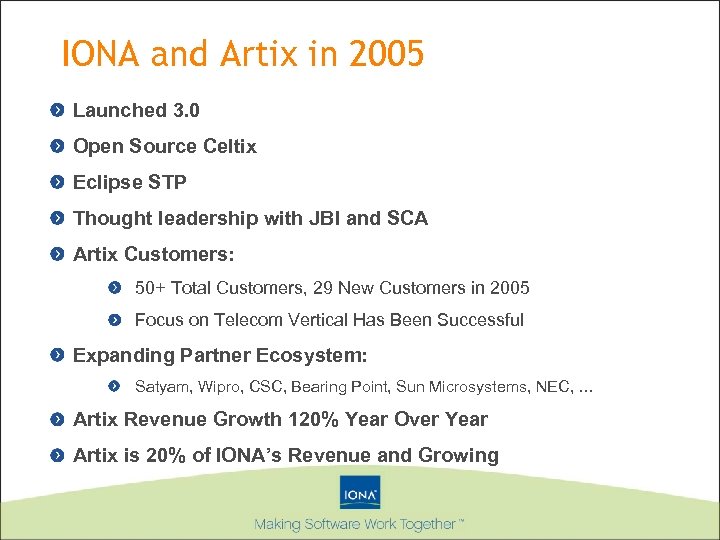
IONA and Artix in 2005 Launched 3. 0 Open Source Celtix Eclipse STP Thought leadership with JBI and SCA Artix Customers: 50+ Total Customers, 29 New Customers in 2005 Focus on Telecom Vertical Has Been Successful Expanding Partner Ecosystem: Satyam, Wipro, CSC, Bearing Point, Sun Microsystems, NEC, … Artix Revenue Growth 120% Year Over Year Artix is 20% of IONA’s Revenue and Growing
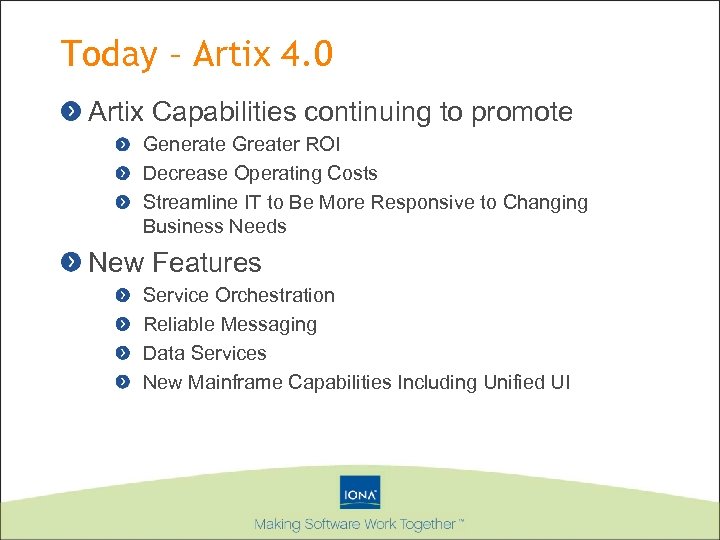
Today – Artix 4. 0 Artix Capabilities continuing to promote Generate Greater ROI Decrease Operating Costs Streamline IT to Be More Responsive to Changing Business Needs New Features Service Orchestration Reliable Messaging Data Services New Mainframe Capabilities Including Unified UI
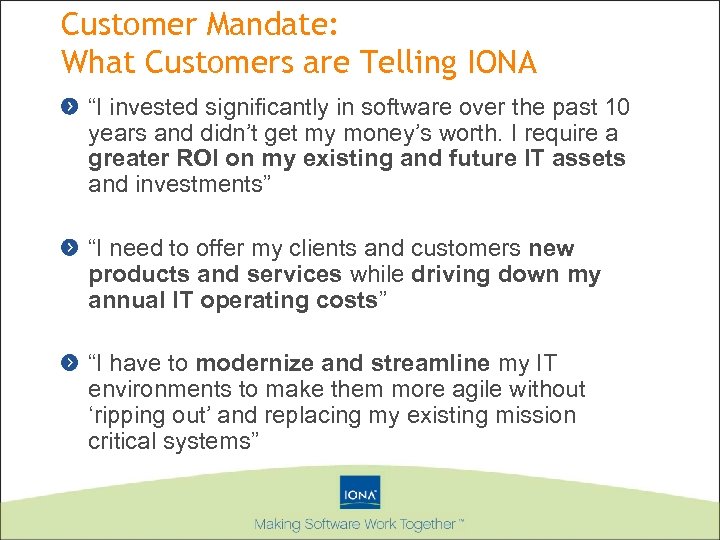
Customer Mandate: What Customers are Telling IONA “I invested significantly in software over the past 10 years and didn’t get my money’s worth. I require a greater ROI on my existing and future IT assets and investments” “I need to offer my clients and customers new products and services while driving down my annual IT operating costs” “I have to modernize and streamline my IT environments to make them more agile without ‘ripping out’ and replacing my existing mission critical systems”
What is Artix, Why it can help Artix is an ESB…. So what? What's the difference? Artix is: Light weight High performance Extensible How light weight is light weight? How High Performance is High Performance? How extensible is extensible?
Light, Fast, and Extensible Less is More! Memory usage as small as 20 M-30 M 3 x to 4 x Faster compared to EAI/J 2 EE Adapters All features are plug-ins Load only the features you need, buy only the features you need Message Format Routing Transport Transformation
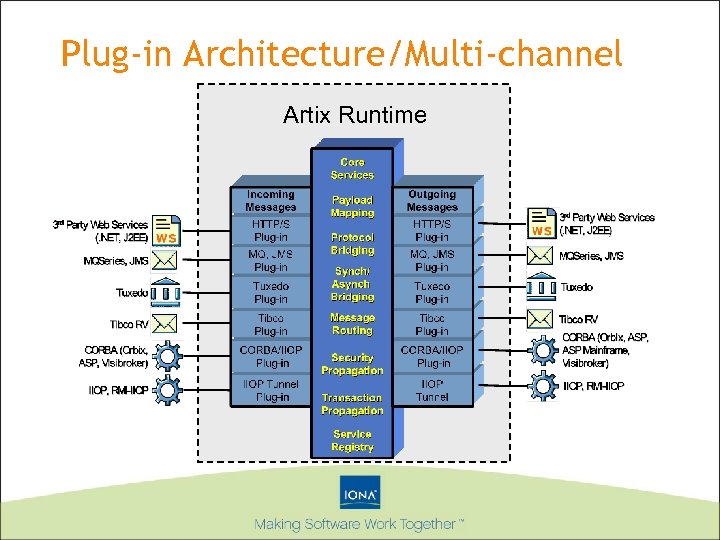
Plug-in Architecture/Multi-channel Artix Runtime
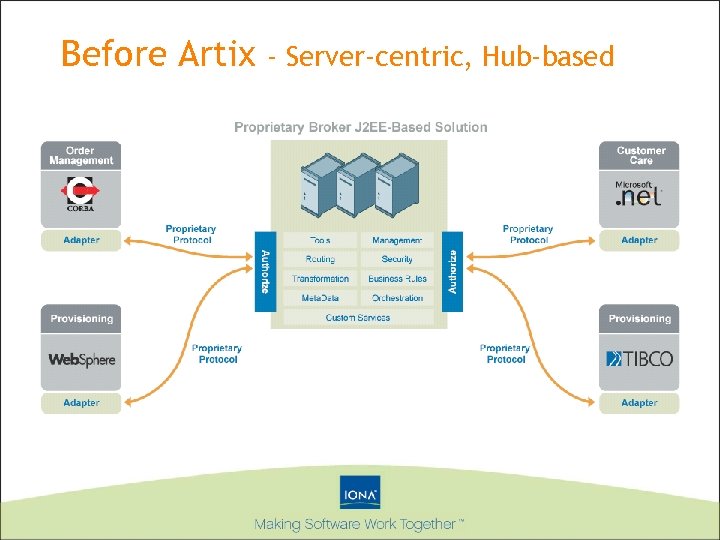
Before Artix - Server-centric, Hub-based
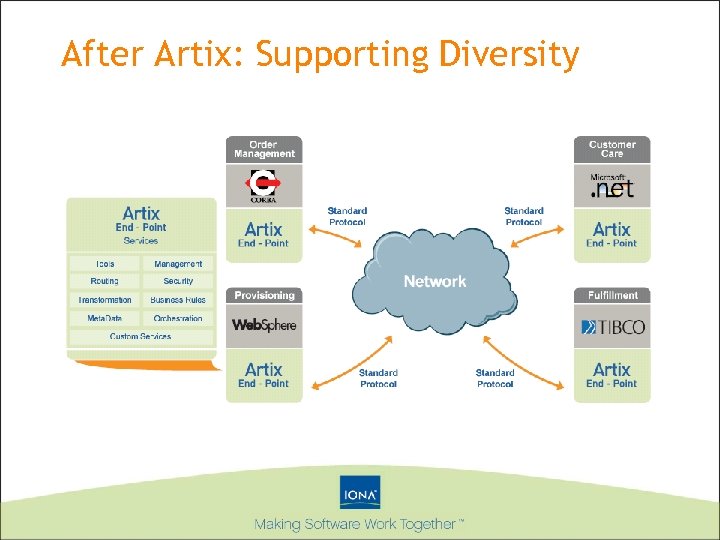
After Artix: Supporting Diversity
But Why is distributed better than Hub? EAI vendors promoted the hub approach for integration Because it "looks" cleaner on paper But if you think about it more, it does not make sense Why did we get away from mainframe to network (and then internet) computing? Why did we changed from client-server to P 2 P, grid computing Answer: Distributed is more efficient, low cost then centralized computing
Still not convinced? Michael Herr, IT Director of Deutsche Post, envisions SOA as "City Planning" Let's look at a real world comparison between Hub vs. Distributed Architecture

City Planning, a real world example Paris Vancouver
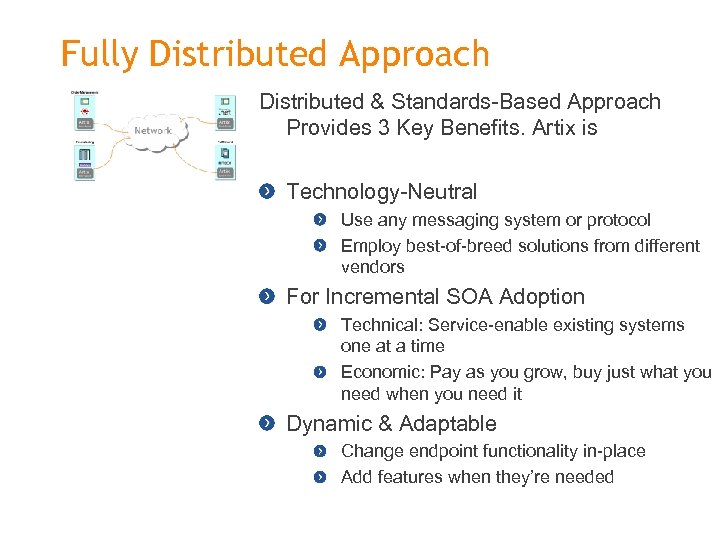
Fully Distributed Approach Distributed & Standards-Based Approach Provides 3 Key Benefits. Artix is Technology-Neutral Use any messaging system or protocol Employ best-of-breed solutions from different vendors For Incremental SOA Adoption Technical: Service-enable existing systems one at a time Economic: Pay as you grow, buy just what you need when you need it Dynamic & Adaptable Change endpoint functionality in-place Add features when they’re needed
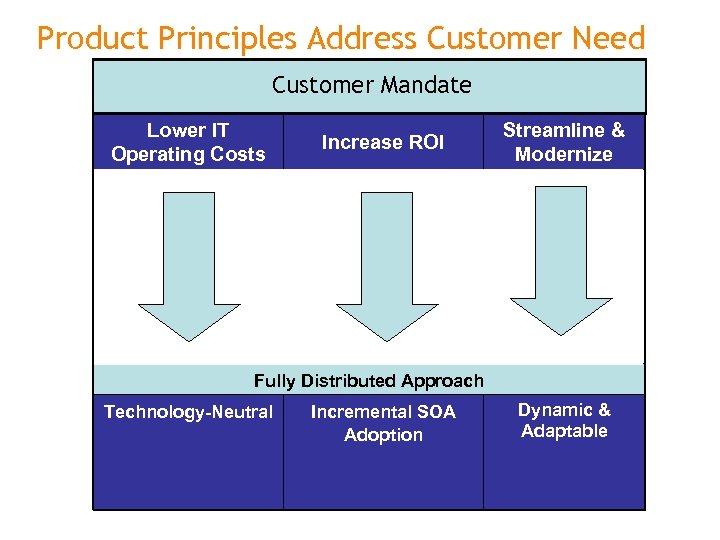
Product Principles Address Customer Need Customer Mandate Lower IT Operating Costs Increase ROI Streamline & Modernize Fully Distributed Approach Technology-Neutral Incremental SOA Adoption Dynamic & Adaptable
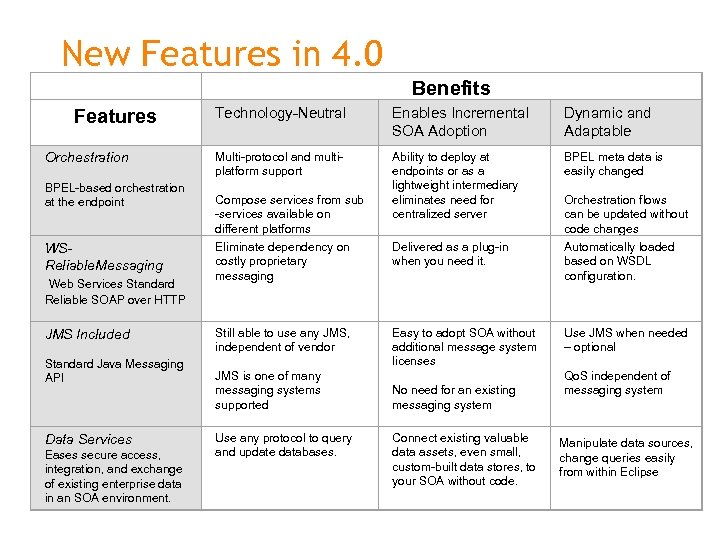
New Features in 4. 0 Benefits Features Orchestration BPEL-based orchestration at the endpoint WSReliable. Messaging Web Services Standard Technology-Neutral Enables Incremental SOA Adoption Dynamic and Adaptable Multi-protocol and multiplatform support Compose services from sub -services available on different platforms Eliminate dependency on costly proprietary Ability to deploy at endpoints or as a lightweight intermediary eliminates need for centralized server BPEL meta data is easily changed Orchestration flows can be updated without code changes Delivered as a plug-in when you need it. Automatically loaded based on WSDL configuration. Easy to adopt SOA without additional message system licenses No need for an existing messaging system Use JMS when needed – optional Connect existing valuable data assets, even small, custom-built data stores, to your SOA without code. Manipulate data sources, change queries easily from within Eclipse messaging Reliable SOAP over HTTP JMS Included Standard Java Messaging API Data Services Eases secure access, integration, and exchange of existing enterprise data in an SOA environment. Still able to use any JMS, independent of vendor JMS is one of many messaging systems supported Use any protocol to query and update databases. Qo. S independent of messaging system
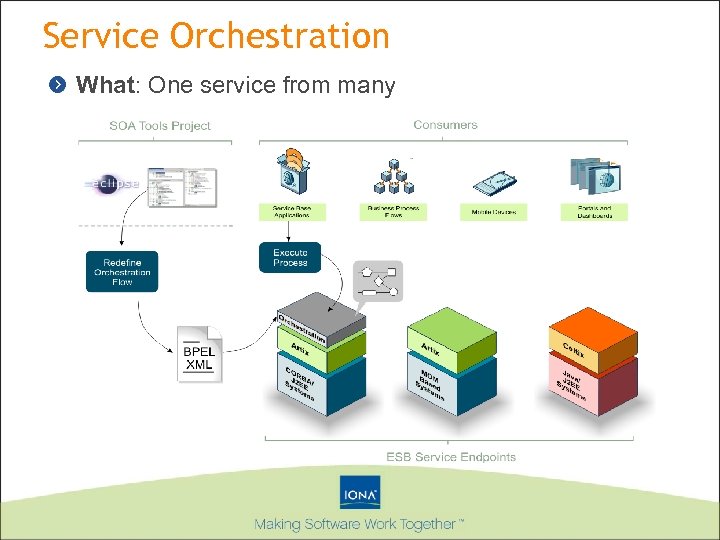
Service Orchestration What: One service from many
Service Orchestration = BPEL + Artix Integration Who: discussing versioning or refactoring, code-free. Sometimes confused with BPM Value: Reduces costs to assemble composite services (save 4 figures / service), eases repartitioning with BPM, decreases capacity requirements for hubs (save 6 figures) End result: allows greater set of use cases to be end-point oriented with superior Qo. S; no coding
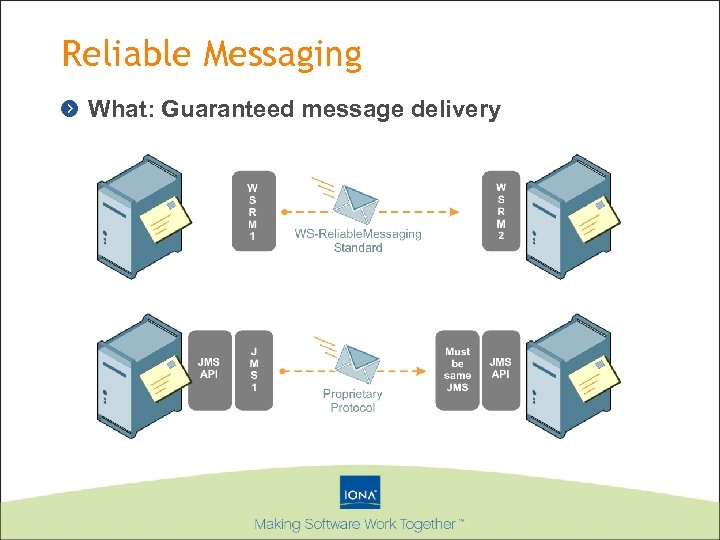
Reliable Messaging What: Guaranteed message delivery
Reliable Messaging Who: customers emphasizing loose coupling between endpoints Value: eliminate license fees otherwise paid to IBM, Tibco, or Sonic (save 4 -5 figures / CPU), saves additional administration costs (4 figures / CPU) End result: Use built-in JMS or WS-RM to get away from relying on MOM's proprietary protocols ; Things to note JMS standardizes the API and the capabilities, not the wire protocol WS-Reliable. Messaging standardizes the wire protocol, not the API – we ship our own engine
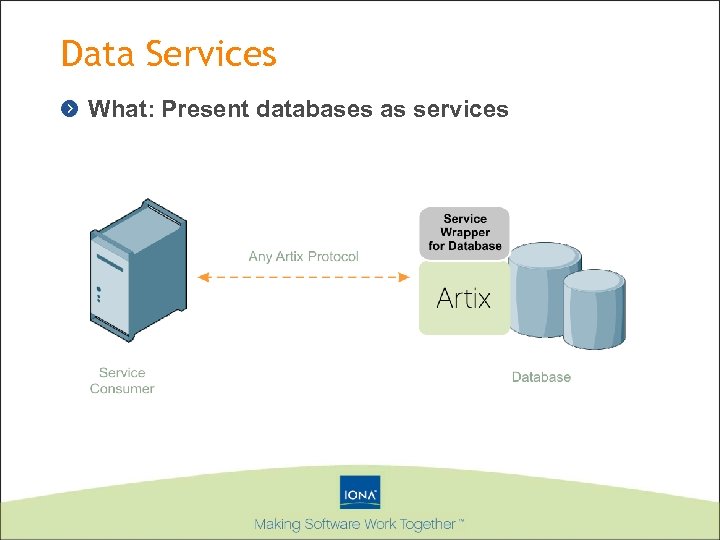
Data Services What: Present databases as services
Data Services Cues: wants code-free solution for DB apps Value: Cost to develop, test, and maintain service enablement (4 figures/service) Eliminates cost for database upgrades needed to get service enablement (save 4 - 5 figures / CPU) plus other costs and politics End result: Make your most valuable data assets more accessible and useful; Visually define database connectivity without code
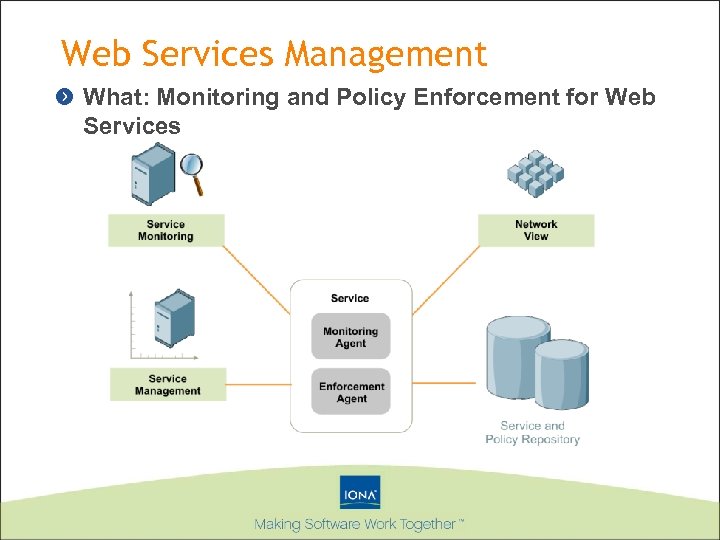
Web Services Management What: Monitoring and Policy Enforcement for Web Services
Web Services Management Cues: IT Governance and SLA concerns Value: Eliminates cost to hand-tool SLA and address Compliance concerns End result: Different levels of Management Strategy (next slide) Things to Note: We provide plugins for policy enforcement and basic management console Partnering with Amber. Point (Nano Agent)
The Artix Management Story Enterprise Managing the Enterprise through Artix plug-ins that connect to BMC Patrol, Tivioli, HP Open. View Web Services SOA Management through Partnership with Amber. Point and support for CA-WSDM Support for Developer Eclipse Management Console for low level Lifecycle management of Artix Container and Services JMX Instrumented Artix Services - interestingly JMX is being adopted by major EMS vendors
Artix 4. 0 - new levels of QOS Massive increases in Performance since 3. 0 Transport Neutrality with WS-Addressing Connect SOAP, MQ, TUXEDO, JMS, CORBA together using W 3 C Standard Required for WS-Reliable. Messaging - also in 4. 0 Service Lifecycle and Performance Monitoring Artix Management Console JMX Instrumentation for Artix Services and Endpoints Transaction Enhancements designed to be compatible with a variety of different underlying transaction systems FTP Transport Major IT systems still rely on Batch Processing using FTP Artix Security Advanced hides the complexity of using 3 rd party backend Security systems e. g. JAAS, RACF, TLS, HTTPS, Kerberos, Microsoft Active Directory
Improved Support for z/OS Customers want to leverage their existing mainframe PL/I, CICS and IMS services, via SOAP/HTTP or SOAP/MQ IONA has the expertise to service-enable mainframes in a secure and extensible way Promotes use of mainframe assets as equal citizens in SOA and expands customer ability to take holistic view of SOA Common tooling and no requirement to change existing applications
Commitment to Standards Successfully demonstrated Artix at the Microsoft “Windows Communication Foundation” Interoperability Plug-Fest (March 2006) Only vendor with working WS-Atomic. Transactions Completed the BEA Validation Program, fully demonstrating the ability to inter-operate with BEA's Weblogic 9. 0 and Aqua. Logic Service Bus 2. 1. Connects Aqua. Logic to CICS and IMS-based mainframe environments
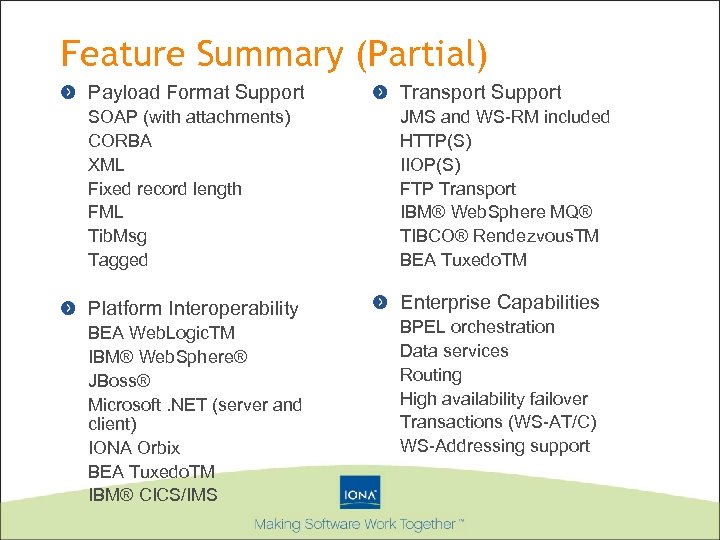
Feature Summary (Partial) Payload Format Support Transport Support SOAP (with attachments) CORBA XML Fixed record length FML Tib. Msg Tagged JMS and WS-RM included HTTP(S) IIOP(S) FTP Transport IBM® Web. Sphere MQ® TIBCO® Rendezvous. TM BEA Tuxedo. TM Platform Interoperability Enterprise Capabilities BEA Web. Logic. TM IBM® Web. Sphere® JBoss® Microsoft. NET (server and client) IONA Orbix BEA Tuxedo. TM IBM® CICS/IMS BPEL orchestration Data services Routing High availability failover Transactions (WS-AT/C) WS-Addressing support
IONA’s Open Source Strategy Change the Market Dynamics § Drive the adoption of SOA projects and Infrastructure § Create demand for our commercial offerings § Disrupt established competition Partner with Established Leaders § Object Web – the leader in open source middleware § Eclipse Foundation – the leader in open source tooling § IONA will take a strategic role in both these communities
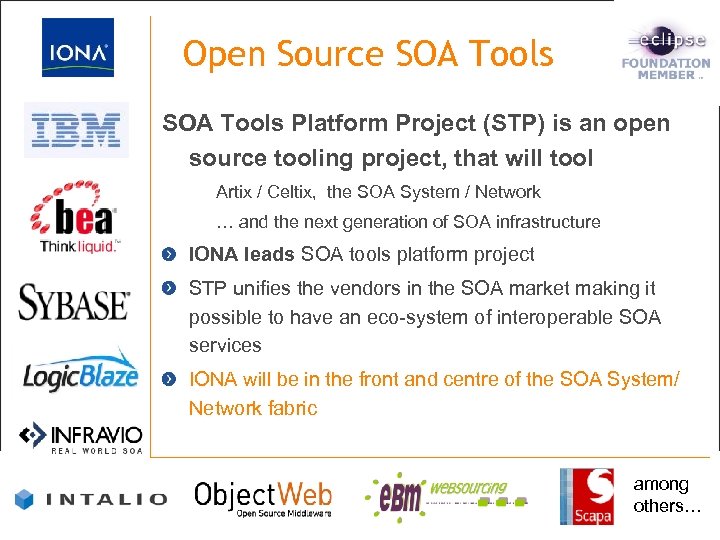
Open Source SOA Tools Platform Project (STP) is an open source tooling project, that will tool Artix / Celtix, the SOA System / Network … and the next generation of SOA infrastructure IONA leads SOA tools platform project STP unifies the vendors in the SOA market making it possible to have an eco-system of interoperable SOA services IONA will be in the front and centre of the SOA System/ Network fabric among others…
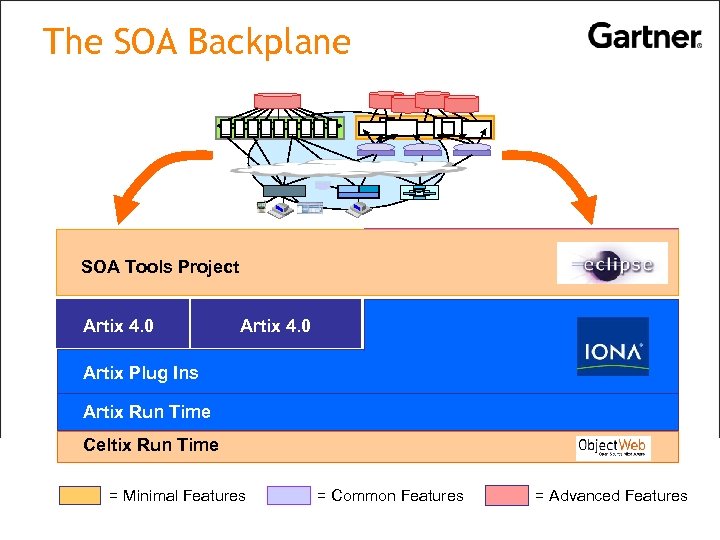
The SOA Backplane Life Cycle Management Tools SOA Tools Project Orchestration Artix 4. 0 Development Tools Registry 4. 0 Artix Policies Security Management Adapters Extensibility. Ins Routing/ Mediation/ Artix Plug Naming QOS Framework Addressing Transformation Artix Run Time Communication Celtix Run Time (SOAP, IIOP, JMS, MOM, RPC, ORB, TPM) = Minimal Features = Common Features = Advanced Features
Скачать презентацию Artix 4 0 Think Big Start Small Scale
c257a1577bfeea4590a5f5bfc210a409.ppt