


 Скачать презентацию Artificial Life lecture 16 Game Theory Communication Evolution
7d5917f68ec1f6d1db33aebedef65539.ppt
- Количество слайдов: 36
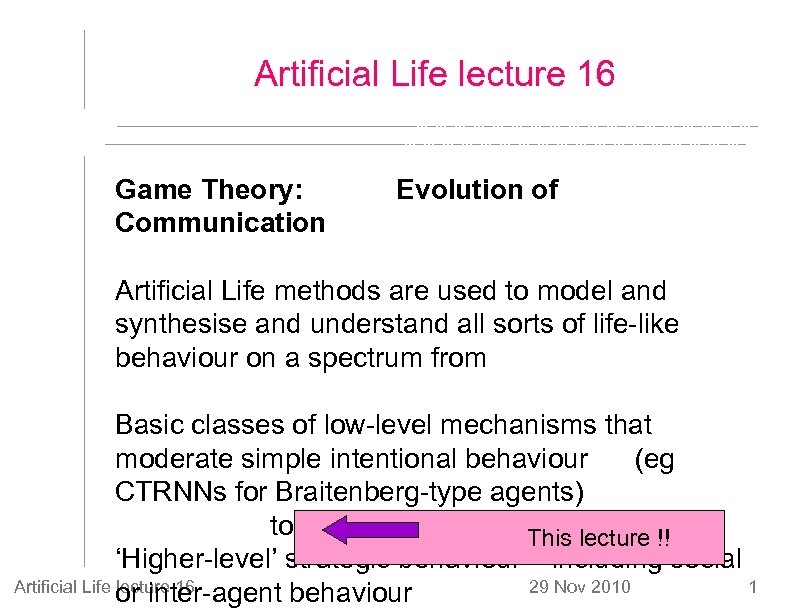 Artificial Life lecture 16 Game Theory: Communication Evolution of Artificial Life methods are used to model and synthesise and understand all sorts of life-like behaviour on a spectrum from Basic classes of low-level mechanisms that moderate simple intentional behaviour (eg CTRNNs for Braitenberg-type agents) to This lecture !! ‘Higher-level’ strategic behaviour – including social Artificial Life lecture 16 29 Nov 2010 1 or inter-agent behaviour
 Game Theory 20 th C development: maths originally developed by von Neumann. Initial applications primarily towards economics, but then turned out to be really significant for biology. John Maynard Smith (Sussex) “Evolution and the Theory of Games” 1982 Evolutionarily Stable Strategies Artificial Life lecture 16 29 Nov 2010 2
 Basics of Game Theory Suppose 2, or more, agents interact such that each has strategic choices (…fight or flee … chase or ignore… buy or don’t buy…. sell or don’t sell … cooperate or defect…) … and the outcome (…or outcomes, both shortterm and longer-term) for each agent depends on what others do as well as its own choice …then you can model this as a GAME, in which agents can have better or worse strategies, which maybe they want to optimise Artificial Life lecture 16 29 Nov 2010 3
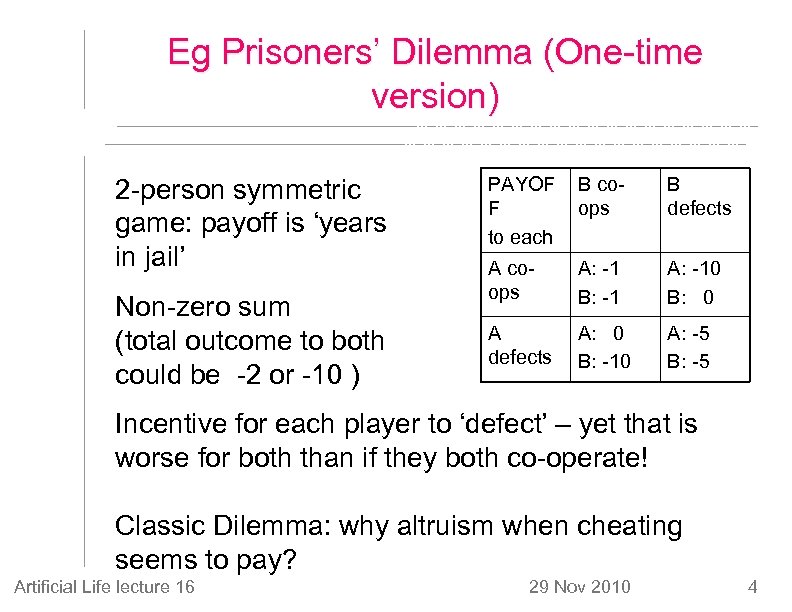 Eg Prisoners’ Dilemma (One-time version) 2 -person symmetric game: payoff is ‘years in jail’ Non-zero sum (total outcome to both could be -2 or -10 ) PAYOF F to each B coops B defects A coops A: -1 B: -1 A: -10 B: 0 A defects A: 0 B: -10 A: -5 B: -5 Incentive for each player to ‘defect’ – yet that is worse for both than if they both co-operate! Classic Dilemma: why altruism when cheating seems to pay? Artificial Life lecture 16 29 Nov 2010 4
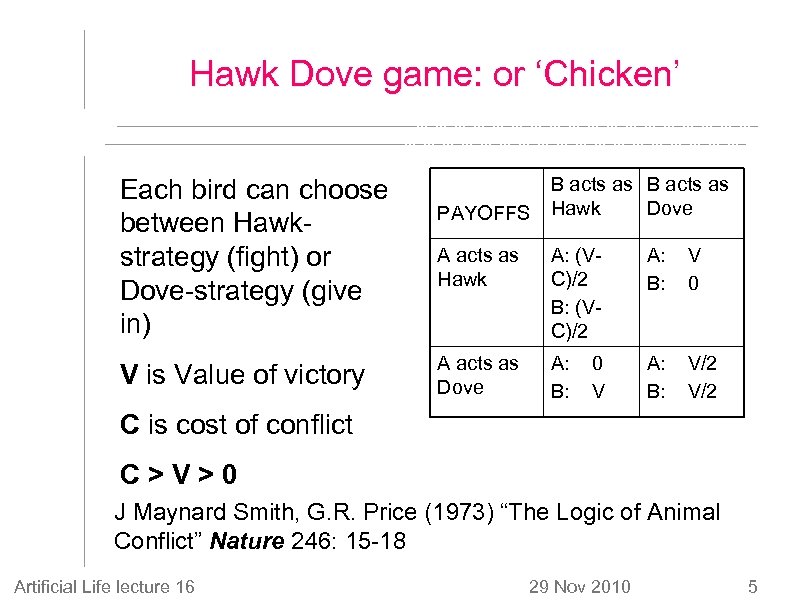 Hawk Dove game: or ‘Chicken’ Each bird can choose between Hawkstrategy (fight) or Dove-strategy (give in) V is Value of victory PAYOFFS B acts as Hawk Dove A acts as Hawk A: (VC)/2 B: (VC)/2 A: V B: 0 A acts as Dove A: 0 B: V A: V/2 B: V/2 C is cost of conflict C>V>0 J Maynard Smith, G. R. Price (1973) “The Logic of Animal Conflict” Nature 246: 15 -18 Artificial Life lecture 16 29 Nov 2010 5
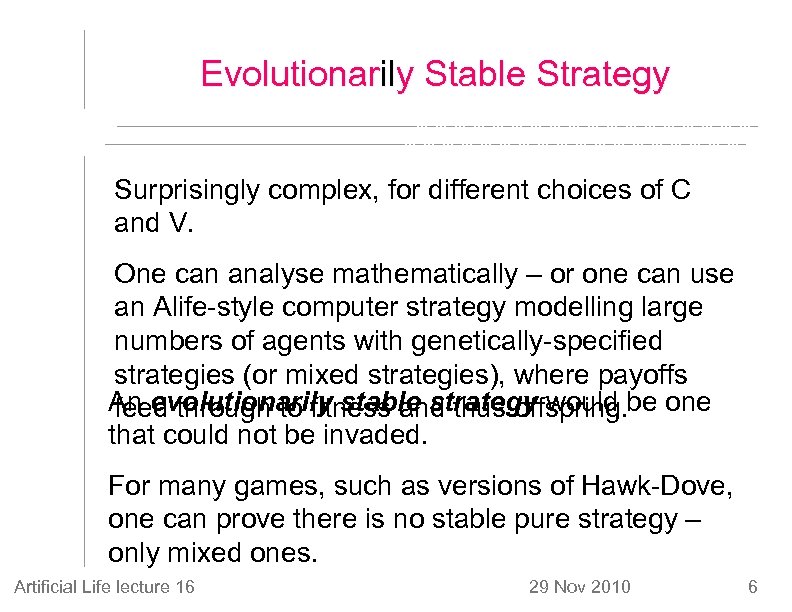 Evolutionarily Stable Strategy Surprisingly complex, for different choices of C and V. One can analyse mathematically – or one can use an Alife-style computer strategy modelling large numbers of agents with genetically-specified strategies (or mixed strategies), where payoffs An evolutionarily stable strategy would be one feed through to fitness and thus offspring. that could not be invaded. For many games, such as versions of Hawk-Dove, one can prove there is no stable pure strategy – only mixed ones. Artificial Life lecture 16 29 Nov 2010 6
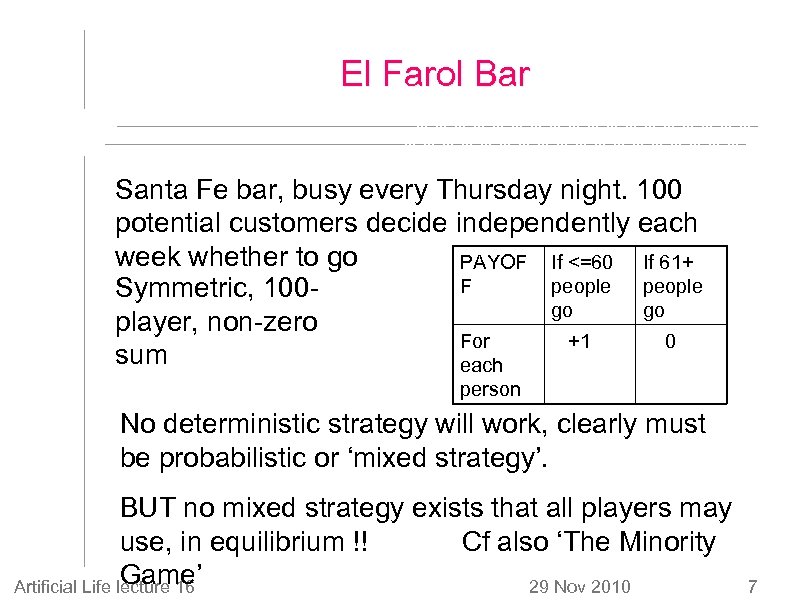 El Farol Bar Santa Fe bar, busy every Thursday night. 100 potential customers decide independently each week whether to go PAYOF If <=60 If 61+ F people Symmetric, 100 go go player, non-zero For +1 0 sum each person No deterministic strategy will work, clearly must be probabilistic or ‘mixed strategy’. BUT no mixed strategy exists that all players may use, in equilibrium !! Cf also ‘The Minority Game’ Artificial Life lecture 16 29 Nov 2010 7
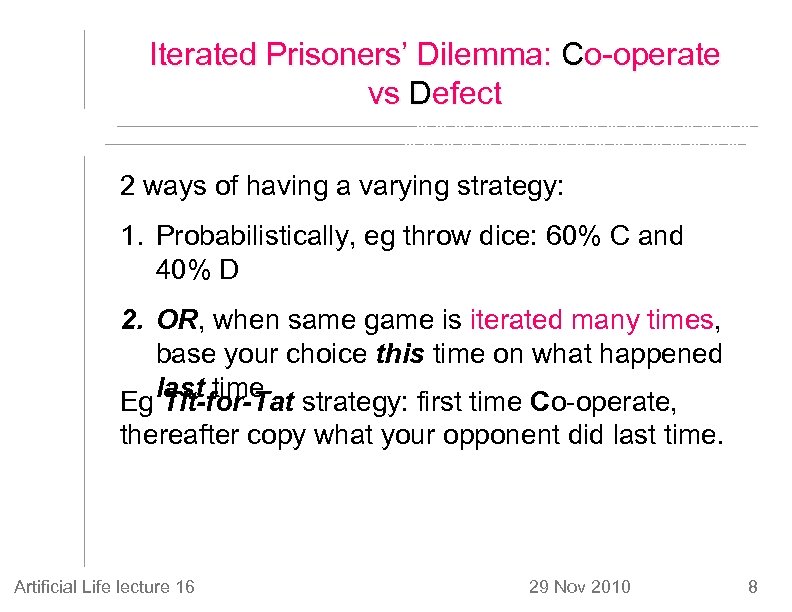 Iterated Prisoners’ Dilemma: Co-operate vs Defect 2 ways of having a varying strategy: 1. Probabilistically, eg throw dice: 60% C and 40% D 2. OR, when same game is iterated many times, base your choice this time on what happened last time Eg Tit-for-Tat strategy: first time Co-operate, thereafter copy what your opponent did last time. Artificial Life lecture 16 29 Nov 2010 8
 IPD Iterated Prisoners’ Dilemma: references Robert Axelrod (1984): The Evolution of Cooperation. New York, Basic Books. [report of open tournaments] Axelrod, Robert and Hamilton, William D. (1981). "The Evolution of Cooperation. " Science, 211(4489): 1390 -6 K. Lindgren, "Evolutionary phenomena in simple dynamics", pp. 295 -312 in Artificial Life II, C. Langton et al (eds. ), (Addison-Wesley, Redwood City, 1992). K. Lindgren and J. Johansson, "Coevolution of strategies in n-person Prisoner´s Dilemma", in J. Crutchfield and P. Schuster, Evolutionary Dynamics - Exploring the Interplay of Selection, Neutrality, Accident, and Function (Addison. Wesley, 2001). Artificial Life lecture 16 29 Nov 2010 9
 IPD: Alife relevance Fertile field for ABMs (Agent Based Models) or IBMs (Individual Based Models) -- going beyond purely mathematical analysis that typically assumes uniformity within a population (eg Mean Field Theory) Typical ALife-style simulation: large numbers of (relatively) simple agents interacting – sometimes with some basic geographical modelling – and analysing global behaviour. Potential to interact also with evolution IPD, and other Game Theory models, immensely influential in Economics, Animal Behaviour, Social Artificial Life lecture 16 29 Nov 2010 10 Sciences … etc…
 Related: Evolution of Communication Bruce Mac. Lennan (1991): Synthetic Ethology: An Approach to the Study of Communication (pp 631 -658) Proc of Artificial Life II ed. CG Langton C Taylor JD Farmer and S Rasmussen, Addison Wesley There are many more recent papers on all aspects of communication, in fact this is one of the more popular Alife subject areas. Not all the work is good! Artificial Life lecture 16 29 Nov 2010 11
 Other work Couple of other mentions of recent stuff: Luc Steels 'Talking Heads' Ezequiel di Paolo, on 'Social Coordination', DPhil thesis plus papers via web page http: //www. informatics. susx. ac. uk/users/ezequiel/ Artificial Life lecture 16 29 Nov 2010 12
 General Lessons for Alife projects As an Alife study of communication, the model discussed today attempted to simplify as much as possible whilst retaining only what Mac. Lennan thought was the bare minimum he wanted to study. He worked out objective criteria for success, and demonstrated that these were attained. He did comparative studies. Your own Alife project may be very different, but you will probably have to be concerned about similar issues. Artificial Life lecture 16 29 Nov 2010 13
 What is communication ? What is communication, what is meaning? Cannot divorce these questions from philosophical issues. Here is a very partial survey: Naive and discredited denotational theory of meaning 'the meaning of a word is the thing that it denotes' bit like a luggage-label. Runs into problems, what does 'of' and 'the' denote? Artificial Life lecture 16 29 Nov 2010 14
 What is it -- ctd Then along came sensible people like Wittgenstein -- the idea of a 'language game'. "Howzaaat? " makes sense in the context of a game of cricket. The meaning of language is grounded in its use in a social context. The same words mean different things in different contexts. Artificial Life lecture 16 29 Nov 2010 15
 Social context cf Heidegger -- our use of language is part of our culturally constituted and situated world of needs, concerns and skilful behaviour. SO. . . you cannot study language separately from some social world in which it makes sense. Artificial Life lecture 16 29 Nov 2010 16
 Synthetic Ethology So, (says Mac. Lennan) we must set up some simulated world, some ethology in which to study language. Ethology = looking at behaviour of organisms within their environment (not a Skinner box) Artificial Life lecture 16 29 Nov 2010 17
 Burghardt’s definition GM Burghardt (see refs in Mac. Lennan) Definition of communication (see any problems with it? ): "Communication is the phenomenon of one organism producing a signal that, when responded to by another organism, confers some advantage (or the statistical probability of it) to the signaler or its group“ Grounding in evolutionary advantage Artificial Life lecture 16 29 Nov 2010 18
 Criticisms Ezequiel Di Paolo's methodological criticism of Burghardt: "This mixes up a characterisation of the phenomenon of communication with an (admittedly plausible) explanation of how it arose" Another dodgy area: treatment of 'communication' as 'transmission of information' without being rigorous about definition of information -- see Artificial Life lecture 16 29 Nov 2010 19 Lecture 17 to come.
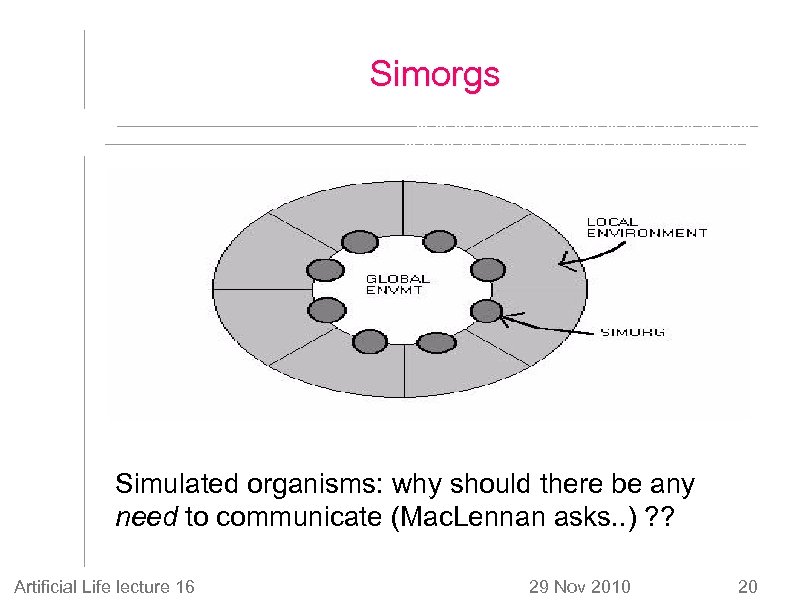 Simorgs Simulated organisms: why should there be any need to communicate (Mac. Lennan asks. . ) ? ? Artificial Life lecture 16 29 Nov 2010 20
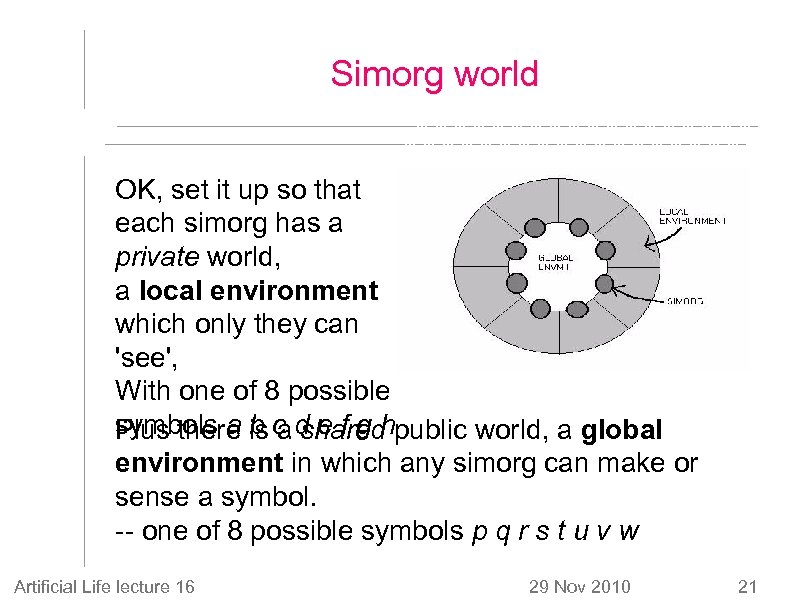 Simorg world OK, set it up so that each simorg has a private world, a local environment which only they can 'see', With one of 8 possible symbols a b c d e f g h Plus there is a shared public world, a global environment in which any simorg can make or sense a symbol. -- one of 8 possible symbols p q r s t u v w Artificial Life lecture 16 29 Nov 2010 21
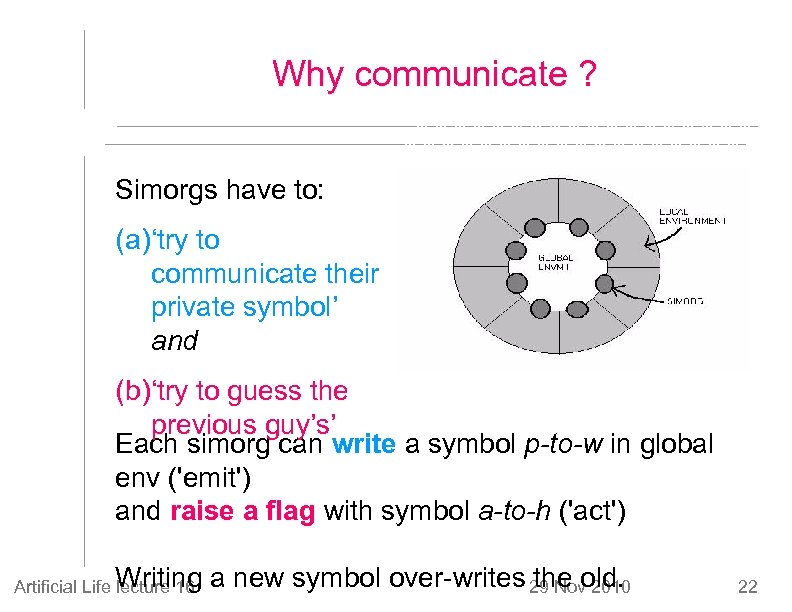 Why communicate ? Simorgs have to: (a) ‘try to communicate their private symbol’ and (b) ‘try to guess the previous guy’s’ Each simorg can write a symbol p-to-w in global env ('emit') and raise a flag with symbol a-to-h ('act') Writing a new symbol over-writes the old. Artificial Life lecture 16 29 Nov 2010 22
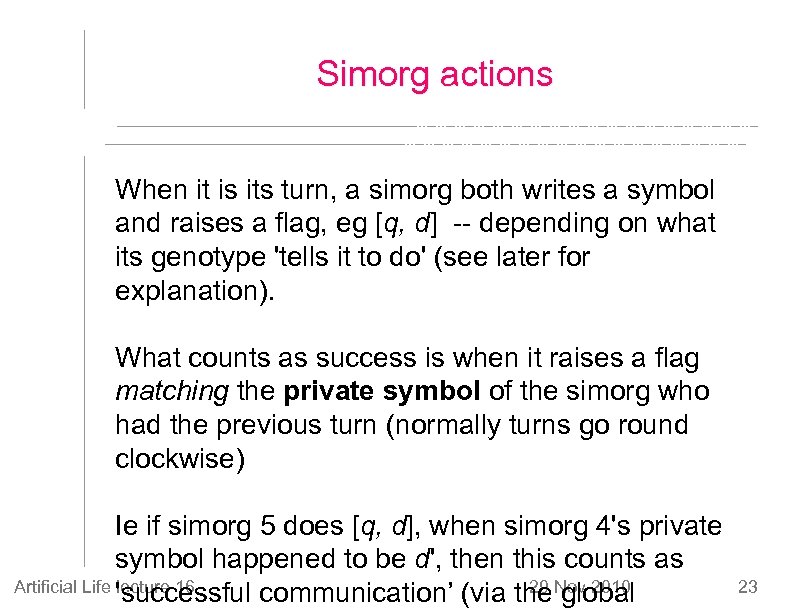 Simorg actions When it is its turn, a simorg both writes a symbol and raises a flag, eg [q, d] -- depending on what its genotype 'tells it to do' (see later for explanation). What counts as success is when it raises a flag matching the private symbol of the simorg who had the previous turn (normally turns go round clockwise) Ie if simorg 5 does [q, d], when simorg 4's private symbol happened to be d', then this counts as Artificial Life lecture 16 29 Nov 2010 23 'successful communication’ (via the global
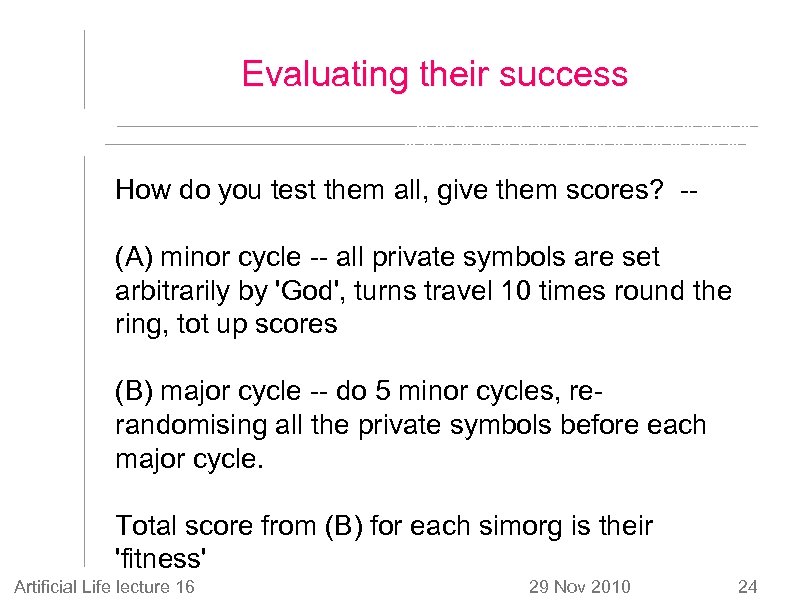 Evaluating their success How do you test them all, give them scores? -(A) minor cycle -- all private symbols are set arbitrarily by 'God', turns travel 10 times round the ring, tot up scores (B) major cycle -- do 5 minor cycles, rerandomising all the private symbols before each major cycle. Total score from (B) for each simorg is their 'fitness' Artificial Life lecture 16 29 Nov 2010 24
 Simorg genotype Each simorg faces 64 possible different situations -8 symbols a-to-h privately, plus 8 symbols p-to-w in the public global space. For each of these 64 possibilities, it has a genetically specified pair of outputs such as [q, d] which means 'write q in public space, raise flag d' So a genotype is 64 such pairs, eg [q d] [w f] [v c]. . . 64 pairs long. . [r a] Artificial Life lecture 16 29 Nov 2010 25
 The Evolutionary Algorithm A Genetic Algorithm selects parents according to fitness (actually he used a particular form of steady-state GA) and offspring generated by crossover and mutation, treating pairs [q d] as a single gene. NOTE: the importance of using steady-state GA, where only one simorg dies and is replaced at a time -- it allows for 'cultural transmission', since the new simorg is born into 'an existing community' Artificial Life lecture 16 29 Nov 2010 26
 Adding learning To complicate matters, in some experiments there was an additional factor he calls 'learning'. Think of the genotype as DNA, which is inherited as characters. When a simorg is born, it translates its DNA into a lookup table, or transition table, which is used to determine its actions. Artificial Life lecture 16 29 Nov 2010 27
 How ‘learning’ works WHEN learning is enabled, then after each action it is checked to see if it 'raised the wrong flag'. If so, the entry in the lookup table is changed so that another time it would 'raise the correct flag' (ie matching previous simorg's private symbol) BUT this change is only made to the phenotype, affecting scores and fitness, NO CHANGE is made to the genotype (which is what will be passed on to offspring) -- ie it is not Lamarckian. Artificial Life lecture 16 29 Nov 2010 28
 How to interpret results? Suppose you run an experiment, with 100 simorgs in a ring, 8 private (a-h) and 8 public (p-w) symbols, for 5000 new births. You may find communication taking place, after selection for increased fitness, with some (initially arbitrary) code being used such as 'if my private symbol is a, write a p into public space -- if you see a p, raise a flag with a‘ -- etc. But how can you objectively check whethere Artificial Life lecture 16 really is some communication? 29 Nov 2010 29
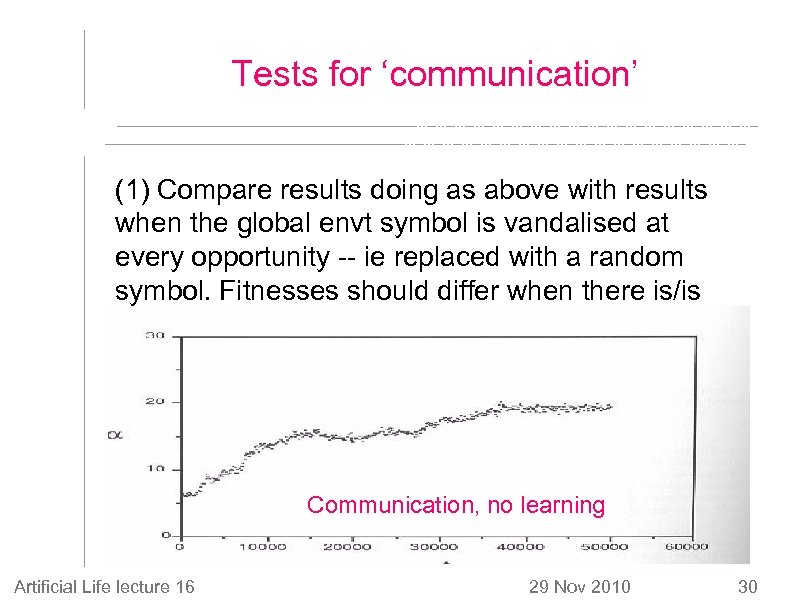 Tests for ‘communication’ (1) Compare results doing as above with results when the global envt symbol is vandalised at every opportunity -- ie replaced with a random symbol. Fitnesses should differ when there is/is not such vandalism. Communication, no learning Artificial Life lecture 16 29 Nov 2010 30
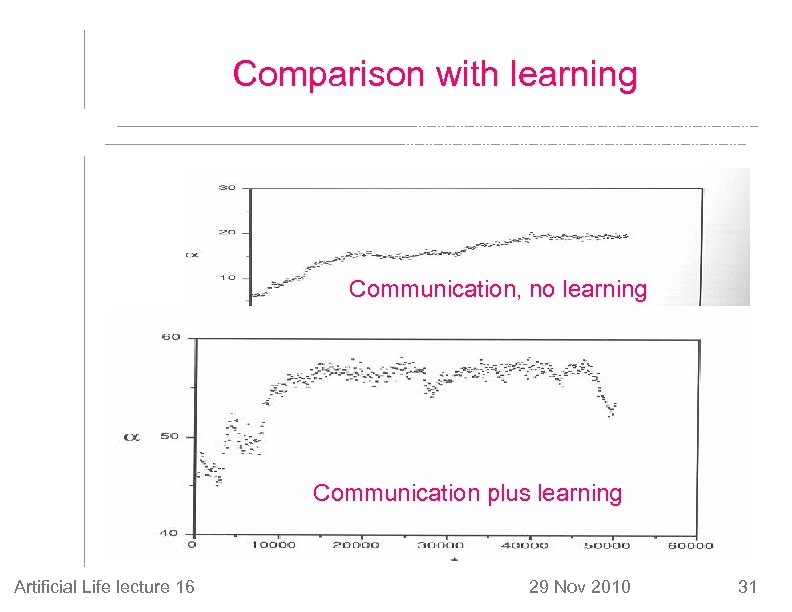 Comparison with learning Communication, no learning Communication plus learning Artificial Life lecture 16 29 Nov 2010 31
 Dialects test (2) Second way to test for communication: keep a record of every symbol/situation pair, such as 'see a global p, raise flag a' -- how often seen? 'see a global p, raise flag b' -- ditto. . . see a global w, raise flag h' -- ditto If no communication, one should not expect any particular pattern to emerge, whereas with communication you should expect such statistics to have some discernible structure. Artificial Life lecture 16 29 Nov 2010 32
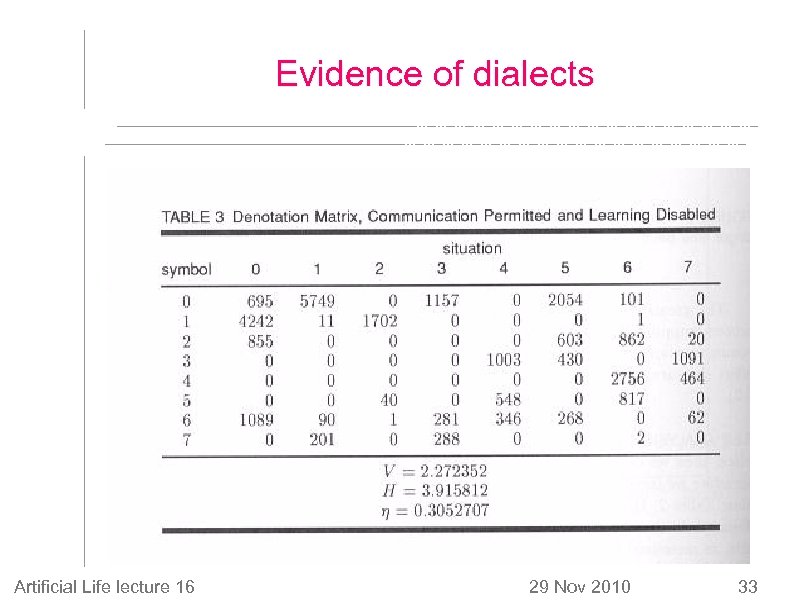 Evidence of dialects Artificial Life lecture 16 29 Nov 2010 33
 Comments q. Rarely a one-to-one denotation in the matrix q. Not always symmetric q. Probabilistic -- symbol 4 'means' situation 6 84% of time, means situation 7 16% of time. Interesting comment: this method of GA saw communication arising, ---- but the original experiments were deterministic in the sense that: “least fit always died, the two fittest simorgs always bred to produce the replacement offspring” -- in these original experiments communication Artificial Life lecture 16 29 Nov 2010 34 never arose !
 General Lessons for Alife projects As an Alife study of communication, this model attempted to simplify as much as possible whilst retaining only what Mac. Lennan thought was the bare minimum he wanted to study. He worked out objective criteria for success, and demonstrated that these were attained. He did comparative studies. Your own Alife project may be very different, but you will probably have to be concerned about similar issues. Artificial Life lecture 16 29 Nov 2010 35
 Some different views on Communication See Ezequiel di Paolo "An investigation into the evolution of communication“ Adaptive Behavior, vol 6 no 2, pp 285 -324 (1998) via his web page http: //www. informatics. susx. ac. uk/users/ezequiel/ Suggests the idea of information as a commodity has contaminated many peoples' views, including Mac. Lennan explicitly sets up the scenario such Artificial Life lecture 16 29 Nov 2010 that some information is not available to everyone. 36