 Скачать презентацию ARTIFICIAL LEAVES SOLVING THE ENERGY CRISIS BY MIMICKING
43dac9719e860310132866e9223f246a.ppt
- Количество слайдов: 35



ARTIFICIAL LEAVES SOLVING THE ENERGY CRISIS BY MIMICKING NATURE BY: PHILIP HOF PHOF 8723@GMAIL. COM CHICAGO-KENT, COLLEGE OF LAW ENERGY LAW, FALL 2010
OUTLINE 1. OVERVIEW 5. CURRENT RESEARCH 2. STATE OF THE PLANET 6. SCALABILITY 3. HOW IT WORKS 7. ROLE OF CHEMISTRY 4. KEY ISSUES 8. FUTURE POSSIBILITIES
1. OVERVIEW § Question of the day: • What energy-producing technology can be envisioned today that will last for millennia and can be implemented in developing countries, in addition to the US? § Answer…
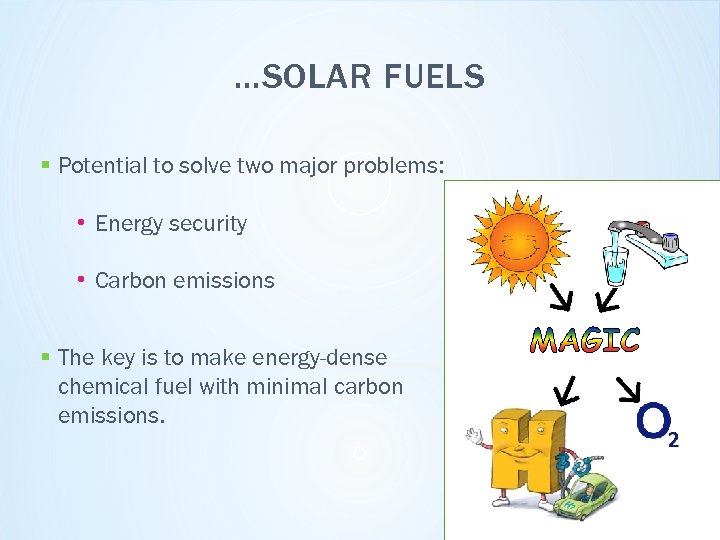
…SOLAR FUELS § Potential to solve two major problems: • Energy security • Carbon emissions § The key is to make energy-dense chemical fuel with minimal carbon emissions.
MOTIVATION IS ALL AROUND US § Real-life leaves prove that sunlight can be converted into fuel using only common elements Q: Can humankind imitate this process to rescue the planet from global warming?
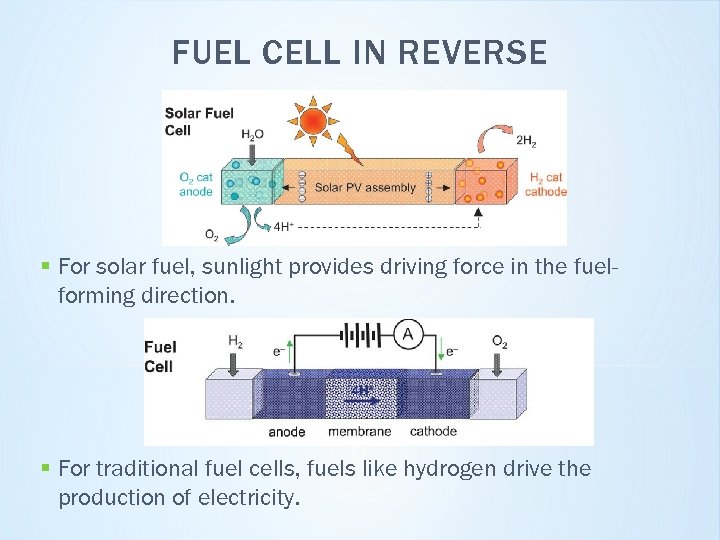
FUEL CELL IN REVERSE § For solar fuel, sunlight provides driving force in the fuelforming direction. § For traditional fuel cells, fuels like hydrogen drive the production of electricity.
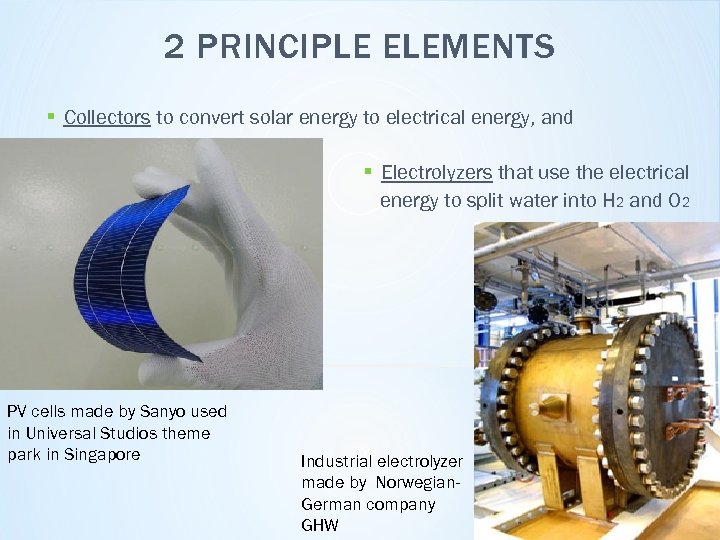
2 PRINCIPLE ELEMENTS § Collectors to convert solar energy to electrical energy, and § Electrolyzers that use the electrical energy to split water into H 2 and O 2 PV cells made by Sanyo used in Universal Studios theme park in Singapore Industrial electrolyzer made by Norwegian. German company GHW
2. STATE OF THE PLANET
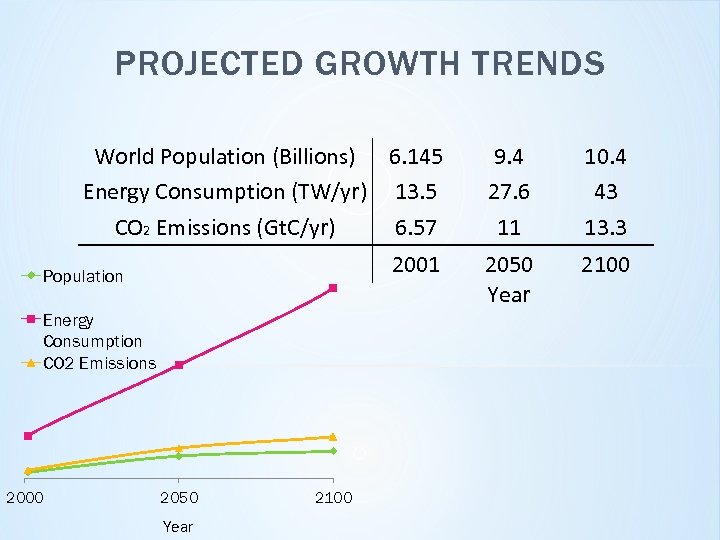
PROJECTED GROWTH TRENDS World Population (Billions) 6. 145 Energy Consumption (TW/yr) 13. 5 CO 2 Emissions (Gt. C/yr) 6. 57 9. 4 27. 6 11 10. 4 43 13. 3 2001 2050 Year 2100 Population Energy Consumption CO 2 Emissions 2000 2050 Year 2100
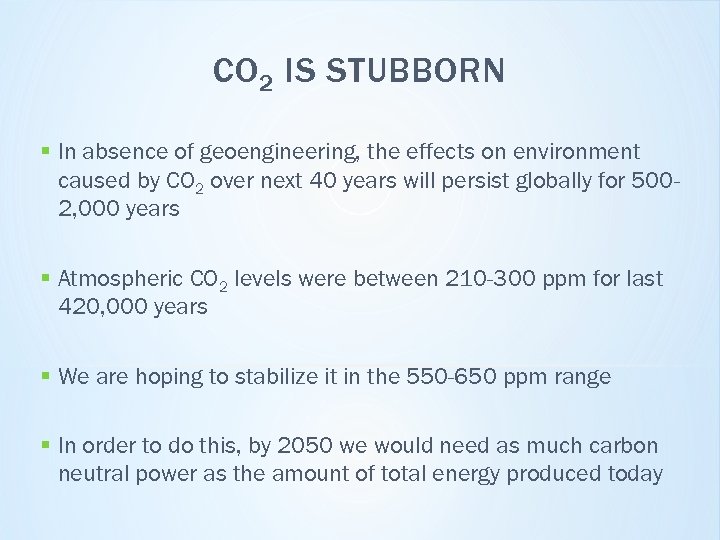
CO 2 IS STUBBORN § In absence of geoengineering, the effects on environment caused by CO 2 over next 40 years will persist globally for 5002, 000 years § Atmospheric CO 2 levels were between 210 -300 ppm for last 420, 000 years § We are hoping to stabilize it in the 550 -650 ppm range § In order to do this, by 2050 we would need as much carbon neutral power as the amount of total energy produced today
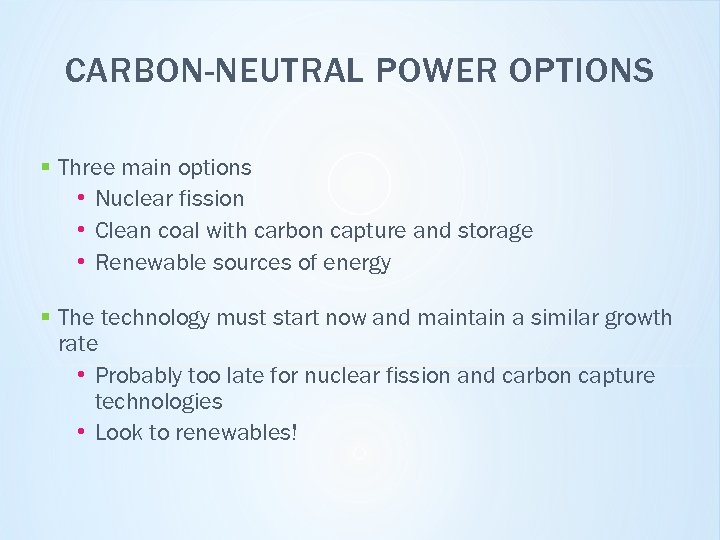
CARBON-NEUTRAL POWER OPTIONS § Three main options • Nuclear fission • Clean coal with carbon capture and storage • Renewable sources of energy § The technology must start now and maintain a similar growth rate • Probably too late for nuclear fission and carbon capture technologies • Look to renewables!
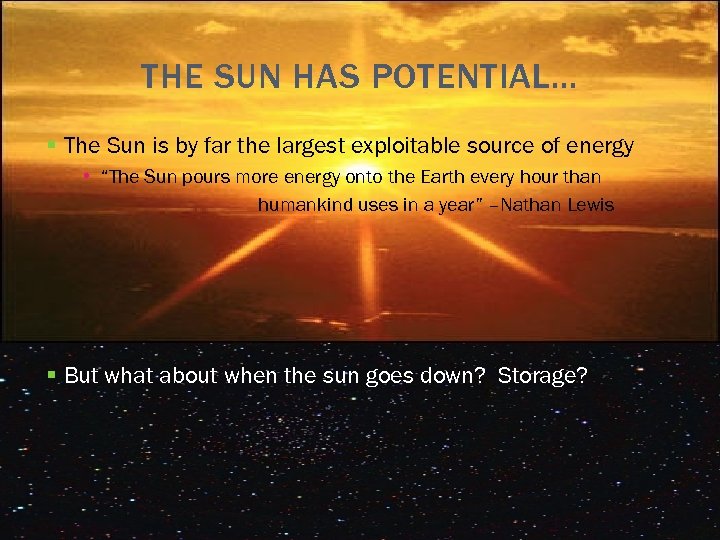
THE SUN HAS POTENTIAL… § The Sun is by far the largest exploitable source of energy • “The Sun pours more energy onto the Earth every hour than humankind uses in a year” –Nathan Lewis § But what about when the sun goes down? Storage?
STORE ENERGY IN CHEMICAL BONDS § Use the Sun to churn out fuel that we can burn • To power cars, • To create heat, • To generate electricity, § And that we can store for use when the Sun goes down.
3. HOW IT WORKS
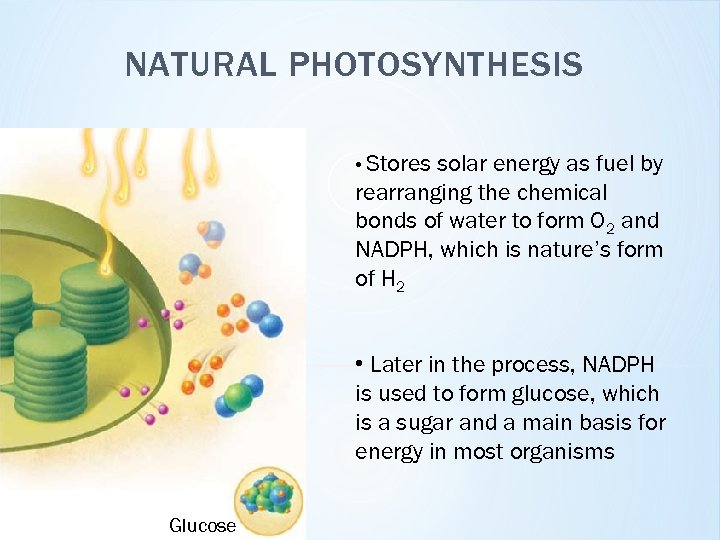
NATURAL PHOTOSYNTHESIS • Stores solar energy as fuel by rearranging the chemical bonds of water to form O 2 and NADPH, which is nature’s form of H 2 • Later in the process, NADPH is used to form glucose, which is a sugar and a main basis for energy in most organisms Glucose
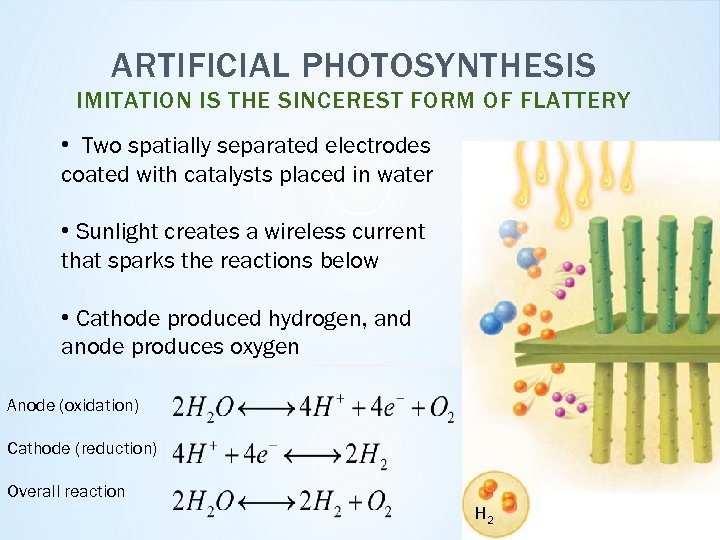
ARTIFICIAL PHOTOSYNTHESIS IMITATION IS THE SINCEREST FORM OF FLATTERY • Two spatially separated electrodes coated with catalysts placed in water • Sunlight creates a wireless current that sparks the reactions below • Cathode produced hydrogen, and anode produces oxygen Anode (oxidation) Cathode (reduction) Overall reaction H 2
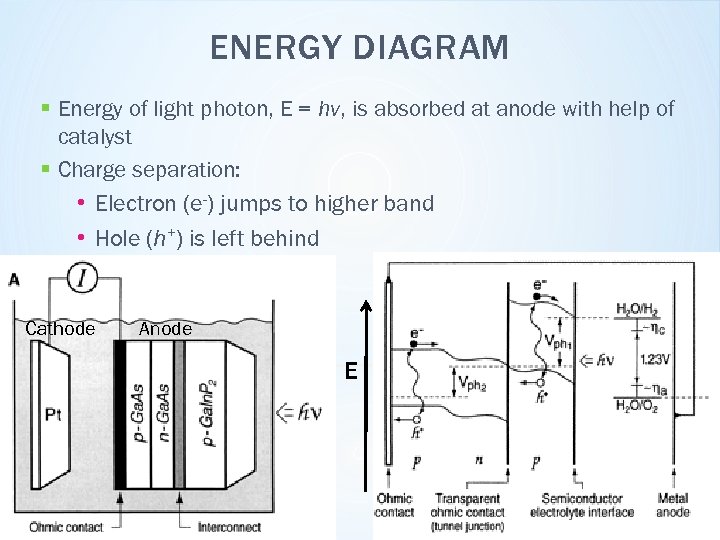
ENERGY DIAGRAM § Energy of light photon, E = hv, is absorbed at anode with help of catalyst § Charge separation: • Electron (e-) jumps to higher band • Hole (h+) is left behind § § Cathode § Anode E
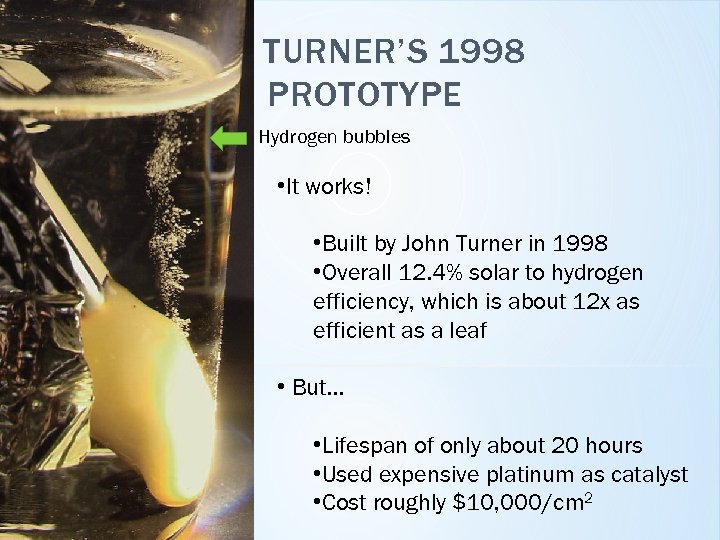
TURNER’S 1998 PROTOTYPE Hydrogen bubbles • It works! • Built by John Turner in 1998 • Overall 12. 4% solar to hydrogen efficiency, which is about 12 x as efficient as a leaf • But… • Lifespan of only about 20 hours • Used expensive platinum as catalyst • Cost roughly $10, 000/cm 2
4. KEY ISSUES § Cost of Catalysts § Thermodynamic Barriers § Corrosion
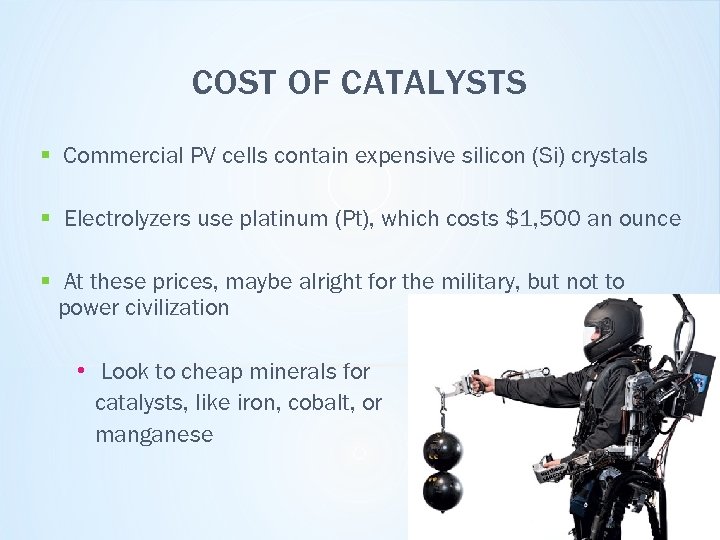
COST OF CATALYSTS § Commercial PV cells contain expensive silicon (Si) crystals § Electrolyzers use platinum (Pt), which costs $1, 500 an ounce § At these prices, maybe alright for the military, but not to power civilization • Look to cheap minerals for catalysts, like iron, cobalt, or manganese
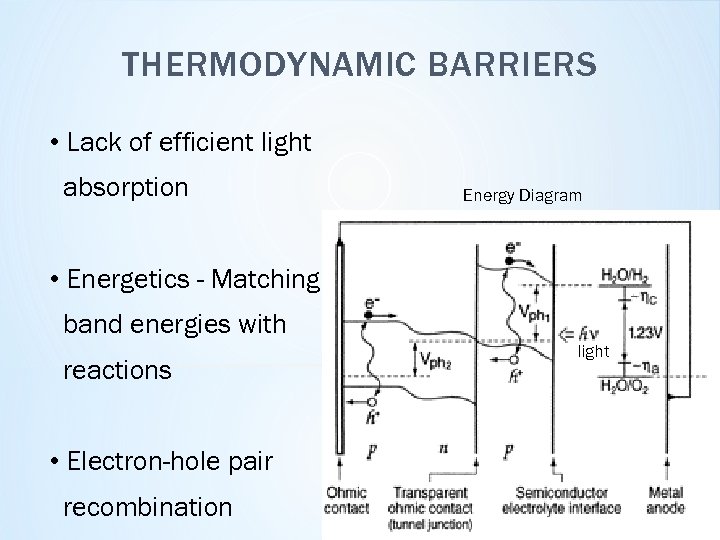
THERMODYNAMIC BARRIERS • Lack of efficient light absorption Energy Diagram • Energetics - Matching band energies with reactions • Electron-hole pair recombination light
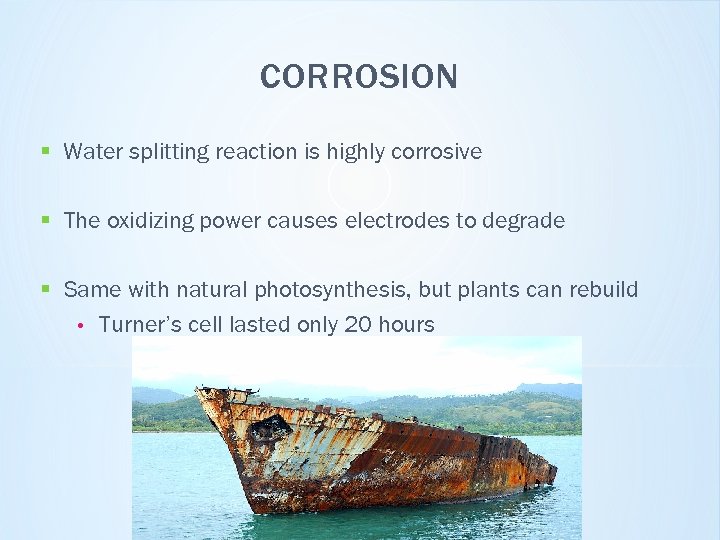
CORROSION § Water splitting reaction is highly corrosive § The oxidizing power causes electrodes to degrade § Same with natural photosynthesis, but plants can rebuild • Turner’s cell lasted only 20 hours
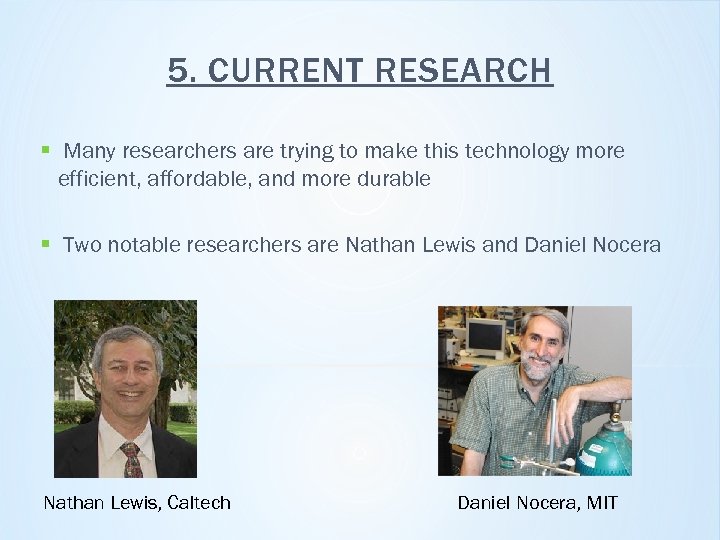
5. CURRENT RESEARCH § Many researchers are trying to make this technology more efficient, affordable, and more durable § Two notable researchers are Nathan Lewis and Daniel Nocera Nathan Lewis, Caltech Daniel Nocera, MIT
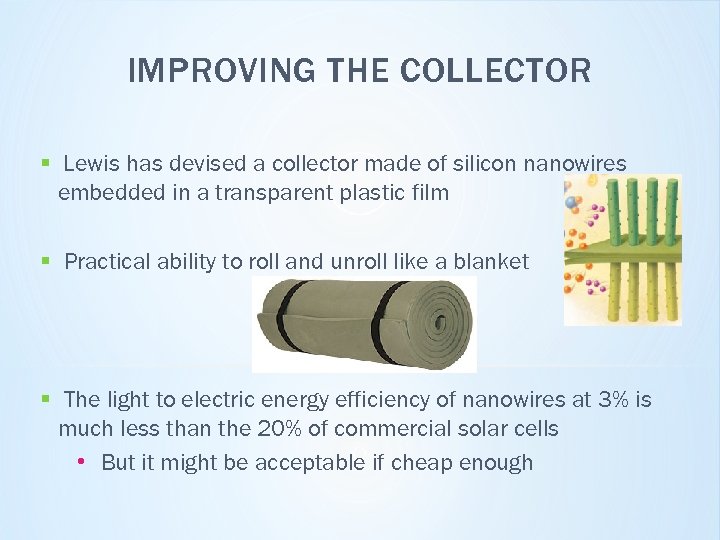
IMPROVING THE COLLECTOR § Lewis has devised a collector made of silicon nanowires embedded in a transparent plastic film § Practical ability to roll and unroll like a blanket § The light to electric energy efficiency of nanowires at 3% is much less than the 20% of commercial solar cells • But it might be acceptable if cheap enough
FINDING A BETTER CATALYST § In 2008, Nocera hit on an inexpensive combination of phosphate and cobalt that can catalyze the production of O 2 § Used an electrode made of inert indium tin oxide in phosphate-buffered water containing cobalt ions § Many similarities to natural photosynthesis • Catalyst that forms in situ from earth-abundant materials • Generates O 2 in neutral water under ambient conditions § Highlights a new era of exploration
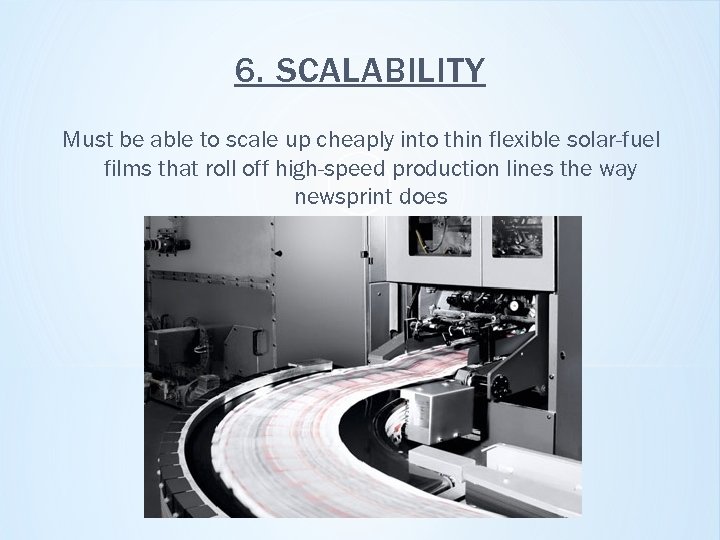
6. SCALABILITY Must be able to scale up cheaply into thin flexible solar-fuel films that roll off high-speed production lines the way newsprint does
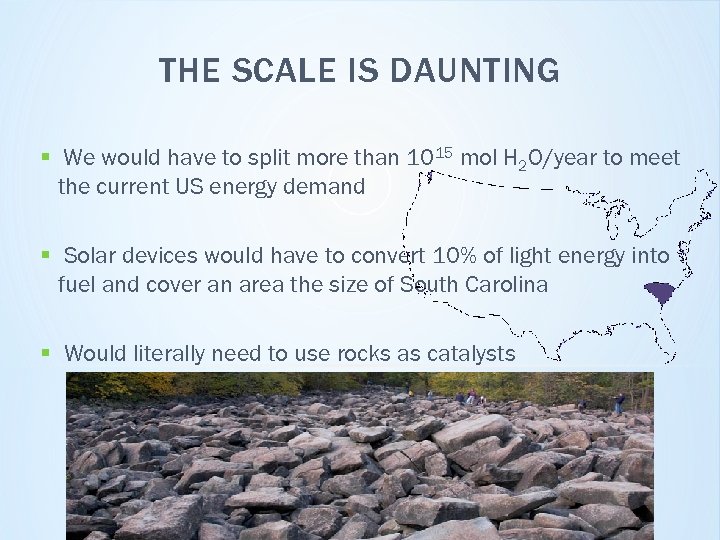
THE SCALE IS DAUNTING § We would have to split more than 1015 mol H 2 O/year to meet the current US energy demand § Solar devices would have to convert 10% of light energy into fuel and cover an area the size of South Carolina § Would literally need to use rocks as catalysts
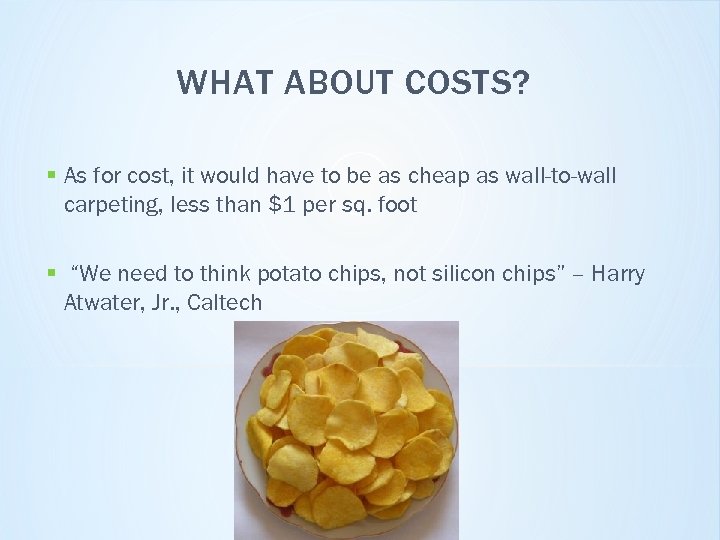
WHAT ABOUT COSTS? § As for cost, it would have to be as cheap as wall-to-wall carpeting, less than $1 per sq. foot § “We need to think potato chips, not silicon chips” – Harry Atwater, Jr. , Caltech
7. ROLE OF CHEMISTRY
JULY 2010 DOE GRANT § $122 M over 5 years to a team of scientists to explore solar technologies, including solar fuels § Team consists of researchers at: • Colorado School of Mines, University of Colorado, University of Wisconsin, Switzerland, Mexico, Armenia, Sweden, and Japan § One of the targets is a solar device with a 10, 000 hour service life
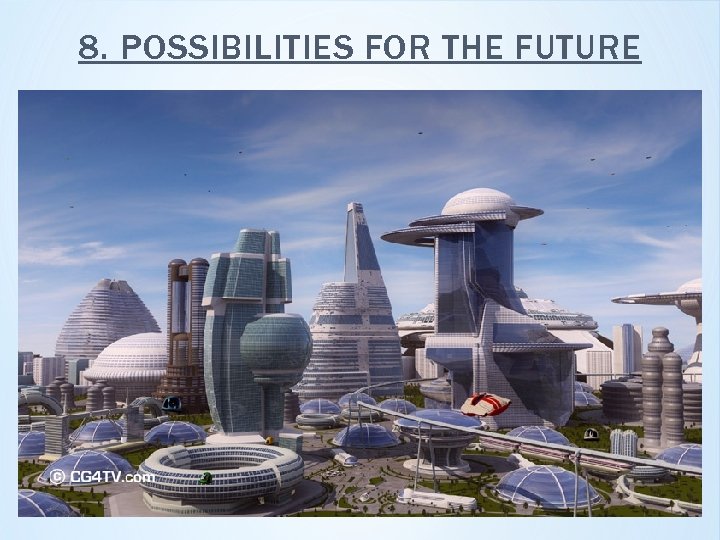
8. POSSIBILITIES FOR THE FUTURE
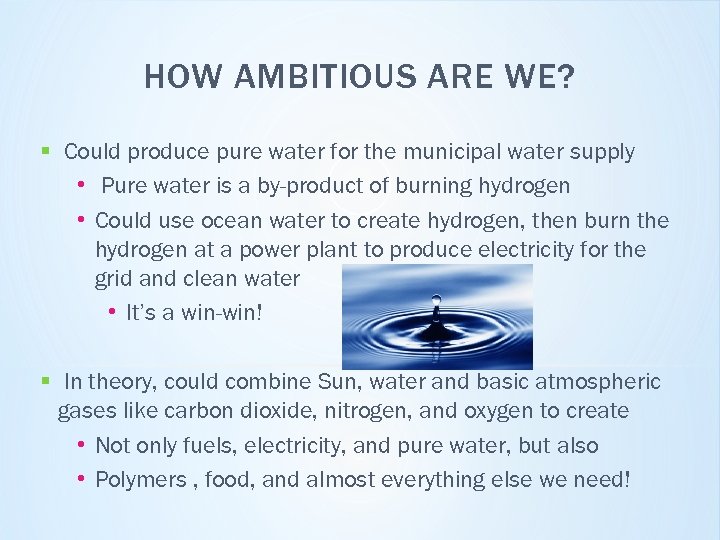
HOW AMBITIOUS ARE WE? § Could produce pure water for the municipal water supply • Pure water is a by-product of burning hydrogen • Could use ocean water to create hydrogen, then burn the hydrogen at a power plant to produce electricity for the grid and clean water • It’s a win-win! § In theory, could combine Sun, water and basic atmospheric gases like carbon dioxide, nitrogen, and oxygen to create • Not only fuels, electricity, and pure water, but also • Polymers , food, and almost everything else we need!
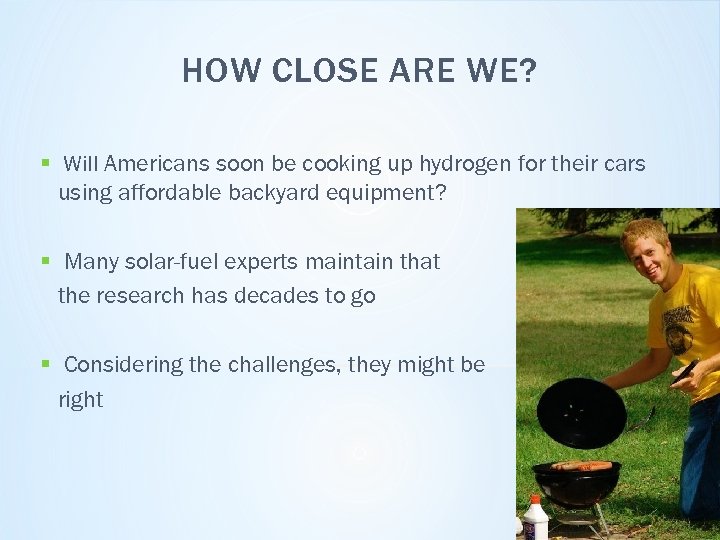
HOW CLOSE ARE WE? § Will Americans soon be cooking up hydrogen for their cars using affordable backyard equipment? § Many solar-fuel experts maintain that the research has decades to go § Considering the challenges, they might be right

THE END
SOURCES § Oscar Khaselev & John Turner, A Monolithic Photovoltaic-Photoelectrochemical Device for Hydrogen Production via Water Splitting, SCIENCE, April 17, 1998, at 425 -27. § John Turner, A Realizable Renewable Energy Future, SCIENCE, July 30, 1999, at 68789. § Antonio Regalado, Reinventing the Leaf: The ultimate fuel may come not from corn or algae but directly from the sun itself, SCIENTIFIC AMERICAN, October 2010, at 32 -35. § Matthew Kanan & Daniel Nocera, In Situ Formation of an Oxygen-Evolving Catalyst in Neutral Water Containing Phosphate and Co 2+ , SCIENCE, Aug. 22, 2008, at 1072 -75. § Harry Gray, Powering the Planet with Solar Fuel, Nature Chemistry, April 2009, at 7. § Nathan Lewis & Daniel Nocera, Powering the Planet: Chemical Challenges in Solar Energy Utilization, PNAS, Oct. 24, 2006, at 15729 -35. § $122 Million Granted to Solar Fuel Research, CALFINDER (July 26, 2010), http: //solar. calfinder. com/blog /solar-research/122 -million-solar-fuel-research/. § Solar Fuel Starting Up, CALFINDER (April 30, 2010), http: //solar. calfinder. com/blog/news/solar-fuel-starting-up/ § Sunlight Advances Hydrogen-Production Technology, ENERGY INNOVATIONS: SCIENCE AND TECHNOLOGY, Winter 2010 (published by National Renewable Energy Laboratory).
Скачать презентацию ARTIFICIAL LEAVES SOLVING THE ENERGY CRISIS BY MIMICKING
43dac9719e860310132866e9223f246a.ppt