


 Скачать презентацию Artificial Intelligence Planning Gholamreza Ghassem-Sani Sharif University of
94341b070e3f7f32b0d9be82014ac214.ppt
- Количество слайдов: 40
 Artificial Intelligence Planning Gholamreza Ghassem-Sani Sharif University of Technology Lecture slides are mainly based on Dana Nau’s AI Planning University of Maryland 1
 Related Reading For technical details: Malik Ghallab, Dan Nau, and Paolo Traverso Automated Planning: Theory and Practice Morgan Kaufmann, May 2004 ISBN 1 -55860 -856 -7 Web site: » http: //www. laas. fr/planning 2
 Outline Planning Successful Applications Conceptual model for planning Example planning algorithms 3
 Planning Successful Applications Space Exploration Manufacturing Games 4
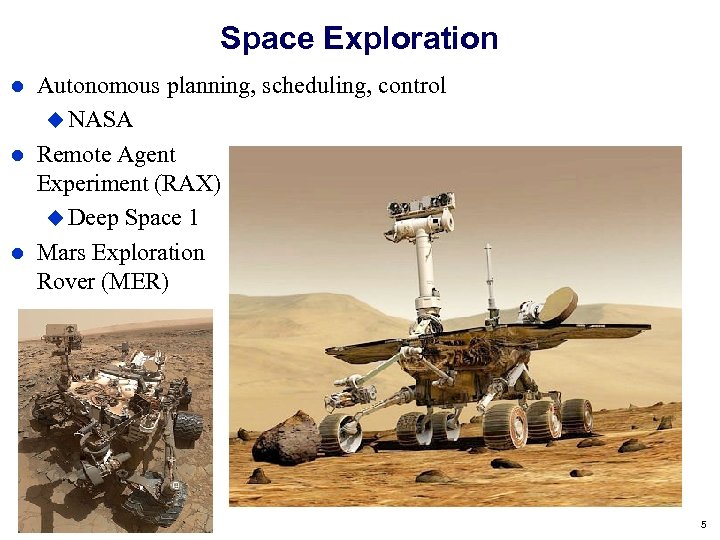 Space Exploration Autonomous planning, scheduling, control NASA Remote Agent Experiment (RAX) Deep Space 1 Mars Exploration Rover (MER) 5
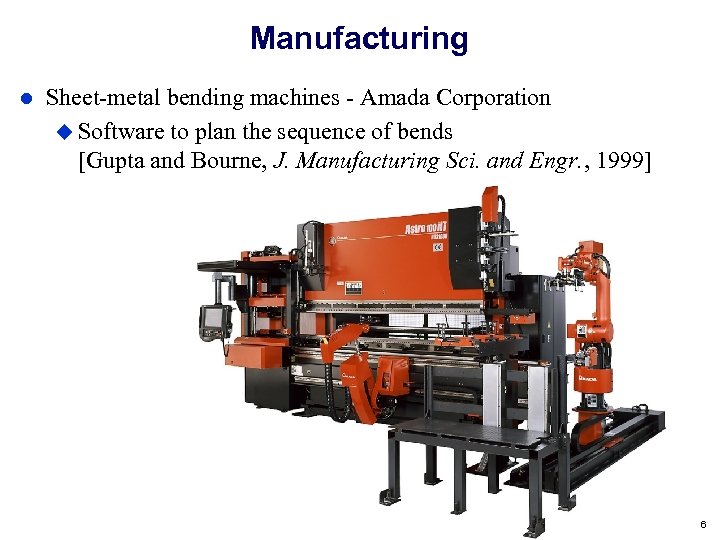 Manufacturing Sheet-metal bending machines - Amada Corporation Software to plan the sequence of bends [Gupta and Bourne, J. Manufacturing Sci. and Engr. , 1999] 6
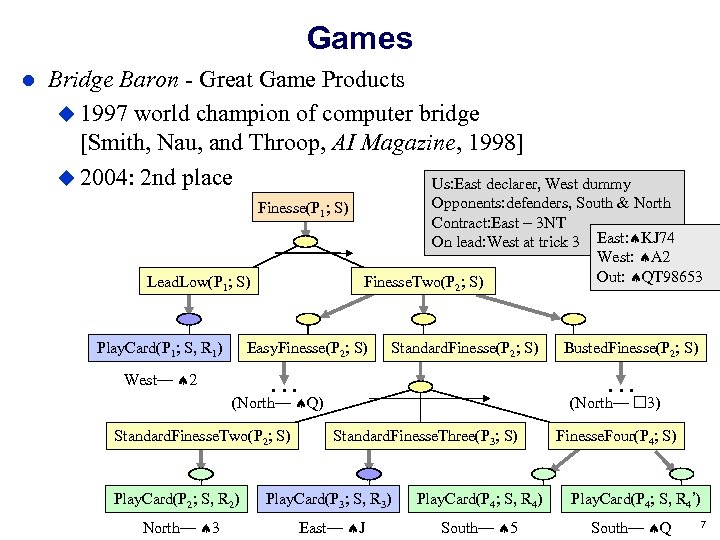 Games Bridge Baron - Great Game Products 1997 world champion of computer bridge [Smith, Nau, and Throop, AI Magazine, 1998] 2004: 2 nd place Us: East declarer, West dummy Finesse(P 1; S) Lead. Low(P 1; S) Play. Card(P 1; S, R 1) Opponents: defenders, South & North Contract: East – 3 NT On lead: West at trick 3 East: KJ 74 West: A 2 Out: QT 98653 Finesse. Two(P ; S) 2 Easy. Finesse(P 2; S) West— 2 Standard. Finesse(P 2; S) … … (North— Q) Standard. Finesse. Two(P 2; S) Play. Card(P 2; S, R 2) North— 3 Busted. Finesse(P 2; S) (North— 3) Standard. Finesse. Three(P 3; S) Finesse. Four(P 4; S) Play. Card(P 3; S, R 3) Play. Card(P 4; S, R 4’) East— J South— 5 South— Q 7
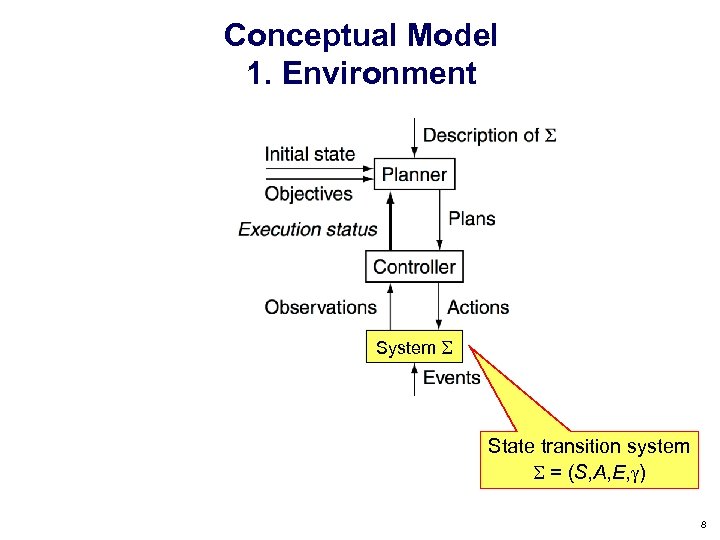 Conceptual Model 1. Environment System State transition system = (S, A, E, ) 8
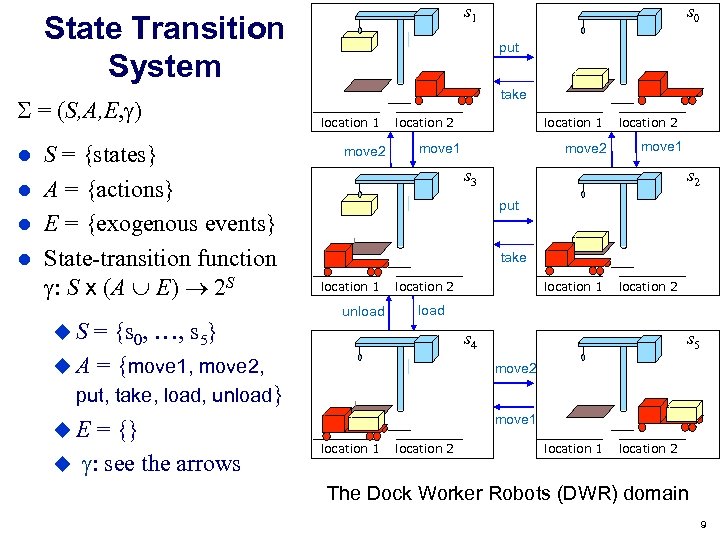 s 1 State Transition System = (S, A, E, ) S = {states} A = {actions} E = {exogenous events} State-transition function : S x (A E) 2 S S = {s 0, …, s 5} A = {move 1, move 2, s 0 put take location 1 move 2 move 1 location 2 move 1 s 3 s 2 put take location 1 unload location 2 location 1 location 2 load s 4 s 5 move 2 put, take, load, unload} E = {} : see the arrows move 1 location 2 location 1 location 2 The Dock Worker Robots (DWR) domain 9
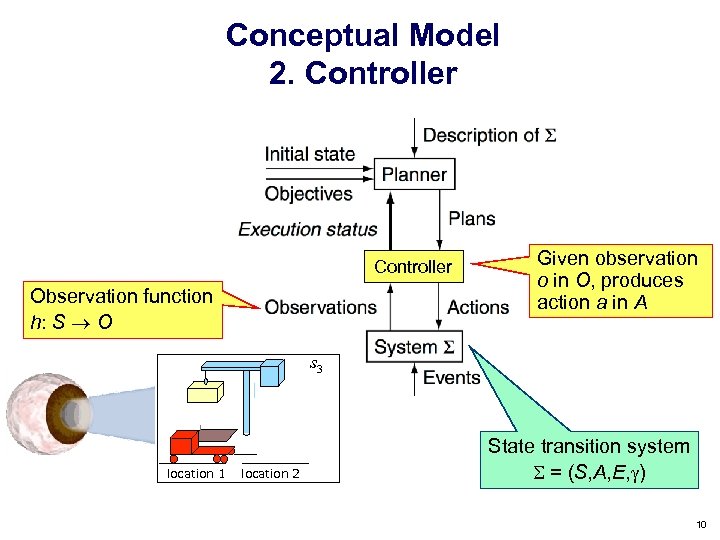 Conceptual Model 2. Controller Observation function h: S O Given observation o in O, produces action a in A s 3 location 1 location 2 State transition system = (S, A, E, ) 10
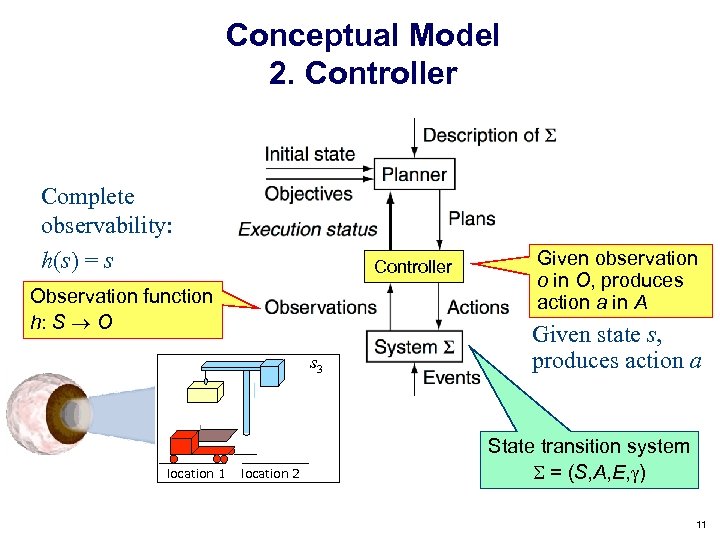 Conceptual Model 2. Controller Complete observability: h(s) = s Controller Observation function h: S O s 3 location 1 location 2 Given observation o in O, produces action a in A Given state s, produces action a State transition system = (S, A, E, ) 11
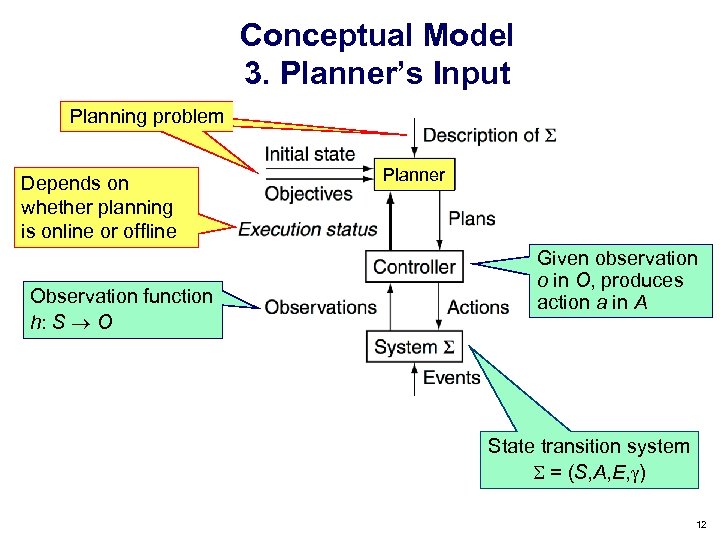 Conceptual Model 3. Planner’s Input Planning problem Depends on whether planning is online or offline Observation function h: S O Planner Given observation o in O, produces action a in A State transition system = (S, A, E, ) 12
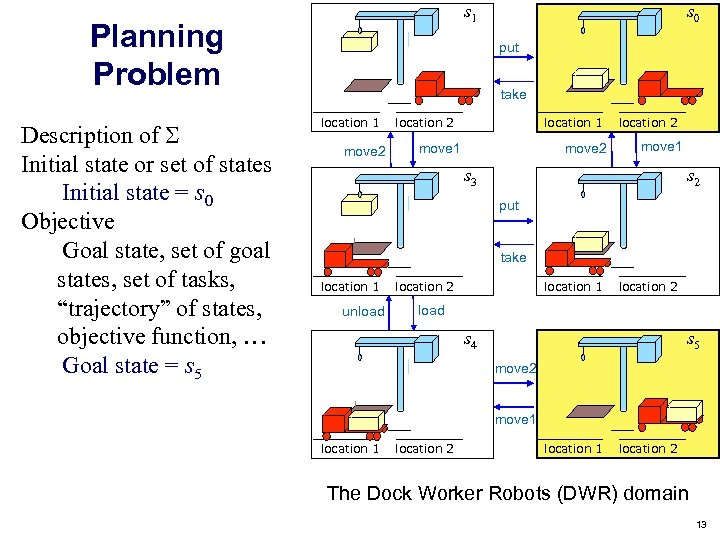 s 1 Planning Problem Description of Initial state or set of states Initial state = s 0 Objective Goal state, set of goal states, set of tasks, “trajectory” of states, objective function, … Goal state = s 5 s 0 put take location 1 move 2 move 1 location 2 move 1 s 3 s 2 put take location 1 unload location 2 location 1 location 2 load s 4 s 5 move 2 move 1 location 2 location 1 location 2 The Dock Worker Robots (DWR) domain 13
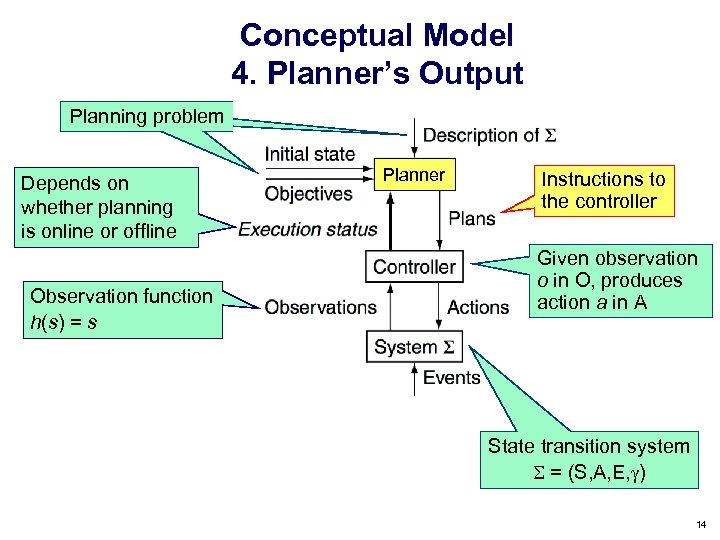 Conceptual Model 4. Planner’s Output Planning problem Depends on whether planning is online or offline Observation function h(s) = s Planner Instructions to the controller Given observation o in O, produces action a in A State transition system = (S, A, E, ) 14
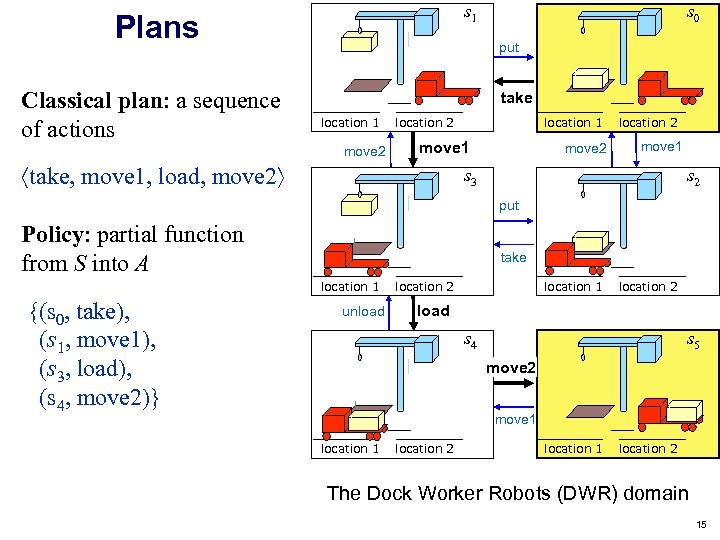 s 1 Plans Classical plan: a sequence of actions s 0 put take location 1 move 2 location 1 move 1 take, move 1, load, move 2 location 2 move 1 s 3 s 2 put Policy: partial function from S into A take location 1 {(s 0, take), (s 1, move 1), (s 3, load), (s 4, move 2)} unload location 2 location 1 location 2 load s 4 s 5 move 2 move 1 location 2 location 1 location 2 The Dock Worker Robots (DWR) domain 15
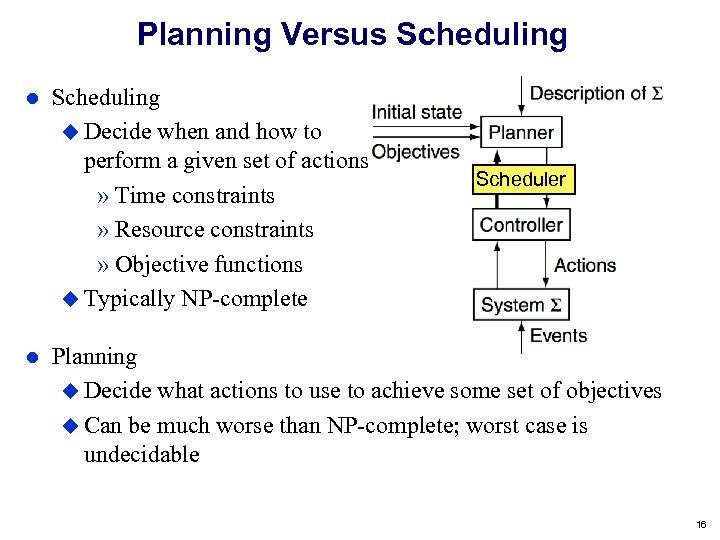 Planning Versus Scheduling Decide when and how to perform a given set of actions » Time constraints » Resource constraints » Objective functions Typically NP-complete Scheduler Planning Decide what actions to use to achieve some set of objectives Can be much worse than NP-complete; worst case is undecidable 16
 Three Main Types of Planners 1. Domain-specific 2. Domain-independent 3. Configurable 17
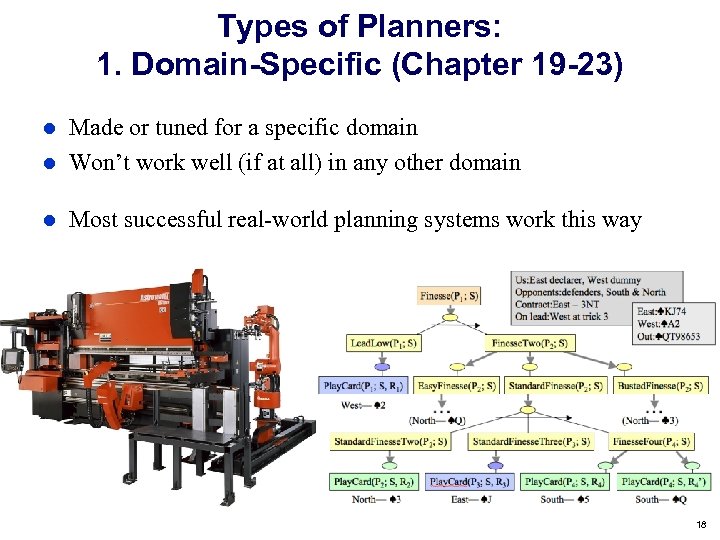 Types of Planners: 1. Domain-Specific (Chapter 19 -23) Made or tuned for a specific domain Won’t work well (if at all) in any other domain Most successful real-world planning systems work this way 18
 Types of Planners 2. Domain-Independent In principle, a domain-independent planner works in any planning domain Uses no domain-specific knowledge except the definitions of the basic actions 19
 Types of Planners 2. Domain-Independent In practice, Not feasible to develop domain-independent planners that work in every possible domain Make simplifying assumptions to restrict the set of domains Classical planning Historical focus of most automated-planning research 20
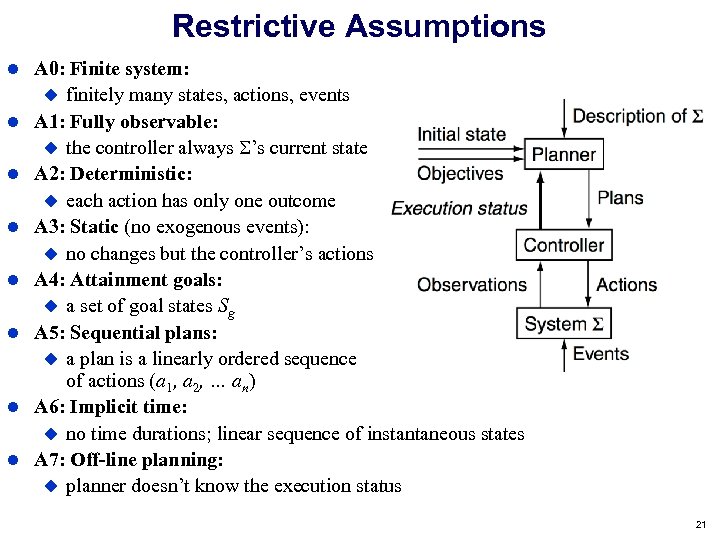 Restrictive Assumptions A 0: Finite system: finitely many states, actions, events A 1: Fully observable: the controller always ’s current state A 2: Deterministic: each action has only one outcome A 3: Static (no exogenous events): no changes but the controller’s actions A 4: Attainment goals: a set of goal states Sg A 5: Sequential plans: a plan is a linearly ordered sequence of actions (a 1, a 2, … an) A 6: Implicit time: no time durations; linear sequence of instantaneous states A 7: Off-line planning: planner doesn’t know the execution status 21
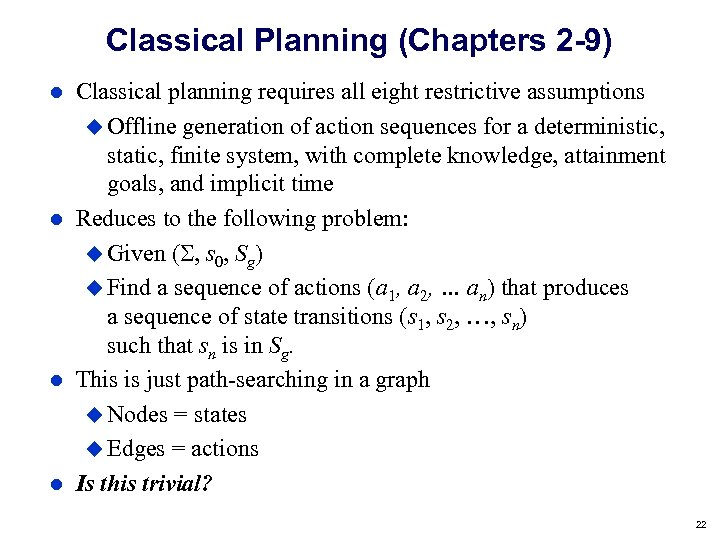 Classical Planning (Chapters 2 -9) Classical planning requires all eight restrictive assumptions Offline generation of action sequences for a deterministic, static, finite system, with complete knowledge, attainment goals, and implicit time Reduces to the following problem: Given ( , s 0, Sg) Find a sequence of actions (a 1, a 2, … an) that produces a sequence of state transitions (s 1, s 2, …, sn) such that sn is in Sg. This is just path-searching in a graph Nodes = states Edges = actions Is this trivial? 22
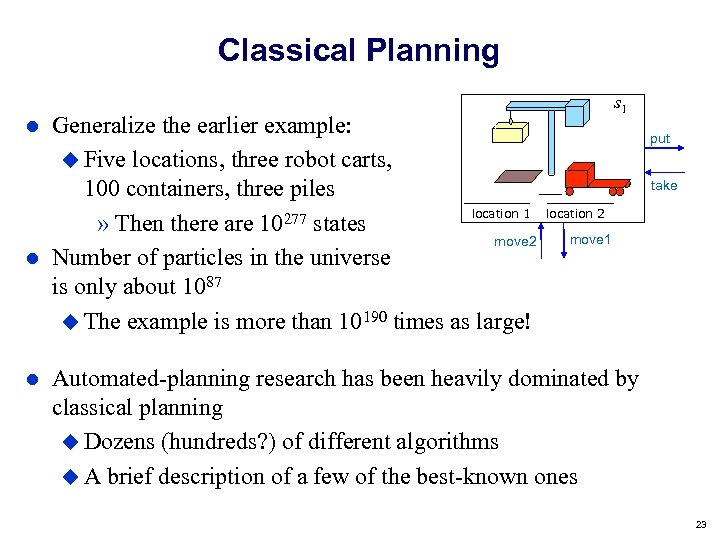 Classical Planning Generalize the earlier example: Five locations, three robot carts, 100 containers, three piles location 1 » Then there are 10277 states move 2 Number of particles in the universe is only about 1087 The example is more than 10190 times as large! s 1 put take location 2 move 1 Automated-planning research has been heavily dominated by classical planning Dozens (hundreds? ) of different algorithms A brief description of a few of the best-known ones 23
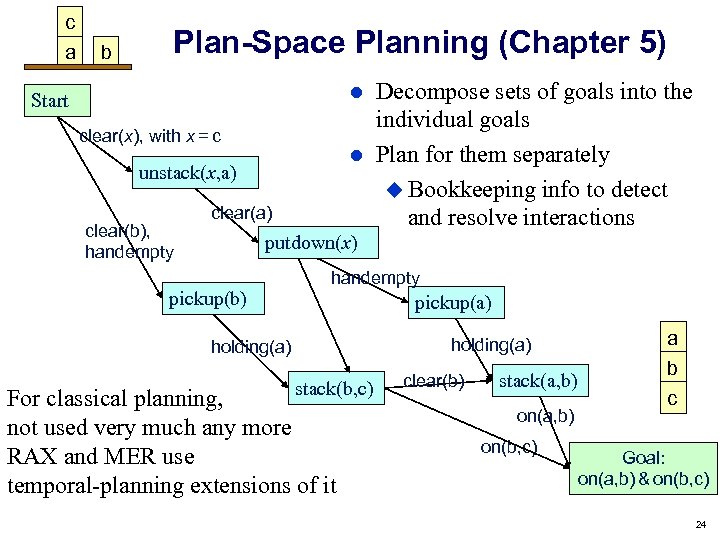 c a b Plan-Space Planning (Chapter 5) Decompose sets of goals into the individual goals Plan for them separately Bookkeeping info to detect and resolve interactions Start clear(x), with x = c unstack(x, a) clear(b), handempty clear(a) putdown(x) pickup(b) handempty pickup(a) holding(a) stack(b, c) For classical planning, not used very much any more RAX and MER use temporal-planning extensions of it clear(b) stack(a, b) on(b, c) a b c Goal: on(a, b) & on(b, c) 24
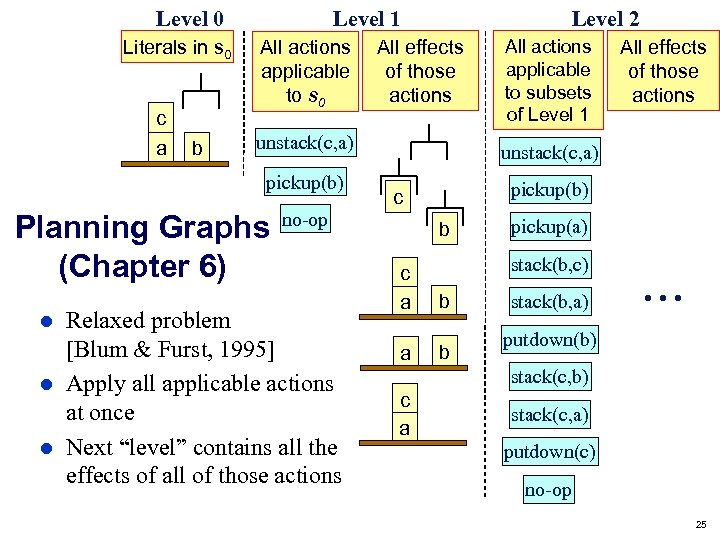 Level 0 Literals in s 0 c a b Level 1 All actions applicable to s 0 All effects of those actions unstack(c, a) pickup(b) Planning Graphs (Chapter 6) no-op Relaxed problem [Blum & Furst, 1995] Apply all applicable actions at once Next “level” contains all the effects of all of those actions Level 2 All actions applicable to subsets of Level 1 All effects of those actions unstack(c, a) pickup(b) c b pickup(a) stack(b, c) c a b stack(b, a) • • • putdown(b) stack(c, b) c a stack(c, a) putdown(c) no-op 25
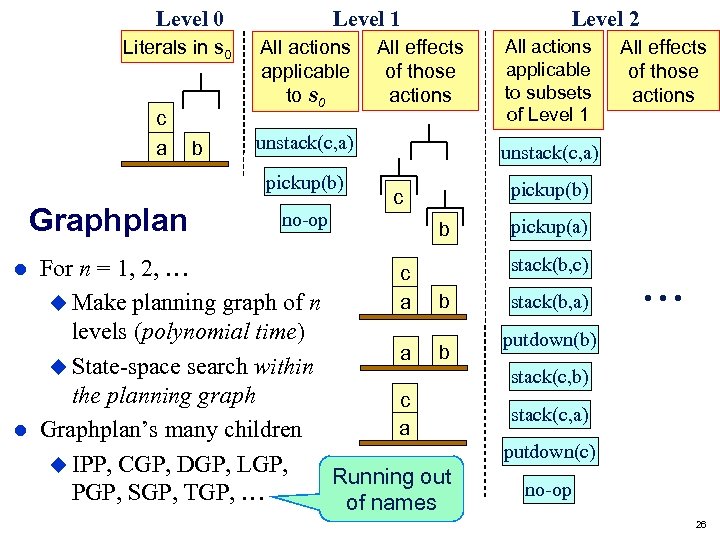 Level 0 Literals in s 0 c a b Level 1 All actions applicable to s 0 All effects of those actions unstack(c, a) pickup(b) Graphplan Level 2 no-op All actions applicable to subsets of Level 1 All effects of those actions unstack(c, a) pickup(b) c b pickup(a) For n = 1, 2, … c a b Make planning graph of n levels (polynomial time) a b State-space search within the planning graph c a Graphplan’s many children IPP, CGP, DGP, LGP, Running out PGP, SGP, TGP, … of names stack(b, c) stack(b, a) • • • putdown(b) stack(c, a) putdown(c) no-op 26
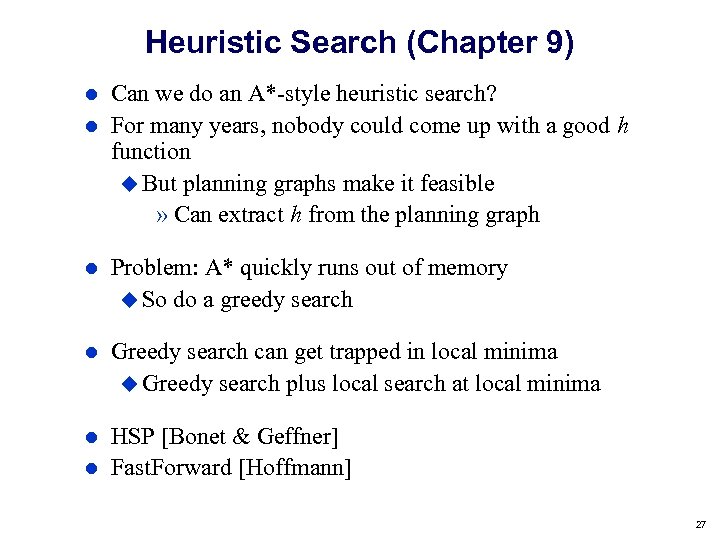 Heuristic Search (Chapter 9) Can we do an A*-style heuristic search? For many years, nobody could come up with a good h function But planning graphs make it feasible » Can extract h from the planning graph Problem: A* quickly runs out of memory So do a greedy search Greedy search can get trapped in local minima Greedy search plus local search at local minima HSP [Bonet & Geffner] Fast. Forward [Hoffmann] 27
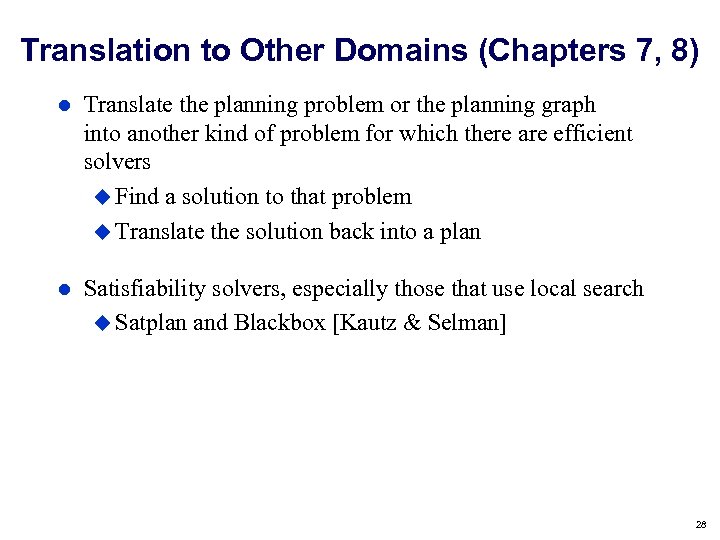 Translation to Other Domains (Chapters 7, 8) Translate the planning problem or the planning graph into another kind of problem for which there are efficient solvers Find a solution to that problem Translate the solution back into a plan Satisfiability solvers, especially those that use local search Satplan and Blackbox [Kautz & Selman] 28
 Types of Planners: 3. Configurable Domain-independent planners are quite slow compared with domain-specific planners Blocks world in linear time [Slaney and Thiébaux, A. I. , 2001] Can get analogous results in many other domains But we don’t want to write a whole new planner for every domain! Configurable planners Domain-independent planning engine Input includes info about how to solve problems in the domain » Hierarchical Task Network (HTN) planning 29
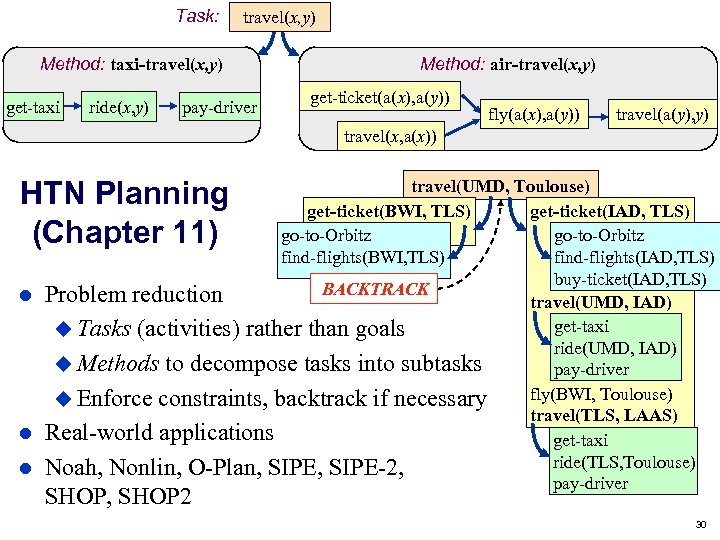 Task: travel(x, y) Method: taxi-travel(x, y) get-taxi ride(x, y) pay-driver Method: air-travel(x, y) get-ticket(a(x), a(y)) fly(a(x), a(y)) travel(a(y), y) travel(x, a(x)) HTN Planning (Chapter 11) travel(UMD, Toulouse) get-ticket(BWI, TLS) get-ticket(IAD, TLS) go-to-Orbitz find-flights(IAD, TLS) find-flights(BWI, TLS) buy-ticket(IAD, TLS) BACKTRACK Problem reduction travel(UMD, IAD) get-taxi Tasks (activities) rather than goals ride(UMD, IAD) Methods to decompose tasks into subtasks pay-driver fly(BWI, Toulouse) Enforce constraints, backtrack if necessary travel(TLS, LAAS) Real-world applications get-taxi ride(TLS, Toulouse) Noah, Nonlin, O-Plan, SIPE-2, pay-driver SHOP, SHOP 2 30
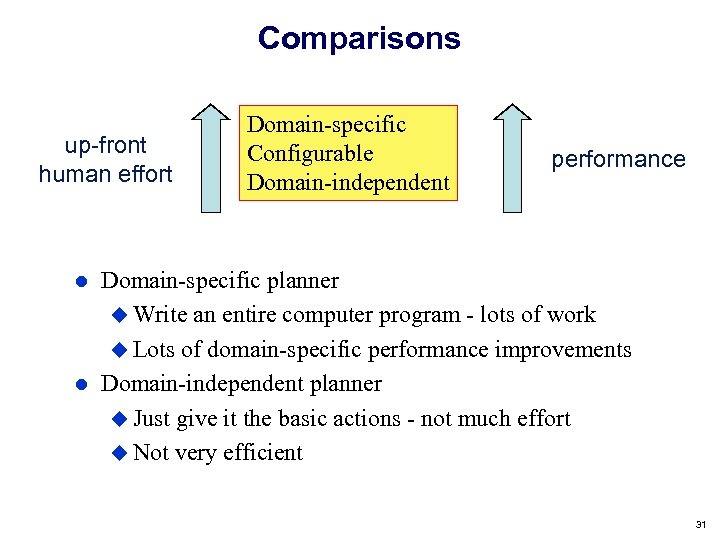 Comparisons up-front human effort Domain-specific Configurable Domain-independent performance Domain-specific planner Write an entire computer program - lots of work Lots of domain-specific performance improvements Domain-independent planner Just give it the basic actions - not much effort Not very efficient 31
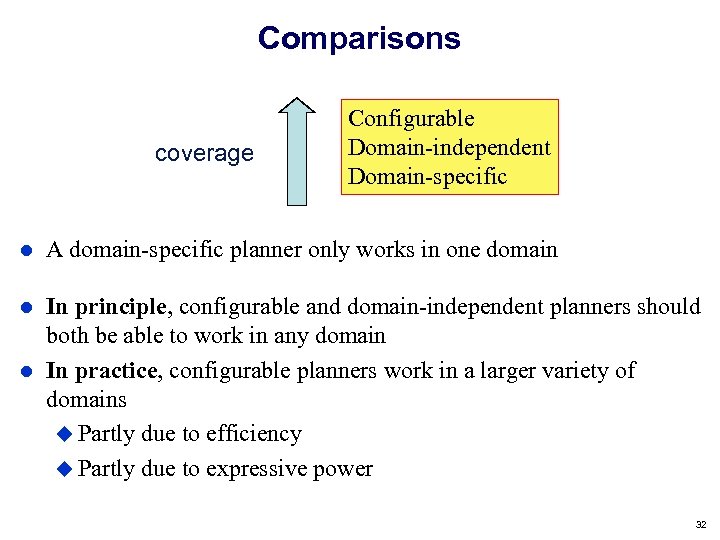 Comparisons coverage Configurable Domain-independent Domain-specific A domain-specific planner only works in one domain In principle, configurable and domain-independent planners should both be able to work in any domain In practice, configurable planners work in a larger variety of domains Partly due to efficiency Partly due to expressive power 32
 Typical characteristics of application domains Dynamic world Multiple agents Imperfect/uncertain info External info sources » users, sensors, databases Durations, time constraints, asynchronous actions Numeric computations » geometry, probability, etc. Classical planning excludes all of these 33
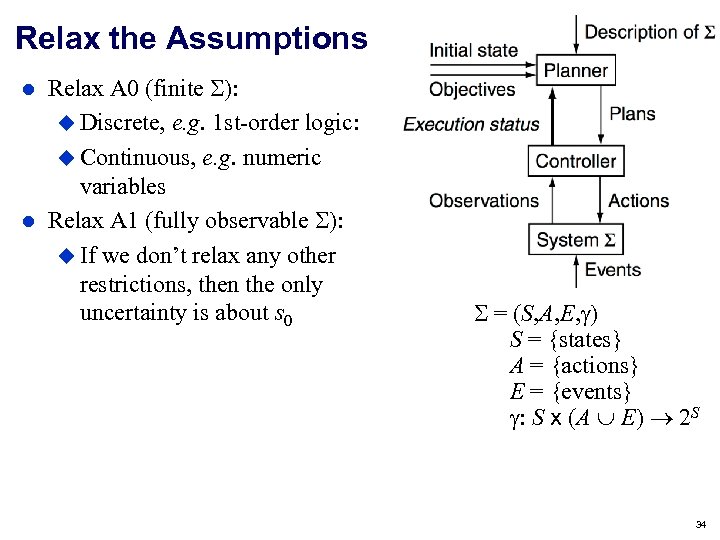 Relax the Assumptions Relax A 0 (finite ): Discrete, e. g. 1 st-order logic: Continuous, e. g. numeric variables Relax A 1 (fully observable ): If we don’t relax any other restrictions, then the only uncertainty is about s 0 = (S, A, E, ) S = {states} A = {actions} E = {events} : S x (A E) 2 S 34
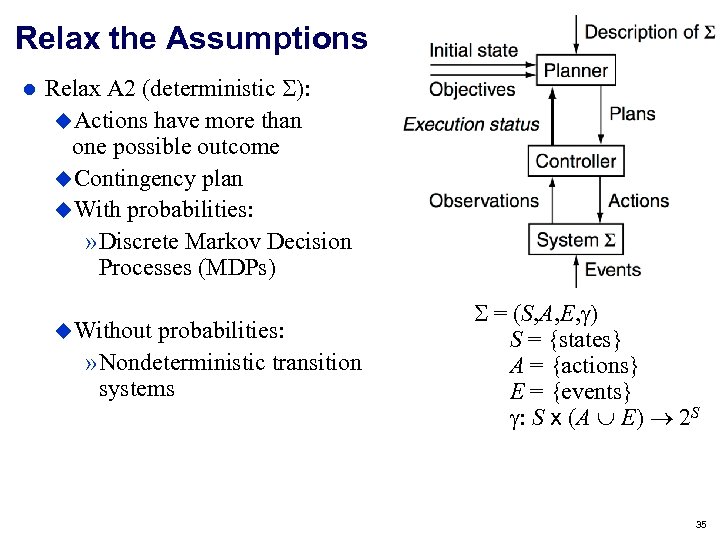 Relax the Assumptions Relax A 2 (deterministic ): Actions have more than one possible outcome Contingency plan With probabilities: » Discrete Markov Decision Processes (MDPs) Without probabilities: » Nondeterministic transition systems = (S, A, E, ) S = {states} A = {actions} E = {events} : S x (A E) 2 S 35
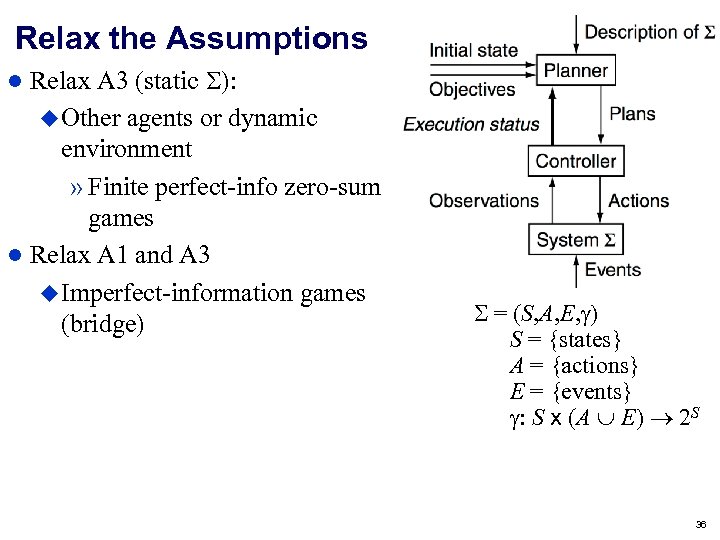 Relax the Assumptions Relax A 3 (static ): Other agents or dynamic environment » Finite perfect-info zero-sum games Relax A 1 and A 3 Imperfect-information games (bridge) = (S, A, E, ) S = {states} A = {actions} E = {events} : S x (A E) 2 S 36
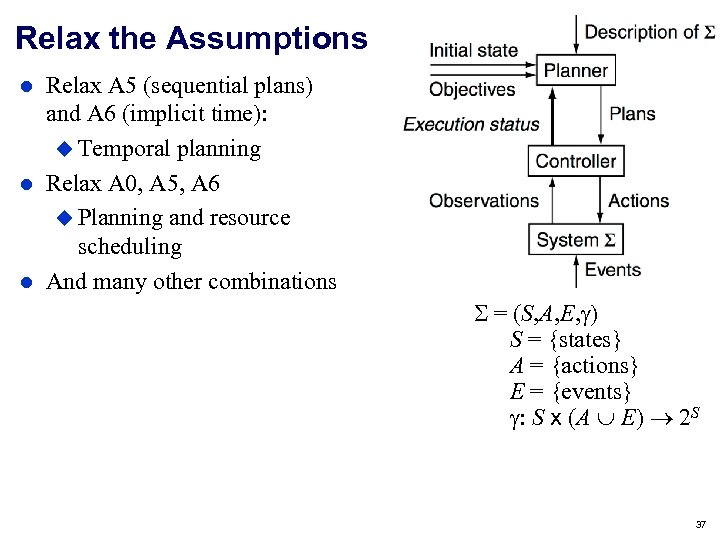 Relax the Assumptions Relax A 5 (sequential plans) and A 6 (implicit time): Temporal planning Relax A 0, A 5, A 6 Planning and resource scheduling And many other combinations = (S, A, E, ) S = {states} A = {actions} E = {events} : S x (A E) 2 S 37
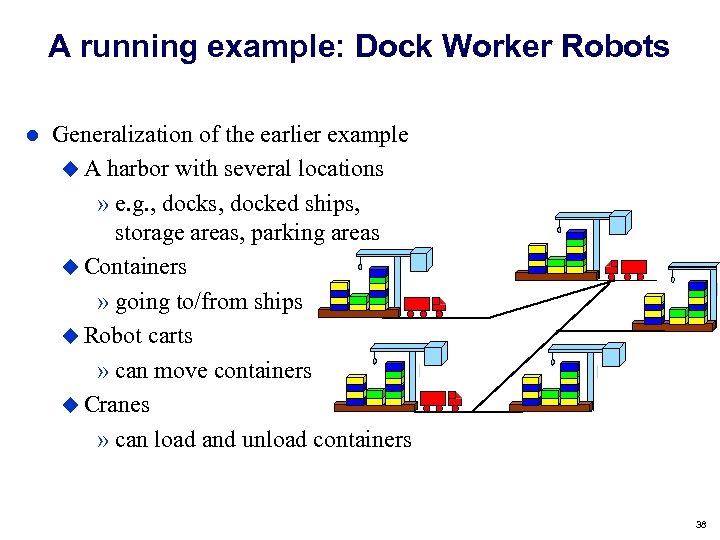 A running example: Dock Worker Robots Generalization of the earlier example A harbor with several locations » e. g. , docks, docked ships, storage areas, parking areas Containers » going to/from ships Robot carts » can move containers Cranes » can load and unload containers 38
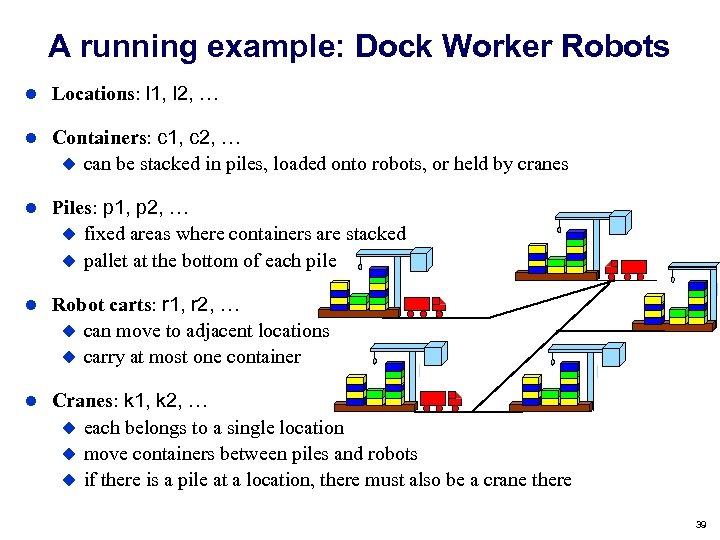 A running example: Dock Worker Robots Locations: l 1, l 2, … Containers: c 1, c 2, … can be stacked in piles, loaded onto robots, or held by cranes Piles: p 1, p 2, … fixed areas where containers are stacked pallet at the bottom of each pile Robot carts: r 1, r 2, … can move to adjacent locations carry at most one container Cranes: k 1, k 2, … each belongs to a single location move containers between piles and robots if there is a pile at a location, there must also be a crane there 39
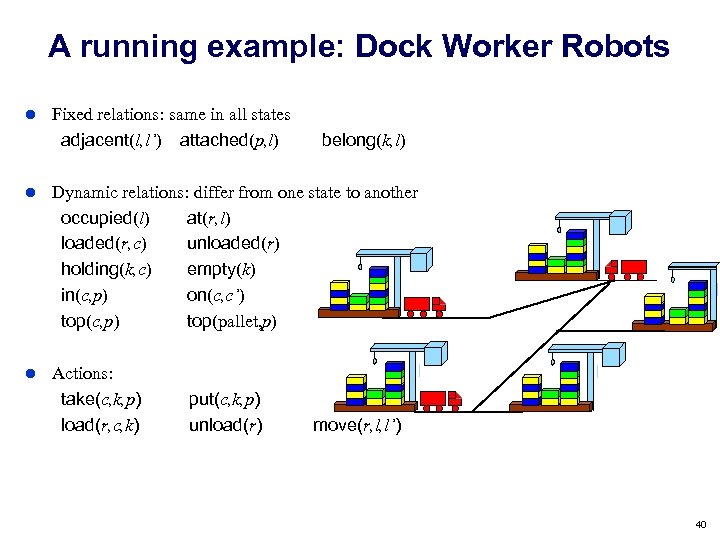 A running example: Dock Worker Robots Fixed relations: same in all states adjacent(l, l’) attached(p, l) belong(k, l) Dynamic relations: differ from one state to another occupied(l) at(r, l) loaded(r, c) unloaded(r) holding(k, c) empty(k) in(c, p) on(c, c’) top(c, p) top(pallet, p) Actions: take(c, k, p) load(r, c, k) put(c, k, p) unload(r) move(r, l, l’) 40