


 Скачать презентацию Artificial Intelligence Nell Dale John Lewis adaptation
2c1936e253d6ee622ca6fdfe5f7f3416.ppt
- Количество слайдов: 57
 Artificial Intelligence Nell Dale & John Lewis (adaptation by Michael Goldwasser and Erin Chambers)
 Limitations of Computers? • Are there tasks which cannot easily be automated? If so, what are the limitations? • How do computers abilities compare to that of humans? 13 -2
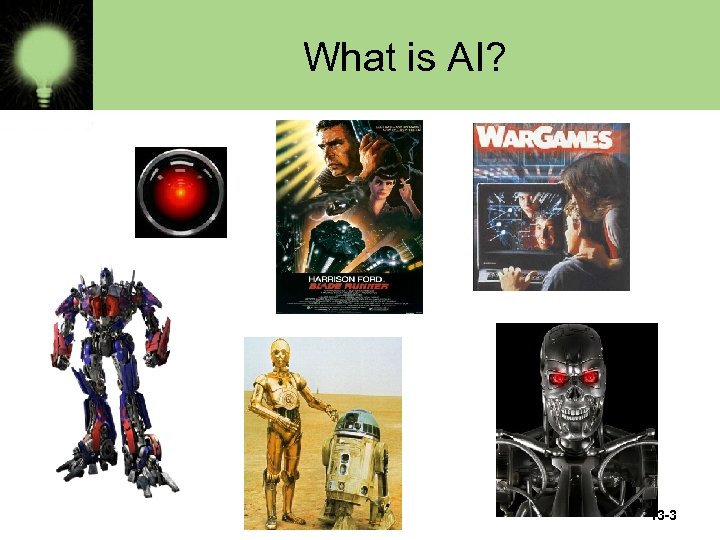 What is AI? 13 -3
 Computer vs. Humans? • A computer can do some things better than a human can – Adding a thousand four-digit numbers – Drawing complex, 3 D images – Store and retrieve massive amounts of data 13 -4
 Computer vs. Humans? Let’s reverse the tables. • Name some things that a human can do better than a computer. – – – 13 -5
 Computer vs. Human • Point out the cat in the picture – A computer might have difficulty making that identification Figure 13. 1 A computer might have trouble identifying the cat in this picture. 13 -6
 Computer vs. Humans? • Could the following occupations be performed by computers? If so, should they be? 13 -7
 Artificial Intelligence • The field of artificial intelligence (AI) is the study of computer systems that attempt to model and apply the intelligence of the human mind • Of course, first we have to understand why we use the term “intelligence” in regard to humans. – What defines “intelligence”? – Why is it that we assume humans are intelligent? – Are monkeys intelligent? Dogs? Ants? Pine trees? 13 -8
 Early History (1950 s) • In 1950 English mathematician Alan Turing wrote a landmark paper titled “Computing Machinery and Intelligence” that asked the question: “Can machines think? ” • Further work came out of a 1956 workshop at Dartmouth sponsored by John Mc. Carthy. In the proposal for that workshop, he coined the phrase a “study of artificial intelligence” 13 -9
 Can machines think? • So Turing asked: “Can machines think? ” He felt that such machines would eventually be constructed. • But he also realized a bigger problem. How would we know if we’ve succeeded? 13 -10
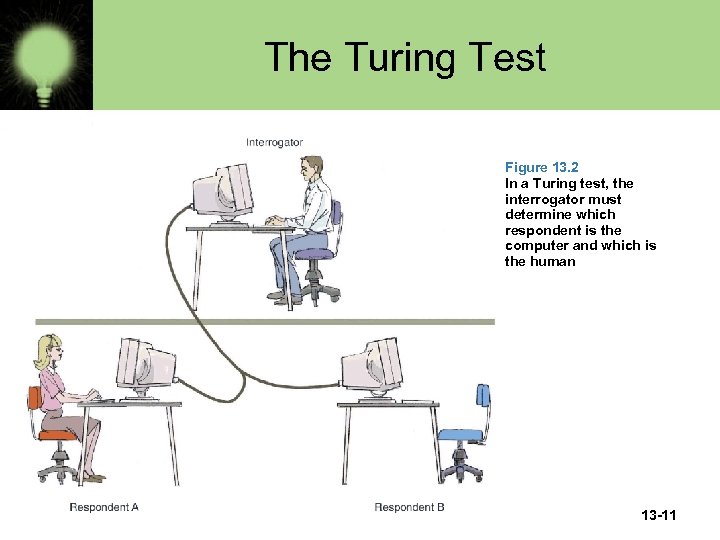 The Turing Test Figure 13. 2 In a Turing test, the interrogator must determine which respondent is the computer and which is the human 13 -11
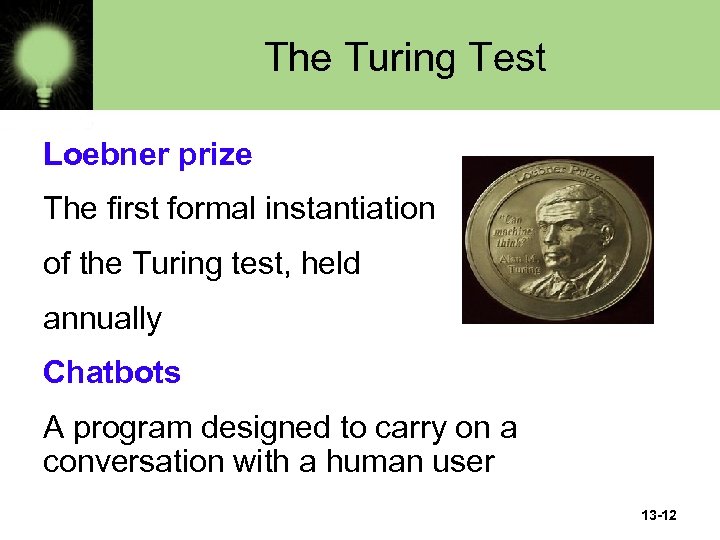 The Turing Test Loebner prize The first formal instantiation of the Turing test, held annually Chatbots A program designed to carry on a conversation with a human user 13 -12
 The Turing Test • Passing the Turing Test does not truly show that the machine was thinking. It simply shows that it generated behavior consistent with thinking. • weak equivalence: the two systems (human and computer) are equivalent in results (output), but they do not necessarily arrive at those results in the same way • Strong equivalence: the two systems use the same internal processes to produce results 13 -13
 Overview of Issues • We want to compare the way that computers and humans work to see if we can better understand why each have their (computational) strengths. – Processing Models – Knowledge Representation – Reasoning 13 -14
 The Human Brain • Let’s first look at how a biological neural networks – A neuron is a single cell that conducts a chemically-based electronic signal – At any point in time a neuron is in either an excited or inhibited state 13 -15
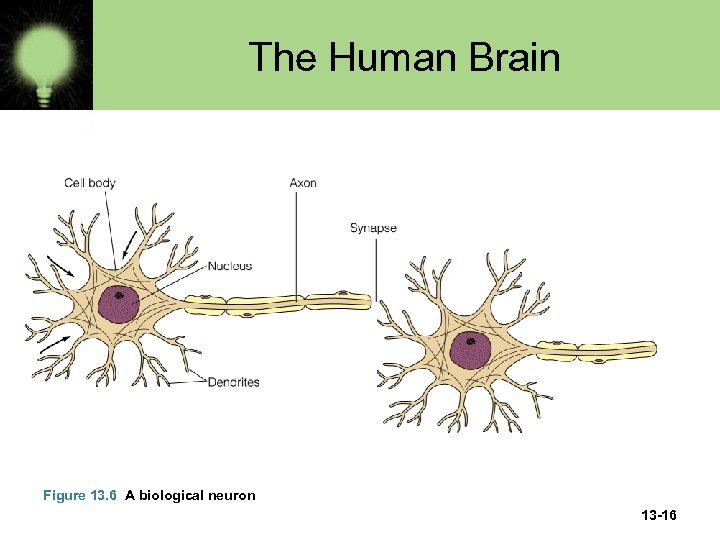 The Human Brain Figure 13. 6 A biological neuron 13 -16
 The Human Brain – A series of connected neurons forms a pathway – A series of excited neurons creates a strong pathway – A biological neuron has multiple input tentacles called dendrites and one primary output tentacle called an axon – The gap between an axon and a dendrite is called a synapse 13 -17
 The Human Brain • A neuron accepts multiple input signals and then controls the contribution of each signal based on the “importance” the corresponding synapse gives to it • The pathways along the neural nets are in a constant state of flux • As we learn new things, new strong neural pathways in our brain are formed 13 -18
 Artificial Neural Networks Some have tried to use computers to mimic the neural network model of the human brain. • Each processing element in an artificial neural net is analogous to a biological neuron – An element accepts a certain number of input values and produces a single output value of either 0 or 1 – Associated with each input value is a numeric weight 13 -19
 Artificial Neural Networks – The effective weight of the element is defined to be the sum of the weights multiplied by their respective input values v 1*w 1 + v 2*w 2 + v 3*w 3 – Each element has a numeric threshold value – If the effective weight exceeds the threshold, the unit produces an output value of 1 – If it does not exceed the threshold, it produces an output value of 0 13 -20
 Artificial Neural Networks • The process of adjusting the weights and threshold values in a neural net is called training • A neural net can presumably be trained to produce whatever results are required (Ay, there’s the rub) 13 -21
 Human vs. Computer 13 -22
 Knowledge Representation • The first example we consider is the use of a search tree to represent the state of knowledge. • Another example we consider is a knowledge-based system which reasons based upon the notion of a semantic network. 13 -23
 Search Trees • Search tree A structure that represents all possible moves in a game, for both you and your opponent • The paths down a search tree represent a series of decisions made by the players 13 -24
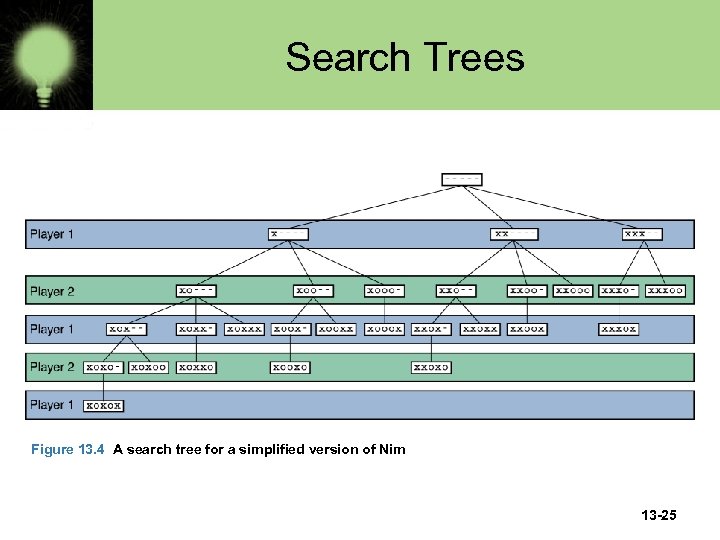 Search Trees Figure 13. 4 A search tree for a simplified version of Nim 13 -25
 Search Trees Techniques for searching trees • Depth-first A technique that involves the analysis of selected paths all the way down the tree • Breadth-first A technique that involves the analysis of all possible paths but only for a short distance down the tree 13 -26
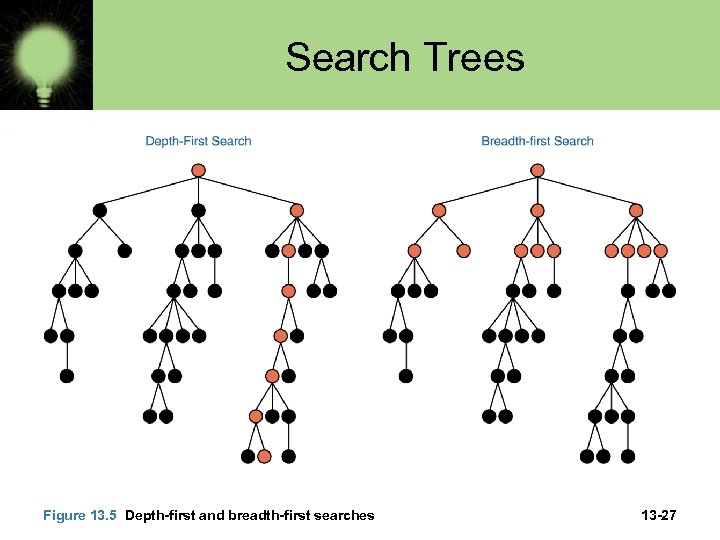 Search Trees Figure 13. 5 Depth-first and breadth-first searches 13 -27
 Search Trees • Search tree analysis can be applied nicely to other, more complicated games such as chess • Because these trees are so large, only a fraction of the tree can be analyzed in a reasonable time limit, even with modern computing power 13 -28
 Semantic Networks • Semantic network A knowledge representation technique that focuses on the relationships between objects • A directed graph is used to represent a semantic network or net 13 -29
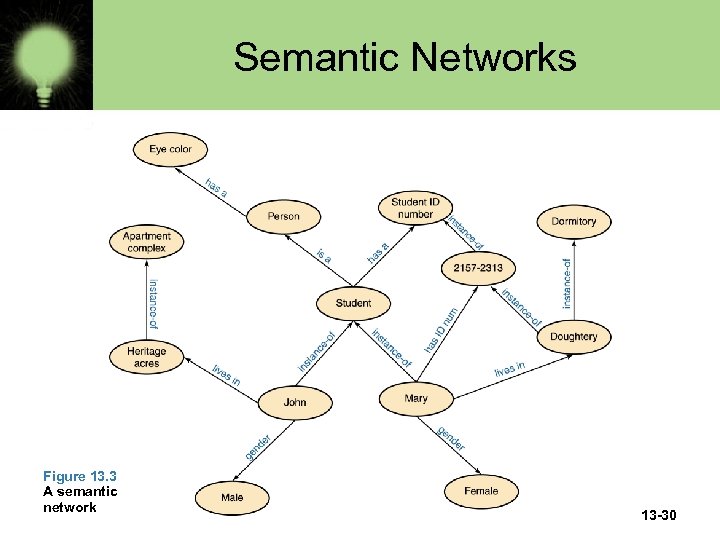 Semantic Networks Figure 13. 3 A semantic network 13 -30
 Semantic Networks • The relationships that we represent are completely our choice, based on the information we need to answer the kinds of questions that we will face • The types of relationships represented determine which questions are easily answered, which are more difficult to answer, and which cannot be answered 13 -31
 Expert Systems Knowledge-based system Software that uses a specific set of information, from which it extracts and processes particular pieces Expert system A software system based the knowledge of human experts; it is – – Rule-based system A software system based on a set of if-then rules Inference engine The software that processes rules to draw conclusions 13 -32
 Expert Systems 13 -33
 Expert Systems Named abbreviations that represent conclusions – NONE—apply no treatment at this time – TURF—apply a turf-building treatment – WEED—apply a weed-killing treatment – BUG—apply a bug-killing treatment – FEED—apply a basic fertilizer treatment – WEEDFEED—apply a weed-killing and fertilizer combination treatment 13 -34
 Expert Systems Boolean variables needed to represent state of the lawn – BARE—the lawn has large, bare areas – SPARSE—the lawn is generally thin – WEEDS—the lawn contains many weeds – BUGS—the lawn shows evidence of bugs 13 -35
 Expert Systems Data that is available – LAST—the date of last lawn treatment – CURRENT—current date – SEASON—the current season Now we can formulate some rules for our gardening expert system 13 -36
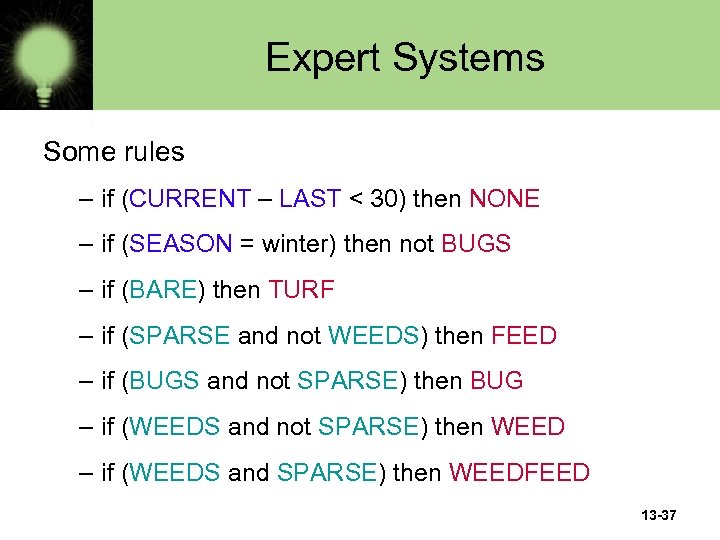 Expert Systems Some rules – if (CURRENT – LAST < 30) then NONE – if (SEASON = winter) then not BUGS – if (BARE) then TURF – if (SPARSE and not WEEDS) then FEED – if (BUGS and not SPARSE) then BUG – if (WEEDS and not SPARSE) then WEED – if (WEEDS and SPARSE) then WEEDFEED 13 -37
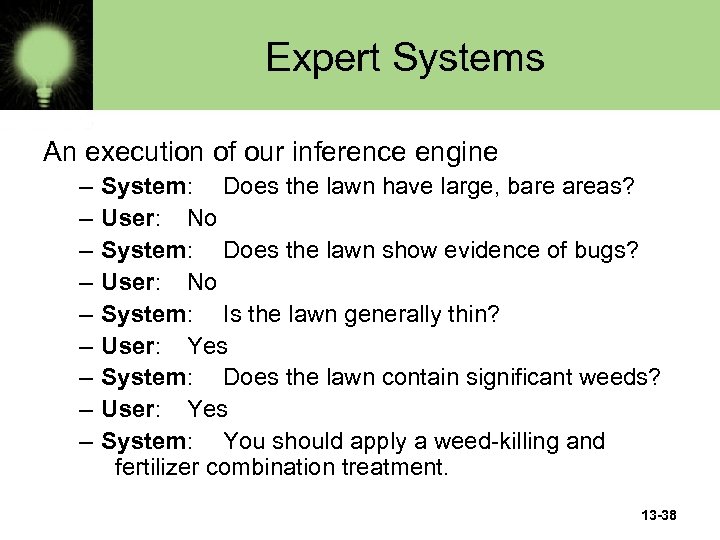 Expert Systems An execution of our inference engine – – – – – System: Does the lawn have large, bare areas? User: No System: Does the lawn show evidence of bugs? User: No System: Is the lawn generally thin? User: Yes System: Does the lawn contain significant weeds? User: Yes System: You should apply a weed-killing and fertilizer combination treatment. 13 -38
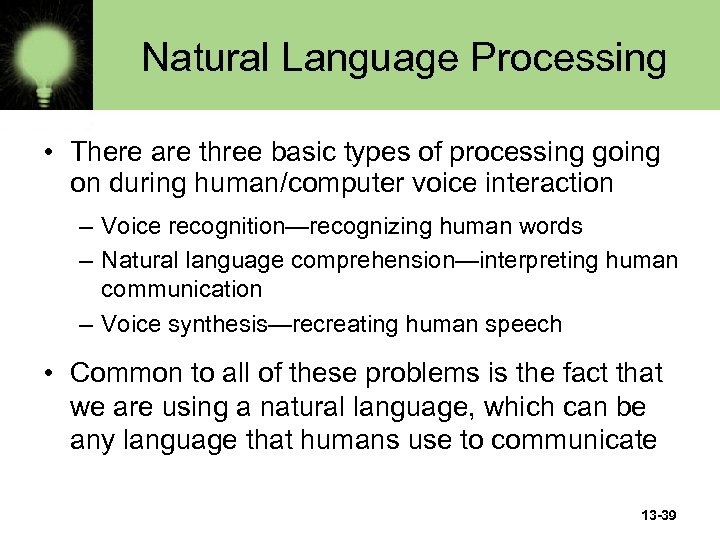 Natural Language Processing • There are three basic types of processing going on during human/computer voice interaction – Voice recognition—recognizing human words – Natural language comprehension—interpreting human communication – Voice synthesis—recreating human speech • Common to all of these problems is the fact that we are using a natural language, which can be any language that humans use to communicate 13 -39
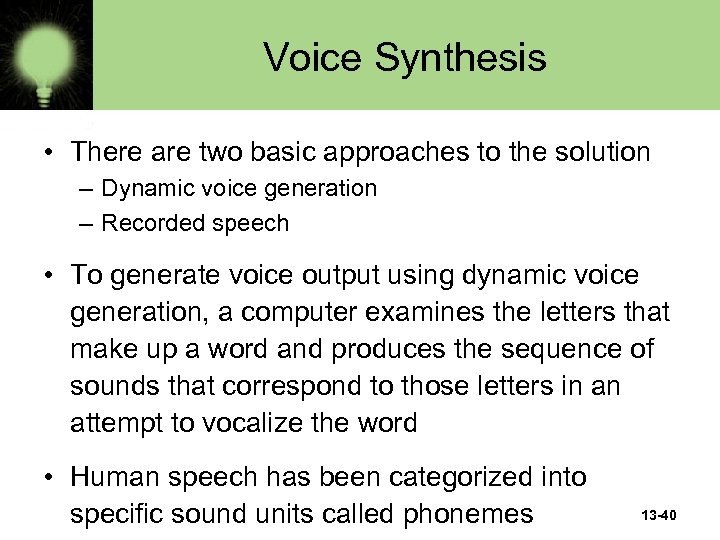 Voice Synthesis • There are two basic approaches to the solution – Dynamic voice generation – Recorded speech • To generate voice output using dynamic voice generation, a computer examines the letters that make up a word and produces the sequence of sounds that correspond to those letters in an attempt to vocalize the word • Human speech has been categorized into specific sound units called phonemes 13 -40
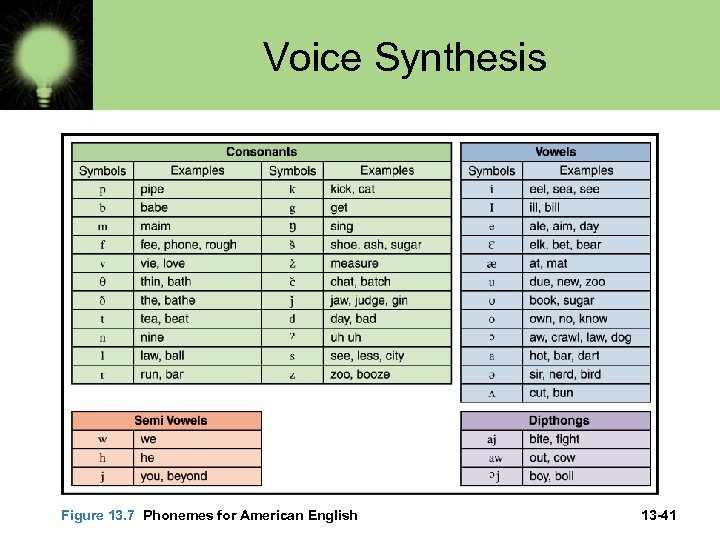 Voice Synthesis Figure 13. 7 Phonemes for American English 13 -41
 Voice Synthesis • The other approach to voice synthesis is to play digital recordings of a human voice saying specific words – Telephone voice mail systems often use this approach: “Press 1 to leave a message for Alex Wakefield” 13 -42
 Voice Synthesis (cont. ) • Each word or phrase needed must be recorded separately • Furthermore, since words are pronounced differently in different contexts, some words may have to be recorded multiple times – For example, a word at the end of a question rises in pitch compared to its use in the middle of a sentence 13 -43
 Voice Recognition • The sounds that each person makes when speaking are unique • We each have a unique shape to our mouth, tongue, throat, and nasal cavities that affect the pitch and resonance of our spoken voice • Speech impediments, mumbling, volume, regional accents, and the health of the speaker further complicate this problem 13 -44
 Voice Recognition (cont. ) • Furthermore, humans speak in a continuous, flowing manner – Words are strung together into sentences – Sometimes it’s difficult to distinguish between phrases like “ice cream” and “I scream” – Also, homonyms such as “I” and “eye” or “see” and “sea” • Humans can often clarify these situations by the context of the sentence, but that processing requires another level of comprehension • Modern voice-recognition systems still do not do well with continuous, conversational speech 13 -45
 Natural Language Comprehension • Even if a computer recognizes the words that are spoken, it is another task entirely to understand the meaning of those words • Natural language is often ambiguous, for a variety of reasons. Let’s look at several classes of ambiguity (though admittedly there is some overlap in such a classification) 13 -46
 Lexical Ambiguity • A single word can have two meanings. – “The bat slipped from his hand” – “Cinderella had a ball” – “Ron lies asleep in his bed” • Worse yet, those meanings may even constitute different parts of speech. – “Time flies like an arrow” – “They are racing horses” – “Stampeding cattle can be dangerous” 13 -47
 Syntactic Ambiguity • Even if all words have a clear meaning, ambiguity may exist because the phrases can be combined in several ways when parsing. – “I saw the Grand Canyon flying to New York” – “The clams are ready to eat” – “I saw the man in the park with the telescope” 13 -48
 Referential Ambiguity • Pronouns may cause ambiguity when it is not clear which noun is being referenced. – “The brick fell on the computer but it is not broken” – “Jon met Bill before he went to the store” 13 -49
 Rules of Conversation – “Do you know what time it is? ” • Presumably, a correct response is “Yes. ” • Does this sentence’s meaning change if it is said by your boss when you walk into a meeting 30 minutes late? – “Do you know you have a flat tire? ” – “I’d like to ask everyone to raise their hand for two seconds. ” • How did you respond? 13 -50
 Need for “real world” knowledge – “Norman Rockwell painted people” • Did he do tattoos? Face-painting? 13 -51
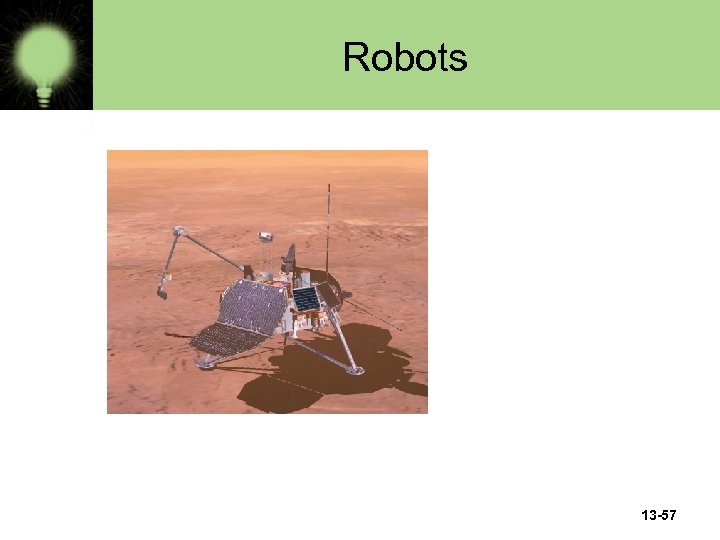
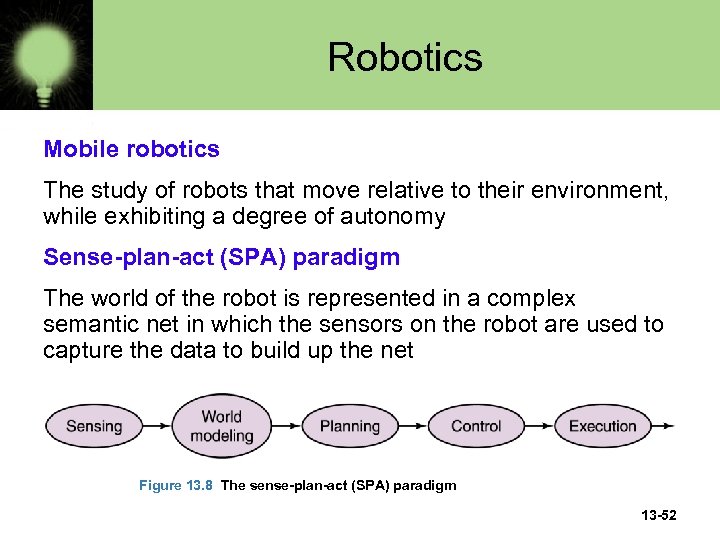 Robotics Mobile robotics The study of robots that move relative to their environment, while exhibiting a degree of autonomy Sense-plan-act (SPA) paradigm The world of the robot is represented in a complex semantic net in which the sensors on the robot are used to capture the data to build up the net Figure 13. 8 The sense-plan-act (SPA) paradigm 13 -52
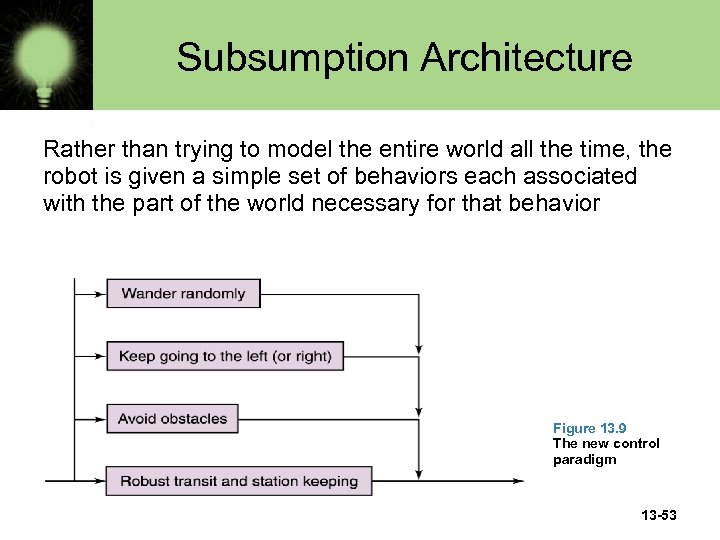 Subsumption Architecture Rather than trying to model the entire world all the time, the robot is given a simple set of behaviors each associated with the part of the world necessary for that behavior Figure 13. 9 The new control paradigm 13 -53
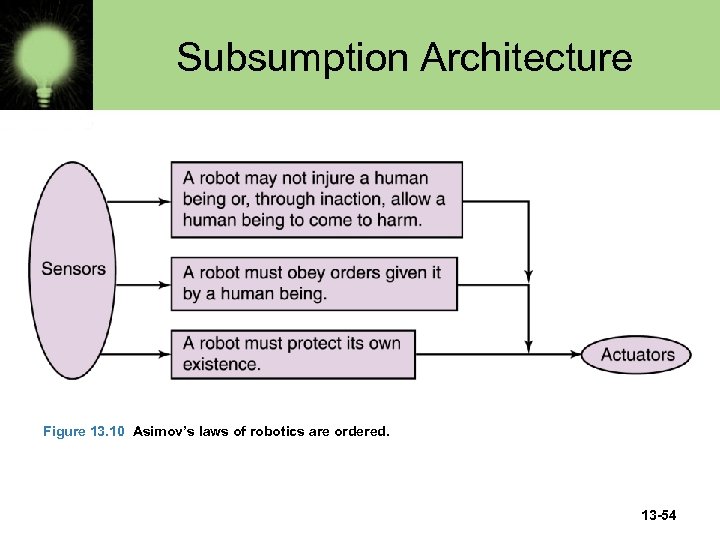 Subsumption Architecture Figure 13. 10 Asimov’s laws of robotics are ordered. 13 -54
 Robots 13 -55
 Robots 13 -56
 Robots 13 -57