


 Скачать презентацию Artificial Intelligence Introduction Alison Cawsey room G 36
ccfa6d2d5f61eaf0d583335bcc420d65.ppt
- Количество слайдов: 17
 Artificial Intelligence Introduction Alison Cawsey room: G 36 email: alison@macs. hw. ac. uk Ruth Aylett Room: 1. 37 Email: ruth@macs. hw. ac. uk
 What is AI? n Various definitions: u Building intelligent entities. u Getting computers to do tasks which require human intelligence. n n But what is “intelligence”? Simple things turn out to be the hardest to automate: u Recognising a face. u Navigating a busy street. u Understanding what someone says. n All tasks require reasoning on knowledge.
 Why do AI? n Two main goals of AI: u To understand human intelligence better. We test theories of human intelligence by writing programs which emulate it. u To create useful “smart” programs able to do tasks that would normally require a human expert.
 Who does AI? n Many disciplines contribute to goal of creating/modelling intelligent entities: u Computer Science u Psychology (human reasoning) u Philosophy (nature of belief, rationality, etc) u Linguistics (structure and meaning of language) u Human Biology (how brain works) n Subject draws on ideas from each discipline.
 Typical AI Problems n n Intelligent entities (or “agents”) need to be able to do both “mundane” and “expert” tasks: Mundane tasks - consider going shopping: u Planning a route, and sequence of shops to visit! u Recognising (through vision) buses, people. u Communicating (through natural language). u Navigating round obstacles on the street, and manipulating objects for purchase. n Expert tasks are things like: u medical diagnosis. u equipment repair. n Often “mundane” tasks are the hardest.
 Philosophical Issues What is intelligence? n Can a machine be truly “intelligent”? Is there more to human intelligence than rules, data and calculations? Tests: n Turing Test: Can someone tell which is the machine, when communicating to human and to a machine in another room? If not, can we call the machine intelligent? n Chinese room: Searle says no. Describes a thought experiment where talk in Chinese by looking up what to say from huge rule book. n Loebner contest: Contest for most human-like conversation system. n
 Example conversation with system winning Loebner prize P: No worries! Hey! I didn’t come here to be subjected to bad language! How rude! n J: Sorry, sorry. Didn’t mean to offend. So, how old are you? n P: That’s OK. Just don’t do it again. Well, should my age really matter. Just for the record I’m 24. How old are you then. But. . System was based on fairly simple methods, with prestored amusing replies. These simple methods first used in “Eliza” - a program to emulate psychotherapist. n Try esc-x doctor while in emacs for a version of Eliza. n Human-like performance doesn’t guarantee intelligence.
 About this Module Covers following AI topics u AI Programming, using Prolog. u Knowledge representation: F How do we represent knowledge about the world in a formal manner that can be manipulated in a sound and efficient manner? u Search: F How can an AI system go through all the possibilities in a systematic manner when looking for solutions to complex problems.
 About this Module u Natural Language: F How can a system communicate in a natural language such as English. u Machine learning and neural networks: F How can a system learn from experience, or from past case data. u Agents: F How can we develop and use practical “intelligent agents”. u Knowledge F How Engineering: do we elicit the human expertise required to build intelligent applications.
 Labs and Coursework n n n Weekly lab, starting Wed 16 th April! Labs give you experience of two AI programming languages: Prolog and Net. Logo. Weeks 1 -4: Exercises on AI Programming in Prolog. u n Some of these must be “ticked off” by Lab demonstrators and will contribute to your coursework mark. Weeks 5 -8: Net. Logo with assessed exercise.
 Books etc. n “Essence of Artificial Intelligence” by Alison Cawsey, Prentice Hall. u n n n Review: “I missed most of the lectures but thanks to this short and sweet book I passed my first year introduction to AI course. If you are a slack student taking an AI course - buy this book. “ Artificial Intelligence: A Modern Approach (second edition), Russell & Norvig, Prentice Hall. 2003 Artificial Intelligence: Structures and Strategies for Complex Problem Solving, Luger, Benjamin Cummings. Slides, lab exercises etc for weeks 1 -4 on www. macs. hw. ac. uk/~alison/ai 3/
 Module prerequisites/assumptions n n Programming (software engineering). CS students will benefit from: u Logic n and Proof IT students will benefit from u Cognitive n Science. Relevant material from logic and proof will be reviewed again for benefit of IT students.
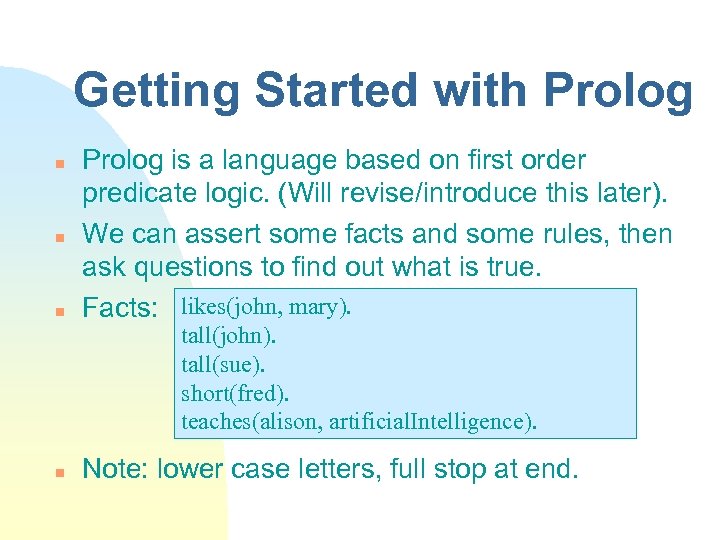 Getting Started with Prolog n n n Prolog is a language based on first order predicate logic. (Will revise/introduce this later). We can assert some facts and some rules, then ask questions to find out what is true. Facts: likes(john, mary). tall(john). tall(sue). short(fred). teaches(alison, artificial. Intelligence). n Note: lower case letters, full stop at end.
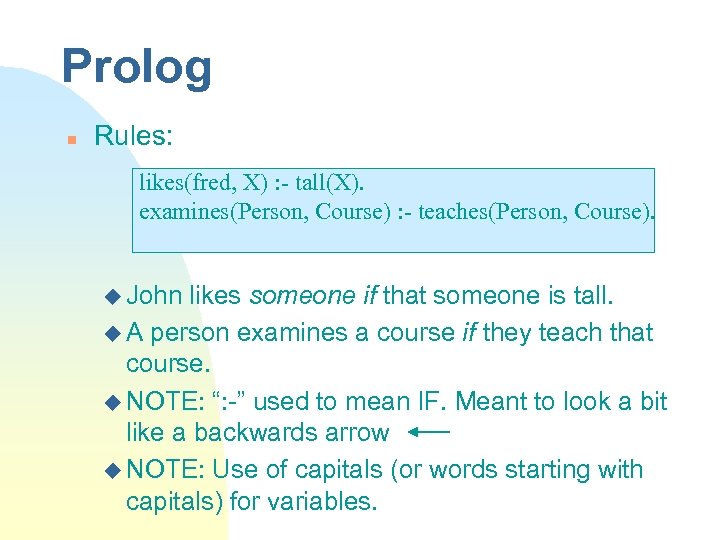 Prolog n Rules: likes(fred, X) : - tall(X). examines(Person, Course) : - teaches(Person, Course). u John likes someone if that someone is tall. u A person examines a course if they teach that course. u NOTE: “: -” used to mean IF. Meant to look a bit like a backwards arrow u NOTE: Use of capitals (or words starting with capitals) for variables.
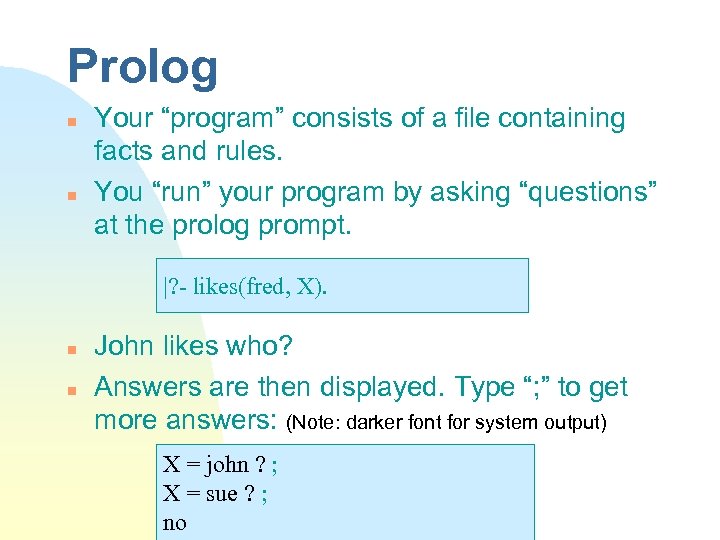 Prolog n n Your “program” consists of a file containing facts and rules. You “run” your program by asking “questions” at the prolog prompt. |? - likes(fred, X). n n John likes who? Answers are then displayed. Type “; ” to get more answers: (Note: darker font for system output) X = john ? ; X = sue ? ; no
 Prolog and Search n n n Prolog can return more than one answer to a question. It has a built in search method for going through all the possible rules and facts to obtain all possible answers. Search method “depth first search” with “backtracking”.
 Summary n n n AI about creating intelligent entities, with a range of abilities such as language, vision, manipulation/navigation. . Intelligence involves knowledge - this must be represented with and reasoned with. Solving problems involves search. Prolog is a language geared to representing knowledge and searching for solutions. Prolog programs based on facts and rules, and run by asking questions.