 Скачать презентацию Artificial Intelligence E-Commerce Based Agents over P 2
84d7b755448f55d502c8e4bff1f149d8.ppt
- Количество слайдов: 12



Artificial Intelligence E-Commerce Based Agents over P 2 P Network Zhibing Zhang Arbab Abdul Waheed MSc in Smart Systems Student # 0804515 Nov 23, 2008
Introduction E-Commerce Based Agents over P 2 P Network
INTRODUCTION v The continuous development of Internet technology and the increasing number of people getting connected to it v. They lack facilities for automated negotiation and agent cooperation v. Kasbah is a Web-based system where users can create autonomous agents to buy and sell goods v. Kasbah can be qualified as a closed system as it is a proprietary system, which uses a very limited message protocol v. MAGMA is an agent-based electronic commerce architecture which models traditional market activity through a platform-independent API v. MAGMA uses a central communication relay server, which could be the failure point of any industrial adaptation
INTRODUCTION v. The traditional market and the centralized systems already proposed could be classified as classic solutions which share the following list of limitations v. Inflexibility: every e-commerce solution has it own trading environment v. Only price counts: most current systems, offer auctions or negotiation to select either buyer or seller v. Centralization: trader may want to have more control v. Static predefined behavior: the proposed systems suppose that the environment is stable and predictable v. Weak automation: many operations are still not supported v. Open environments are characterized by having components that are: vautonomous (acting independently) vheterogeneous (designed independently) vof dynamic membership (joining, changing, and leaving arbitrarily) vof large scale (numerous) v. The combination of agent and P 2 P technology brings more autonomy and flexibility to the proposed ecommerce system v. This paper proposes an agent-based integration system and the idea is to have a flexible integration framework, which facilitates dynamic partner selection and supports agents’ heterogeneity
Peer-To-Peer Paradigm E-Commerce Based Agents over P 2 P Network
PEER-TO-PEER PARADIGM v. P 2 P concept is not a new one: Mail servers, network news servers(NNTP), and domain name servers(DNS) operate in P 2 P networks v. P 2 P networks replace the traditional centralized structure of client-server interactions with peer interactions, where each machine acts as both a client and a server in the network v. Napster is the good example of a monolithic centralization that causes all the P 2 P functionality to fail if the main server fails or is disconnected v. Today’s best known peer-to-peer applications are Napster, Kazaa, Gnutella, Freenet or SETI@Home v. Napster, Kazaa and Gnutella are primarily file-sharing applications: exchanging of files between peers v. SETI@Home is the world’s largest distributed computing system with a capacity of an estimated 26 Teraflops/sec
Agent Architecture E-Commerce Based Agents over P 2 P Network
AGENT ARCHITECTURE v. Every company will be represented by an agent system in the P 2 P network v. Companies have already invested a lot of resources and money in their existing systems v. The solution proposed could be used as a wrapper or a bridge between their internal systems and the P 2 P network v. It will allows to leverage from their previous investments in information system v. Using this agent-based integration solution, companies could have more autonomy and more control over their business decisions and their partner selection v. Companies and users will create their own relationship and maintain their partner network
The Internal Agent Architecture E-Commerce Based Agents over P 2 P Network
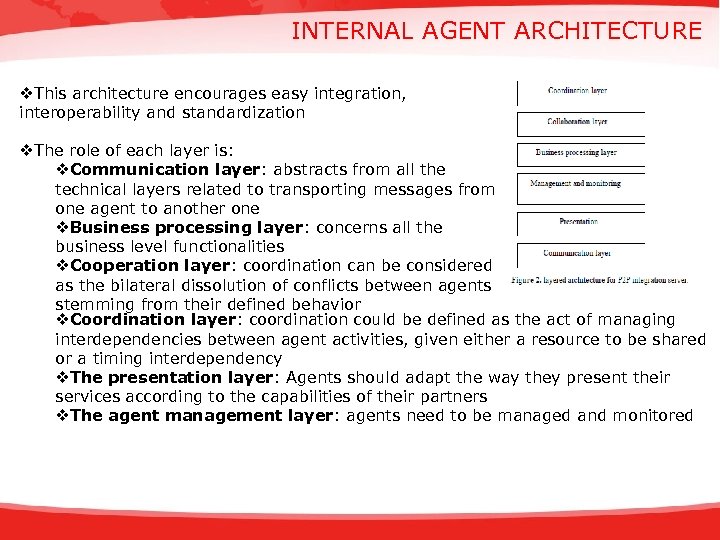
INTERNAL AGENT ARCHITECTURE v. This architecture encourages easy integration, interoperability and standardization v. The role of each layer is: v. Communication layer: abstracts from all the technical layers related to transporting messages from one agent to another one v. Business processing layer: concerns all the business level functionalities v. Cooperation layer: coordination can be considered as the bilateral dissolution of conflicts between agents stemming from their defined behavior v. Coordination layer: coordination could be defined as the act of managing interdependencies between agent activities, given either a resource to be shared or a timing interdependency v. The presentation layer: Agents should adapt the way they present their services according to the capabilities of their partners v. The agent management layer: agents need to be managed and monitored
Conclusion E-Commerce Based Agents over P 2 P Network
CONCLUSION v. This paper proposed a distributed architecture dedicated for inter-agent interactions v. Every agent is considered as an autonomous peer v. These agents will easily wrap existing systems extending them to support new ecommerce functionalities v. The agent architecture proposed in this paper has many layers v. Each layer abstracts a set of functionalities and has many components THANK YOU!
Скачать презентацию Artificial Intelligence E-Commerce Based Agents over P 2
84d7b755448f55d502c8e4bff1f149d8.ppt