


 Скачать презентацию Artificial Intelligence Dr Paul Wagner Department of Computer
a8e159bfbe80aa775b2d02d8577fbbd1.ppt
- Количество слайдов: 30
 Artificial Intelligence Dr. Paul Wagner Department of Computer Science University of Wisconsin – Eau Claire
 Messages Artificial Intelligence (AI) is an interesting sub-field of computer science that provides many contributions to the overall field n CS 420, as the AI course at UWEC, is a good opportunity to begin to explore these issues n
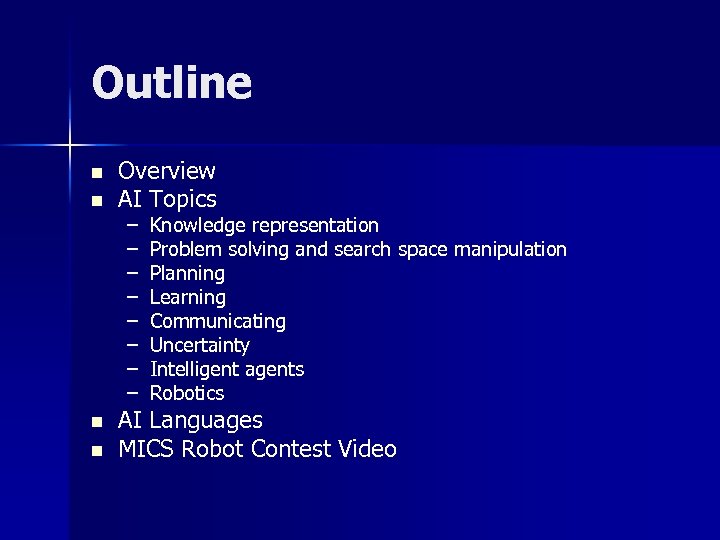 Outline n n Overview AI Topics – – – – Knowledge representation Problem solving and search space manipulation Planning Learning Communicating Uncertainty Intelligent agents Robotics AI Languages MICS Robot Contest Video
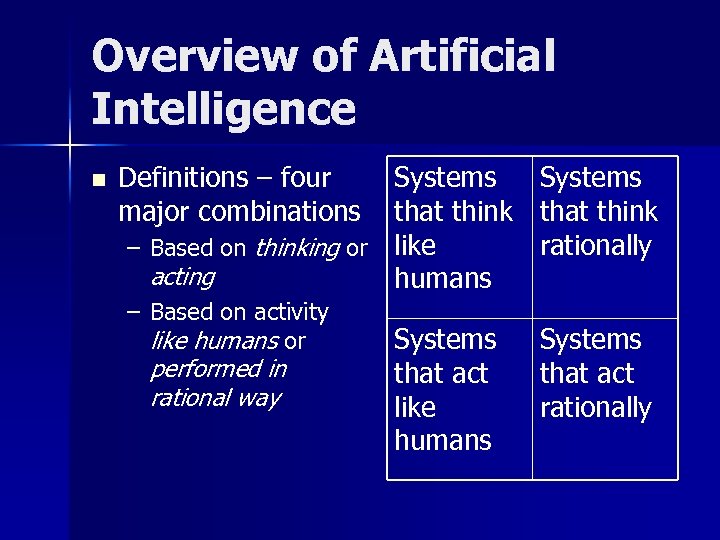 Overview of Artificial Intelligence n Systems that think – Based on thinking or like acting humans Definitions – four major combinations – Based on activity like humans or performed in rational way Systems that act like humans Systems that think rationally Systems that act rationally
 AI Definitions n Acting Humanly – Turing Test – computer passes test if a human interrogator asking written questions can distinguish written answers from computer or human – Computer needs: n Natural language processing n Knowledge representation n Automated reasoning n Machine learning
 AI Definitions (2) – Total Turing Test – includes video component (to test subject’s perceptual abilities) and opportunity to pass physical objects to subject – Computer also needs: n Computer n Robotics vision
 AI Definitions (3) n Thinking Humanly – Cognitive Modeling approach to AI – Involves crossover between computer science and psychology – cognitive science – Areas of interest n Cognitive models n Neural networks
 AI Definitions (4) n Thinking Rationally – “Laws of thought” approach to AI – Goal: solve any problem based on logical manipulation – Problems n n Difficult to represent certain types of knowledge (e. g. common sense, informal knowledge) Difference between solving problems in principle and in practice – E. g. computational limits
 AI Definitions (4) n Acting Rationally – “Design a rational agent” approach to AI – Advantages over logic approach n Logic is only one tool or many that can be used to design rational agent n Scientific advances can provide more tools for developing better agents
 Knowledge Representation n How to represent information? Generally, we use some sort of tree, grid or network Options n Problem n n – OO programming languages: classes/objects – Relational database system: tables/rows/columns – The world is more varied, with many types of things to represent
 Knowledge Representation (2) n Abstract Objects – – – Sets Sentences Measurements n n n Times Weights Generalized Events – – Intervals Places Physical Objects Processes
 Knowledge Representation (3) n Some things are very difficult to represent – Common sense n See http: //www. cyc. com/ – Combinations of multiple types n n Issues of: – – Type Scale Granularity Combination Other Questions – How to distinguish knowledge and belief? – What is the best way to reason with this information?
 Problem Solving and Search Space Manipulation n Many Algorithmic Approaches to Problem Solving – Depth-First Search – Breadth-First Search n Variations – Depth-Limited Search – Iterative Deepening Depth-First Search – Bi-directional Search
 Problem Solving and Search Space Manipulation (2) n Smarter Search – Greedy best-first search – A* search (combine costs of path so far plus path from current node to goal) – Memory-bounded heuristic search n Heuristic – means of estimating a measurement such as cost of search
 Problem Solving and Search Space Manipulation (3) n Issues – Avoiding repeated search – Searching with partial information
 Problem Solving and Search Space Manipulation (4) n Adversarial Search – E. g. games and game trees – Minimax algorithm – Alpha-Beta pruning
 Problem Solving and Search Space Manipulation (5) n Applications of Problem Solving – Expert Systems n Approximating human expert the functionality of an absent – Robotics n Encountering unexpected obstacles
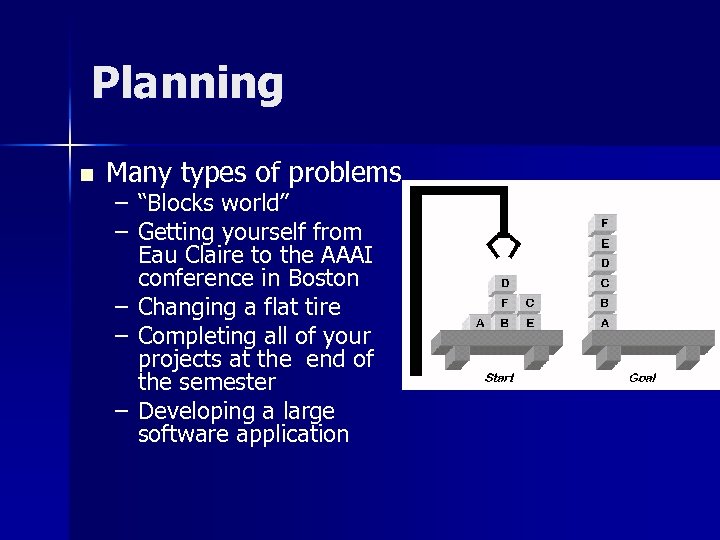 Planning n Many types of problems – “Blocks world” – Getting yourself from Eau Claire to the AAAI conference in Boston – Changing a flat tire – Completing all of your projects at the end of the semester – Developing a large software application
 Planning (2) n Approaches – State-based search – Partial-order planning – Planning graphs n Issues – Time – Scheduling – Resources
 Learning n n Definition - Building on current knowledge by using experience to improve a system Various approaches – Supervised/unsupervised/reinforcement n Forms of learning algorithms – Inductive logic n Example: given a set of point, approximate a line – Decision tree (set of questions, act differently depending on answer)
 Learning (2) n Issues – Computational Learning Theory n Intersection of theoretical CS, AI, statistics – How many examples do you need?
 Communicating n Major issue - Natural language processing – Many issues n n n Syntax Semantics Context – Steps n n n Perception Parsing Analysis Disambiguation Incorporation
 Uncertainty n Much knowledge is not absolute – Boundary between knowledge and belief is gray n Techniques for dealing with uncertainty – – – n Probabilistic reasoning over time Fuzzy sets / fuzzy logic Simple decision-making (evaluating utility) Complex decision-making (taking ability to reevaluate into account) Applications – Expert systems
 Intelligent Agents n Everything we’ve talked about can be viewed in terms of embedding intelligence within an agent – Software system – Machine with embedded software – Robot
 Intelligent Agents (2) n Issues for agents – – n Limitations on memory Perceiving its environment Working with other agents Affecting its environment (through actuators) Processes – Simple – based on rules – Complex – based on multiple pieces of logic, dealing with uncertainty
 Robotics n n Field encompassing elements of computer science/AI, engineering, physical systems Issues – – – Many that we’ve discussed, plus: Perception Actuation – – Worker bots (e. g. floor cleaners) Intelligent navigation (DARPA vehicle contest) Recent successes Test environments – Lego Mindstorms – Other robot packages or custom systems
 AI Languages n Scheme / LISP – Functional – Simple knowledge representation (list) – Easy to apply functionality to represented elements n Prolog – – – n Logic-based Facts and rules easily represented Built-in search engine Specialized languages – Rule languages (e. g. CLIPS) – Planning languages (e. g. STRIPS)
 CS 420 Spring semester, about every other year n Will be offered Spring 2007 n Prerequisite: CS 330 (to get Scheme and Prolog background) n Topics n – All of the above!
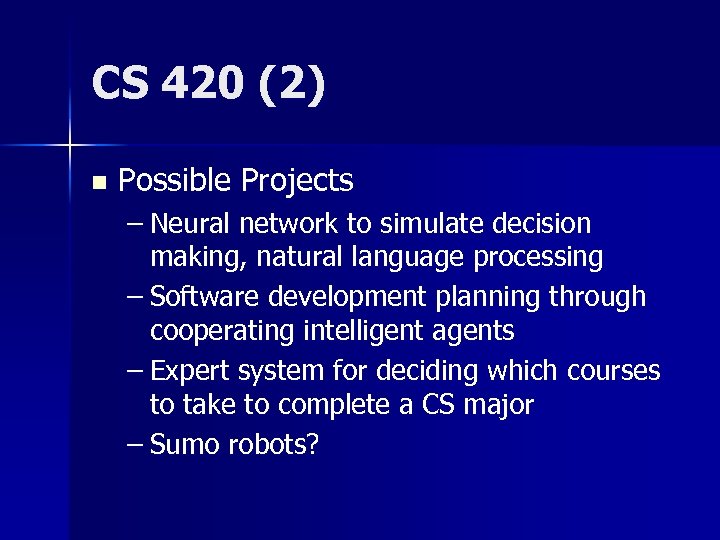 CS 420 (2) n Possible Projects – Neural network to simulate decision making, natural language processing – Software development planning through cooperating intelligent agents – Expert system for deciding which courses to take to complete a CS major – Sumo robots?
 MICS Robot Contest Video n http: //video. google. com/videoplay? doc id=7851913746457357108&hl=en