


 Скачать презентацию Artificial Intelligence Can computers machines think
f70dbfbe86e1c2344aa211bcb2a5ff4d.ppt
- Количество слайдов: 19
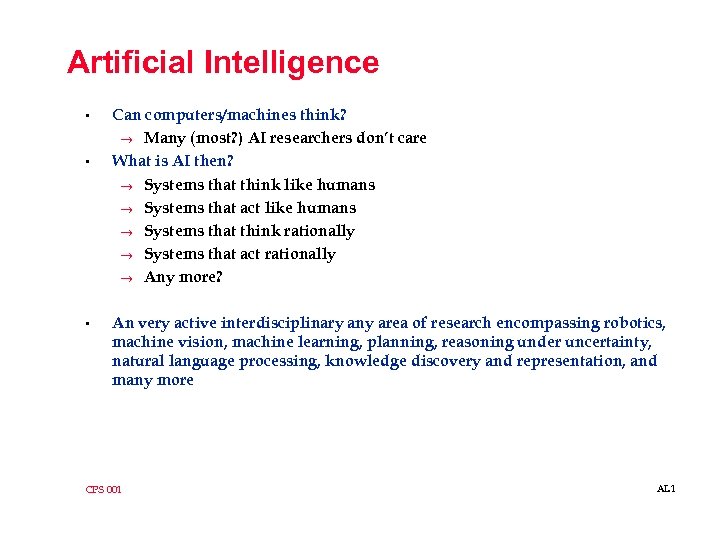 Artificial Intelligence • • • Can computers/machines think? ® Many (most? ) AI researchers don’t care What is AI then? ® Systems that think like humans ® Systems that act like humans ® Systems that think rationally ® Systems that act rationally ® Any more? An very active interdisciplinary any area of research encompassing robotics, machine vision, machine learning, planning, reasoning under uncertainty, natural language processing, knowledge discovery and representation, and many more CPS 001 AI. 1
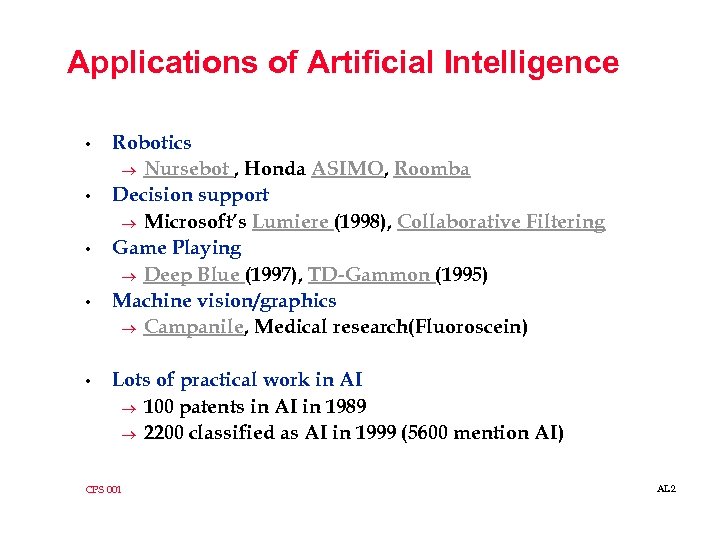 Applications of Artificial Intelligence • • • Robotics ® Nursebot , Honda ASIMO, Roomba Decision support ® Microsoft’s Lumiere (1998), Collaborative Filtering Game Playing ® Deep Blue (1997), TD-Gammon (1995) Machine vision/graphics ® Campanile, Medical research(Fluoroscein) Lots of practical work in AI ® 100 patents in AI in 1989 ® 2200 classified as AI in 1999 (5600 mention AI) CPS 001 AI. 2
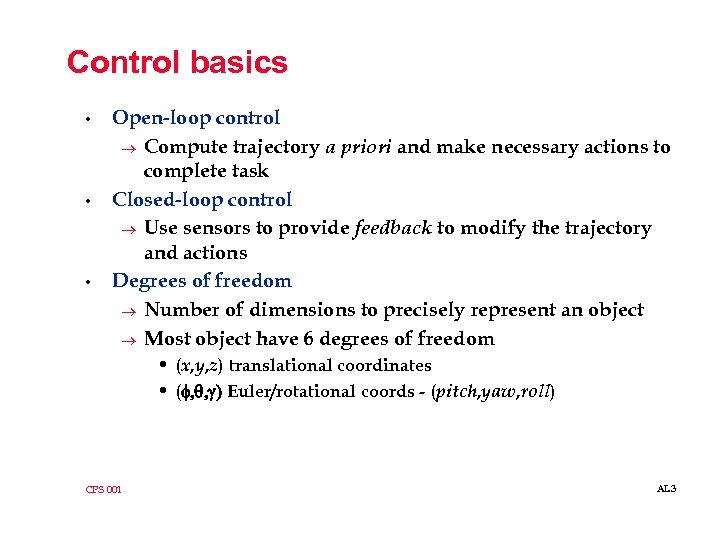 Control basics • • • Open-loop control ® Compute trajectory a priori and make necessary actions to complete task Closed-loop control ® Use sensors to provide feedback to modify the trajectory and actions Degrees of freedom ® Number of dimensions to precisely represent an object ® Most object have 6 degrees of freedom • (x, y, z) translational coordinates • (f, q, g) Euler/rotational coords - (pitch, yaw, roll) CPS 001 AI. 3
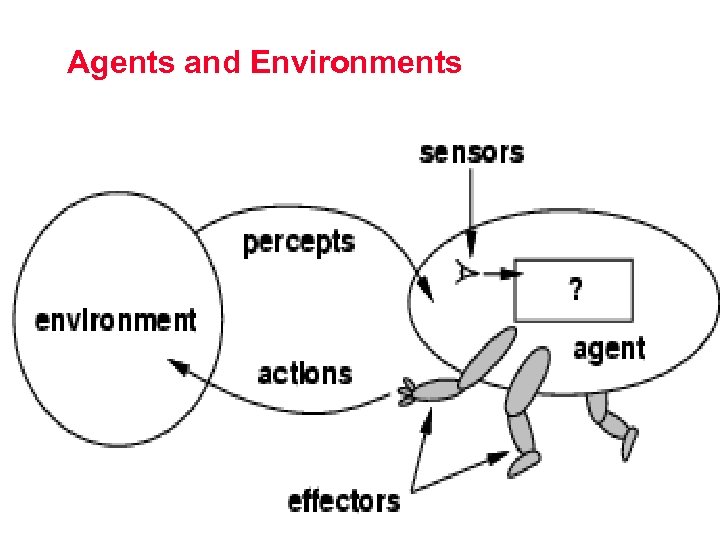 Agents and Environments CPS 001 AI. 4
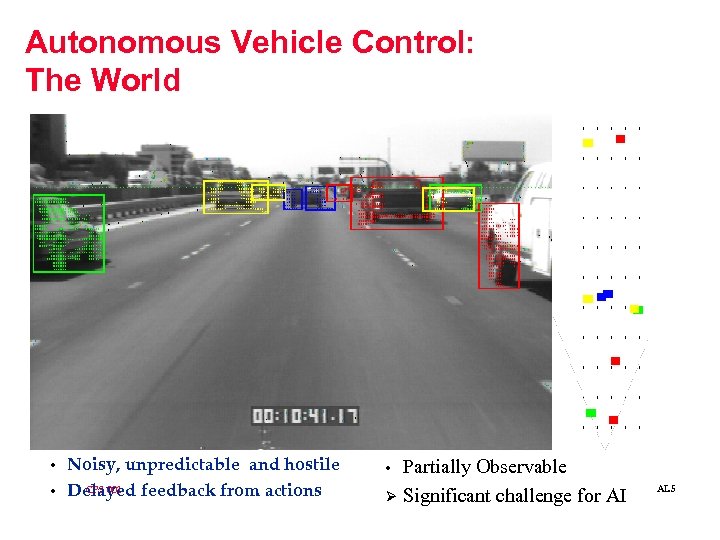 Autonomous Vehicle Control: The World • • Noisy, unpredictable and hostile CPS 001 Delayed feedback from actions Partially Observable Ø Significant challenge for AI • AI. 5
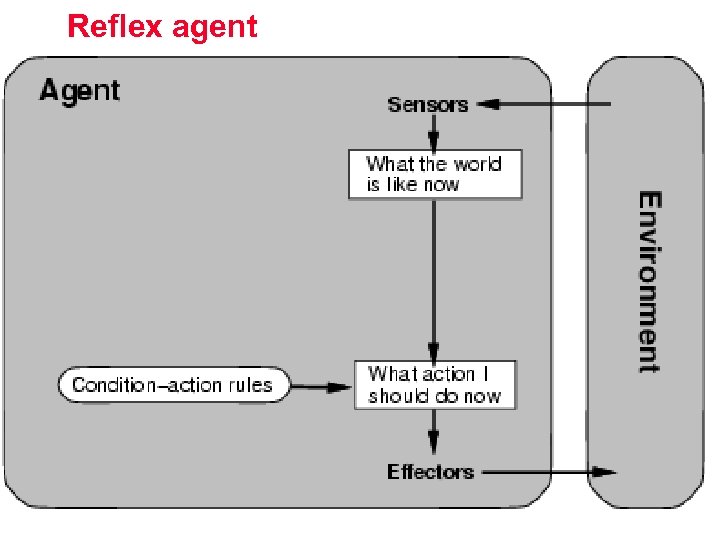 Reflex agent CPS 001 AI. 6
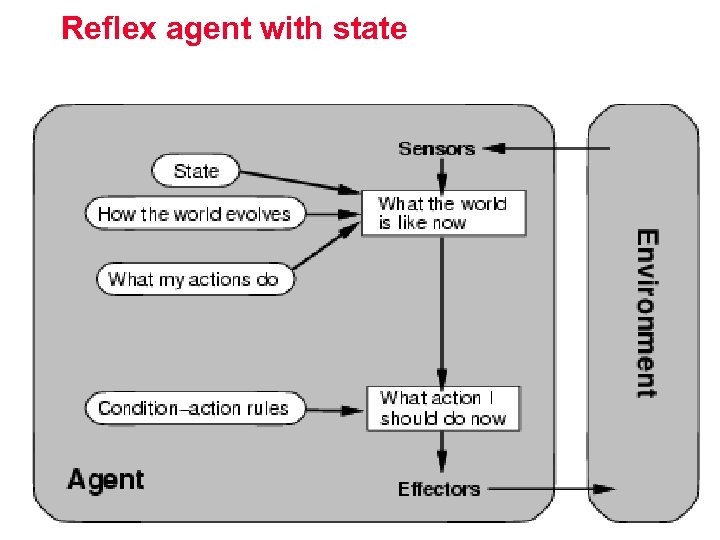 Reflex agent with state CPS 001 AI. 7
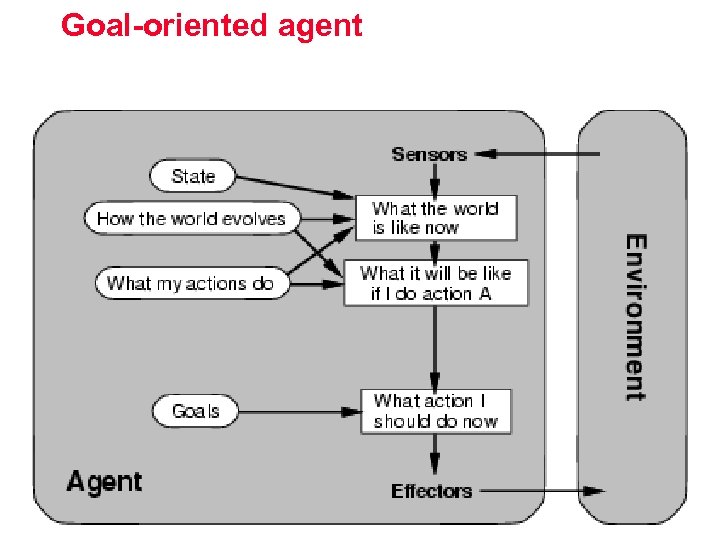 Goal-oriented agent CPS 001 AI. 8
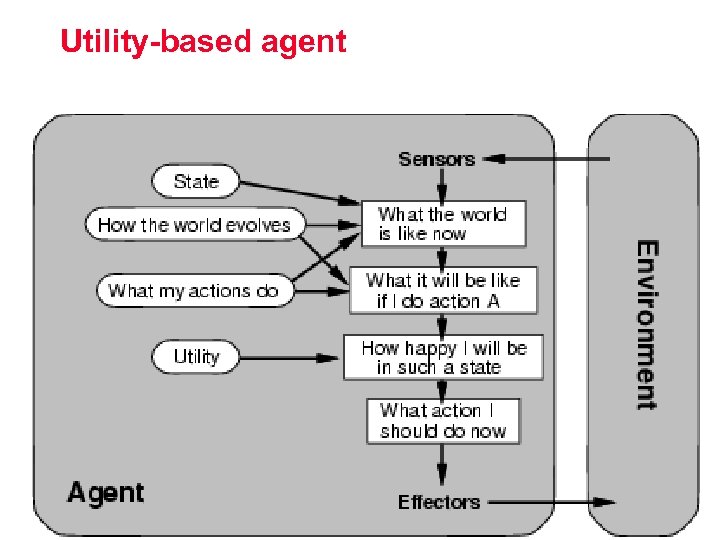 Utility-based agent CPS 001 AI. 9
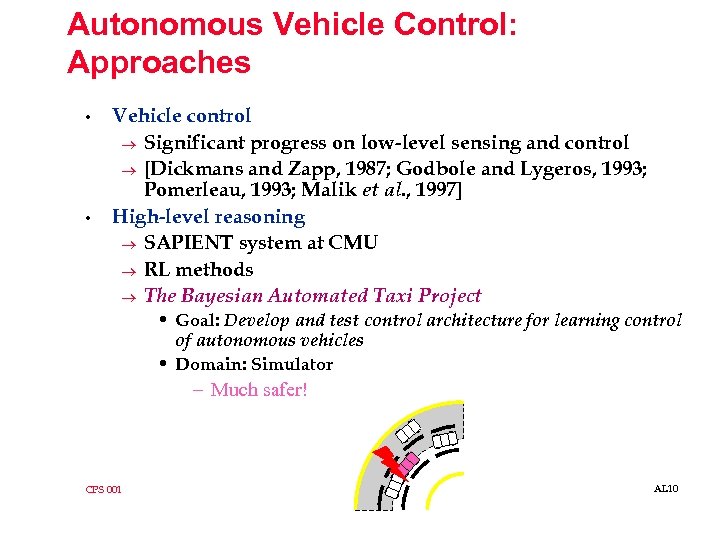 Autonomous Vehicle Control: Approaches • • Vehicle control ® Significant progress on low-level sensing and control ® [Dickmans and Zapp, 1987; Godbole and Lygeros, 1993; Pomerleau, 1993; Malik et al. , 1997] High-level reasoning ® SAPIENT system at CMU ® RL methods ® The Bayesian Automated Taxi Project • Goal: Develop and test control architecture for learning control of autonomous vehicles • Domain: Simulator – Much safer! CPS 001 AI. 10
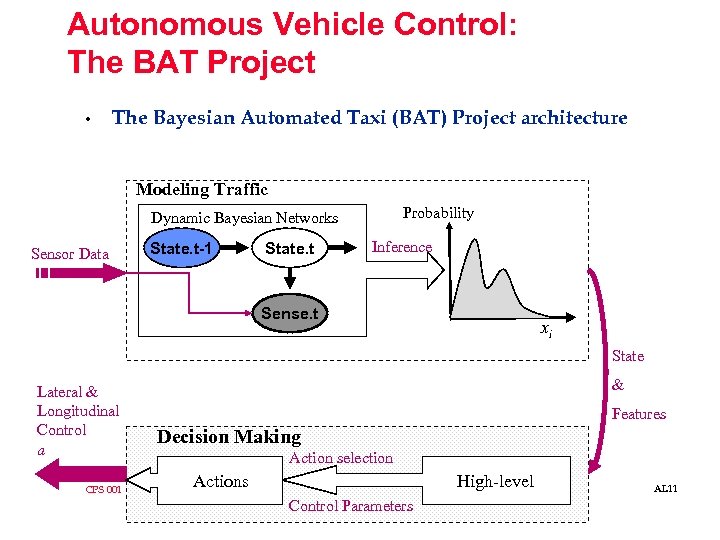 Autonomous Vehicle Control: The BAT Project • The Bayesian Automated Taxi (BAT) Project architecture Modeling Traffic Probability Dynamic Bayesian Networks Sensor Data State. t-1 State. t Inference Sense. t xi State Lateral & Longitudinal Control a CPS 001 & Features Decision Making Action selection Actions High-level Control Parameters AI. 11
 Autonomous Vehicle Control: Learning to Drive à No single optimal trajectory or path à Not easily amenable to supervised learning or regulatory control methods Developed an explicit policy representation for control which performed robustly in a number of driving scenarios à Somewhat fragile and not easily adaptable • Reinforcement learning (RL) • ® • Successively improves and adapts control strategies through trial-and-error interactions with a dynamic environment RL techniques have shown some promise in solving complex control problems ® TD-Gammon [Tesauro, 1992], Cell phone routing [Singh, 1996] à Need to scale and extend for continuous control domains CPS 001 AI. 12
 What is a robot? • Definitions ® Webster: a machine that looks like a human being and performs various acts (as walking and talking) of a human being ® Robotics Institute of America: a robot is a reprogrammable multifunctional manipulator designed to move material, parts, tools, or specialized devices through variable programmed motions for the performance of a variety of tasks ® What’s our definition • Components of a robot system? CPS 001 AI. 13
 History • • • 1921: Karel Capek’s play, Rossum’s Universal Robots 1942: Asimov wrote Runaround which contained the “Three Laws of Robotics” 1. A robot must may not injure a human being or through inaction allow a human being to come to harm. 2. A robot must obey the orders given it by human beings, except where such orders would conflict with Rule 1. 3. A robot must protect its own existence, as long as such protection does not conflict with Rules 1 -2. 1948: Weiner wrote “Cybernetics” 1961: General Motors’ puts UNIMATE online (first industrial robot) 1970: SRI’s Shakey: first AI mobile robot CPS 001 AI. 14
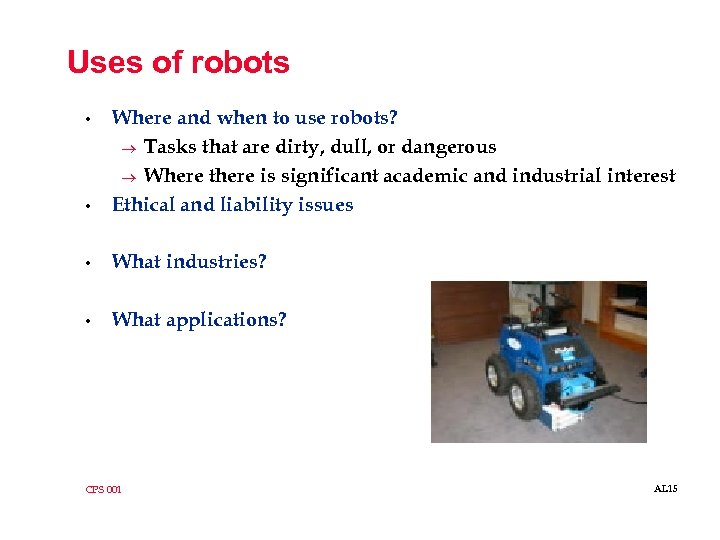 Uses of robots • Where and when to use robots? ® Tasks that are dirty, dull, or dangerous ® Where there is significant academic and industrial interest Ethical and liability issues • What industries? • What applications? • CPS 001 AI. 15
 Robots Good or Bad CPS 001 AI. 16
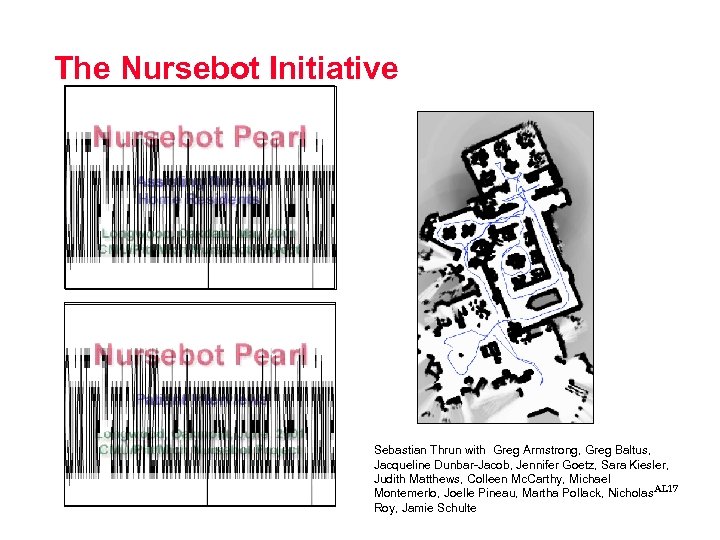 The Nursebot Initiative CPS 001 Sebastian Thrun with Greg Armstrong, Greg Baltus, Jacqueline Dunbar-Jacob, Jennifer Goetz, Sara Kiesler, Judith Matthews, Colleen Mc. Carthy, Michael Montemerlo, Joelle Pineau, Martha Pollack, Nicholas. AI. 17 Roy, Jamie Schulte
 Teleoperation • • • Remote control of robot manipulators Intermediate solution to tasks that currently could or should not be handled with autonomous robots Various levels of abstraction Issues ® Control latency ® Communication bandwidth ® Operator training Some definitions: ® Control system: arrangement of physics components connected or related in such a manner as to form and/or act as an entire unit ® Kinematics: the description or study of the geometry of motion ® Dynamics: the description or study of the forces that affect the motion of objects CPS 001 AI. 18
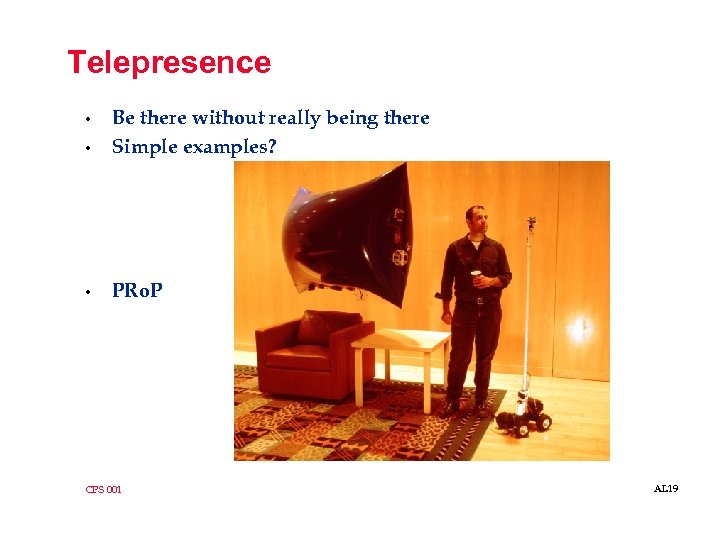 Telepresence • Be there without really being there Simple examples? • PRo. P • CPS 001 AI. 19