


 Скачать презентацию Articulatory phonetics consonants General organization of sounds
333333333 Articulatory phonetics (consonants).pptx
- Количество слайдов: 26
 Articulatory phonetics (consonants)
 General organization of sounds Four general classes of sounds in American English – Vowels, diphthongs, semivowels, and consonants – Each can be further divided according to articulators (manner, place)
 In terms of articulators, consonants can be described by – Place of articulation: Defines the place of contact between an active articulator (i. e. tongue) and a passive articulator (i. e. palate) – Manner of articulation: Concerned with airflow, the path it takes and the degree to which it is impeded – Voicing: Determined by the behavior of the vocal folds (vibrating vs. open)
![Place of articulation • Bilabial: constriction at the lips: [b], [m] – Labiodental: (губно-зубной)](https://present5.com/presentation/158102164_425426775/image-4.jpg "Place of articulation • Bilabial: constriction at the lips: [b], [m] – Labiodental: (губно-зубной)") Place of articulation • Bilabial: constriction at the lips: [b], [m] – Labiodental: (губно-зубной) Lower lips against upper teeth: [f], [v] • Interdentally: (межзубной) constriction between the teeth: [th] thing, [dh] that • Alveolar: (альвеолярный) constriction is at the alveolar ridge: [t], [n], [z] • Palatal-alveolar: (смег. Альвеолярной) constriction slightly behind alveolar ridge: [sh] sherry, [zh] measure
Place of articulation • Bilabial: constriction at the lips: [b], [m] – Labiodental: (губно-зубной) Lower lips against upper teeth: [f], [v] • Interdentally: (межзубной) constriction between the teeth: [th] thing, [dh] that • Alveolar: (альвеолярный) constriction is at the alveolar ridge: [t], [n], [z] • Palatal-alveolar: (смег. Альвеолярной) constriction slightly behind alveolar ridge: [sh] sherry, [zh] measure
![Place of articulation • Palatal: (небный) constriction in the hard palate: [jh] joke •](https://present5.com/presentation/158102164_425426775/image-5.jpg "Place of articulation • Palatal: (небный) constriction in the hard palate: [jh] joke •") Place of articulation • Palatal: (небный) constriction in the hard palate: [jh] joke • Velar: (велярный) constriction closer to the soft palate: [k], [ng] sing • Labiovelar: constriction both at lips and velum: [w] • Glottal: (голосовая шель) when closure occurs as far back as the glottis: glottal stop [], as in the negative utterance uh-uh • Uvular: (язычковый) constriction in the uvula; none in English, French /r/ in rouge
Place of articulation • Palatal: (небный) constriction in the hard palate: [jh] joke • Velar: (велярный) constriction closer to the soft palate: [k], [ng] sing • Labiovelar: constriction both at lips and velum: [w] • Glottal: (голосовая шель) when closure occurs as far back as the glottis: glottal stop [], as in the negative utterance uh-uh • Uvular: (язычковый) constriction in the uvula; none in English, French /r/ in rouge
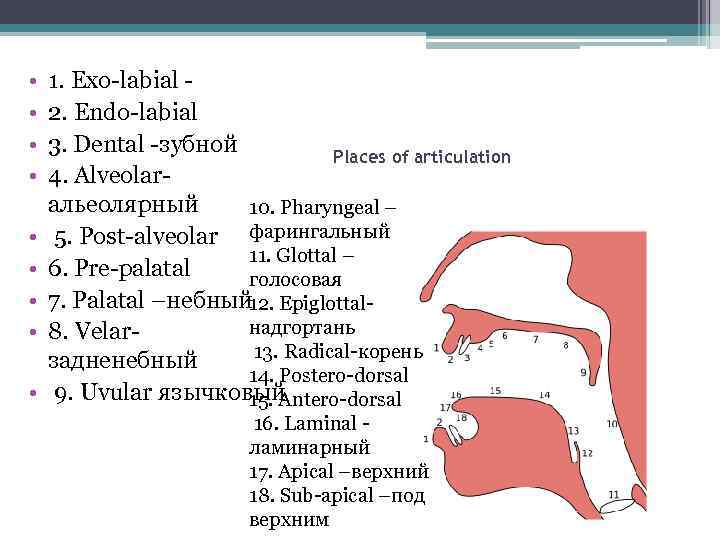 • • • 1. Exo-labial 2. Endo-labial 3. Dental -зубной Places of articulation 4. Alveolarальеолярный 10. Pharyngeal – 5. Post-alveolar фарингальный 11. Glottal – 6. Pre-palatal голосовая 7. Palatal –небный 12. Epiglottalнадгортань 8. Velar 13. Radical-корень задненебный 14. Postero-dorsal 9. Uvular язычковый 15. Antero-dorsal 16. Laminal ламинарный 17. Apical –верхний 18. Sub-apical –под верхним
![Manner of articulation • Stops: produced by complete stoppage of the airstream: [p] •](https://present5.com/presentation/158102164_425426775/image-7.jpg "Manner of articulation • Stops: produced by complete stoppage of the airstream: [p] •") Manner of articulation • Stops: produced by complete stoppage of the airstream: [p] • Fricatives: tongue comes very close to a full closure: [f], [sh] sherry • Affricatives: combination b/w stops and fricatives: cherry • Nasals: closed oral passage (as in stops), open nasal cavity: [n], [ng] sing • Approximants: halfway between consonants and vowels • Liquids: [l], [r] • Glides: [y], [w]
Manner of articulation • Stops: produced by complete stoppage of the airstream: [p] • Fricatives: tongue comes very close to a full closure: [f], [sh] sherry • Affricatives: combination b/w stops and fricatives: cherry • Nasals: closed oral passage (as in stops), open nasal cavity: [n], [ng] sing • Approximants: halfway between consonants and vowels • Liquids: [l], [r] • Glides: [y], [w]
 Voicing • When the vocal folds vibrate, it is voiced; otherwise it is voiceless • – Examples of voiceless/voiced: Sue vs. zoo, pat vs. bat
 Articulatory phonetics (vowels) Vowels can be described in a similar way • – Manner of articulation, just considered to be “vowel” • – Place of articulation is generally described with three major parameters: frontness, height, and roundness
 Frontness (or backness) • – Provides a general indication of the greatest place of constriction, and correlates with F 2 • – Three positions in English • Front: [iy] beat, [ih] bit, [eh] bet, [ae] bat • Central: “schwa” *ax+ about • Back: [uw] boot, [ao] bought, [ah] but, [aa] father
 Height – Refers to how far lower jaw is from upper jaw when making the vowel • High vowels have lower and upper jaw close: [iy], [uw] • Low vowels have a more open oral cavity: [ae], [aa] – Correlates with F 1 (high vowel: low F 1; low vowel: high F 1)
 Roundness – Refers to whether the lips have been rounded as opposed to spread – In English, front vowels are unrounded whereas back vowels are rounded: bit vs. boot
 Acoustic phonetics is concerned with – Time domain waveform of the speech signal, and – Its time-varying spectral characteristics
 Acoustic phonetics Visualizations of speech waveforms – Time-domain waveforms are rarely studied directly • This is because phase differences can significantly affect its shape but are rarely relevant for speech perception
 Acoustic phonetics Instead, frequency-domain signals are commonly used – The spectrum (log-magnitude) of a voiced phone shows two types of information • A comb-like structure, which represent the harmonics of F 0 (the source), • A broader envelope, which represents the resonances (formants) of the vocal tract filter Various techniques exist to separate the two sources of information • Linear prediction, homomorphic (cepstral) analysis …
 The spectrogram – Can be thought of as a moving spectrum over time – Typically represented as a 3 D graphic where • Horizontal dimension represents time, • Vertical dimension represents frequency, and • Color represents magnitude (typically in log scale)
 Two general types of spectrograms – Wideband • Computed over a short window of time (e. g. , 5 ms) • High temporal resolution, poor frequency resolution • Vertical striations represent individual pitch periods (for voiced phones)
 – Narrowband • Computed over a relatively large window of time (e. g. , 25 ms) • High frequency resolution, poor temporal resolution
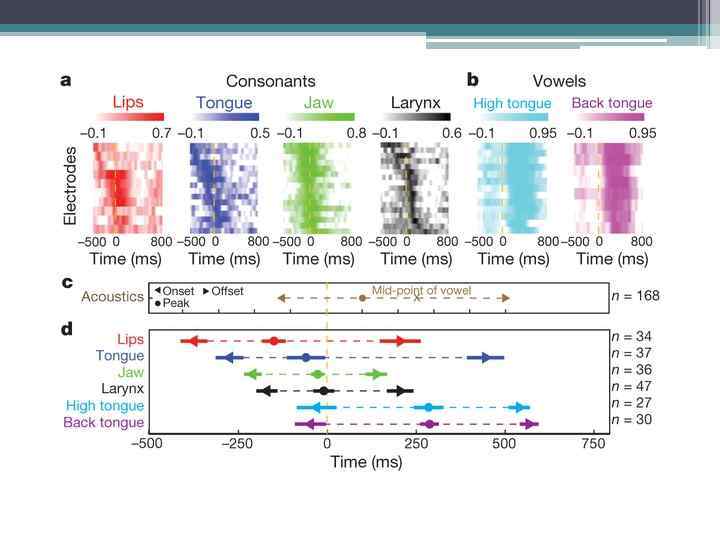
 Vowels – The largest phoneme group and most interesting one • Carry little information in written speech, but most ASR systems rely heavily on them for performance – Vowels are voiced (except when whispered) and have the greatest intensity and duration in the range of 50 to 400 ms – Vowels are distinguished mainly by their first three formants • However, there is a significant individual variability, so other cues can be employed for discrimination (upper formants, bandwidths)
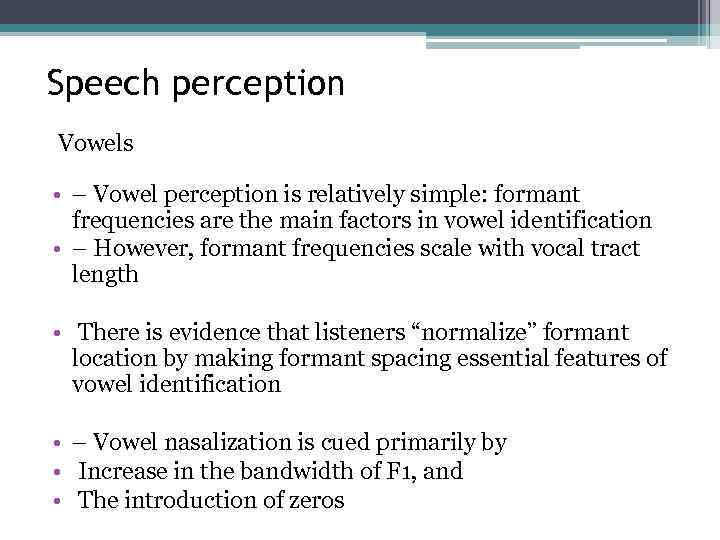 Speech perception Vowels • – Vowel perception is relatively simple: formant frequencies are the main factors in vowel identification • – However, formant frequencies scale with vocal tract length • There is evidence that listeners “normalize” formant location by making formant spacing essential features of vowel identification • – Vowel nasalization is cued primarily by • Increase in the bandwidth of F 1, and • The introduction of zeros
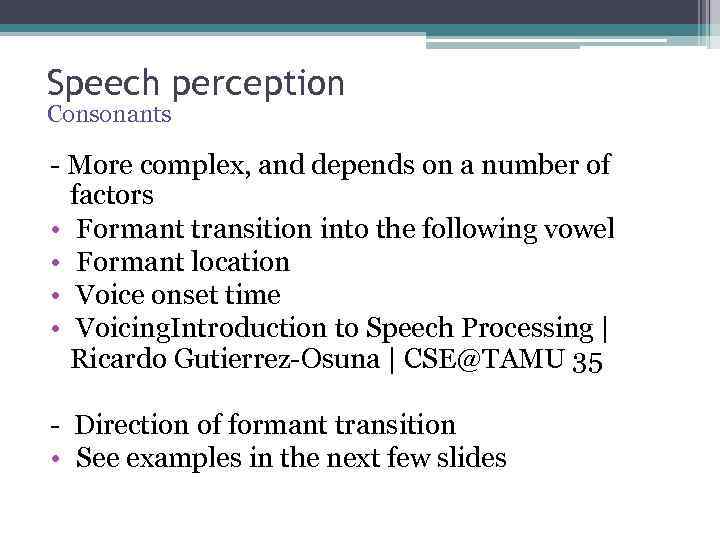 Speech perception Consonants - More complex, and depends on a number of factors • Formant transition into the following vowel • Formant location • Voice onset time • Voicing. Introduction to Speech Processing | Ricardo Gutierrez-Osuna | CSE@TAMU 35 - Direction of formant transition • See examples in the next few slides
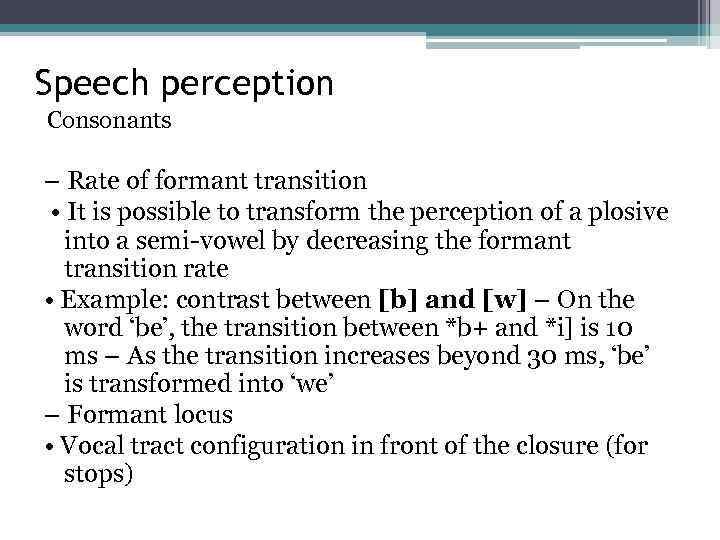 Speech perception Consonants – Rate of formant transition • It is possible to transform the perception of a plosive into a semi-vowel by decreasing the formant transition rate • Example: contrast between [b] and [w] – On the word ‘be’, the transition between *b+ and *i] is 10 ms – As the transition increases beyond 30 ms, ‘be’ is transformed into ‘we’ – Formant locus • Vocal tract configuration in front of the closure (for stops)
 Speech perception Consonants • Voice onset time (VOT) • Length of time between release of a closure and the start of voicing • Critical for the perception of stop consonants • Example: contrast between [t] and [d] • On the word ‘do’, segment the sound *d+ and increase the delay wrt [o] • When VOT exceeds about 25 ms, the word is perceived as ‘to
![Задания 1. Дайте описания следующих согласных [s], [m], [v], [h] 2. Приведите примеры слова](https://present5.com/presentation/158102164_425426775/image-25.jpg "Задания 1. Дайте описания следующих согласных [s], [m], [v], [h] 2. Приведите примеры слова") Задания 1. Дайте описания следующих согласных [s], [m], [v], [h] 2. Приведите примеры слова содержащего этот звук a) глухой, губно-губной, неаспирированный, взрывной, b) Звонкий, альвеолярный, взрывной, c) Боковой аппроксимант, d) Велярный носовой, e) Звонкий, зубной, фрикаивный, f) Глухой, аспирированный , альвеолярный , взрывной. 3 Назовите общие черты объдиняюшие следующие согласные a. [h], [b], [m] b. [g], [p], [t], [d], [k], [b] c. [t], [s], [p], [k], [f], d. [v], [z], [n], [g], [d], [b], [l], [r], [w] e. [t], [d], [s], [l], [n]
Задания 1. Дайте описания следующих согласных [s], [m], [v], [h] 2. Приведите примеры слова содержащего этот звук a) глухой, губно-губной, неаспирированный, взрывной, b) Звонкий, альвеолярный, взрывной, c) Боковой аппроксимант, d) Велярный носовой, e) Звонкий, зубной, фрикаивный, f) Глухой, аспирированный , альвеолярный , взрывной. 3 Назовите общие черты объдиняюшие следующие согласные a. [h], [b], [m] b. [g], [p], [t], [d], [k], [b] c. [t], [s], [p], [k], [f], d. [v], [z], [n], [g], [d], [b], [l], [r], [w] e. [t], [d], [s], [l], [n]
![Задания 1. [s]- альвеолярный, фрикативный, сильный глухой , 2. [m]-губной фрикативный слабый звонкий ,](https://present5.com/presentation/158102164_425426775/image-26.jpg "Задания 1. [s]- альвеолярный, фрикативный, сильный глухой , 2. [m]-губной фрикативный слабый звонкий ,") Задания 1. [s]- альвеолярный, фрикативный, сильный глухой , 2. [m]-губной фрикативный слабый звонкий , 3. [v]- губно-зубной фрикативный , [h]-глотальный 4. Приведите примеры слова содержащего этот звук a) глухой, губно-губной, неаспирированный, взрывной, - stop b) Звонкий, альвеолярный, взрывной, - day c) Боковой аппроксимант, -lake d) Велярный носовой, -wrong e) Звонкий, зубной, фрикаивный, this f) Глухой, аспирированный , альвеолярный , взрывной. tea 3 Назовите общие черты объдиняюшие следующие согласные a. [h], [b], [m] b. [g], [p], [t], [d], [k], [b] c. [t], [s], [p], [k], [f], d. [v], [z], [n], [g], [d], [b], [l], [r], [w] e. [t], [d], [s], [l], [n] все губно-губные, взрывные, альвеолярные, велярные.
Задания 1. [s]- альвеолярный, фрикативный, сильный глухой , 2. [m]-губной фрикативный слабый звонкий , 3. [v]- губно-зубной фрикативный , [h]-глотальный 4. Приведите примеры слова содержащего этот звук a) глухой, губно-губной, неаспирированный, взрывной, - stop b) Звонкий, альвеолярный, взрывной, - day c) Боковой аппроксимант, -lake d) Велярный носовой, -wrong e) Звонкий, зубной, фрикаивный, this f) Глухой, аспирированный , альвеолярный , взрывной. tea 3 Назовите общие черты объдиняюшие следующие согласные a. [h], [b], [m] b. [g], [p], [t], [d], [k], [b] c. [t], [s], [p], [k], [f], d. [v], [z], [n], [g], [d], [b], [l], [r], [w] e. [t], [d], [s], [l], [n] все губно-губные, взрывные, альвеолярные, велярные.