


 Скачать презентацию Articles and Determiners UNIT 4 26 01 2009 New Headway
fdc313531850bd2c099e4aedc7d064c8.ppt
- Количество слайдов: 10
 Articles and Determiners UNIT 4 26/01/2009 New Headway, Unit 4 1
 SOME / ANY / NO / MUCH / MANY Some means ‘a certain (not large) number or amount of’. Some is used mostly in affirmative sentences. We also use some in requests when we expect people to say ‘Yes’ (for example in request and offers. ) (p 162 Good Grammar Book) Examples: She has some good DVDs at home. Could I have some sugar, please? Would you like some coffee? 26/01/2009 New Headway, Unit 4 2
 SOME / ANY / NO / MUCH / MANY We use any instead of some in negative sentences, in most questions, with if, and with words like never, hardly, without, refuse, doubt (which have a negative kind of meaning) (pp 163 -164 Good Grammar Book) Examples: There isn’t any milk. . If you find any mistakes, tell me? We arrived without any difficulties 26/01/2009 New Headway, Unit 4 3
 SOME / ANY / NO / MUCH / MANY We use some /any to talk about indefinite, not very large numbers or amounts – when we don’t know, care or say exactly how much/many. We use no article when we are thinking about unlimited numbers or amounts, or not thinking about numbers/ amounts. We do not use some/any when it is clear exactly how much / many. (p 166 Good Grammar Book) Examples: I planted some roses in the garden. I like roses. 26/01/2009 New Headway, Unit 4 4
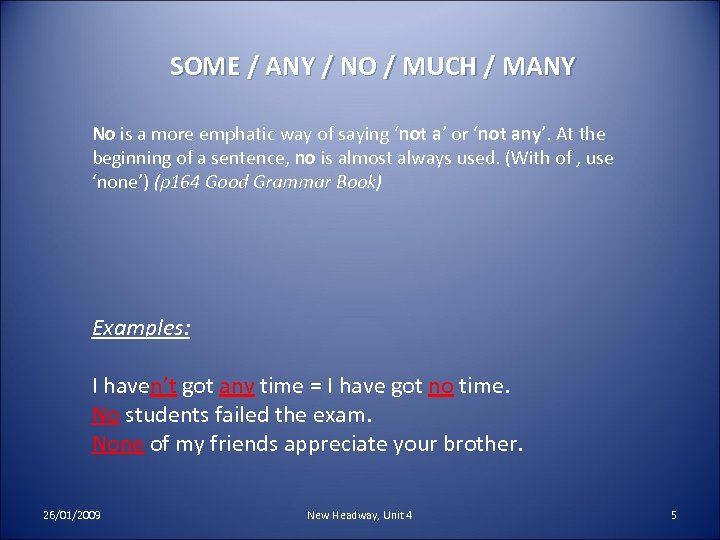 SOME / ANY / NO / MUCH / MANY No is a more emphatic way of saying ‘not a’ or ‘not any’. At the beginning of a sentence, no is almost always used. (With of , use ‘none’) (p 164 Good Grammar Book) Examples: I haven’t got any time = I have got no time. No students failed the exam. None of my friends appreciate your brother. 26/01/2009 New Headway, Unit 4 5
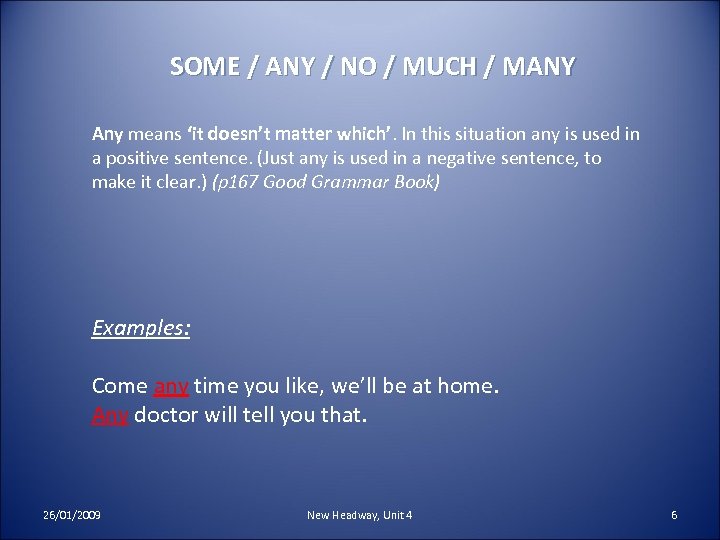 SOME / ANY / NO / MUCH / MANY Any means ‘it doesn’t matter which’. In this situation any is used in a positive sentence. (Just any is used in a negative sentence, to make it clear. ) (p 167 Good Grammar Book) Examples: Come any time you like, we’ll be at home. Any doctor will tell you that. 26/01/2009 New Headway, Unit 4 6
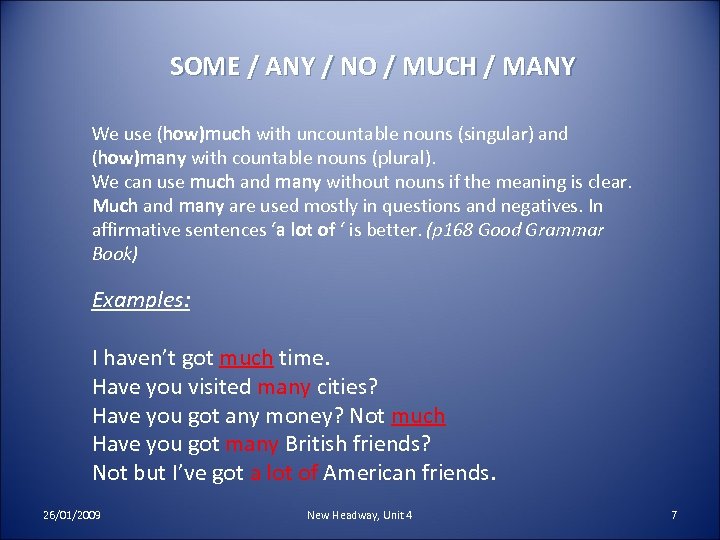 SOME / ANY / NO / MUCH / MANY We use (how)much with uncountable nouns (singular) and (how)many with countable nouns (plural). We can use much and many without nouns if the meaning is clear. Much and many are used mostly in questions and negatives. In affirmative sentences ‘a lot of ‘ is better. (p 168 Good Grammar Book) Examples: I haven’t got much time. Have you visited many cities? Have you got any money? Not much Have you got many British friends? Not but I’ve got a lot of American friends. 26/01/2009 New Headway, Unit 4 7
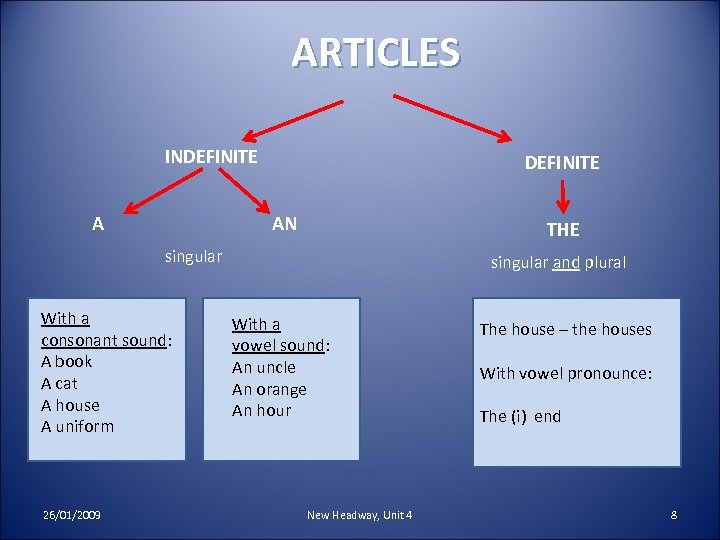 ARTICLES INDEFINITE AN THE singular With a consonant sound: A book A cat A house A uniform 26/01/2009 singular and plural With a vowel sound: An uncle An orange An hour New Headway, Unit 4 The house – the houses With vowel pronounce: The (i) end 8
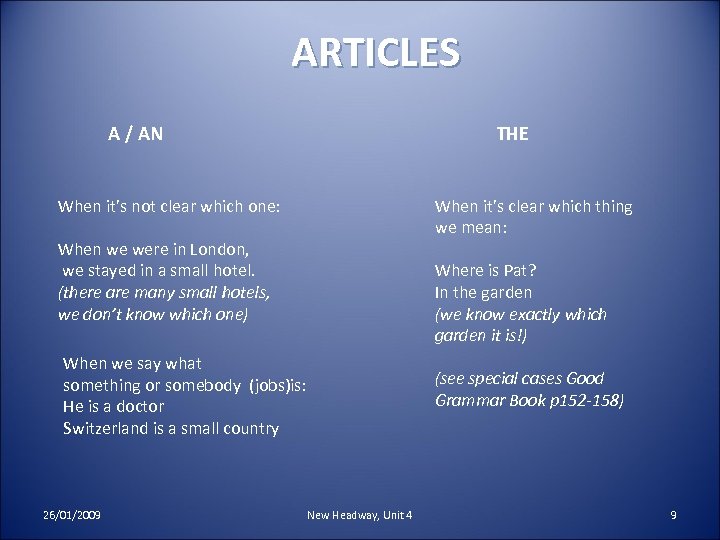 ARTICLES A / AN THE When it’s not clear which one: When it’s clear which thing we mean: When we were in London, we stayed in a small hotel. (there are many small hotels, we don’t know which one) Where is Pat? In the garden (we know exactly which garden it is!) When we say what something or somebody (jobs)is: He is a doctor Switzerland is a small country 26/01/2009 (see special cases Good Grammar Book p 152 -158) New Headway, Unit 4 9
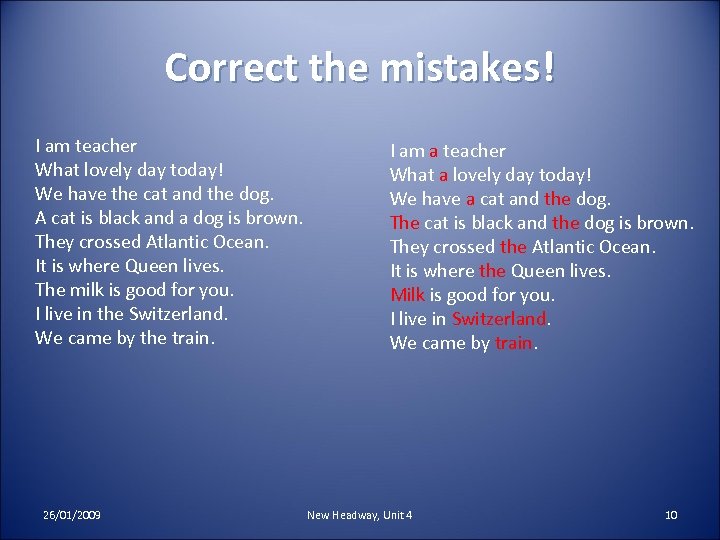 Correct the mistakes! I am teacher What lovely day today! We have the cat and the dog. A cat is black and a dog is brown. They crossed Atlantic Ocean. It is where Queen lives. The milk is good for you. I live in the Switzerland. We came by the train. 26/01/2009 I am a teacher What a lovely day today! We have a cat and the dog. The cat is black and the dog is brown. They crossed the Atlantic Ocean. It is where the Queen lives. Milk is good for you. I live in Switzerland. We came by train. New Headway, Unit 4 10