 Скачать презентацию Array Express a public database for microarray
0f21a5e38417823f181eb5a1885cdd4b.ppt
- Количество слайдов: 35



Array. Express – a public database for microarray gene expression data Helen Parkinson Microarray Informatics Team European Bioinformatics Institute Transcriptome 2002, Seattle The European Bioinformatics Institute
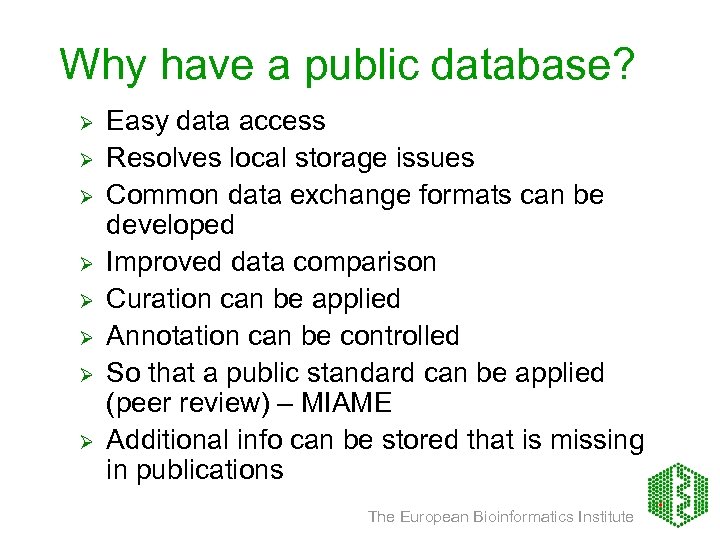
Why have a public database? Ø Ø Ø Ø Easy data access Resolves local storage issues Common data exchange formats can be developed Improved data comparison Curation can be applied Annotation can be controlled So that a public standard can be applied (peer review) – MIAME Additional info can be stored that is missing in publications The European Bioinformatics Institute
Or, to put it another way “…to encourage and empower biologists to provide results in a structured and computable format alongside publication” Mark Boguski The European Bioinformatics Institute
Talk structure MIAME standard Ø Sample description and annotation Ontologies Ø Array. Express Ø Submission and annotation tool Ø The future Ø The European Bioinformatics Institute
Problems of microarray data analysis Ø Ø Ø Size of the datasets Different platforms - nylon, glass Different technologies on platformsoligo/spotted Ø Ø Referencing external databases which are not stable Sample annotation Array annotation Need for LIMS systems and the need for bioinformaticians The European Bioinformatics Institute
Standardisation of microarray data and annotations -MGED group The goal of the group is to facilitate the adoption of standards for DNA-array experiment annotation and data representation, as well as the introduction of standard experimental controls and data normalisation methods. www. mged. org Includes most of the worlds largest microarray laboratories and companies (TIGR, Affymetrix, Stanford, Sanger, Agilent, Rosetta, etc) The European Bioinformatics Institute
Glossary MIAME is a standard Ø MAGE-OM is an object model Ø Array. Express is a database implementation which uses that model Ø MAGE-ML is a mark-up language auto generated from MAGE-OM Ø MIAMExpress is a tool for generating data in MAGE-ML format Ø The European Bioinformatics Institute
General MIAME principles Ø Recorded info should be sufficient to interpret and replicate the experiment Ø Information should be structured so that querying and automated data analysis and mining are feasible Brazma et al, . Nature Genetics, 2001 The European Bioinformatics Institute
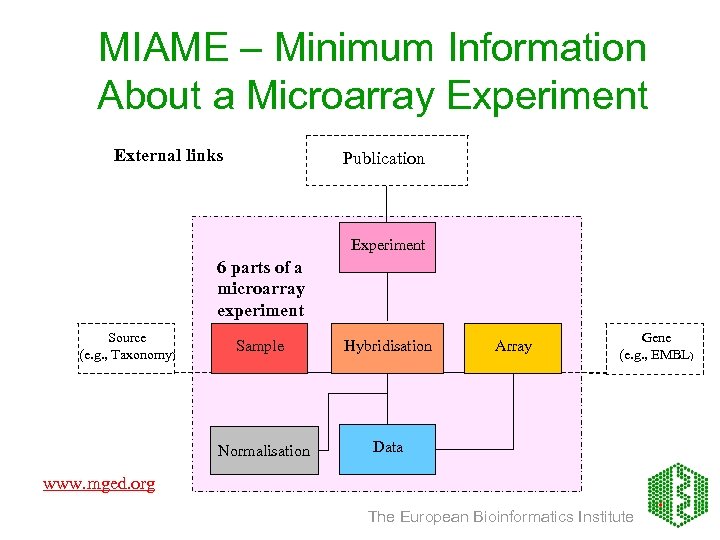
MIAME – Minimum Information About a Microarray Experiment External links Publication Experiment 6 parts of a microarray experiment Source (e. g. , Taxonomy) Sample Hybridisation Normalisation Array Gene (e. g. , EMBL) Data www. mged. org The European Bioinformatics Institute
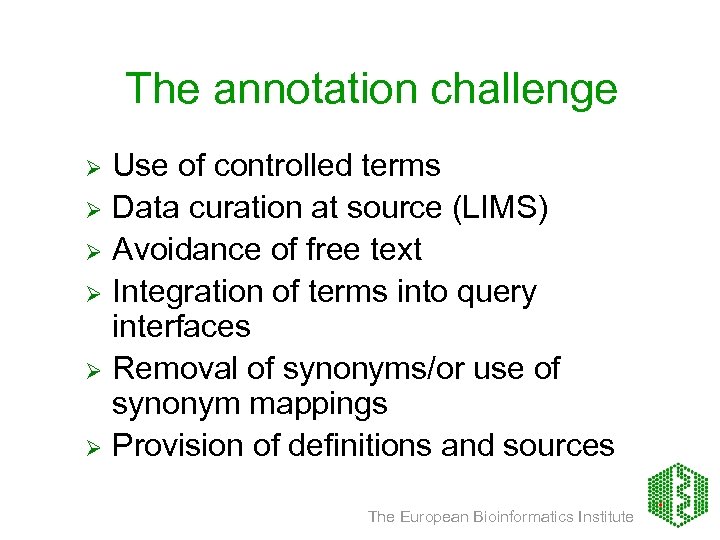
The annotation challenge Use of controlled terms Ø Data curation at source (LIMS) Ø Avoidance of free text Ø Integration of terms into query interfaces Ø Removal of synonyms/or use of synonym mappings Ø Provision of definitions and sources Ø The European Bioinformatics Institute
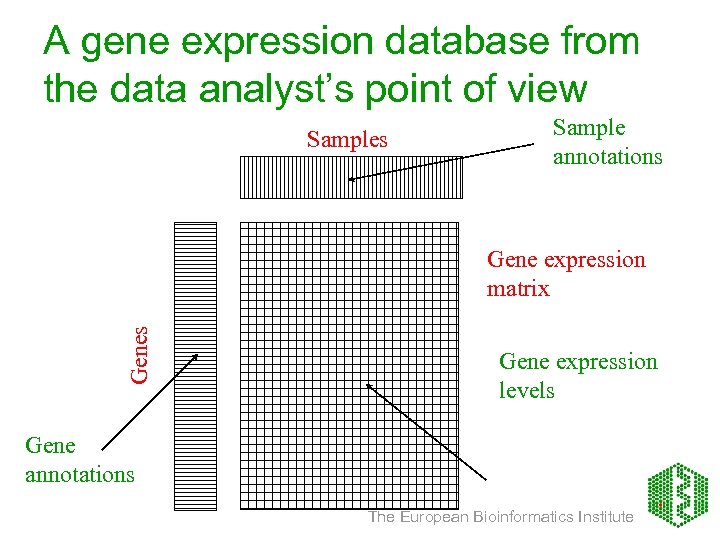
A gene expression database from the data analyst’s point of view Samples Sample annotations Gene expression matrix Gene expression levels Gene annotations The European Bioinformatics Institute
Gene Annotation Ø Ø Can be given by links to gene sequence databases and GO can be used on the analysis side MIAME is flexible, allows many kinds of sequence identifiers or even sequence itself In some cases it’s more useful to include a real sequence than an inaccurate id Submitters are encourage to submit seqs to public databases The European Bioinformatics Institute
Sample annotation Ø Ø Gene expression data only have meaning in the context of detailed sample descriptions If the data is going to be interpreted by independent parties, sample information has to be searchable and in the database Controlled vocabularies and ontologies (species, cell types, compound nomenclature, treatments, etc) are needed for unambiguous sample description These resources need mapping The European Bioinformatics Institute
What Does an Ontology Do? Captures knowledge Ø Creates a shared understanding – between humans and for computers Ø Makes knowledge machine processable Ø Makes meaning explicit – by definition and context Ø It is more than a controlled vocabulary Ø From Building and Using Ontologies, Robert Stevens, U. of Manchester
Examples of usable external ontologies Ø Ø Ø Ø NCBI taxonomy database Jackson Lab mouse strains and genes Edinburgh mouse atlas anatomy HUGO nomenclature for Human genes Chemical and compound Ontologies TAIR Flybase GO (www. geneontology. org) The European Bioinformatics Institute
Sample annotation- what can be done? Ø Ø Ø Build an ontology for gene expression data (MGED) Incorporate the ontology into the database and tools Use existing ontologies Develop internal editing tools for the ontology Develop browser or other interface for the ontology and link to LIMS Some use of free text descriptions are unavoidable (curation workload) The European Bioinformatics Institute
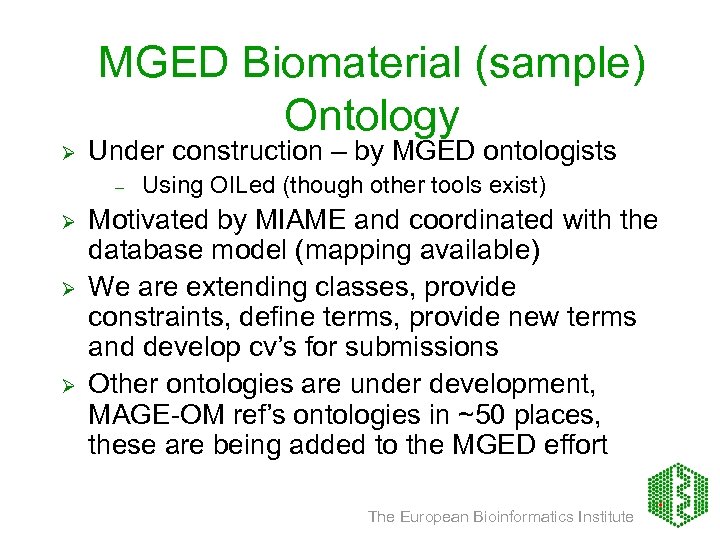
MGED Biomaterial (sample) Ontology Ø Under construction – by MGED ontologists – Ø Ø Ø Using OILed (though other tools exist) Motivated by MIAME and coordinated with the database model (mapping available) We are extending classes, provide constraints, define terms, provide new terms and develop cv’s for submissions Other ontologies are under development, MAGE-OM ref’s ontologies in ~50 places, these are being added to the MGED effort The European Bioinformatics Institute
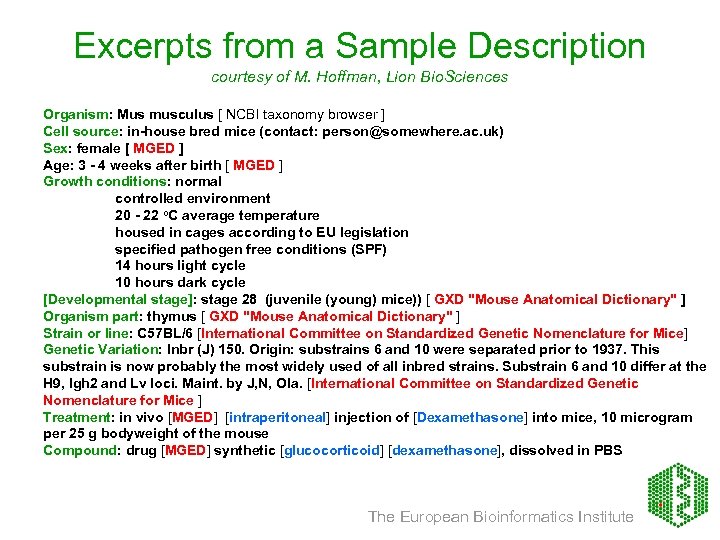
Excerpts from a Sample Description courtesy of M. Hoffman, Lion Bio. Sciences Organism: Mus musculus [ NCBI taxonomy browser ] Cell source: in-house bred mice (contact: person@somewhere. ac. uk) Sex: female [ MGED ] Age: 3 - 4 weeks after birth [ MGED ] Growth conditions: normal controlled environment 20 - 22 o. C average temperature housed in cages according to EU legislation specified pathogen free conditions (SPF) 14 hours light cycle 10 hours dark cycle [Developmental stage]: stage 28 (juvenile (young) mice)) [ GXD "Mouse Anatomical Dictionary" ] Organism part: thymus [ GXD "Mouse Anatomical Dictionary" ] Strain or line: C 57 BL/6 [International Committee on Standardized Genetic Nomenclature for Mice] Genetic Variation: Inbr (J) 150. Origin: substrains 6 and 10 were separated prior to 1937. This substrain is now probably the most widely used of all inbred strains. Substrain 6 and 10 differ at the H 9, Igh 2 and Lv loci. Maint. by J, N, Ola. [International Committee on Standardized Genetic Nomenclature for Mice ] Treatment: in vivo [MGED] [intraperitoneal] injection of [Dexamethasone] into mice, 10 microgram per 25 g bodyweight of the mouse Compound: drug [MGED] synthetic [glucocorticoid] [dexamethasone], dissolved in PBS The European Bioinformatics Institute
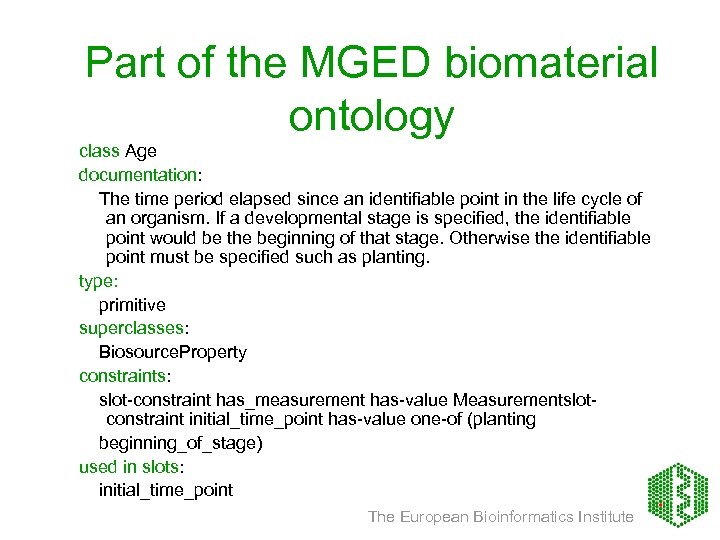
Part of the MGED biomaterial ontology class Age documentation: The time period elapsed since an identifiable point in the life cycle of an organism. If a developmental stage is specified, the identifiable point would be the beginning of that stage. Otherwise the identifiable point must be specified such as planting. type: primitive superclasses: Biosource. Property constraints: slot-constraint has_measurement has-value Measurementslotconstraint initial_time_point has-value one-of (planting beginning_of_stage) used in slots: initial_time_point The European Bioinformatics Institute
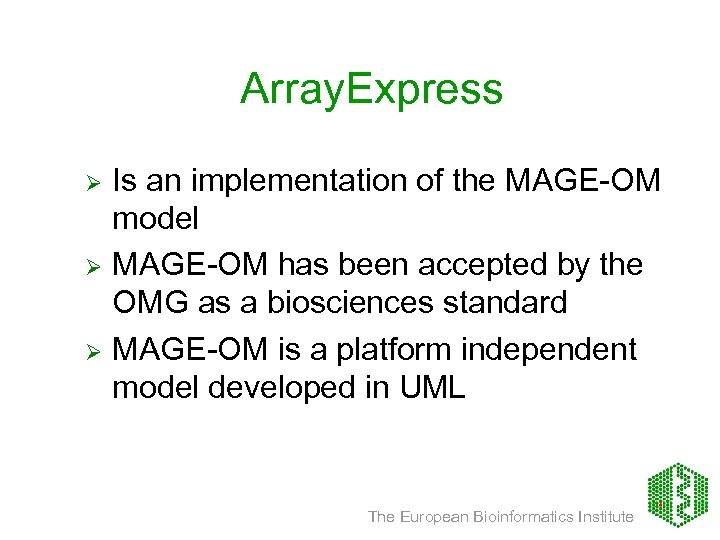
Array. Express Is an implementation of the MAGE-OM model Ø MAGE-OM has been accepted by the OMG as a biosciences standard Ø MAGE-OM is a platform independent model developed in UML Ø The European Bioinformatics Institute
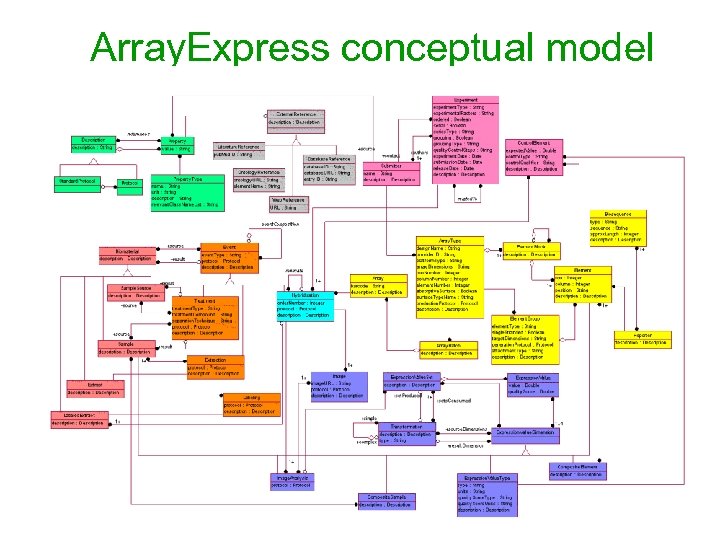
Array. Express conceptual model Publication External links Experiment Source (e. g. , Taxonomy) Sample Normalisation Hybridisation Array Gene (e. g. , EMBL) Data The European Bioinformatics Institute
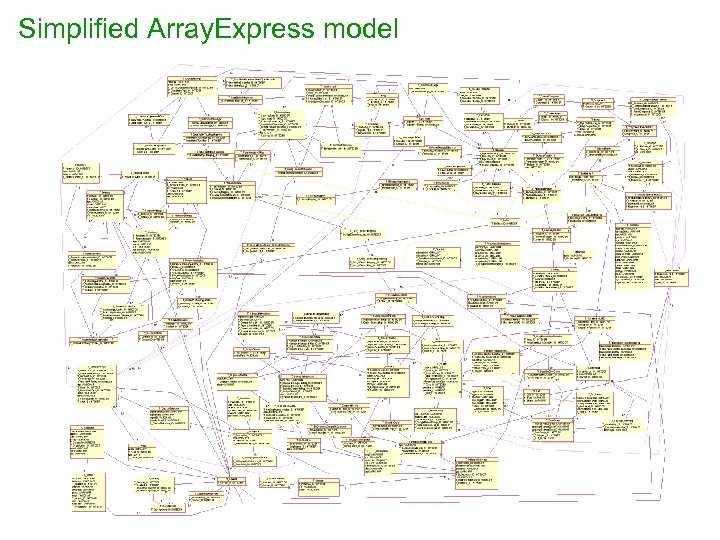
Simplified Array. Express model The European Bioinformatics Institute
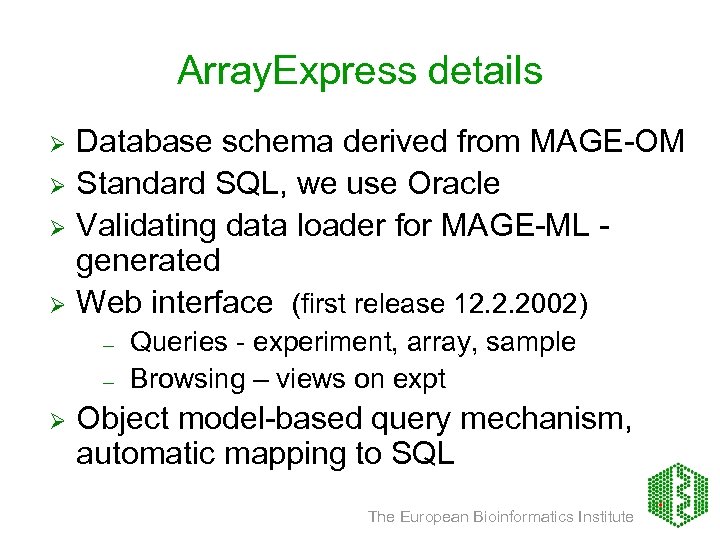
Array. Express details Database schema derived from MAGE-OM Ø Standard SQL, we use Oracle Ø Validating data loader for MAGE-ML generated Ø Web interface (first release 12. 2. 2002) Ø – – Ø Queries - experiment, array, sample Browsing – views on expt Object model-based query mechanism, automatic mapping to SQL The European Bioinformatics Institute
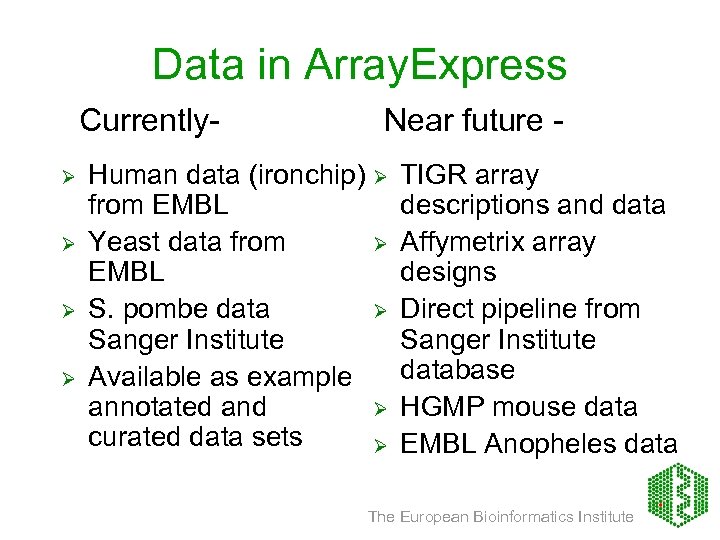
Data in Array. Express CurrentlyØ Ø Near future - Human data (ironchip) Ø from EMBL Yeast data from Ø EMBL S. pombe data Ø Sanger Institute Available as example annotated and Ø curated data sets Ø TIGR array descriptions and data Affymetrix array designs Direct pipeline from Sanger Institute database HGMP mouse data EMBL Anopheles data The European Bioinformatics Institute
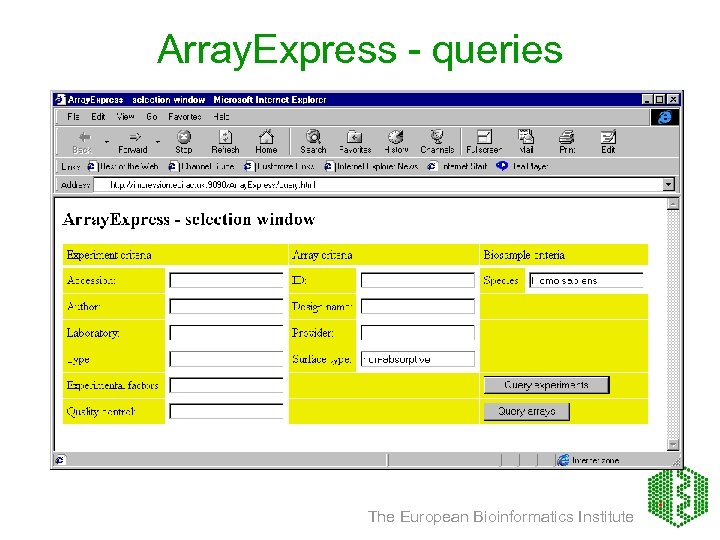
Array. Express - queries The European Bioinformatics Institute
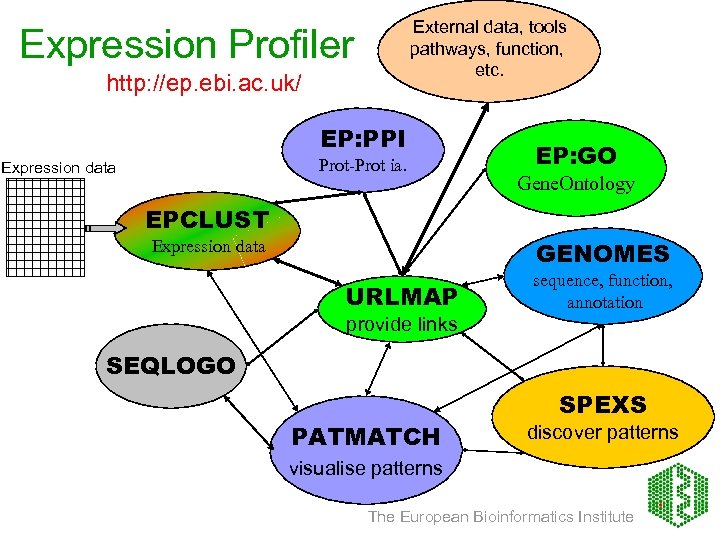
External data, tools pathways, function, etc. Expression Profiler http: //ep. ebi. ac. uk/ EP: PPI Prot-Prot ia. Expression data EP: GO Gene. Ontology EPCLUST Expression data GENOMES URLMAP sequence, function, annotation provide links SEQLOGO PATMATCH SPEXS discover patterns visualise patterns The European Bioinformatics Institute
Array. Express curation effort User support and help documentation Ø Curation at source (not destination) Ø Support on ontologies and CV’s Ø Minimize free text, removal of synonyms Ø MIAME encouragement Ø Help on MAGE-ML Ø Goal: to provide high-quality, wellannotated data to allow automated data analysis Ø The European Bioinformatics Institute
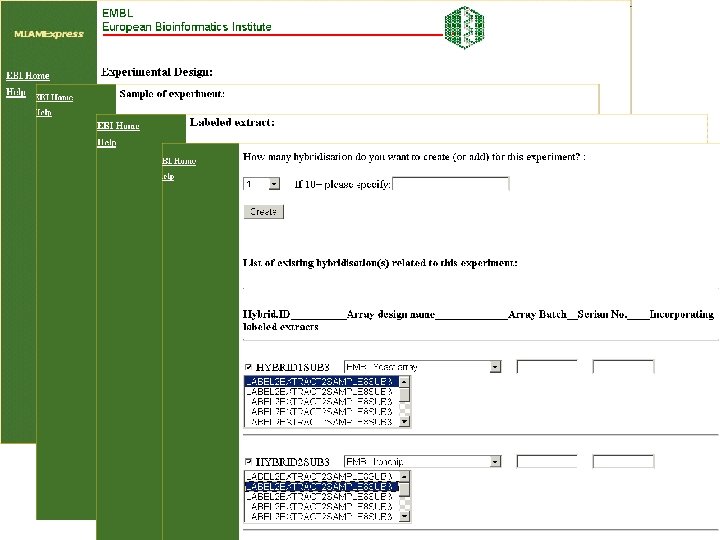
Data Submission routes Ø Via MAGE-ML generated from a local database, (array, protocol and experiment submissions) Ø Via MIAMExpress, a MIAME compliant data annotation tool (array, protocol and experiment submissions) The European Bioinformatics Institute
MIAMExpress submission and annotation tool Ø Ø Ø Ø Based on MIAME concepts and questionnaire Experiment, Array, Protocol submissions Uses CV/Ontology wherever possible Future versions organism specific pages and related linked ontologies Allows user driven ontology development Will be developed according to user needs Can be used as an update tool Can be used as basis of LIMS The European Bioinformatics Institute
The European Bioinformatics Institute
Expected Users with limited local bioinformatics support Ø Users of bought in arrays without LIMS Ø Small scale users with self made arrays who will need to provide a description Ø Commercial array descriptions will be provided Ø The European Bioinformatics Institute
MIAMExpress future developments Ø Ø Ø Ø Species and domain specific pages and ontologies, ontology development Life-span of data submissions is long Integrated curation control, submissions tracking Full compatibility with Array. Express Full MAGE-OM, data updating Usability, flexibility, scalability, platform independence User needs, free in-house installation The European Bioinformatics Institute
Array. Express Future Ø Ø Ø Loading of public data in MAGE-ML format (TIGR, EMBL, DESPRAD partners) into Array. Express V 2. 0 MIAMExpress, the Key. Largo. Express Improved query interfaces Further ontology development and integration into tools Curation tools Join MGED www. mged. org The European Bioinformatics Institute
Resources Schemas for both Array. Express and MIAMExpress, access to code Ø Annotation examples in MAGE-ML Ø MIAME glossary, MAGE-MIAME-ontology mappings Ø List of ontology resources from MGED pages Ø MAGE-OM tutorials at MGED meetings Ø MAGE-OM support for submitters from EBI Ø MAGE-stk API’s www. mged. org www. ebi. ac. uk/microarray Ø The European Bioinformatics Institute
Acknowledgments Microarray Informatics Team, EBI Ø Chris Stoeckert, U. Penn. Ø Members of MGED Ø Sanger Institute - Rob Andrews, Jurg Bahler, Adam Butler, Kate Rice, Ø EMBL Heidelberg - Wilhelm Ansorge, Martina Muckenthaler, Thomas Preiss Ø The European Bioinformatics Institute
Скачать презентацию Array Express a public database for microarray
0f21a5e38417823f181eb5a1885cdd4b.ppt