 Скачать презентацию Arlington County RACES Basic Operator Course Unit 4
bf847713484d8d1dfbe83e0bc33978ce.ppt
- Количество слайдов: 61



Arlington County RACES Basic Operator Course Unit 4 Copyright (c) 2006 VA RACES, Inc. All rights reserved. Personal and Family Preparedness, Equipment Recommendations 1
All Rights Reserved – VA RACES Inc. All Original Materials Copyright Virginia RACES, Inc. - All Rights Reserved. The entire contents on this electronic media may be re-distributed without fee or charge for non-profit organization or governmental use under the following conditions: (i) no charge may be made for the contents, (ii) no charge made be made for viewing or use of the contents, (iii) public performance is strictly prohibited, and (iv) none of the contents may be re-branded, extracted in part, disassembled nor re-assembled, by any means nor by any manner. Redistribution hereunder does not impute change in ownership, right or title to this copyrighted work. The exclusive copyright owner is: Virginia RACES, Inc.
OBJECTIVES § § § Family preparedness steps RACES member preparedness Frequency plans and coordination When to use simplex vs repeaters Recommended RACES Equipment – 3 “Levels” -- “ 24 -Hr Pack” for deployments – Rigs and antennas for portable, mobile, remote – Auxiliary power - battery, generator, solar § Share Lessons Learned 3
Prevent “A Disaster” from Becoming “YOUR” Disaster” through Planning and Preparedness! • Every community is affected by disasters! • Remember that Family Comes First! • Your family must be self-reliant • After you have planned, so they are prepared / self-reliant, you will know they’ll be OK. • Then, you can concentrate on doing your job!
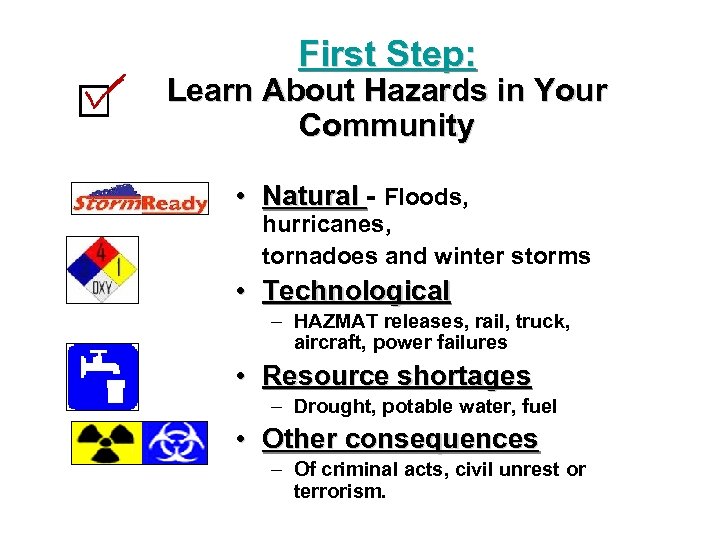
First Step: Learn About Hazards in Your Community • Natural - Floods, hurricanes, tornadoes and winter storms • Technological – HAZMAT releases, rail, truck, aircraft, power failures • Resource shortages – Drought, potable water, fuel • Other consequences – Of criminal acts, civil unrest or terrorism.
Next step Obtain basic knowledge to enable you to cope with known hazards • Where are community emergency shelters located? • What are the recommended evacuation routes? • Who would you call? For help or to let family members know where you are and that you are OK. • Where would family members meet if
Third Step Develop your family disaster plan Two Safe meeting places: • “Nearby Neighborhood Refuge” – Neighbor within walking distance • Safe for children to go when you aren’t home • To meet and account for everyone after a fire • “Farther Away Friend” within driving distance – As an alternative to a public shelter – “Out of Area Contact, ” If family members become separated, this party agrees to
Family Disaster Plan (continued) In case of evacuation, ensure that family members know how: • To shut off electricity at the main circuit breaker or fuse box. • To shut off water at the main valve. • To shut off gas at the meter or pipe into the house, or at LP tanks. • (By showing them, and labeling the valves and circuit breakers. )
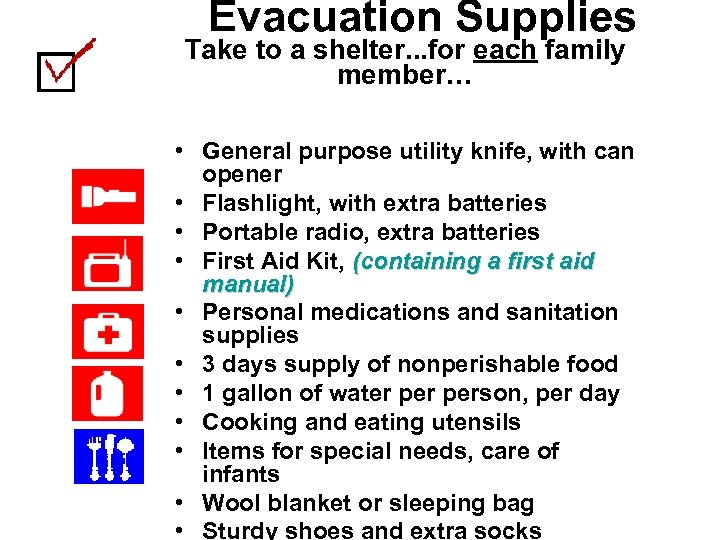
Evacuation Supplies Take to a shelter. . . for each family member… • General purpose utility knife, with can opener • Flashlight, with extra batteries • Portable radio, extra batteries • First Aid Kit, (containing a first aid manual) • Personal medications and sanitation supplies • 3 days supply of nonperishable food • 1 gallon of water person, per day • Cooking and eating utensils • Items for special needs, care of infants • Wool blanket or sleeping bag • Sturdy shoes and extra socks
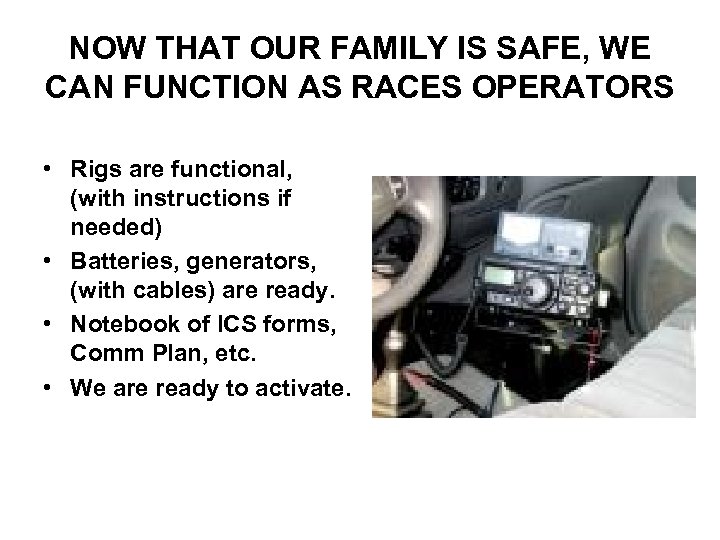
NOW THAT OUR FAMILY IS SAFE, WE CAN FUNCTION AS RACES OPERATORS • Rigs are functional, (with instructions if needed) • Batteries, generators, (with cables) are ready. • Notebook of ICS forms, Comm Plan, etc. • We are ready to activate.
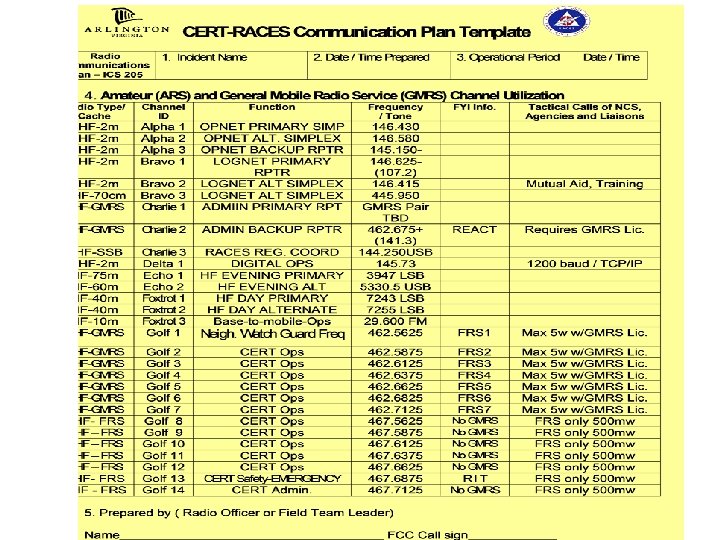
Communications Plans • SIMPLEX in “most cases” is ROUTINE – Repeater use as BACKUP, not primary BACKUP – Only if wide area coverage is needed • ESTABLISH LOCAL FREQUENCY PLANS – Contingency plans for operations – Anticipates storm-related repeater loss – Test regularly in exercises • Use ICS FORM 205 Comm. Plan Template – Pre-program rigs to a standard list
WHY DO WE NEED SIMPLEX? Essential for local RACES / CERT Communications • Reduce congestion on OPERATIONS net, • Repeater loss due to storm damage • AC power failure, depleted battery backup • Don't tie up a repeater for local activities • Use scheduled nets as drill opportunities • Simplex is ideal for localized events
Teach Simplex Awareness • • TEACH what the ‘reverse’ button is for DON’T hog a “machine” for rag chews DO USE the repeater for initial contact THEN. . . LISTEN to the input THEN IF both stations have good copy… THEN change to simplex, but. . PLEASE. . . respect the band plan!
Become Familiar with Appropriate SIMPLEX VOICE FREQUENCIES • Regional simplex frequency plans are not “coordinated, ” but “gentleman’s agreement” • Reduce interference during local operations • Please relinquish them for RACES ops • Normal amateur use is actively ENCOURAGED at all other times • Establish listening watch for preparedness
Observe band plans – Use standard channelization – Reduce adjacent channel interference – Routine use, drills, non- emergency ops – Pre-assigned frequencies for local ops – Assignments in exception to approved band plans should be made during declared emergencies only.
2 m Band Plans T-MARC / SERA • No FM below 144. 500 MHz! – No digital in simplex voice sub-bands! • Standard channelization: – Thirteen 15 k. Hz Channels 146. 415 -146. 595 – Twelve 15 k. Hz. Channels 147. 42 -147. 585
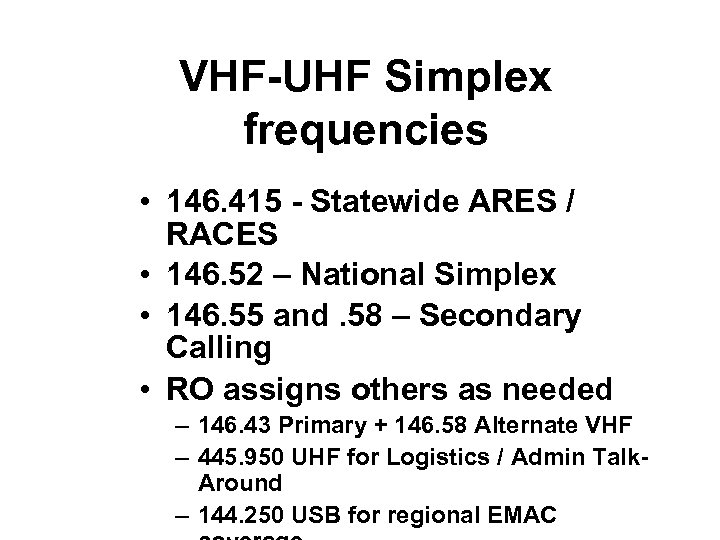
VHF-UHF Simplex frequencies • 146. 415 - Statewide ARES / RACES • 146. 52 – National Simplex • 146. 55 and. 58 – Secondary Calling • RO assigns others as needed – 146. 43 Primary + 146. 58 Alternate VHF – 445. 950 UHF for Logistics / Admin Talk. Around – 144. 250 USB for regional EMAC
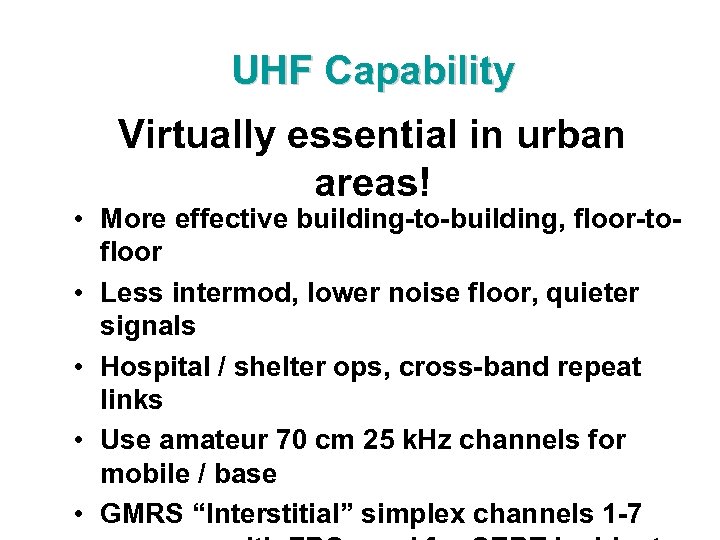
UHF Capability Virtually essential in urban areas! • More effective building-to-building, floor-tofloor • Less intermod, lower noise floor, quieter signals • Hospital / shelter ops, cross-band repeat links • Use amateur 70 cm 25 k. Hz channels for mobile / base • GMRS “Interstitial” simplex channels 1 -7
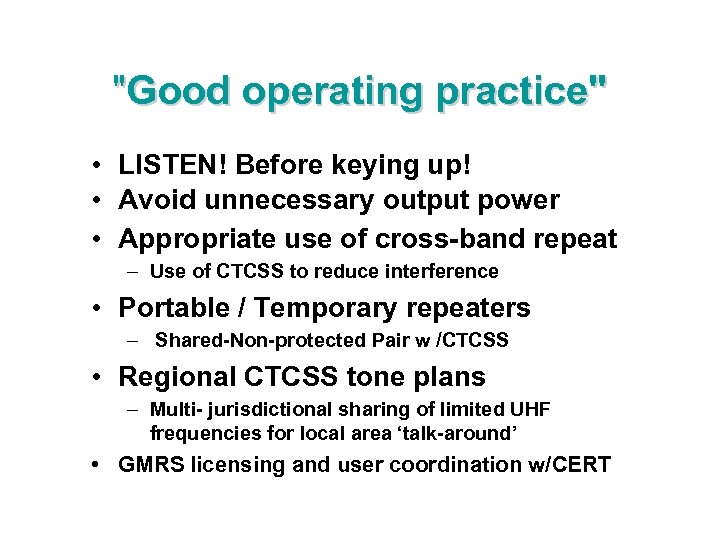
"Good operating practice" • LISTEN! Before keying up! • Avoid unnecessary output power • Appropriate use of cross-band repeat – Use of CTCSS to reduce interference • Portable / Temporary repeaters – Shared-Non-protected Pair w /CTCSS • Regional CTCSS tone plans – Multi- jurisdictional sharing of limited UHF frequencies for local area ‘talk-around’ • GMRS licensing and user coordination w/CERT
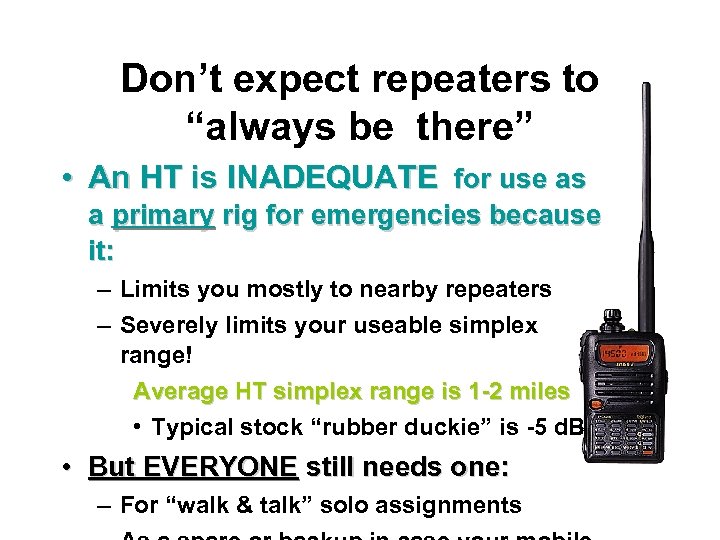
Don’t expect repeaters to “always be there” • An HT is INADEQUATE for use as a primary rig for emergencies because it: – Limits you mostly to nearby repeaters – Severely limits your useable simplex range! Average HT simplex range is 1 -2 miles • Typical stock “rubber duckie” is -5 d. B! • But EVERYONE still needs one: – For “walk & talk” solo assignments
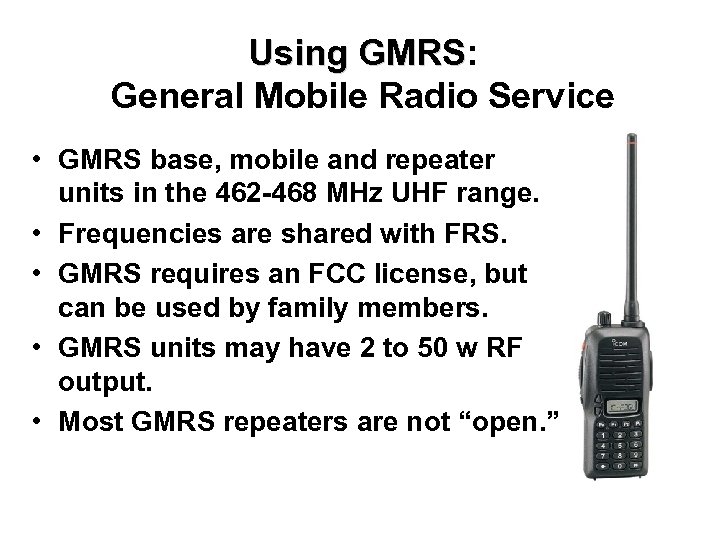
Using GMRS: GMRS General Mobile Radio Service • GMRS base, mobile and repeater units in the 462 -468 MHz UHF range. • Frequencies are shared with FRS. • GMRS requires an FCC license, but can be used by family members. • GMRS units may have 2 to 50 w RF output. • Most GMRS repeaters are not “open. ”
For more info on GMRS: • National Capital REACT Incorporated (NCRI) is composed of two area REACT teams -- Fairfax, Virginia and Montgomery County, Maryland -- as well as members of its own (designated "300" units). NCRI and its member teams have an open membership policy. • Two repeaters are maintained by NCRI. Members, and non-REACT users, pay a yearly fee to use them. Non-REACT repeater users are designated as either "800" or "900" unit numbers.
FAMILY RADIO SERVICE • FRS is an unlicensed service. • Only hand-held units are FCC type accepted, with ½ watt RF. • Range is limited to < one mile. • FRS can communicate with GMRS. • Some radios have all 14 channels. • All radios have channel 1.
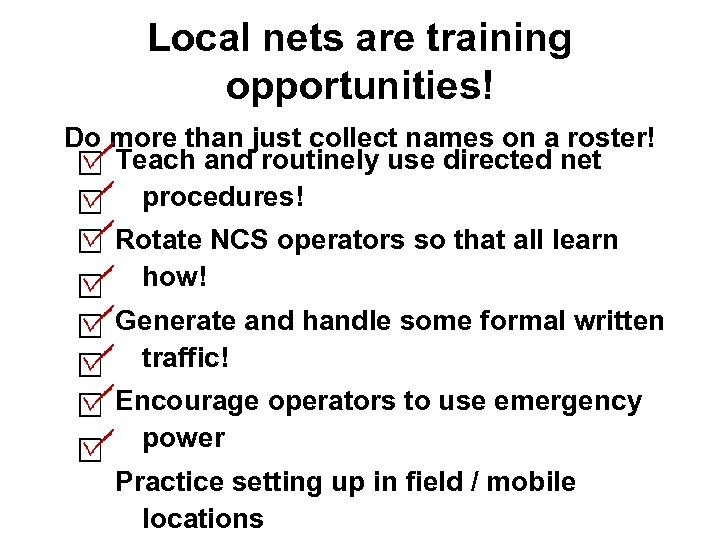
Local nets are training opportunities! Do more than just collect names on a roster! Teach and routinely use directed net procedures! Rotate NCS operators so that all learn how! Generate and handle some formal written traffic! Encourage operators to use emergency power Practice setting up in field / mobile locations
Realistic training • Anticipates repeater loss – Storm damage from wind or icing – Battery backup must be conserved • If a repeater is "down" – Revert to the output frequency on simplex – To meet for scheduled nets. – ( Idea! ) - Have control “op” turn off repeater during a scheduled net! This
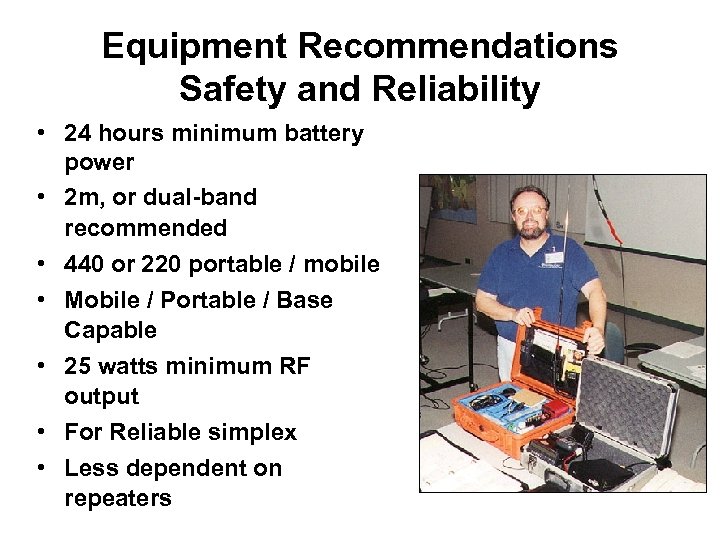
Equipment Recommendations Safety and Reliability • 24 hours minimum battery power • 2 m, or dual-band recommended • 440 or 220 portable / mobile • Mobile / Portable / Base Capable • 25 watts minimum RF output • For Reliable simplex • Less dependent on repeaters
Equipment Recommendations Your basic rig should be capable of: • Operation on 12 -15 V DC power (battery capable) • "Low" -- 5 w RF to conserve battery and, • "High" -- 25 w min. RF output for reliable simplex • Frequency agile, field programmable, w/ PL • Minimum ten field-programmable memories
Arlington RACES May Add: • Packet capability extremely valuable and highly desired. • 2 m SSB capability is useful if enough people have it. • Portable / mobile HF, if General license or above. • Cross-band repeat not essential, but “nice to have”
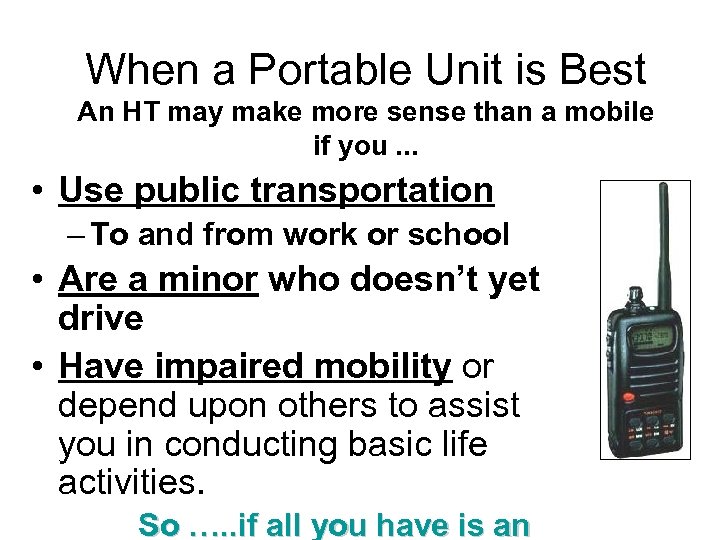
When a Portable Unit is Best An HT may make more sense than a mobile if you. . . • Use public transportation – To and from work or school • Are a minor who doesn’t yet drive • Have impaired mobility or depend upon others to assist you in conducting basic life activities. So …. . if all you have is an
HANDHELD USERS Supplement your equipment! • 1/2 -wave ‘no ground plane’ antenna, unity gain – Equal to a 1/4 wave with a ground plane – 2. 15 db gain if used with a ground plane – Single or dual-band mobile antenna + mag mount – – Telescoping 1/2 wave whip, or. . . Roll-up 300 -Ohn twin-lead, or copper J-pole Works well when pulled up high into a tree ! Or when attached to a bicycle or wheel chair!
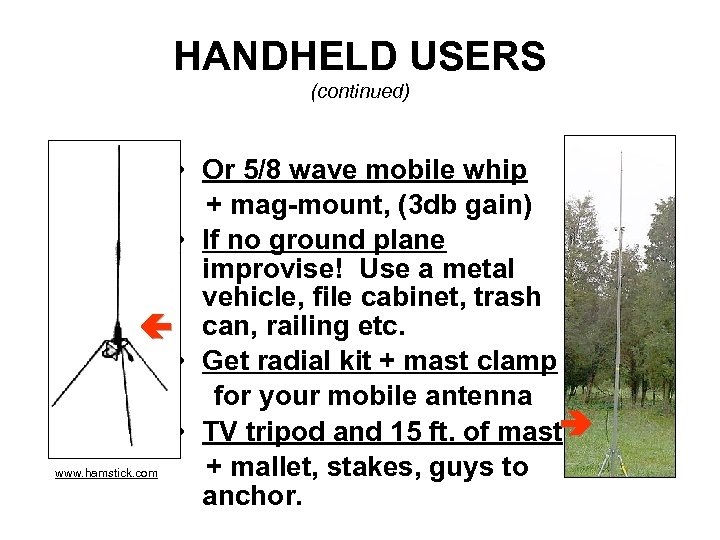
HANDHELD USERS (continued) • Or 5/8 wave mobile whip + mag-mount, (3 db gain) • If no ground plane improvise! Use a metal vehicle, file cabinet, trash can, railing etc. • Get radial kit + mast clamp for your mobile antenna • TV tripod and 15 ft. of mast, + mallet, stakes, guys to www. hamstick. com anchor.
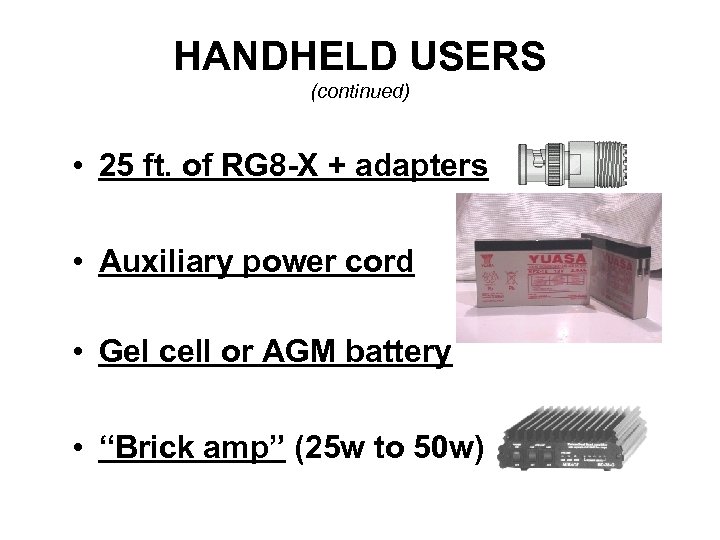
HANDHELD USERS (continued) • 25 ft. of RG 8 -X + adapters • Auxiliary power cord • Gel cell or AGM battery • “Brick amp” (25 w to 50 w)
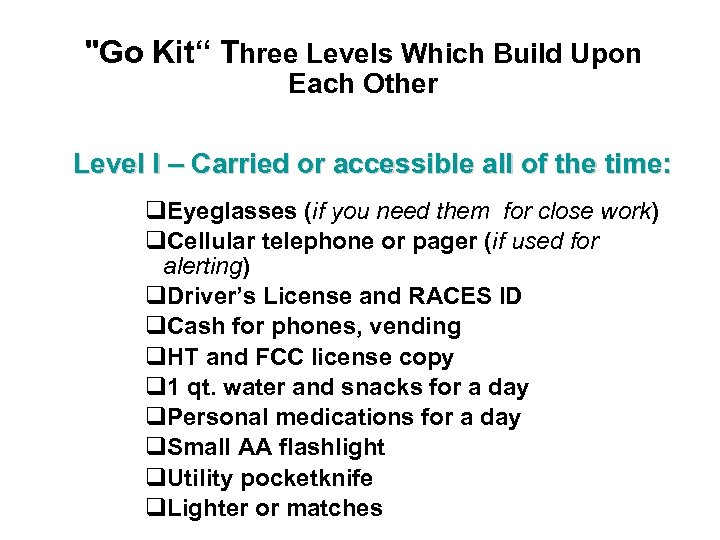
"Go Kit“ Three Levels Which Build Upon Each Other Level I – Carried or accessible all of the time: q. Eyeglasses (if you need them for close work) q. Cellular telephone or pager (if used for alerting) q. Driver’s License and RACES ID q. Cash for phones, vending q. HT and FCC license copy q 1 qt. water and snacks for a day q. Personal medications for a day q. Small AA flashlight q. Utility pocketknife q. Lighter or matches
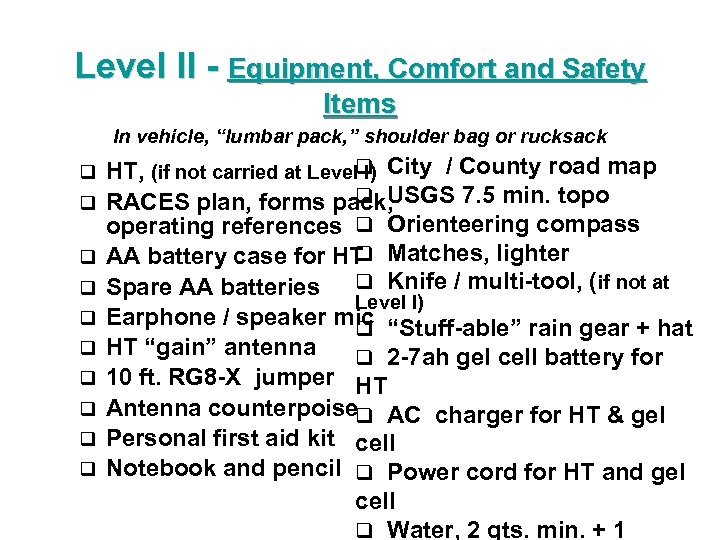
Level II - Equipment, Comfort and Safety Items In vehicle, “lumbar pack, ” shoulder bag or rucksack q q q q q HT, (if not carried at Levelq City / County road map I) q USGS 7. 5 min. topo RACES plan, forms pack, operating references q Orienteering compass q AA battery case for HT Matches, lighter Spare AA batteries q Knife / multi-tool, (if not at Level I) Earphone / speaker mic “Stuff-able” rain gear + hat q HT “gain” antenna q 2 -7 ah gel cell battery for 10 ft. RG 8 -X jumper HT Antenna counterpoiseq AC charger for HT & gel Personal first aid kit cell Notebook and pencil q Power cord for HT and gel cell q Water, 2 qts. min. + 1
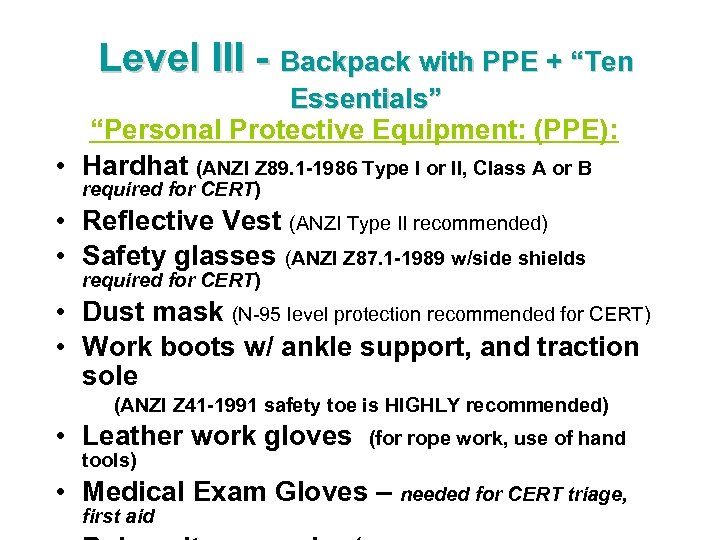
Level III - Backpack with PPE + “Ten Essentials” “Personal Protective Equipment: (PPE): • Hardhat (ANZI Z 89. 1 -1986 Type I or II, Class A or B required for CERT) • Reflective Vest (ANZI Type II recommended) • Safety glasses (ANZI Z 87. 1 -1989 w/side shields required for CERT) • Dust mask (N-95 level protection recommended for CERT) • Work boots w/ ankle support, and traction sole (ANZI Z 41 -1991 safety toe is HIGHLY recommended) • Leather work gloves tools) (for rope work, use of hand • Medical Exam Gloves – needed for CERT triage, first aid
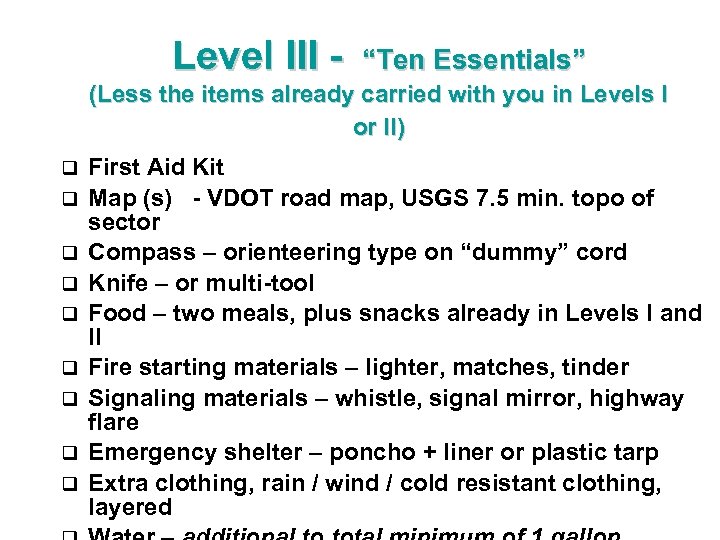
Level III - “Ten Essentials” (Less the items already carried with you in Levels I or II) q q q q q First Aid Kit Map (s) - VDOT road map, USGS 7. 5 min. topo of sector Compass – orienteering type on “dummy” cord Knife – or multi-tool Food – two meals, plus snacks already in Levels I and II Fire starting materials – lighter, matches, tinder Signaling materials – whistle, signal mirror, highway flare Emergency shelter – poncho + liner or plastic tarp Extra clothing, rain / wind / cold resistant clothing, layered
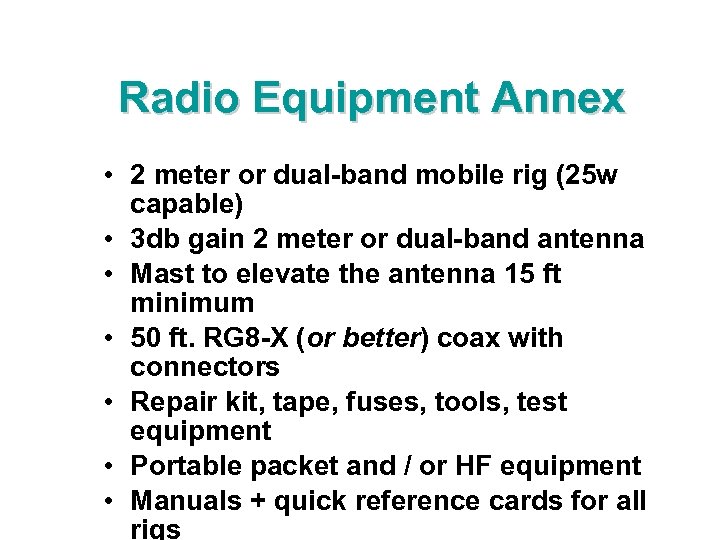
Radio Equipment Annex • 2 meter or dual-band mobile rig (25 w capable) • 3 db gain 2 meter or dual-band antenna • Mast to elevate the antenna 15 ft minimum • 50 ft. RG 8 -X (or better) coax with connectors • Repair kit, tape, fuses, tools, test equipment • Portable packet and / or HF equipment • Manuals + quick reference cards for all rigs
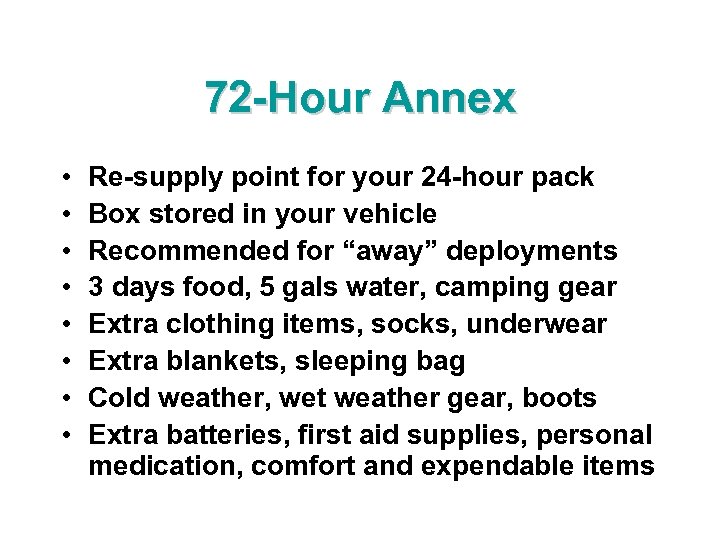
72 -Hour Annex • • Re-supply point for your 24 -hour pack Box stored in your vehicle Recommended for “away” deployments 3 days food, 5 gals water, camping gear Extra clothing items, socks, underwear Extra blankets, sleeping bag Cold weather, wet weather gear, boots Extra batteries, first aid supplies, personal medication, comfort and expendable items
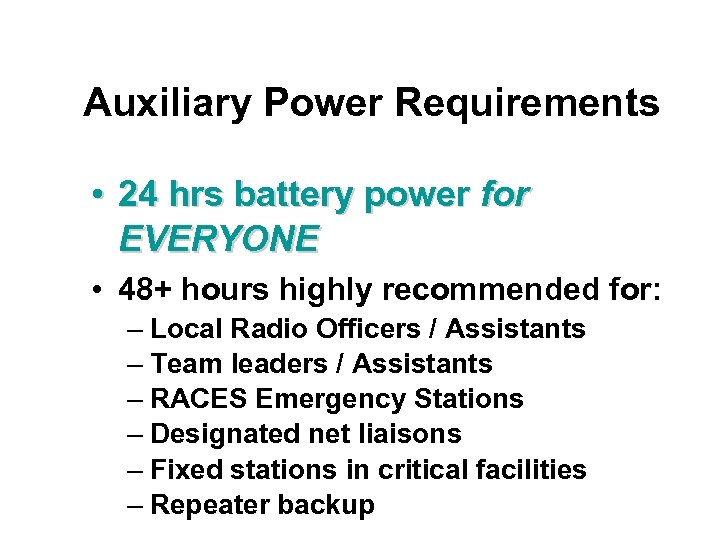
Auxiliary Power Requirements • 24 hrs battery power for EVERYONE • 48+ hours highly recommended for: – Local Radio Officers / Assistants – Team leaders / Assistants – RACES Emergency Stations – Designated net liaisons – Fixed stations in critical facilities – Repeater backup
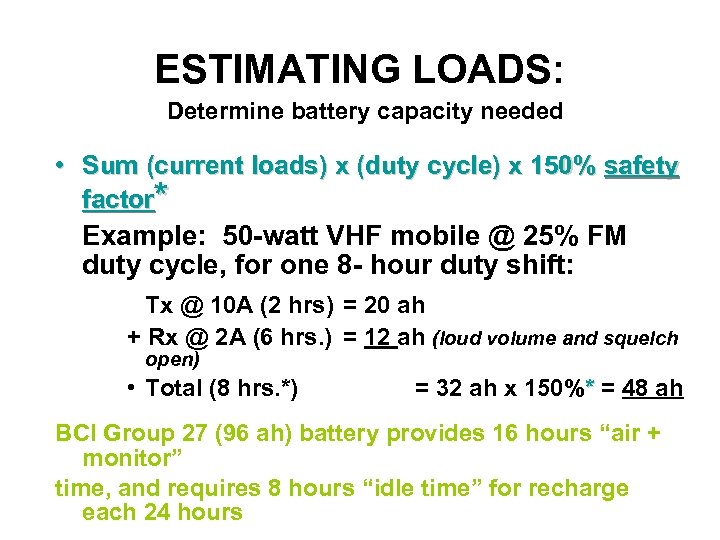
ESTIMATING LOADS: Determine battery capacity needed • Sum (current loads) x (duty cycle) x 150% safety factor* Example: 50 -watt VHF mobile @ 25% FM duty cycle, for one 8 - hour duty shift: Tx @ 10 A (2 hrs) = 20 ah + Rx @ 2 A (6 hrs. ) = 12 ah (loud volume and squelch open) • Total (8 hrs. *) = 32 ah x 150%* = 48 ah BCI Group 27 (96 ah) battery provides 16 hours “air + monitor” time, and requires 8 hours “idle time” for recharge each 24 hours
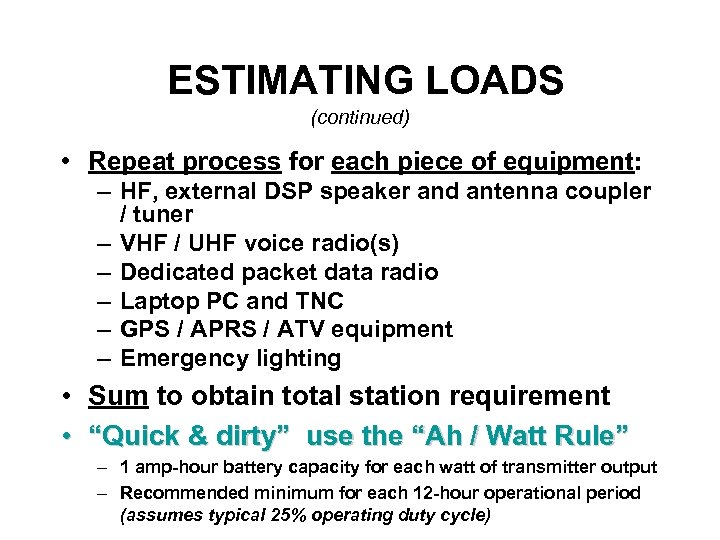
ESTIMATING LOADS (continued) • Repeat process for each piece of equipment: – HF, external DSP speaker and antenna coupler / tuner – VHF / UHF voice radio(s) – Dedicated packet data radio – Laptop PC and TNC – GPS / APRS / ATV equipment – Emergency lighting • Sum to obtain total station requirement • “Quick & dirty” use the “Ah / Watt Rule” – 1 amp-hour battery capacity for each watt of transmitter output – Recommended minimum for each 12 -hour operational period (assumes typical 25% operating duty cycle)
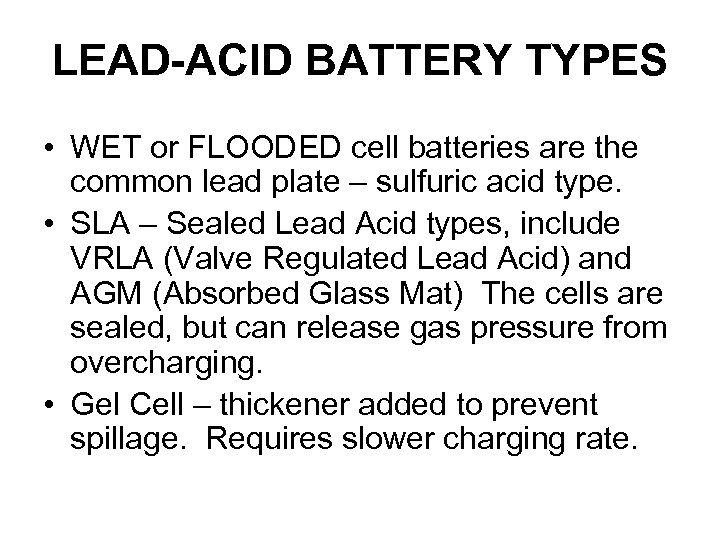
LEAD-ACID BATTERY TYPES • WET or FLOODED cell batteries are the common lead plate – sulfuric acid type. • SLA – Sealed Lead Acid types, include VRLA (Valve Regulated Lead Acid) and AGM (Absorbed Glass Mat) The cells are sealed, but can release gas pressure from overcharging. • Gel Cell – thickener added to prevent spillage. Requires slower charging rate.
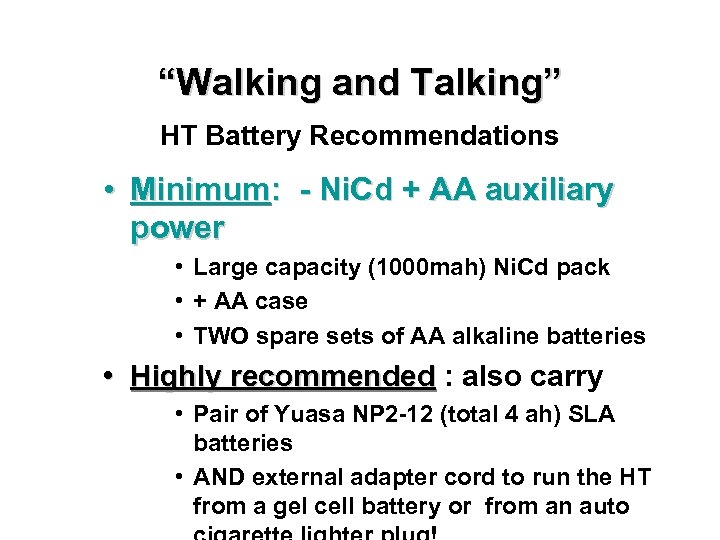
“Walking and Talking” HT Battery Recommendations • Minimum: - Ni. Cd + AA auxiliary power • Large capacity (1000 mah) Ni. Cd pack • + AA case • TWO spare sets of AA alkaline batteries • Highly recommended : also carry • Pair of Yuasa NP 2 -12 (total 4 ah) SLA batteries • AND external adapter cord to run the HT from a gel cell battery or from an auto
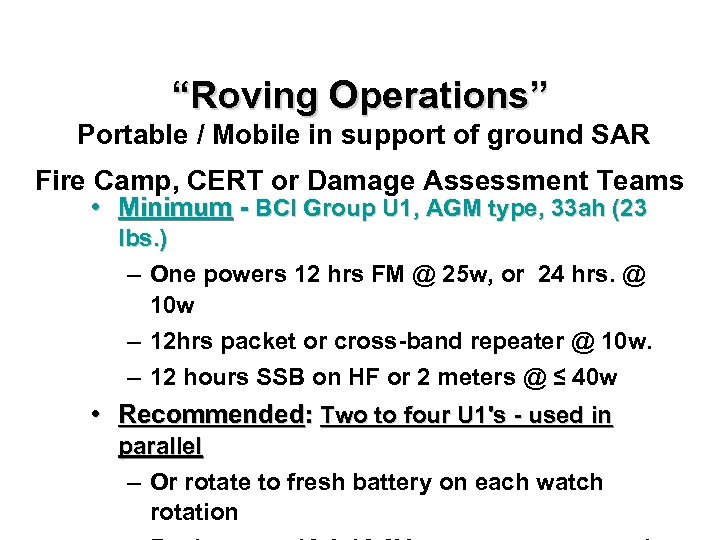
“Roving Operations” Portable / Mobile in support of ground SAR Fire Camp, CERT or Damage Assessment Teams • Minimum - BCI Group U 1, AGM type, 33 ah (23 lbs. ) – One powers 12 hrs FM @ 25 w, or 24 hrs. @ 10 w – 12 hrs packet or cross-band repeater @ 10 w. – 12 hours SSB on HF or 2 meters @ ≤ 40 w • Recommended: Two to four U 1's - used in parallel – Or rotate to fresh battery on each watch rotation
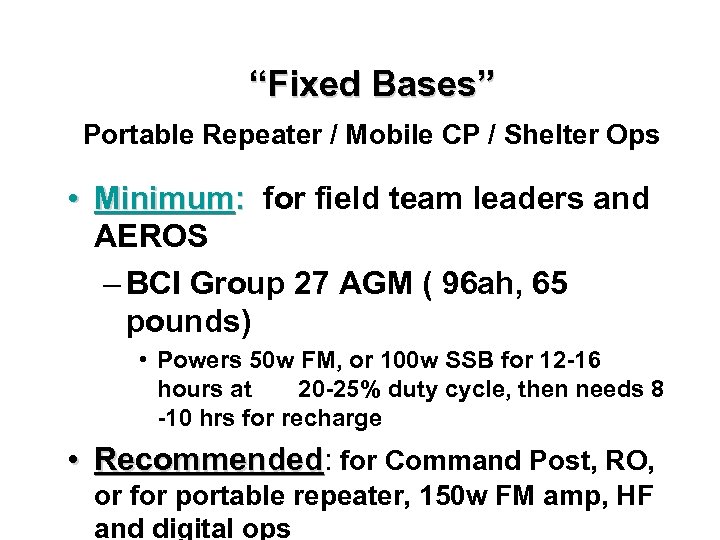
“Fixed Bases” Portable Repeater / Mobile CP / Shelter Ops • Minimum: for field team leaders and AEROS – BCI Group 27 AGM ( 96 ah, 65 pounds) • Powers 50 w FM, or 100 w SSB for 12 -16 hours at 20 -25% duty cycle, then needs 8 -10 hrs for recharge • Recommended: for Command Post, RO, or for portable repeater, 150 w FM amp, HF and digital ops
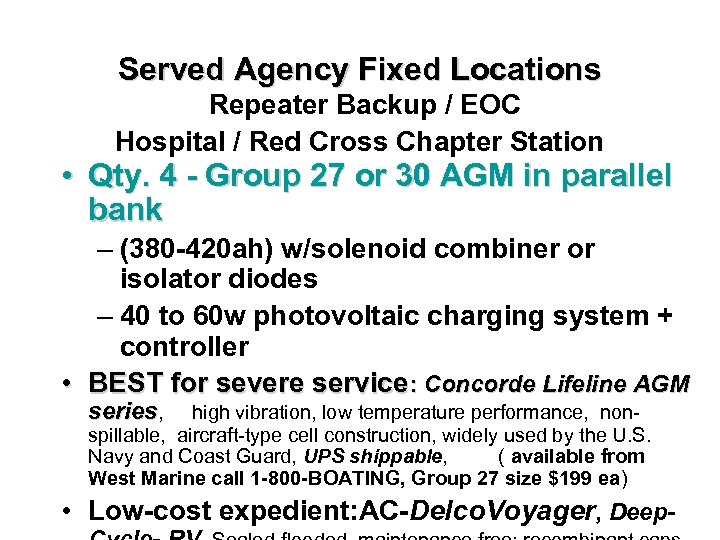
Served Agency Fixed Locations Repeater Backup / EOC Hospital / Red Cross Chapter Station • Qty. 4 - Group 27 or 30 AGM in parallel bank – (380 -420 ah) w/solenoid combiner or isolator diodes – 40 to 60 w photovoltaic charging system + controller • BEST for severe service: Concorde Lifeline AGM series, high vibration, low temperature performance, non- spillable, aircraft-type cell construction, widely used by the U. S. Navy and Coast Guard, UPS shippable, ( available from West Marine call 1 -800 -BOATING, Group 27 size $199 ea) • Low-cost expedient: AC-Delco. Voyager, Deep-
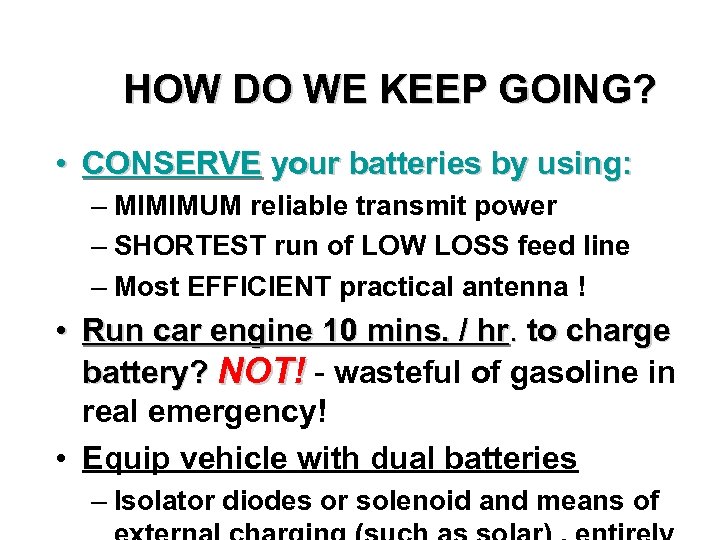
HOW DO WE KEEP GOING? • CONSERVE your batteries by using: – MIMIMUM reliable transmit power – SHORTEST run of LOW LOSS feed line – Most EFFICIENT practical antenna ! • Run car engine 10 mins. / hr. to charge battery? NOT! - wasteful of gasoline in battery? real emergency! • Equip vehicle with dual batteries – Isolator diodes or solenoid and means of
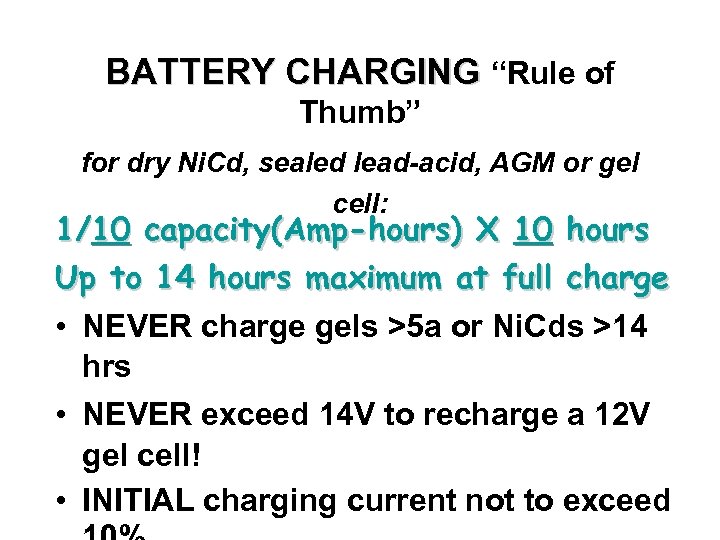
BATTERY CHARGING “Rule of Thumb” for dry Ni. Cd, sealed lead-acid, AGM or gel cell: 1/10 capacity(Amp-hours) X 10 hours Up to 14 hours maximum at full charge • NEVER charge gels >5 a or Ni. Cds >14 hrs • NEVER exceed 14 V to recharge a 12 V gel cell! • INITIAL charging current not to exceed
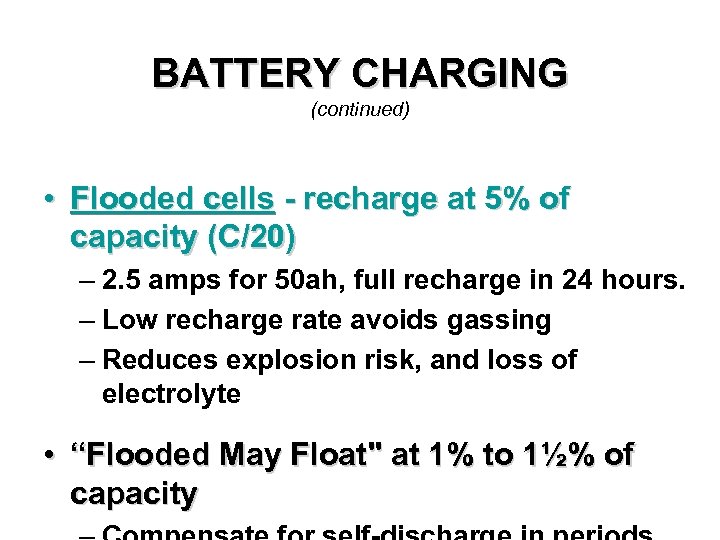
BATTERY CHARGING (continued) • Flooded cells - recharge at 5% of capacity (C/20) – 2. 5 amps for 50 ah, full recharge in 24 hours. – Low recharge rate avoids gassing – Reduces explosion risk, and loss of electrolyte • “Flooded May Float" at 1% to 1½% of capacity
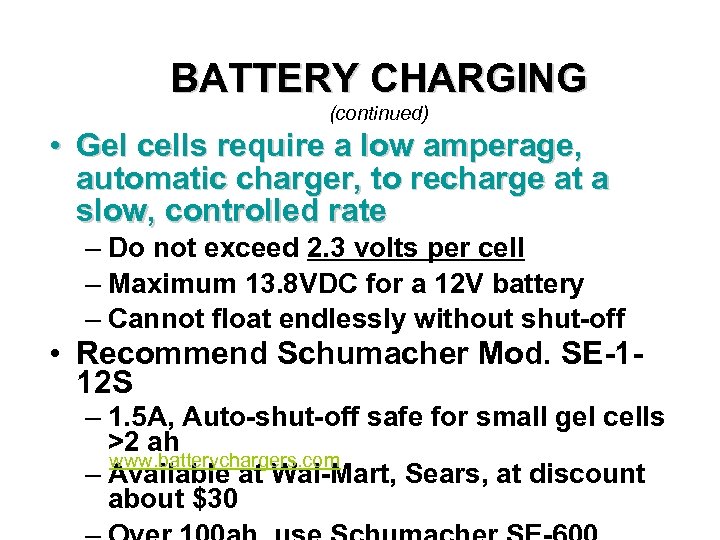
BATTERY CHARGING (continued) • Gel cells require a low amperage, automatic charger, to recharge at a slow, controlled rate – Do not exceed 2. 3 volts per cell – Maximum 13. 8 VDC for a 12 V battery – Cannot float endlessly without shut-off • Recommend Schumacher Mod. SE-112 S – 1. 5 A, Auto-shut-off safe for small gel cells >2 ah www. batterychargers. com – Available at Wal-Mart, Sears, at discount about $30
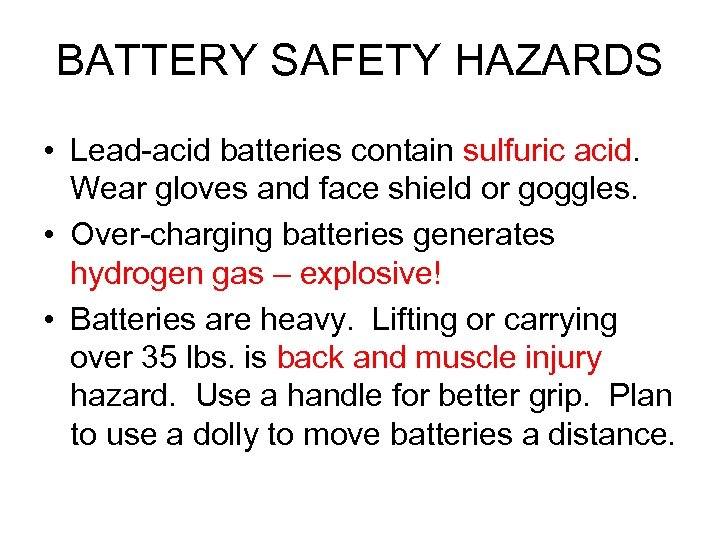
BATTERY SAFETY HAZARDS • Lead-acid batteries contain sulfuric acid. Wear gloves and face shield or goggles. • Over-charging batteries generates hydrogen gas – explosive! • Batteries are heavy. Lifting or carrying over 35 lbs. is back and muscle injury hazard. Use a handle for better grip. Plan to use a dolly to move batteries a distance.
"EMERGENCY POWER" POWER • Batteries are "auxiliary"- not "emergency" power – Finite capacity, Limited depth of discharge – Require regular load testing and recharging • How long can you operate your station? – During a prolonged power failure. . . • All RACES operators should be ready for 24 hours – MINIMUM - 48+ hrs. for net liaisons, team leaders!
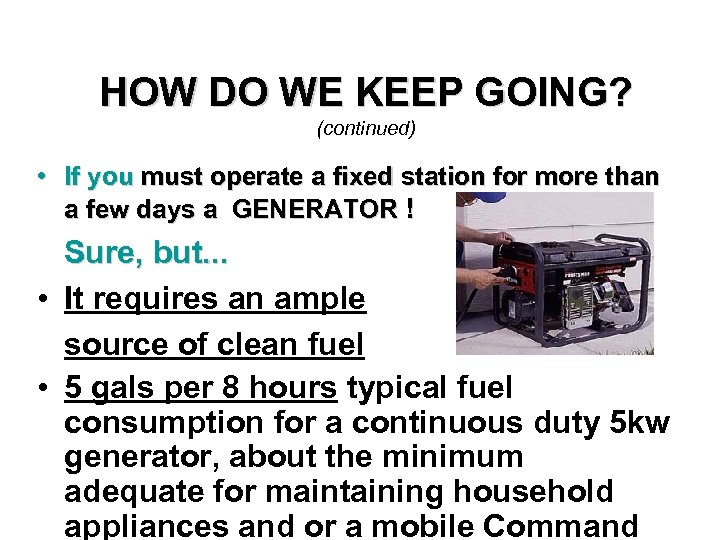
HOW DO WE KEEP GOING? (continued) • If you must operate a fixed station for more than a few days a GENERATOR ! Sure, but. . . • It requires an ample source of clean fuel • 5 gals per 8 hours typical fuel consumption for a continuous duty 5 kw generator, about the minimum adequate for maintaining household appliances and or a mobile Command
Generator Safety Tips From the U. S. Consumer Product Safety Commission • Carbon monoxide hazard! – Never use indoors or in attached garages! – Set up OUTDOORS in a well ventilated, dry area – Away from HVAC air intakes – Under a canopy, open shed or carport • Electrocution Hazard! – Adequate grounding of generator and equipment! – DO NOT connect or plug into household AC!
Generator Safety (continued) • Explosion / fire hazard! – Fuel vapors can travel along the ground and be ignited by sparks, arcs from switching equipment, or pilot lights from appliances! – Store fuel outdoors in a ventilated shed – Use Fire Marshall approved containers F-3201. 2 of the Virginia Statewide Uniform Fire Code prohibits storage of more than 5 gallons of gasoline in residential areas
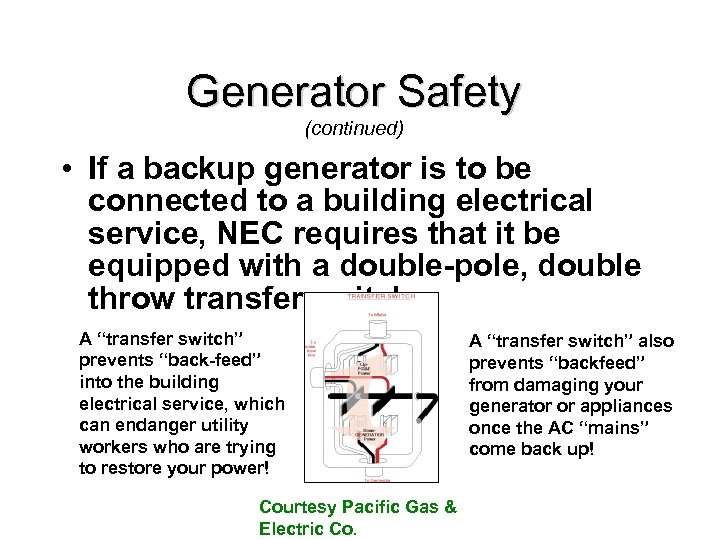
Generator Safety (continued) • If a backup generator is to be connected to a building electrical service, NEC requires that it be equipped with a double-pole, double throw transfer switch: A “transfer switch” prevents “back-feed” into the building electrical service, which can endanger utility workers who are trying to restore your power! Courtesy Pacific Gas & Electric Co. A “transfer switch” also prevents “backfeed” from damaging your generator or appliances once the AC “mains” come back up!
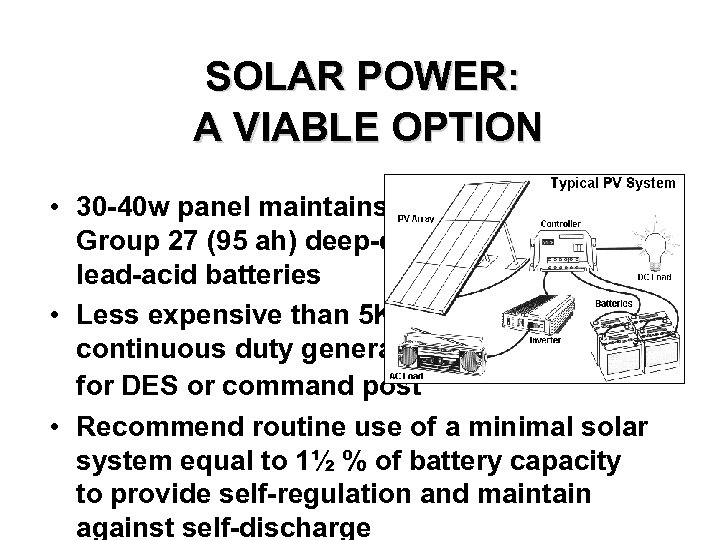
SOLAR POWER: A VIABLE OPTION • 30 -40 w panel maintains 2 -4 Group 27 (95 ah) deep-cycle lead-acid batteries • Less expensive than 5 Kw continuous duty generator for DES or command post • Recommend routine use of a minimal solar system equal to 1½ % of battery capacity to provide self-regulation and maintain against self-discharge
READINESS SUMMARY ü ü ü ü Everyone maintains preparedness Level 1 24 hours minimum battery power for all! At home VHF 25 w, + 3 d. Bd antenna desired Mobile 25 w VHF, hardwired to battery Inspect / test batteries and equipment weekly Use simplex nets for equipment checks Those with standing assignments at Level 2 DRTs able to reach Level 3 within 4 hours
RACES Stations and Teamwork Stress highest ERP, (effective radiated power) station efficiency and reliability! Get your message through the first time RACES can provide Em. Com independent of repeater infrastructure More information: www. varaces. org
Acknowledgements: Arlington County RACES is extremely grateful to the following Individuals and organizations who have provided materials used in the production of this training Virginia RACES, Incorporated Wind River Search and Rescue Group San Francisco, CA - Office of Emergency Management www. 72 hours. org
Скачать презентацию Arlington County RACES Basic Operator Course Unit 4
bf847713484d8d1dfbe83e0bc33978ce.ppt