


 Скачать презентацию ARIZONA ODYSSEY OF THE MIND COACHES TRAINING WELCOME
1163eb6ca3cd1c513cd38ac256bbfe1f.ppt
- Количество слайдов: 71
 ARIZONA ODYSSEY OF THE MIND COACHES TRAINING WELCOME
 ODYSSEY OF THE MIND Creative, Problem-solving program which allows teams to demonstrate their critical thinking & problem-solving skills in a competitive setting.
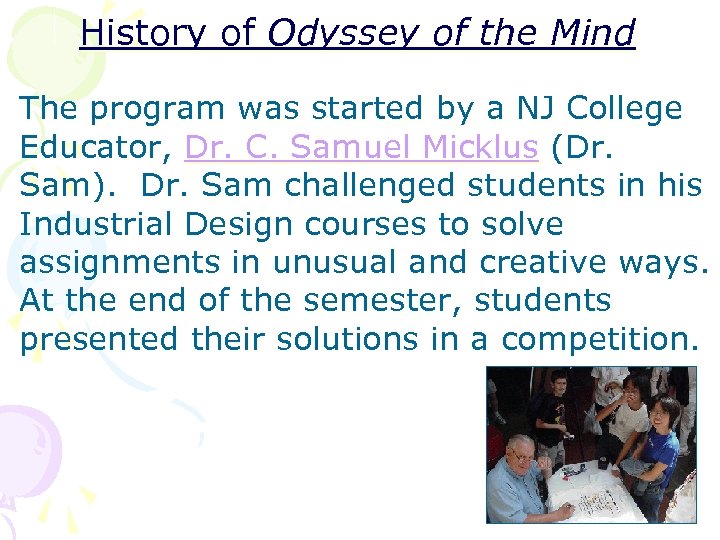 H i s t o r y o f O d y s s e y o f t h e M i n d History of Odyssey of the Mind The program was started by a NJ College Educator, Dr. C. Samuel Micklus (Dr. Sam). Dr. Sam challenged students in his Industrial Design courses to solve assignments in unusual and creative ways. At the end of the semester, students presented their solutions in a competition.
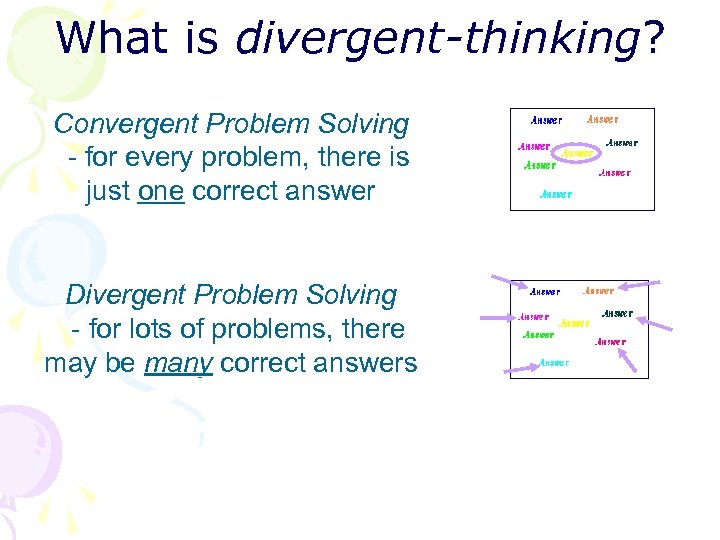 What is divergent-thinking? W h a t i s D i v e r g e n t T h i n k i n g ? Convergent Problem Solving - for every problem, there is just one correct answer Divergent Problem Solving - for lots of problems, there may be many correct answers
 • Odyssey of the Mind encourages young people to explore many possible answers and to be creative in finding a solution • Because there are no wrong solutions, teams are free to take calculated risks in attempting to solving the problem Odyssey of the Mind allows kids to use their imaginations to interpret and solve complex problems in a FUN way!
 TEAMS • Broken down by problems • Up to 7 members per team • Compete with other teams in their age group – – – Division Primary I (grades K-5) II (grades 6 -8) III (grades 9 -12) IV (College) (grades K-2) • Division Finder – (Members Area) – Division determined by oldest member on team.
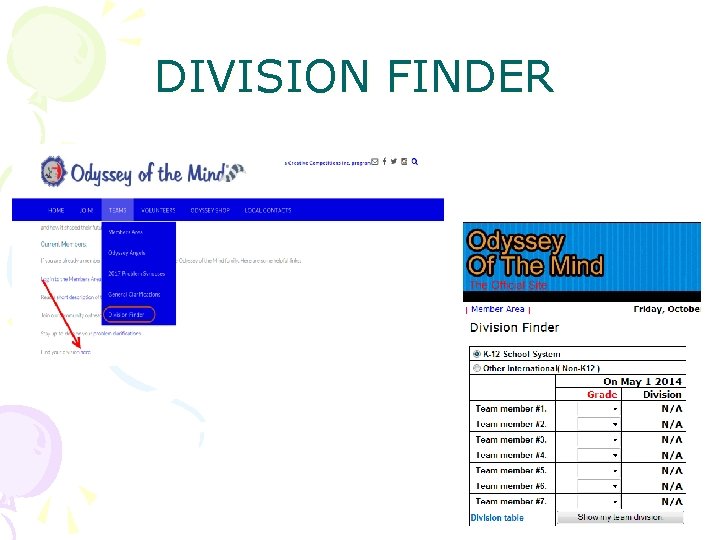 DIVISION FINDER
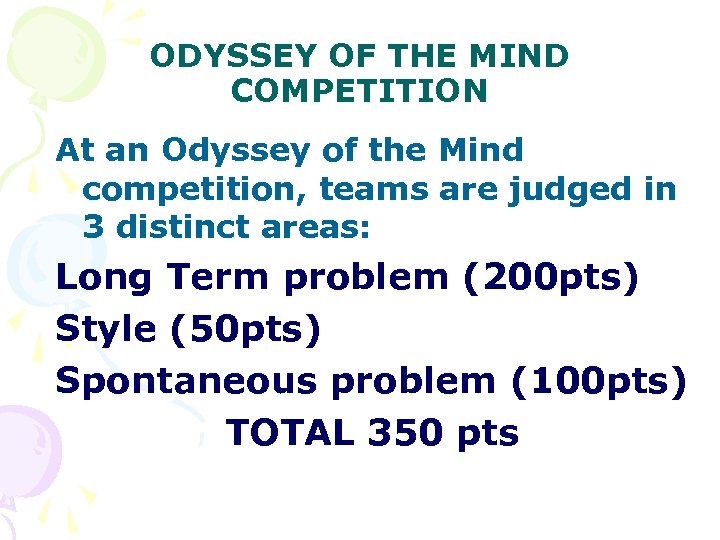 ODYSSEY OF THE MIND COMPETITION At an Odyssey of the Mind competition, teams are judged in 3 distinct areas: Long Term problem (200 pts) Style (50 pts) Spontaneous problem (100 pts) TOTAL 350 pts
 LONG TERM PROBLEM Solve a problem during an 8 minute presentation 5 COMPETITIVE PROBLEMS Problem 1 — Vehicle Problem 2 — Technical Problem 3 — Classics Problem 4 — Structure Problem 5 — Theatrical Primary problem — non-competitive
 VEHICLE PROBLEM Teams design, build and operate vehicles of various sizes and with various power sources.
 TECHNICAL PROBLEM Teams make innovative contraptions and incorporate artistic elements into their solutions.
 CLASSICS PROBLEM The theme of this problem is based on the classical, from literature to architecture to art.
 STRUCTURE PROBLEM Teams design and build structures, using only balsa wood and glue. They test them by supporting and holding as much weight as possible.
 THEATRICAL PROBLEM In this problem, teams present performances that revolve around a specific theme and incorporate required elements.
 PRIMARY PROBLEM • NON-COMPETITIVE PROBLEM • KINDERGARTEN - 2 ND GRADE • PREPARES YOUNGER CHILDREN FOR THE ODYSSEY OF THE MIND EXPERIENCE
 T h e L o n g T e r m 2017 -2018 Long-Term Problems P r o b l e m s Vehicle – Problem 1 Triathlon Travels Technical– Problem 2 Emoji, Speak for Yourself Classics – Problem 3 Classics… Mockumentary! Seriously? Structure – Problem 4 Animal House Theatrics – Problem 5 A Stellar Hangout Primary – Demonstration Only We’re Cooking Now
 STYLE • Style is judged at the same time as long term problem • Rewards teams for elaborating their long term solution, since elaboration requires additional creativity • Think of it as: Icing of the Cake ØThe cake is the long term problem ØStyle is decorating the cake
 STYLE Style is the place for the team to showcase their strengths and talents. v v artistic design, music, songs, choreography construction, creative use of materials humor, rhyme overall effect (theme) Can not be anything that is already being judged in the long-term problem
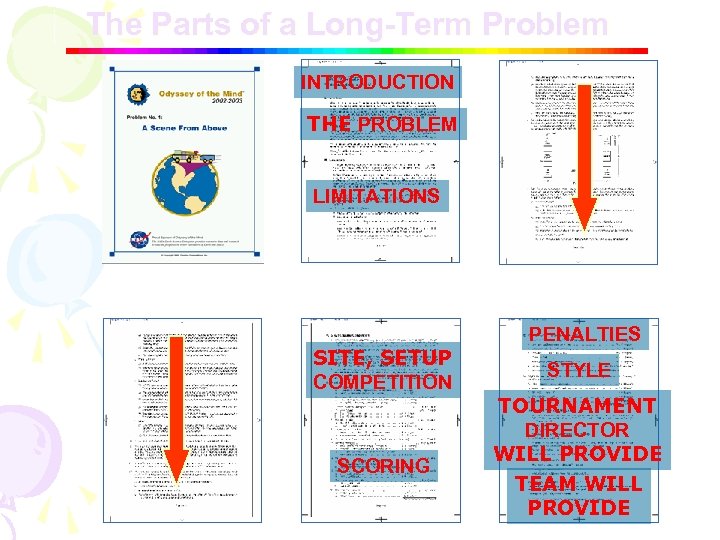 T h e P a r t s o f a L o n g T e r m P r o b l e m The Parts of a Long-Term Problem INTRODUCTION THE PROBLEM LIMITATIONS PENALTIES SITE, SETUP COMPETITION STYLE SCORING TOURNAMENT DIRECTOR WILL PROVIDE TEAM WILL PROVIDE
 SPONTANEOUS • Separate competition • See how well teams can solve a problem “on the spot” • Team involvement only – All 7 team members hear the problem – Only 5 team members can compete
 Spontaneous 3 TYPES OF SPONTANEOUS PROBLEMS • Verbal – Problems requiring creative verbal responses • Hands-on – Problems require manipulation of materials • Verbal/Hands-on – Problems with both verbal and hands on components
 SPONTANEOUS • Teams may also be judged on their ability to work together. • The same spontaneous problem is used for all teams that compete against the same problem/division. • Team members can NOT discuss the problem with any other individuals until given permission to do so at the end of the Odyssey season. (Includes: parents, other team members, friends, everyone)
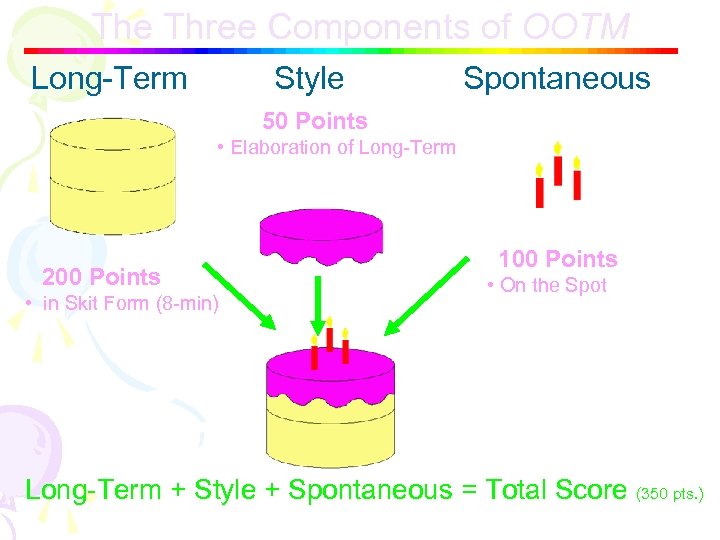 O O T M The Three Components of OOTM Long-Term Style Spontaneous 50 Points • Elaboration of Long-Term 200 Points • in Skit Form (8 -min) 100 Points • On the Spot Long-Term + Style + Spontaneous = Total Score (350 pts. )
 DEVELOPING TEAMS/COACHES RESPONSIBILITY
 RESOURCES • 2018 Program Guide • Websites – www. odysseyofthemind. com – www. azodyssey. org • Central Region Director – wingatedeana@gmail. com
 Program Guide • Important information about program – Read & review all chapters – Coaches are responsible for know the contents • Take with you to tournament • Chapters to Review before tournament: – Going to Competition – Chapter III (pg. 29 -33) – Program Rules – Chapter V (pg. 36 -43) – Penalty Categories (pg. 44 -49) • Assigned Value Items (pg. 48) • Exempt Items (pg. 49) – Potential Reasons for Discipline (pg. 50 -51) – Glossary – Chapter VI (pg. 52 -54)
 CHOOSING TEAMS CHOOSING PROBLEMS CAN A TEAM MEMBER QUIT? (pg 18 Program Guide) Team members may not be removed from the roster for any reason even if a team member decides to no longer participate. Once a team member has contributed to the problem solution, in any way and to any degree, they are part of that team even if they don’t participate at a competition. DOES ALL TEAM MEMBERS NEED TO COMPETE? NO CAN A TEAM MEMBER BE ADDED? (pg 18 Program Guide) A team with less than seven members on its roster may add to the roster, at any time and without penalty, until it reaches a full complement of seven. REMEMBER TO READ THE PROBLEM OVER & OVER AGAIN!!
 t a n c e Outside Assistance OUTSIDE ASSISTANCE OOTM is a Hands-On Program for Kids, but a Hands-Off Program for Adults Help external to the team is termed Outside Assistance (OA) It’s Important that Parents Know OA Rules, Too! *Refer to Program Guide -pg. 45 -46
 HOW TO QUESTION • Ask open ended questions • Ask questions that help focus • Ask questions as a follow up to ideas • BUT DO NOT GIVE IDEAS OR SOLVE PROBLEM FOR TEAM
 P e n a l t i e s PENALTIES Penalties are designed to prevent teams from bending or breaking the rules, creating a safety hazard, interfering with other teams, delaying competition, or misbehaving. • Outside Assistance – (-5 to -200 Points) If team receives help from anyone. This applies to audience as well. Thus teams shouldn’t encourage audience participation • Spirit of the Problem - (-1 to -100 Points) Aimed at preventing teams from circumventing the intention of the rules in either Long -Term or Spontaneous • Unsportsmanlike Conduct – (-1 to -100 Points) For impairing another team’s solution, disruptive behavior, inappropriate language. Intentional (or unintentional) damage to facilities • Incorrect/Missing Membership Sign – (-1 to -15 Points) • Over Cost Limit – (-1 to -100 Points) Materials over cost limit • Over Time Limit – (-5 Points) For each 10 sec or fraction
 Preparing for Spontaneous • PRACTICE… PRACTICE ! • Do lots of different types. • Do at least two spontaneous problems each time the team meets. • Critique the teams performance (Coaches Hints are fine here) • Have each team member specialize in something. • Fall back plans …. Spontaneous Resources: • Brainstorm ways to get Odyssey of the Mind AZ Odyssey of the Mind “unstuck” Baseball Cap Basics ($35) VOICES Weekly Problem Maine Practice Problems CTOM Spontaneous Zone Georgia Odyssey – Build Your Own
 M e m b e r s h i p s & T e a m s Memberships & Teams Memberships: • School/Organization memberships • Allows school/organization to enter 1 team per problem per division into competition. • Can not have 2 teams compete in the same problem in the same division (i. e. 2 Div. II teams competing in Vehicle problem) EXCEPTION - Unlimited Primary Teams • Team member may be on more than one team EXCEPTION – a team member may not enter competition in the same problem for more than one team EXCEPTION – a Division 4 team must have a majority of members have high school diploma. All must be enrolled in a college course. • The purchase of additional (Team A, Team B) memberships allows more teams to participate in the same problem.
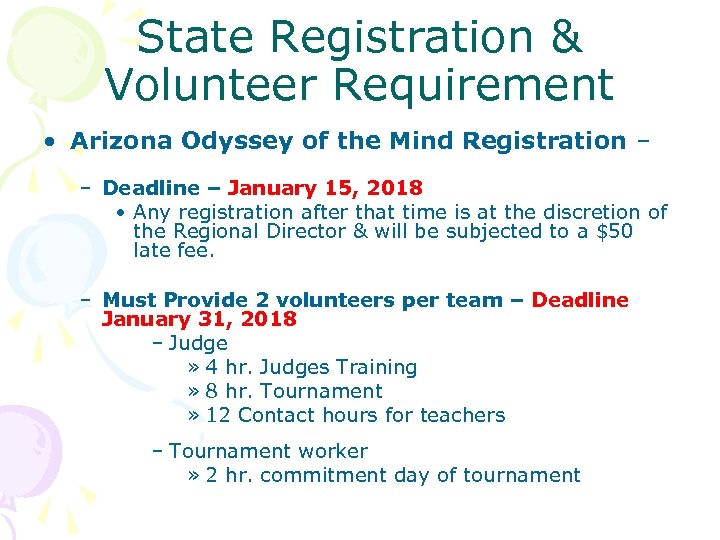 State Registration & Volunteer Requirement • Arizona Odyssey of the Mind Registration – – Deadline – January 15, 2018 • Any registration after that time is at the discretion of the Regional Director & will be subjected to a $50 late fee. – Must Provide 2 volunteers per team – Deadline January 31, 2018 – Judge » 4 hr. Judges Training » 8 hr. Tournament » 12 Contact hours for teachers – Tournament worker » 2 hr. commitment day of tournament
 Treasurer Change • AZ State Treasurer, Rebecca Ford: übecmelin@yahoo. com üPlease contact her about any payment issues (i. e. purchase orders, where to send payments, did I pay? , etc)
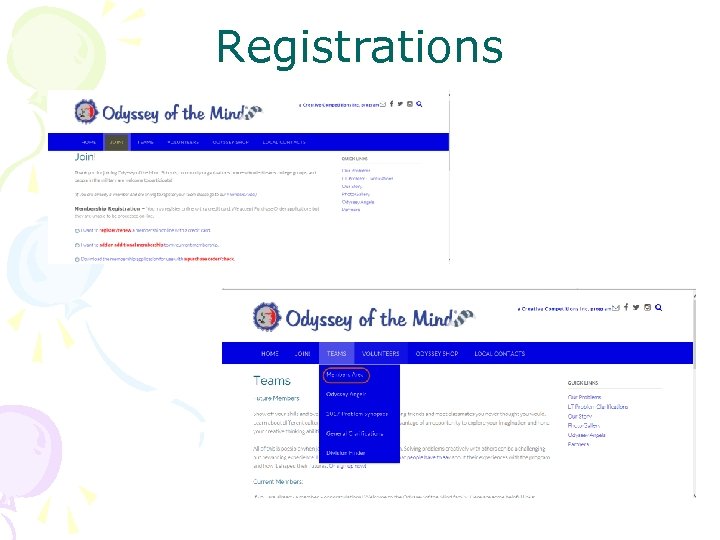 Registrations
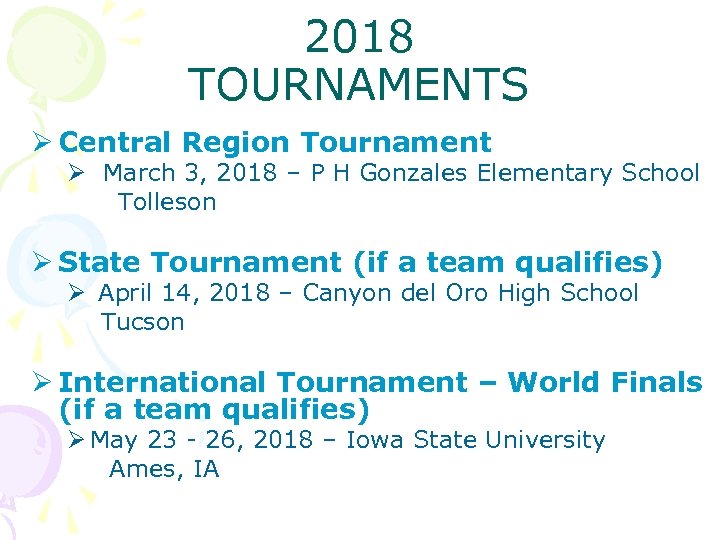 2018 TOURNAMENTS Ø Central Region Tournament Ø March 3, 2018 – P H Gonzales Elementary School Tolleson Ø State Tournament (if a team qualifies) Ø April 14, 2018 – Canyon del Oro High School Tucson Ø International Tournament – World Finals (if a team qualifies) Ø May 23 - 26, 2018 – Iowa State University Ames, IA
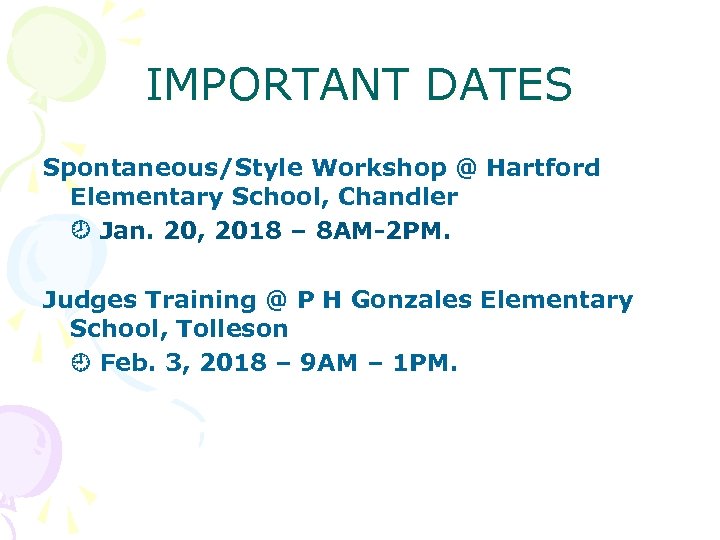 IMPORTANT DATES Spontaneous/Style Workshop @ Hartford Elementary School, Chandler Jan. 20, 2018 – 8 AM-2 PM. Judges Training @ P H Gonzales Elementary School, Tolleson Feb. 3, 2018 – 9 AM – 1 PM.
 PREPARING FOR COMPITITION
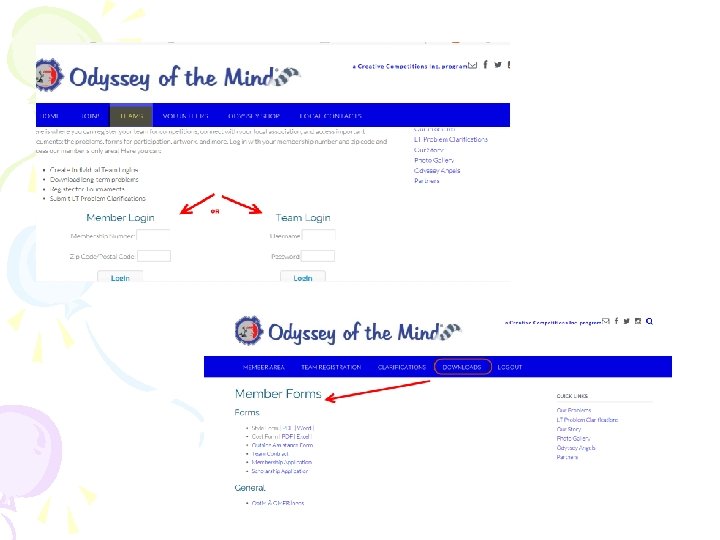
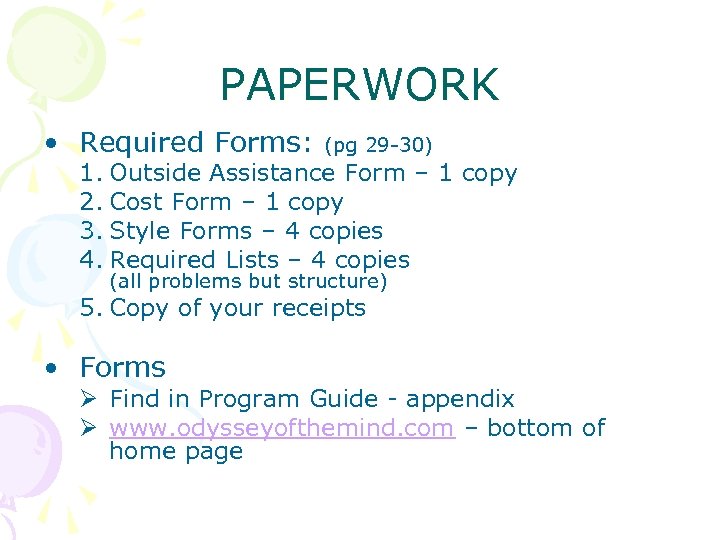 PAPERWORK • Required Forms: (pg 29 -30) 1. Outside Assistance Form – 1 copy 2. Cost Form – 1 copy 3. Style Forms – 4 copies 4. Required Lists – 4 copies (all problems but structure) 5. Copy of your receipts • Forms Ø Find in Program Guide - appendix Ø www. odysseyofthemind. com – bottom of home page
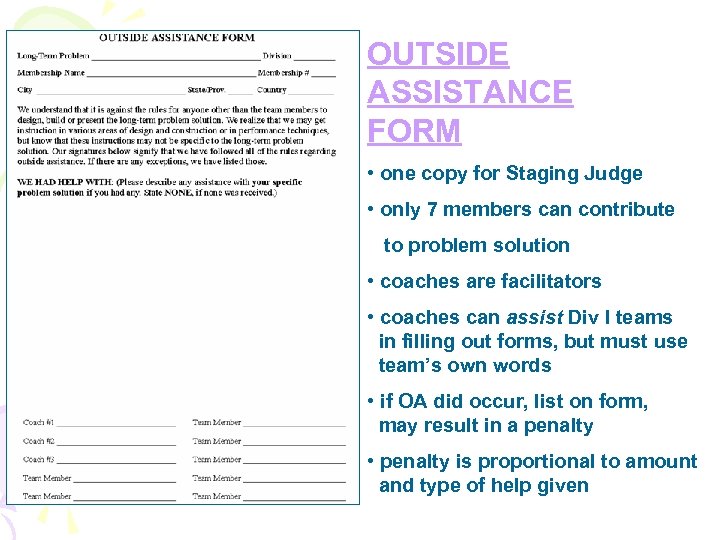 F o r m OUTSIDE ASSISTANCE FORM • one copy for Staging Judge • only 7 members can contribute to problem solution • coaches are facilitators • coaches can assist Div I teams in filling out forms, but must use team’s own words • if OA did occur, list on form, may result in a penalty • penalty is proportional to amount and type of help given
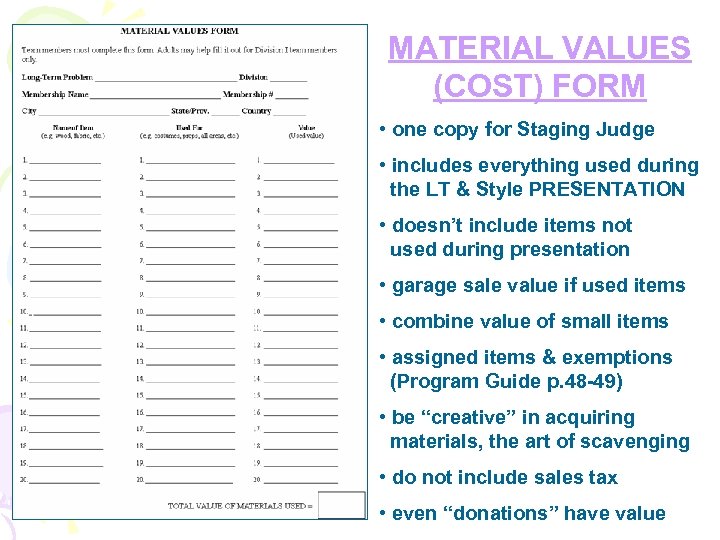 F o r m MATERIAL VALUES (COST) FORM • one copy for Staging Judge • includes everything used during the LT & Style PRESENTATION • doesn’t include items not used during presentation • garage sale value if used items • combine value of small items • assigned items & exemptions (Program Guide p. 48 -49) • be “creative” in acquiring materials, the art of scavenging • do not include sales tax • even “donations” have value
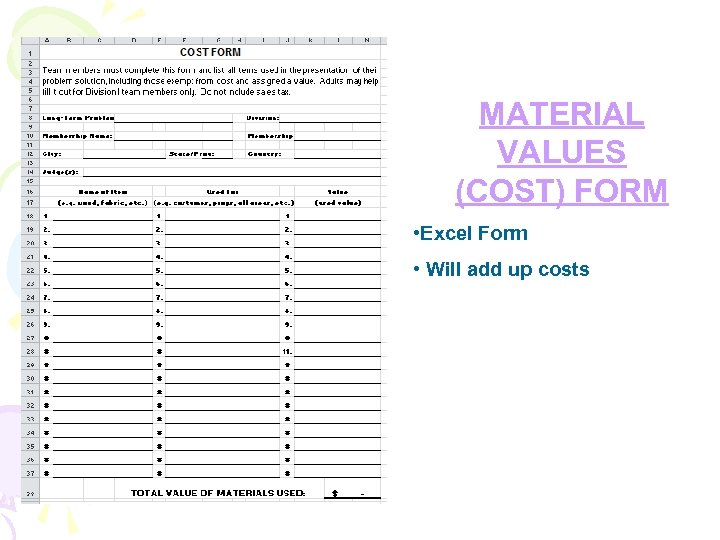 MATERIAL VALUES (COST) FORM • Excel Form • Will add up costs
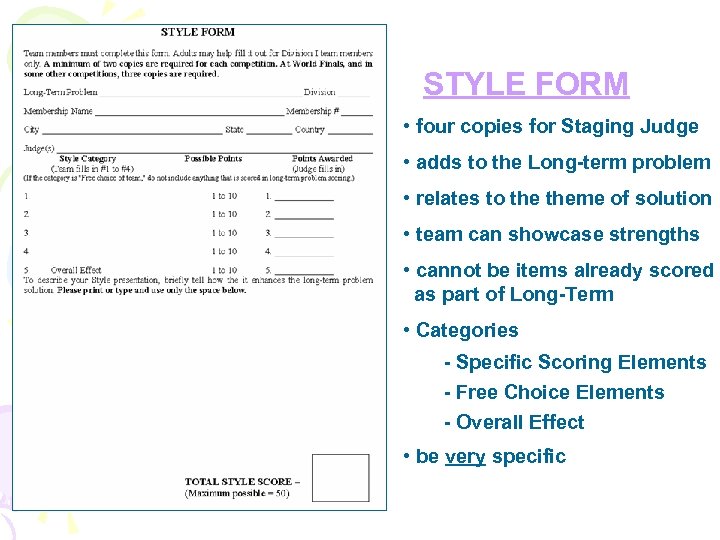 F o r m STYLE FORM • four copies for Staging Judge • adds to the Long-term problem • relates to theme of solution • team can showcase strengths • cannot be items already scored as part of Long-Term • Categories - Specific Scoring Elements - Free Choice Elements - Overall Effect • be very specific
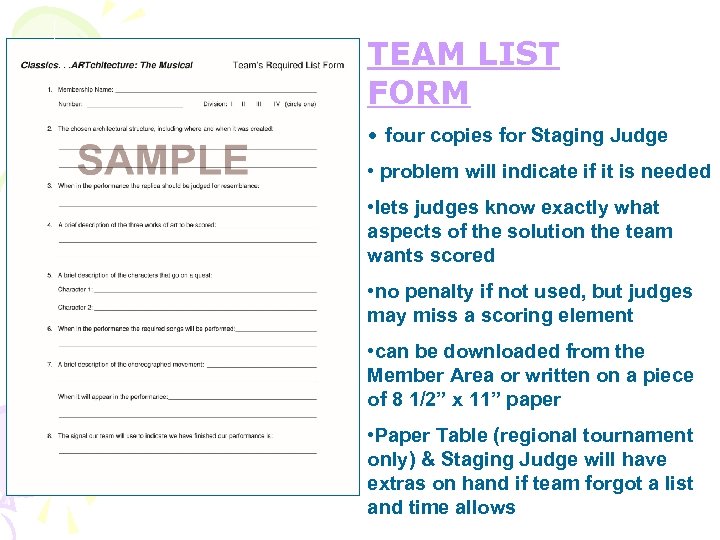 O u t s i d e A s s i s t a n c e F o r m TEAM LIST FORM • four copies for Staging Judge • problem will indicate if it is needed • lets judges know exactly what aspects of the solution the team wants scored • no penalty if not used, but judges may miss a scoring element • can be downloaded from the Member Area or written on a piece of 8 1/2” x 11” paper • Paper Table (regional tournament only) & Staging Judge will have extras on hand if team forgot a list and time allows
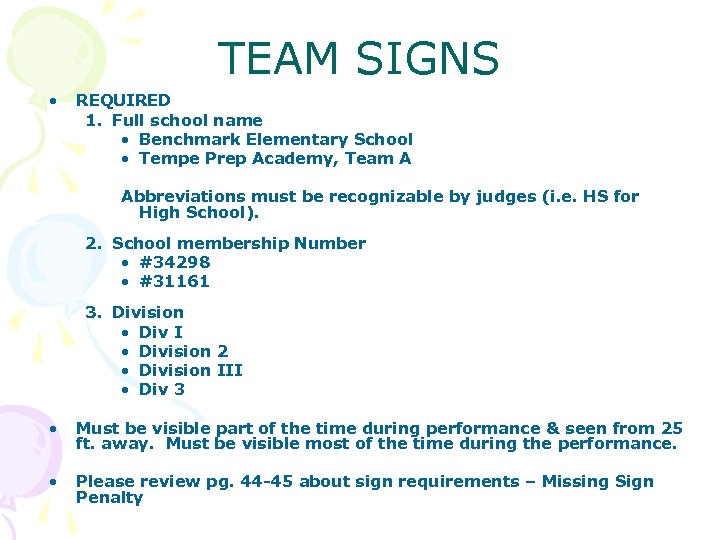 TEAM SIGNS • REQUIRED 1. Full school name • Benchmark Elementary School • Tempe Prep Academy, Team A Abbreviations must be recognizable by judges (i. e. HS for High School). 2. School membership Number • #34298 • #31161 3. Division • Div I • Division 2 • Division III • Div 3 • Must be visible part of the time during performance & seen from 25 ft. away. Must be visible most of the time during the performance. • Please review pg. 44 -45 about sign requirements – Missing Sign Penalty
 BREAK
BREAK
 MONITOR WEBSITES • Arizona–www. azodyssey. org – Tournament Schedules – Additional Information – Workshops/Trainings – Other Additional Information • International–www. odysseyofthemind. com – Clarifications – Other Additional Information
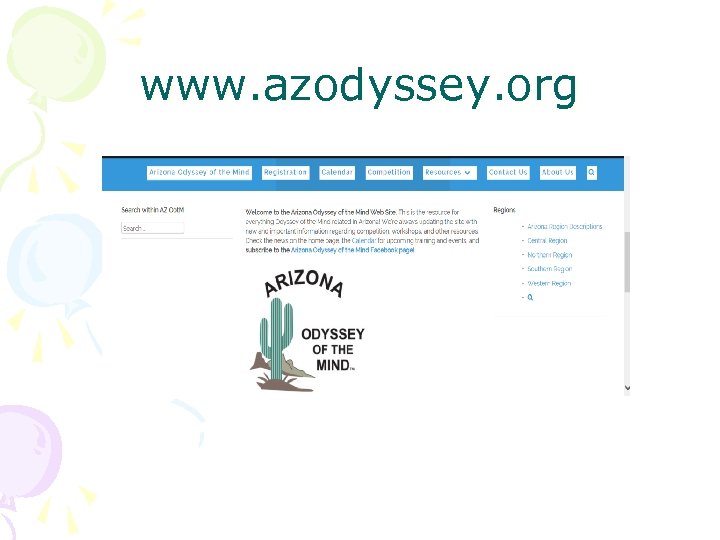 www. azodyssey. org
 CLARIFICATIONS pg 24 -25 Program Guide
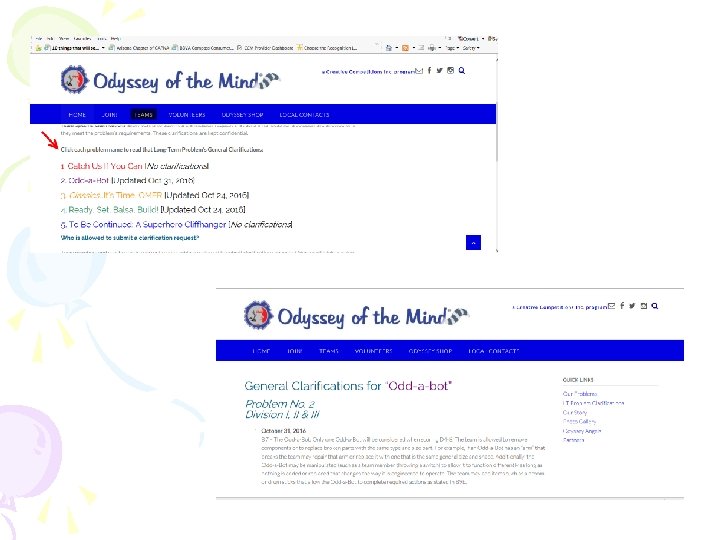
 General Clarifications • General Clarifications v Amend or further explain LT problem limitations v Found www. odysseyofthemind. com v Check for new clarifications often & before each level of competition
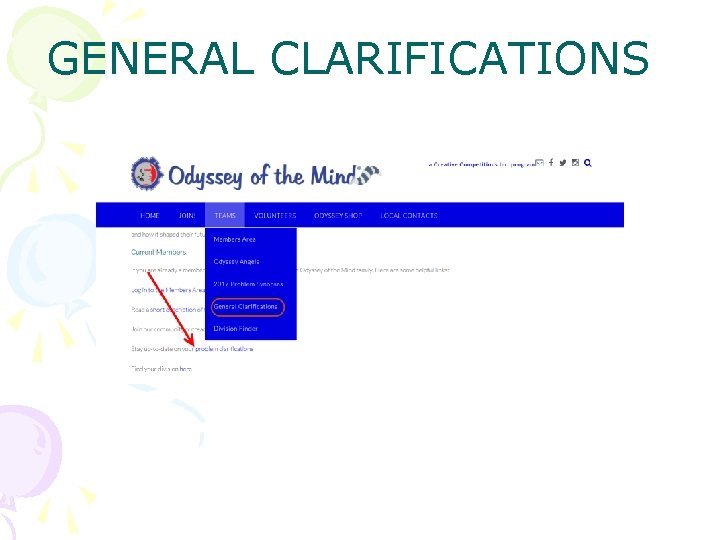 GENERAL CLARIFICATIONS
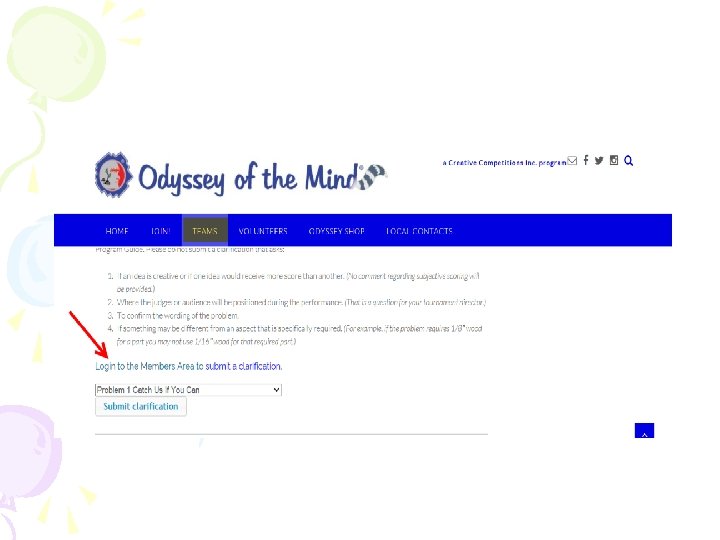
 Team Clarifications • Team Clarifications v. When questioning an interpretation & answer not found in general clarifications v. Team clarifications pertain to a particular team’s solution v. Confidential v. Must be presented to judges on competition day v. Deadline for Team Clarification Submission: 2/15/2018
 GOING TO TOURNAMENT
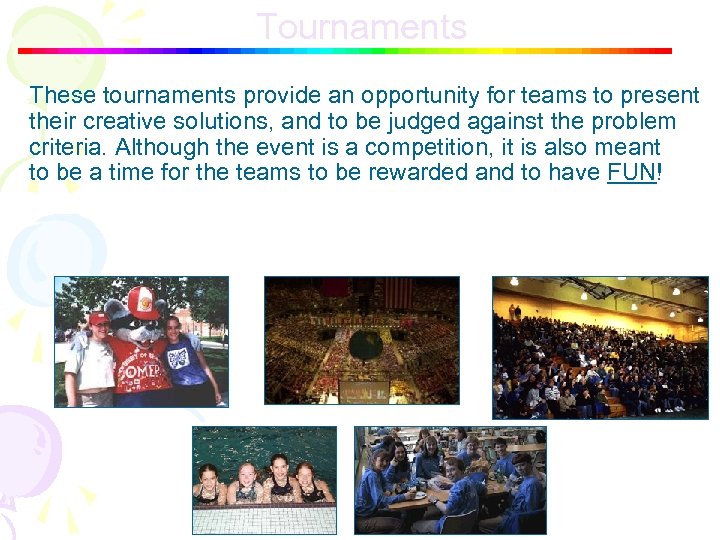 m e n t s Tournaments These tournaments provide an opportunity for teams to present their creative solutions, and to be judged against the problem criteria. Although the event is a competition, it is also meant to be a time for the teams to be rewarded and to have FUN!
 TOURNAMENT DAY: REGISTRATION • Check in at Registration Desk. • Check the schedule for last minute changes. • Check in at the Paper Table (next to Registration) with all their required paperwork. – Only at the Central Region Tournament
 TOURNAMENT DAY COMPETITION SITE • Find your LT Problem & Spontaneous Competition sites. • Find an area near your LT competition area to set up props/costumes/etc. • Teams should report to the competition areas (LT & Spontaneous) at least 15 minutes prior to scheduled competition time. – Please remind parents to arrive early at the LT competition site. – Once doors are closed, no one will be allowed in (no exceptions). – Remind parents that they will not be able to watch spontaneous
 Tournament Day: Long Term Performance • STAGING AREA – Report no later than 15 minutes before performance time – Coaches & Team only – no parents allowed in area • PERFORMANCE – Performance will never begin earlier than scheduled time – Coaches will be directed to their seats • AFTER THE PERFORMANCE – Coaches/Parents are not permitted on competition floor until judges are done speaking with team & directed to do so
 Tournament Day: Picking Up Scores • Coaches only pick up the score sheets from Head Judge when available. • Long Term & Style Scores – Teams receive Long Term & Style scores after competition – Only Long Term scores & Style scores are given to team coaches • Spontaneous Scores – Spontaneous scores will not be available until after the awards ceremony. – Teams will not receive individual judging score sheets.
 SCORES • Must pick up scores by 30 minutes after last team competes in that problem/judging team • Coaches have 30 minutes once they receive Long Term scores to return to the Head Judge with any questions or to contest results. – Coaches may only dispute Long Term scores. – Coaches may not dispute any subjective scoring elements. – Coaches may not dispute style or spontaneous scores.
 Tribunals • Long Term Problems only • Tribunal is to convened only when the question regards a rule infraction. Issues that arise as to whether or not something happened or did not happen during a team’s performance are not eligible for a tribunal
 SCORING • Scores consist of the combined Long-Term, Style & Spontanous percentaged scores. Penalty points are deducted from final combined score. • The highest score determine the winners in each problem within each division. • Final scores are carried to two decimal places. • Ties are awarded if there is less than 1 point difference total score
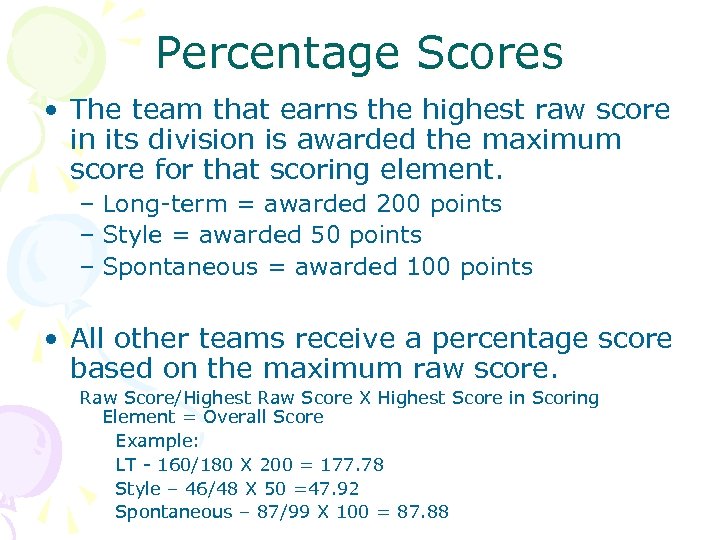 Percentage Scores • The team that earns the highest raw score in its division is awarded the maximum score for that scoring element. – Long-term = awarded 200 points – Style = awarded 50 points – Spontaneous = awarded 100 points • All other teams receive a percentage score based on the maximum raw score. Raw Score/Highest Raw Score X Highest Score in Scoring Element = Overall Score Example: LT - 160/180 X 200 = 177. 78 Style – 46/48 X 50 =47. 92 Spontaneous – 87/99 X 100 = 87. 88
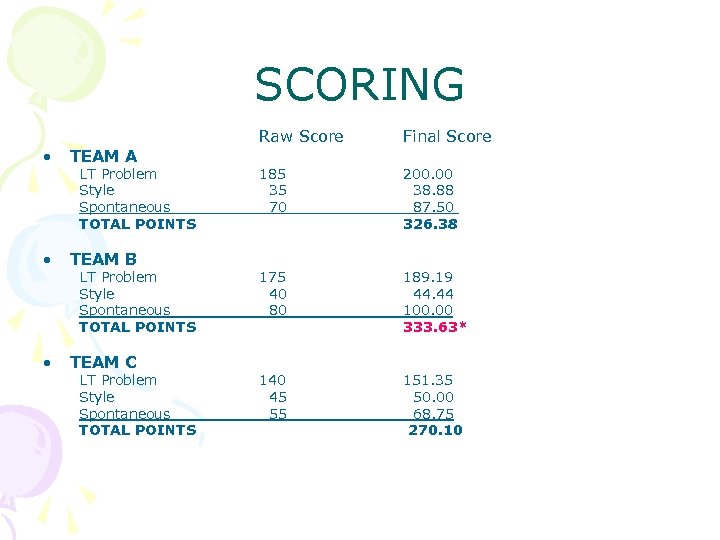 SCORING • TEAM A • TEAM B • TEAM C LT Problem Style Spontaneous TOTAL POINTS Raw Score Final Score 185 35 70 200. 00 38. 88 87. 50 326. 38 175 40 80 189. 19 44. 44 100. 00 333. 63* 140 45 55 151. 35 50. 00 68. 75 270. 10
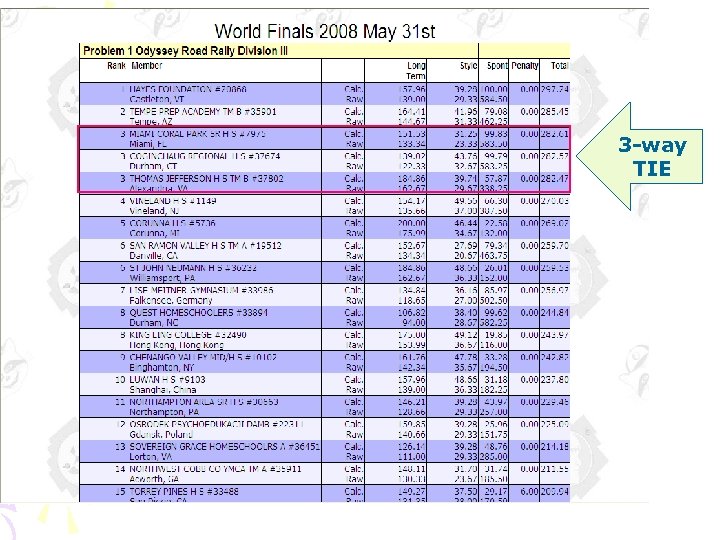 3 -way TIE
 Awards Ceremony Advancing on to the Next Competition Level: • Teams that place 1 st & 2 nd place in their problem & division • Ranatra Fusca Winners
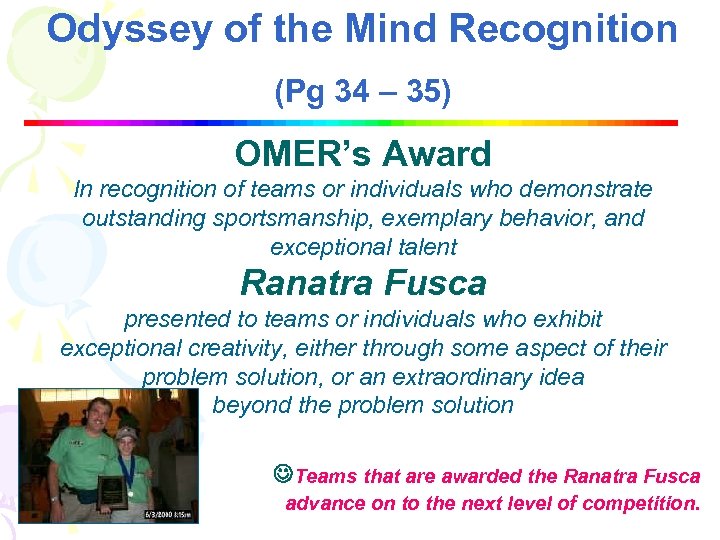 i t i o n Odyssey of the Mind Recognition (Pg 34 – 35) OMER’s Award In recognition of teams or individuals who demonstrate outstanding sportsmanship, exemplary behavior, and exceptional talent Ranatra Fusca presented to teams or individuals who exhibit exceptional creativity, either through some aspect of their problem solution, or an extraordinary idea beyond the problem solution Teams that are awarded the Ranatra Fusca advance on to the next level of competition.
 Tournament • Enjoy other performances • Coaches responsible for monitoring teams/meals • Have fun! • Good Luck!
 THANK YOU & GOOD LUCK!