 Скачать презентацию Areas of Responsibility Risk Assessment Physical Mental
c74fdd382f577813bf36adf03345372c.ppt
- Количество слайдов: 45




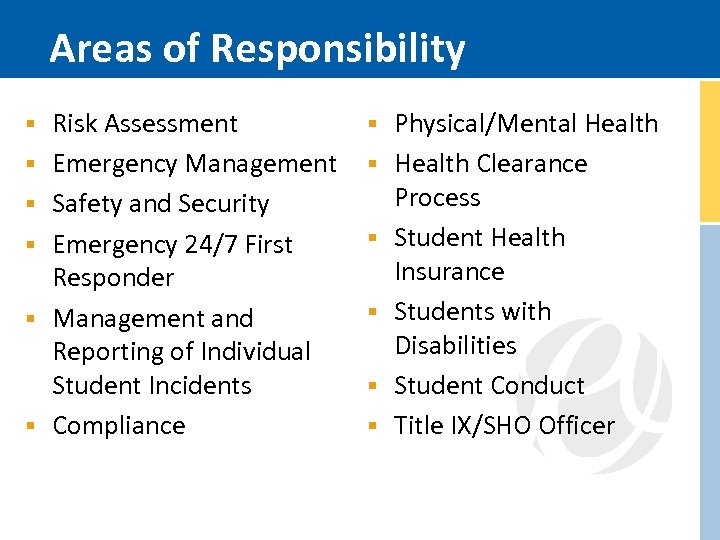
Areas of Responsibility § Risk Assessment § Physical/Mental Health § Emergency Management § Health Clearance § Safety and Security § Emergency 24/7 First Responder § Management and Reporting of Individual Student Incidents § Compliance § § Process Student Health Insurance Students with Disabilities Student Conduct Title IX/SHO Officer
Take a Moment § What are your views about depression, counseling, mental health, suicide? § Recognize your own reactions § Where did you first learn about mental health, counseling, mental illness? § How does your family feel about counseling? § How does your culture view mental health?
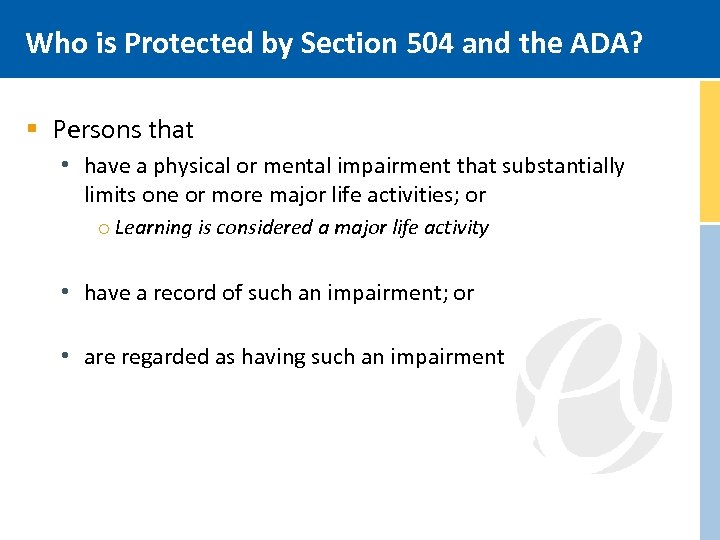
Who is Protected by Section 504 and the ADA? § Persons that • have a physical or mental impairment that substantially limits one or more major life activities; or o Learning is considered a major life activity • have a record of such an impairment; or • are regarded as having such an impairment
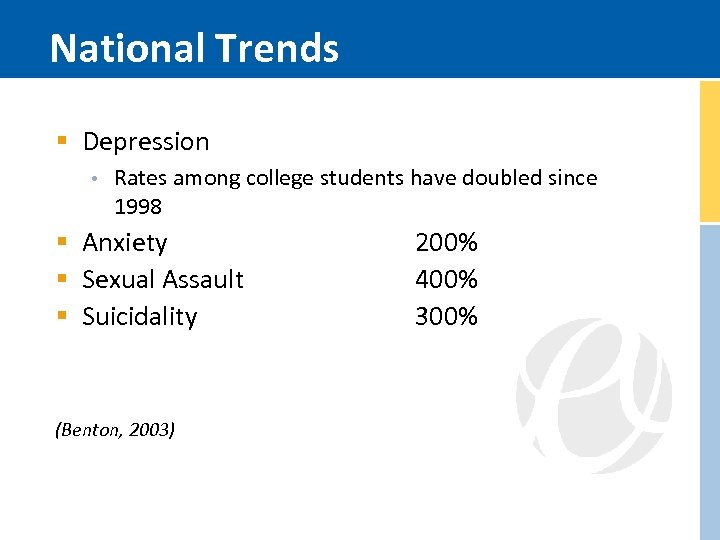
National Trends § Depression • Rates among college students have doubled since 1998 § Anxiety § Sexual Assault § Suicidality (Benton, 2003) 200% 400% 300%
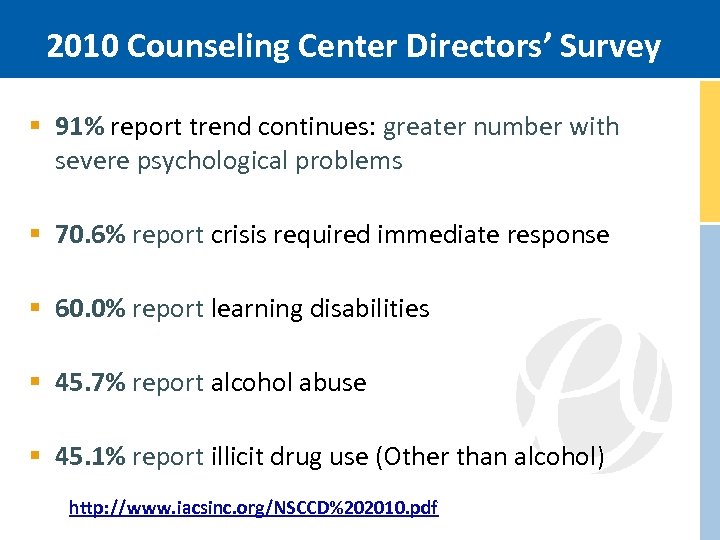
2010 Counseling Center Directors’ Survey § 91% report trend continues: greater number with severe psychological problems § 70. 6% report crisis required immediate response § 60. 0% report learning disabilities § 45. 7% report alcohol abuse § 45. 1% report illicit drug use (Other than alcohol) http: //www. iacsinc. org/NSCCD%202010. pdf
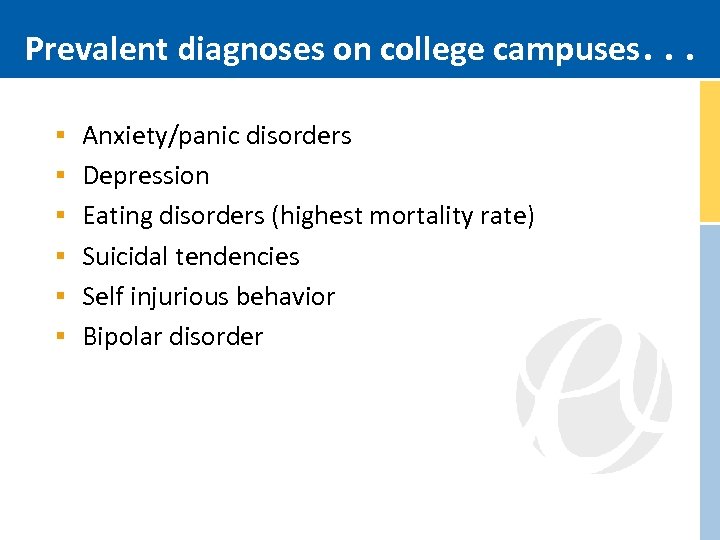
Prevalent diagnoses on college campuses. . . § Anxiety/panic disorders § Depression § Eating disorders (highest mortality rate) § Suicidal tendencies § Self injurious behavior § Bipolar disorder
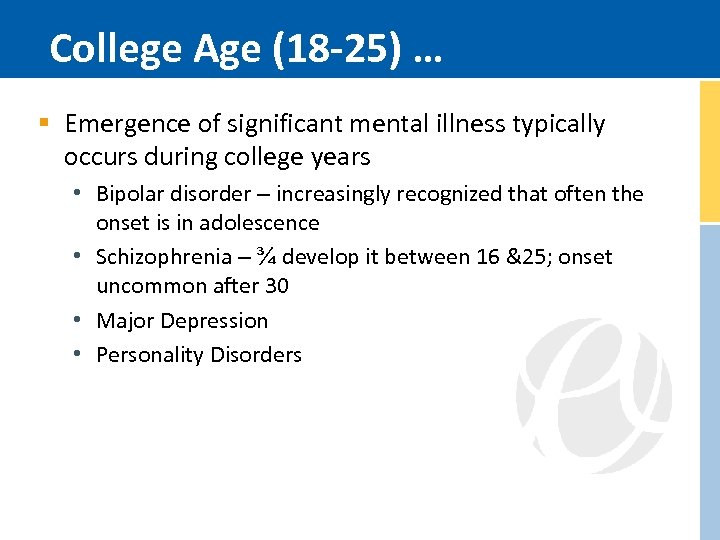
College Age (18 -25) … § Emergence of significant mental illness typically occurs during college years • Bipolar disorder – increasingly recognized that often the onset is in adolescence • Schizophrenia – ¾ develop it between 16 &25; onset uncommon after 30 • Major Depression • Personality Disorders
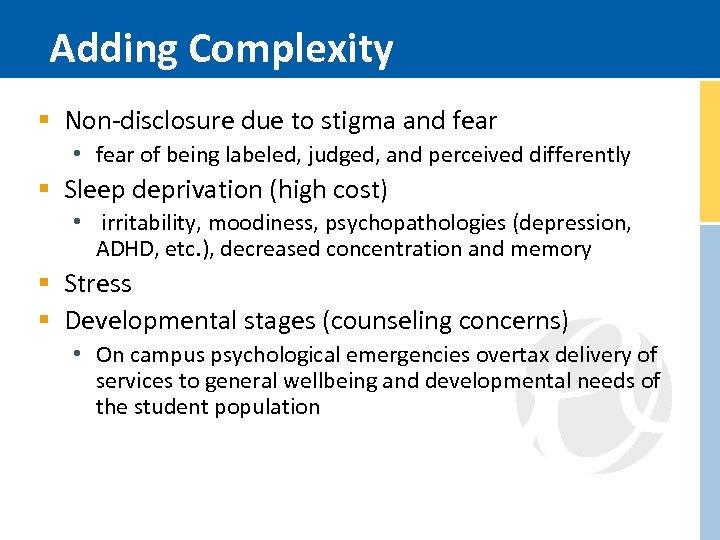
Adding Complexity § Non-disclosure due to stigma and fear • fear of being labeled, judged, and perceived differently § Sleep deprivation (high cost) • irritability, moodiness, psychopathologies (depression, ADHD, etc. ), decreased concentration and memory § Stress § Developmental stages (counseling concerns) • On campus psychological emergencies overtax delivery of services to general wellbeing and developmental needs of the student population
Adding complexity § High risk behaviors: Substance abuse • Co-occurring mental disorders are common where substance abuse is present § Buying/selling medication; abuse of non-prescribed medication; abuse of OTC medication (cough and cold medicines, etc. ) • Adderall § Self-medicating - non-prescribed § Non-compliance with medication; significant issue • Side effects • Interferes with alcohol consumption
Adding complexity § Student’s failure to obtain needed help • Resistance • Lack of awareness • Stigma; discrimination § Therapy reluctance • Waiting until problems are severe • Reluctance to continue treatment (time commitment) • Family cultural values; parental denial
Alcohol Abuse § Binge drinking: five consecutive alcoholic drinks for a man, four for a woman • 2 of every 5 students—more than 40 percent— § About 1, 825 college students die each year in alcohol-related accidents – unintentional injuries, including automobile accidents § About 97, 000 students are raped or sexually assaulted each year http: //www. niaaa. nih. gov/Pages/default. aspx
Alcohol Abuse § About 696, 000 a year are assaulted by another student who has been drinking § About 25% say alcohol has hurt their academic performance § 8% – 400, 000 students – report having unprotected sex when drinking (increased risk for pregnancy, AIDS, STDs) § 100, 000 too intoxicated to know if they consented to having sex
Are Current Users of Alcohol Excluded from Protection under Section 504? § No. Section 504's definition of a student with a disability does not exclude users of alcohol § However, Section 504 allows disciplinary action against students with disabilities using drugs or alcohol to the same extent as students without disabilities
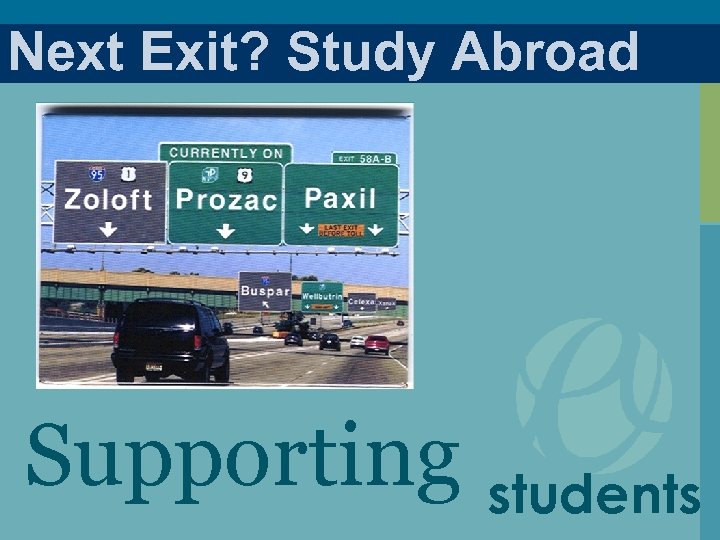
Next Exit? Study Abroad Supporting students
Consultation § Consultation is key § Do not try to handle things on your own § Know your institutional counseling staff
Culture Shock vs. Serious Mental Health Concerns ■ Culture Shock § A normal developmental phase of adjustment § Mimics more severe psychological problems such as clinical depression and anxiety … o feeling helpless, out of control, vulnerable, fearful, anxious, confused, crying or sleeplessness ■ Usually Time Limited – (e. g. 2 -weeks)
Contributing elements § § § Separation § Travel stress § Culture shock; different expectations § § Adjusting to local conditions; social pressures – new friends Learning or using a learned § foreign language to communicate § Managing condition in unfamiliar § setting; foreign language skill § Preexisting or dormant conditions Change in medication Stopping medication Lack of continuity of care─no plan Self medication (drugs, alcohol, etc. ) Unforeseen events New relationships gone wrong Financial hardship • Financial hardship of family in the U. S. due to job loss
Impact on Education Abroad § Upward trend in the number of students with mental disorders (mild – severe) § Local laws are different § Culture is different § Local language may be different
Common Issues Abroad § § Substance Abuse § Anger Management § Disregard of others within § student community § Abruptly stopping medication, or medication not legal/locally available • “magic cure” § History of eating disorder § Unable to manage health condition History of severe depression, anxiety, bipolar disorder History of suicide attempt/ideation • Suicide is the second leading cause of death in college students; the third leading cause of death in adolescents. § Students without any psychological illness experiencing symptoms for the first time abroad § Cutting
Best Practices
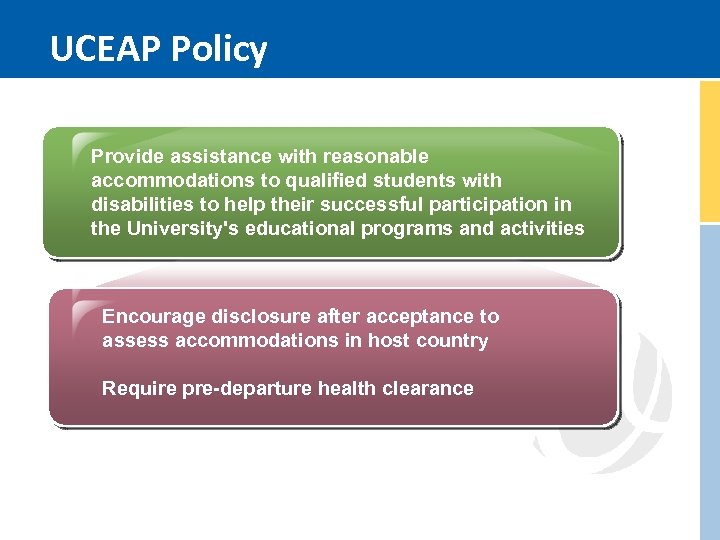
UCEAP Policy Provide assistance with reasonable accommodations to qualified students with disabilities to help their successful participation in the University's educational programs and activities Encourage disclosure after acceptance to assess accommodations in host country Require pre-departure health clearance
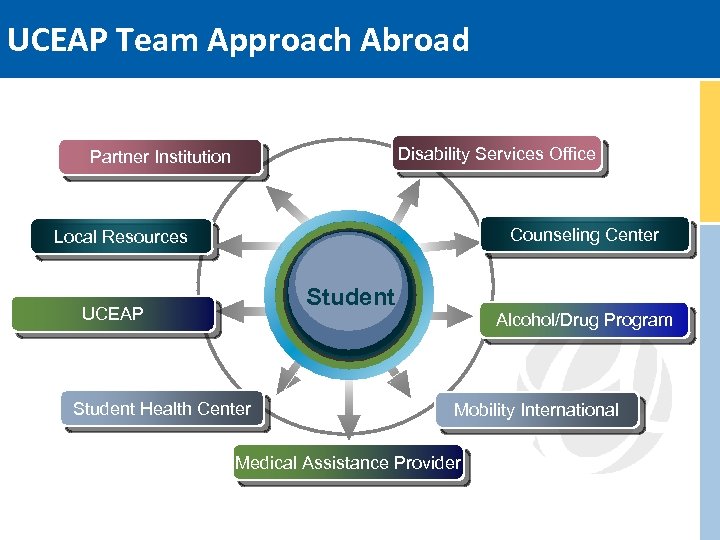
UCEAP Team Approach Abroad Disability Services Office Partner Institution Counseling Center Local Resources Student UCEAP Alcohol/Drug Program Student Health Center Mobility International Medical Assistance Provider
Best Practices § Close work with University Counsel and Risk Manager (protocols, forms/contracts) § Design policies to allow withdrawal for medical reasons (involuntary withdrawal? ) • Consider: Work with travel assistance provider, can student travel alone? • Treatment resources for a safe transition back to the U. S. campus § Design policies to allow return to program; know if you can stipulate conditions
Best Practices § Clearly delineated protocols • Before departure/during program • Review and update protocols and policies regularly • Legal implications should never be the main concern—student/faculty/staff safety
Best Practices § Require health insurance; med evac/repat • Know your insurance/assistance providers § Require a pre-departure health clearance • • After acceptance Explain confidentiality Encourage self-disclosure Consider pre-departure safety health plans
Best Practices § Learn about health resources and have a list ready before you need a referral • • • U. S. Embassy Insurance carrier (travel assistance) U. S. programs in area U. S. university counseling center Local health clinics and hospitals Local health practitioners and specialists (English speakers; culturally sensitive)
Best Practices § Be aware of the attitudes toward mental disabilities in the local culture; explain to students § Determine the role of culture in diagnosis, treatment and outcome of mental illness
Training
Why is Training Important? § Some students in distress seek help § Others will not seek help, but will show warning signs § Impact is on ALL students in program
Understand your Role: 5 Simple Steps 1. Learn to spot signs of distress early (Assess student behavior: Is it normal? Atypical? Any warning signs? ) 2. Know how to offer support; work with student 3. Connect student to resources; know your limits 4. Know emergency procedures; insurance coverage; assistance provider 5. Do not offer support beyond your expertise and official duties
Why are Training and Collaboration Important? § Cross-train Counseling and Student Health staff Consultants Prevent stigma Privacy vs safety Guidance about local resources/legality of prescribed medications from EAO • Helps to remain focused and calm • Helps with international students on your campus and study abroad students (natural disaster, major unrest affecting the host country) • •
What to do when Student Discloses? § Pre-departure: • Discuss with student anticipated challenges, management plan and risks • Identify treatment provider in host country before leaving home • Consider agreeing to a Safety Health Plan (spelling out expected behaviors and consequences of not following) • Send message to all students about local resources, medication
Do’s. . . § Be realistic about local resources § Have contingency plans in place § Provide pre-departure information for students and parents § Normalize process to ask for help § Express your concern directly § Have a plan, especially if clinical support is needed when abroad § Offer assistance with appointment (use your assistance provider) § Remove barriers (lack of money § Use a team approach
Don’ts. . . § Diagnose or analyze § Try to manage situation (not your job) by yourself § Minimize problems § Forget to self care (seek support for yourself) § Ignore comments about suicide § Be caught without a plan § Be sworn to secrecy
You can help… § The majority of students with disabilities can participate successfully • Proper planning • Discuss potential study abroad stressors • Provide resources
Resources § Active Minds (peer to peer resource) • http: //www. activemindsoncampus. org/ § The American Association of Suicidology • www. suicidology. org/ § American College Health Association • www. acha. org/ § American Foundation for Suicide Prevention • www. afsp. org
Resources § Bazelon Center for Mental Health Law • www. bazelon. org/ § College Drinking – Changing the Culture • http: //www. collegedrinkingprevention. gov/ § Jed Foundation • www. jedfoundation. org
Resources § NAFSA Best Practices in Addressing Mental Health Issues Affecting Education Abroad Participants • www. nafsa. org/mentalhealth § My Student Body • www. mystudentbody. com § National Institute on Drug Abuse • www. nida. nih. gov/
Resources § Substance Abuse & Mental Health Services Administration • www. samhsa. gov • What a Difference a Friend Makes o http: //whatadifference. org/support. asp? nav=nav 02_3&con tent=2_3_3_peers § Helping your Student when Stress Turns into Distress (Guide for Parents) http: //uhs. berkeley. edu/parents/stress. shtml
Resources § The Loneliest Disease • http: //www. wtop. com/? nid=226&sid=1357907 • WTOP's Darci Marchese and Kate Ryan look at the impact of mental illness § Urban Dictionary • www. urbandictionary. com § World Health Organization • Mental Health Atlas o http: //www. who. int/globalatlas/default. asp § University of California, Berkeley Online Staff Training http: //uhs. berkeley. edu/facstaff/CPStraining/index. htm http: //uhs. berkeley. edu/training/violenceawareness/
Contact information: Inés De. Romaña, Principal Analyst Health, Security, and Emergency Response University of California System Education Abroad Program 6950 Hollister Ave. Suite 200 Goleta, California 93117 -5823 U. S. A. Ph: 1+805. 893. 7936|Cell: 1+805. 451. 1704 |Email: ideromana@eap. ucop. edu
Permission to Use § Conditioned on acknowledgement of Ines De. Romana as the author, with copyright belonging to The Regents of the University of California.
Скачать презентацию Areas of Responsibility Risk Assessment Physical Mental
c74fdd382f577813bf36adf03345372c.ppt