 Скачать презентацию Are you worried about a child —
81df21c16743a152ec3686a11a9ca532.ppt
- Количество слайдов: 41



‘Are you worried about a child? ’ - Understanding Thresholds in Safeguarding 28 th November 2017 Paulette Laing MASH Team Manager Amanda Jones LSCB Training Manager
Working together • • • Giving everyone space to participate Respecting difference Confidentiality Jargon buster Car Park A
Learning Objectives Participants will be able to: • Describe and understand the ‘levels of need’ which will be applied to determine whether the child and family can be appropriately and safely helped by early intervention and family support services • Discuss indicators of different kinds of risk within these levels • Know how to access services for children with different levels of need effectively, and what kind of response can be expected.
Rationale “Differences in perceived thresholds can lead to frustration or breakdown in effective working, resulting in children falling through the gaps or their needs not being met”. Research by the Department for Education (Df. E) of 293 Serious Case Reviews (SCRs) A
Working Practices: Multi-agency working § It is recommended that staff in Universal Services, take on a greater share of the responsibility of protecting Children (children/young people who are experiencing neglectful or abusive home environments may not stand out at school or to other professionals) § In 2009 - 2011 only 42 % of children were receiving services from Children’s Social Care at the time of the child’s death or incident which prompted a SCR NSPCC : Serious Case Reviews all in one place http: //www. nspcc. org. uk/Inform/resourcesforprofessionals/scrs/serious_case_reviews_2013_wda 94557. html A
Triennial Review of Serious Case Reviews • 293 notifications : 63 in 2011 -12, 95 in 2012 -13, and 135 in 2013 -14 • 41% were aged under one year at the time of their death, or incident of serious harm • half of these babies (43%) were under 3 months old • 22% were aged between 1 and 5 years • 10% aged between 6 and 10 years. • 28% young people aged 11 years and over; of whom 41 were aged 11 -15 years, and 40 aged 16 -18 years
Working in Partnership http: //www. scie. org. uk/socialcaretv/videoplayer. asp? v=partnership-working-in-childprotection
The Redbridge Picture • The contact and referral rates in Redbridge are on an upward trajectory. The MASH receives between 300 -430 contacts per week and between 70 -120 referrals per week. • The highest reasons for contacts and referrals are; Domestic Abuse, Physical Abuse and Neglect. • The levels of need in Redbridge are on trend to increase with the on-going government agenda on welfare reform. E
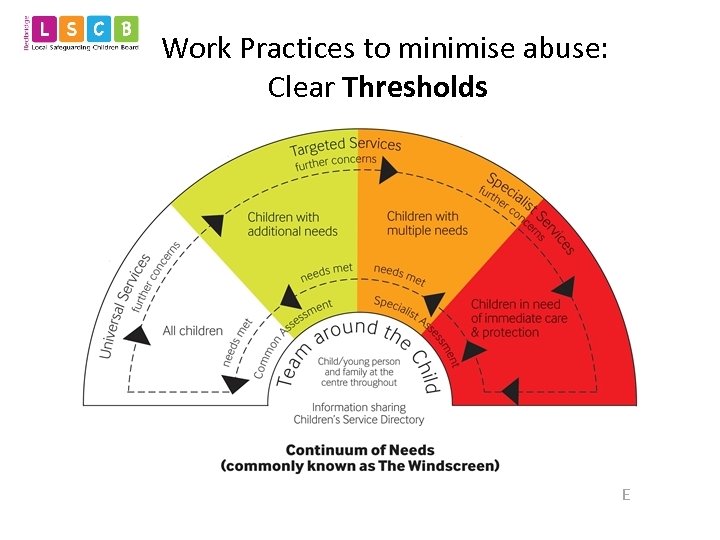
Work Practices to minimise abuse: Clear Thresholds E
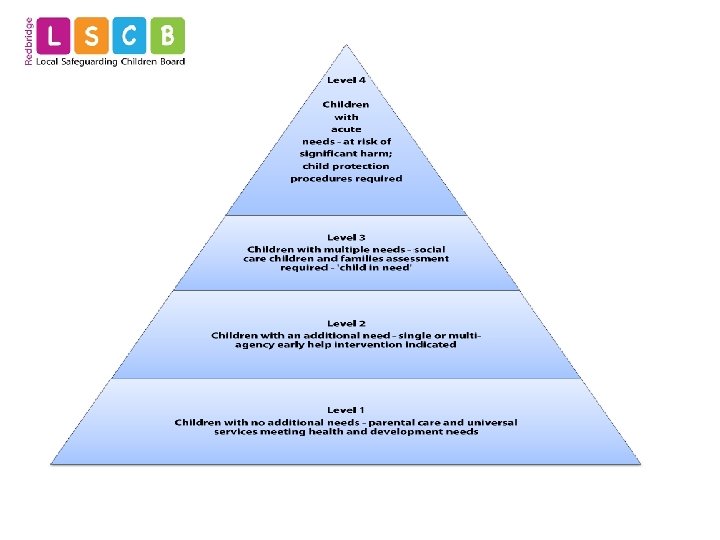
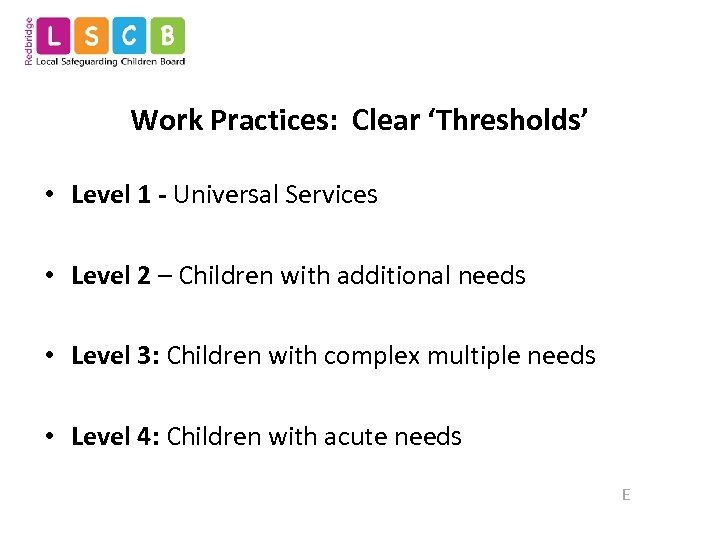
Work Practices: Clear ‘Thresholds’ • Level 1 - Universal Services • Level 2 – Children with additional needs • Level 3: Children with complex multiple needs • Level 4: Children with acute needs E
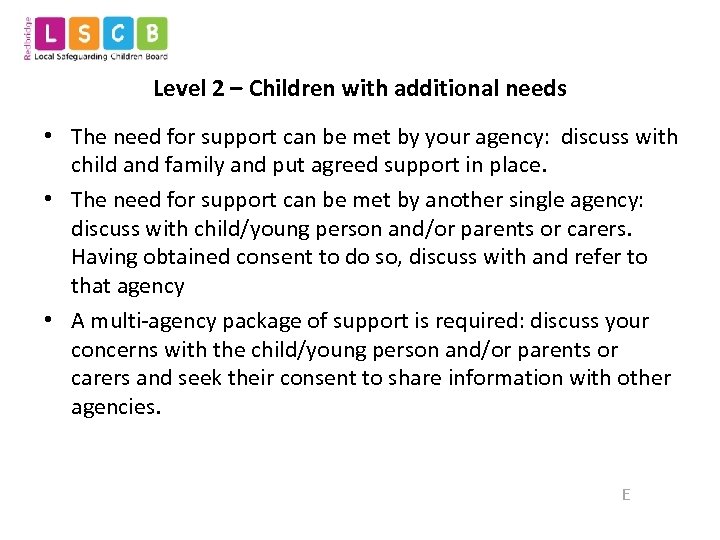
Level 2 – Children with additional needs • The need for support can be met by your agency: discuss with child and family and put agreed support in place. • The need for support can be met by another single agency: discuss with child/young person and/or parents or carers. Having obtained consent to do so, discuss with and refer to that agency • A multi-agency package of support is required: discuss your concerns with the child/young person and/or parents or carers and seek their consent to share information with other agencies. E
Level 2 – Children with additional needs / 2 • Consent obtained: Complete an assessment using the Common Assessment Framework (CAF). The CAF is an assessment that is completed with a child, young person and their family to decide what help is needed. • CAF Coordinator arranges a Team Around the Child (TAC) Meeting where a professional will be identified to lead on organising support. E
In Redbridge…. • Services to meet this level are: • Team of Family Support Workers Team of CAF Coordinators Parenting groups Young Women’s and Young Peoples Group Children’s Centres There is a strong interface between Multi-agency Safeguarding Hub (MASH) and Early Intervention via the daily divert and ‘step down’ meetings with Child Protection & Assessment Team (CPAT). E
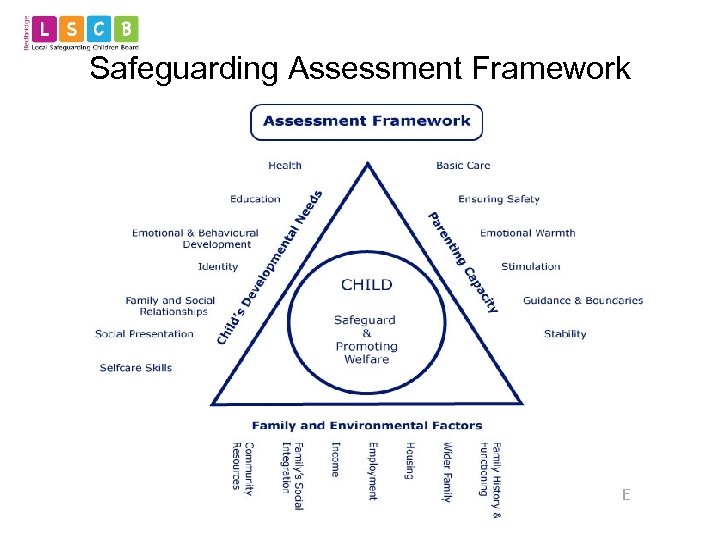
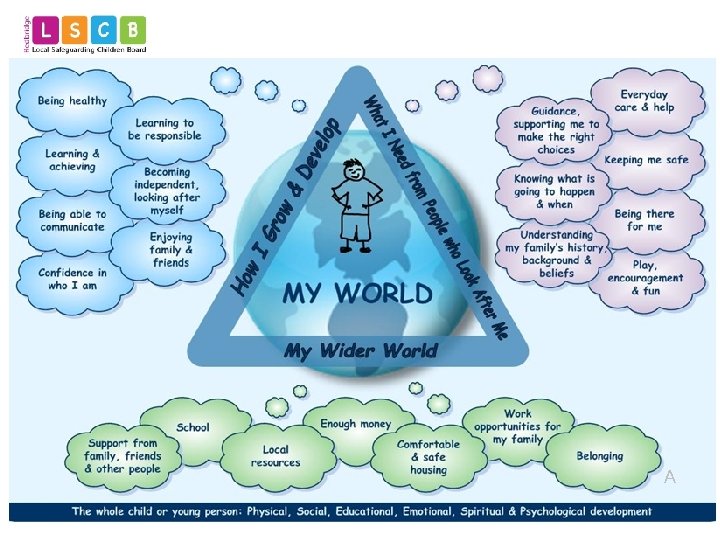
Safeguarding Assessment Framework E
Level 3: Children with complex multiple needs • Discuss concerns with the child or young person’s parents or carers and seek their consent to share information, unless you have reasonable cause to believe that do would place the child at risk of significant harm • If you believe that a child has needs which must be met if the child is to achieve or maintain a satisfactory level of health or development / or to prevent significant impairment of their health and development you should refer to children’s social care E
Other Level 3 complex needs You may also consider a referral to MARAC (Multi Agency Risk Assessment Conference) which is a forum in which information about high risk domestic abuse victims is shared between agencies and a risk focused, co-ordinated safety plan is drawn up to support the victim. E
In Redbridge…. • Services to meet this level are: - Child and Family Assessments - Child in Need work and reviews • These cases can move up to child protection or down to early intervention during the process of assessment or Children In Need (CIN) work. • London CP Procedures: http: //www. londoncp. co. uk/chapters/referral_asses s. html#assess E
Level 4: Children with acute needs • If the child is at immediate risk, contact the police by calling 999 • If a child is at risk of significant harm, information can be shared even if the parent refuses consent. • You should make a referral without delay to children’s social care • If following consideration of all the information available, including multi-agency information obtained via the MASH, the referral is judged to meet the Level 4 threshold, a multi-agency strategy meeting will be held to plan an inquiry under Section 47 of the Children Act 1989. Emergency action will be taken if necessary to protect the child. London Procedures: http: //www. londoncp. co. uk/chapters/chi_prot_enq. html#section E
In Redbridge…. • Services to meet this level are: - Strategy discussions / meetings Section 47 enquiries Child Protection Conferences / Core Groups PLO / Care Proceedings • Cases at level 4 can step down to child in need or progress into court proceedings where children may E be subject to interim or full care orders.
Parental mental health and child welfare – the practitioners’ perspective http: //www. scie. org. uk/socialcaretv/videoplayer. asp? guid=551 ea 41 e-acdb-4 da 3 -b 2171285595 bf 069 A (15 minutes)
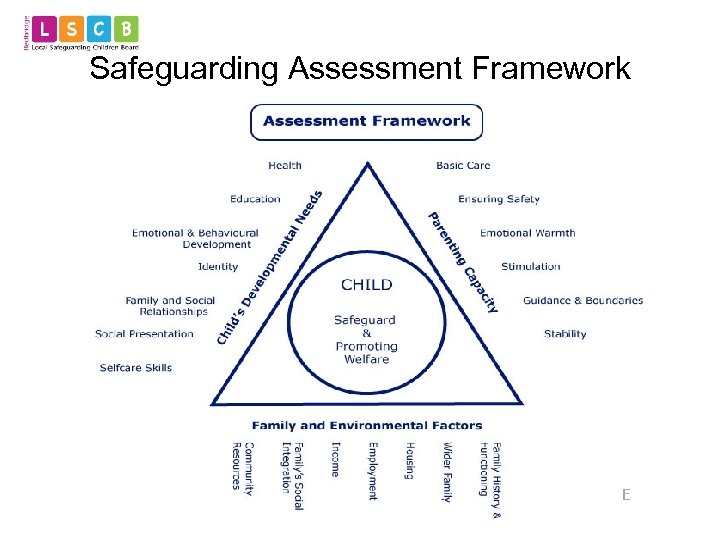
Safeguarding Assessment Framework E
Case studies – Apply threshold • Referral received regarding Sara a 13 year old girl with mild learning difficulties. Her parents allow her to go shopping on Saturday. She gets chatting to two 14 year old boys. One asks Sara for a blow job. She obliges. The other boy then also asks for a blow job. She refuses. There is no further contact with the boys. E
Case studies – Apply threshold • Referral received from the police regarding domestic abuse. Father and mother had an argument which resulted in father headbutting mother. The children, aged 4 and 6, were present. There have been no other reported incidents of domestic abuse. E
Case studies – Apply threshold • Police referral received regarding a 16 year old girl who reported that she was assaulted by her father last week. She is worried about her safety as the family is returning to Afghanistan soon for four months. She is worried she will be forced to marry in Afghanistan and not be returned to the UK. E
Accessing Services • Threshold is pivotal to accessing services at the identified levels of need and risk. • Referrals are often complex and therefore threshold is blurred - this is what MASH is for! • MASH enables confidential screening and research on vulnerable children which is collated analysed by a social worker. E
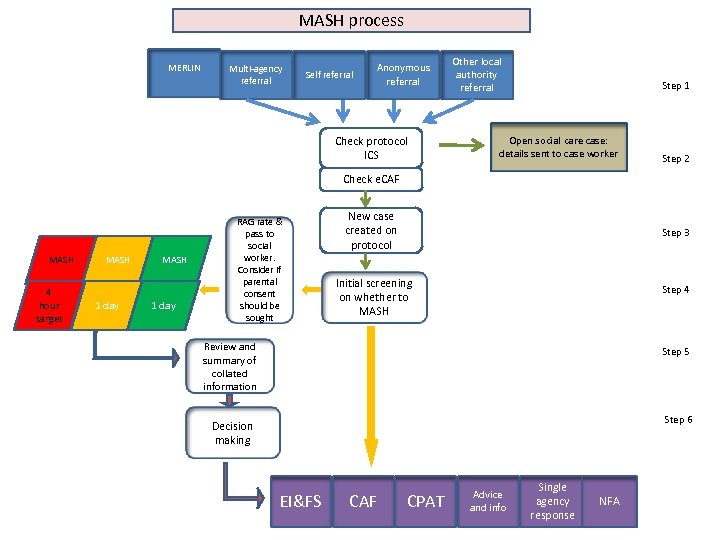
MASH process MERLIN Multi-agency referral Self referral Anonymous referral Check protocol ICS Other local authority referral Step 1 Open social care case: details sent to case worker Step 2 Check e. CAF MASH 4 hour target MASH 1 day RAG rate & pass to social worker. Consider if parental consent should be sought New case created on protocol Step 3 Initial screening on whether to MASH Step 4 Review and summary of collated information Step 5 l Step 6 Decision making EI&FS CAF CPAT Advice and info Single agency response NFA
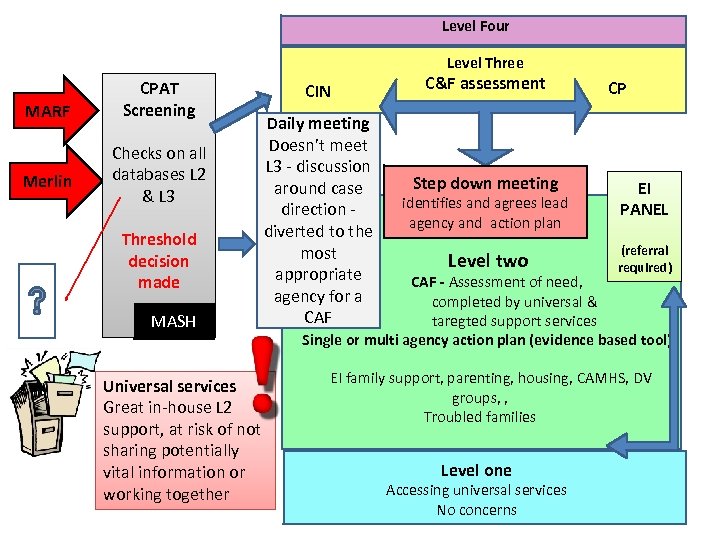
Level Four Level Three MARF Merlin CPAT Screening Checks on all databases L 2 & L 3 Threshold decision made MASH Universal services Great in-house L 2 support, at risk of not sharing potentially vital information or working together CIN C&F assessment Daily meeting Doesn’t meet L 3 - discussion Step down meeting around case identifies and agrees lead direction agency and action plan diverted to the most Level two appropriate CAF - Assessment of need, agency for a completed by universal & CAF taregted support services CP EI PANEL (referral required) Single or multi agency action plan (evidence based tool) EI family support, parenting, housing, CAMHS, DV groups, , Troubled families Level one Accessing universal services No concerns
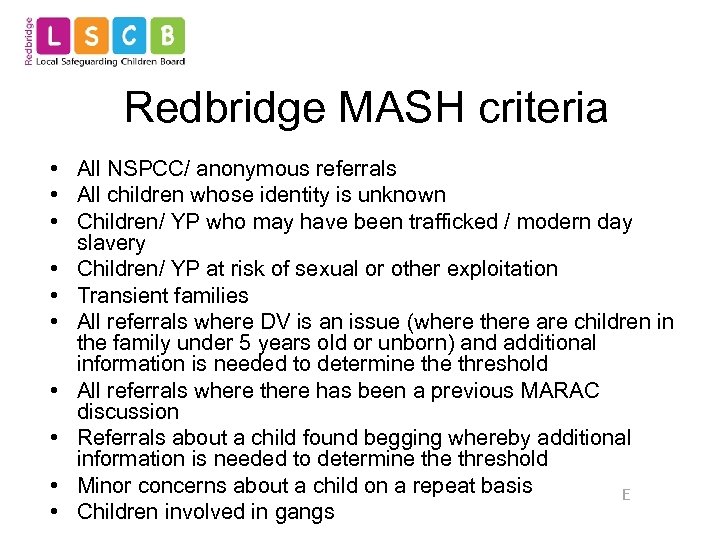
Redbridge MASH criteria • All NSPCC/ anonymous referrals • All children whose identity is unknown • Children/ YP who may have been trafficked / modern day slavery • Children/ YP at risk of sexual or other exploitation • Transient families • All referrals where DV is an issue (where there are children in the family under 5 years old or unborn) and additional information is needed to determine threshold • All referrals where there has been a previous MARAC discussion • Referrals about a child found begging whereby additional information is needed to determine threshold • Minor concerns about a child on a repeat basis E • Children involved in gangs
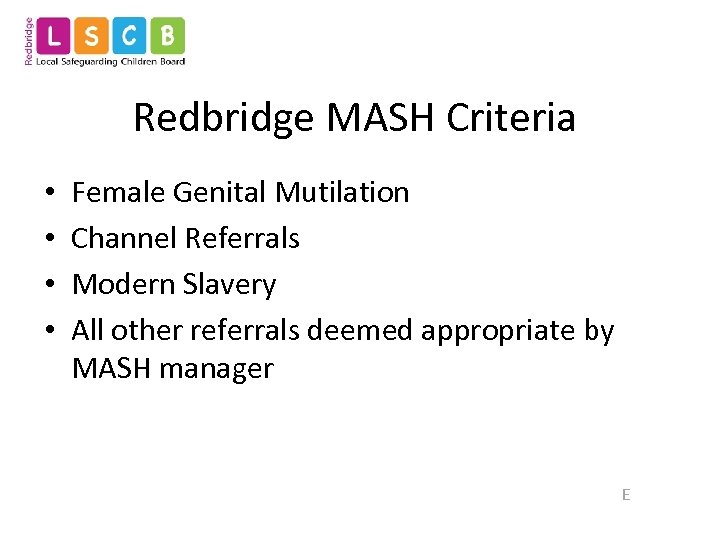
Redbridge MASH Criteria • • Female Genital Mutilation Channel Referrals Modern Slavery All other referrals deemed appropriate by MASH manager E
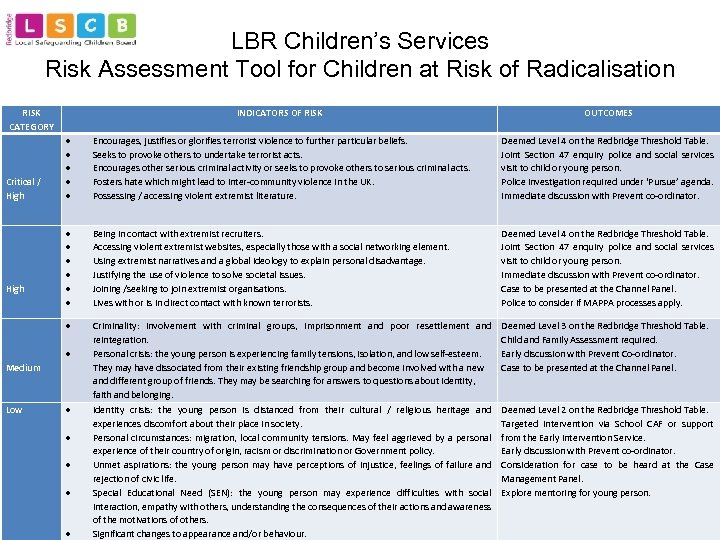
LBR Children’s Services Risk Assessment Tool for Children at Risk of Radicalisation RISK CATEGORY INDICATORS OF RISK OUTCOMES Critical / High Encourages, justifies or glorifies terrorist violence to further particular beliefs. Seeks to provoke others to undertake terrorist acts. Encourages other serious criminal activity or seeks to provoke others to serious criminal acts. Fosters hate which might lead to inter-community violence in the UK. Possessing / accessing violent extremist literature. Deemed Level 4 on the Redbridge Threshold Table. Joint Section 47 enquiry police and social services visit to child or young person. Police investigation required under ‘Pursue’ agenda. Immediate discussion with Prevent co-ordinator. High Being in contact with extremist recruiters. Accessing violent extremist websites, especially those with a social networking element. Using extremist narratives and a global ideology to explain personal disadvantage. Justifying the use of violence to solve societal issues. Joining /seeking to join extremist organisations. Lives with or is in direct contact with known terrorists. Deemed Level 4 on the Redbridge Threshold Table. Joint Section 47 enquiry police and social services visit to child or young person. Immediate discussion with Prevent co-ordinator. Case to be presented at the Channel Panel. Police to consider if MAPPA processes apply. Medium Deemed Level 3 on the Redbridge Threshold Table. Child and Family Assessment required. Early discussion with Prevent Co-ordinator. Case to be presented at the Channel Panel. Low Criminality: involvement with criminal groups, imprisonment and poor resettlement and reintegration. Personal crisis: the young person is experiencing family tensions, isolation, and low self-esteem. They may have dissociated from their existing friendship group and become involved with a new and different group of friends. They may be searching for answers to questions about identity, faith and belonging. Identity crisis: the young person is distanced from their cultural / religious heritage and experiences discomfort about their place in society. Personal circumstances: migration, local community tensions. May feel aggrieved by a personal experience of their country of origin, racism or discrimination or Government policy. Unmet aspirations: the young person may have perceptions of injustice, feelings of failure and rejection of civic life. Special Educational Need (SEN): the young person may experience difficulties with social interaction, empathy with others, understanding the consequences of their actions and awareness of the motivations of others. Significant changes to appearance and/or behaviour. Deemed Level 2 on the Redbridge Threshold Table. Targeted intervention via School CAF or support from the Early Intervention Service. Early discussion with Prevent co-ordinator. Consideration for case to be heard at the Case Management Panel. Explore mentoring for young person.
Brook Traffic Light Tool http: //www. bflscb. org. uk/sites/default/files/sex ual-behaviours-traffic-light-tool. pdf
Sometimes we don’t agree. . LSCB Resolution and Escalation Policy Disagreements between practitioners and agencies can arise at any stage in the safeguarding process and between any of the agencies involved. Some examples of potential areas of disagreement may include: • Levels of need/threshold • Concerns in relation to an agency’s response to safeguarding concerns • Roles and responsibilities • Intra/inter agency communication • Disagreement on lead agency or professional (this can be at step down or step up to/from children’s social care intervention • Practice/case management issues A
Voice of the Child If a Child Tells…. Do: Don’t: • Listen carefully • Ask leading questions • Take it seriously • Make promises you • Reassure the child cannot keep that they are right to • Jump to conclusions tell • Speculate or accuse • Explain what will anybody happen next • Record the child’s A words, the time and Voice of the child: date http: //www. ncb. org. uk/media/756988/research_summar y_7. pdf
A
Neglect • https: //www. youtube. com/watch? v=0 X 8 gsyk 0 Dv 8
Training Transfer • Feedback to your manager and teams • Distribute LSCB Thresholds document • Understanding Mash: Shadow opportunities available • CPPD: CAF workshops and other LSCB Training Programme opportunities http: //www. redbridgelscb. org. uk/ A
Evaluation Learning Objectives Participants will be able to: • Describe and understand the ‘levels of need’ which will be applied to determine whether the child and family can be appropriately and safely helped by early intervention and family support services • Discuss indicators of different kinds of risk within these levels • Know how to access services for children with different levels of need effectively, and what kind of response can be expected. A
Thank you for listening! You will receive your on-line evaluation and will be sent your certificate upon completion A
Скачать презентацию Are you worried about a child —
81df21c16743a152ec3686a11a9ca532.ppt