 Скачать презентацию Are You Really Informed about Healthcare Martha Boutin
a4a2c70efe764beaedfd5a4fe52ad7de.ppt
- Количество слайдов: 42



Are You Really Informed about Healthcare? Martha Boutin White, RN, MBA, PSO Memorial University Medical Center Savannah, Georgia

Memorial University Medical Center • Two-state healthcare organization servicing a 35 -county area in southeast Georgia and southern South Carolina • Four-year medical school on campus affiliated with Mercer University School of Medicine • 530 -bed tertiary hospital with Core Services: • Level 1 Trauma Center • Level 3 Neonatal Intensive Care Nursery • Heart & Vascular Institute • Curtis & Elizabeth Anderson Cancer Institute • George & Marie Backus Children’s Hospital • Rehabilitation Institute
Objectives • Establish history of Patient Safety Movement both in U. S. and international collaborative • Review Human Error Science and the most common error in healthcare • Determine appropriate metrics for measuring your community healthcare’s efficacy in providing safe care • Outline steps consumers can use to mitigate the errors that may occur during their hospitalizations
PATIENT SAFETY MOVEMENT

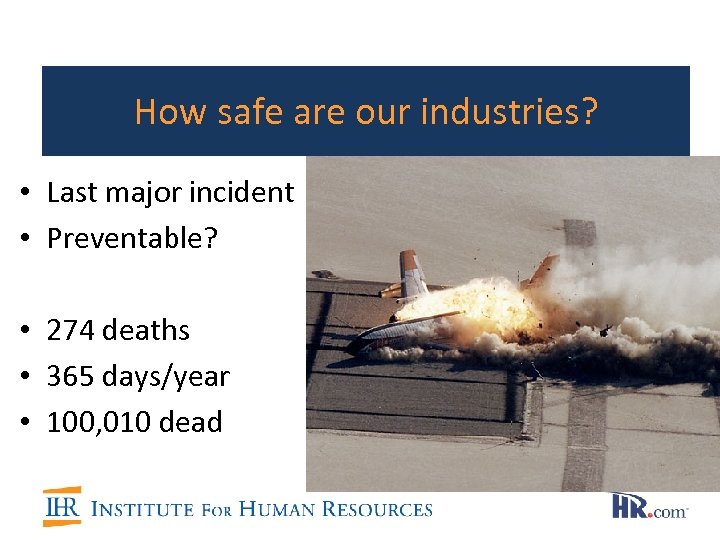
How safe are our industries? • Last major incident • Preventable? • 274 deaths • 365 days/year • 100, 010 dead
How safe is being a patient? • 1999 – IOM report – U. S. hospitals KILL 100, 000 persons per year with medical mistakes • 2001 – To Err is Human brings attention to this public health crisis • 2004 – Peter Pronovost studies the checklist – Blue Cross Blue Shield incentivizes checklist usage • 2006 – Michigan reduces infections by 66% and outperforms 90% of ICUs nationwide • 2012 – How many are hospitals still harming?
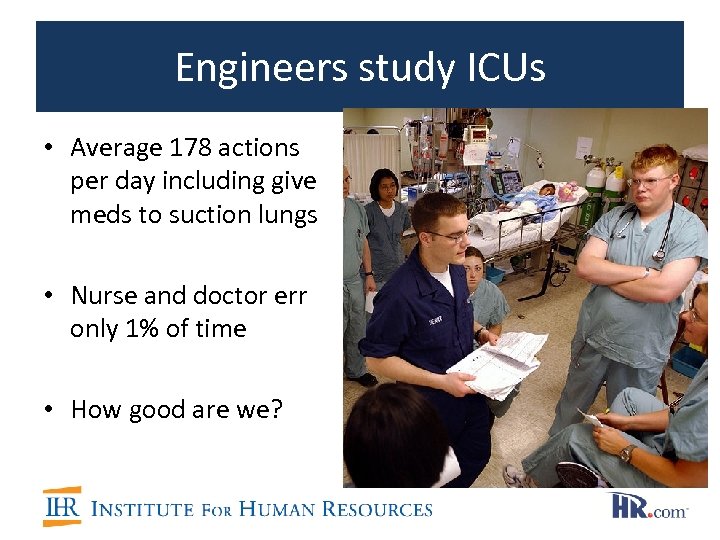
Engineers study ICUs • Average 178 actions per day including give meds to suction lungs • Nurse and doctor err only 1% of time • How good are we?
HUMAN ERROR SCIENCE COMMON ERRORS IN HEALTHCARE
The Science of Human Error • Despite advances in technology, errors are prevalent – Skill-based errors – Rule-based errors – Knowledge-based errors



What can happen? • Wristbands are wrong or missing • “Wrong drug or wrong patient” happens in about 4% of medication delivery* • Hand hygiene compliance rates among health care workers is as low as 50% • Hospital Acquired Infections occur 1. 7 million x per year in U. S. *Bates, D. W. , Boyle, et al. Relationship between medication errors and adverse drug events; Journal of Internal Medicine
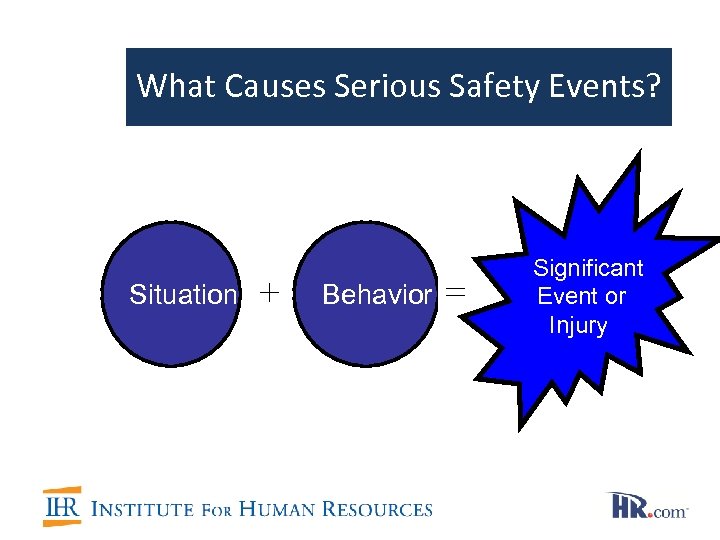
What Causes Serious Safety Events? Situation + Behavior = Significant Event or Injury
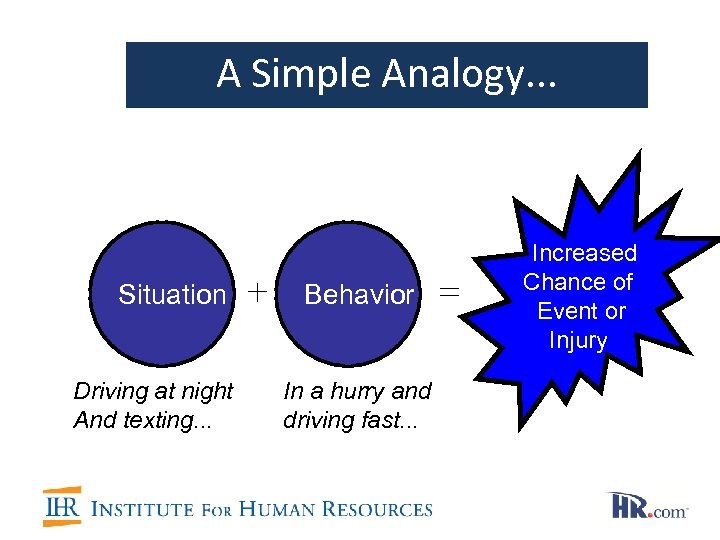
A Simple Analogy. . . Situation Driving at night And texting. . . + Behavior In a hurry and driving fast. . . = Increased Chance of Event or Injury
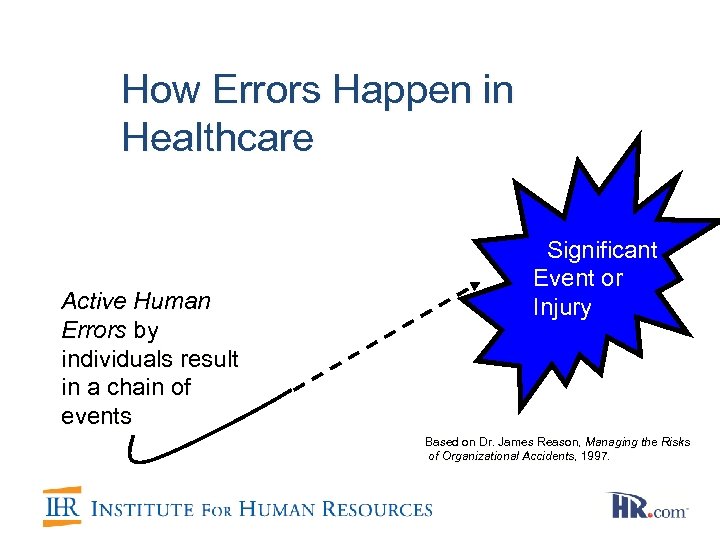
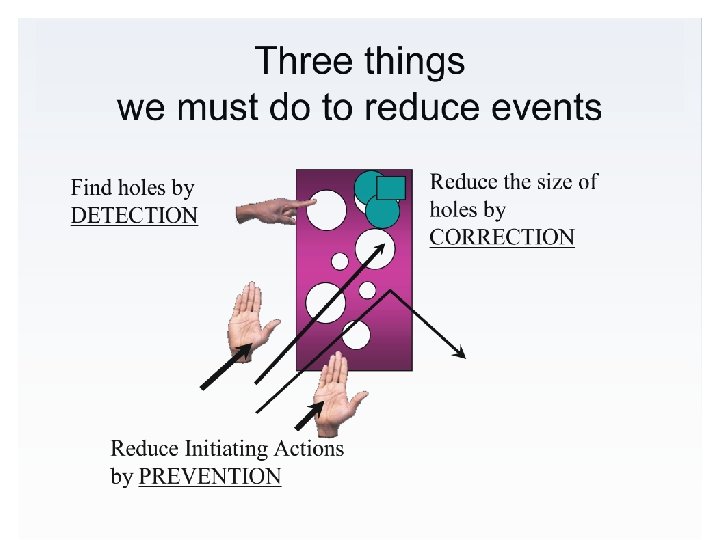
How Errors Happen in Healthcare Active Human Errors by individuals result in a chain of events Significant Event or Injury Based on Dr. James Reason, Managing the Risks of Organizational Accidents, 1997. Accidents,
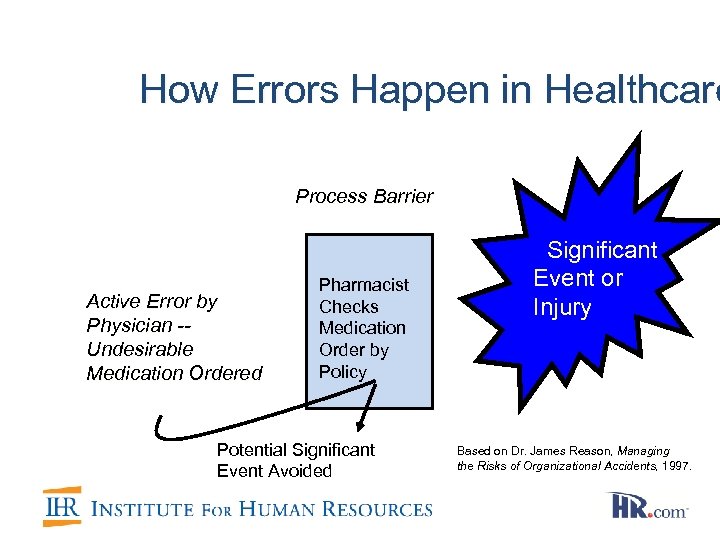
How Errors Happen in Healthcare Process Barrier Active Error by Physician -Undesirable Medication Ordered Pharmacist Checks Medication Order by Policy Potential Significant Event Avoided Significant Event or Injury Based on Dr. James Reason, Managing the Risks of Organizational Accidents, 1997. Accidents,
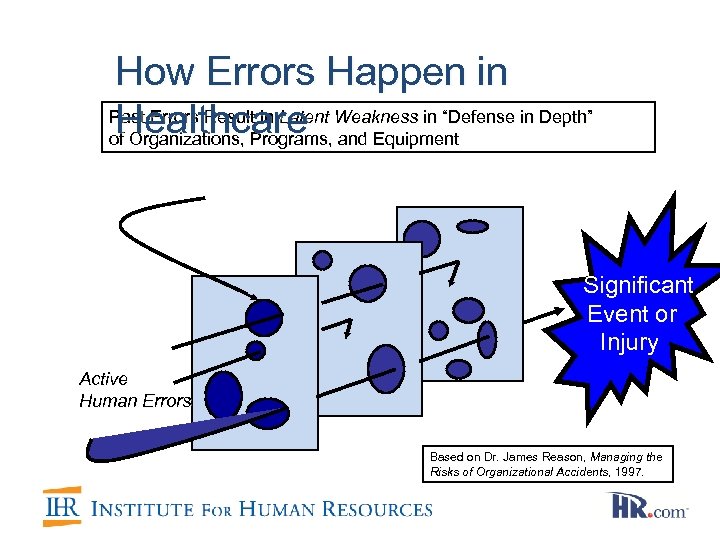
How Errors Happen in Past Errors Result in Latent Weakness in “Defense in Depth” Healthcare of Organizations, Programs, and Equipment Significant Event or Injury Active Human Errors Based on Dr. James Reason, Managing the Risks of Organizational Accidents, 1997. Accidents,
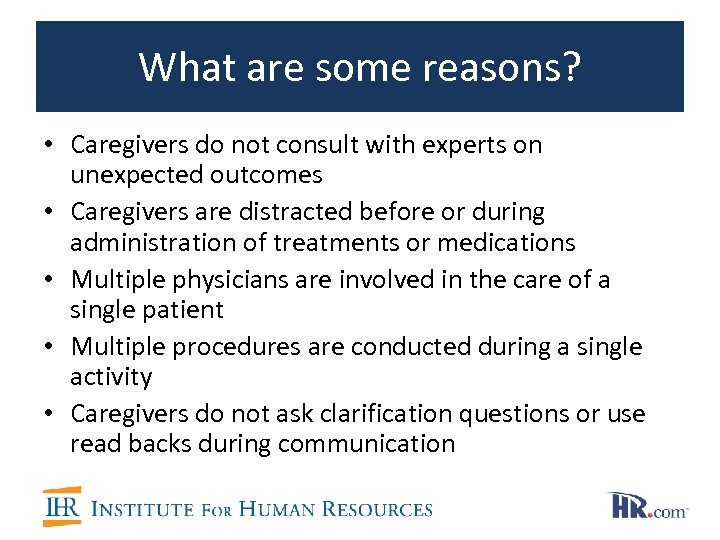
What are some reasons? • Caregivers do not consult with experts on unexpected outcomes • Caregivers are distracted before or during administration of treatments or medications • Multiple physicians are involved in the care of a single patient • Multiple procedures are conducted during a single activity • Caregivers do not ask clarification questions or use read backs during communication
Common Causes in 80% of Medical Errors • • Failure to consider the basics Distractions Lack of communication Suboptimal coordination of services
HOW DO I KNOW HOW MY HEALTHCARE PROVIDERS ARE DOING
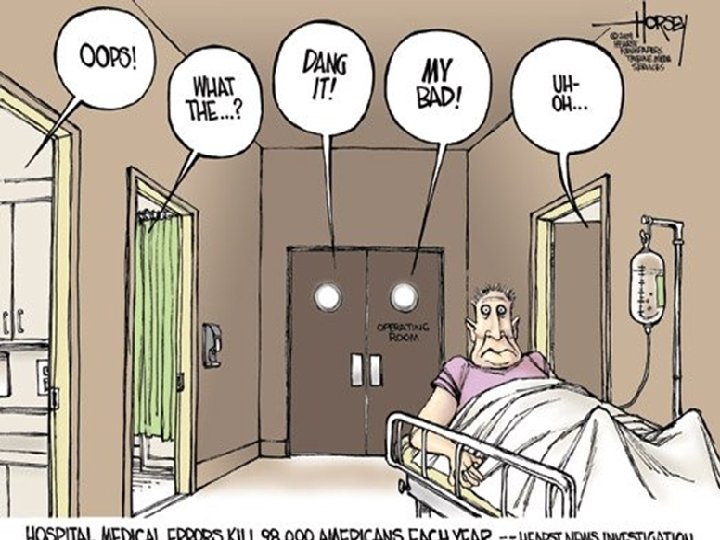
How many hospitals? Errors? • • • Hospitals ICU patients with lines Infected lines @ 10 days # Line infects per year # fatalities per year from line infections • • • 6000 5 million per year 4% 80, 000 5 -28% Read more: http: //www. newyorker. com/reporting/2007/12/10/071210 fa_fact_ gawande#ixzz 2 OECXxlem
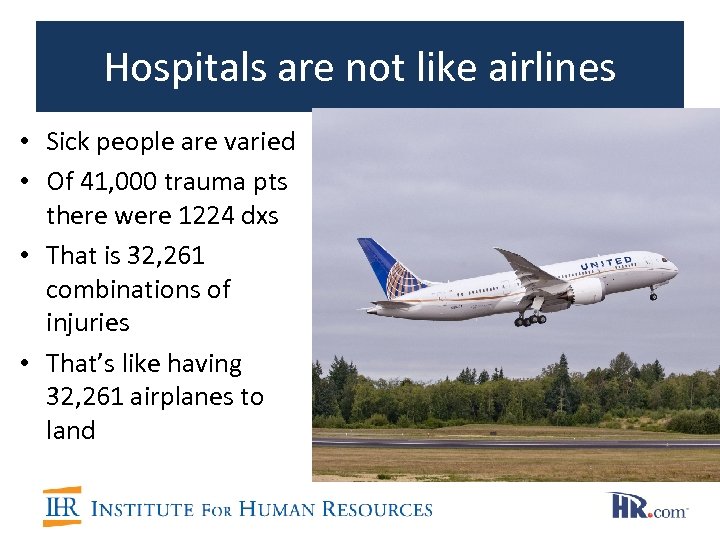
Hospitals are not like airlines • Sick people are varied • Of 41, 000 trauma pts there were 1224 dxs • That is 32, 261 combinations of injuries • That’s like having 32, 261 airplanes to land
Compare • Leapfroggroup. org
Compare • Medicare. gov/Hospitalcompare
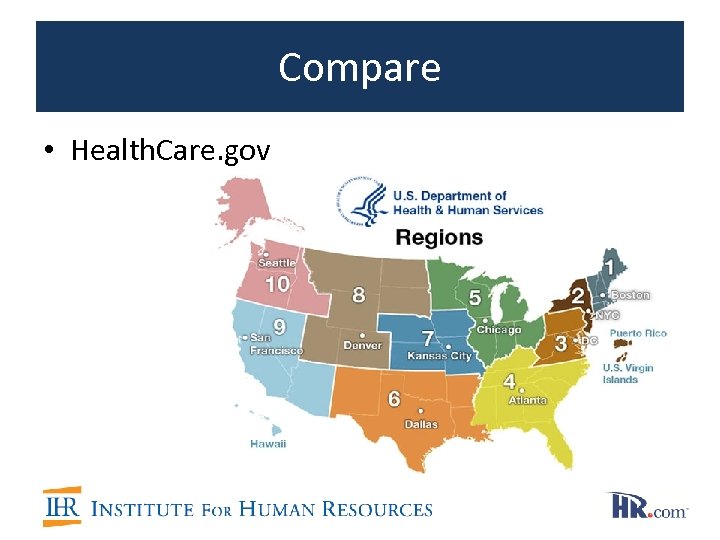
Compare • Health. Care. gov
MITIGATING THE ERRORS MADE WHEN MY FAMILY IS A PATIENT
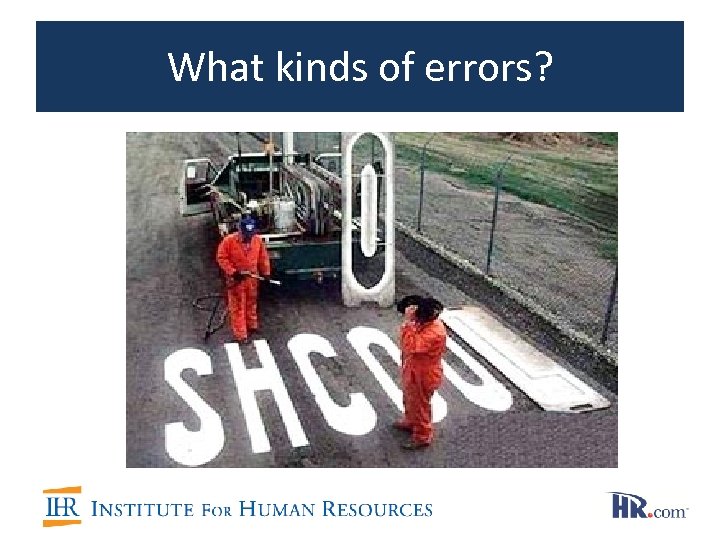
What kinds of errors?
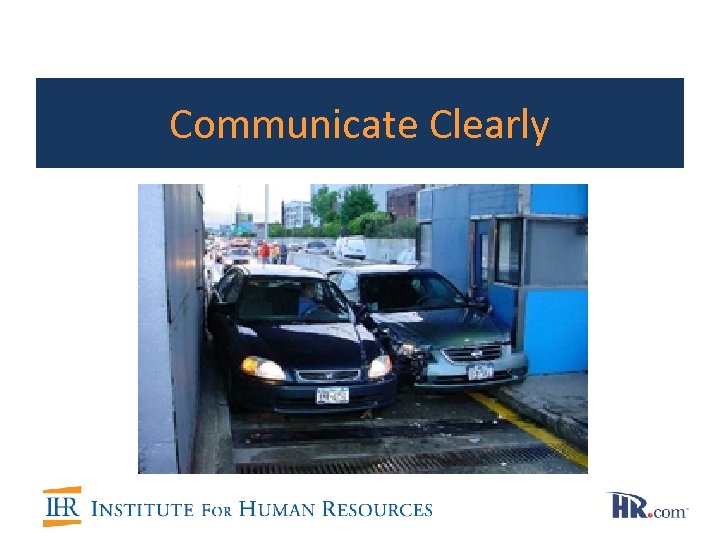
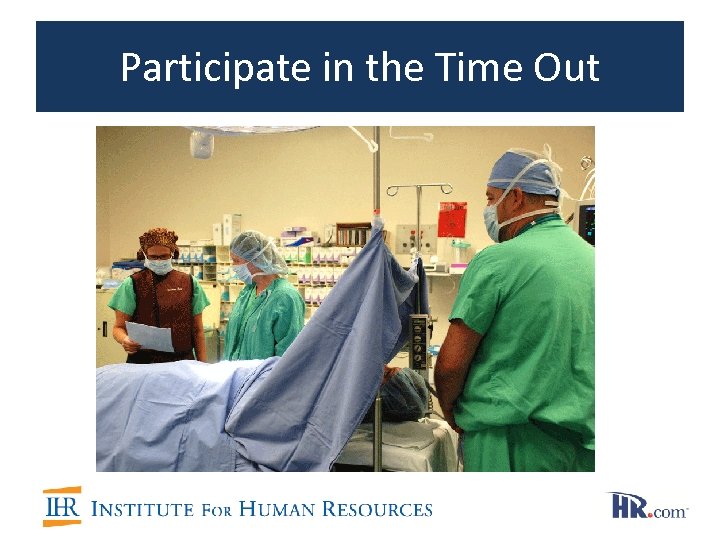
Expect your care providers to… • Identify themselves and their purpose with patients and peers • Use clarifying questions • Check your armband ask your name and date of birth before doing anything to you • Label labs in front of you • Reconcile your medications
Communicate Clearly
Adhere to Red Rules & Policies
Participate in the Time Out
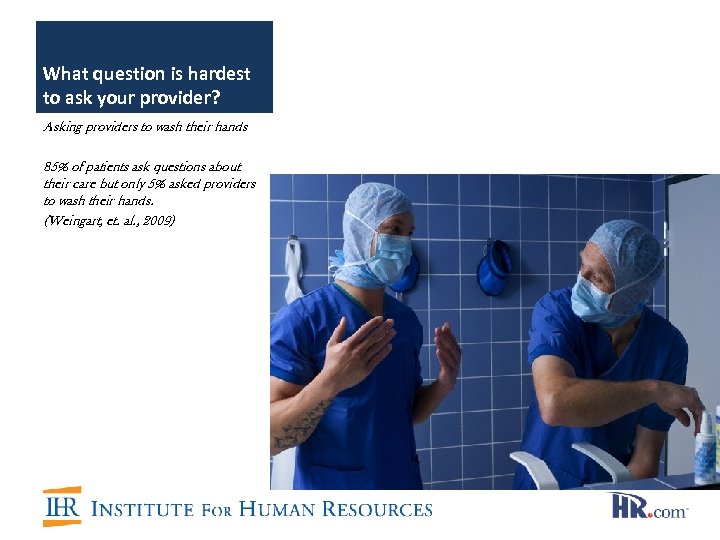
What question is hardest to ask your provider? Asking providers to wash their hands 85% of patients ask questions about their care but only 5% asked providers to wash their hands. (Weingart, et. al. , 2009)
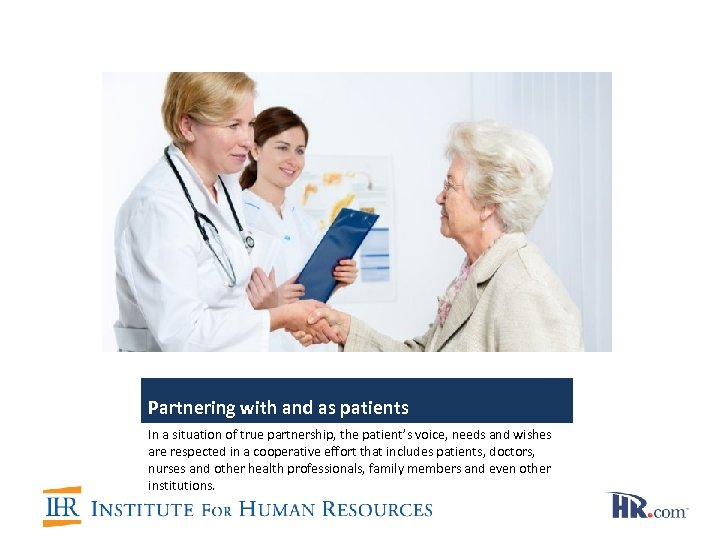
Partnering with and as patients In a situation of true partnership, the patient’s voice, needs and wishes are respected in a cooperative effort that includes patients, doctors, nurses and other health professionals, family members and even other institutions.

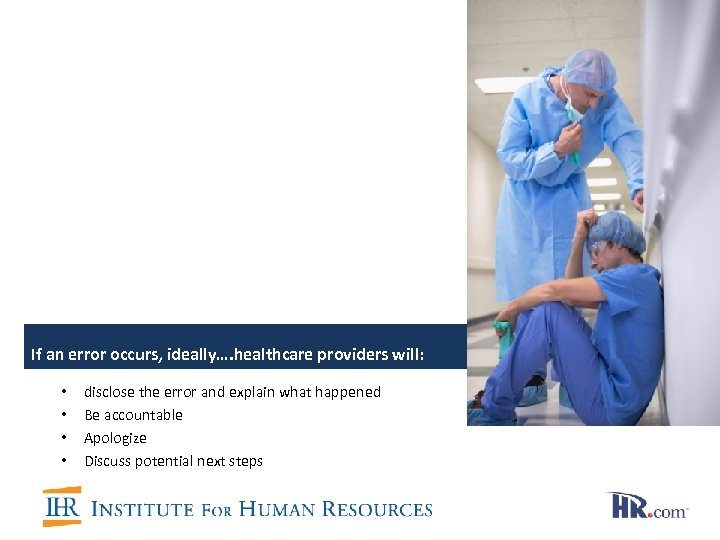
If an error occurs, ideally…. healthcare providers will: • • disclose the error and explain what happened Be accountable Apologize Discuss potential next steps
“The single most important way you can stay healthy is to be an active member of your own health care team. One way to get high quality health care is to find and use information and take an active role in all of the decisions made about your care. ” Atul Gwande
Contact Information • Memorial University Medical Center • 4750 Waters Ave, Suite 451 • Savannah, GA 31404 • Martha White • 912. 350. 7569 • whitema 2@memorialhealth. com
Скачать презентацию Are You Really Informed about Healthcare Martha Boutin
a4a2c70efe764beaedfd5a4fe52ad7de.ppt