


 Скачать презентацию Are you ready for your National Tests 100
b3a7ca3a8866994e99560c09211082a3.ppt
- Количество слайдов: 129
 Are you ready for your National Tests? 100 Questions which can be useful in your oral Test Español 2: 1 -60 Español 3&4: 1 -110 + ADDED KEY VOCABULARY - CLICK ON DUCK FOR VOCABULARY PRACTICE
 Instructions This slide show is designed to help you prepare for the roleplay part of your speaking test. -Level 2 = 1 -60 -Level 3&4 = 1 -110 -The next screen is split into 1 hundred boxes -Choose one box at a time; or, if you wish you can just go through them 1 -110. -Try to note down which numbers you are certain you know. - Each slide has a question – CAN YOU. . . ? -Look at the question and try to answer it. When you have thought of the answer, click again and the answer is shown. Click on alarm clock takes you back to 1 st screen
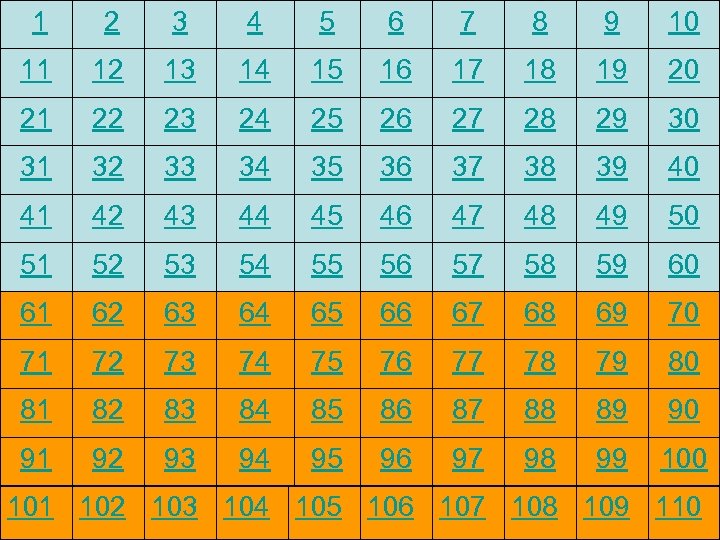 1 2 3 4 5 6 7 8 9 10 11 12 13 14 15 16 17 18 19 20 21 22 23 24 25 26 27 28 29 30 31 32 33 34 35 36 37 38 39 40 41 42 43 44 45 46 47 48 49 50 51 52 53 54 55 56 57 58 59 60 61 62 63 64 65 66 67 68 69 70 71 72 73 74 75 76 77 78 79 80 81 82 83 84 85 86 87 88 89 90 91 92 93 94 95 96 97 98 99 100 101 102 103 104 105 106 107 108 109 110
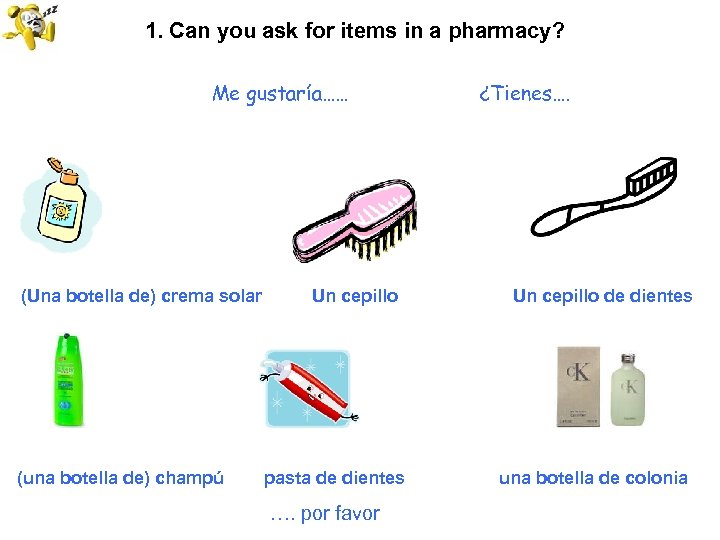 1. Can you ask for items in a pharmacy? Me gustaría…… (Una botella de) crema solar (una botella de) champú Un cepillo pasta de dientes …. por favor ¿Tienes…. Un cepillo de dientes una botella de colonia
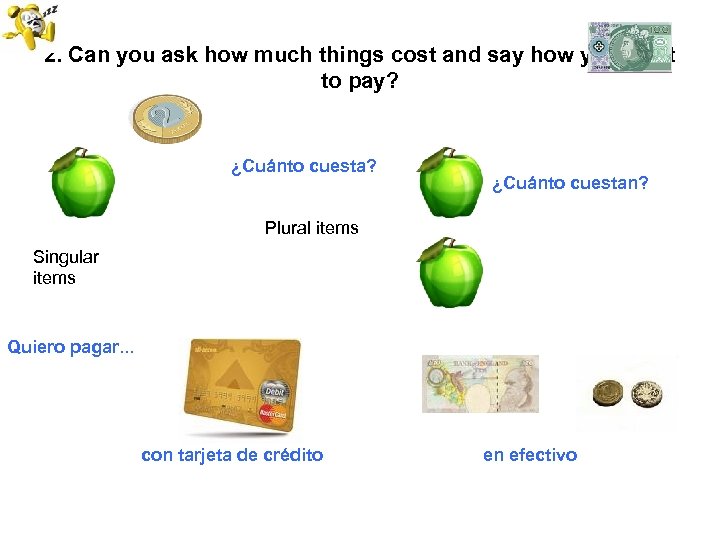 2. Can you ask how much things cost and say how you want to pay? ¿Cuánto cuestan? Plural items Singular items Quiero pagar. . . con tarjeta de crédito en efectivo
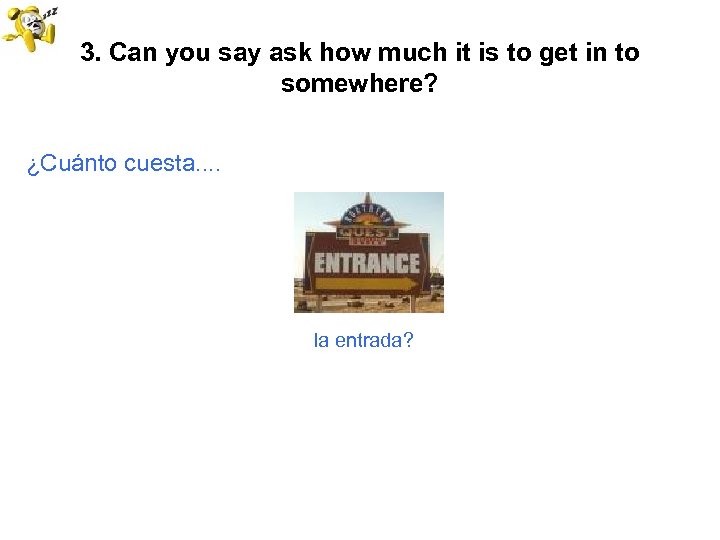 3. Can you say ask how much it is to get in to somewhere? ¿Cuánto cuesta. . la entrada?
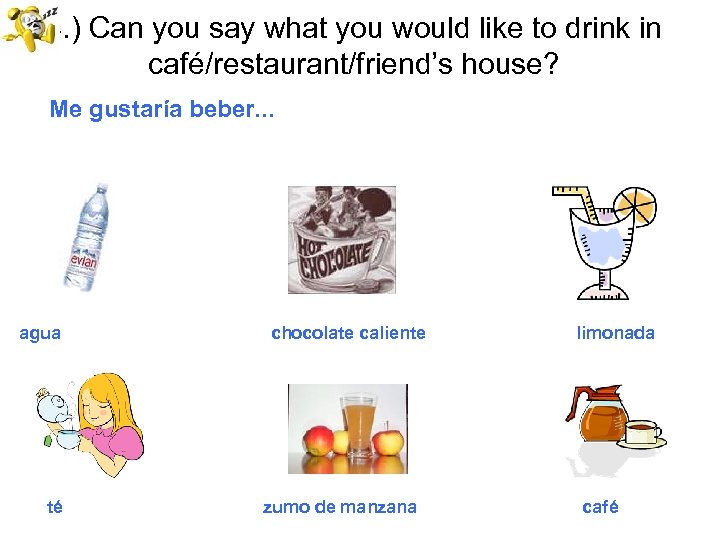 4. ) Can you say what you would like to drink in café/restaurant/friend’s house? Me gustaría beber. . . agua té chocolate caliente zumo de manzana limonada café
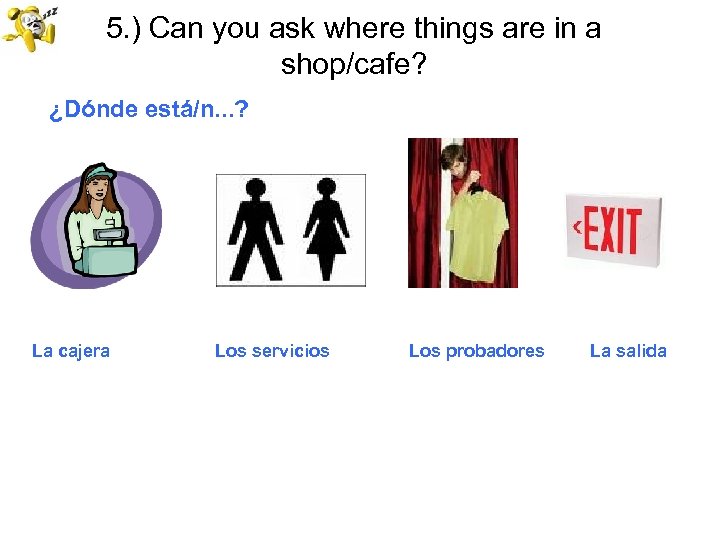 5. ) Can you ask where things are in a shop/cafe? ¿Dónde está/n. . . ? La cajera Los servicios Los probadores La salida
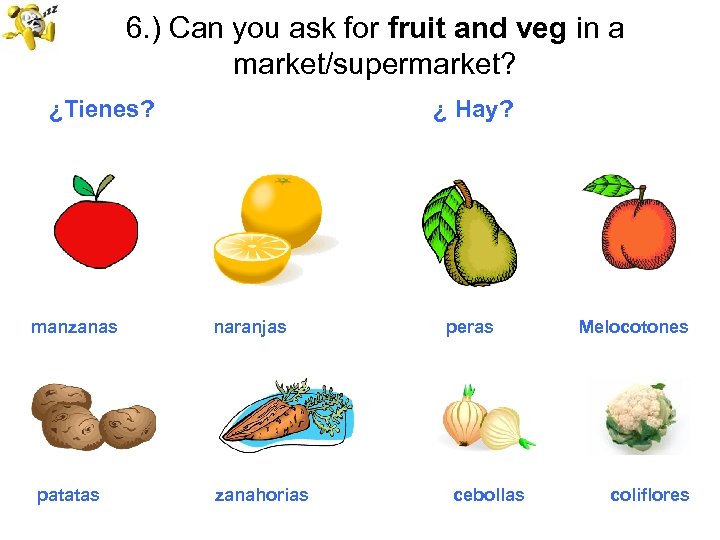 6. ) Can you ask for fruit and veg in a market/supermarket? ¿Tienes? manzanas patatas ¿ Hay? naranjas zanahorias peras cebollas Melocotones coliflores
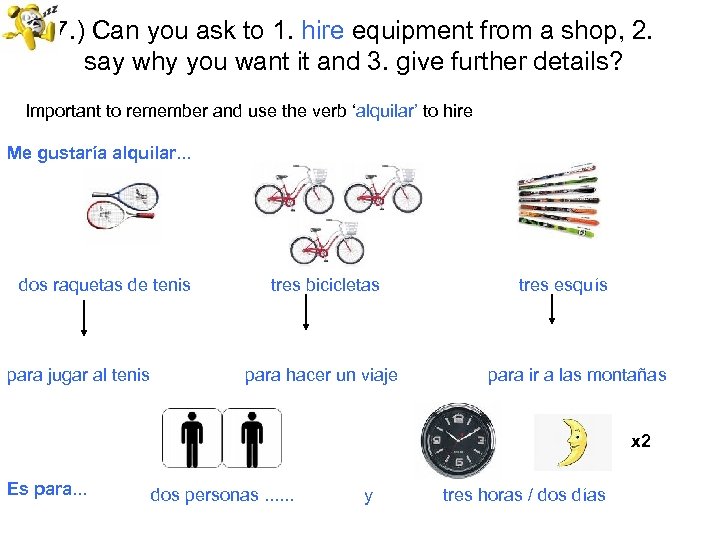 7. ) Can you ask to 1. hire equipment from a shop, 2. say why you want it and 3. give further details? Important to remember and use the verb ‘alquilar’ to hire Me gustaría alquilar. . . dos raquetas de tenis para jugar al tenis tres bicicletas para hacer un viaje tres esquís para ir a las montañas x 2 Es para. . . dos personas. . . y tres horas / dos días
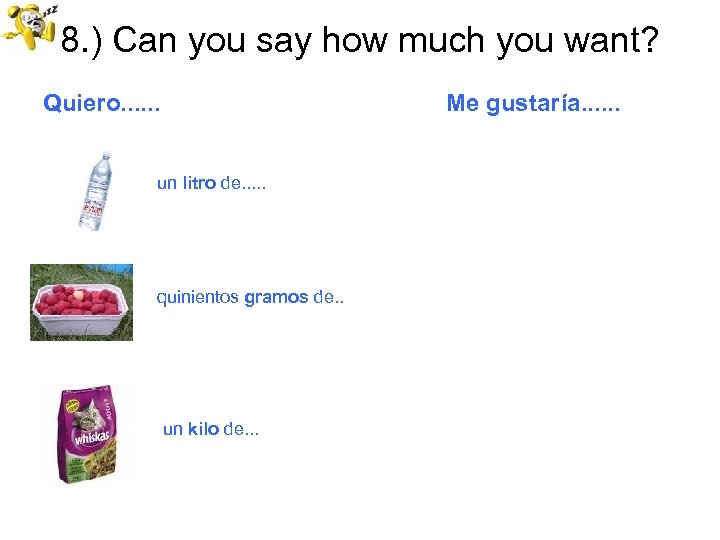 8. ) Can you say how much you want? Quiero. . . Me gustaría. . . un litro de. . . quinientos gramos de. . un kilo de. . .
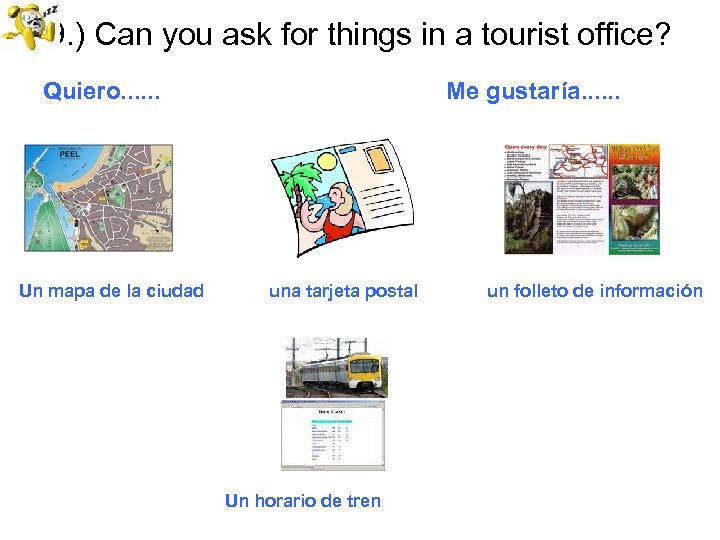 9. ) Can you ask for things in a tourist office? Quiero. . . Un mapa de la ciudad Me gustaría. . . una tarjeta postal Un horario de tren un folleto de información
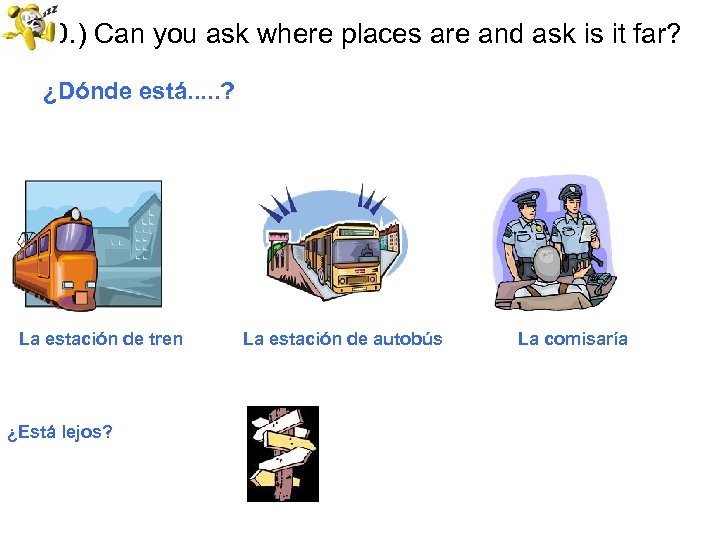 10. ) Can you ask where places are and ask is it far? ¿Dónde está. . . ? La estación de tren ¿Está lejos? La estación de autobús La comisaría
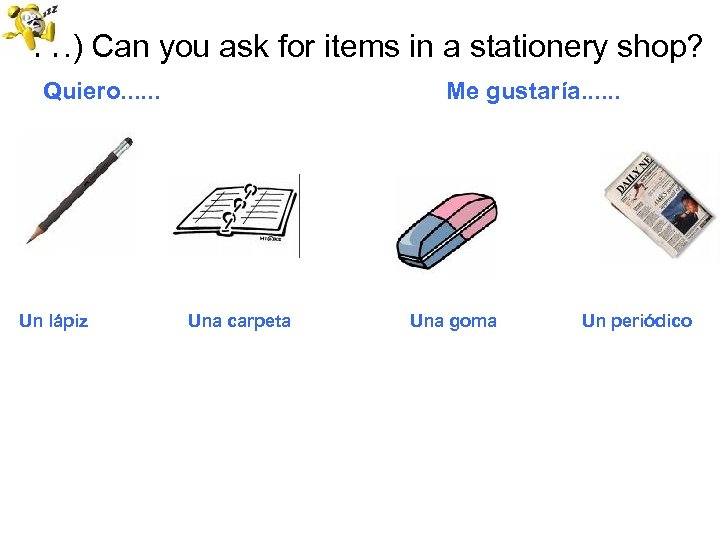 11. ) Can you ask for items in a stationery shop? Quiero. . . Un lápiz Me gustaría. . . Una carpeta Una goma Un periódico
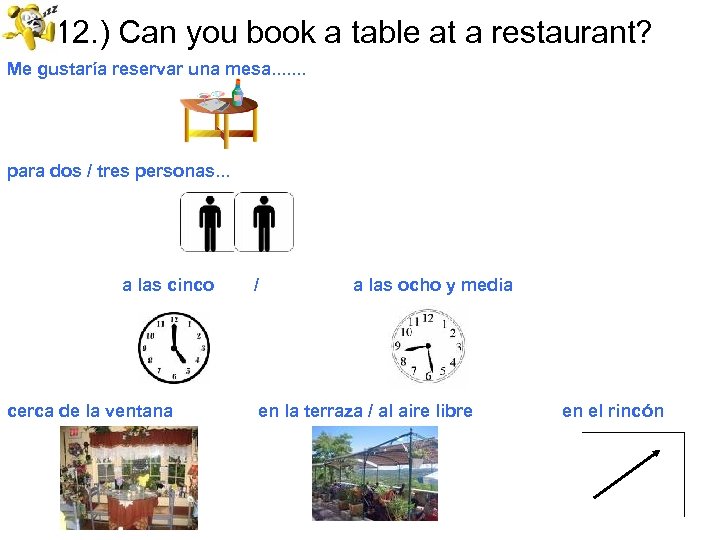 12. ) Can you book a table at a restaurant? Me gustaría reservar una mesa. . . . para dos / tres personas. . . a las cinco cerca de la ventana / a las ocho y media en la terraza / al aire libre en el rincón
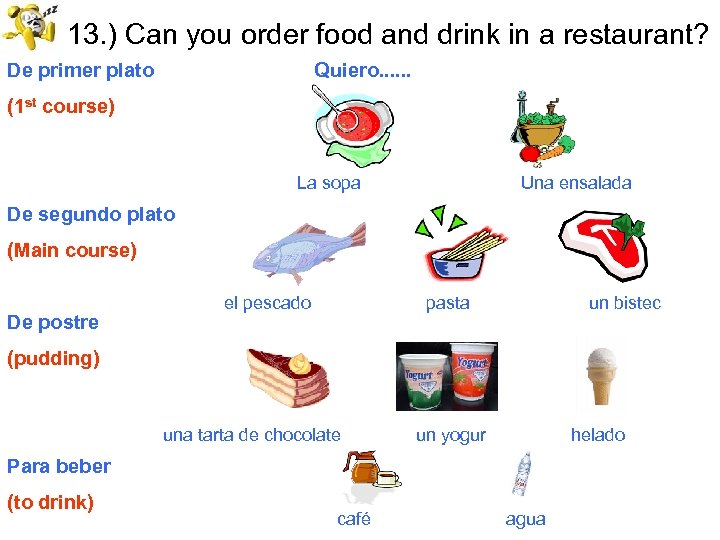 13. ) Can you order food and drink in a restaurant? De primer plato Quiero. . . (1 st course) La sopa Una ensalada De segundo plato (Main course) De postre el pescado pasta un bistec (pudding) una tarta de chocolate un yogur helado Para beber (to drink) café agua
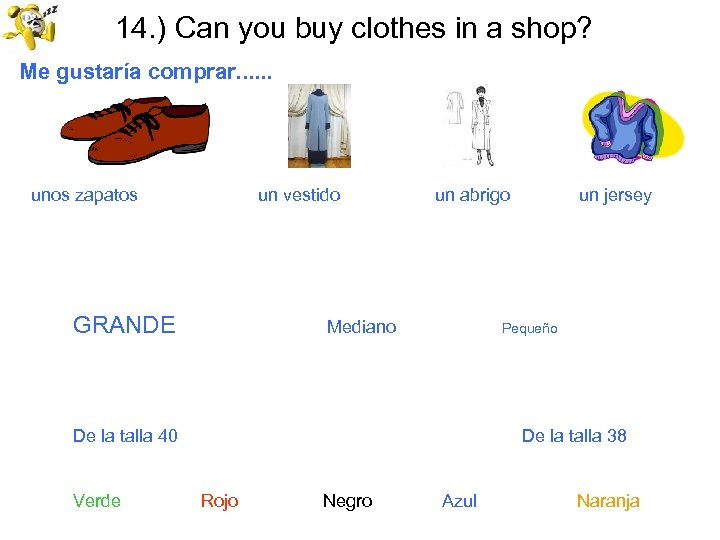 14. ) Can you buy clothes in a shop? Me gustaría comprar. . . unos zapatos un vestido GRANDE un abrigo Mediano Pequeño De la talla 40 Verde un jersey De la talla 38 Rojo Negro Azul Naranja
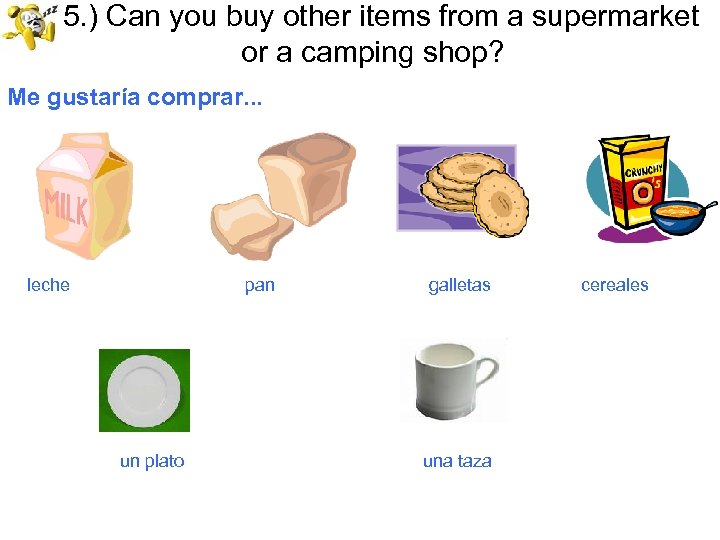 15. ) Can you buy other items from a supermarket or a camping shop? Me gustaría comprar. . . leche pan un plato galletas una taza cereales
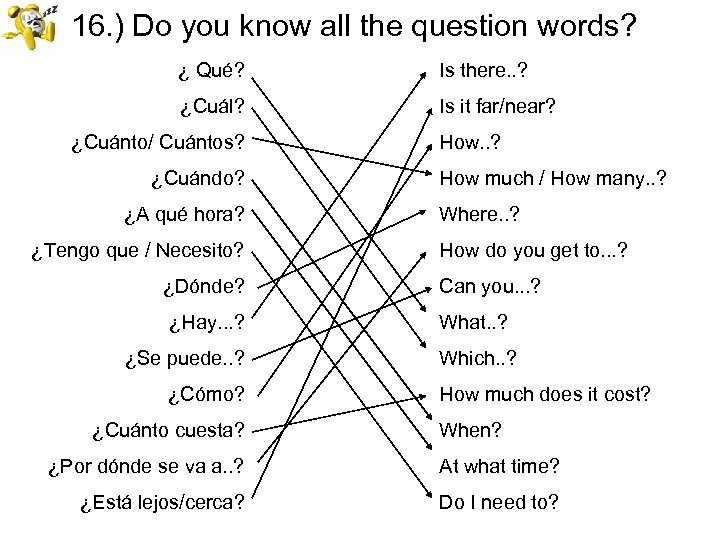 16. ) Do you know all the question words? ¿ Qué? Is there. . ? ¿Cuál? Is it far/near? ¿Cuánto/ Cuántos? ¿Cuándo? ¿A qué hora? ¿Tengo que / Necesito? ¿Dónde? ¿Hay. . . ? ¿Se puede. . ? ¿Cómo? ¿Cuánto cuesta? How. . ? How much / How many. . ? Where. . ? How do you get to. . . ? Can you. . . ? What. . ? Which. . ? How much does it cost? When? ¿Por dónde se va a. . ? At what time? ¿Está lejos/cerca? Do I need to?
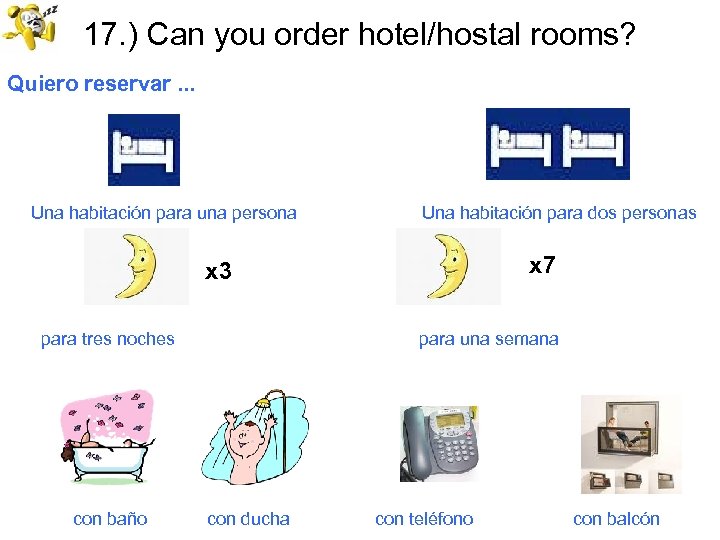 17. ) Can you order hotel/hostal rooms? Quiero reservar. . . Una habitación para una persona Una habitación para dos personas x 7 x 3 para tres noches con baño para una semana con ducha con teléfono con balcón
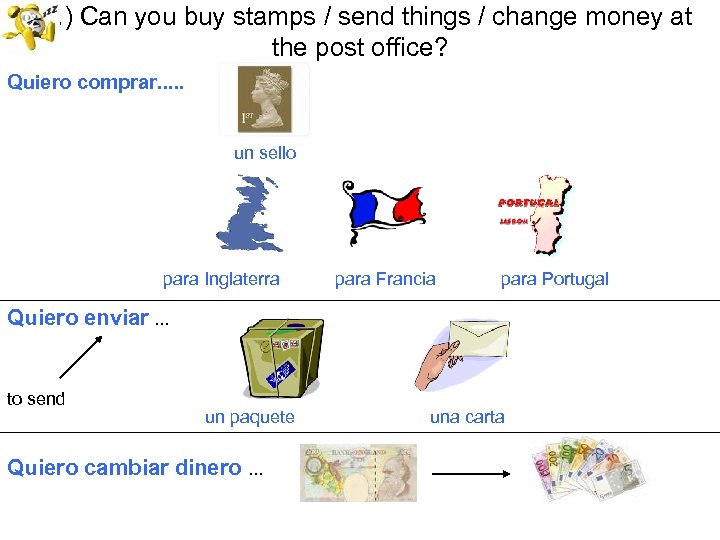 18. ) Can you buy stamps / send things / change money at the post office? Quiero comprar. . . un sello para Inglaterra para Francia para Portugal Quiero enviar. . . to send un paquete Quiero cambiar dinero. . . una carta
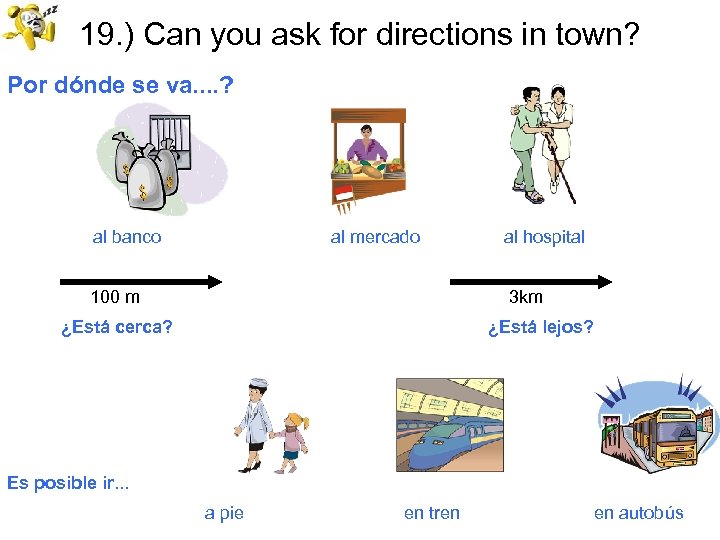 19. ) Can you ask for directions in town? Por dónde se va. . ? al banco al mercado 100 m al hospital 3 km ¿Está cerca? ¿Está lejos? Es posible ir. . . a pie en tren en autobús
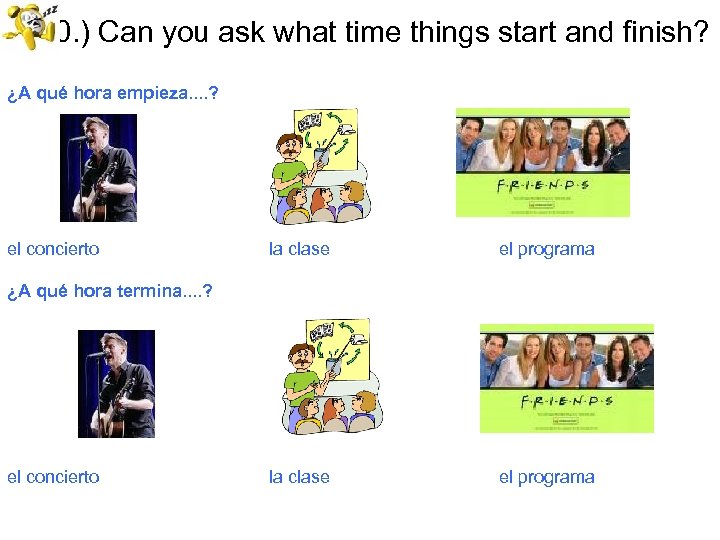 20. ) Can you ask what time things start and finish? ¿A qué hora empieza. . ? el concierto la clase el programa ¿A qué hora termina. . ? el concierto
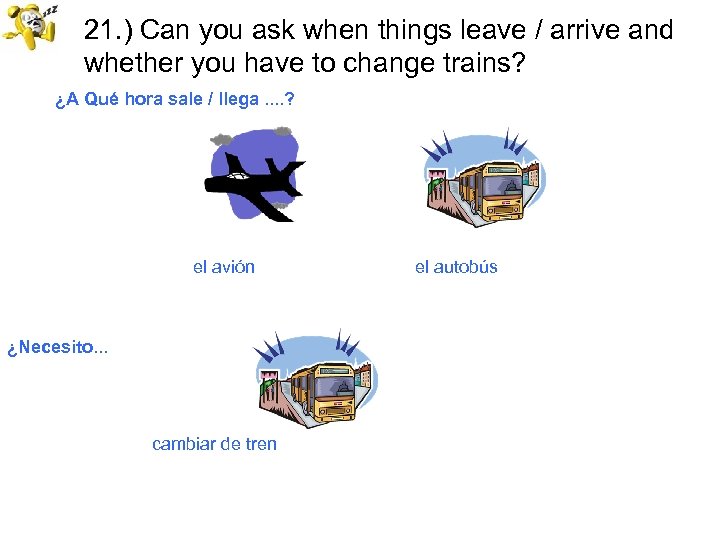 21. ) Can you ask when things leave / arrive and whether you have to change trains? ¿A Qué hora sale / llega. . ? el avión ¿Necesito. . . cambiar de tren el autobús
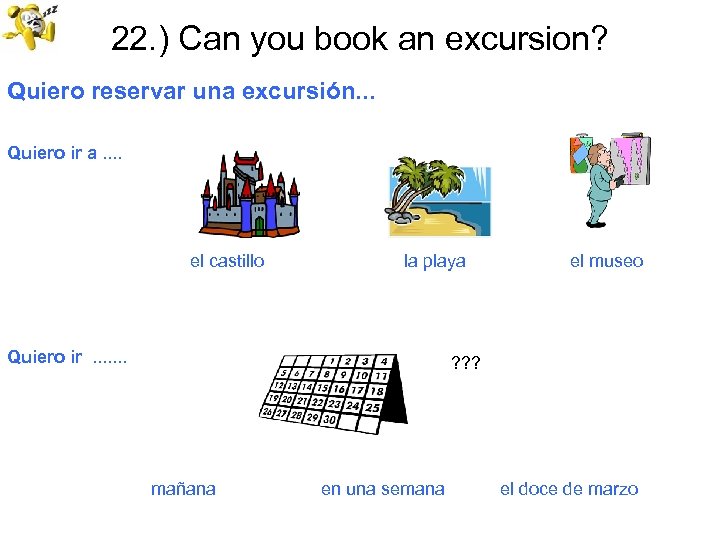 22. ) Can you book an excursion? Quiero reservar una excursión. . . Quiero ir a. . el castillo la playa Quiero ir. . . . el museo ? ? ? mañana en una semana el doce de marzo
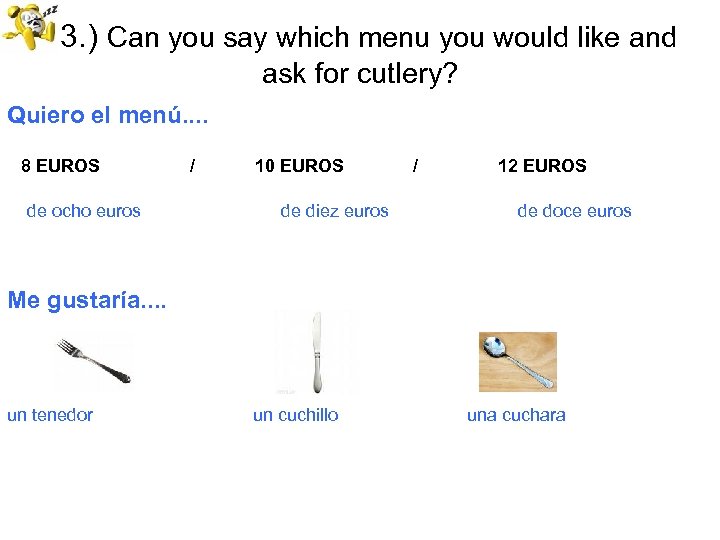 23. ) Can you say which menu you would like and ask for cutlery? Quiero el menú. . 8 EUROS de ocho euros / 10 EUROS de diez euros / 12 EUROS de doce euros Me gustaría. . un tenedor un cuchillo una cuchara
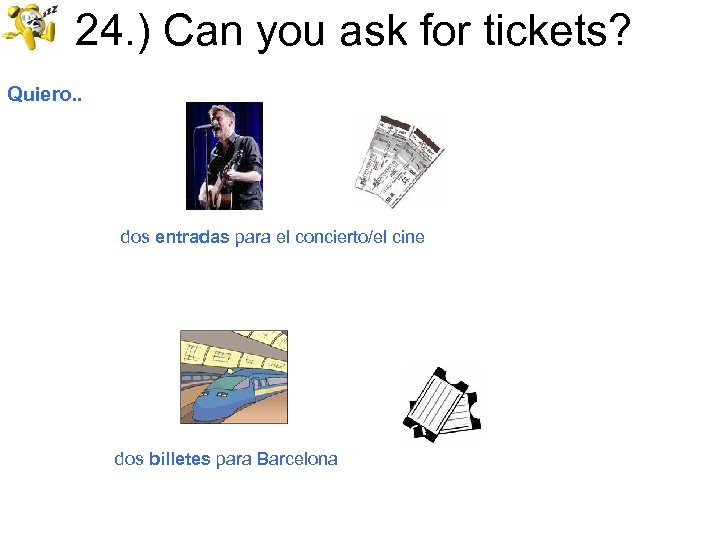 24. ) Can you ask for tickets? Quiero. . dos entradas para el concierto/el cine dos billetes para Barcelona
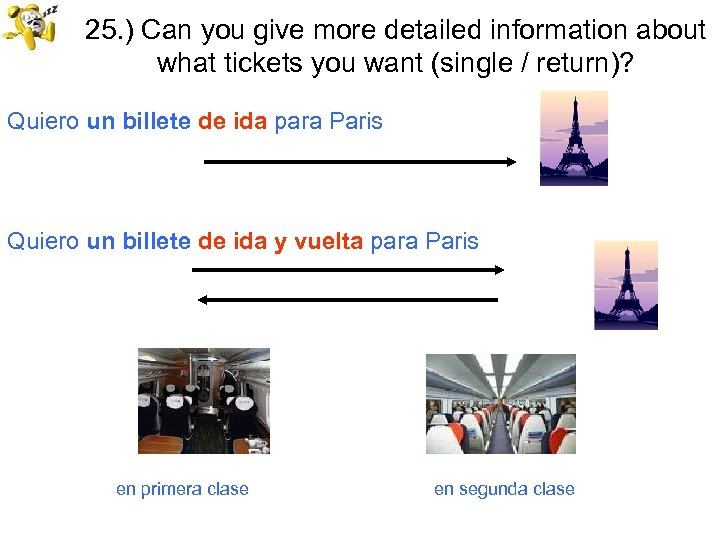 25. ) Can you give more detailed information about what tickets you want (single / return)? Quiero un billete de ida para Paris Quiero un billete de ida y vuelta para Paris en primera clase en segunda clase
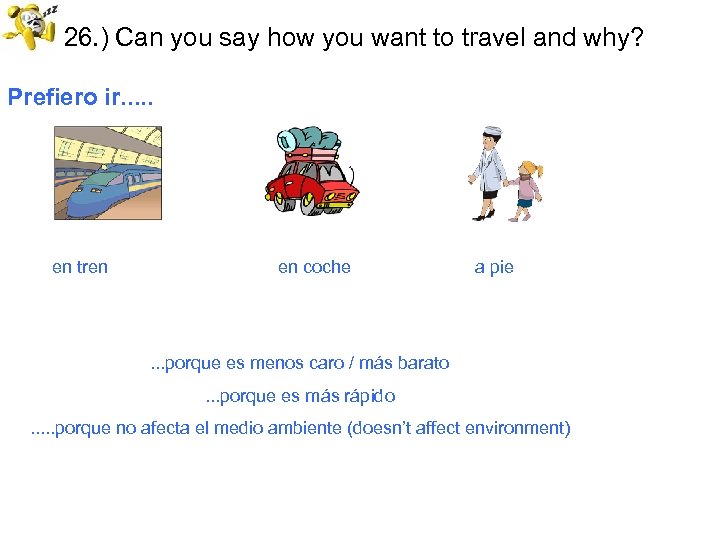 26. ) Can you say how you want to travel and why? Prefiero ir. . . en tren en coche a pie . . . porque es menos caro / más barato. . . porque es más rápido. . . porque no afecta el medio ambiente (doesn’t affect environment)
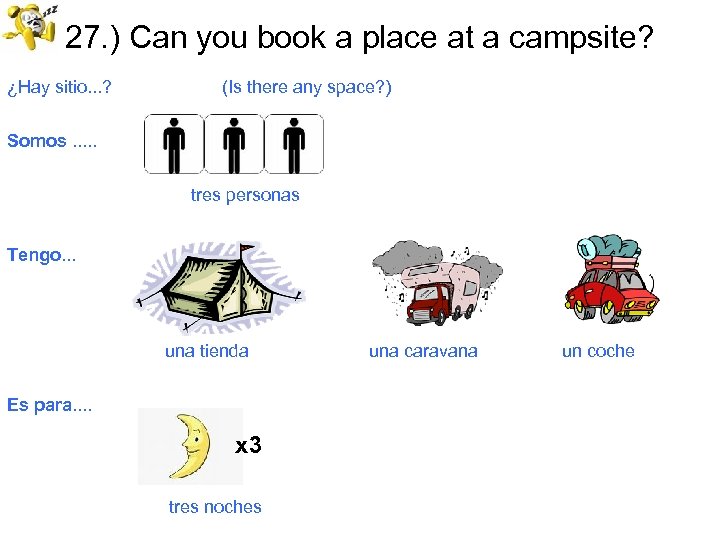 27. ) Can you book a place at a campsite? ¿Hay sitio. . . ? (Is there any space? ) Somos. . . tres personas Tengo. . . una tienda Es para. . x 3 tres noches una caravana un coche
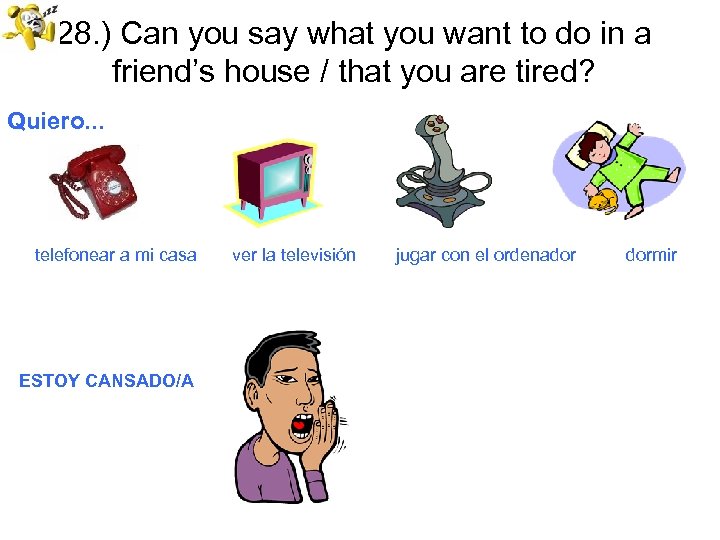 28. ) Can you say what you want to do in a friend’s house / that you are tired? Quiero. . . telefonear a mi casa ESTOY CANSADO/A ver la televisión jugar con el ordenador dormir
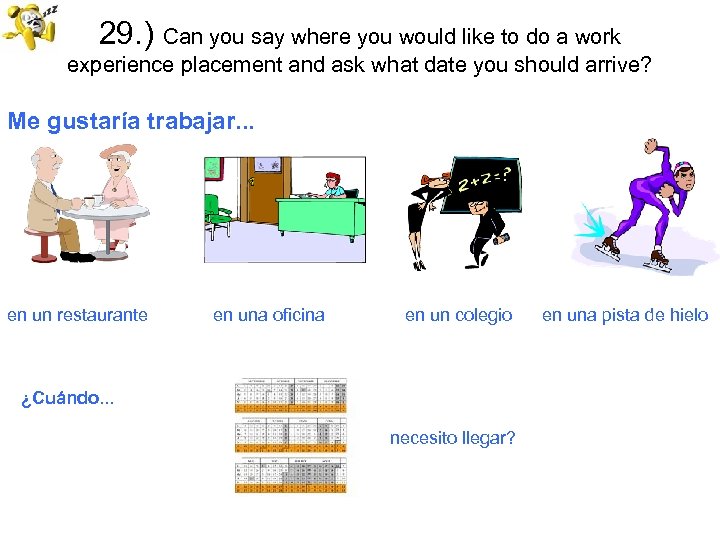 29. ) Can you say where you would like to do a work experience placement and ask what date you should arrive? Me gustaría trabajar. . . en un restaurante en una oficina en un colegio ¿Cuándo. . . necesito llegar? en una pista de hielo
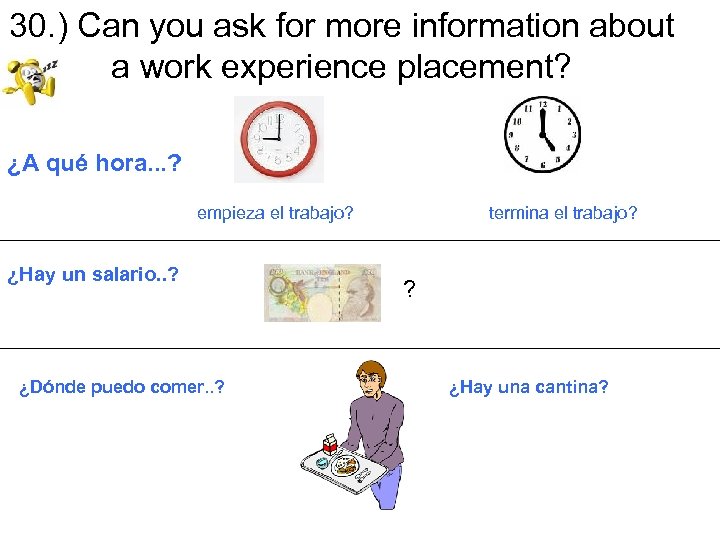 30. ) Can you ask for more information about a work experience placement? ¿A qué hora. . . ? empieza el trabajo? ¿Hay un salario. . ? ¿Dónde puedo comer. . ? termina el trabajo? ? ¿Hay una cantina?
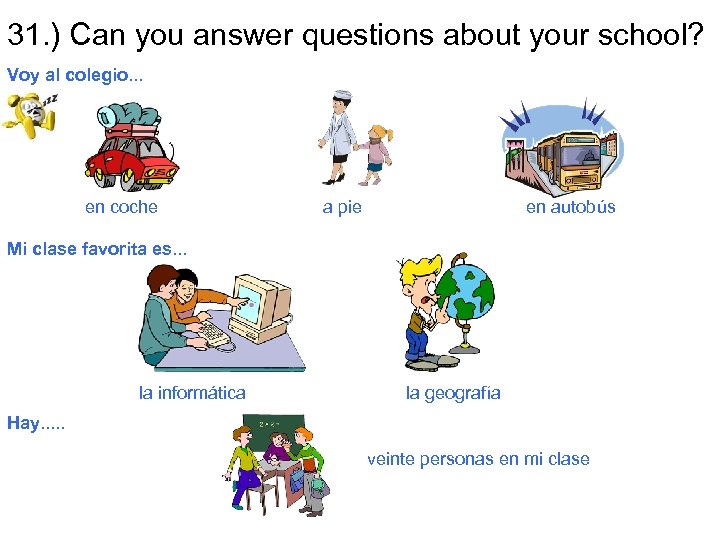 31. ) Can you answer questions about your school? Voy al colegio. . . en coche a pie en autobús Mi clase favorita es. . . la informática la geografía Hay. . . veinte personas en mi clase
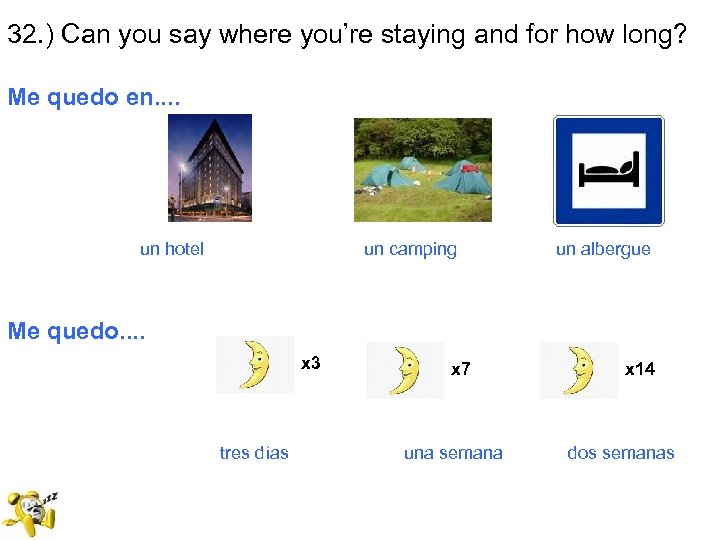 32. ) Can you say where you’re staying and for how long? Me quedo en. . un hotel un camping un albergue Me quedo. . x 3 tres días x 7 una semana x 14 dos semanas
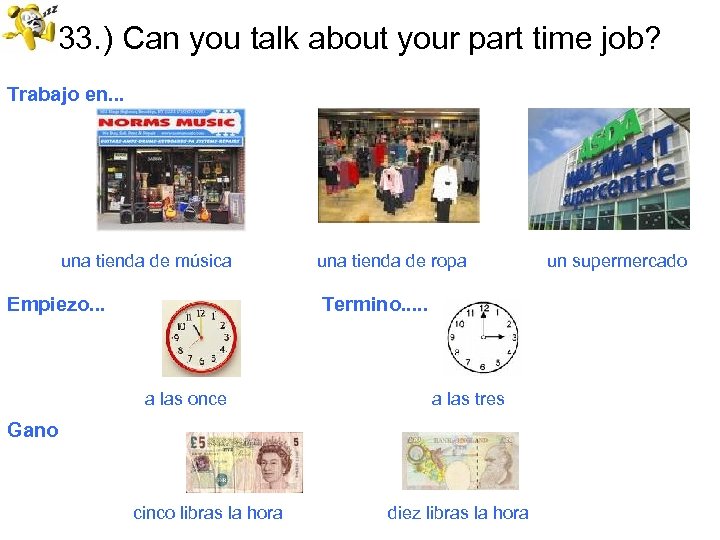 33. ) Can you talk about your part time job? Trabajo en. . . una tienda de música Empiezo. . . una tienda de ropa Termino. . . a las once a las tres Gano cinco libras la hora diez libras la hora un supermercado
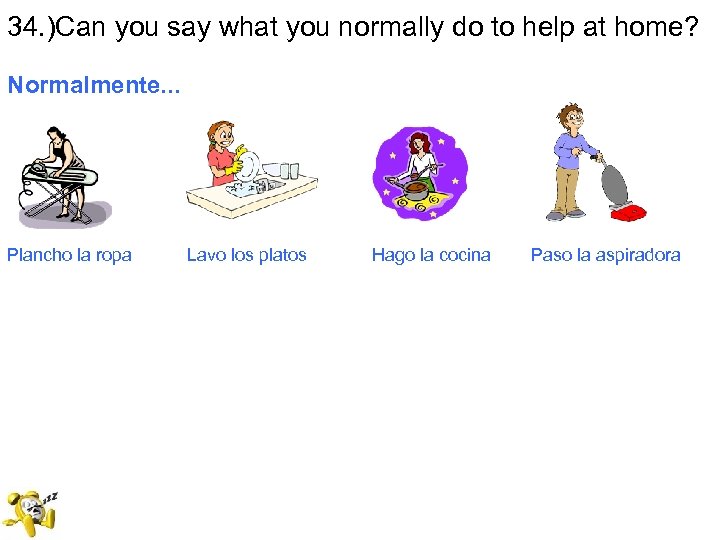 34. )Can you say what you normally do to help at home? Normalmente. . . Plancho la ropa Lavo los platos Hago la cocina Paso la aspiradora
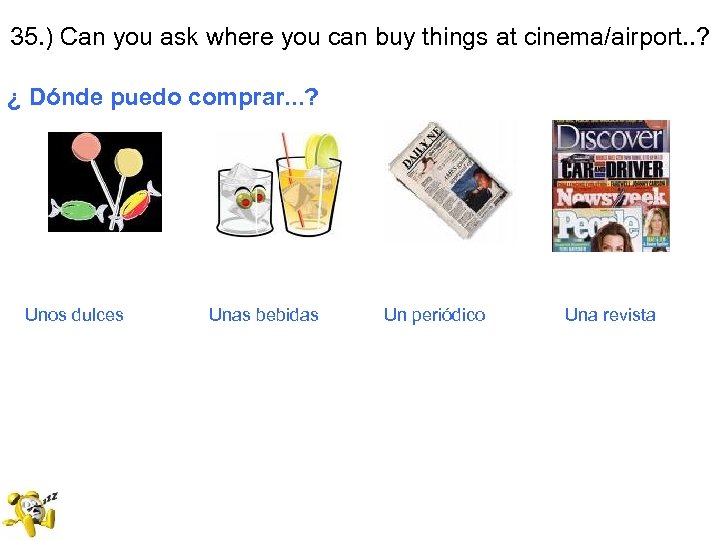 35. ) Can you ask where you can buy things at cinema/airport. . ? ¿ Dónde puedo comprar. . . ? Unos dulces Unas bebidas Un periódico Una revista
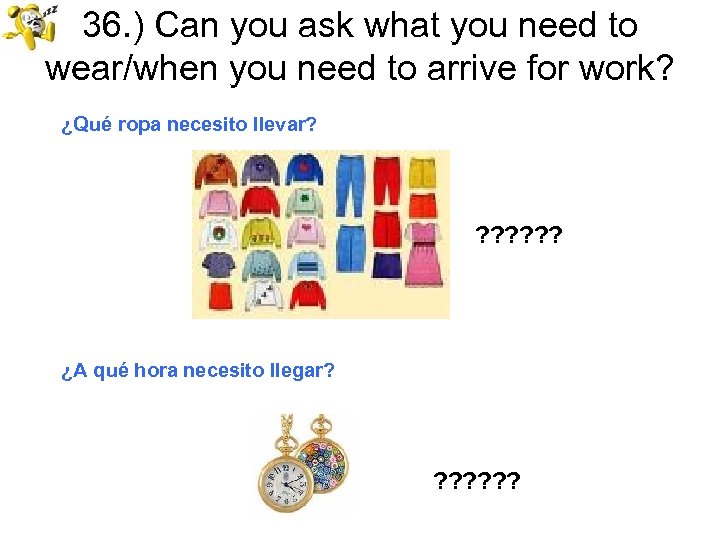 36. ) Can you ask what you need to wear/when you need to arrive for work? ¿Qué ropa necesito llevar? ? ? ? ¿A qué hora necesito llegar? ? ? ?
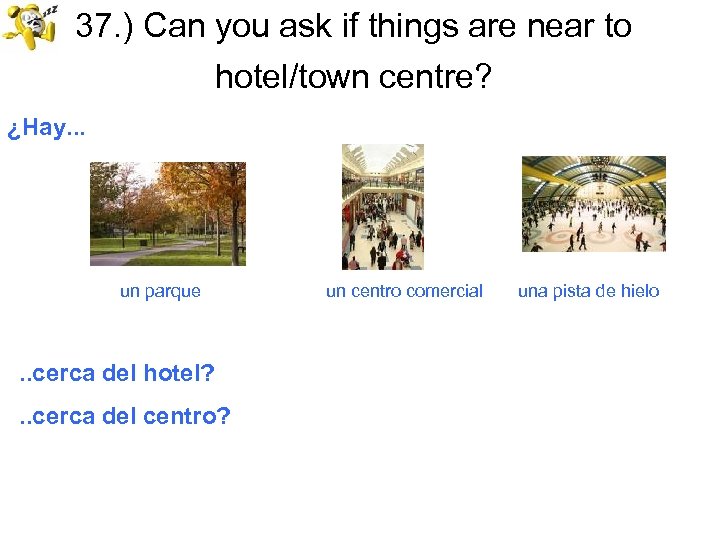 37. ) Can you ask if things are near to hotel/town centre? ¿Hay. . . un parque . . cerca del hotel? . . cerca del centro? un centro comercial una pista de hielo
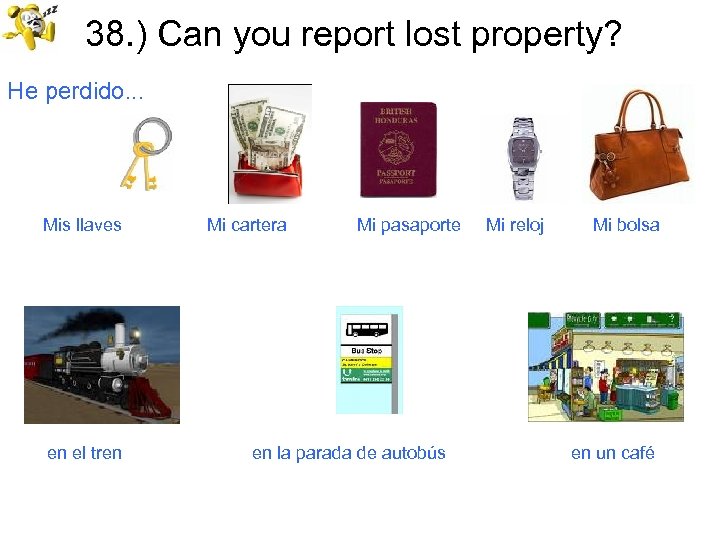 38. ) Can you report lost property? He perdido. . . Mis llaves en el tren Mi cartera Mi pasaporte en la parada de autobús Mi reloj Mi bolsa en un café
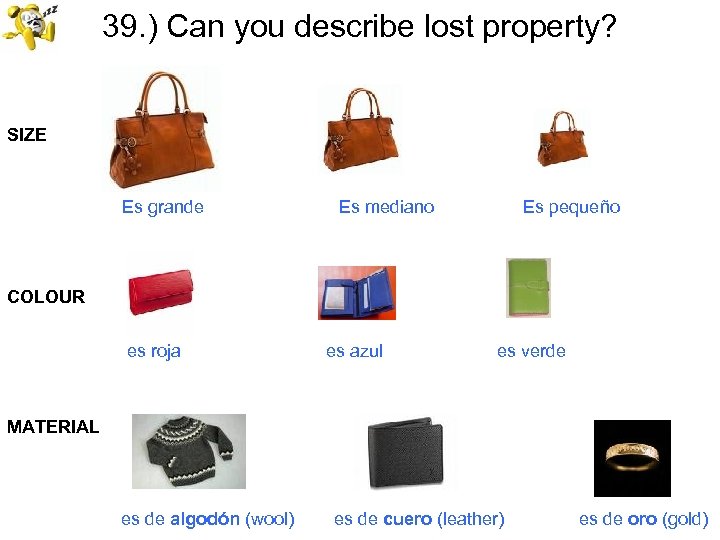 39. ) Can you describe lost property? SIZE Es grande Es mediano Es pequeño COLOUR es roja es azul es verde MATERIAL es de algodón (wool) es de cuero (leather) es de oro (gold)
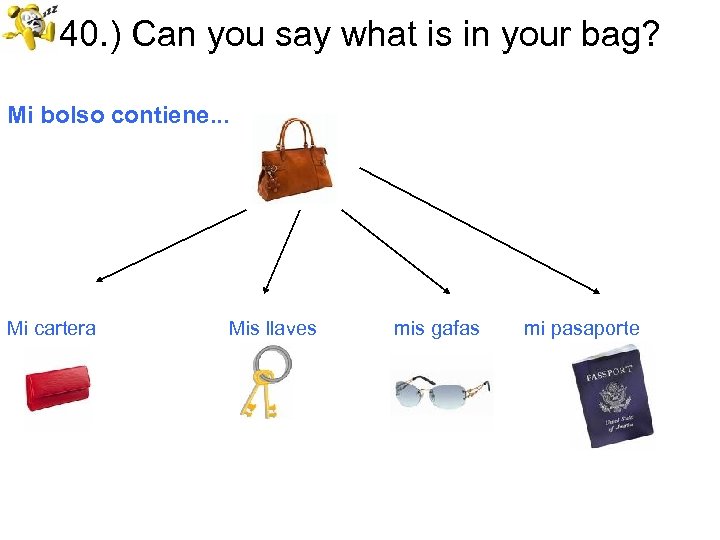 40. ) Can you say what is in your bag? Mi bolso contiene. . . Mi cartera Mis llaves mis gafas mi pasaporte
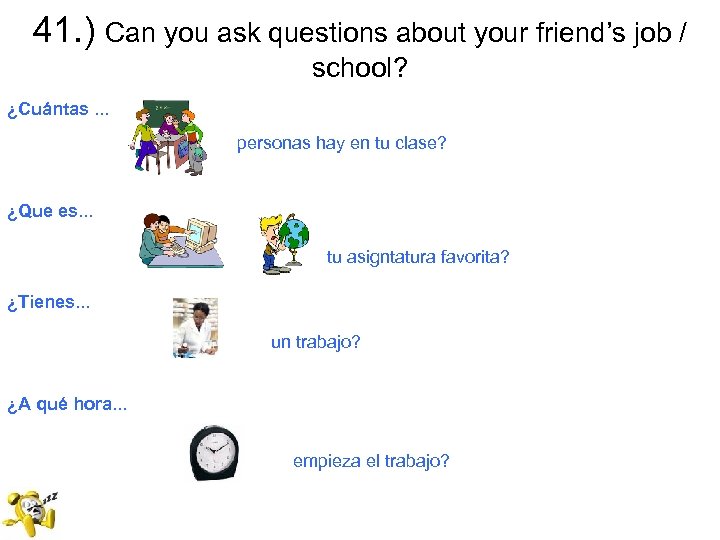 41. ) Can you ask questions about your friend’s job / school? ¿Cuántas. . . personas hay en tu clase? ¿Que es. . . tu asigntatura favorita? ¿Tienes. . . un trabajo? ¿A qué hora. . . empieza el trabajo?
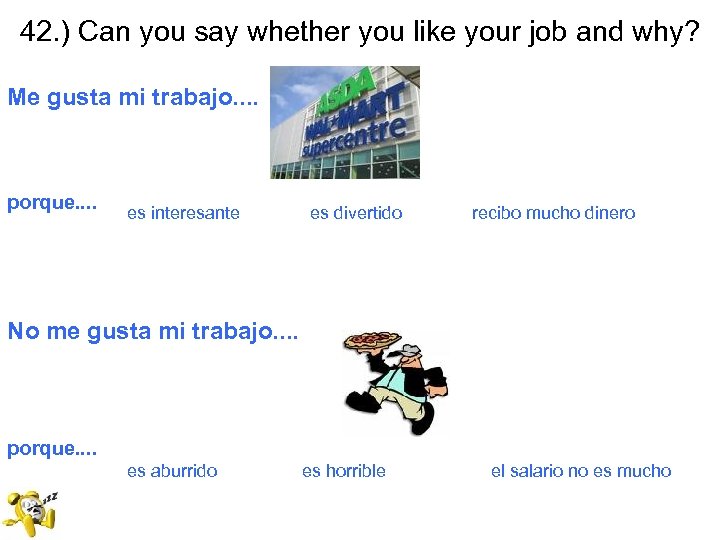 42. ) Can you say whether you like your job and why? Me gusta mi trabajo. . porque. . es interesante es divertido recibo mucho dinero No me gusta mi trabajo. . porque. . es aburrido es horrible el salario no es mucho
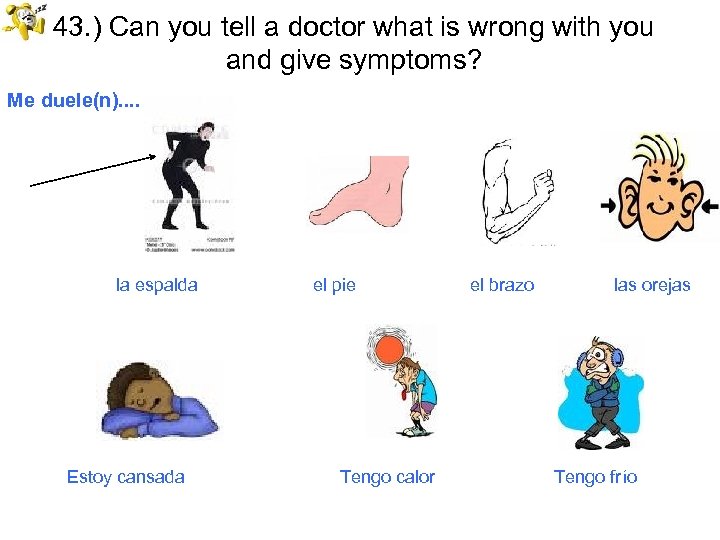 43. ) Can you tell a doctor what is wrong with you and give symptoms? Me duele(n). . la espalda Estoy cansada el pie Tengo calor el brazo las orejas Tengo frío
 44. ) Can you say when your illness began? Empezó. . . Two days ago Hace dos días Yesterday Ayer This morning Esta mañana
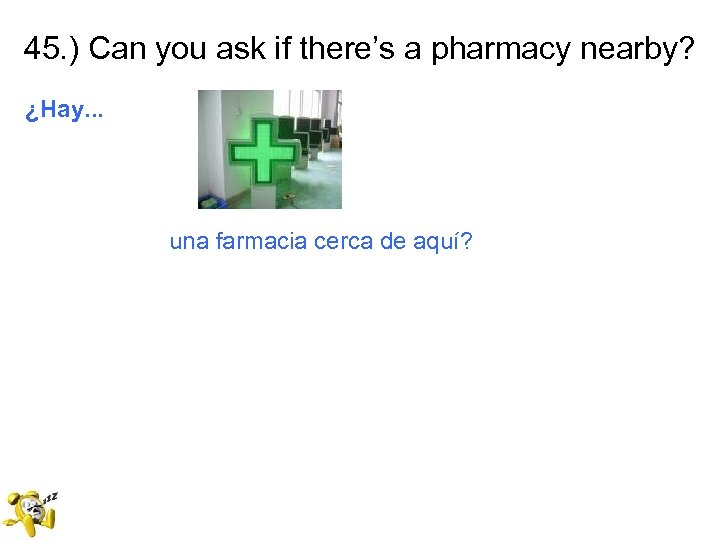 45. ) Can you ask if there’s a pharmacy nearby? ¿Hay. . . una farmacia cerca de aquí?
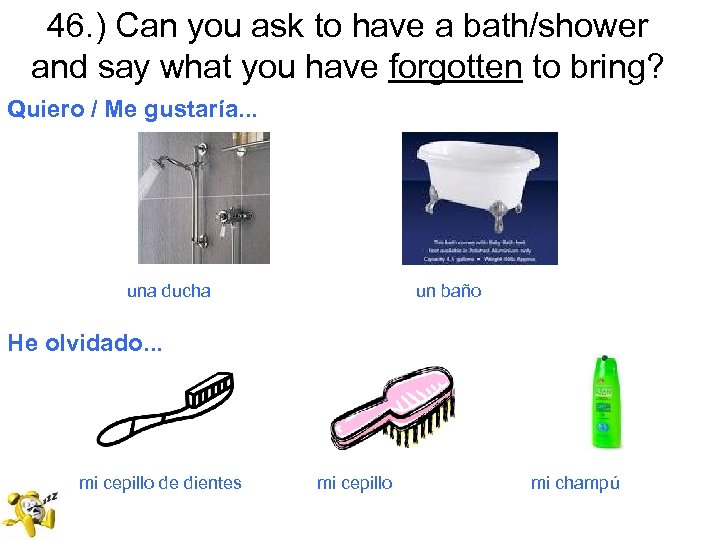 46. ) Can you ask to have a bath/shower and say what you have forgotten to bring? Quiero / Me gustaría. . . una ducha un baño He olvidado. . . mi cepillo de dientes mi cepillo mi champú
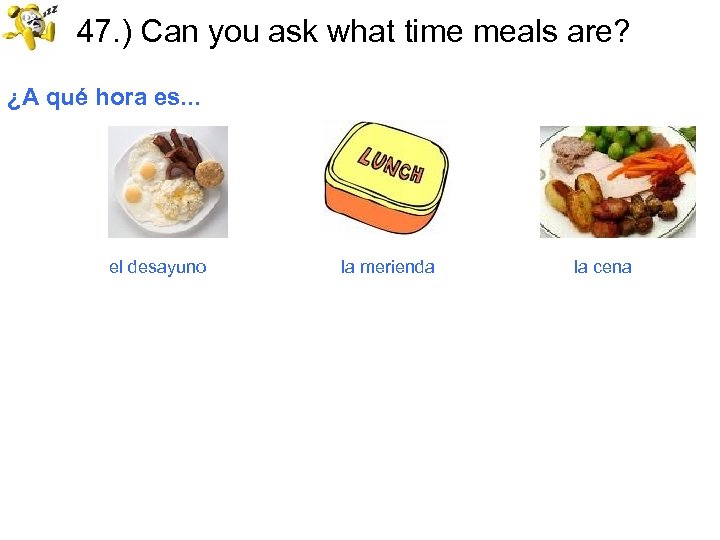 47. ) Can you ask what time meals are? ¿A qué hora es. . . el desayuno la merienda la cena
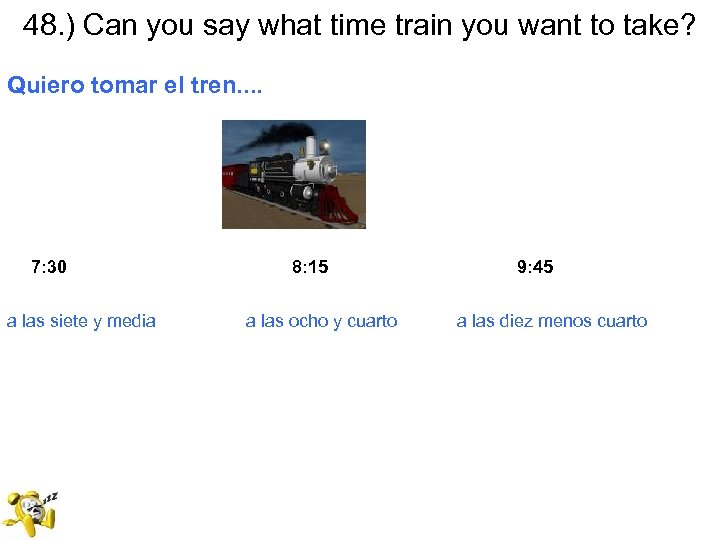 48. ) Can you say what time train you want to take? Quiero tomar el tren. . 7: 30 a las siete y media 8: 15 a las ocho y cuarto 9: 45 a las diez menos cuarto
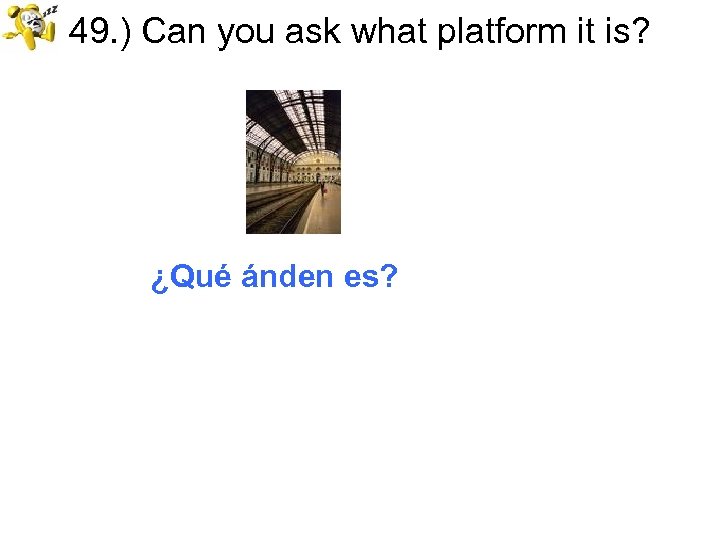 49. ) Can you ask what platform it is? ¿Qué ánden es?
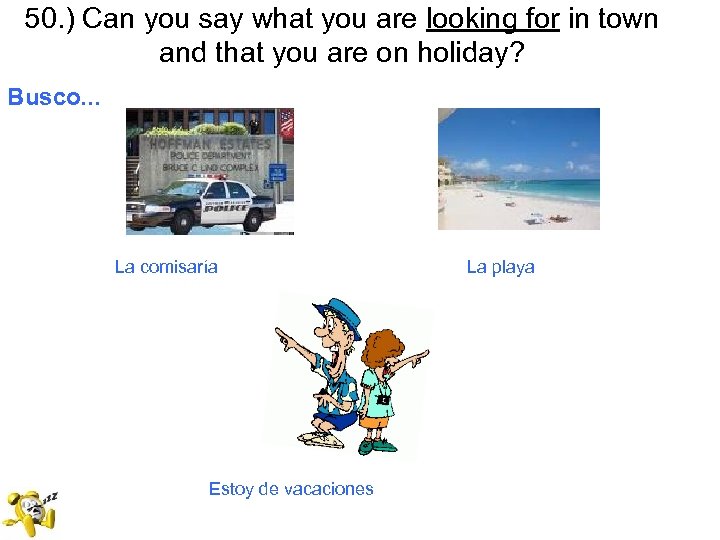 50. ) Can you say what you are looking for in town and that you are on holiday? Busco. . . La comisaría Estoy de vacaciones La playa
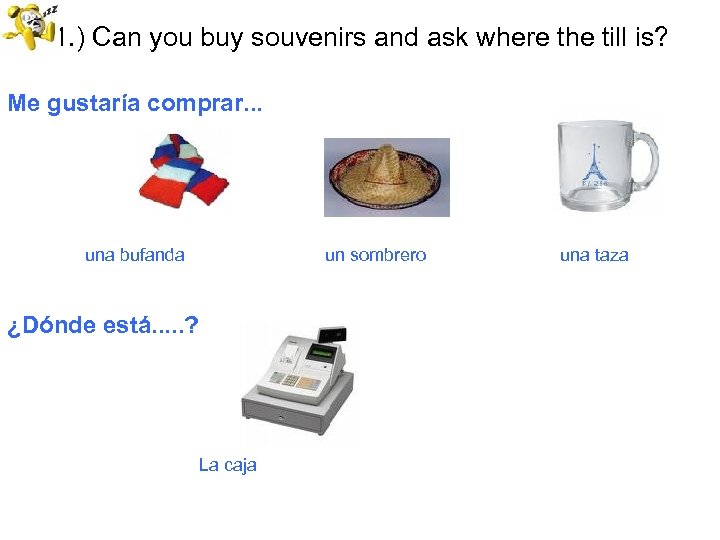 51. ) Can you buy souvenirs and ask where the till is? Me gustaría comprar. . . una bufanda un sombrero ¿Dónde está. . . ? La caja una taza
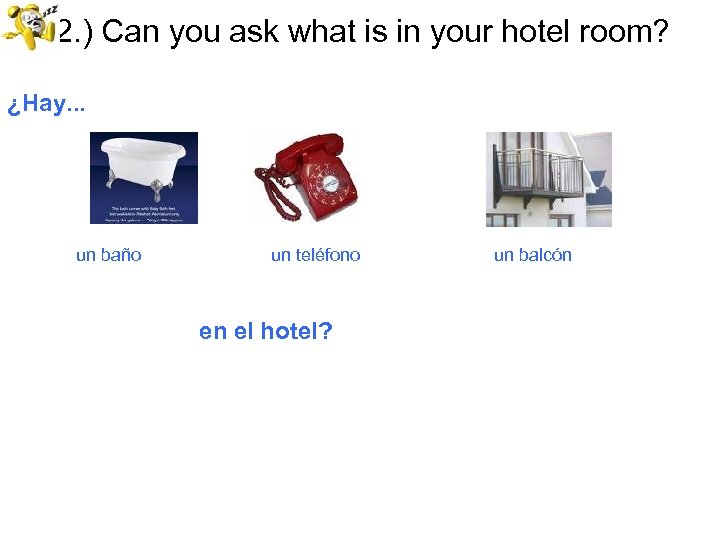 52. ) Can you ask what is in your hotel room? ¿Hay. . . un baño un teléfono en el hotel? un balcón
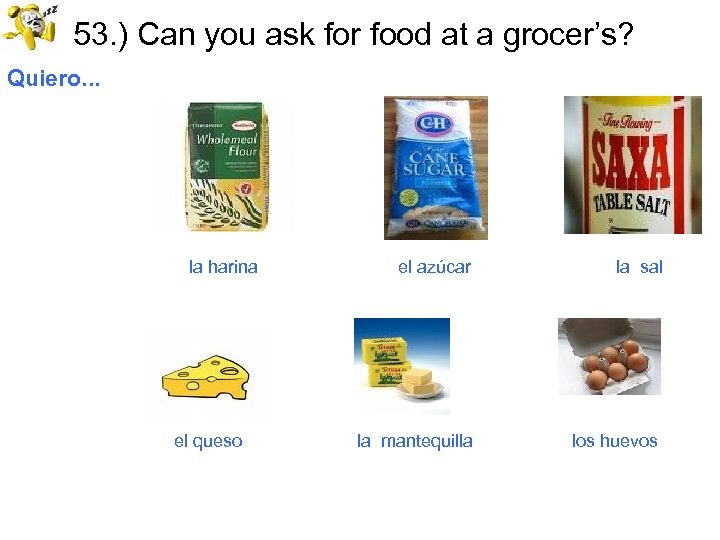 53. ) Can you ask for food at a grocer’s? Quiero. . . la harina el queso el azúcar la sal la mantequilla los huevos
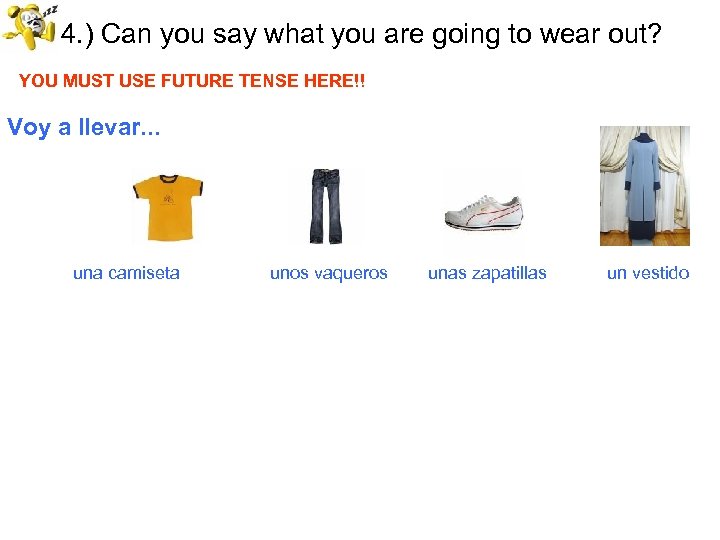 54. ) Can you say what you are going to wear out? YOU MUST USE FUTURE TENSE HERE!! Voy a llevar. . . una camiseta unos vaqueros unas zapatillas un vestido
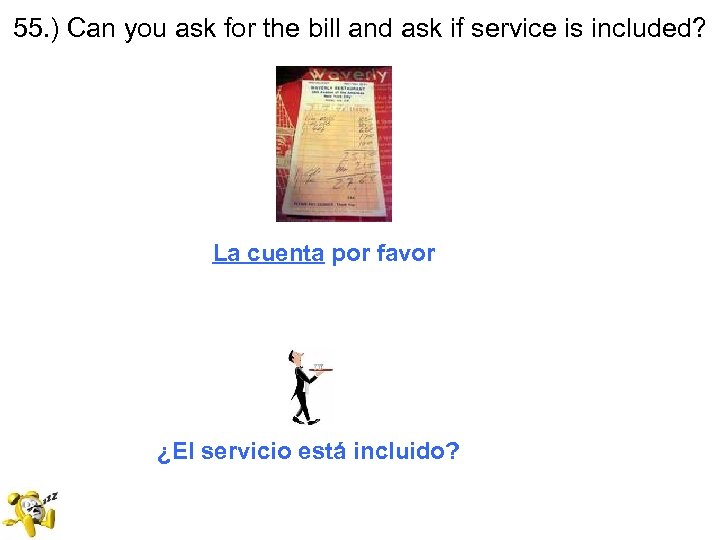 55. ) Can you ask for the bill and ask if service is included? La cuenta por favor ¿El servicio está incluido?
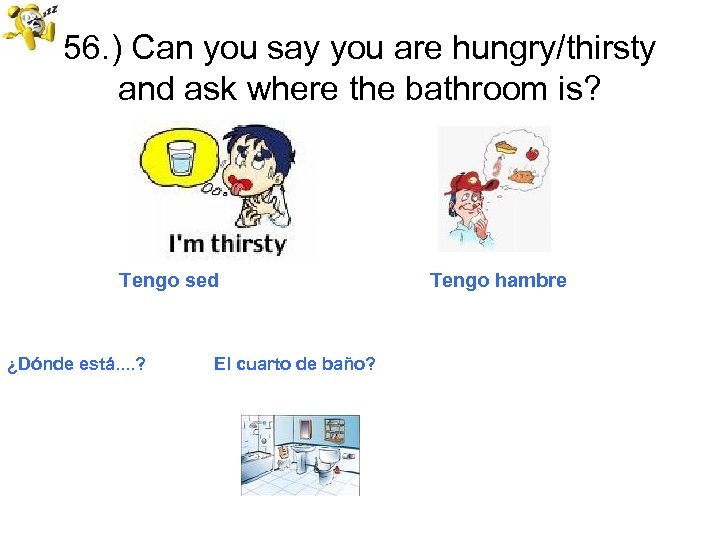 56. ) Can you say you are hungry/thirsty and ask where the bathroom is? Tengo sed ¿Dónde está. . ? El cuarto de baño? Tengo hambre
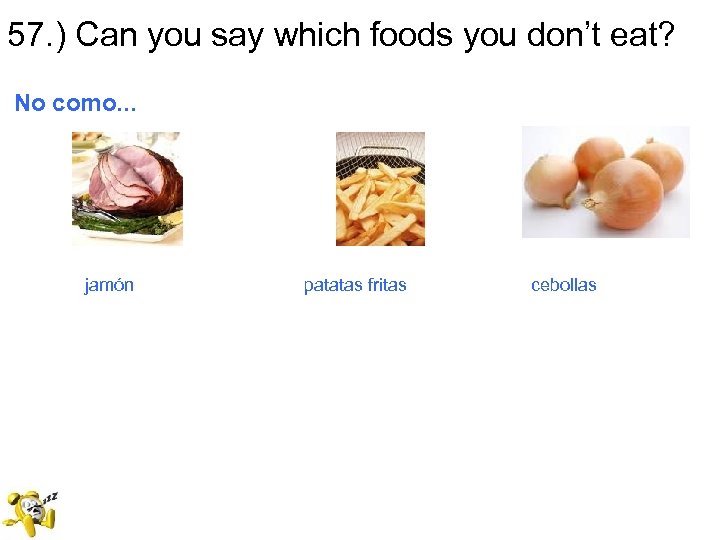 57. ) Can you say which foods you don’t eat? No como. . . jamón patatas fritas cebollas
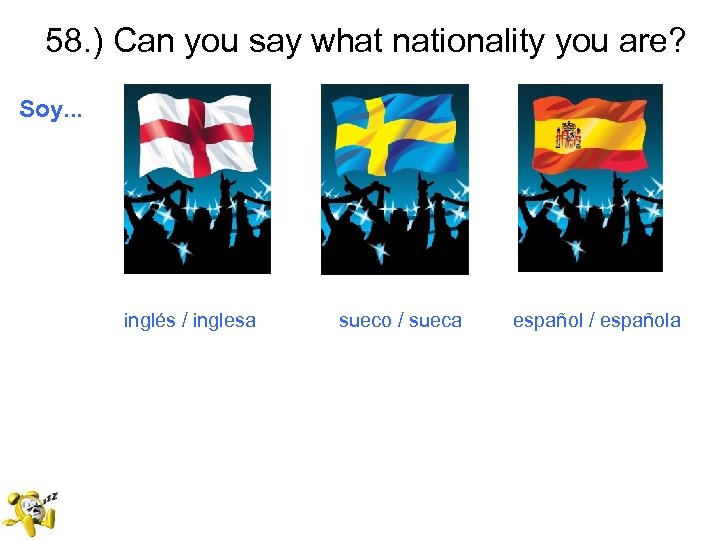 58. ) Can you say what nationality you are? Soy. . . inglés / inglesa sueco / sueca español / española
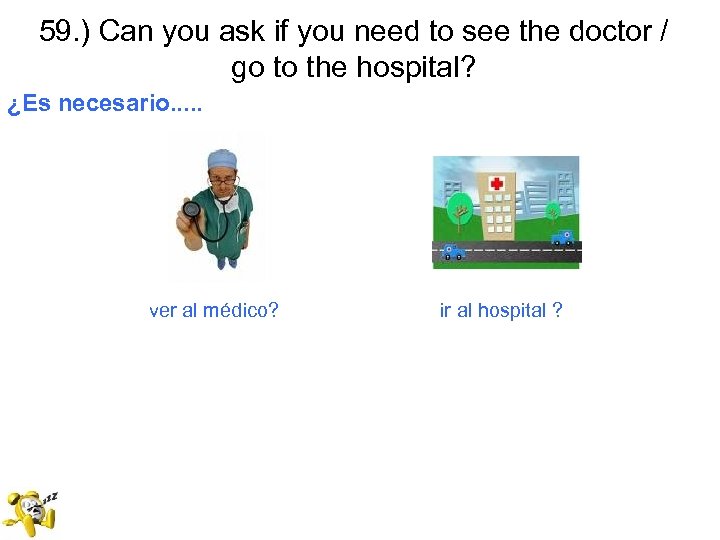 59. ) Can you ask if you need to see the doctor / go to the hospital? ¿Es necesario. . . ver al médico? ir al hospital ?
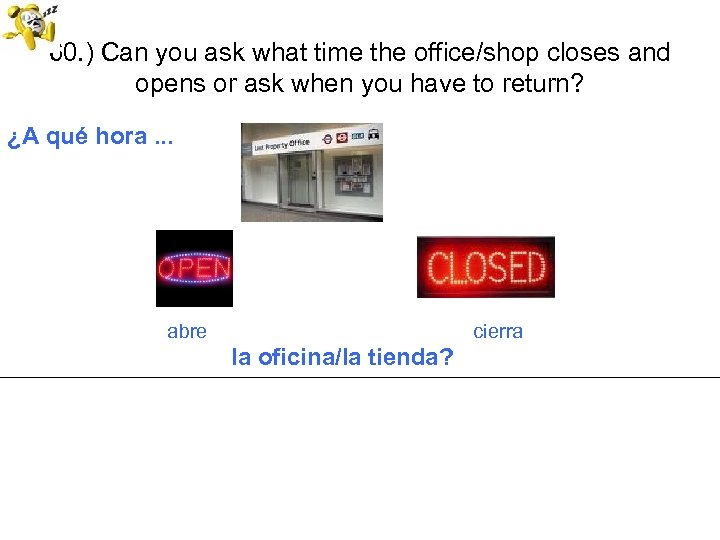 60. ) Can you ask what time the office/shop closes and opens or ask when you have to return? ¿A qué hora. . . abre cierra la oficina/la tienda?
 61. ) Reservación - detalles GIVING INFORMATION ABOUT RESERVATIONS This kind of sentence happens a lot in bus/train stations. Here you need to say at least your full name and destination. You may add the time as well. The higher roleplays really need you to think carefully about the situation you are in. • Tengo una reserva para Londres / Glasgow (a las nueve y media) • Me llamo Emma Persson TIP – Check the box on your roleplay card for a destination. + See also No 73
 62. ) Restaurante/Servicios? ASKING WHETHERE IS A RESTAURANT CAR / TOILETS Note that there is a question mark so you have to ask the question. This is quite easy: simply ask if there is a restaurant/toilets on the train/bus/plane. • ¿Hay un restaurante / servicios TIP –. ”Hay” means ‘There is + There are’ en el tren / autobús / avión?
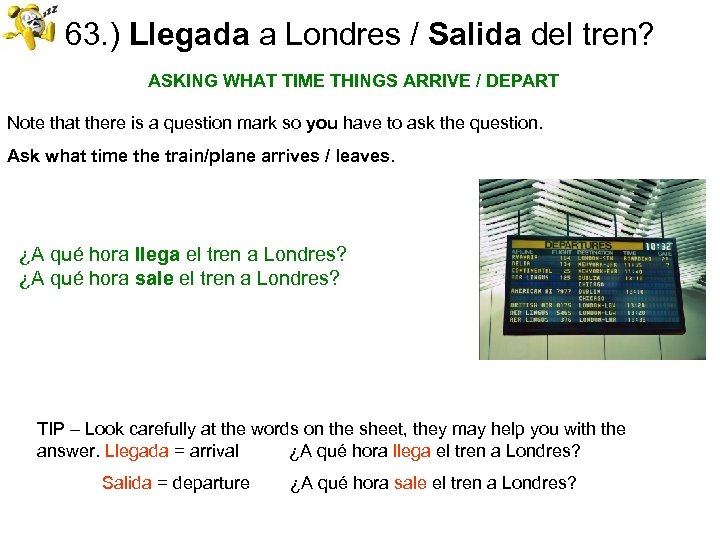 63. ) Llegada a Londres / Salida del tren? ASKING WHAT TIME THINGS ARRIVE / DEPART Note that there is a question mark so you have to ask the question. Ask what time the train/plane arrives / leaves. ¿A qué hora llega el tren a Londres? ¿A qué hora sale el tren a Londres? TIP – Look carefully at the words on the sheet, they may help you with the answer. Llegada = arrival ¿A qué hora llega el tren a Londres? Salida = departure ¿A qué hora sale el tren a Londres?
 64. ) Visita a Fuengirola - cuándo? ASKING WHEN TO VISIT A PLACE Note that there is a question mark so you have to ask the question. Ask when your friend wants to visit a town/place. ¿Cuándo te gustaría visitar Fuengirola? TIP – Be careful to use ‘¿Cuándo? – When? NOT ¿A qué hora? - What time?
 65. ) Comida? ASKING WHERE YOU CAN EAT Note that there is a question mark so you have to ask the question. Ask where you are going to eat? ¿Dónde vamos a comer? ¿Hay restaurantes para comer? Now imagine you are going to a work experience placement and want to know about eating arrangements. TIP – Try to use future tense here. If you arranging a trip and you see the word comida , you need to ask about eating arrangments. The second sentence is a good example of using a common word ‘restaurantes’ to ask the question.
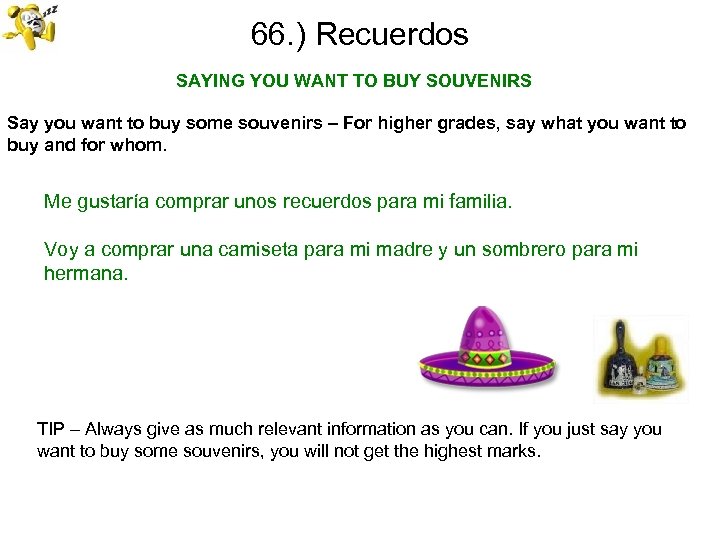 66. ) Recuerdos SAYING YOU WANT TO BUY SOUVENIRS Say you want to buy some souvenirs – For higher grades, say what you want to buy and for whom. Me gustaría comprar unos recuerdos para mi familia. Voy a comprar una camiseta para mi madre y un sombrero para mi hermana. TIP – Always give as much relevant information as you can. If you just say you want to buy some souvenirs, you will not get the highest marks.
 67. ) Por qué estás llamando GIVING A REASON FOR YOUR CALL Put yourself in the roleplay, think. . . why am I calling? For a job? For information ? For a booking? Try to think of an example where you are phoning for information about a job in a hotel. . . ¡Hola! Me gustaría informarme acerca de trabajos en su hotel. ¡Hola! Estoy llamando para obtener información sobre la posibilidad de trabajar en su hotel. TIP – Remember their are lots of words for jobs – empleos, trabajos, puestos.
 68. ) Uniforme / ropa? ASKING WHAT CLOTHES YOU HAVE TO WEAR Note that there is a question mark so you have to ask the question. This type of question is usually put in where there is a phone call to a work placement / job or arranging to go out somewhere. 1 st try to ask if you must wear a uniform ¿Es necesario llevar uniforme? ¿Tengo que llevar un uniforme? Now try to ask what clothes you should wear for a night out ¿Qué ropa debería llevar? TIP – The examiner will want to here a whole sentence with either tengo que. . or es necesario. for the uniform.
 69. ) Salario / Sueldo? Asking how much the salary is. Note that there is a question mark so you have to ask the question. This type of question is usually put in where there is a phone call to a work placement / job. ¿Cuánto es el sueldo? ¿Cuánto es el salario? TIP – The examiner will want to here a whole sentence with either tengo que. . or es necesario. for the uniform.
 70. )Descripción del profesor / del ladrón Describing a person is quite a common task in the higher roleplays. You will need to give detailed information. It is usually a member of your family, a teacher or someone involved in a crime. First have a go at describing a teacher…. Mi profesora se llama María. Es joven, simpática y organizada. A veces es un poco pesada. Now try to describe a robber / criminal. El ladrón tiene el pelo negro, los ojos azules y una barba. Es alto y muy gordo. TIP – Think carefully about what is needed here. For a description of a family member / teacher it is more likely you will describe their character; however for a thief or criminal, the description you give should be physical.
 71. ) El horario del trabajo / del colegio? Asking what the work / school hours are Note that there is a question mark so you have to ask the question. The word ‘horario’ means the hours. There are two ways of tackling this question (using the verbs to start and finish, or just asking what the hours of work are. ¿A qué hora empieza y termina el colegio / el trabajo? ¿Cuáles son las horas del colegio / del trabajo? TIP – You made want to add the word normalmente or generalmente.
 72. ) El desayuno / La merienda / La cena – dónde? Asking where you are going to eat (breakfast, lunch and tea) Note that there is a question mark so you have to ask the question. Also, you’ll need to use future tense so that it is clear you are talking about eating later. ¿Dónde vamos a comer el desayuno? ¿Dónde vamos a comer la merienda? ¿Dónde vamos a comer la cena? TIP – You can use this type of sentence to ask where you are going to stay / buy things… ¿Dónde vamos a quedarnos? ¿Dónde vamos a comprar…. ?
 73. ) Reservación - detalles Giving details on a booking to theatre / concert For this type of reservation you will need to say your name, the concert/production you have booked and the time you have booked it for. . Hola me llamo Emma Persson y he reservado dos billetes para Romeo y Julieta a las ocho y media. Hola me llamo Lisbeth Salander y he reservado dos billetes para el concierto de Héroes del Silencio a las nueve. TIP – The box on your roleplay should give you information on which concert / theatre production it is.
 74. ) Suplemento? Asking if there is a surcharge Note that there is a question mark so you have to ask a question. Here you will just need to ask if you have to pay an extra charge for cancelling / changing a booking. ¿Tengo que pagar un suplemento? ¿Hay un suplemento que pagar? TIP – The 1 st option will score more highly but if you are in doubt, then you could just use ‘hay’
 75. ) Detalles personales Giving your personal details When you see this in an exam, you need to focus on the situation of the roleplay. You have to give at least 3 pieces of information: your name, your telephone number and age. Basically, the rule is that anything that is relevant can be used. Me llamo Malin y mi número de teléfono es 20 45 67 89 Tengo quince años. Other information might include your nationality, the languages you speak and your date of birth. Soy inglesa / sueca / española. Hablo inglés, sueco y español. Mi fecha de nacimiento es el veintitrés de diciembre. TIP – Spanish telephone numbers are usually eight numbers long and you would say the numbers in 2 s (veinte, cuarenta y cinco, sesenta y siete, ochenta y nueve.
 76. ) Problema (coches) Saying you have a problem with the car. When you see this in an exam, you should give at least 1 problem with your vehicle. Give your name first and say you have a problem with your car… Hola me llamo Samehra Khan y tengo un problema con mi coche… Broken windscreen Se ha roto el parabrisas No brakes Los frenos no funcionan Puncture Tengo un pinchazo TIP – To further impress the examiner, you could add phrases like ‘ Necesito ayuda’ or introduce yourself as a tourist…’Estoy de vacaciones aquí’
 77. ) Dónde -detalles Saying where you are When you see this in an exam, you should say where you are so the garage can locate you. There are two main ways to do this – the easiest way to do this is by saying where you are and what you are near. Estoy en el centro de la ciudad. . cerca de la iglesia Estoy en las afueras del pueblo – cerca de un supermercado TIP – Remember to use estar for saying where you are – Estoy. .
 78. ) Esperar mucho tiempo? Asking if you will have to wait a long time Note that there is a question mark so you have to ask the question. Here you will need to use ‘tener que’ – to have to. ¿Tengo que esperar mucho tiempo? Always be prepared to ask the question in another way – this helps if you don’t know the exact vocabulary. How about asking when the mechanic will arrive. ¿A qué hora vas a llegar? TIP – Don’t panic in the exam – Think about what the question is asking you and then if you don’t know the exact phrase, think of another way to say it.
 79. ) Problema – detalles Returning goods to shops - stationary Here you will probably have to say that you have a problem with an item you bought. You must use past tense to do this ( i bought. . . ). Also look at the information on the roleplay card, does it say which shop you are in. You will not get any marks if you complain about clothes in a stationery shop. For this practice, imagine you are in a stationary shop. Buenos días, Compré un libro aquí ayer pero hay un problema. . . . Faltan unas páginas (there’s pages missing). . No es el libro correcto (It’s not the right book). . . Hay una huella (There’s a mark) TIP – In the higher roleplays, remember to pick an item that you can both describe and give a problem for. Don’t say you bought a pencil, shirt. . . if you can’t continue the roleplay.
 80. ) Problema – detalles Returning goods to shops - clothes Here you will probably have to say that you have a problem with an item you bought. You must use past tense to do this ( i bought. . . ). Also look at the information on the roleplay card, does it say which shop you are in? You will not get any marks if you complain about clothes in a stationery shop. For this practice, imagine you are in a clothes shop. Buenos días, Compré unos zapatos aquí ayer pero hay un problema. . . . No me quedan bien (they don’t fit well). . . Hay una huella (there’s a mark). . . No me gusta el color TIP – In the higher roleplays, remember to pick an item that you can both describe and give a problem for. Don’t say you bought a pencil, shirt. . . if you can’t continue the roleplay.
 81. ) Compra - cuando Saying when you bought things Here you need to say when you bought the item. Remember to use past tense again. Compré los zapatos ayer Compré la chaqueta la semana pasada TIP – You could also use a pronoun instead of repeating what you bought. . Lo compré ayer – I bought it yesterday Las compré ayer – I bought them yesterday
 82. ) Solución? Asking if a solution is possible Here you need to say what you want. It’s important you learn 1 -2 phrases for doing this as these types of roleplay are very common. Ask to change it or for a refund ¿Es posible cambiarlo (por otro)? Exchange Me gustaría un reembolso - Refund Learning words like reembolso (refund), cajera (cash desk) and servicios (toilets) is very important because there is no other way of conveying these ideas.
 83. Por qué estás llamando Saying why you are phoning (report a crime) Here you need to phone a police station and say you want to report a crime. If you look on the roleplay card, it is quite likely you will find the word for robbery. Me gustaría denunciar un crimen Now have another go at describing a robber. Remember, the Police would want a physical description. El ladrón tenía el pelo rubio, los ojos marrones y una barba. Llevaba gafas. Tip – It is very likely you are going to be asked for personal information in a ‘reporting a crime’ roleplay. Don’t use the phone number of the police station (which you may find on the roleplay card) , make sure you know your own.
 84. Ir a la comisaría / al médico? Ask whether you need to go to the police station / doctor Note that there is a question mark so you have to ask the question. Here you need to ask whether you need to go to one of these places. You can use either ‘Tengo que’ or ‘Es necesario’ ¿Tengo que ir a la comisaría? ¿Es necesario ir al médico? Tip – Es necesario / Es probable are good phrases to remember as they will be useful in a number of situations.
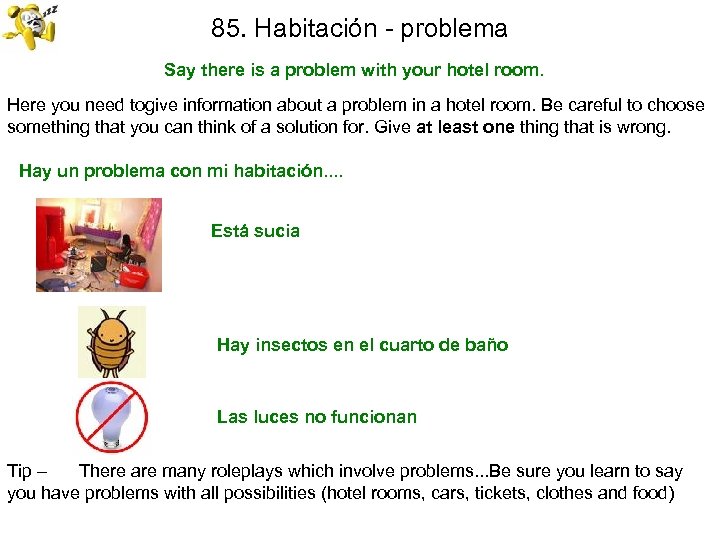 85. Habitación - problema Say there is a problem with your hotel room. Here you need togive information about a problem in a hotel room. Be careful to choose something that you can think of a solution for. Give at least one thing that is wrong. Hay un problema con mi habitación. . Está sucia Hay insectos en el cuarto de baño Las luces no funcionan Tip – There are many roleplays which involve problems. . . Be sure you learn to say you have problems with all possibilities (hotel rooms, cars, tickets, clothes and food)
 86. Acción? Ask what can be done (about a problem in a hotel room) Note that there is a question mark so you have to ask the question. You do not have to suggest a solution but you must ask them what they can do to resolve the problem. Try first of all to just ask them what they are going to do. ¿Qué vas a hacer para solucionar el problema? Now use ‘¿Es posible. . . ? ’ / ‘¿Sería posible. . ? ’ to suggest a solution ¿Es posible cambiar mi habitación? . . ¿Sería posible limpiar la habitación? Tip – BOTH of these answers would be acceptable. The first is maybe more simple but suggesting a solution is a suitable alternative.
 87. Visita a la fería? Suggest visiting somewhere (a fair / a town) Note that there is a question mark so you have to ask the question. You need to suggest visiting place. Usually it will be the place advertised on the speaking card. ¿Visitamos la fería de Valencia? Tip – You could use ‘¿Vamos. . ? – Shall we go?
 88. Qué estabas haciendo. . . Saying what you were doing at the time of accident / crime Here you need to explain what you were doing when something happened. These types of questions usually happen if you are reporting a crime, an accident or a personal injury. For the first example, imagine you have injured yourself and say what you were doing. Estaba jugando al fútbol / baloncesto. . . Estaba bailando en una discoteca Now try to say what you were doing when a road accident happened. . Estaba cruzando la calle. . (crossing road) Estaba comprando una chaqueta (buying something) Tip – Listen carefully for the ‘estabas’ bit. As soon as you hear this, repeat it in your answer estaba. . .
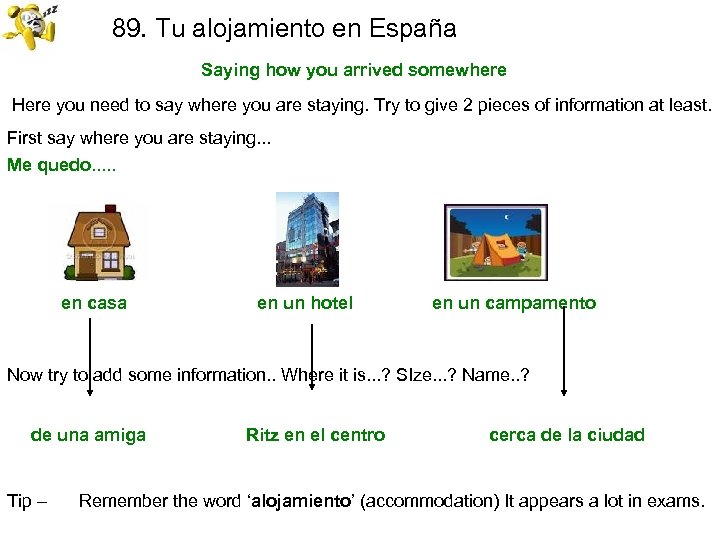 89. Tu alojamiento en España Saying how you arrived somewhere Here you need to say where you are staying. Try to give 2 pieces of information at least. First say where you are staying. . . Me quedo. . . en casa en un hotel en un campamento Now try to add some information. . Where it is. . . ? SIze. . . ? Name. . ? de una amiga Tip – Ritz en el centro cerca de la ciudad Remember the word ‘alojamiento’ (accommodation) It appears a lot in exams.
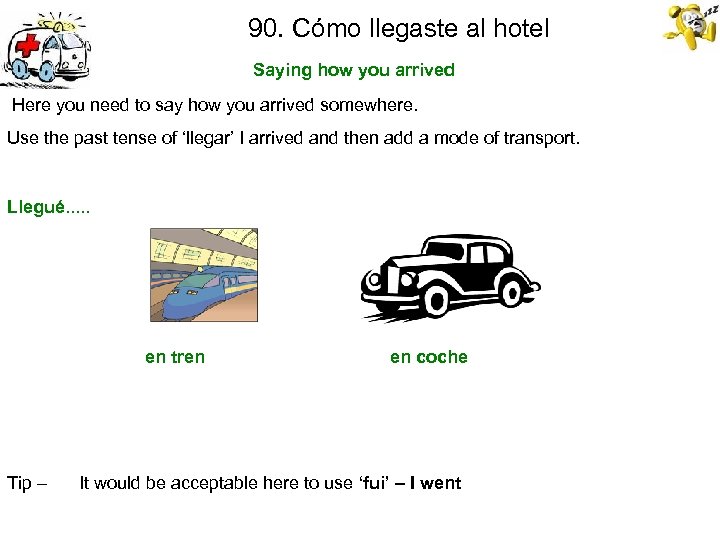 90. Cómo llegaste al hotel Saying how you arrived Here you need to say how you arrived somewhere. Use the past tense of ‘llegar’ I arrived and then add a mode of transport. Llegué. . . en tren Tip – en coche It would be acceptable here to use ‘fui’ – I went
 91. Tus cualidades personales Saying what personal attributes you have to be good for a job Here you need to give your personal qualities Think of 2 -3 describing words and then maybe another good sentence to get you a job. Soy una persona. . . trabajadora sociable simpática divertida energética Now try to add another sentence – You never arrive late / Languages you speak. . Nunca llego tarde. . . Hablo español, inglés y sueco. . . Tip – Anything that is relevant to giving you a job is acceptable here. Try to impress the examiners by using at least one thing without soy. .
 92. Cuándo puedes trabajar Saying when you will be available Here you need to say when you will be available. You should try to use future tense when you see this. You could give an exact date, or say something like ‘next week’ , ‘ tomorrow’. Estaré libre. . . el treinta de agosto. . . mañana. . en una semana Tip – You could also used ‘Puedo trabajar’ – ‘I can work. . . ’
 93. ¿El pronóstico meteorológico? Asking what the weather is going to be like Note that there is a question mark so you have to ask the question. Here you need to use future tense. ¿Qué tiempo va a hacer esta tarde? Tip – future. You could also use the present tense as long as you specify a time in the ¿Qué tiempo hace más tarde? ¿Qué tiempo hace mañana?
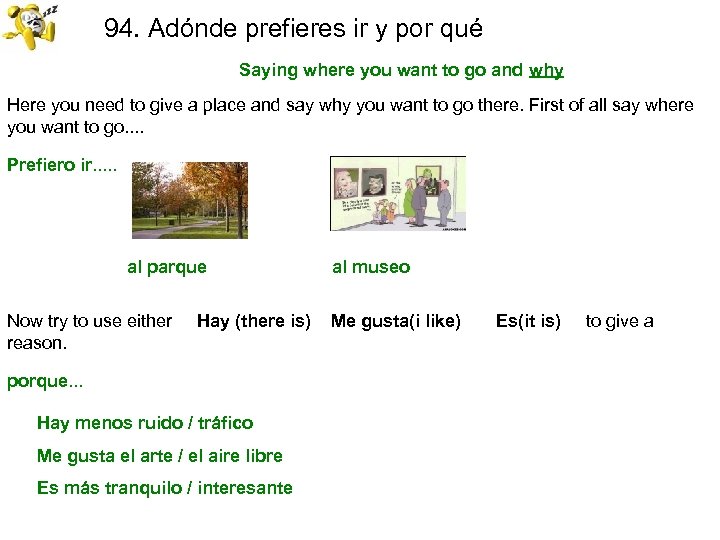 94. Adónde prefieres ir y por qué Saying where you want to go and why Here you need to give a place and say why you want to go there. First of all say where you want to go. . Prefiero ir. . . al parque Now try to use either reason. Hay (there is) porque. . . Hay menos ruido / tráfico Me gusta el arte / el aire libre Es más tranquilo / interesante al museo Me gusta(i like) Es(it is) to give a
 95. Tus planes para mañana / el resto de tu visita Saying what you plan to do later on in day / in trip Here you need to say in the future tense what your plans are for later in the day. Anything realistic will do unless you have broken an arm and say you are going to play football. Begin by saying what you might do later on in the day. Voy a jugar al fútbol y luego voy a volver al hotel para ducharme. Voy a visitar los sitios de interés y después voy a ver la tele. Now try to say what you will do with the rest of your visit. Saying you are going to have a shower is NOT a correct response. Me gustaría visitar los sitios y comer en un restaurante Me gustaría salir a una discoteca para bailar. Tip – Be careful !, sometimes you will be asked what your plans are for the future. . In this case, you would need to say something like ‘ Voy a continuar mis estudios’
 96. Lo que te gustó de tu visita y por qué Saying what you have enjoyed In this question, you will need to say what you liked about a visit and why. You must talk in past tense here. . . Say you liked the food / attractions / people / opportunity to practice language. . ANYTHING RELEVANT Me gustó la comida española Me gustó la gente española Me gustó visitar el museo / el parque de atracciones Important to use preterite. . . Me gustó la oportunidad de practicar mi español I liked + Now try to think of a reason why porque. . . fue una experiencia útil buena la ciudad es muy bonita / / la comida estaba muy quiero mejorar mi español Tip – You may also be asked what you did NOT like about a place you visit, so be prepared to be critical as well. . No me gustó la comida (I didn’t like the food)
 97. Las diferencias entre tu insitituto y el instituto español Say what the differences are between something in England Spain Here you have to make a comparison between something you have seen in England Spain. You should be using the words ‘más’ and ‘menos’. For this example, try to think of two differences you could give between a Spanish/French school and one in England. . En mi colegio las clases empiezan más tarde En mi colegio la comida es mejor En los colegios en España, los estudiantes son más ruidosos En mi colegio hay menos respeto por los profesores Tip – You may also wish to use the words ‘Mejor’ – better or ‘peor’ worse
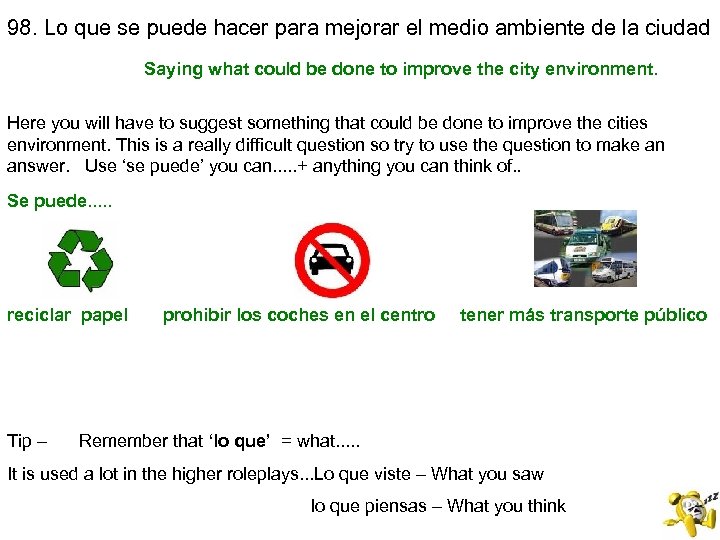 98. Lo que se puede hacer para mejorar el medio ambiente de la ciudad Saying what could be done to improve the city environment. Here you will have to suggest something that could be done to improve the cities environment. This is a really difficult question so try to use the question to make an answer. Use ‘se puede’ you can. . . + anything you can think of. . Se puede. . . reciclar papel Tip – prohibir los coches en el centro tener más transporte público Remember that ‘lo que’ = what. . . It is used a lot in the higher roleplays. . . Lo que viste – What you saw lo que piensas – What you think
 99. Lo que viste Describing what you saw - Accident or robbery Here you need to use past tense to describe what you saw. This is a very hard question to do. The easiest (but lowest scoring way) would be to simply say you saw an accident between a pedestrian and a car. Try this first. . Vi un accidente entre un coche y un peatón pedestrian Now try to say what they were both doing. This will score the higher grades. Clue + Try to use the estaba. . . construction Vi un accidente entre una mujer que estaba cruzando la calle y un coche que estaba girando a la derecha. cruzar = to cross girar a la derecha = to turn to the right It is very important you use the correct tense here. Remember phrases like Vi – I saw Noté – I noted Había – There was
 100. Cómo ocurrió el accidente Saying how an accident / injury happened You need to use the past tense (preterite) to say how you injured yourself. There is a really important phrase which you can use for all of these types of questions. . . ’I fell’ Say what you were doing first using the ‘estaba. . construction. Estaba jugando al fútbol Estaba bailando Estaba caminando en el parque Now try to say how you did it. . . Can you remember how to say ‘I fell’? y. . . Me caí (I fell) y. . . Lo quemé (I burnt it Tip – You could also say you didn’t see something to further impress the examiner. . . No vi un árbol. . . No vi la pelota
 101. Fechas ? Asking about dates of job / exchange Note that there is a question mark so you have to ask the question. ¿Cuáles son las fechas del trabajo? ¿Qué fecha empieza el trabajo?
 102. Cena – detalles? Asking for details about what you are going to do about dinner Note that there is a question mark so you have to ask the question. . You could ask ‘ Is there a restaurant’? / What can we do for dinner? ¿Hay un restaurante? ¿Qué se puede hacer para la cena? This could also be ‘desayuno’ or merienda’
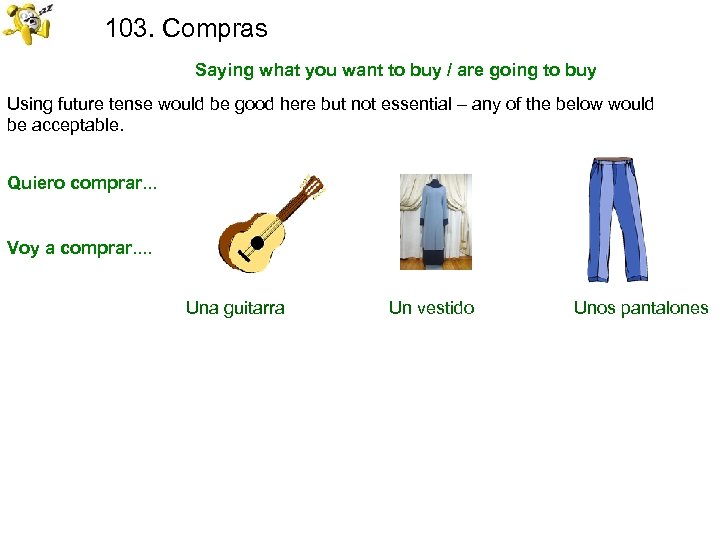 103. Compras Saying what you want to buy / are going to buy Using future tense would be good here but not essential – any of the below would be acceptable. Quiero comprar. . . Voy a comprar. . Una guitarra Un vestido Unos pantalones
 104. Medicamentos? Asking if you can have / if you need some medicine Note that there is a question mark so you have to ask the question. . ¿Necesito tomar medicina? ¿Puedo tener una receta? Can you give me a prescription?
 105. Televisión / cine – detalles? Asking what there is to see on tv / at cinema Note that there is a question mark so you have to ask the question. . ¿Hay una buena película en el cine? ¿Qué hay en el cine esta tarde? ¿Hay un programa interesante esta tarde? Is there an interesting program this evening?
 106. Cuanto tiempo - visita? Asking how long the visit will last Note that there is a question mark so you have to ask the question. . ¿Cuánto tiempo dura la visita? or if you cant remember the 1 st sentence. . La visita, ¿es para mucho tiempo?
 107. Descripción del artículo Describing something you lost/left behind Obviously what you lost determines the outcome of your answer but the examiner will want to see you expanding to 3 or 4 things. You might want to include. . Colour, Brand, Size, Age, Material. Es un nuevo reloj. Es un reloj para chicos y es un Rolex. Es un abrigo blanco y de cuero. Es bastante largo. Es un regalo de cumpleaños.
 108. Vuelo perdido - razón Saying why you missed your flight It would be very good to introduce yur problem here – just use the words from the title and put into the past tense. . then give your reason. He perdido mi vuelo porque. . . Había. . . mucho tráfico un problema con el coche un problema con las maletas Había is a really useful phrase to use here – there was + anything that could have stopped you.
 109. Ropa? Asking what clothes someone is going to wear Note that there is a question mark so you have to ask the question. . ¿Qué ropa te gustaría llevar?
 110. vuelta – cuando? Asking when you should come back (e. g to a lost property office) Note that there is a question mark so you have to ask the question. . ¿A qué hora debería volver? ¿Hace falta volver a qué hora? Note* This question could also appear without the question mark, in which case you would need to say when you are returning home (from country / back to house) Voy a volver mañana
 Vocab boost!!! Some essential vocab for your speaking test – Click on a picture for some essential practice. Days/Months Post office Clothes Fruit/Veg Other food Cutlery etc Souvenirs Lost property Activities In town Transport Tourist office Feelings Stationery Helping in house
 Los días y los meses Enero Lunes Febrero Martes Marzo Miércoles Abril Jueves Mayo Viernes Junio Sábado Julio Domingo Agosto Septiembre Octubre Noviembre Diciembre
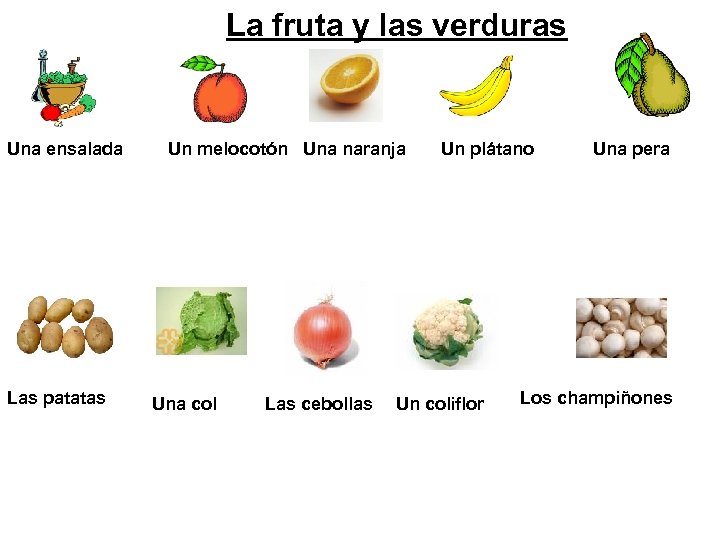 La fruta y las verduras Una ensalada Las patatas Un melocotón Una naranja Una col Las cebollas Un plátano Un coliflor Una pera Los champiñones
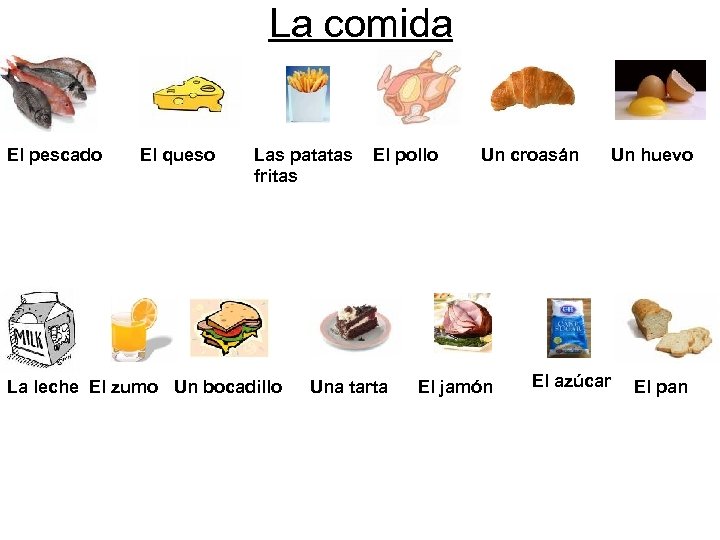 La comida El pescado El queso Las patatas fritas La leche El zumo Un bocadillo El pollo Una tarta Un croasán El jamón El azúcar Un huevo El pan
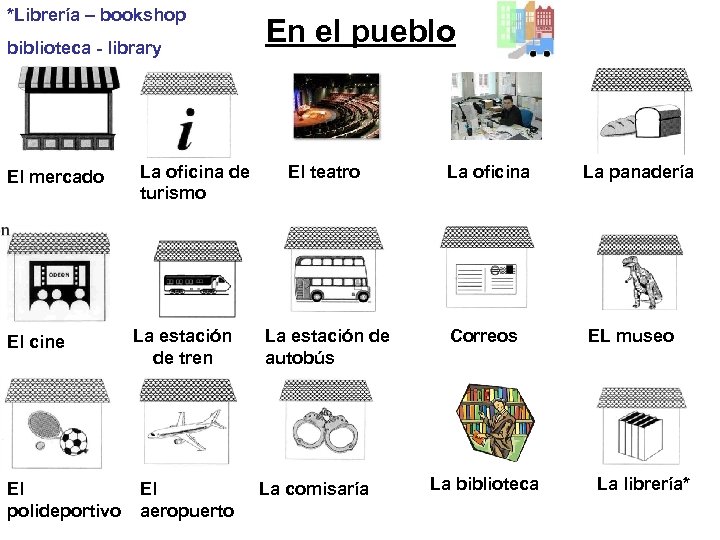 *Librería – bookshop biblioteca - library El mercado El cine El polideportivo La oficina de turismo La estación de tren El aeropuerto En el pueblo El teatro La oficina La estación de autobús Correos La comisaría La biblioteca La panadería EL museo La librería*
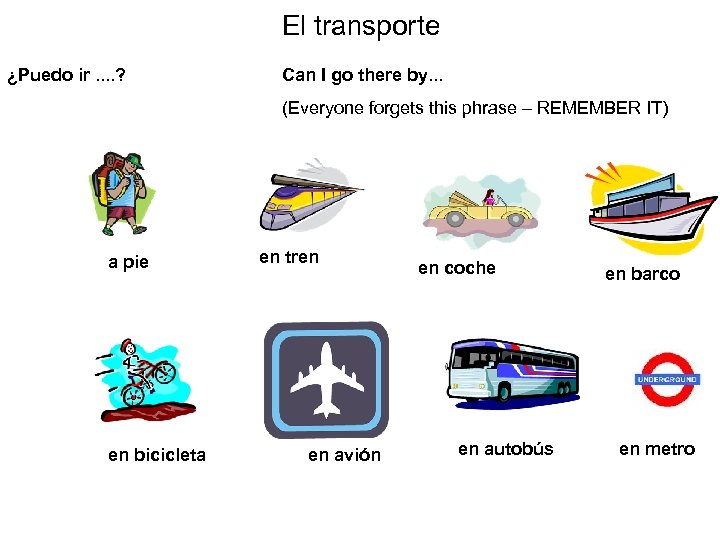 El transporte ¿Puedo ir. . ? Can I go there by. . . (Everyone forgets this phrase – REMEMBER IT) a pie en bicicleta en tren en avión en coche en autobús en barco en metro
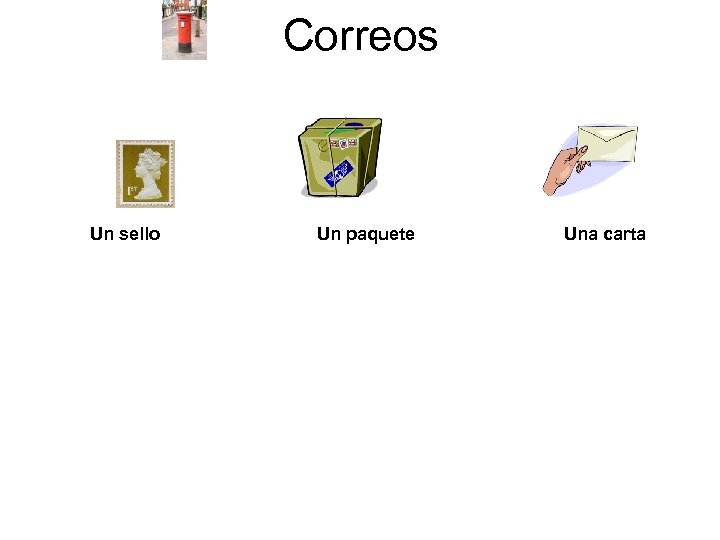 Correos Un sello Un paquete Una carta
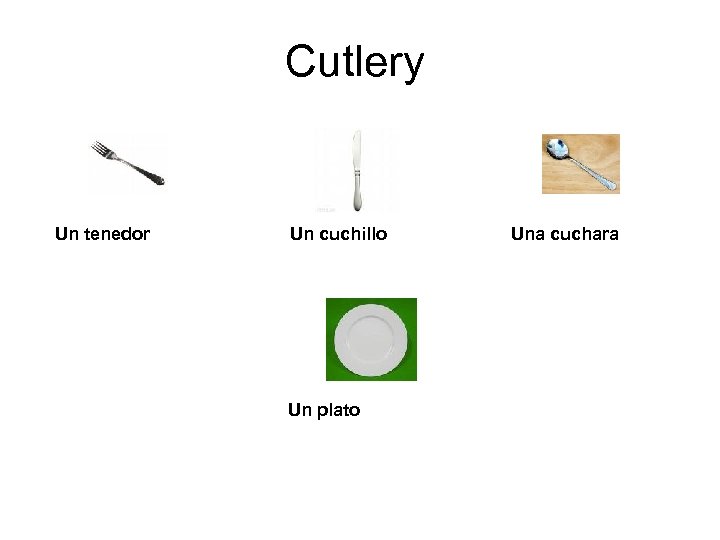 Cutlery Un tenedor Un cuchillo Un plato Una cuchara
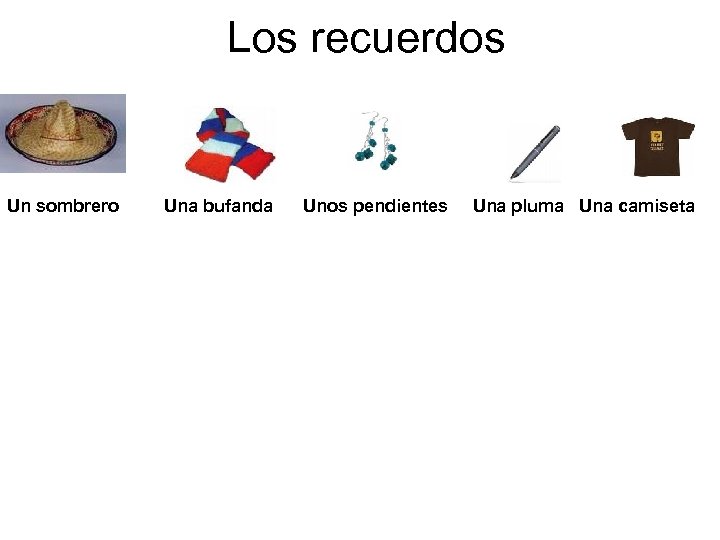 Los recuerdos Un sombrero Una bufanda Unos pendientes Una pluma Una camiseta
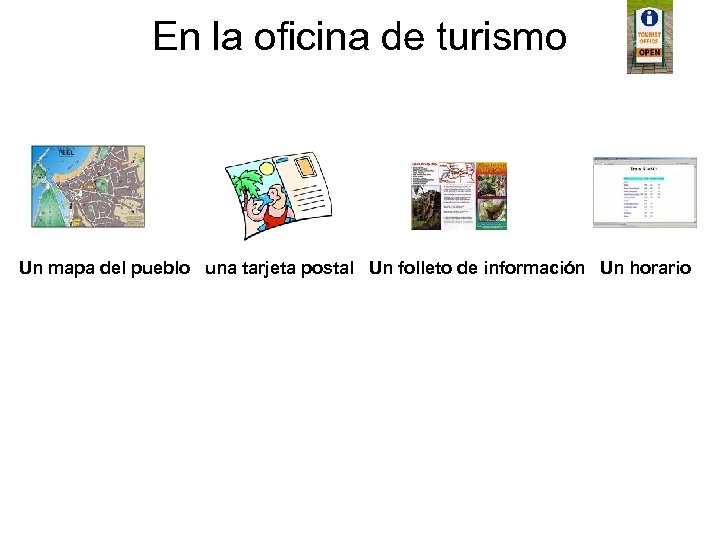 En la oficina de turismo Un mapa del pueblo una tarjeta postal Un folleto de información Un horario
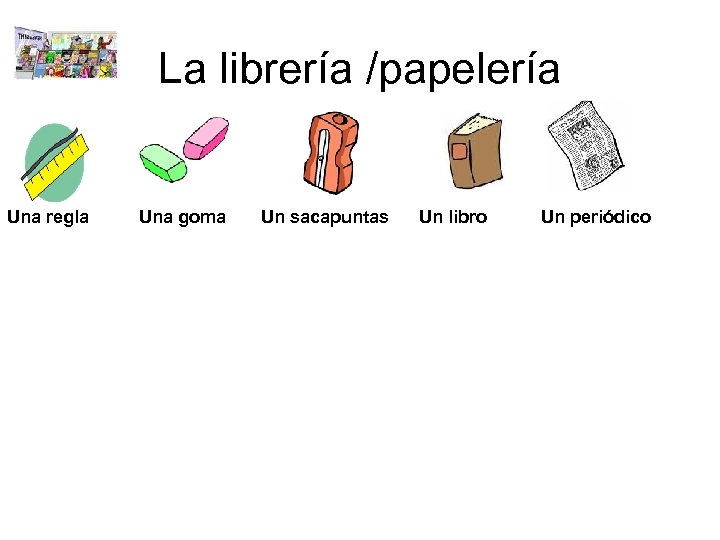 La librería /papelería Una regla Una goma Un sacapuntas Un libro Un periódico
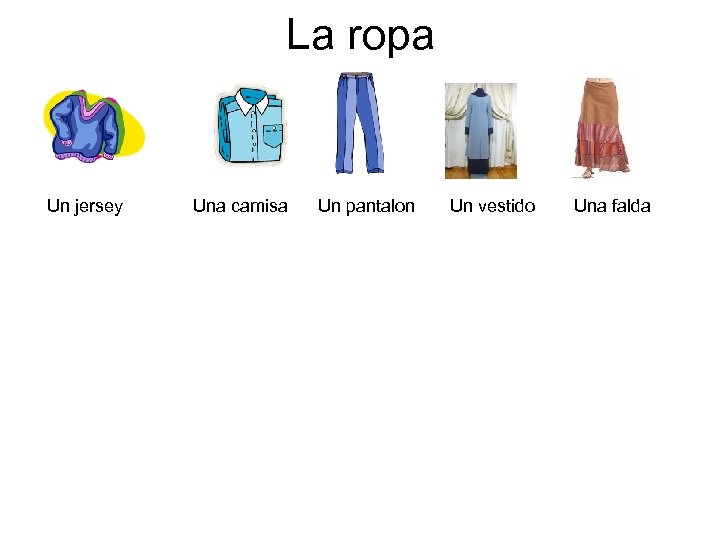 La ropa Un jersey Una camisa Un pantalon Un vestido Una falda
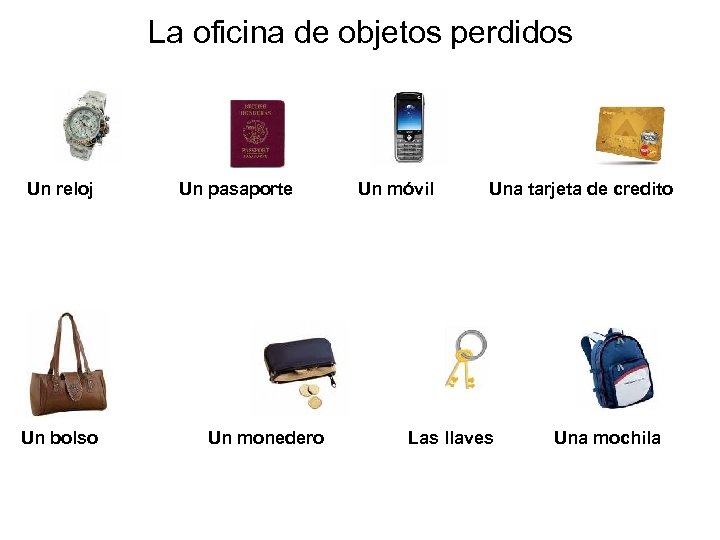 La oficina de objetos perdidos Un reloj Un bolso Un pasaporte Un monedero Un móvil Una tarjeta de credito Las llaves Una mochila
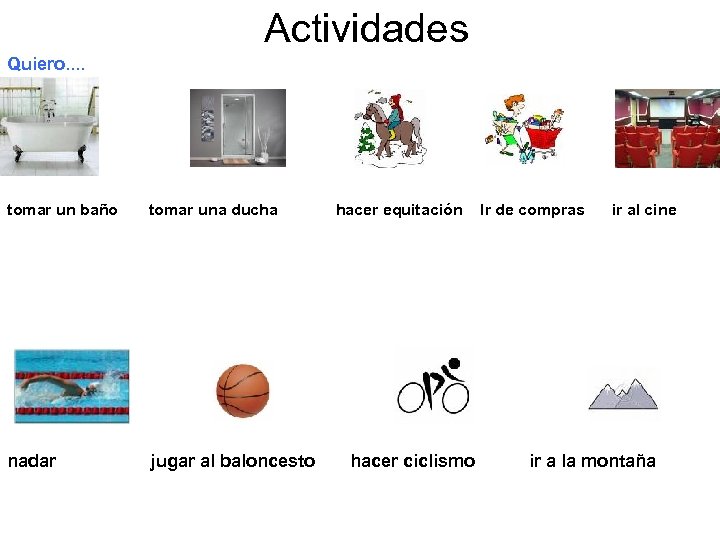 Actividades Quiero. . tomar un baño tomar una ducha nadar jugar al baloncesto hacer equitación hacer ciclismo Ir de compras ir al cine ir a la montaña
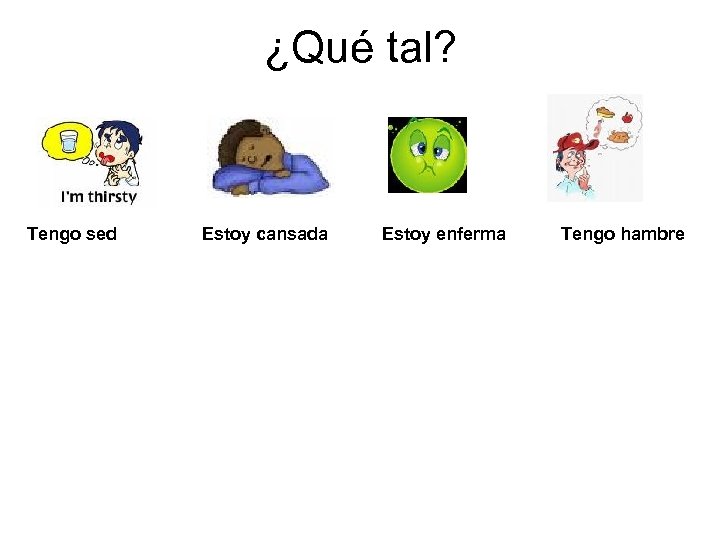 ¿Qué tal? Tengo sed Estoy cansada Estoy enferma Tengo hambre
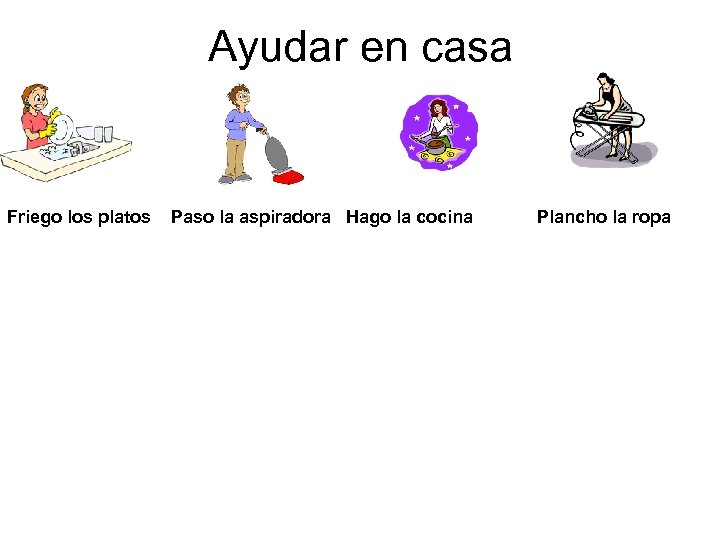 Ayudar en casa Friego los platos Paso la aspiradora Hago la cocina Plancho la ropa