


 Скачать презентацию Archiving What is it and why should it
e1a1e62d5423143e11ca1f3347b0911c.ppt
- Количество слайдов: 39
 Archiving What is it and why should it be important to me? John Shaw Director, Publishing Technologies SAGE Publications, U. S.
 I. Archiving Overview II. Types of Archives II. A SAGE Example IV. Risks, Questions, and More Questions
 Archiving Part I: Archiving Overview
 What is an Archive ? n n An authoritative collection Preserved and professionally managed in perpetuity n n History, institutional commitment & policy, integrity re: preservation “…information needed for society’s memory. ” "Schellenberg in Cyberspace, " American Archivist 61: 2 (Fall 1998), p. 309 -327. n Preservation first
 What is a Repository? n “A place where things can be stored and maintained; a storehouse. ” [Society of American Archivists Glossary] n “Depository” is same n n also library that receives government documents to public access Not all repositories are archives
 Why Care? “Preserving information for decades or even centuries has proved important. Shang dynasty (12 th century BC) Chinese astronomers inscribed eclipse observations on “oracle bones" (animal bones and tortoise shells). About 3200 years later researchers used these records, together with one from 1302 BC, to estimate that the accumulated clock error was just over 7 hours, and from this derived a value for the viscosity of the Earth's mantle as it rebounds from the weight of the glaciers. . ” ****
 Why Care? “These timescales of many decades, even centuries, contrast with the typical 5 -year lifetime for computing hardware and digital media” “A Fresh Look at the Reliability of Long term Digital Storage. ” Baker, Mary, et al. . Euro. Sys '06, April 18 -21, 2006
 Why Care? Preservation: Digital information is impermanent n Publisher: Safety n to insure ongoing availability of your content n Your library customers: Custodianship n to insure continuity of the record of scientific progress n Very long view: epistemology, history of science and culture
 What Should be Preserved? n n n Scholarly content Research materials Web-based, digitally born content
 How e-Archives Differ n n n Mission: collection v. preservation Access control, dark v. light Deposits n n n n Why: voluntary v. mandated Who: author v. publisher What: manuscripts v. final work When: backfile v. current content Future format migration Rights transfer Costs
 Archiving Part II: Types of Archives
 Types of Archives: n n National archives Institutional repositories Community-based archives Product solution archives
 Types of Archives: National n n Dutch National library Koninklijke Bibliotheek (KB) British Library NIH – Pub. Med. Central? n “NIH’s digital repository for biomedical research” Library of Congress?
 KB: Dutch National Library n Mission: Legal deposit library n n n Deposits: Source files from publishers n n n “…collect, catalogue and preserve all publications appearing in the Netherlands. ” Capable of ingesting 60, 000 articles/day Automated, strict Costs? Access Control: n n Local patron access Publisher sets remote access rules
 KB: Dutch National Library n Migration: Preservation research leader n n Committed to format migration Archiving agreements with: n OUP, Sage, Blackwell, Elsevier, Kluwer Academic, etc.
 The British Library Legal Deposit Pilot n Mission: Legal deposit library n n UK-published (to start) Pilot: Legal deposit for e-journals n n 23 volunteer publishers Secure infrastructure Uses Digi. Tool by Ex-Libris n Shared with the other UK legal deposit libraries n n n To “scope and test” ingest, storage, retrieval Cost?
 The British Library: Preservation and Migration n BL’s future for managing digital assets n n Migration n preserve any type of digital material in perpetuity ensure that users can view the material with contemporary applications preserve the original look-and-feel where possible Access Control n “appropriate permissions”
 PMC: US National Library of Medicine Journal Archive n n n Mission: Make research more accessible Free full-text archive of 230 journals Deposit: publishers submit source files Migration Access Control Cost?
 PMC: Depository for NIH-Funded Research Articles n Authors of NIH-funded articles “encouraged” to deposit final manuscript n n n “After all modifications due to …peer review” MS Word, PDF, etc. With supplementary information Publisher can replace with published version To be required soon?
 Library of Congress n n National Digital Information Infrastructure and Preservation Program (NDIIPP) – formed in 2000 n Members: National Library of Medicine, the National Agricultural Library, the National Institute of Standards and Technology, the Research Libraries Group, the OCLC Online Computer Library Center, and the Council on Library and Information Resources Preliminary investigation and software development phase Primarily e-journal deposit Future …? ? ?
 Types of Archives: Institutional n n University with expansive focus n Stanford Digital Repository Automated n LOCKSS
 Stanford Digital Repository n n Stanford Univ. Libraries initiative Digital preservation serving n n n Stanford University Broader academic community Publishers Principles: Trust, Security, Transparency Costs?
 LOCKSS n n n Technology to preserve local library collection Automated, self-correcting cache servers n Requires LOCKSS server at library Requires publisher participation Builds collection of all resources which the institution licenses Goes online to users if data source becomes unavailable n Provides access to static “HTML images” of source Costs
 Types of Archives: Product Solution n Non-profit organization n Portico
 Portico n Mission: scholarly preservation n n Standalone archive Initiated by JSTOR, with grant funding Deposits: source files from publisher Migration: planned Costs n Publishers annual fee $250 to $75, 000 n n based on annual revenue Libraries annual fee $1, 500 to $24, 000 n based on Library Materials Expenditure
 Portico: Access Control n Member libraries get access: n n “when specific trigger events occur, and when titles are no longer available from the publisher or other source. ” Trigger events include: n n n Publisher stops operations Publisher ceases to publish a title Publisher no longer offers back issues Catastrophic and sustained failure of a publisher’s delivery platform Can also fulfill “perpetual access” subscription obligations
 Types of Archives: Community n Community based and openly run n CLOCKSS
 CLOCKSS (Controlled LOCKSS) n Long-term global archiving solution n n Small number library participants maintain the archive on behalf of larger community n n n libraries preserve member publisher content whether they subscribe or not Release only after a trigger event n n Community-managed, failsafe repository for scholarly content Serve libraries & publishers in the event of a long-term business interruption Publishers participation is voluntary Publisher, libraries, and society collaborative decision to release “cost sharing” for system, not access Costs?
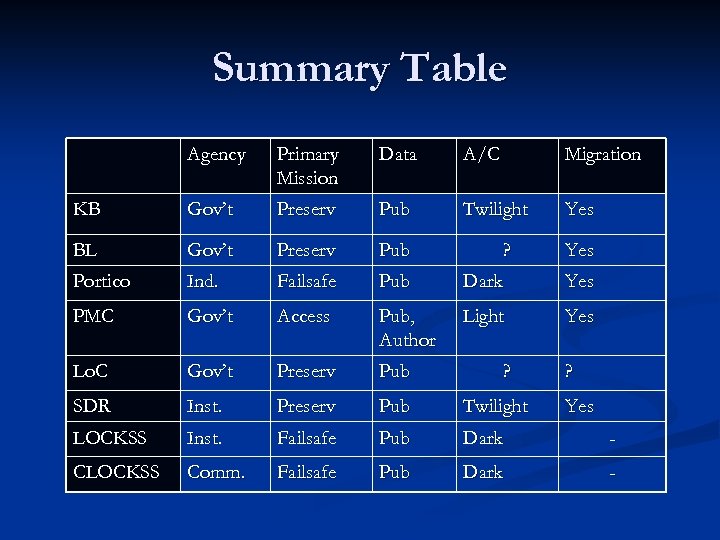 Summary Table Agency Primary Mission Data A/C Migration KB Gov’t Preserv Pub Twilight Yes BL Gov’t Preserv Pub Portico Ind. Failsafe Pub Dark Yes PMC Gov’t Access Pub, Author Light Yes Lo. C Gov’t Preserv Pub SDR Inst. Preserv Pub Twilight LOCKSS Inst. Failsafe Pub Dark - CLOCKSS Comm. Failsafe Pub Dark - ? ? Yes ? Yes
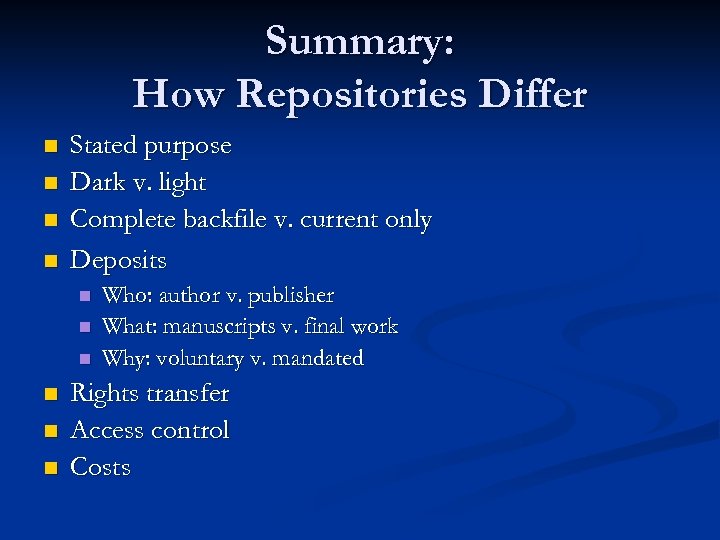 Summary: How Repositories Differ n n Stated purpose Dark v. light Complete backfile v. current only Deposits n n n Who: author v. publisher What: manuscripts v. final work Why: voluntary v. mandated Rights transfer Access control Costs
 Archiving Part III: A SAGE Example
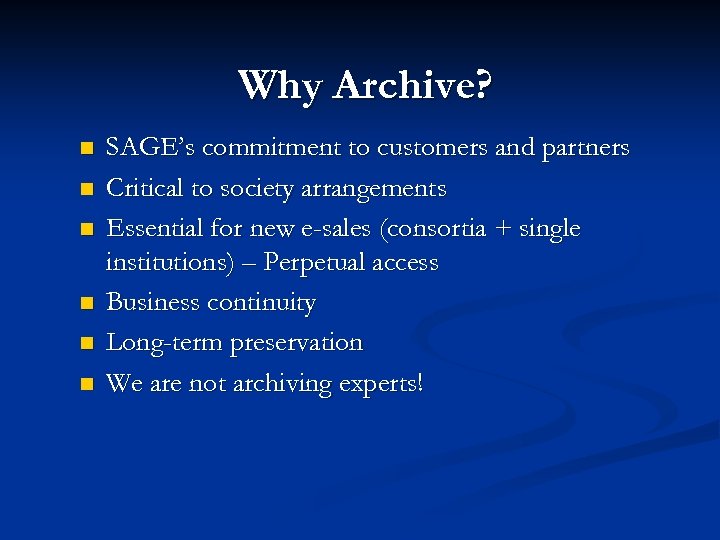 Why Archive? n n n SAGE’s commitment to customers and partners Critical to society arrangements Essential for new e-sales (consortia + single institutions) – Perpetual access Business continuity Long-term preservation We are not archiving experts!
 Where to Archive? n n n Dutch KB CLOCKSS Portico Library of Congress British Library
 How to Archive? n n n Provide details of digital availability Provide sample of content Provide details of content format (DTD) Send all backfile for loading Set up content flow for ongoing content
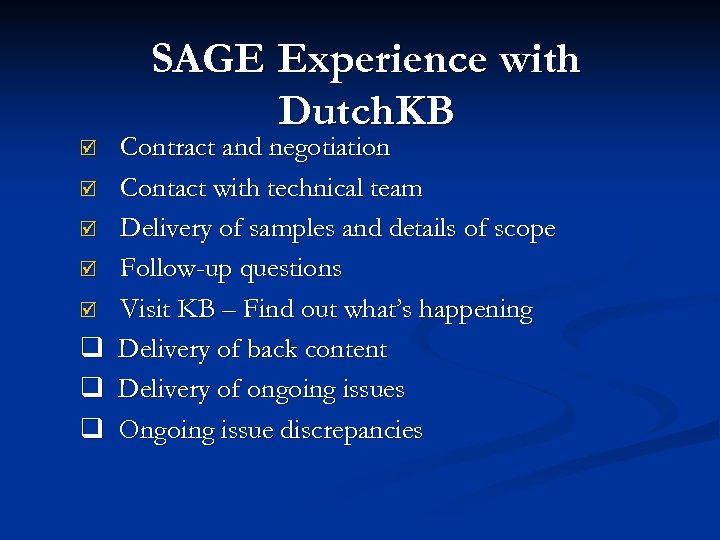 SAGE Experience with Dutch. KB Contract and negotiation þ Contact with technical team þ Delivery of samples and details of scope þ Follow-up questions þ Visit KB – Find out what’s happening Delivery of back content Delivery of ongoing issues Ongoing issue discrepancies þ
 Archiving Part IV: Questions, Questions and More Questions
 Measurements of Success n n Who is overseeing the archiving process and governance? Compliance? Accuracy and legitimacy? Financial stability?
 Resources n n n Archiving should be done by librarians ad archivists, period. Gordon Tibbitts, Blackwell Publishing. April 4, 2006 UKSG Portico - http: //www. portico. org/ LOCKSS - http: //lockss. stanford. edu CLOCKSS - http: //www. lockss. org/clockss/Home KB E-Depot - http: //www. kb. nl/index-en. html Depot. Digital Archiving at the national library of the Netherlands- http: //www 5. ibm. com/be/pdf/en/events/nextlevel/presentation_kb_den_haag_edepot_ibm_brussels_v 03. pdf “A Fresh Look at the Reliability of Long term Digital Storage. ” Baker, Mary, et al. . Euro. Sys '06, April 18 -21, 2006 Digital Archives & Repositories: Why should I care? – Bernard Hecker, High. Wire Press, Publishers Meeting, October 2004 Archive Overview, – Bernard Hecker, High. Wire Press, Publishers Meeting, April 2006 Trusted Digital Repositories: Attributes and Responsibilities An RLG-OCLC Report. © 2002 Research Libraries Group British Library: Project: JCLD Pilot Project in Anticipation of E-Journals, June 2005 Simon Inger Note: Presentation based on Digital Archives & Repositories: Why should I care? – Bernard Hecker, High. Wire Press, Publishers Meeting, October 2004; Archive Overview. Bernard Hecker, High. Wire Press, Publishers Meeting, April 2006; Archiving: A SAGE Example. John Shaw. Publishers Meeting, April 2006
 Thank You! Contact info: John. Shaw@sagepub. com www. sagepub. com