


 Скачать презентацию Architectures for Delay Disruption Tolerant Networking Implementations for Space
5fca9e95dd8e6b26c1afcdce829a1fc0.ppt
- Количество слайдов: 24
 Architectures for Delay/Disruption Tolerant Networking Implementations for Space Authors Unnikrishnan E, Ravichandran V, Sudhakar S, Subramanya Udupa, (Indian Space Research Organization-ISRO, India)
 Overview Introduction to DTN architecture Underlying protocols Study on DTN 2 reference implementation Architectural components Design models for flight implementation Hardware implementation using VHDL Embedded processor based implementation Software implementation on SBC Conclusion
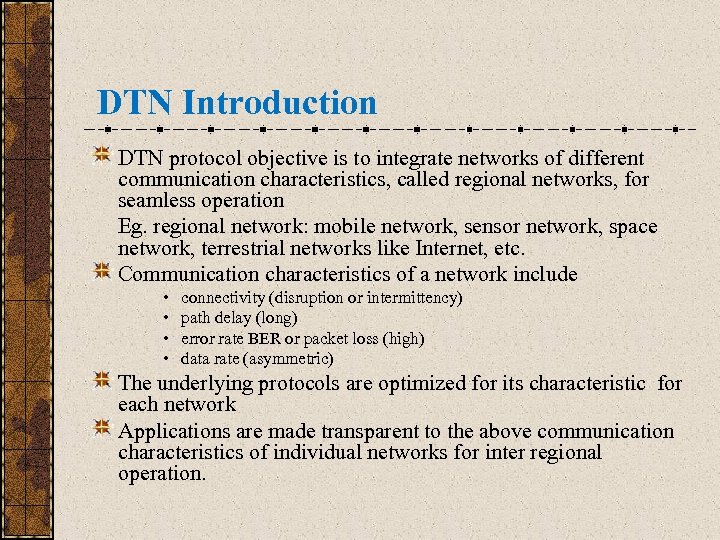 DTN Introduction DTN protocol objective is to integrate networks of different communication characteristics, called regional networks, for seamless operation Eg. regional network: mobile network, sensor network, space network, terrestrial networks like Internet, etc. Communication characteristics of a network include • • connectivity (disruption or intermittency) path delay (long) error rate BER or packet loss (high) data rate (asymmetric) The underlying protocols are optimized for its characteristic for each network Applications are made transparent to the above communication characteristics of individual networks for inter regional operation.
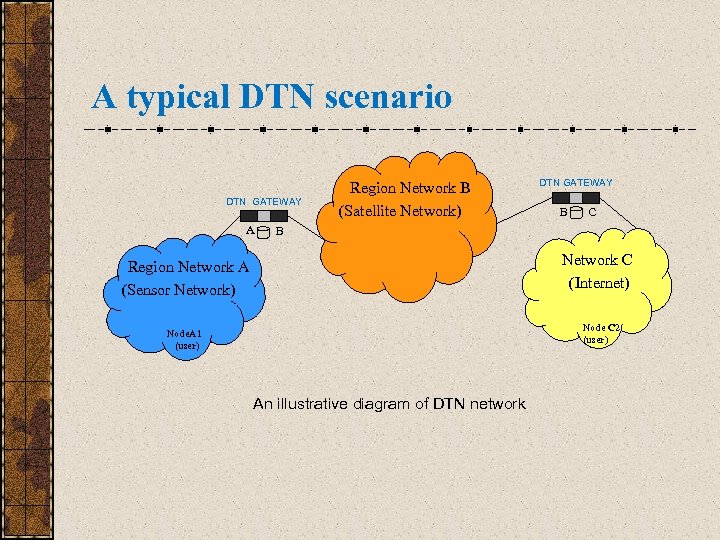 A typical DTN scenario DTN GATEWAY A Region Network B (Satellite Network) DTN GATEWAY B C B Network C (Internet) Region Network A (Sensor Network) Node C 2 (user) Node. A 1 (user) An illustrative diagram of DTN network
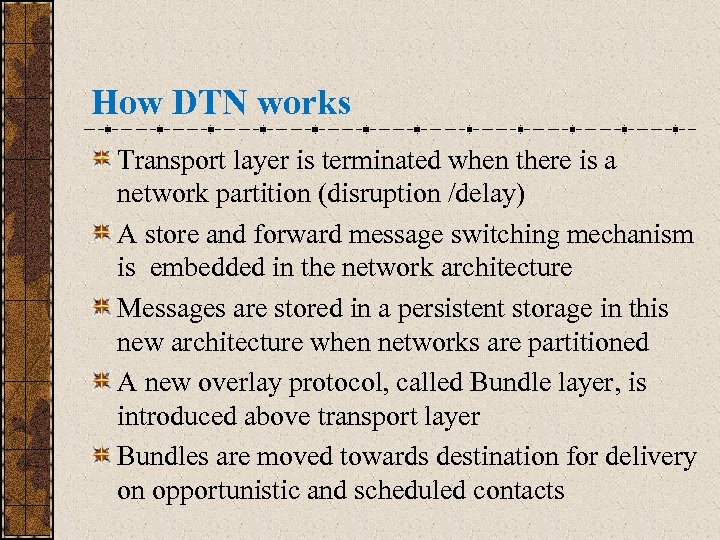 How DTN works Transport layer is terminated when there is a network partition (disruption /delay) A store and forward message switching mechanism is embedded in the network architecture Messages are stored in a persistent storage in this new architecture when networks are partitioned A new overlay protocol, called Bundle layer, is introduced above transport layer Bundles are moved towards destination for delivery on opportunistic and scheduled contacts
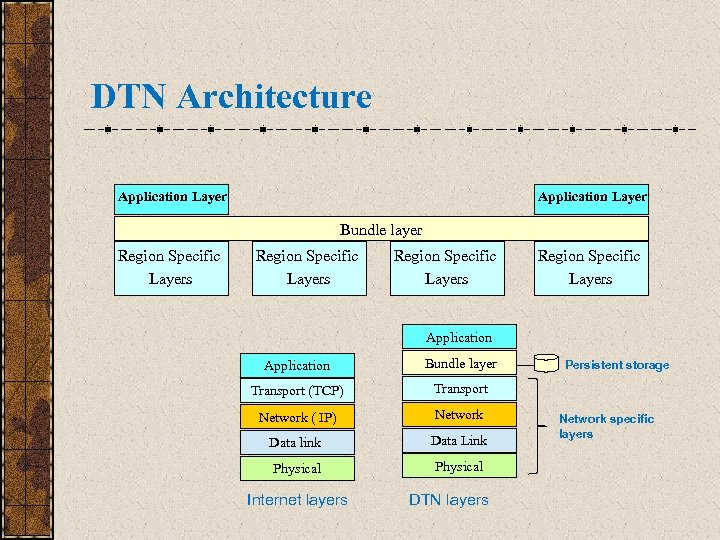 DTN Architecture Application Layer Bundle layer Region Specific Layers Application Bundle layer Transport (TCP) Transport Network ( IP) Network Data link Data Link Physical Internet layers DTN layers Persistent storage Network specific layers
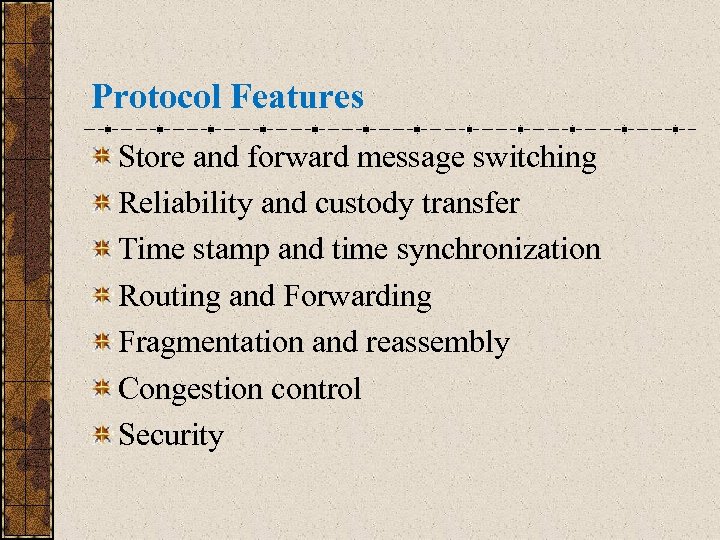 Protocol Features Store and forward message switching Reliability and custody transfer Time stamp and time synchronization Routing and Forwarding Fragmentation and reassembly Congestion control Security
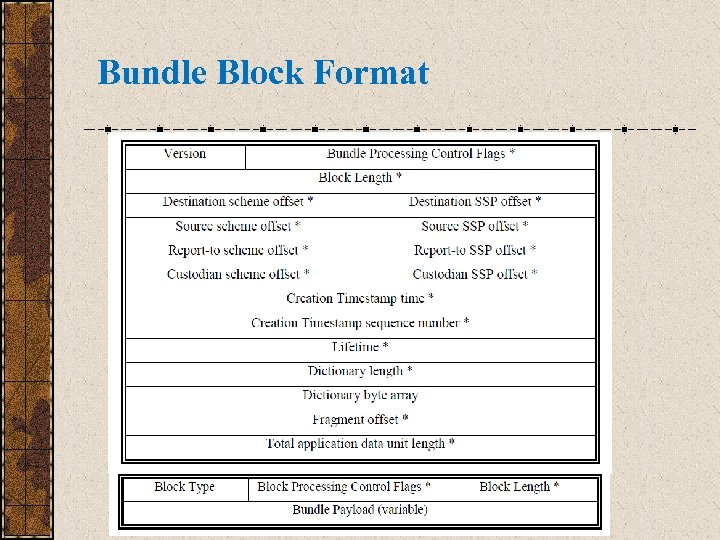 Bundle Block Format
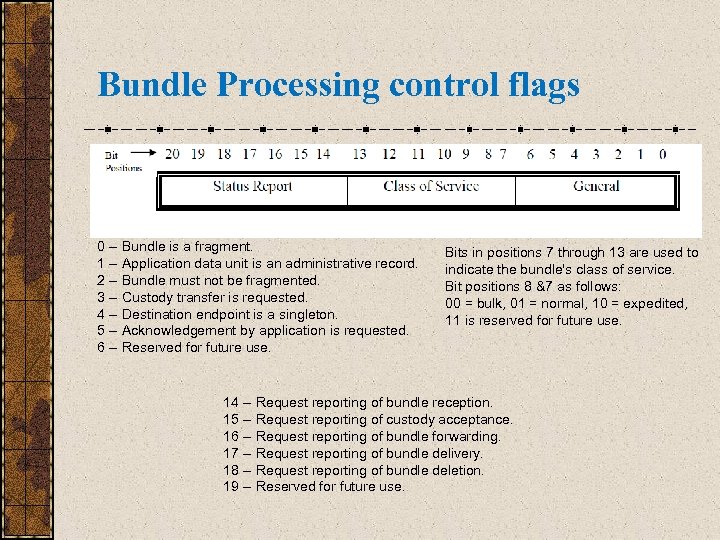 Bundle Processing control flags 0 -- Bundle is a fragment. 1 -- Application data unit is an administrative record. 2 -- Bundle must not be fragmented. 3 -- Custody transfer is requested. 4 -- Destination endpoint is a singleton. 5 -- Acknowledgement by application is requested. 6 -- Reserved for future use. Bits in positions 7 through 13 are used to indicate the bundle's class of service. Bit positions 8 &7 as follows: 00 = bulk, 01 = normal, 10 = expedited, 11 is reserved for future use. 14 -- Request reporting of bundle reception. 15 -- Request reporting of custody acceptance. 16 -- Request reporting of bundle forwarding. 17 -- Request reporting of bundle delivery. 18 -- Request reporting of bundle deletion. 19 -- Reserved for future use.
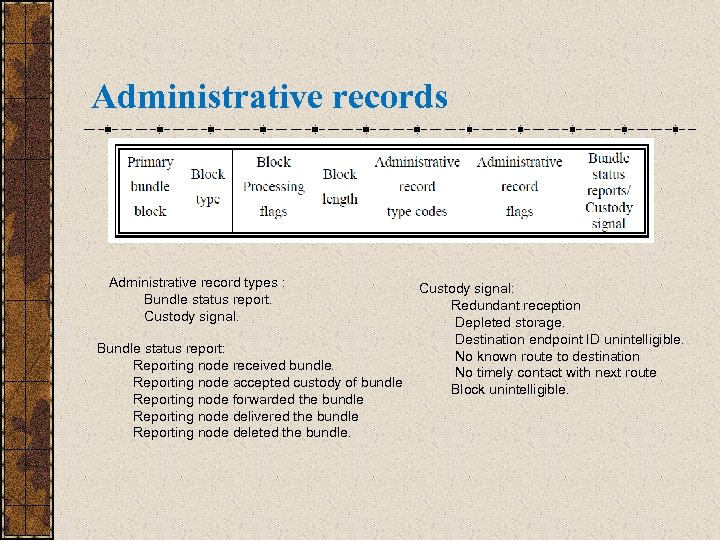 Administrative records Administrative record types : Bundle status report. Custody signal. Bundle status report: Reporting node received bundle. Reporting node accepted custody of bundle Reporting node forwarded the bundle Reporting node delivered the bundle Reporting node deleted the bundle. Custody signal: Redundant reception Depleted storage. Destination endpoint ID unintelligible. No known route to destination No timely contact with next route Block unintelligible.
 Evaluation of DTN 2 reference implementation Configured and evaluated reference implementation DTN 2 on a Linux test bed Simulated DTN operation for a typical configuration of a ground node, orbiter and a rover on the test bed Simulated command file delivery to rover and telemetry reception at ground for intermittently connected links (LAN) Proved the concept of DTN operation over disrupted link where other protocols fail to operate Contact Graph based routing was configured
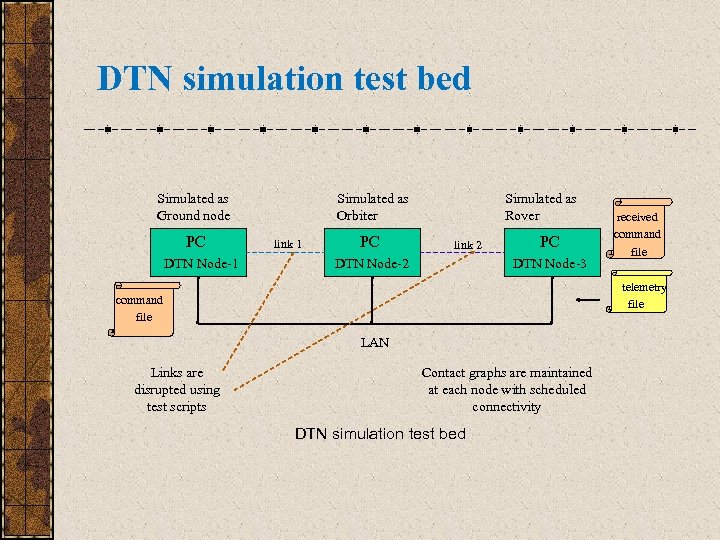 DTN simulation test bed Simulated as Ground node PC DTN Node-1 Simulated as Orbiter link 1 PC Simulated as Rover link 2 DTN Node-2 PC DTN Node-3 telemetry file command file LAN Links are disrupted using test scripts received command file Contact graphs are maintained at each node with scheduled connectivity DTN simulation test bed
 DTN prototype on FPGA (hardware implementation) Specification (scaled down) EID is singleton (only unicast is supported) Storage – 4 memory blocks DTN Timer resolution - 1 ms Priority levels – 3 Life time of bundle – 10 minutes Bundle size – 1024 bytes (primary block 64 bytes + 4 bytes payload block + 956 bytes payload ADU) SDNV encoding / decoding Contact graph based routing Security (not addressed)
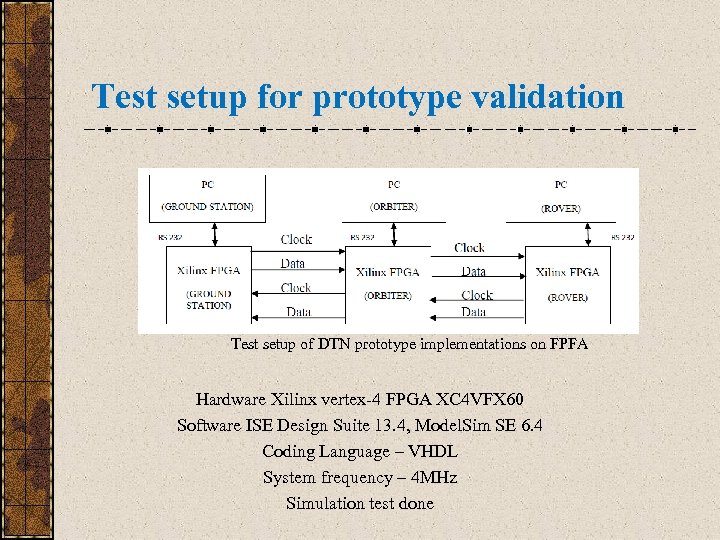 Test setup for prototype validation Test setup of DTN prototype implementations on FPFA Hardware Xilinx vertex-4 FPGA XC 4 VFX 60 Software ISE Design Suite 13. 4, Model. Sim SE 6. 4 Coding Language – VHDL System frequency – 4 MHz Simulation test done
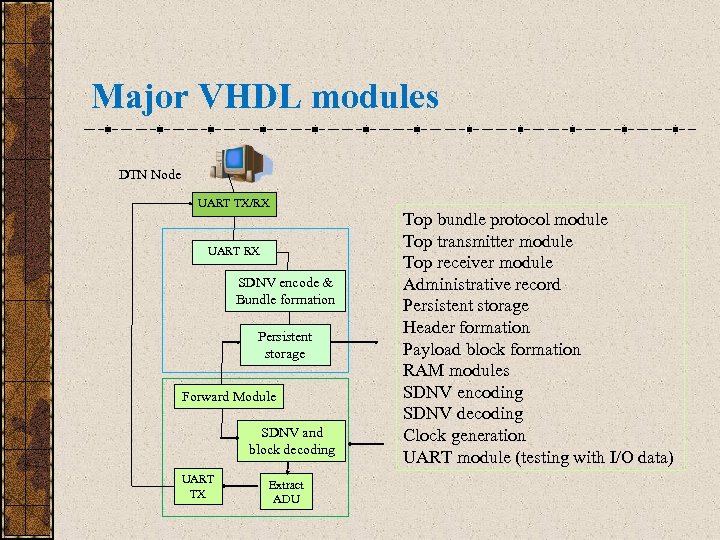 Major VHDL modules DTN Node UART TX/RX UART RX SDNV encode & Bundle formation Persistent storage Forward Module SDNV and block decoding UART TX Extract ADU Top bundle protocol module Top transmitter module Top receiver module Administrative record Persistent storage Header formation Payload block formation RAM modules SDNV encoding SDNV decoding Clock generation UART module (testing with I/O data)
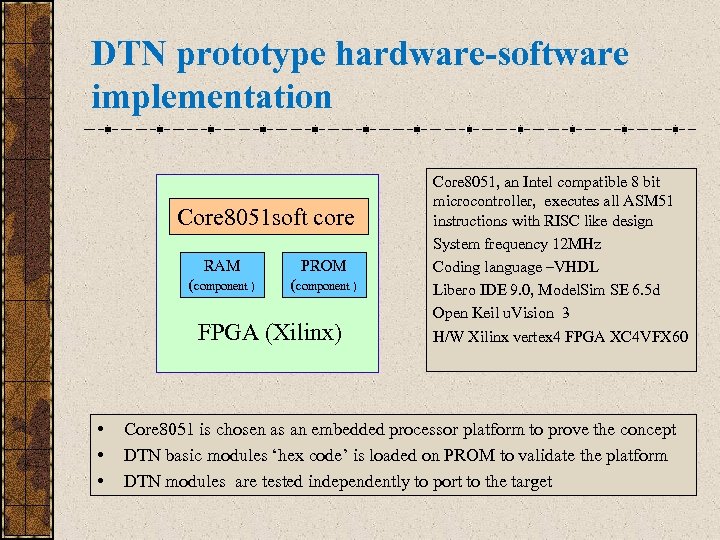 DTN prototype hardware-software implementation Core 8051 soft core RAM PROM (component ) FPGA (Xilinx) • • • Core 8051, an Intel compatible 8 bit microcontroller, executes all ASM 51 instructions with RISC like design System frequency 12 MHz Coding language –VHDL Libero IDE 9. 0, Model. Sim SE 6. 5 d Open Keil u. Vision 3 H/W Xilinx vertex 4 FPGA XC 4 VFX 60 Core 8051 is chosen as an embedded processor platform to prove the concept DTN basic modules ‘hex code’ is loaded on PROM to validate the platform DTN modules are tested independently to port to the target
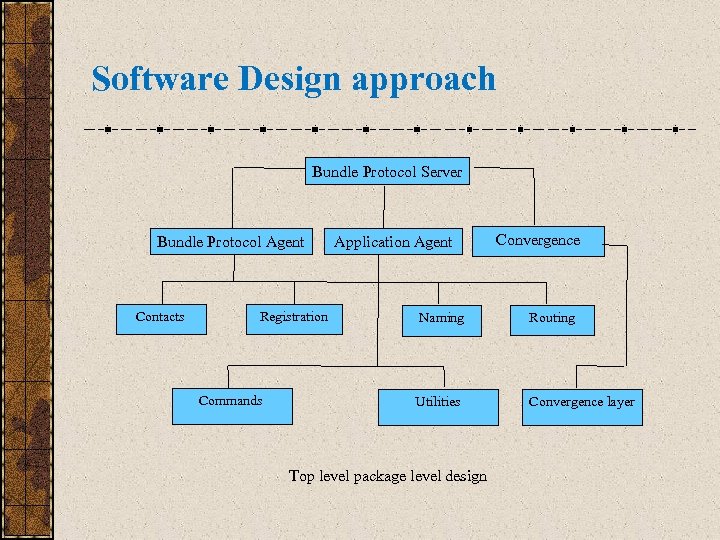 Software Design approach Bundle Protocol Server Bundle Protocol Agent Contacts Registration Commands Application Agent Convergence Naming Routing Utilities Convergence layer Top level package level design
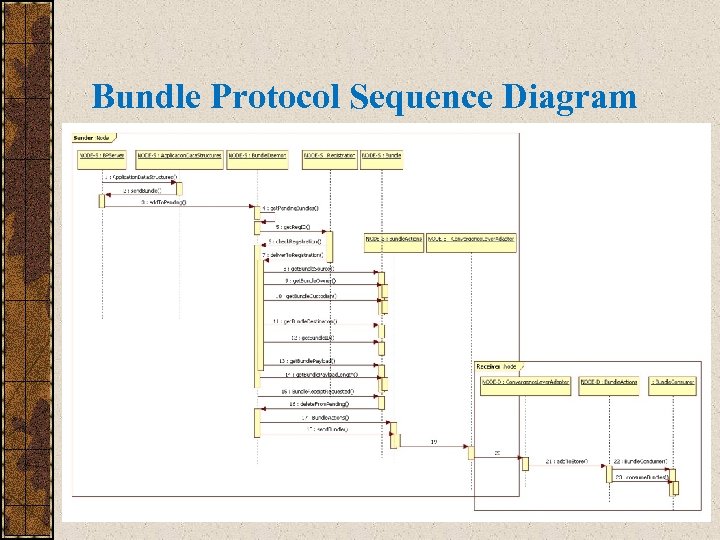 Bundle Protocol Sequence Diagram
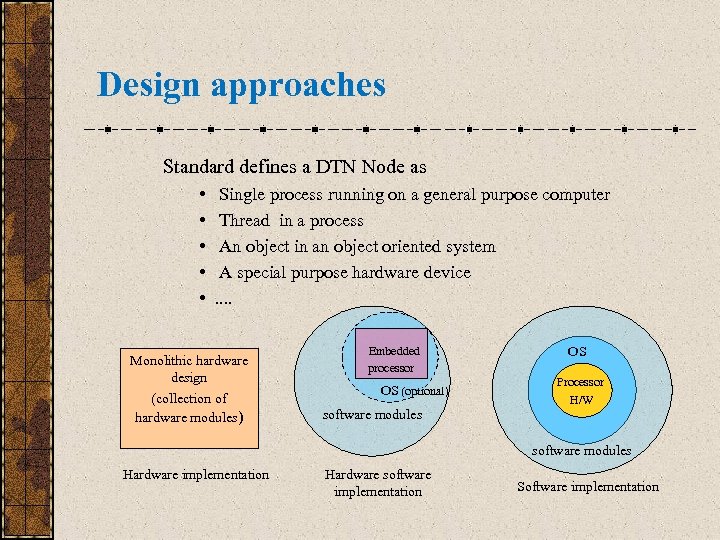 Design approaches Standard defines a DTN Node as • • • Single process running on a general purpose computer Thread in a process An object in an object oriented system A special purpose hardware device. . Monolithic hardware design (collection of hardware modules) Embedded processor OS (optional) OS Processor H/W software modules Hardware implementation Hardware software implementation Software implementation
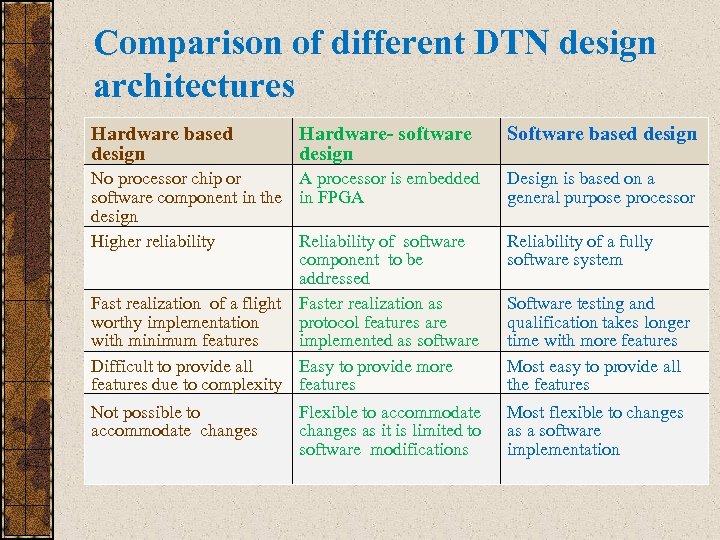 Comparison of different DTN design architectures Hardware based design Hardware- software design Software based design No processor chip or A processor is embedded software component in the in FPGA design Higher reliability Reliability of software component to be addressed Fast realization of a flight Faster realization as worthy implementation protocol features are with minimum features implemented as software Difficult to provide all Easy to provide more features due to complexity features Design is based on a general purpose processor Not possible to accommodate changes Most flexible to changes as a software implementation Flexible to accommodate changes as it is limited to software modifications Reliability of a fully software system Software testing and qualification takes longer time with more features Most easy to provide all the features
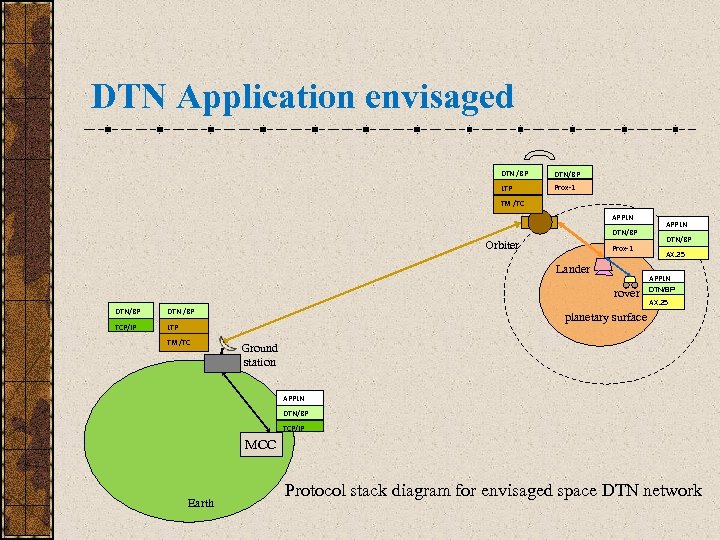 DTN Application envisaged DTN /BP DTN/BP LTP Prox-1 TM /TC APPLN DTN/BP Orbiter Prox-1 Lander DTN /BP TCP/IP LTP TM /TC DTN/BP AX. 25 APPLN rover DTN/BP APPLN DTN/BP AX. 25 planetary surface Ground station APPLN DTN/BP TCP/IP MCC Earth Protocol stack diagram for envisaged space DTN network
 Conclusion Results of the study on DTN-2 reference implementation are promising for its usage on a disconnected network. For DTN for space a highly reliable and light weight version of the protocol suit is required. Different design approaches are compared and efforts for prototyping were summarized Protocol implementations need to undergo sufficient testing on simulators for all possible end to end scenarios More simulations at ground are required for introducing dynamic routing of bundles for a large network CCSDS standards on the DTN protocols help the space agencies to deploy an interoperable network for future
 References 1. Rationale, Scenarios, and Requirements for DTN in Space Informational Report CCSDS 734. 0 G-1 August 2010 2. CCSDS Bundle Protocol Specification Recommended Standard CCSDS 734. 2 B-1 September 2015 3. RFC 5050 Bundle Protocol Specification , Network Working Group Category: Experimental 2007 4. RFC 4838 Delay-Tolerant Networking Architecture, Network Working Group Category: Informational 2007 5. Solar System Internetwork Architecture Informational Report CCSDS 730. 1 G-1 July 2014 6. Report of the Interagency Operations Advisory Group Space Internetworking Strategy Group Recommendations on a Strategy for Space Internetworking July 2008 7. Licklider Transport Protocol (LTP) for CCSDS 734. 1 B-1 May 2015 8. Proximity-1 Space Link Protocol— Data Link Layer CCSDS 211. 0 -B-5 December 2013 9. “Design of DTN for Interplanetary Communication” , M Tech Thesis, Samreen Fiza , Project work done at TMD/DSG/CDA/ISAC 2013 -14 10. “Design of a Platform for embedded applications using 8051 IP core”, M Tech Thesis, Pranam Amin, Project work done at TMD/CDEG/CDA/ISAC 2014 -15 11. “Design and Modeling of DTN Bundling Protocol”, Deepak N A, Unnikrishnan E, et al International Conference on Modeling and Simulation August 2007
 Thank you Acknowledgement to Dr. M Annadurai, Director ISRO, Satellite Centre