


 Скачать презентацию Architecture Implementation Pilot Phase 2 AIP-2 presentation to
e1f294383822e0c43e90b775d085971a.ppt
- Количество слайдов: 32
 Architecture Implementation Pilot, Phase 2 (AIP-2) presentation to ADC/UIC meeting, Stresa, Italy AIP-2 SBA Demonstrations and discussion of UIC/AIP-2 Coordination Nadine Alameh, George Percivall Open Geospatial Consortium GEO Task AR-09 -01 b Task POC 8 May 2009
 Agenda • Background • AIP-2 – Schedule & Themes – Communities and scenarios – Deliverables • Video Demonstrations • Wrap-up – UIC/AIP coordination
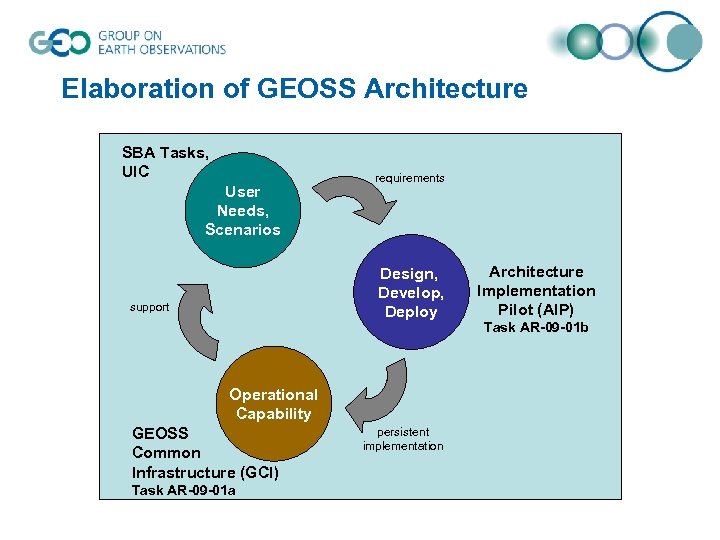 Elaboration of GEOSS Architecture SBA Tasks, UIC User Needs, Scenarios requirements Design, Develop, Deploy support Operational Capability GEOSS Common Infrastructure (GCI) Task AR-09 -01 a persistent implementation Architecture Implementation Pilot (AIP) Task AR-09 -01 b
 GEO Task AR-09 -01 b Architecture Implementation Pilot • Lead incorporation of contributed components consistent with the GEOSS Architecture… • …using a GEO Web Portal and a GEOSS Clearinghouse search facility • …to access services through GEOSS Interoperability Arrangements • …in support of GEOSS Societal Benefit Areas Slide 4
 AIP Phase 1 Results – Early 2008 • Elements of the GEOSS Common Infrastructure (GCI) – Initial Operating Capability established • Effective development process for GEO – CFP, Kickoff, Execution, etc. – Approximately 120 organizations participated – Methods for international coordination • Prepared “Architecture Implementation Report” • 10 Demonstrations of Initial Operating Capability AI Pilot has broad international participation that could only have occurred with GEO. High interest & momentum to support GEOSS. Slide 5
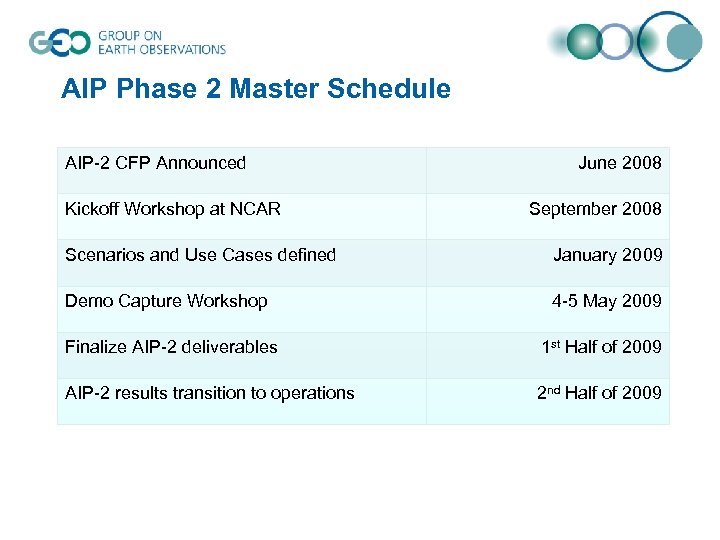 AIP Phase 2 Master Schedule AIP-2 CFP Announced Kickoff Workshop at NCAR June 2008 September 2008 Scenarios and Use Cases defined January 2009 Demo Capture Workshop 4 -5 May 2009 Finalize AIP-2 deliverables 1 st Half of 2009 AIP-2 results transition to operations 2 nd Half of 2009
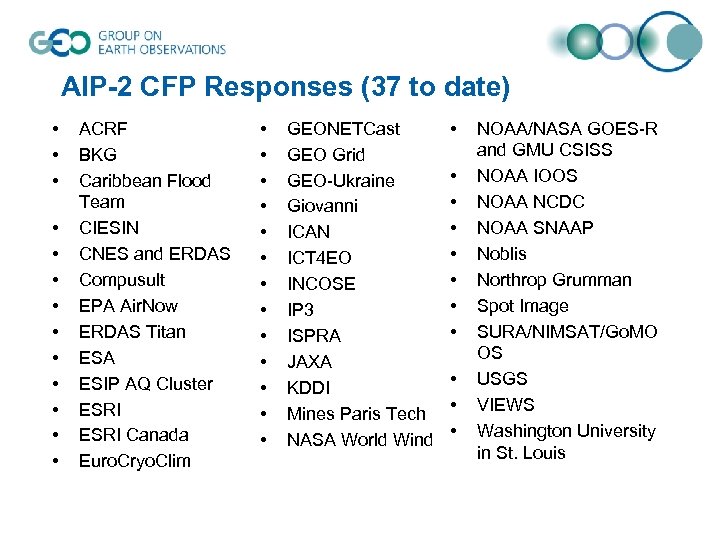 AIP-2 CFP Responses (37 to date) • • • • ACRF BKG Caribbean Flood Team CIESIN CNES and ERDAS Compusult EPA Air. Now ERDAS Titan ESA ESIP AQ Cluster ESRI Canada Euro. Cryo. Clim • • • • GEONETCast GEO Grid GEO-Ukraine Giovanni ICAN ICT 4 EO INCOSE IP 3 ISPRA JAXA KDDI Mines Paris Tech NASA World Wind • • • NOAA/NASA GOES-R and GMU CSISS NOAA IOOS NOAA NCDC NOAA SNAAP Noblis Northrop Grumman Spot Image SURA/NIMSAT/Go. MO OS USGS VIEWS Washington University in St. Louis
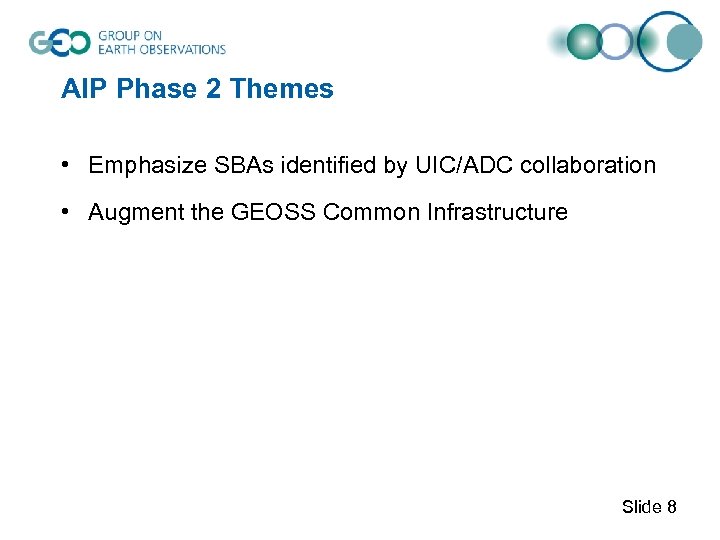 AIP Phase 2 Themes • Emphasize SBAs identified by UIC/ADC collaboration • Augment the GEOSS Common Infrastructure Slide 8
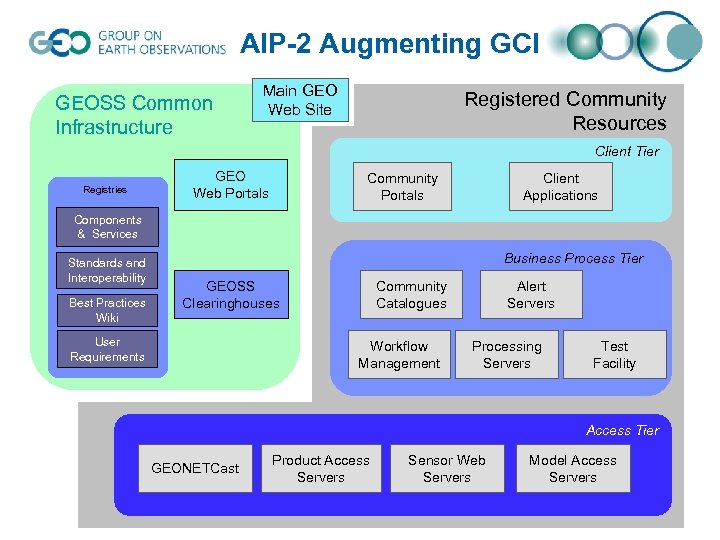 AIP-2 Augmenting GCI GEOSS Common Infrastructure Main GEO Web Site Registered Community Resources Client Tier Registries GEO Web Portals Community Portals Client Applications Components & Services Standards and Interoperability Best Practices Wiki Business Process Tier Community Catalogues GEOSS Clearinghouses User Requirements Workflow Management Alert Servers Processing Servers Test Facility Access Tier GEONETCast Product Access Servers Sensor Web Servers Model Access Servers
 AIP Phase 2 Themes • Emphasize SBAs identified by UIC/ADC collaboration • Augment the GEOSS Common Infrastructure • Develop "persistent exemplars” • Elaborate GEOSS Architecture – Scenarios and Use Cases – Service and Component types – Interoperability Arrangements Slide 10
 AIP-2 Working Groups (WGs) • Community WGs – Disaster Response • Flood disaster management scenario – Climate Change and Biodiversity • Pika Distribution scenario • Polar ecosystems scenario • Arctic food chain scenario – Renewable Energy • Site selection process for solar and wind energy scenario – Air Quality and Health • Smoke events and AQ scenario
 Community WG Leaders • Disaster Response – Stuart Frye, NASA; – Didier Giacobbo, Spot Image • Health SBA: Air Quality – David Mc. Cabe, EPA – Frank Lindsay, NASA; – Stefan Falke & Rudy Husar, Washington Univ. • Biodiversity and Climate Change – Stefano Nativi, CNR; – Gary Geller, NASA/JPL • Energy SBA – Thierry Ranchin & Lionel Menard, Mines Paris Tech; – Ellsworth Le. Drew, Univ Waterloo;
 AIP-2 Working Groups (WGs) • Transverse Technology WGs: – Portals and Application Clients – Clearinghouse, Catalogues, Registries and Metadata – Access Services: products, sensors, models – Workflow and Processing – Test Facility for Service Registration
 Scenarios and Use Cases • Transverse Use Cases support Community Scenarios • Scenarios: end user view of the value of GEOSS – – Focused on topics of interest to a community Occur in a geographic Area of Interest (AOI) Steps in a scenario are Use Cases Scenarios developed by Community WGs • Use Cases: reusable service oriented architecture – Use cases for discovery, data access, etc – Utilize Interoperability Arrangements – Use Cases developed by Transverse Technology WGs
 AIP-2 Deliverables (GEO Task AR-09 -01 b) • • • Demonstration – Demonstration of community Scenarios implemented through transverse Use Cases – Demonstrations to be recorded and made available via WWW Persistent Exemplars – Registered services (‘continuous operation’) with 99% availability (~7 hours down time a month); on a reliable network; plan for performance scaling – Nomination to operational task (AR-09 -01 a) Engineering Reports To be considered for GEOSS Best Practice Registry – Community Scenarios – Transverse Technology Use Cases – AIP-2 Summary Report – Technology guides
 AIP-2 Technology Demonstrations • GEO Web Portal to Clearinghouses – Compusult - Robert Thomas – ESA/FAO – Gianni Sotis, Jolyon Martin – ESRI – Marten Hogeweg • Geo-Processing with WPS: Brian Falk • Publish, test, register, and monitor: Hervé Caumont
 AIP-2 Scenario Demonstrations • Renewable Energy - Facility Planner: Lionel Menard • Biodiversity: Pika Distribution: Stefano Nativi • Disaster Management: Stuart Frye, Didier Giacobbo • AQ & Health – Smoke Event: Rudy Husar, David Mc. Cabe • Biodiversity: Arctic Food Chain: Stefano Nativi • Biodiversity: Polar Ecosystems: Doug Nebert
 AIP-2 Renewable Energy Scenario 7 May 2009 Lionel Menard – Mines Paris. Tech & Team
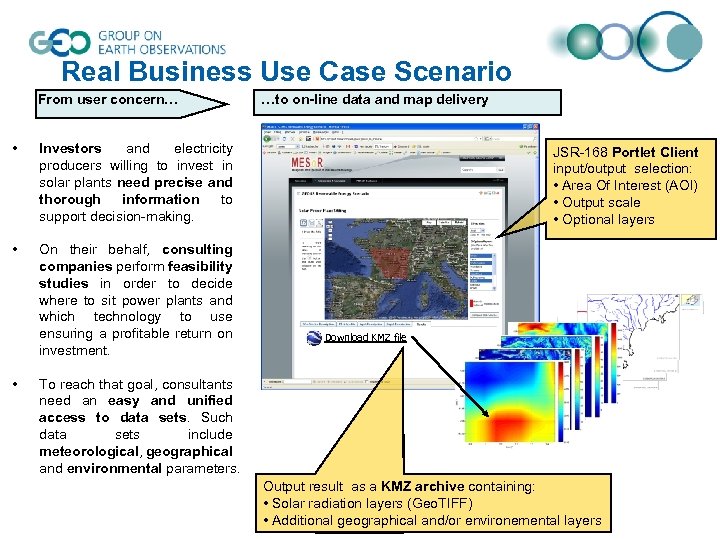 Real Business Use Case Scenario From user concern… • Investors and electricity producers willing to invest in solar plants need precise and thorough information to support decision-making. • On their behalf, consulting companies perform feasibility studies in order to decide where to sit power plants and which technology to use ensuring a profitable return on investment. …to on-line data and map delivery • JSR-168 Portlet Client input/output selection: • Area Of Interest (AOI) • Output scale • Optional layers Download KMZ file To reach that goal, consultants need an easy and unified access to data sets. Such data sets include meteorological, geographical and environmental parameters. Output result as a KMZ archive containing: • Solar radiation layers (Geo. TIFF) • Additional geographical and/or environemental layers
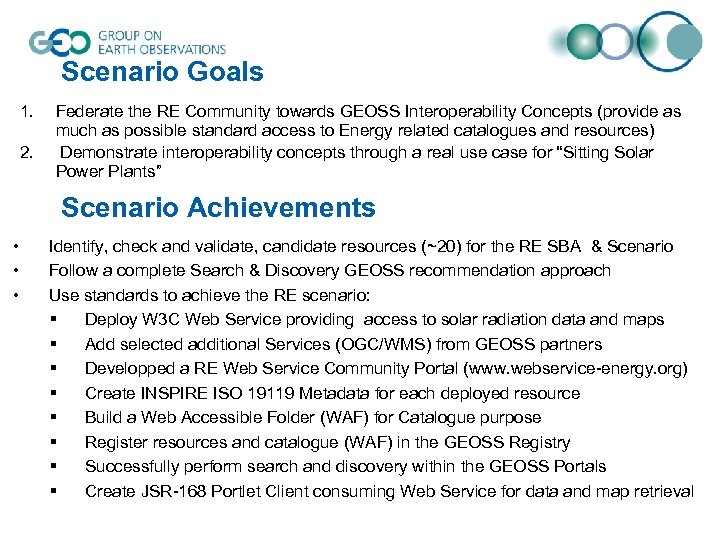 Scenario Goals 1. 2. Federate the RE Community towards GEOSS Interoperability Concepts (provide as much as possible standard access to Energy related catalogues and resources) Demonstrate interoperability concepts through a real use case for “Sitting Solar Power Plants” Scenario Achievements • • • Identify, check and validate, candidate resources (~20) for the RE SBA & Scenario Follow a complete Search & Discovery GEOSS recommendation approach Use standards to achieve the RE scenario: § Deploy W 3 C Web Service providing access to solar radiation data and maps § Add selected additional Services (OGC/WMS) from GEOSS partners § Developped a RE Web Service Community Portal (www. webservice-energy. org) § Create INSPIRE ISO 19119 Metadata for each deployed resource § Build a Web Accessible Folder (WAF) for Catalogue purpose § Register resources and catalogue (WAF) in the GEOSS Registry § Successfully perform search and discovery within the GEOSS Portals § Create JSR-168 Portlet Client consuming Web Service for data and map retrieval
 ADC Meeting Stresa, Italy 7 May 2009 AIP-2 CC&Bio WG Demos Stefano Nativi (CNR), Gary Geller (NASA/JPL), Chris Ray (Univ. Of Colorado), Falk Huettmann (University of Alaska ), Mattia Santoro (CNR), Siri Jodha Khalsa (Univ. of Colorado), Eamonn O’Tuama (GBIF), David Thomas (WMO)
 CC IMPACT ON PIKA DISTRIBUTION
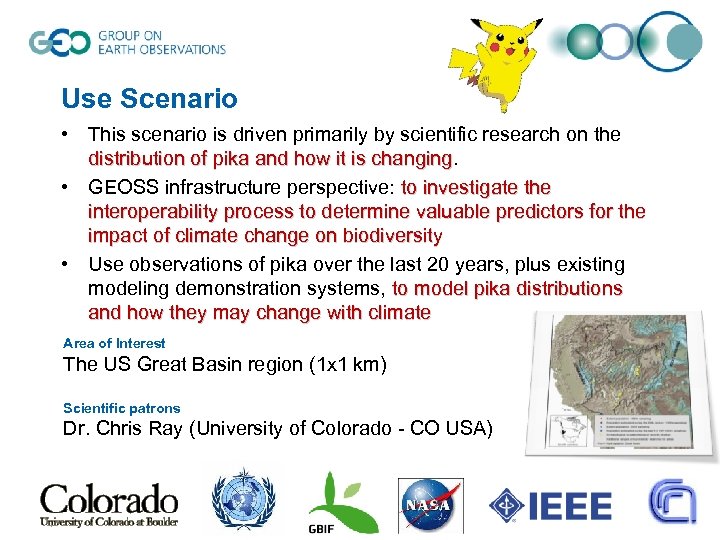 Use Scenario • This scenario is driven primarily by scientific research on the distribution of pika and how it is changing • GEOSS infrastructure perspective: to investigate the interoperability process to determine valuable predictors for the impact of climate change on biodiversity • Use observations of pika over the last 20 years, plus existing modeling demonstration systems, to model pika distributions and how they may change with climate Area of Interest The US Great Basin region (1 x 1 km) Scientific patrons Dr. Chris Ray (University of Colorado - CO USA)
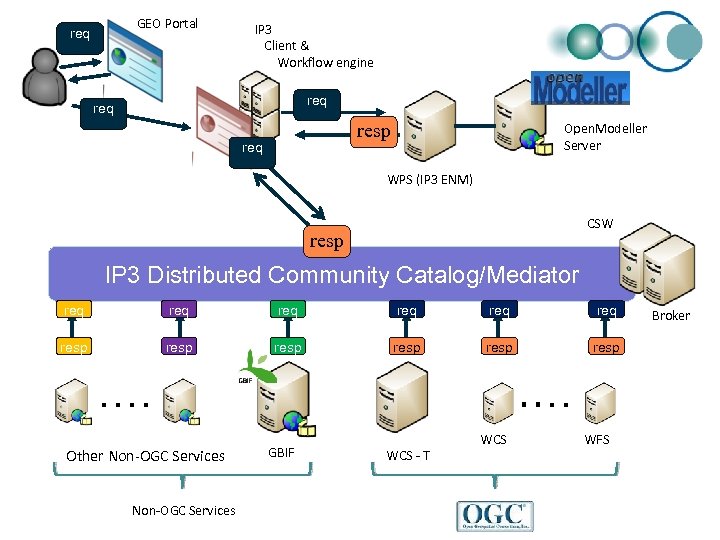 GEO Portal req IP 3 Client & Workflow engine req resp req Open. Modeller Server WPS (IP 3 ENM) CSW resp IP 3 Distributed Community Catalog/Mediator req req req resp resp Other Non-OGC Services GBIF WCS - T WCS WFS Broker
 AIP-2 Results Disaster Management Scenario GEO ADC/UIC Committee Report 7 -8 May 2009
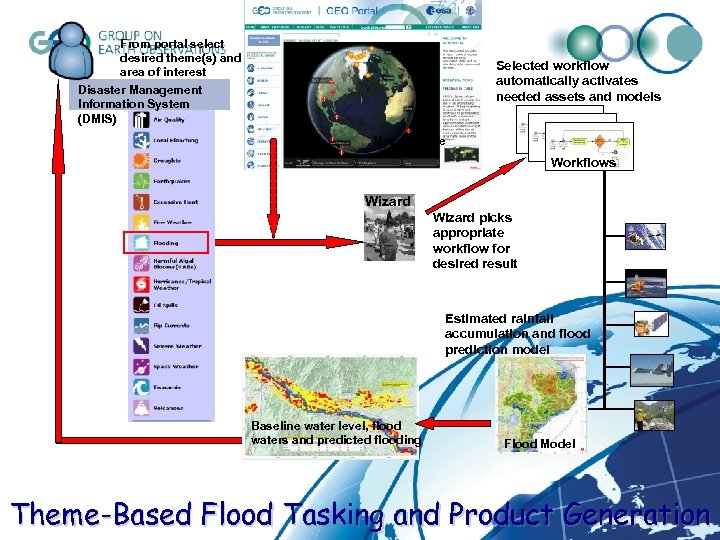
 Disaster Management Summary • Activity involved data provider components and services and end user involvement from disaster management communities of interest • Demonstrated capability to find, access, display, and use data from Myanmar, Ike, and Hannah events replayed from 2008 using Geoportal to discover SIREN community of interest portal and related data providers registered in the GEOSS registry • Components and services remain ready to serve future needs, in particular, the Caribbean Flood Pilot GEO Task DI-09 -02 B
 From portal select desired theme(s) and area of interest Disaster Management Information System (DMIS) Selected workflow automatically activates needed assets and models Mozambique Workflows Wizard picks appropriate workflow for desired result Estimated rainfall accumulation and flood prediction model Baseline water level, flood waters and predicted flooding Flood Model Theme-Based Flood Tasking and Product Generation
 GEOSS Common Infrastructure: Application to Air Quality & Health SBA Prepared by the GEOSS AIP-2 Air Quality & Health Working Group 7 May 2009 The Palazzo dei Congressi di Stresa, Italy
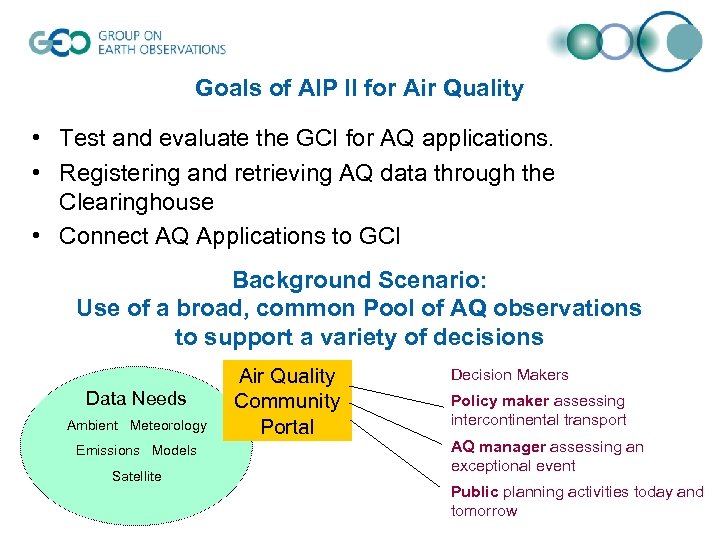 Goals of AIP II for Air Quality • Test and evaluate the GCI for AQ applications. • Registering and retrieving AQ data through the Clearinghouse • Connect AQ Applications to GCI Background Scenario: Use of a broad, common Pool of AQ observations to support a variety of decisions Data Needs Ambient Meteorology Emissions Models Satellite Air Quality Community Portal Decision Makers Policy maker assessing intercontinental transport AQ manager assessing an exceptional event Public planning activities today and tomorrow
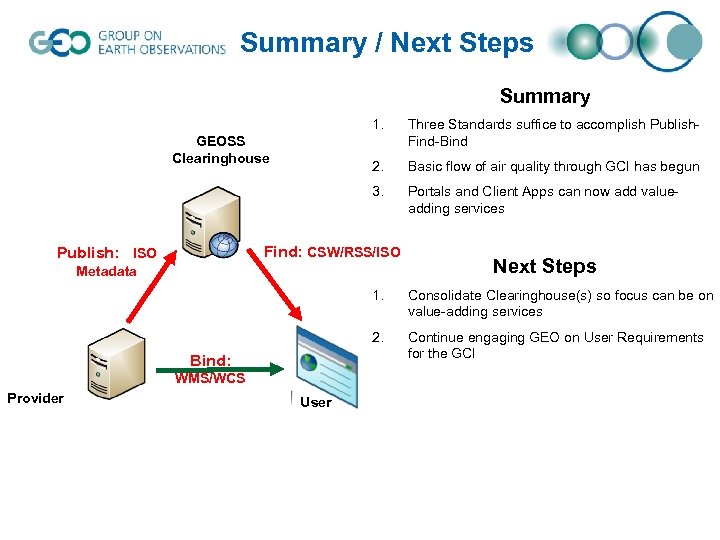 Summary / Next Steps Summary 1. 2. Basic flow of air quality through GCI has begun 3. GEOSS Clearinghouse Three Standards suffice to accomplish Publish. Find-Bind Portals and Client Apps can now add valueadding services Find: CSW/RSS/ISO Publish: ISO Metadata Next Steps 1. 2. Bind: WMS/WCS Provider User Consolidate Clearinghouse(s) so focus can be on value-adding services Continue engaging GEO on User Requirements for the GCI
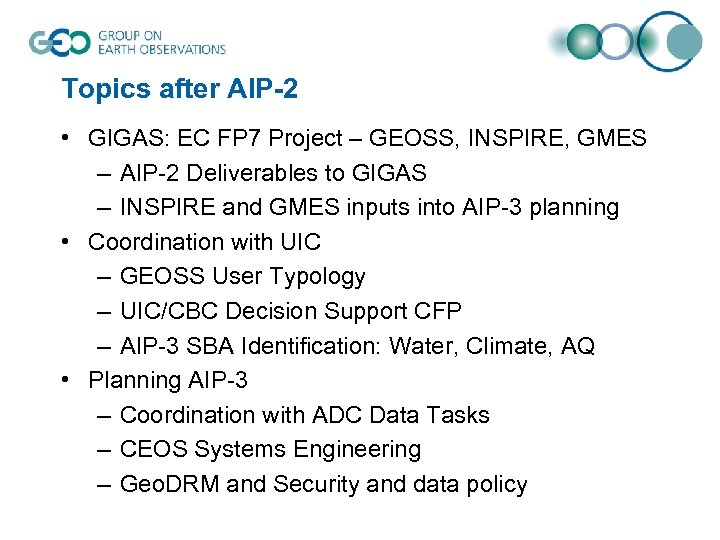 Topics after AIP-2 • GIGAS: EC FP 7 Project – GEOSS, INSPIRE, GMES – AIP-2 Deliverables to GIGAS – INSPIRE and GMES inputs into AIP-3 planning • Coordination with UIC – GEOSS User Typology – UIC/CBC Decision Support CFP – AIP-3 SBA Identification: Water, Climate, AQ • Planning AIP-3 – Coordination with ADC Data Tasks – CEOS Systems Engineering – Geo. DRM and Security and data policy
 References • GEO – earthobservations. org • GEO Architecture Implementation Pilot – www. ogcnetwork. net/AIpilot • GEOSS registries and SIF – geossregistries. info Nadine Alameh nadinesa@mobilaps. com George Percivall percivall@myogc. org