


 Скачать презентацию Architecture Arnon Rotem-Gal-Oz Product Line Architect arnon rgoarchitects com
5dfc4aa1357874ffcf473bbed6b4021f.ppt
- Количество слайдов: 58
 Architecture Arnon Rotem-Gal-Oz Product Line Architect arnon@rgoarchitects. com http: //www. rgoarchitects. com
 Agenda Why Software Architecture? What’s Software Architecture? Architecture types ? Levels ? ? ? Introduction to Architecture Documentation
 Discussion What’s Software Architecture
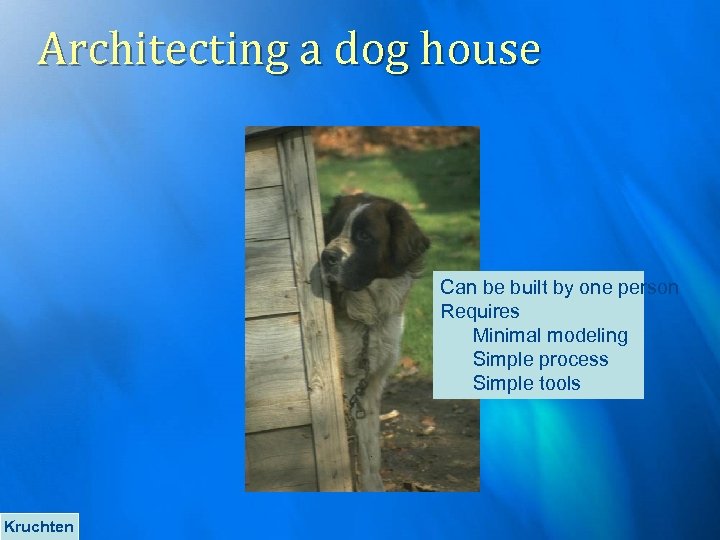 Architecting a dog house Can be built by one person Requires Minimal modeling Simple process Simple tools Kruchten
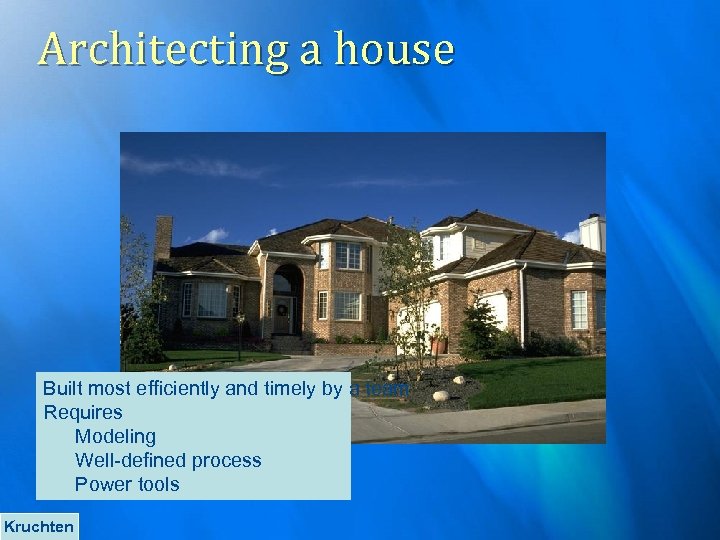 Architecting a house Built most efficiently and timely by a team Requires Modeling Well-defined process Power tools Kruchten
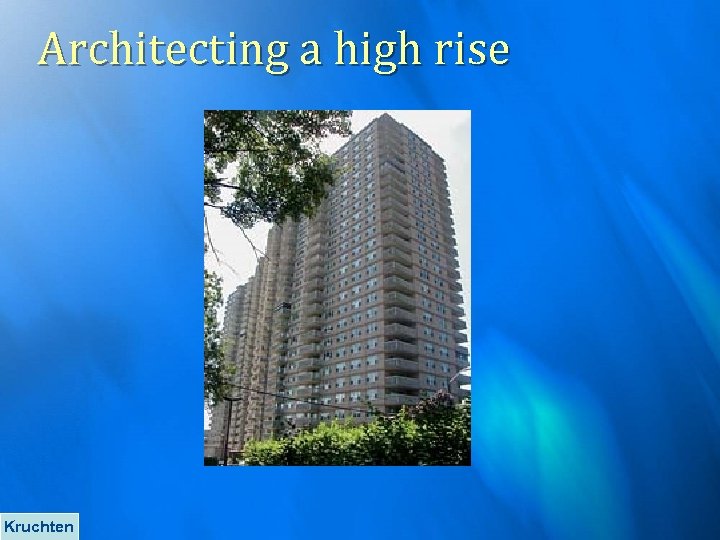 Architecting a high rise Kruchten
 Differences Scale Process Cost Schedule Skills and development teams Materials and technologies Stakeholders Risks
 Agenda Why Software Architecture? What’s Software Architecture? Architecture types ? Levels ? ? ? Introduction to Architecture Documentation
 Architecture defined Software architecture is what software architects do Beck
 Architecture defined Formal Definition IEEE 1471 -2000 Software architecture is the fundamental organization of a system, embodied in its components, their relationships to each other and the environment, and the principles governing its design and evolution IEEE 1471 -2000
 Architecture defined Another Go Software architecture encompasses the set of significant decisions about the organization of a software system Selection of the structural elements and their interfaces by which a system is composed Behavior as specified in collaborations among those elements Composition of these structural and behavioral elements into larger subsystems Architectural style that guides this organization Booch, Kruchten, Reitman, Bittner, and Shaw
 Architecture defined Few More Perry and Wolf, 1992 A set of architectural (or design) elements that have a particular form Boehm et al. , 1995 A software system architecture comprises A collection of software and system components, connections, and constraints A collection of system stakeholders' need statements A rationale which demonstrates that the components, connections, and constraints define a system that, if implemented, would satisfy the collection of system stakeholders' need statements Clements et al. , 1997 The software architecture of a program or computing system is the structure or structures of the system, which comprise software components, the externally visible properties of those components, and the relationships among them http: //www. sei. edu/architecture/definitions. html
 Common elements 1/2 Architecture defines major components Architecture defines component relationships (structures) and interactions Architecture omits content information about components that does not pertain to their interactions Behavior of components is a part of architecture insofar as it can be discerned from the point of view of another component
 Common elements 2/2 Every system has an architecture (even a system composed of one component) Architecture defines the rationale behind the components and the structure Architecture definitions do not define what a component is Architecture is not a single structure -- no single structure is the architecture
 Architecture is Early Architecture represents the set of earliest design decisions Hardest to change Most critical to get right Architecture is the first design artifact where a system’s quality attributes are addressed
 Architecture Drives Architecture serves as the blueprint for the system but also the project: Team structure Documentation organization Work breakdown structure Scheduling, planning, budgeting Unit testing, integration Architecture establishes the communication and coordination mechanisms among components
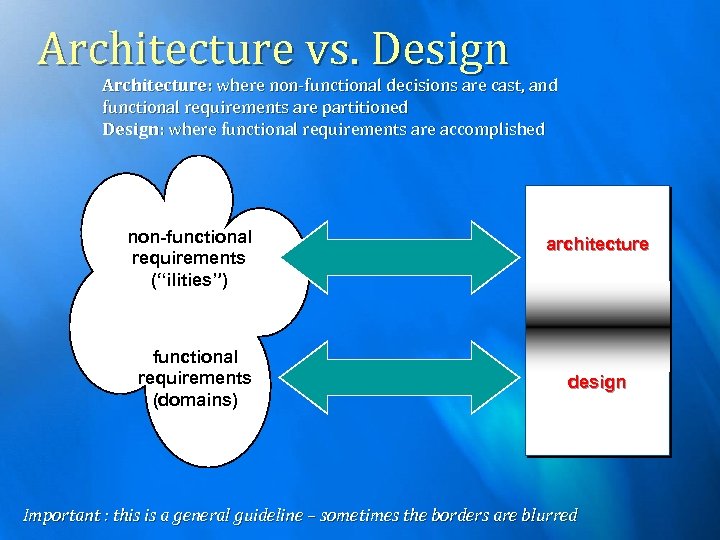 Architecture vs. Design Architecture: where non-functional decisions are cast, and functional requirements are partitioned Design: where functional requirements are accomplished non-functional requirements (“ilities”) functional requirements (domains) architecture design Important : this is a general guideline – sometimes the borders are blurred
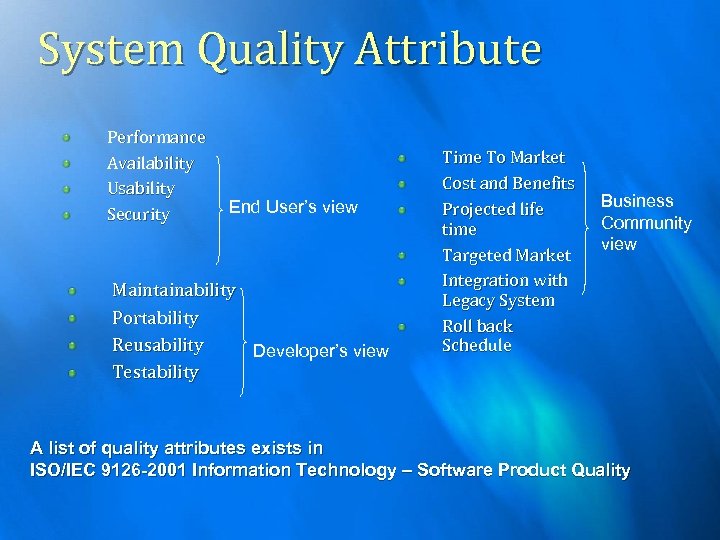 System Quality Attribute Performance Availability Usability Security End User’s view Maintainability Portability Reusability Developer’s view Testability Time To Market Cost and Benefits Projected life time Targeted Market Integration with Legacy System Roll back Schedule Business Community view A list of quality attributes exists in ISO/IEC 9126 -2001 Information Technology – Software Product Quality
 Agenda Why Software Architecture? What’s Software Architecture? Software Architecture types ? Levels ? ? ? Introduction to Architecture Documentation
 Business Architecture Concerned with the business model as it relates to an automated solution. E-business is a good candidate Structural part of requirements analysis. Domain Specific
 Technical Architecture Specific to technology and the use of this technology to structure the technical points (Technology Mapping) of an architecture. NET J 2 EE Hardware architects
 Solutions Architecture Specific to a particular business area (or project) but still reliant on being a technical focal point for communications between the domain architect, business interests and development.
 Enterprise Architecture The organizing logic for a firm’s core business processes and IT capabilities captured in a set of principles, policies and technical choices to achieve the business standardization and integration requirements of the firm’s operating model. Concerned with cross project/solution architecture and communication between different practices in architecture.
 Product Line Architecture Common Architecture for a set of products or systems developed by an organization
 Product Line - Initiation Evolutionary Product line architecture and components evolve with the requirements posed by new product line members. Revolutionary Product line architecture and components developed to match requirements of all expected product-line members
 Agenda Why Software Architecture? What’s Software Architecture? Architecture types ? Levels ? ? ? Introduction to Architecture Documentation
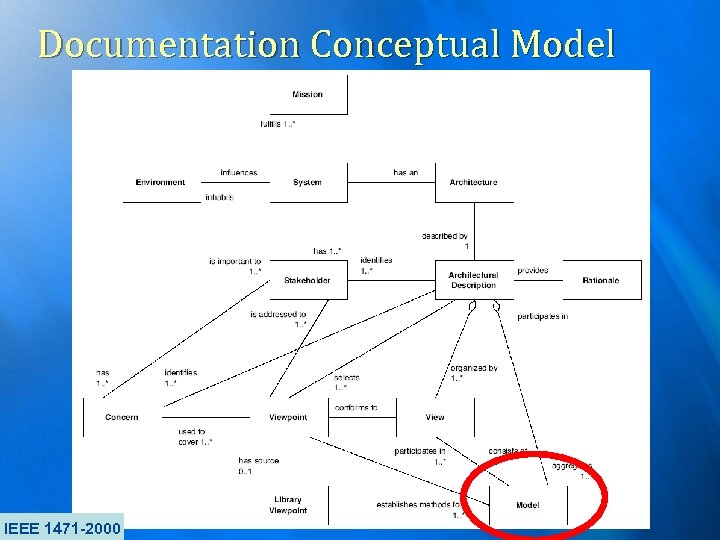
 IEEE 1471 - Recap Recommended Practice for Architectural Description of Software-Intensive Systems Define the Relations between Stakeholders Concerns Viewpoint Models Architectural Description
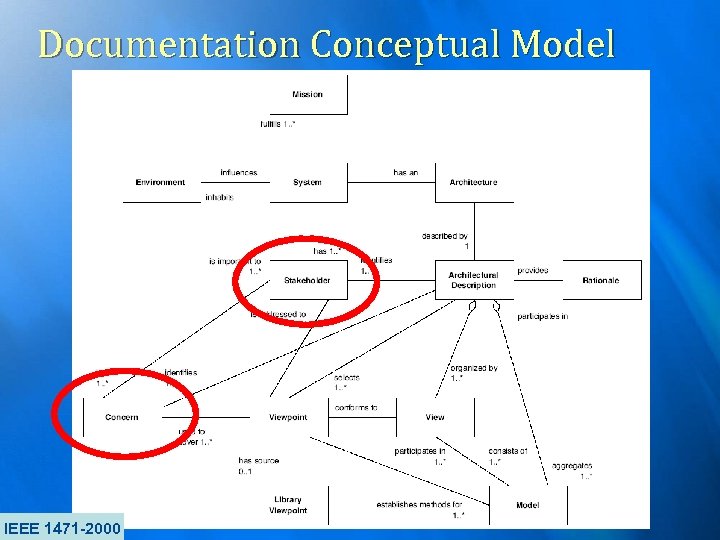 Documentation Conceptual Model IEEE 1471 -2000
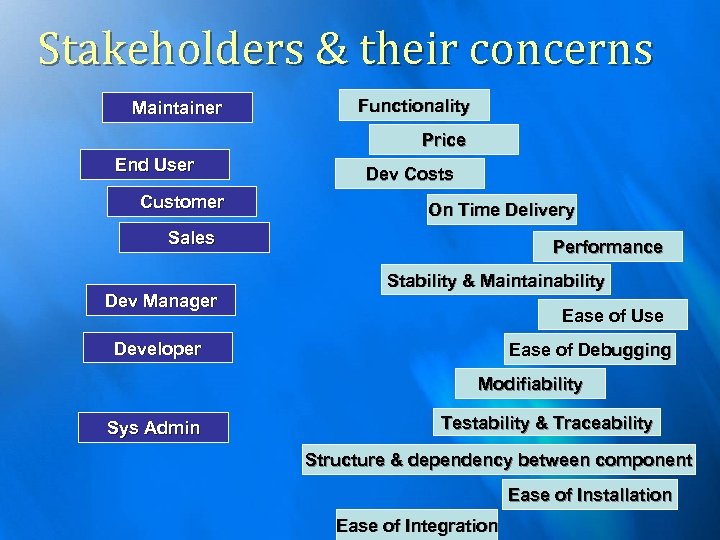 Stakeholders & their concerns Maintainer Functionality Price End User Customer Dev Costs On Time Delivery Sales Dev Manager Performance Stability & Maintainability Ease of Use Developer Ease of Debugging Modifiability Sys Admin Testability & Traceability Structure & dependency between component Ease of Installation Ease of Integration
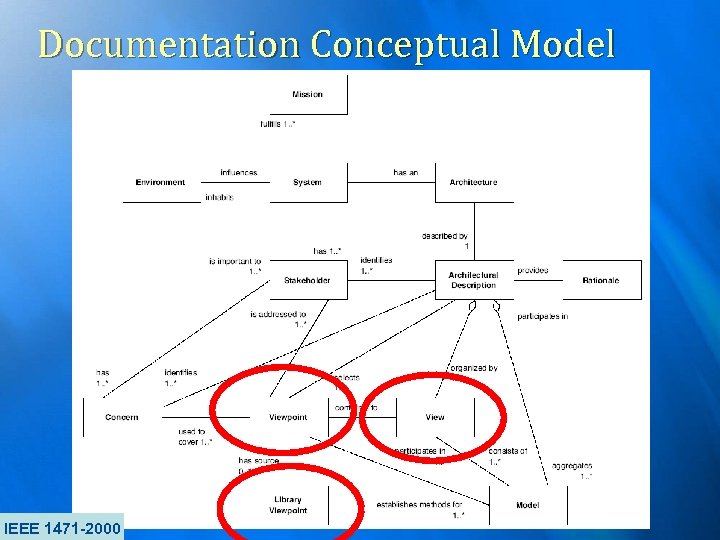 Documentation Conceptual Model IEEE 1471 -2000
 Discussion What views do you know / use
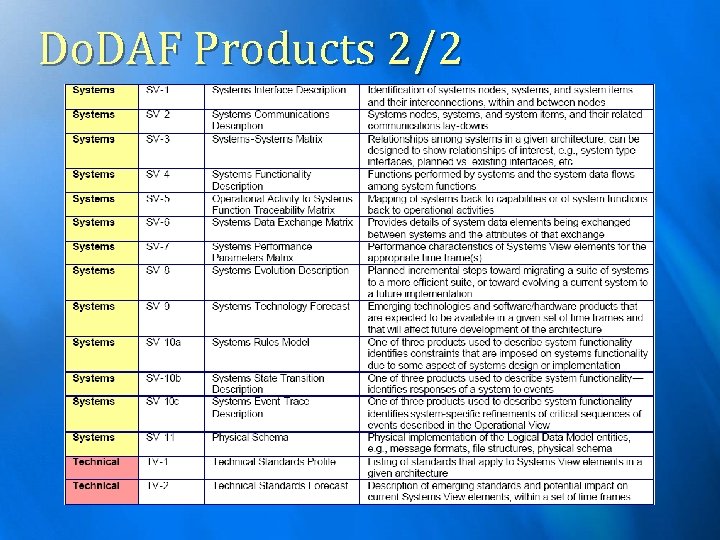
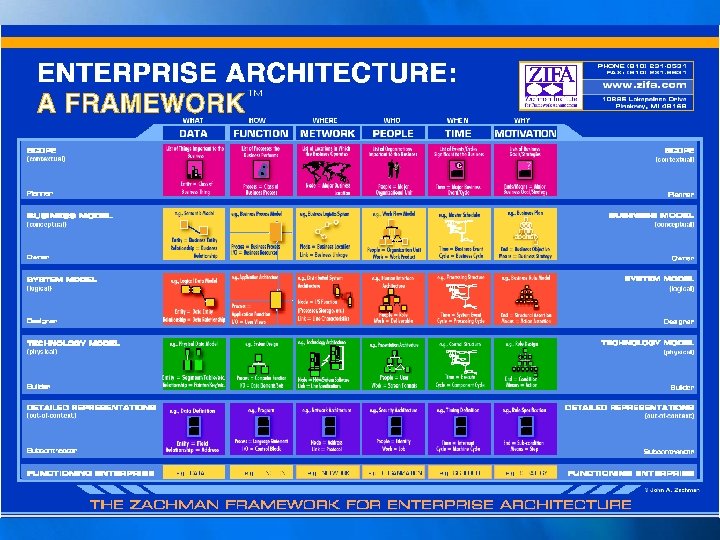
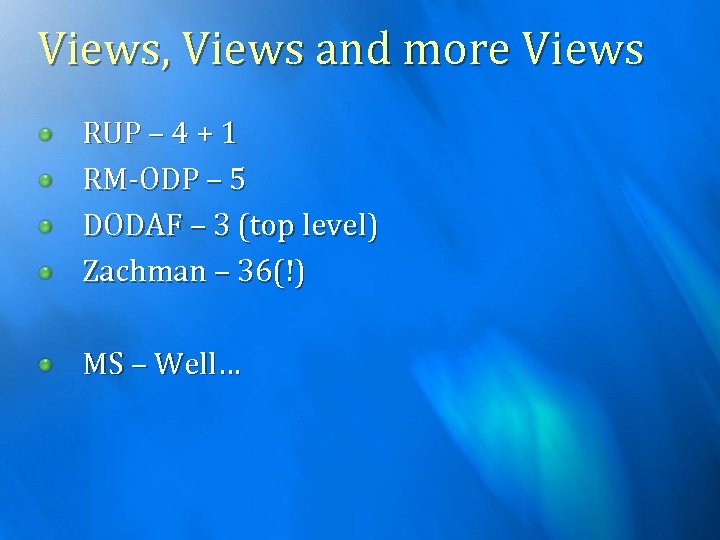 Views, Views and more Views RUP – 4 + 1 RM-ODP – 5 DODAF – 3 (top level) Zachman – 36(!) MS – Well…
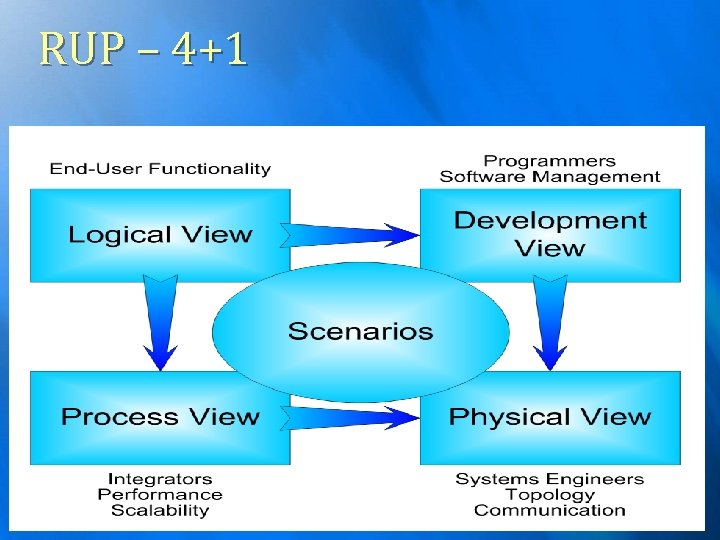 RUP – 4+1
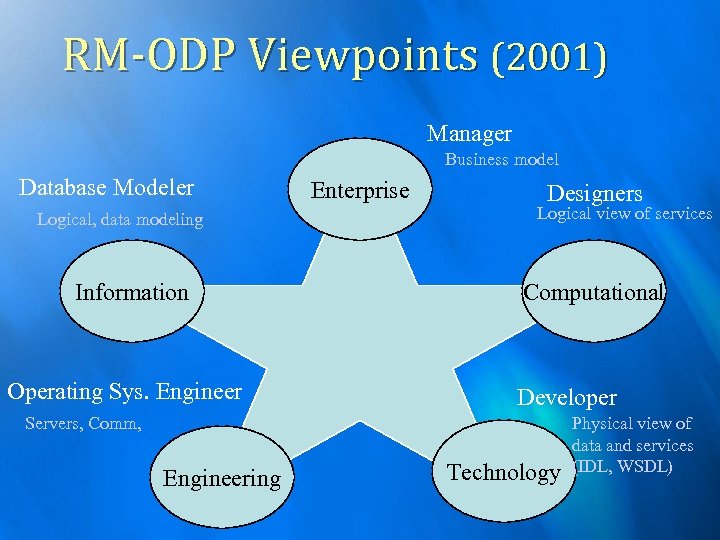 RM-ODP Viewpoints (2001) Manager Business model Database Modeler Logical, data modeling Information Operating Sys. Engineer Enterprise Designers Logical view of services Computational Developer Servers, Comm, Engineering Technology Physical view of data and services (IDL, WSDL)
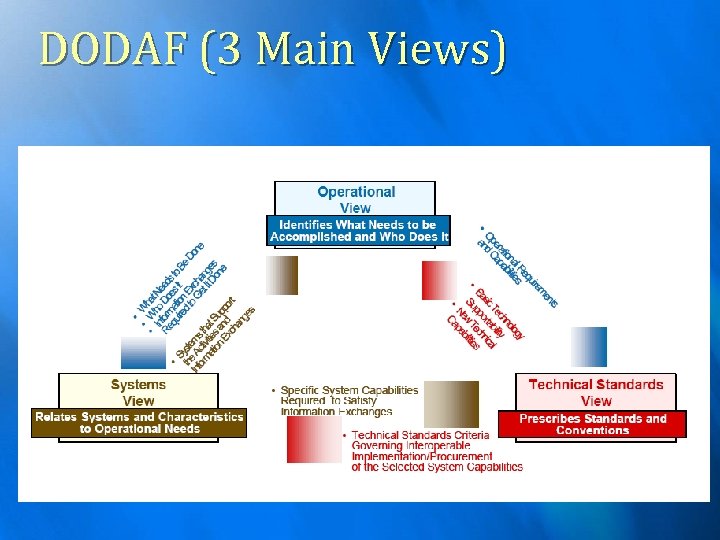 DODAF (3 Main Views)
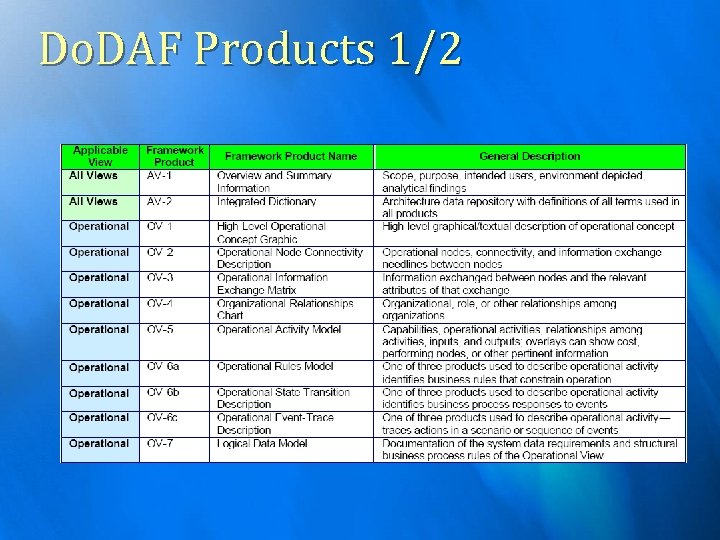 Do. DAF Products 1/2
 Do. DAF Products 2/2
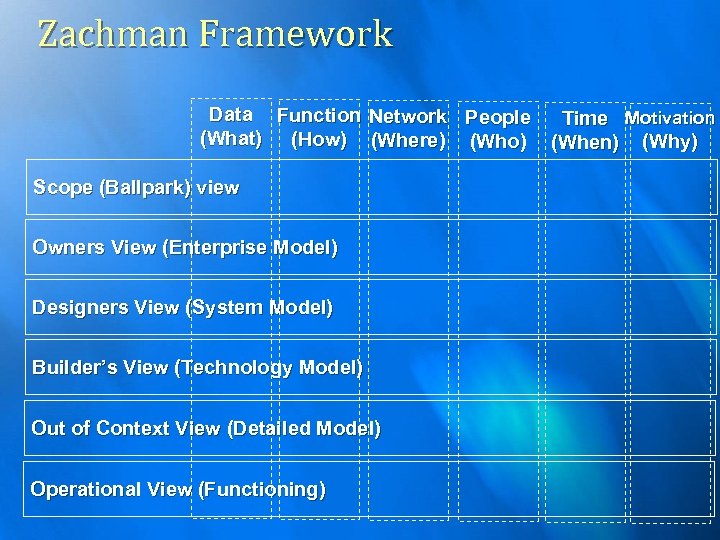 Zachman Framework Data Function Network People Time Motivation (What) (How) (Where) (Who) (When) (Why) Scope (Ballpark) view Owners View (Enterprise Model) Designers View (System Model) Builder’s View (Technology Model) Out of Context View (Detailed Model) Operational View (Functioning)
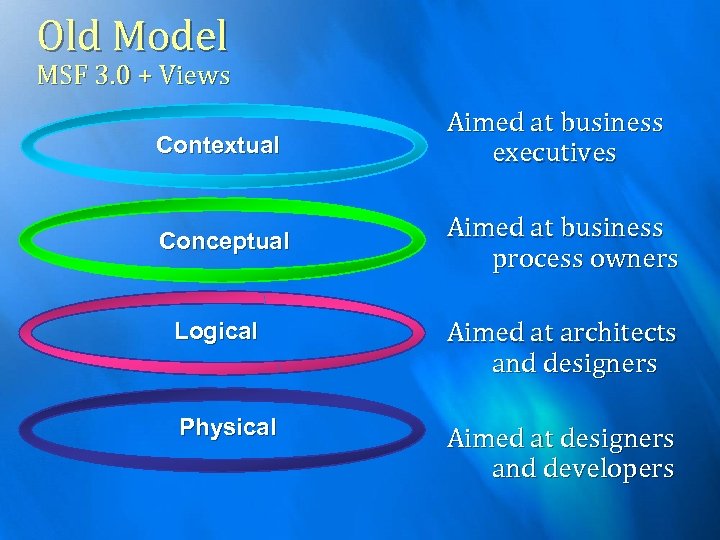 Old Model MSF 3. 0 + Views Contextual Aimed at business executives Conceptual Aimed at business process owners Logical Aimed at architects and designers Physical Aimed at designers and developers
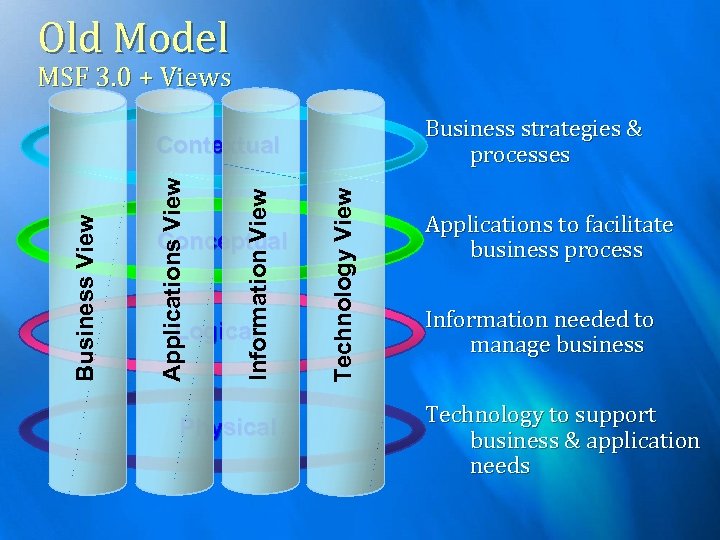 Old Model MSF 3. 0 + Views Business strategies & processes Conceptual Logical Physical Technology View Information View Applications View Business View Contextual Applications to facilitate business process Information needed to manage business Technology to support business & application needs
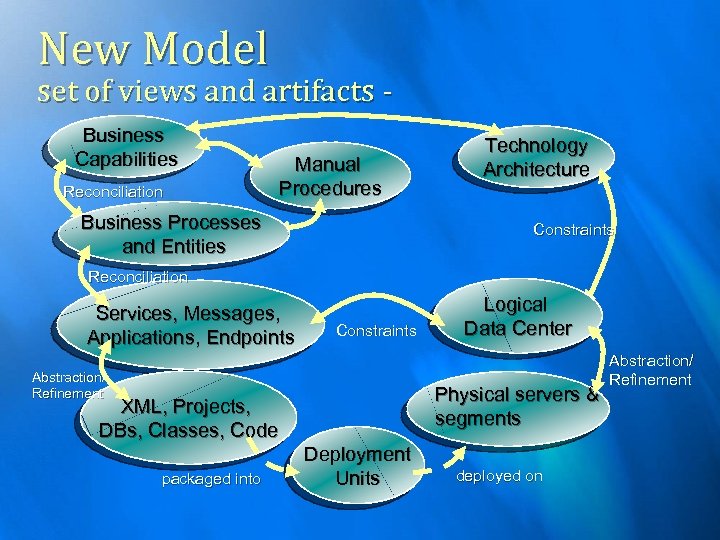 New Model set of views and artifacts Business Capabilities Reconciliation Manual Procedures Business Processes and Entities Technology Architecture Constraints Reconciliation Services, Messages, Applications, Endpoints Constraints Abstraction/ Refinement Physical servers & segments XML, Projects, DBs, Classes, Code packaged into Logical Data Center Deployment Units deployed on Abstraction/ Refinement
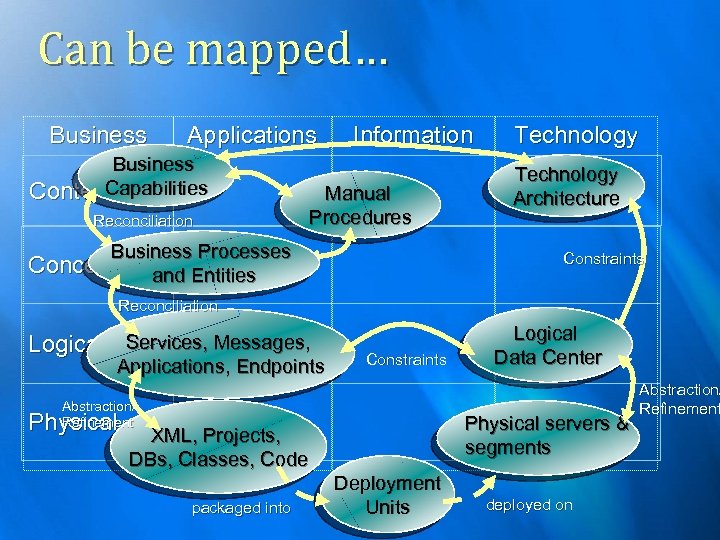 Can be mapped… Business Applications Business Capabilities Contextual Reconciliation Information Manual Procedures Business Processes Conceptual and Entities Technology Architecture Constraints Reconciliation Logical Services, Messages, Applications, Endpoints Constraints Abstraction/ Refinement Physical servers & segments XML, Projects, DBs, Classes, Code packaged into Logical Data Center Deployment Units deployed on Abstraction/ Refinement
 Documentation Conceptual Model IEEE 1471 -2000
 Models Non-standard Models ADL UML DSL
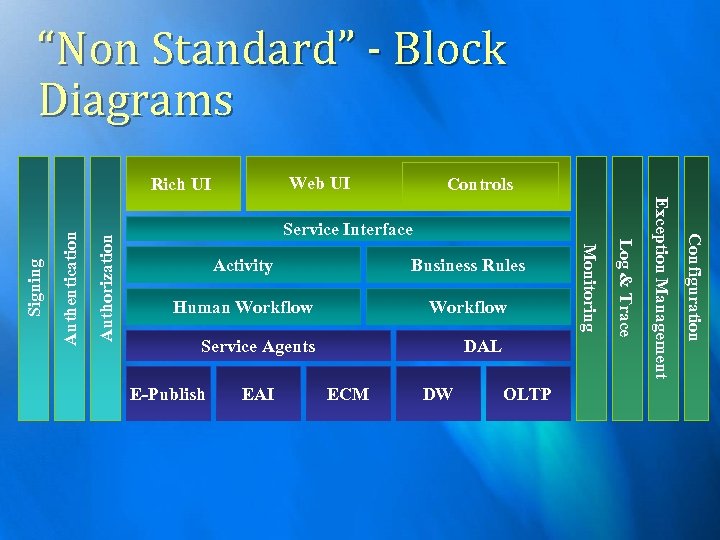 “Non Standard” - Block Diagrams Web UI Authorization Business Rules Human Workflow Service Agents DAL E-Publish EAI ECM DW OLTP Configuration Activity Exception Management Service Interface Log & Trace Authentication Controls Monitoring Signing Rich UI
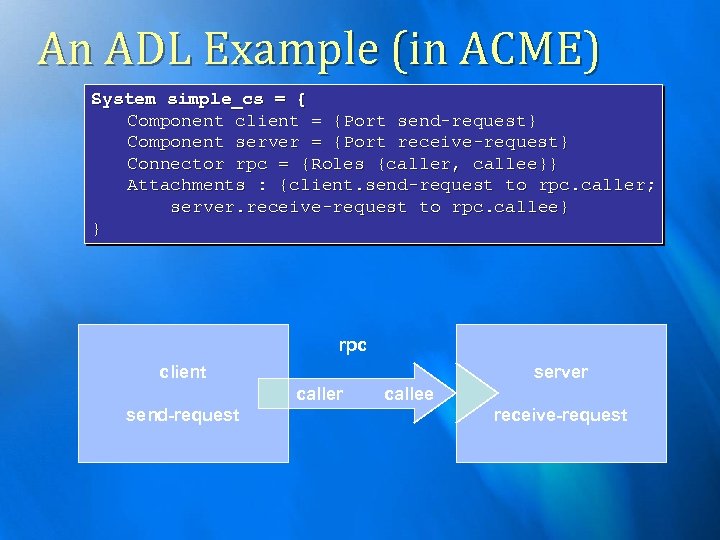 An ADL Example (in ACME) System simple_cs = { Component client = {Port send-request} Component server = {Port receive-request} Connector rpc = {Roles {caller, callee}} Attachments : {client. send-request to rpc. caller; server. receive-request to rpc. callee} } rpc client server caller send-request callee receive-request
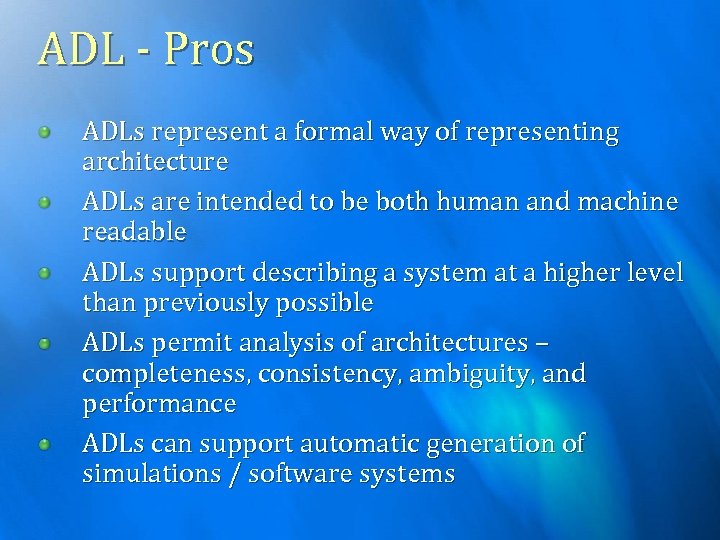 ADL - Pros ADLs represent a formal way of representing architecture ADLs are intended to be both human and machine readable ADLs support describing a system at a higher level than previously possible ADLs permit analysis of architectures – completeness, consistency, ambiguity, and performance ADLs can support automatic generation of simulations / software systems
 ADL - Cons There is not universal agreement on what ADLs should represent, particularly as regards the behavior of the architecture Representations currently in use are relatively difficult to parse and are not supported by commercial tools Most ADLs tend to be very vertically optimized toward a particular kind of analysis Most ADL work today has been undertaken with academic rather than commercial goals in mind
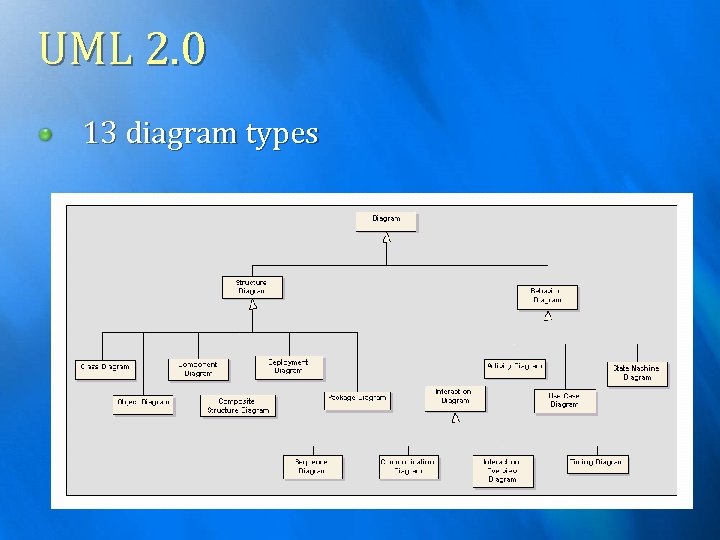 UML 2. 0 13 diagram types
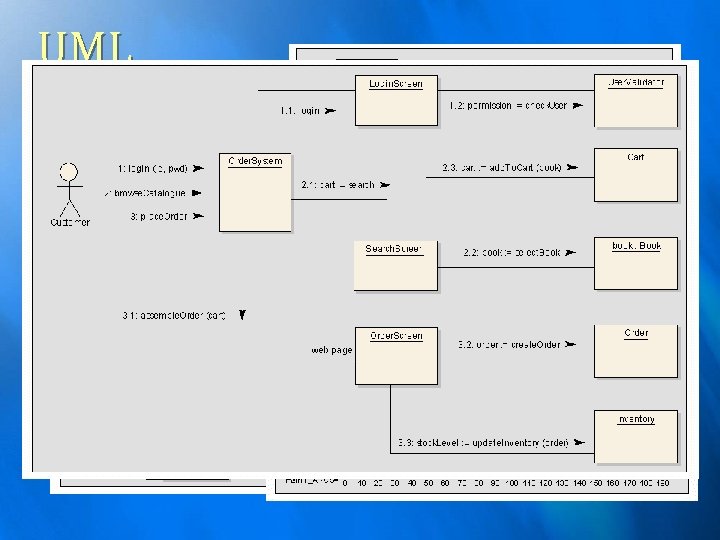 UML
UML
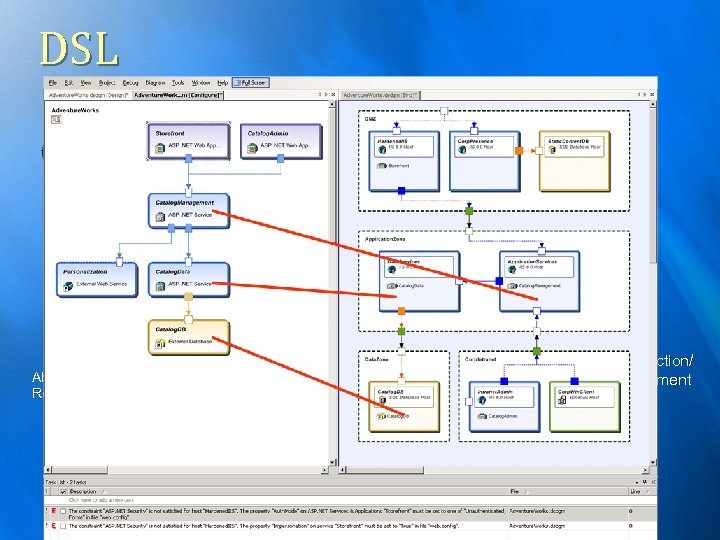 DSL Business Capabilities Reconciliation Manual Procedures Business Processes and Entities Technology Architecture Constraints Reconciliation Services, Messages, Applications, Endpoints Constraints Abstraction/ Refinement Physical servers & segments XML, Projects, DBs, Classes, Code packaged into Logical Data Center Deployment Units deployed on Abstraction/ Refinement
 ADL - revisited ADLs are essentially a DSL for architecture The Architecture DSLs in VSTS – can be considered as an ADL The difference – VSTS has a set of languages instead of one trying to encompass all views
 Discussion What’s the “best” modeling techniques
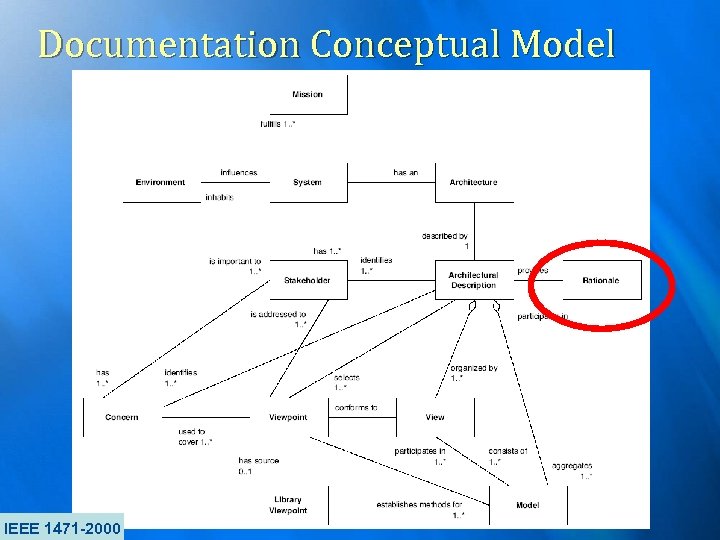 Documentation Conceptual Model IEEE 1471 -2000
 Discussion How much documentation
 Famous Last Words… “It is a very humbling experience to make a multimillion-dollar mistake, but it is also very memorable…. ” (Fred Brooks - “Mythical Man -Month” p. 47)
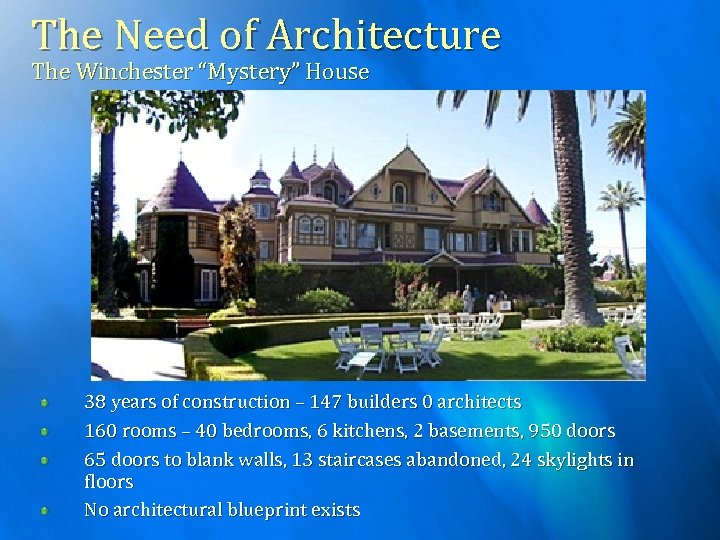 The Need of Architecture The Winchester “Mystery” House 38 years of construction – 147 builders 0 architects 160 rooms – 40 bedrooms, 6 kitchens, 2 basements, 950 doors 65 doors to blank walls, 13 staircases abandoned, 24 skylights in floors No architectural blueprint exists