


 Скачать презентацию Architectural Trends and Programming Model Strategies for Large-Scale
0ec9b035e36fc8a06d8a6283ce661760.ppt
- Количество слайдов: 32
 Architectural Trends and Programming Model Strategies for Large-Scale Machines Katherine Yelick U. C. Berkeley and Lawrence Berkeley National Lab http: //titanium. cs. berkeley. edu http: //upc. lbl. gov 1 Kathy Yelick
 Architecture Trends • • • What happened to Moore’s Law? Power density and system power Multicore trend Game processors and GPUs What this means to you Climate 2007 Kathy Yelick, 2
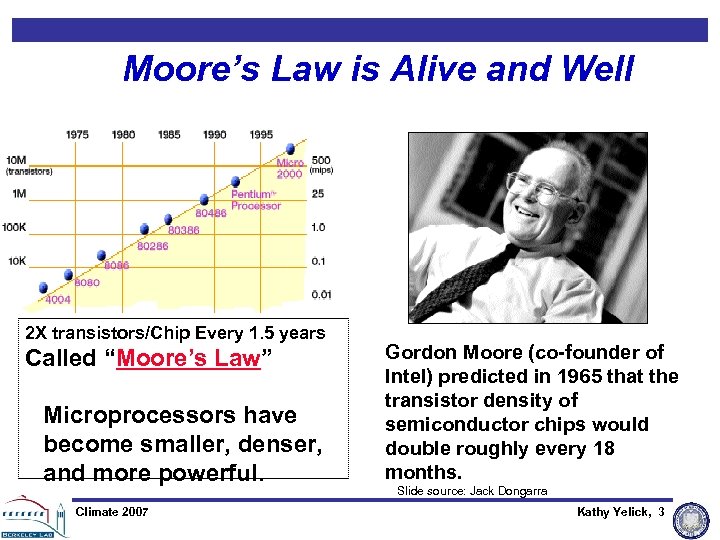 Moore’s Law is Alive and Well Moore’s Law 2 X transistors/Chip Every 1. 5 years Called “Moore’s Law” Microprocessors have become smaller, denser, and more powerful. Climate 2007 Gordon Moore (co-founder of Intel) predicted in 1965 that the transistor density of semiconductor chips would double roughly every 18 months. Slide source: Jack Dongarra Kathy Yelick, 3
 But Clock Scaling Bonanza Has Ended • Processor designers forced to go “multicore”: • Heat density: faster clock means hotter chips • more cores with lower clock rates burn less power • Declining benefits of “hidden” Instruction Level Parallelism (ILP) • Last generation of single core chips probably over-engineered • Lots of logic/power to find ILP parallelism, but it wasn’t in the apps • Yield problems • Parallelism can also be used for redundancy • IBM Cell processor has 8 small cores; a blade system with all 8 sells for $20 K, whereas a PS 3 is about $600 and only uses 7 Climate 2007 Kathy Yelick, 4
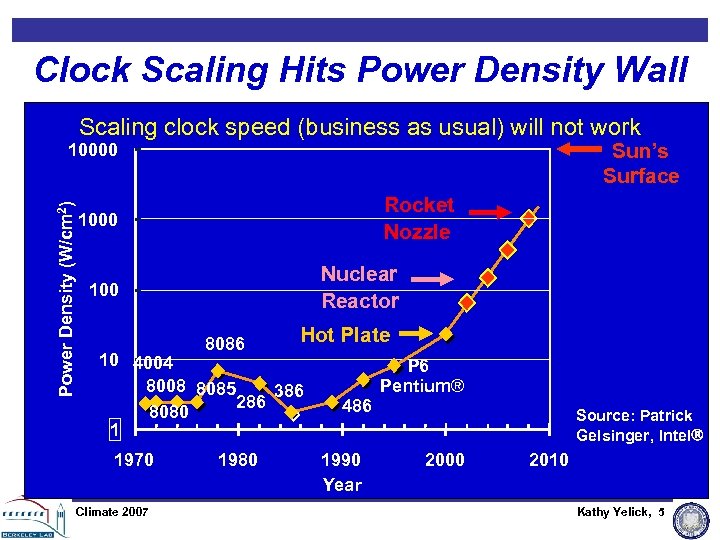 Clock Scaling Hits Power Density Wall Scaling clock speed (business as usual) will not work Power Density (W/cm 2) 10000 Sun’s Surface Rocket Nozzle 1000 Nuclear Reactor 100 8086 Hot Plate 10 4004 8008 8085 386 286 8080 1 1970 Climate 2007 1980 P 6 Pentium® 486 1990 Year Source: Patrick Gelsinger, Intel 2000 2010 Kathy Yelick, 5
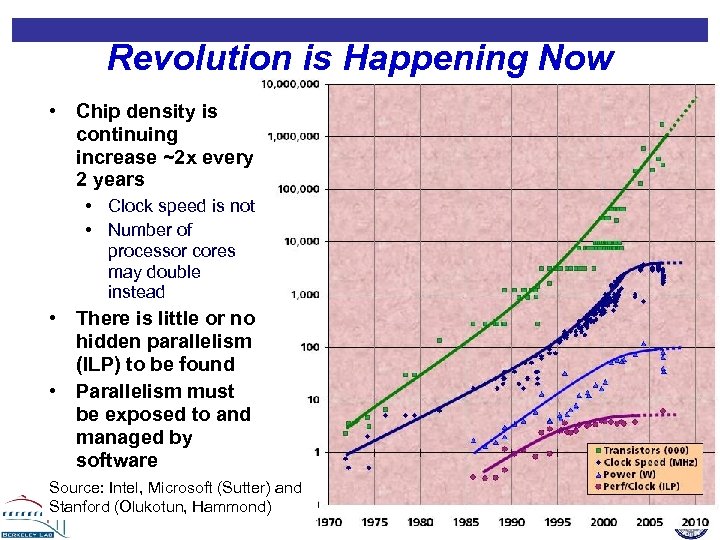 Revolution is Happening Now • Chip density is continuing increase ~2 x every 2 years • Clock speed is not • Number of processor cores may double instead • There is little or no hidden parallelism (ILP) to be found • Parallelism must be exposed to and managed by software Source: Intel, Microsoft (Sutter) and Stanford (Olukotun, Hammond) Climate 2007 Kathy Yelick, 6
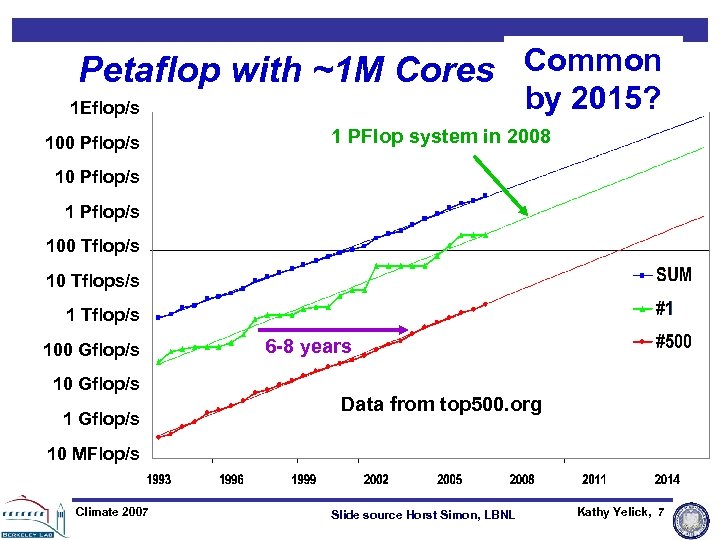 Common Petaflop with ~1 M Cores By 2008 by 2015? 1 Eflop/s 100 Pflop/s 1 PFlop system in 2008 10 Pflop/s 100 Tflop/s 10 Tflops/s 1 Tflop/s 100 Gflop/s 1 Gflop/s 6 -8 years Data from top 500. org 10 MFlop/s Climate 2007 Slide source Horst Simon, LBNL Kathy Yelick, 7
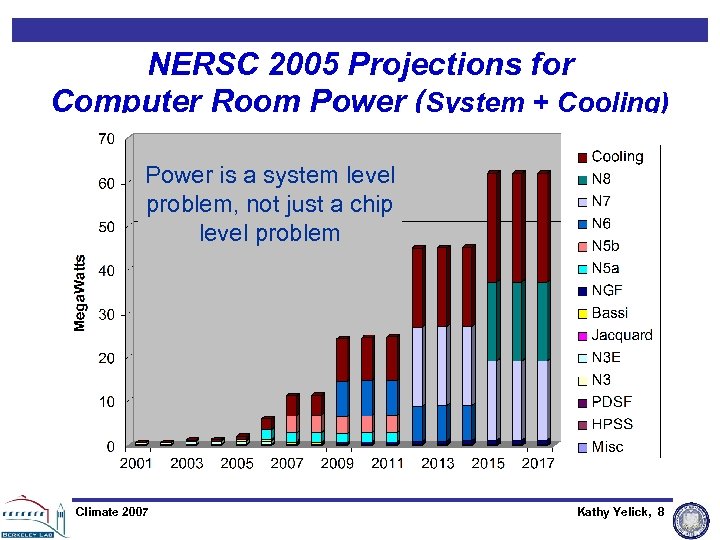 NERSC 2005 Projections for Computer Room Power (System + Cooling) Power is a system level problem, not just a chip level problem Climate 2007 Kathy Yelick, 8
 Concurrency for Low Power • Highly concurrent systems are more power efficient • Dynamic power is proportional to V 2 f. C • Increasing frequency (f) also increases supply voltage (V): more than linear effect • Increasing cores increases capacitance (C) but has only a linear effect • Hidden concurrency burns power • Speculation, dynamic dependence checking, etc. • Push parallelism discover to software (compilers and application programmers) to save power • Challenge: Can you double the concurrency in your algorithms every 18 months? Climate 2007 Kathy Yelick, 9
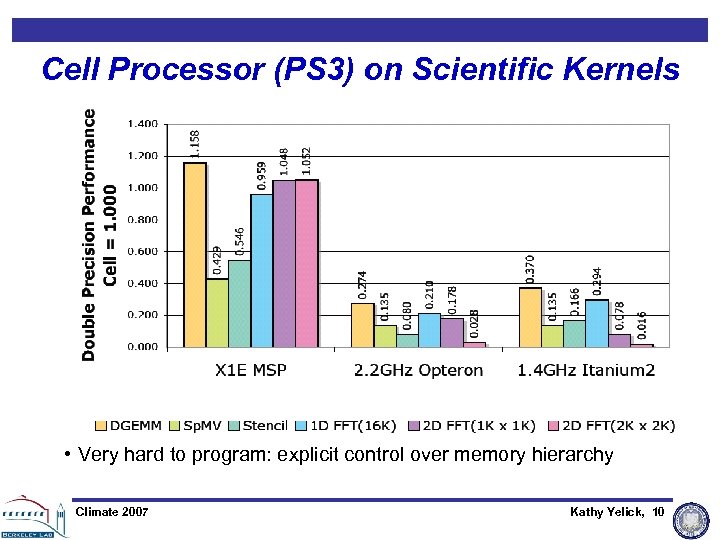 Cell Processor (PS 3) on Scientific Kernels • Very hard to program: explicit control over memory hierarchy Climate 2007 Kathy Yelick, 10
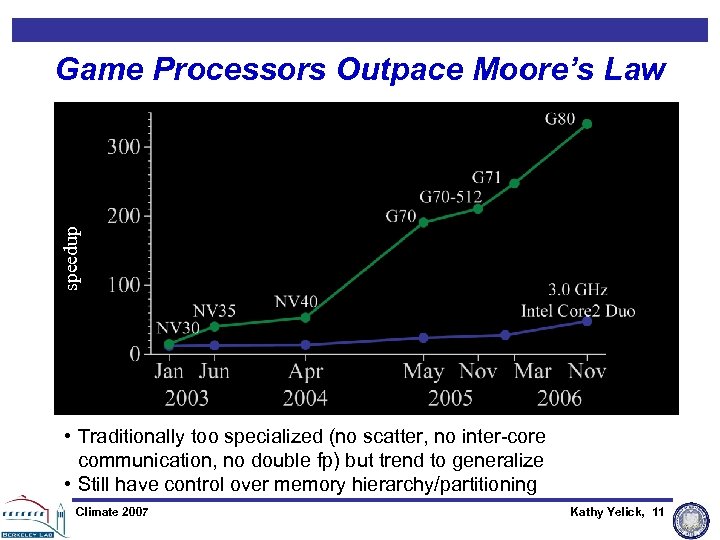 speedup Game Processors Outpace Moore’s Law • Traditionally too specialized (no scatter, no inter-core communication, no double fp) but trend to generalize • Still have control over memory hierarchy/partitioning Climate 2007 Kathy Yelick, 11
 What Does this Mean to You? • The world of computing is going parallel • Number of cores will double every 12 -24 months • Petaflop (1 M processor) machines common by 2015 • More parallel programmers to hire • Climate codes must have more parallelism • Need for fundamental rewrite and new algorithms • Added challenge of combining with adaptive algorithms • New programming model or language likely • Can the HPC benefit from investments in parallel languages and tools? • One programming model for all? Climate 2007 Kathy Yelick, 12
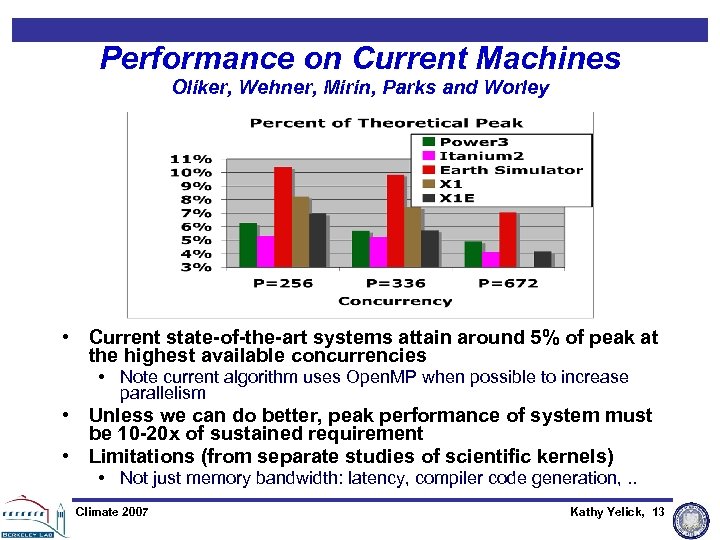 Performance on Current Machines Oliker, Wehner, Mirin, Parks and Worley • Current state-of-the-art systems attain around 5% of peak at the highest available concurrencies • Note current algorithm uses Open. MP when possible to increase parallelism • Unless we can do better, peak performance of system must be 10 -20 x of sustained requirement • Limitations (from separate studies of scientific kernels) • Not just memory bandwidth: latency, compiler code generation, . . Climate 2007 Kathy Yelick, 13
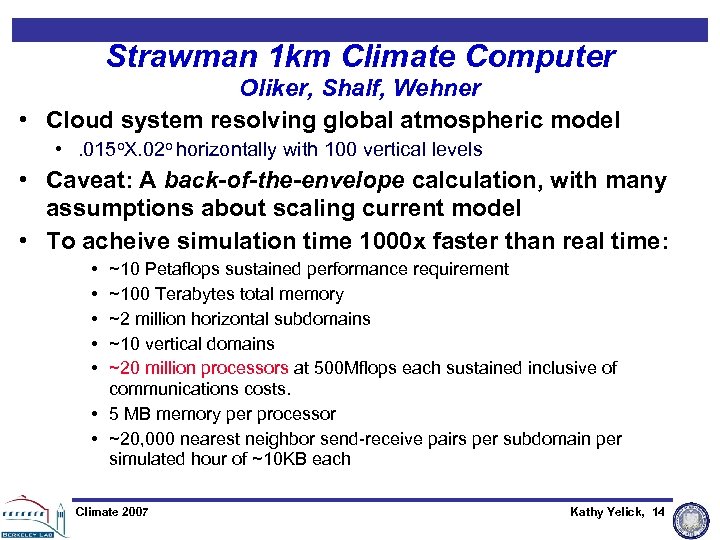 Strawman 1 km Climate Computer Oliker, Shalf, Wehner • Cloud system resolving global atmospheric model • . 015 o. X. 02 o horizontally with 100 vertical levels • Caveat: A back-of-the-envelope calculation, with many assumptions about scaling current model • To acheive simulation time 1000 x faster than real time: • • • ~10 Petaflops sustained performance requirement ~100 Terabytes total memory ~2 million horizontal subdomains ~10 vertical domains ~20 million processors at 500 Mflops each sustained inclusive of communications costs. • 5 MB memory per processor • ~20, 000 nearest neighbor send-receive pairs per subdomain per simulated hour of ~10 KB each Climate 2007 Kathy Yelick, 14
 A Programming Model Approach: Partitioned Global Address Space (PGAS) Languages What, Why, and How 15 Kathy Yelick
 Parallel Programming Models • Easy parallel software is still an unsolved problem ! • Goals: • Making parallel machines easier to use • Ease algorithm experiments • Make the most of your machine (network and memory) • Enable compiler optimizations • Partitioned Global Address Space (PGAS) Languages • Global address space like threads (programmability) • One-sided communication • Current static (SPMD) parallelism like MPI • Local/global distinction, i. e. , layout matters (performance) Climate 2007 Kathy Yelick, 16
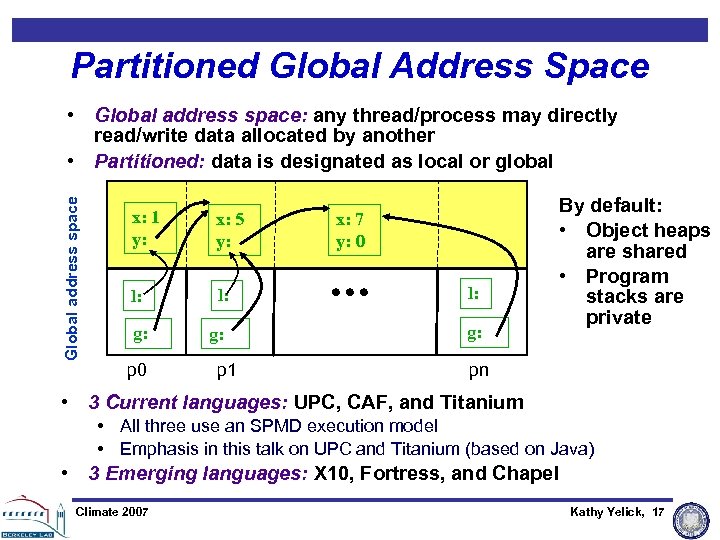 Partitioned Global Address Space Global address space • Global address space: any thread/process may directly read/write data allocated by another • Partitioned: data is designated as local or global x: 1 y: x: 5 y: l: l: g: g: p 0 p 1 x: 7 y: 0 By default: • Object heaps are shared • Program stacks are private pn • 3 Current languages: UPC, CAF, and Titanium • All three use an SPMD execution model • Emphasis in this talk on UPC and Titanium (based on Java) • 3 Emerging languages: X 10, Fortress, and Chapel Climate 2007 Kathy Yelick, 17
 PGAS Language for Hybrid Parallelism • PGAS languages are a good fit to shared memory machines • Global address space implemented as reads/writes • Current UPC and Titanium implementation uses threads • Working on System V shared memory for UPC • PGAS languages are a good fit to distributed memory machines and networks • Good match to modern network hardware • Decoupling data transfer from synchronization can improve bandwidth Climate 2007 Kathy Yelick, 18
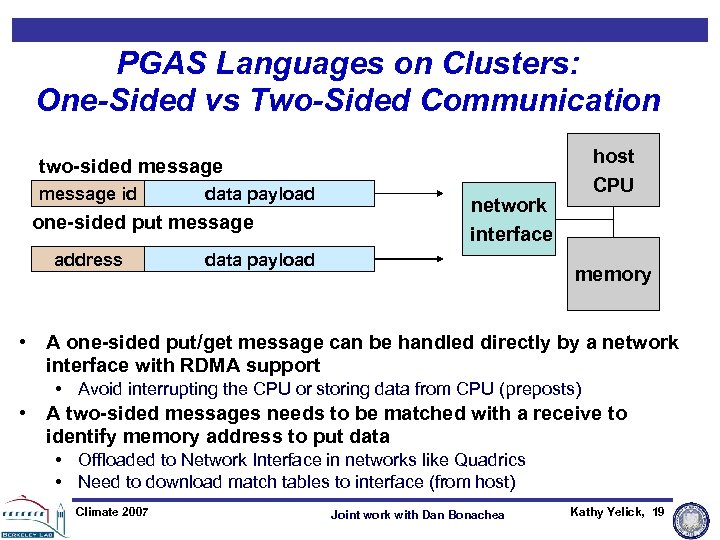 PGAS Languages on Clusters: One-Sided vs Two-Sided Communication host CPU two-sided message id data payload one-sided put message address network interface data payload memory • A one-sided put/get message can be handled directly by a network interface with RDMA support • Avoid interrupting the CPU or storing data from CPU (preposts) • A two-sided messages needs to be matched with a receive to identify memory address to put data • Offloaded to Network Interface in networks like Quadrics • Need to download match tables to interface (from host) Climate 2007 Joint work with Dan Bonachea Kathy Yelick, 19
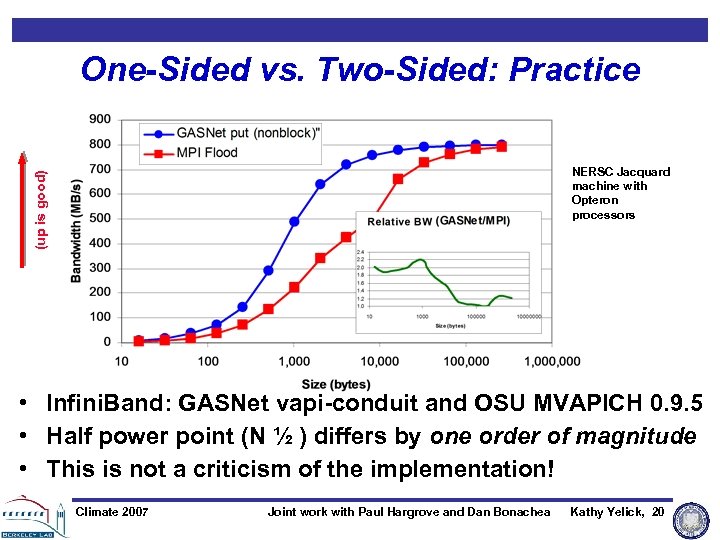 One-Sided vs. Two-Sided: Practice (up is good) NERSC Jacquard machine with Opteron processors • Infini. Band: GASNet vapi-conduit and OSU MVAPICH 0. 9. 5 • Half power point (N ½ ) differs by one order of magnitude • This is not a criticism of the implementation! Climate 2007 Joint work with Paul Hargrove and Dan Bonachea Kathy Yelick, 20
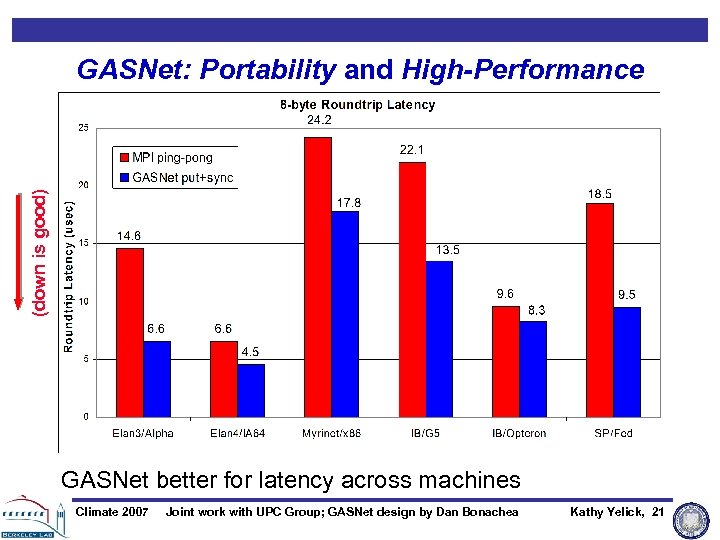 (down is good) GASNet: Portability and High-Performance GASNet better for latency across machines Climate 2007 Joint work with UPC Group; GASNet design by Dan Bonachea Kathy Yelick, 21
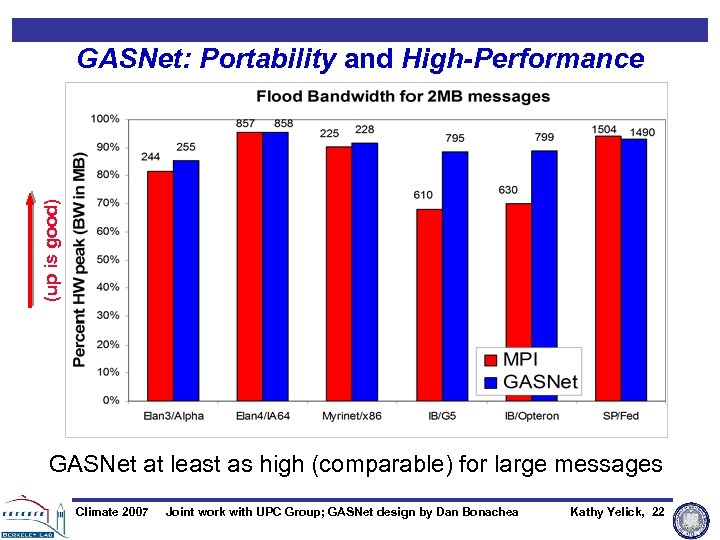 (up is good) GASNet: Portability and High-Performance GASNet at least as high (comparable) for large messages Climate 2007 Joint work with UPC Group; GASNet design by Dan Bonachea Kathy Yelick, 22
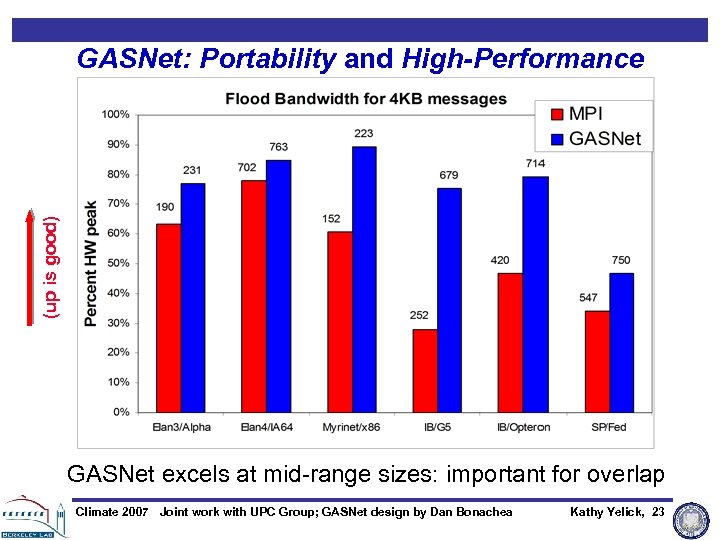 (up is good) GASNet: Portability and High-Performance GASNet excels at mid-range sizes: important for overlap Climate 2007 Joint work with UPC Group; GASNet design by Dan Bonachea Kathy Yelick, 23
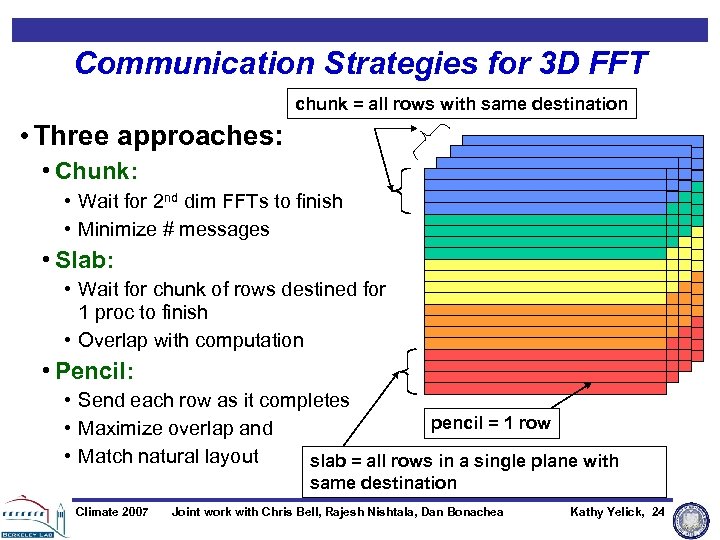 Communication Strategies for 3 D FFT chunk = all rows with same destination • Three approaches: • Chunk: • Wait for 2 nd dim FFTs to finish • Minimize # messages • Slab: • Wait for chunk of rows destined for 1 proc to finish • Overlap with computation • Pencil: • Send each row as it completes pencil = 1 row • Maximize overlap and • Match natural layout slab = all rows in a single plane with same destination Climate 2007 Joint work with Chris Bell, Rajesh Nishtala, Dan Bonachea Kathy Yelick, 24
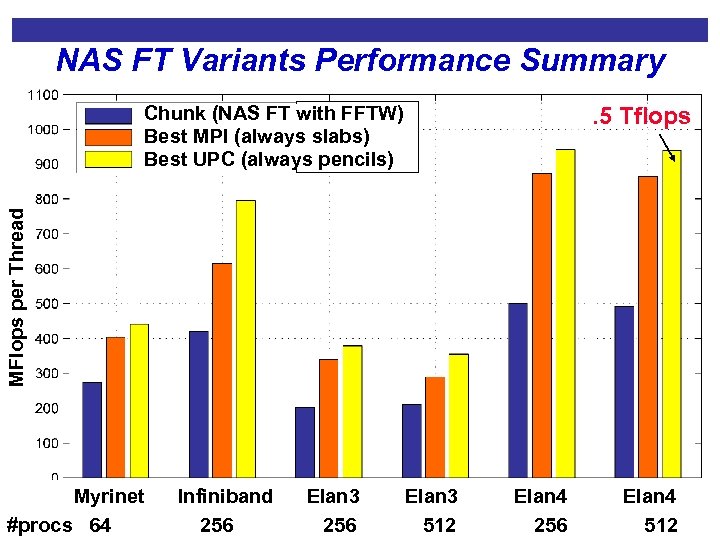 NAS FT Variants Performance Summary Chunk (NAS FT with FFTW) Best MPI (always slabs) Best UPC (always pencils) MFlops per Thread . 5 Tflops • Slab is always best for MPI; small message cost too high • Pencil is always best for UPC; more overlap Myrinet Climate 2007 #procs 64 Infiniband 256 Elan 3 512 Elan 4 Kathy Yelick, 25 256 512
 Making PGAS Real: Applications and Portability 26 Kathy Yelick
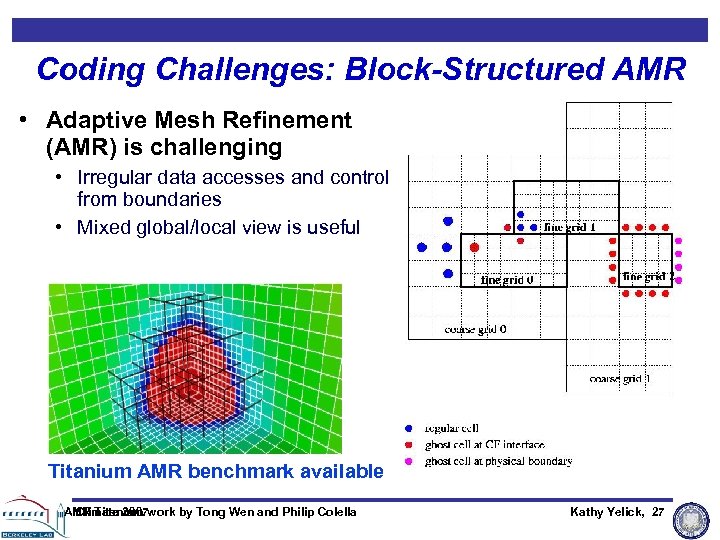 Coding Challenges: Block-Structured AMR • Adaptive Mesh Refinement (AMR) is challenging • Irregular data accesses and control from boundaries • Mixed global/local view is useful Titanium AMR benchmark available AMR Titanium work by Tong Wen and Philip Colella Climate 2007 Kathy Yelick, 27
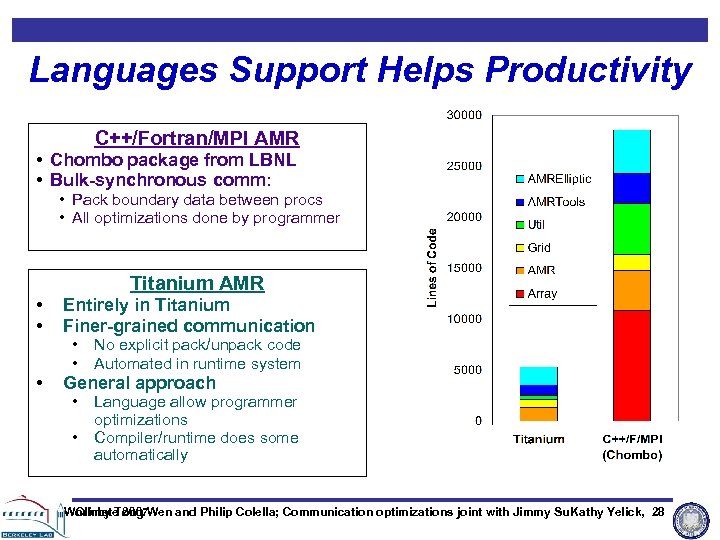 Languages Support Helps Productivity C++/Fortran/MPI AMR • Chombo package from LBNL • Bulk-synchronous comm: • Pack boundary data between procs • All optimizations done by programmer • • • Titanium AMR Entirely in Titanium Finer-grained communication • • No explicit pack/unpack code Automated in runtime system General approach • • Language allow programmer optimizations Compiler/runtime does some automatically Work by Tong Wen and Philip Colella; Communication optimizations joint with Jimmy Su Kathy Yelick, 28 Climate 2007
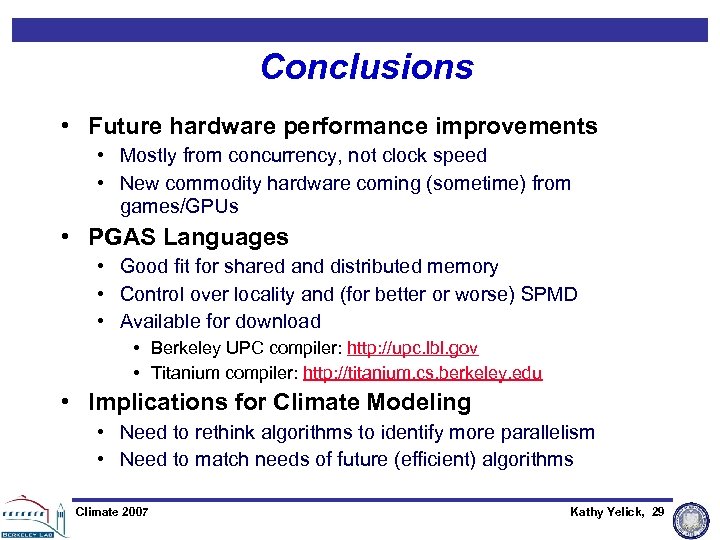 Conclusions • Future hardware performance improvements • Mostly from concurrency, not clock speed • New commodity hardware coming (sometime) from games/GPUs • PGAS Languages • Good fit for shared and distributed memory • Control over locality and (for better or worse) SPMD • Available for download • Berkeley UPC compiler: http: //upc. lbl. gov • Titanium compiler: http: //titanium. cs. berkeley. edu • Implications for Climate Modeling • Need to rethink algorithms to identify more parallelism • Need to match needs of future (efficient) algorithms Climate 2007 Kathy Yelick, 29
 Extra Slides 30 Kathy Yelick
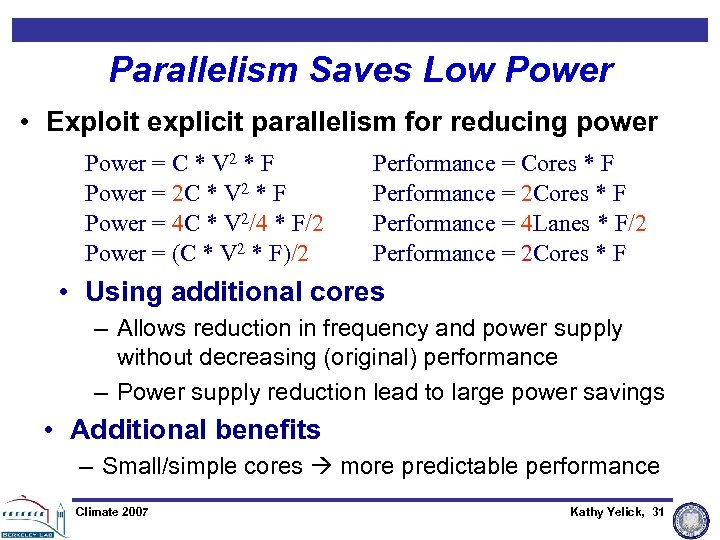 Parallelism Saves Low Power • Exploit explicit parallelism for reducing power Power = C * V 2 * F Power = 2 C * V 2 * F Power = 4 C * V 2/4 * F/2 Power = (C * V 2 * F)/2 Performance = Cores * F Performance = 2 Cores * F Performance = 4 Lanes * F/2 Performance = 2 Cores * F • Using additional cores – Allows reduction in frequency and power supply without decreasing (original) performance – Power supply reduction lead to large power savings • Additional benefits – Small/simple cores more predictable performance Climate 2007 Kathy Yelick, 31
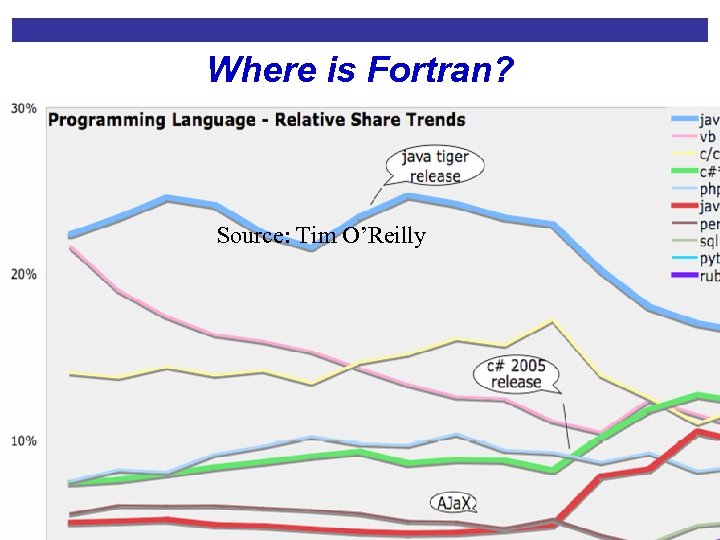 Where is Fortran? Source: Tim O’Reilly Climate 2007 Kathy Yelick, 32