 Скачать презентацию Architectural Standards Infosys Mysore December 16 Copyright
5ee72e06a3edd2d747d82fec0e18a145.ppt
- Количество слайдов: 80



Architectural Standards Infosys, Mysore December 16 Copyright © Richard N. Taylor, Nenad Medvidovic, and Eric M. Dashofy. All rights reserved.
Software Architecture Foundations, Theory, and Practice Objectives l l Concepts u What are standards? u Why use standards? l And why not? (drawbacks) u Deciding when to adopt a standard Prevalent Architectural Standards u Conceptual standards u Notational standards u Standard tools u Process standards 2
Software Architecture Foundations, Theory, and Practice Objectives l l Concepts u What are standards? u Why use standards? l And why not? (drawbacks) u Deciding when to adopt a standard Prevalent Architectural Standards u Conceptual standards u Notational standards u Standard tools u Process standards 3
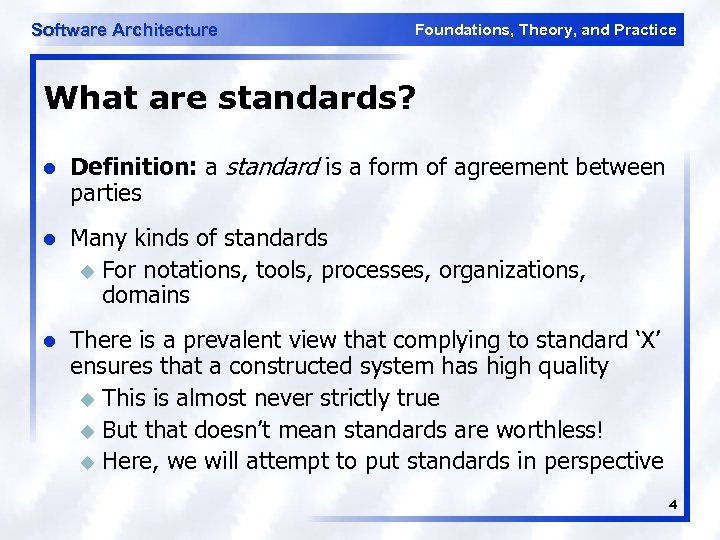
Software Architecture Foundations, Theory, and Practice What are standards? l Definition: a standard is a form of agreement between parties l Many kinds of standards u For notations, tools, processes, organizations, domains l There is a prevalent view that complying to standard ‘X’ ensures that a constructed system has high quality u This is almost never strictly true u But that doesn’t mean standards are worthless! u Here, we will attempt to put standards in perspective 4
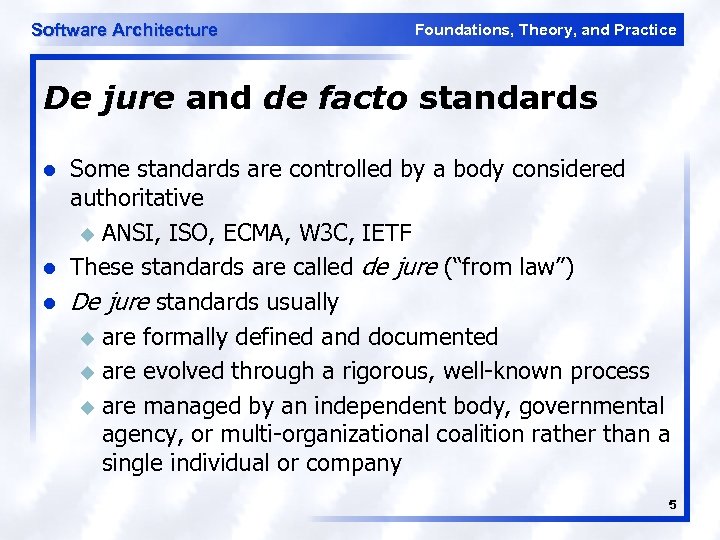
Software Architecture Foundations, Theory, and Practice De jure and de facto standards l l l Some standards are controlled by a body considered authoritative u ANSI, ISO, ECMA, W 3 C, IETF These standards are called de jure (“from law”) De jure standards usually u are formally defined and documented u are evolved through a rigorous, well-known process u are managed by an independent body, governmental agency, or multi-organizational coalition rather than a single individual or company 5
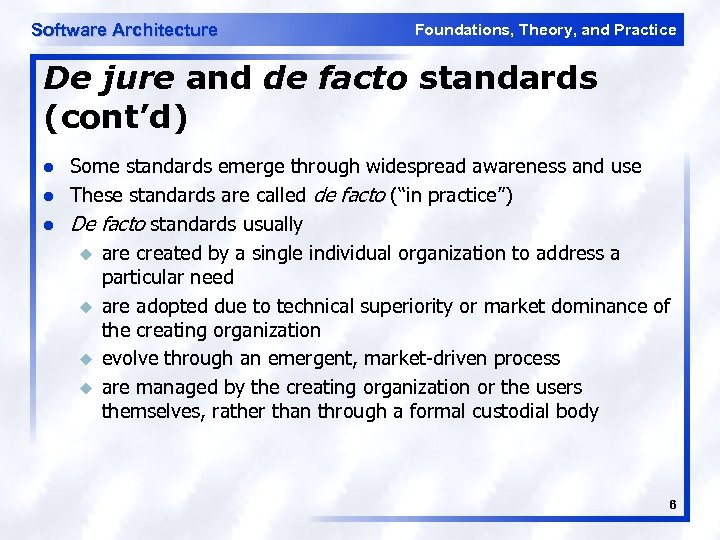
Software Architecture Foundations, Theory, and Practice De jure and de facto standards (cont’d) l l l Some standards emerge through widespread awareness and use These standards are called de facto (“in practice”) De facto standards usually u are created by a single individual organization to address a particular need u are adopted due to technical superiority or market dominance of the creating organization u evolve through an emergent, market-driven process u are managed by the creating organization or the users themselves, rather than through a formal custodial body 6
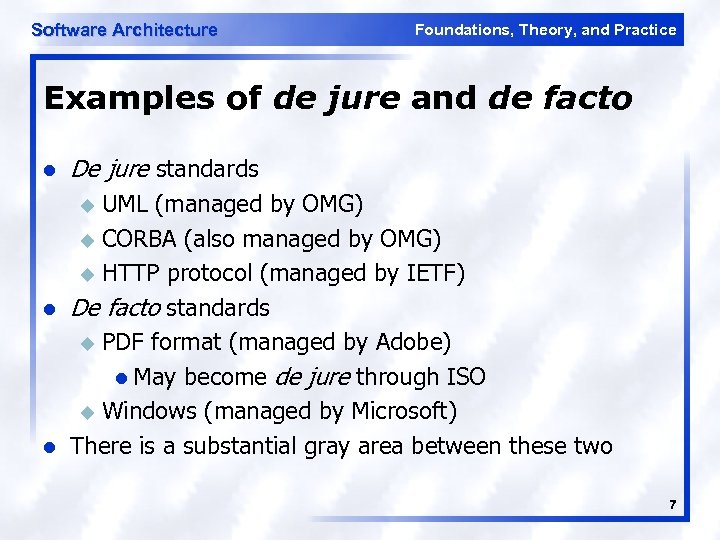
Software Architecture Foundations, Theory, and Practice Examples of de jure and de facto l De jure standards UML (managed by OMG) u CORBA (also managed by OMG) u HTTP protocol (managed by IETF) De facto standards u PDF format (managed by Adobe) l May become de jure through ISO u Windows (managed by Microsoft) There is a substantial gray area between these two u l l 7
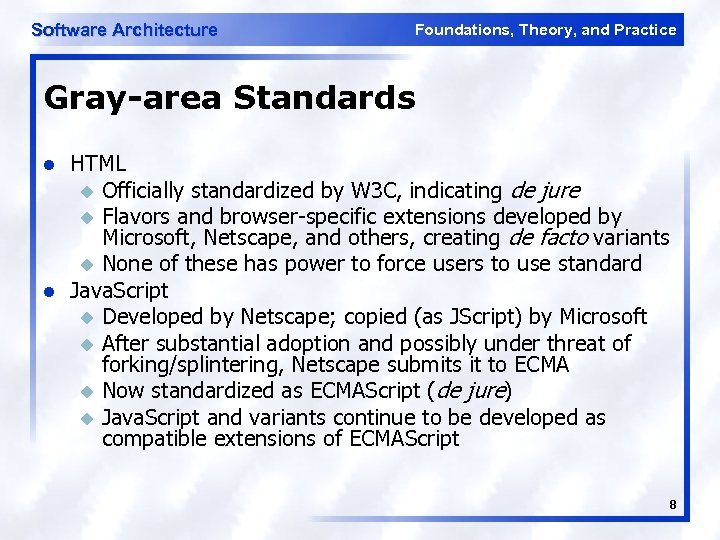
Software Architecture Foundations, Theory, and Practice Gray-area Standards l l HTML u Officially standardized by W 3 C, indicating de jure u Flavors and browser-specific extensions developed by Microsoft, Netscape, and others, creating de facto variants u None of these has power to force users to use standard Java. Script u Developed by Netscape; copied (as JScript) by Microsoft u After substantial adoption and possibly under threat of forking/splintering, Netscape submits it to ECMA u Now standardized as ECMAScript (de jure) u Java. Script and variants continue to be developed as compatible extensions of ECMAScript 8
Software Architecture Foundations, Theory, and Practice Another spectrum l Standards (whether de jure or de facto) can be: u Open l Allow public participation in the standardization process l Anyone can submit ideas or changes for review u Closed (a. k. a. proprietary) l Only the custodians of a standard can participate in its evolution 9
Software Architecture Foundations, Theory, and Practice Open vs. closed standards l Another spectrum with a gray area u Some standards bodies have high barriers to entry (e. g. , steep membership fees, vote of existing membership) u Some standards (e. g. , Java) have aspects of both l Sun Microsystems is effectively in control of Java as a de facto standard l There is an open “community process” by which external parties can participate in a limited way 10
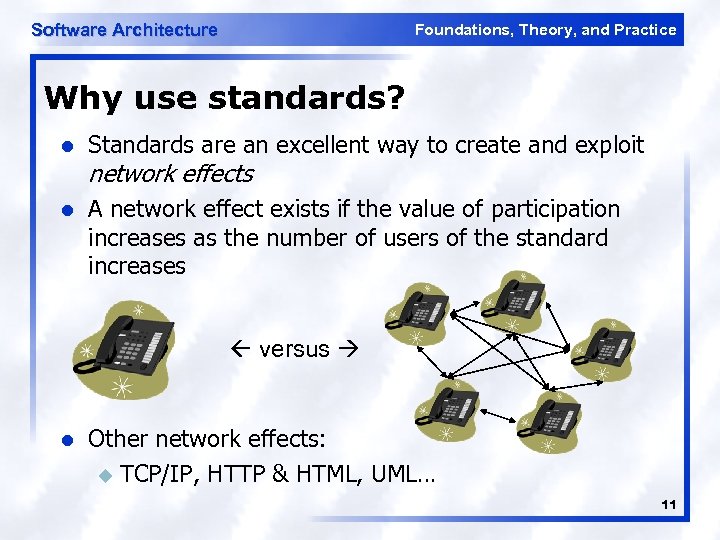
Software Architecture Foundations, Theory, and Practice Why use standards? l Standards are an excellent way to create and exploit l A network effect exists if the value of participation increases as the number of users of the standard increases network effects versus l Other network effects: u TCP/IP, HTTP & HTML, UML… 11
Software Architecture Foundations, Theory, and Practice Why use standards? (cont’d) l l To ensure interoperability between products developed by different organizations u Usually in the interest of fostering a network effect To carry hard-won engineering knowledge from one project to another u To take advantage of hard-won engineering knowledge created by others As an effort to attract tool vendors u To create economies of scale in tools To attempt to control the standard’s evolution in your favor 12
Software Architecture Foundations, Theory, and Practice Drawbacks of standards l l l Limits your agility u Remember that doing ‘good’ architecture-based development means identifying what is important in your project Standards often attempt to apply the same techniques to a too-broad variety of situations The most widely adopted standards are often the most general 13
Software Architecture Foundations, Theory, and Practice Overspecification vs. underspecification l l l A perennial tension in standards use and development Overspecification u A standard prescribes too much and therefore limits applicability too much Underspecification u A standard prescribes too little and therefore doesn’t provide enough guidance l Possibly in an effort to broaden adoption 14
Software Architecture Foundations, Theory, and Practice Two different kinds of underspecification l l l Two compromises often made in negotiation when disagreements occur u Leave the disagreeable part of the standard unspecified or purposefully ambiguous u Include both opinions in the standard but make them both optional Both of these weaken the standard’s value u Consider the different kinds of reduction in interoperability imposed by these strategies Although they may improve adoption! 15
Software Architecture Foundations, Theory, and Practice When to adopt a standard? l Early adoption u Benefits l Improved ability to influence the standard u Get l Early your own goals incorporated; exclude competitors to market u If standard becomes successful, early marketers will profit l Early experience u Leverage enhanced experience to your benefit 16
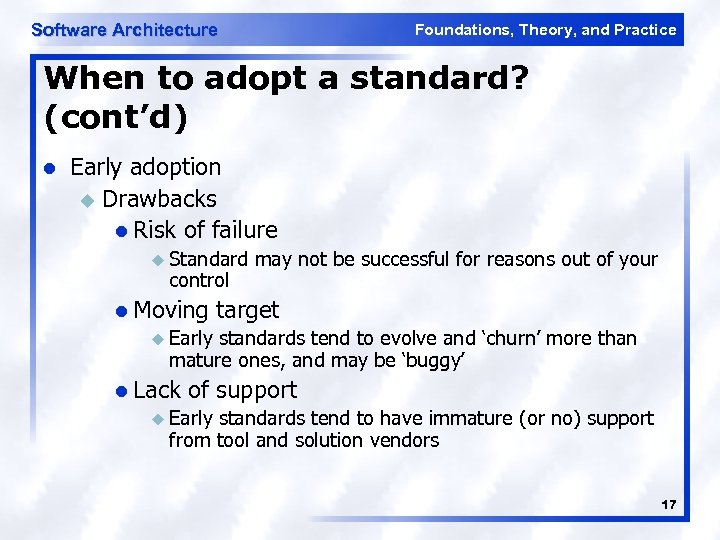
Software Architecture Foundations, Theory, and Practice When to adopt a standard? (cont’d) l Early adoption u Drawbacks l Risk of failure u Standard control l Moving may not be successful for reasons out of your target u Early standards tend to evolve and ‘churn’ more than mature ones, and may be ‘buggy’ l Lack of support u Early standards tend to have immature (or no) support from tool and solution vendors 17
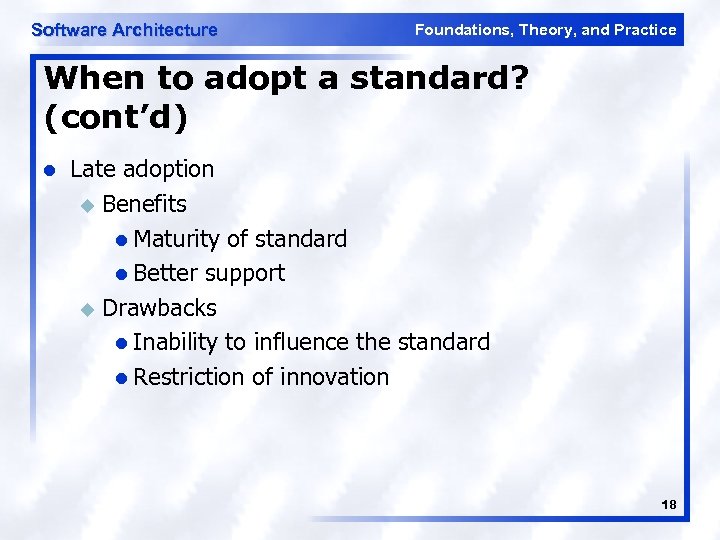
Software Architecture Foundations, Theory, and Practice When to adopt a standard? (cont’d) l Late adoption u Benefits l Maturity of standard l Better support u Drawbacks l Inability to influence the standard l Restriction of innovation 18
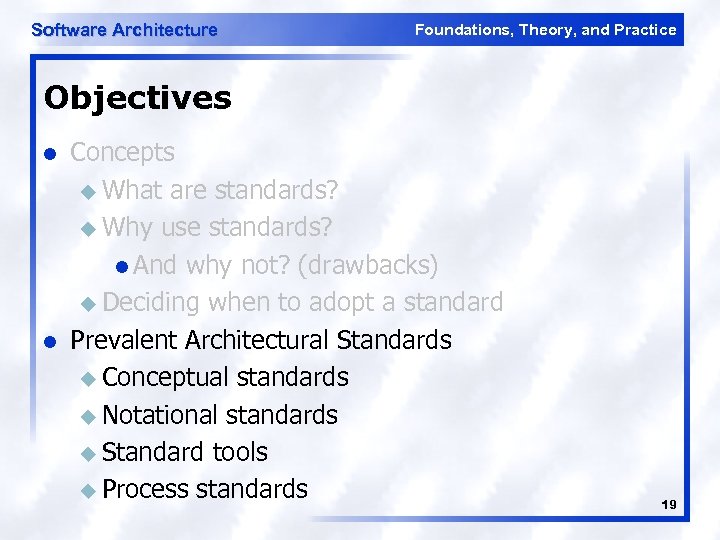
Software Architecture Foundations, Theory, and Practice Objectives l l Concepts u What are standards? u Why use standards? l And why not? (drawbacks) u Deciding when to adopt a standard Prevalent Architectural Standards u Conceptual standards u Notational standards u Standard tools u Process standards 19
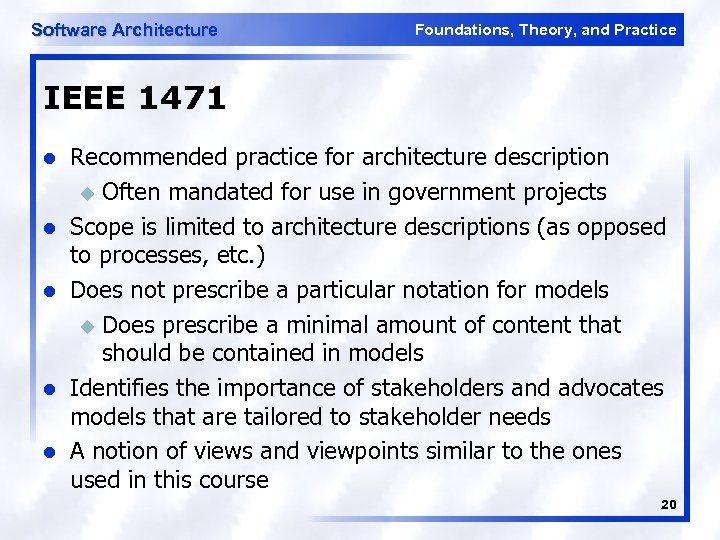
Software Architecture Foundations, Theory, and Practice IEEE 1471 l l l Recommended practice for architecture description u Often mandated for use in government projects Scope is limited to architecture descriptions (as opposed to processes, etc. ) Does not prescribe a particular notation for models u Does prescribe a minimal amount of content that should be contained in models Identifies the importance of stakeholders and advocates models that are tailored to stakeholder needs A notion of views and viewpoints similar to the ones used in this course 20
Software Architecture Foundations, Theory, and Practice IEEE 1471 (cont’d) l l l Very high level u Purposefully light on specification u Does not advocate any specific notation or process Useful as a starting point for thinking about architecture u Defines key terms u Advocates focus on stakeholders Being compliant does NOT ensure that you are doing good architecture-centric development 21
Software Architecture Foundations, Theory, and Practice Department of Defense Architecture Framework l l Do. DAF, evolved from C 4 ISR u Has some other international analogs (Mo. DAF) u ‘Framework’ here refers to a process or set of viewpoints that should be used in capturing an architecture l Not necessarily an architecture implementation framework Identifies specific viewpoints that should be captured u Includes what kinds of information should be captured u Does not prescribe a particular notation for doing the 22 capture
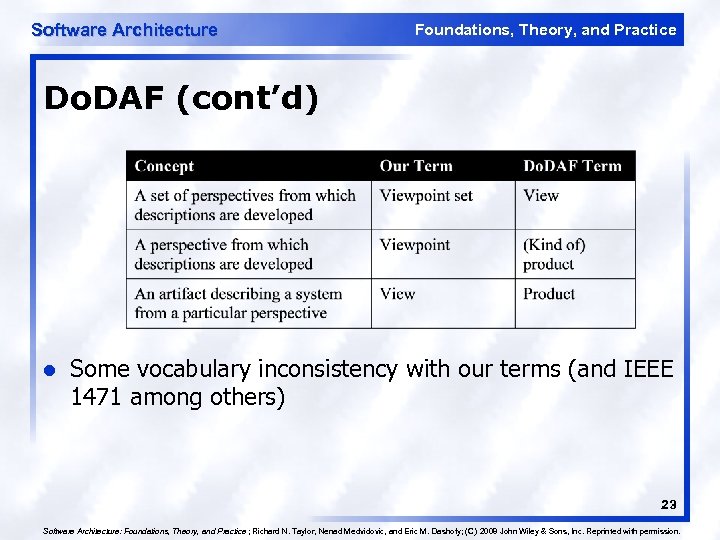
Software Architecture Foundations, Theory, and Practice Do. DAF (cont’d) l Some vocabulary inconsistency with our terms (and IEEE 1471 among others) 23 Software Architecture: Foundations, Theory, and Practice ; Richard N. Taylor, Nenad Medvidovic, and Eric M. Dashofy; (C) 2008 John Wiley & Sons, Inc. Reprinted with permission.
Software Architecture Foundations, Theory, and Practice Do. DAF (cont’d) l Three views (in our terms: viewpoint sets) u Operational View (OV) l “Identifies what needs to be accomplished and who does it” l Defines processes and activities, the operational elements that participate in those activities, and the information exchanges between the elements u Systems View (SV) l Describe the systems that provide or support operational functions and the interconnections between them l Systems in SV associated with elements in OV 24
Software Architecture Foundations, Theory, and Practice Do. DAF (cont’d) l l Three views (in our terms: viewpoint sets) – continued u Technical Standards View (TV) l Identify standards, (engineering) guidelines, rules, conventions, and other documents l To ensure that implemented systems meet their requirements and are consistent with respect to the fact that they are implemented according to a common set of rules Also a few products address cross cutting concerns that affect All Views (AV) u E. g. , dictionary of terms 25
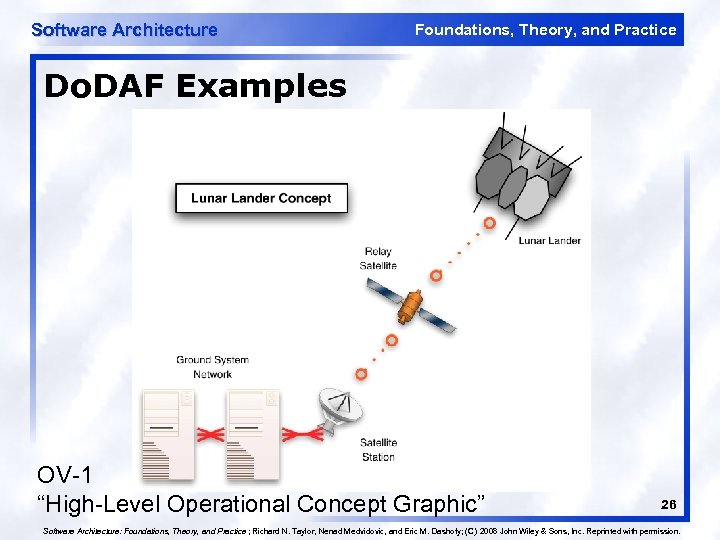
Software Architecture Foundations, Theory, and Practice Do. DAF Examples OV-1 “High-Level Operational Concept Graphic” 26 Software Architecture: Foundations, Theory, and Practice ; Richard N. Taylor, Nenad Medvidovic, and Eric M. Dashofy; (C) 2008 John Wiley & Sons, Inc. Reprinted with permission.
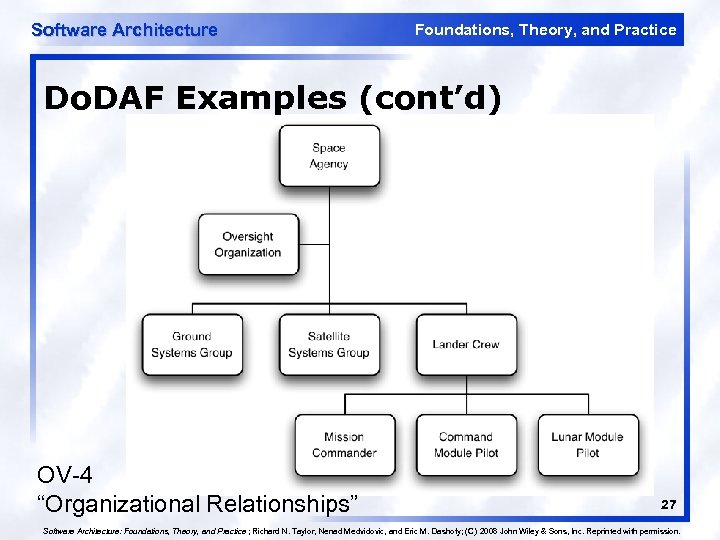
Software Architecture Foundations, Theory, and Practice Do. DAF Examples (cont’d) OV-4 “Organizational Relationships” 27 Software Architecture: Foundations, Theory, and Practice ; Richard N. Taylor, Nenad Medvidovic, and Eric M. Dashofy; (C) 2008 John Wiley & Sons, Inc. Reprinted with permission.
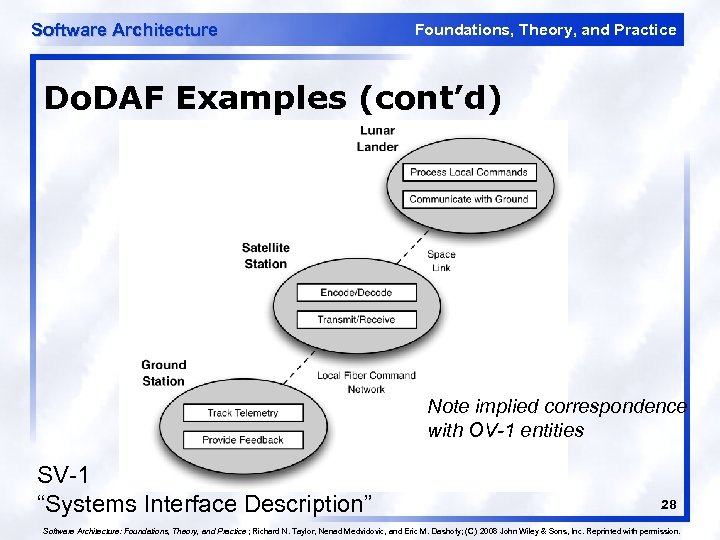
Software Architecture Foundations, Theory, and Practice Do. DAF Examples (cont’d) Note implied correspondence with OV-1 entities SV-1 “Systems Interface Description” 28 Software Architecture: Foundations, Theory, and Practice ; Richard N. Taylor, Nenad Medvidovic, and Eric M. Dashofy; (C) 2008 John Wiley & Sons, Inc. Reprinted with permission.
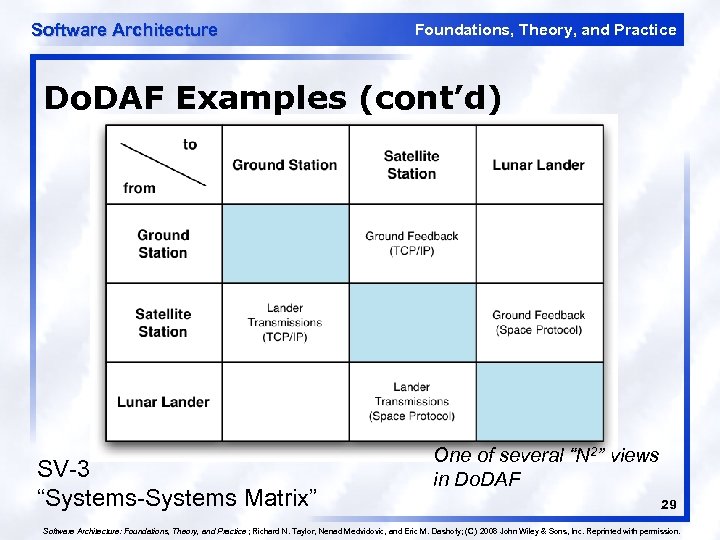
Software Architecture Foundations, Theory, and Practice Do. DAF Examples (cont’d) SV-3 “Systems-Systems Matrix” One of several “N 2” views in Do. DAF 29 Software Architecture: Foundations, Theory, and Practice ; Richard N. Taylor, Nenad Medvidovic, and Eric M. Dashofy; (C) 2008 John Wiley & Sons, Inc. Reprinted with permission.
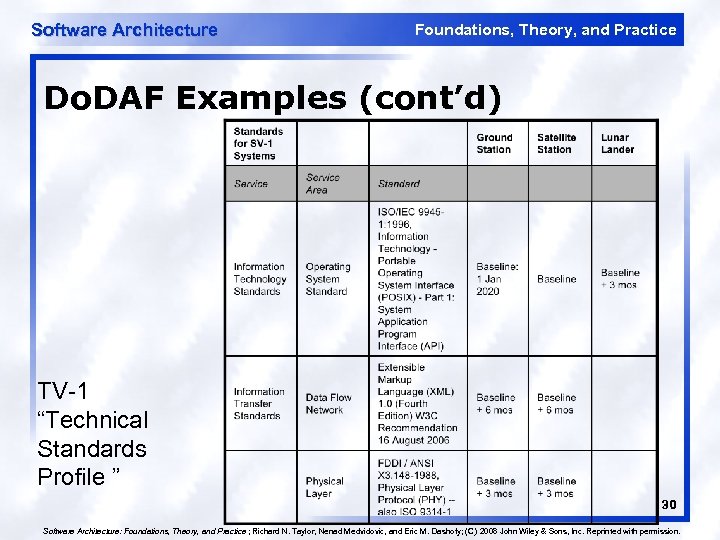
Software Architecture Foundations, Theory, and Practice Do. DAF Examples (cont’d) TV-1 “Technical Standards Profile ” 30 Software Architecture: Foundations, Theory, and Practice ; Richard N. Taylor, Nenad Medvidovic, and Eric M. Dashofy; (C) 2008 John Wiley & Sons, Inc. Reprinted with permission.
Software Architecture Foundations, Theory, and Practice Do. DAF Takeaways l l Extremely comprehensive standard advocating capture of many views u Takes a high-level organizational perspective u OV views tend to deal with human and systems organizations u SV views tend to deal with technical aspects of systems (most like the architectural descriptions we have been talking about) u TV views tend to deal with practical issues of reuse and leveraging existing technology Tells us a lot about WHAT to model, but nearly nothing about HOW to model it 31
Software Architecture Foundations, Theory, and Practice The Open Group Architecture Framework l l TOGAF – an “enterprise architecture” framework u Focuses beyond hardware/software u How can enterprises build systems to achieve business goals? Four key areas addressed u Business concerns, which address business strategies, organizations, and processes; u Application concerns, which address applications to be deployed, their interactions, and their relationships to business processes; u Data concerns, which address the structure of physical and logical data assets of an organization and the resources that manage these assets; and u Technology concerns, which address issues of infrastructure and middleware. 32
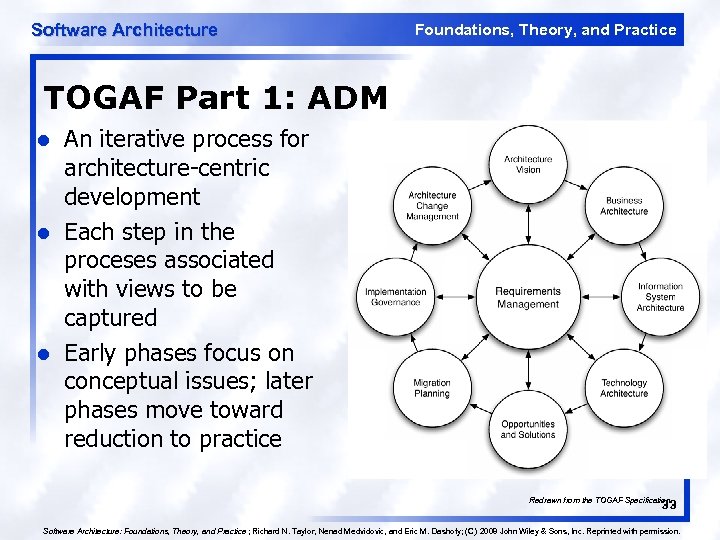
Software Architecture Foundations, Theory, and Practice TOGAF Part 1: ADM l l l An iterative process for architecture-centric development Each step in the proceses associated with views to be captured Early phases focus on conceptual issues; later phases move toward reduction to practice 33 Redrawn from the TOGAF Specification Software Architecture: Foundations, Theory, and Practice ; Richard N. Taylor, Nenad Medvidovic, and Eric M. Dashofy; (C) 2008 John Wiley & Sons, Inc. Reprinted with permission.
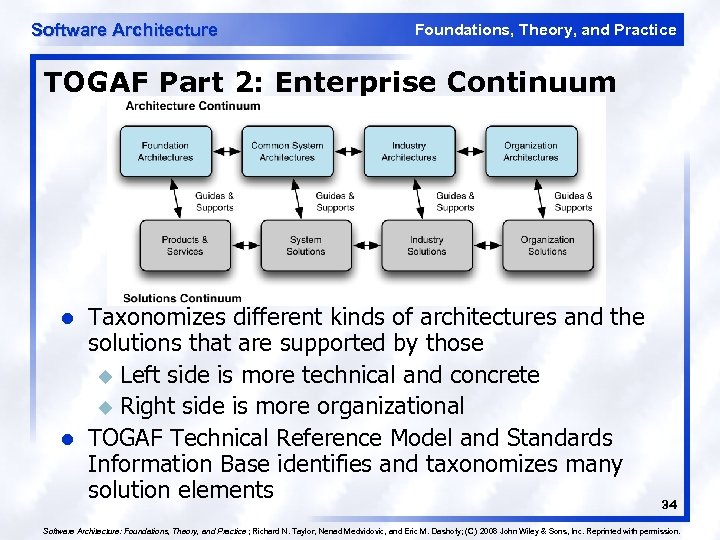
Software Architecture Foundations, Theory, and Practice TOGAF Part 2: Enterprise Continuum l l Taxonomizes different kinds of architectures and the solutions that are supported by those u Left side is more technical and concrete u Right side is more organizational TOGAF Technical Reference Model and Standards Information Base identifies and taxonomizes many solution elements 34 Software Architecture: Foundations, Theory, and Practice ; Richard N. Taylor, Nenad Medvidovic, and Eric M. Dashofy; (C) 2008 John Wiley & Sons, Inc. Reprinted with permission.
Software Architecture Foundations, Theory, and Practice TOGAF Part 3: TOGAF Resource Base l l A collection of useful information and resources that can be employed in following the ADM process Includes u advice on how to set up boards and contracts for managing architecture u checklists for various phases of the ADM process u a catalog of different models that exist for evaluating architectures u how to identify and prioritize different skills needed to develop architectures u. . 35
Software Architecture Foundations, Theory, and Practice TOGAF Takeaways l l l Large size and broad scope looks at systems development from an enterprise perspective More suited to developing entire organizational information systems rather than indivdiual applications A collection and clearinghouse for IT “best practices” of all sorts 36
Software Architecture Foundations, Theory, and Practice RM-ODP l l Another standard for viewpoints, similar to Do. DAF but more limited in scope; resemble Do. DAF SV Prescribes 5 viewpoints for distributed systems u Enterprise – system, environment, context u Information – information processing u Computational – architectural structure and component distribution u Engineering – distribution infrastructure u Technology – technology choices available 37 Software Architecture: Foundations, Theory, and Practice ; Richard N. Taylor, Nenad Medvidovic, and Eric M. Dashofy; (C) 2008 John Wiley & Sons, Inc. Reprinted with permission.
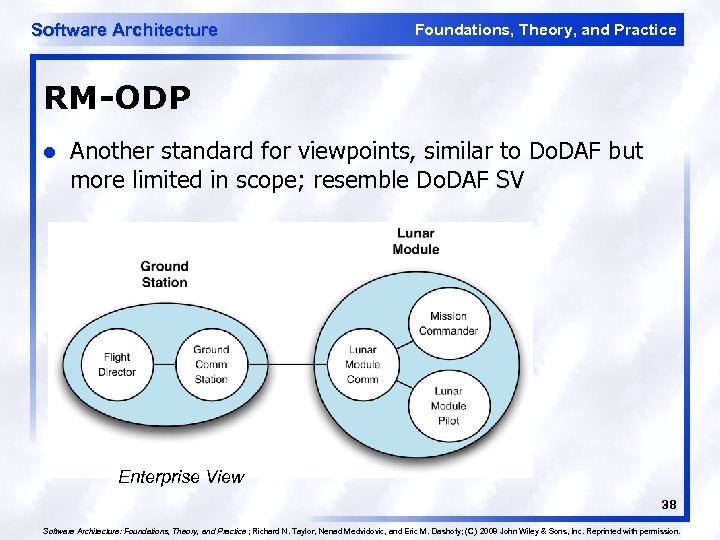
Software Architecture Foundations, Theory, and Practice RM-ODP l Another standard for viewpoints, similar to Do. DAF but more limited in scope; resemble Do. DAF SV Enterprise View 38 Software Architecture: Foundations, Theory, and Practice ; Richard N. Taylor, Nenad Medvidovic, and Eric M. Dashofy; (C) 2008 John Wiley & Sons, Inc. Reprinted with permission.
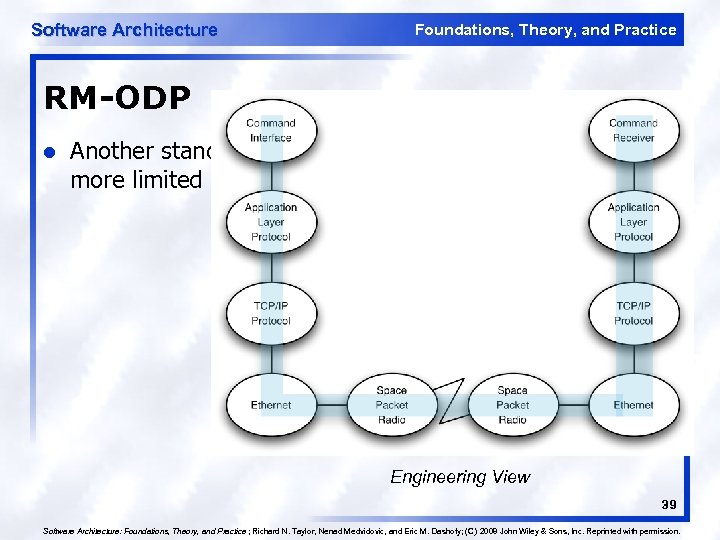
Software Architecture Foundations, Theory, and Practice RM-ODP l Another standard for viewpoints, similar to Do. DAF but more limited in scope; resemble Do. DAF SV Engineering View 39 Software Architecture: Foundations, Theory, and Practice ; Richard N. Taylor, Nenad Medvidovic, and Eric M. Dashofy; (C) 2008 John Wiley & Sons, Inc. Reprinted with permission.
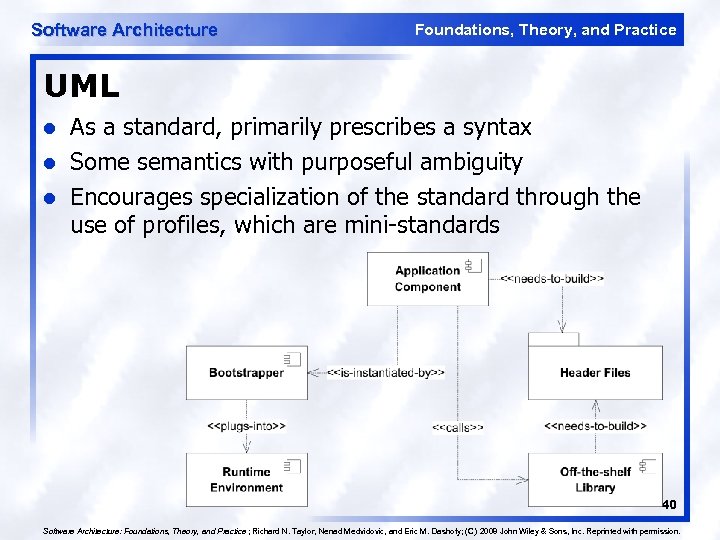
Software Architecture Foundations, Theory, and Practice UML l l l As a standard, primarily prescribes a syntax Some semantics with purposeful ambiguity Encourages specialization of the standard through the use of profiles, which are mini-standards 40 Software Architecture: Foundations, Theory, and Practice ; Richard N. Taylor, Nenad Medvidovic, and Eric M. Dashofy; (C) 2008 John Wiley & Sons, Inc. Reprinted with permission.
Software Architecture Foundations, Theory, and Practice UML Takeaways l l l Provide a common syntactic framework to express many common types of design decisions Profiles are needed to improve rigor u But profiles can only specialize existing UML diagram types, not create new ones Documenting a system in UML does not ensure overall system quality u You can document a bad architecture in UML as easily as a good one 41
Software Architecture Foundations, Theory, and Practice Sys. ML l l An extended version of UML Developed by a large consortium of organizations (mainly large system integrators and developers) Intended to mitigate UML’s “software bias” Sys. ML group found UML standard insufficient and profiles not enough to resolve this u Developed new diagram types to capture systemengineering specific views u Limited momentum among tool vendors; focus shifting to more heavily use UML profiles 42
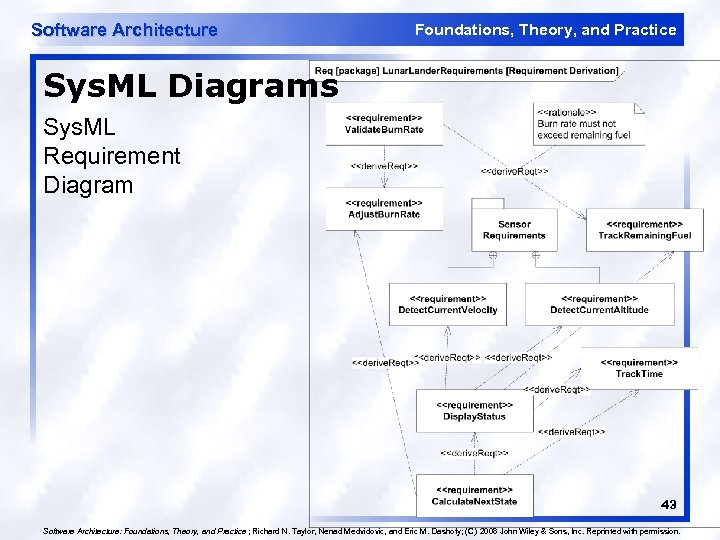
Software Architecture Foundations, Theory, and Practice Sys. ML Diagrams Sys. ML Requirement Diagram 43 Software Architecture: Foundations, Theory, and Practice ; Richard N. Taylor, Nenad Medvidovic, and Eric M. Dashofy; (C) 2008 John Wiley & Sons, Inc. Reprinted with permission.
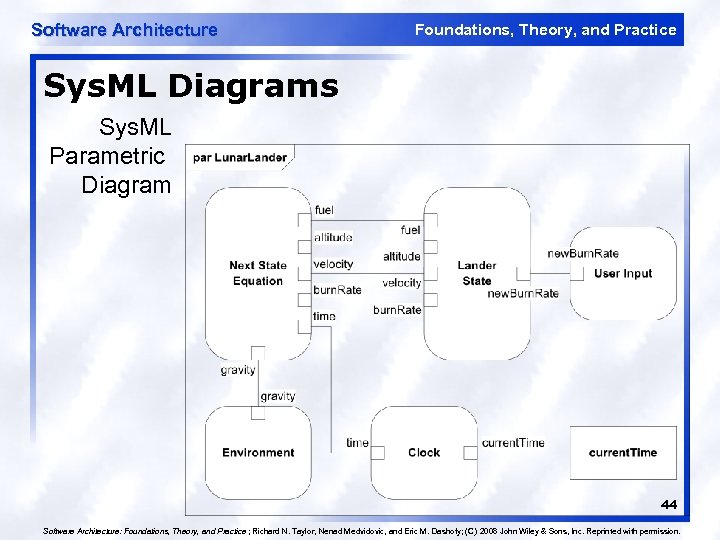
Software Architecture Foundations, Theory, and Practice Sys. ML Diagrams Sys. ML Parametric Diagram 44 Software Architecture: Foundations, Theory, and Practice ; Richard N. Taylor, Nenad Medvidovic, and Eric M. Dashofy; (C) 2008 John Wiley & Sons, Inc. Reprinted with permission.
Software Architecture Foundations, Theory, and Practice Standard UML Tools l l E. g. , Rational Rose, Argo. UML, Microsoft Visio These are de facto standards All support drawing UML diagrams Vary along several dimensions u Support for built-in UML extension mechanisms l Profiles, stereotypes, tagged values, constraints u Support for UML consistency checking u Ability to generate other artifacts u Generation of UML from other artifacts u Traceability to other systems u Support for capturing non-UML information 45
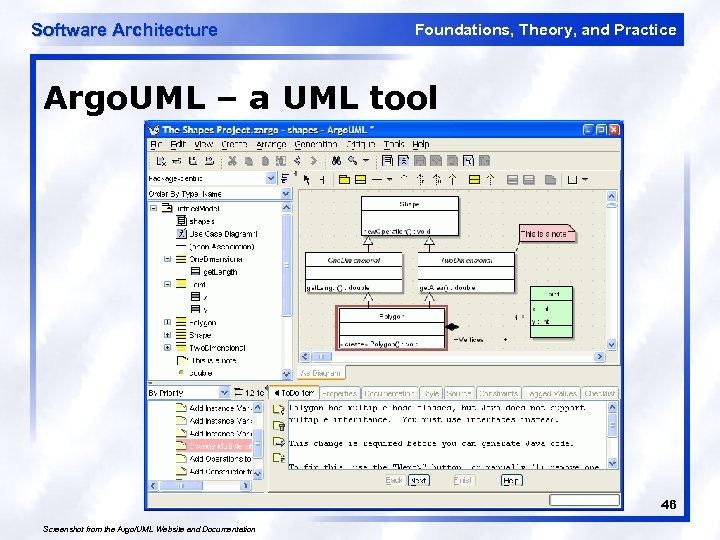
Software Architecture Foundations, Theory, and Practice Argo. UML – a UML tool 46 Screenshot from the Argo/UML Website and Documentation
Software Architecture Foundations, Theory, and Practice Telelogic System Architect l l Formerly Popkin System Architect; popular among architects u Supports 50+ different diagram types l UML, IDEF, OMT, generic flowcharting, even GUI design l Variants for Do. DAF, service-oriented architectures, enterprise resource planning Effectively generic diagram editor specialized for many different diagram types with different symbols, connections u Very little understanding of diagram semantics u Specialized variants have some understanding of semantics but generally less than notation-specific editors 47
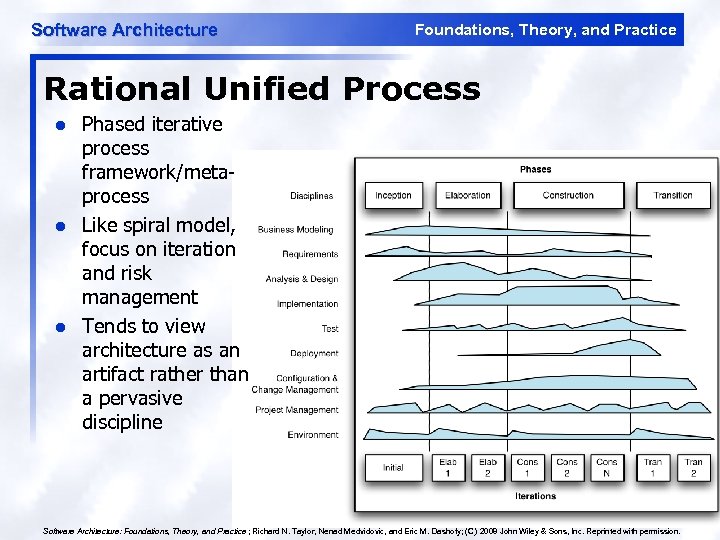
Software Architecture Foundations, Theory, and Practice Rational Unified Process l l l Phased iterative process framework/metaprocess Like spiral model, focus on iteration and risk management Tends to view architecture as an artifact rather than a pervasive discipline 48 Software Architecture: Foundations, Theory, and Practice ; Richard N. Taylor, Nenad Medvidovic, and Eric M. Dashofy; (C) 2008 John Wiley & Sons, Inc. Reprinted with permission.
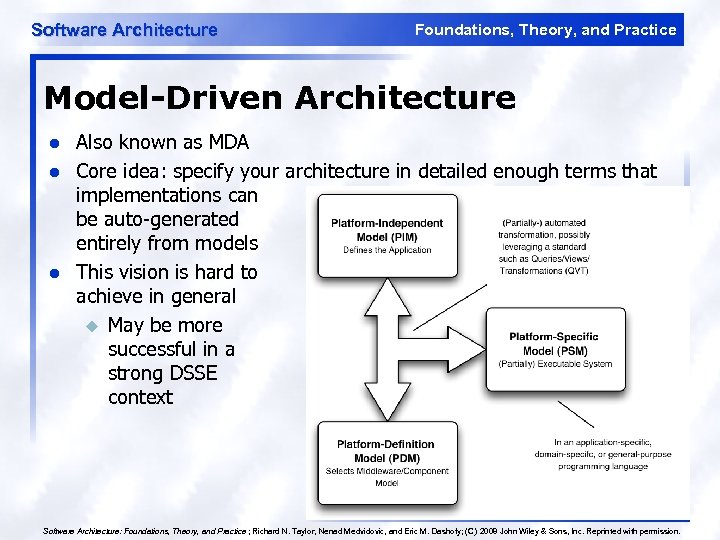
Software Architecture Foundations, Theory, and Practice Model-Driven Architecture l l l Also known as MDA Core idea: specify your architecture in detailed enough terms that implementations can be auto-generated entirely from models This vision is hard to achieve in general u May be more successful in a strong DSSE context 49 Redrawn from the MDA documentation Software Architecture: Foundations, Theory, and Practice ; Richard N. Taylor, Nenad Medvidovic, and Eric M. Dashofy; (C) 2008 John Wiley & Sons, Inc. Reprinted with permission.
Software Architecture Foundations, Theory, and Practice Overall Takeaways l l l Standards confer many benefits u Network effects, reusable engineering knowledge, interoperability, common vocabulary and understanding But are not a panacea! u Knowledge of a breadth of standards is needed to be a good architect, but it is critical to maintain perspective Caveats u This has been a very quick tour through complex standards; many standards are hundreds of pages and can’t adequately be explained in five minutes u Most available online – investigate yourself! 50
Software Architecture Foundations, Theory, and Practice Some More on UML l l l UML combines several visual specification techniques u use case diagrams, component diagrams, package diagrams, deployment diagrams, class diagrams, sequence diagrams, collaboration diagrams, state diagrams, activity diagrams + OCL Semi-formal u Precise syntax but no formal semantics u There are efforts in formalizing UML semantics OMG defines the UML standard u The current UML language specification is available at: http: //www. uml. org/
Software Architecture Foundations, Theory, and Practice UML Class Diagrams l Class diagram describes u Types of objects in the system u Static relationships among them l Two principal kinds of static relationships u Associations between classes u Subtype relationships between classes l Class descriptions show u Attributes u Operations
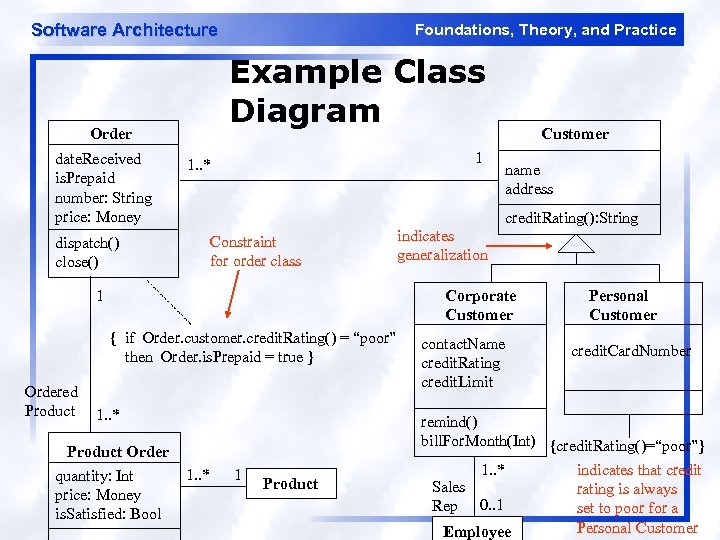
Software Architecture Example Class Diagram Order date. Received is. Prepaid number: String price: Money Foundations, Theory, and Practice 1 1. . * name address credit. Rating(): String Constraint for order class dispatch() close() 1 indicates generalization Corporate Customer { if Order. customer. credit. Rating() = “poor” then Order. is. Prepaid = true } Ordered Product Customer 1. . * Product Order quantity: Int price: Money is. Satisfied: Bool 1. . * 1 Product contact. Name credit. Rating credit. Limit Personal Customer credit. Card. Number remind() bill. For. Month(Int) {credit. Rating()=“poor”} 1. . * indicates that credit Sales rating is always Rep 0. . 1 set to poor for a Personal Customer Employee
Software Architecture Foundations, Theory, and Practice Sequence Diagrams l A sequence diagram shows a particular sequence of messages exchanged between a number of objects l Sequence diagrams also show behavior by showing the ordering of message exchange l A sequence diagram shows some particular communication sequences in some run of the system u it is not characterizing all possible runs
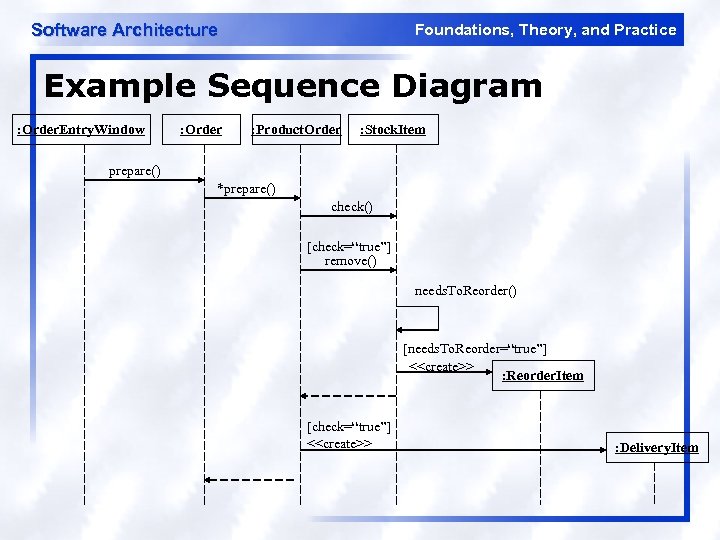
Software Architecture Foundations, Theory, and Practice Example Sequence Diagram : Order. Entry. Window : Order : Product. Order : Stock. Item prepare() *prepare() check() [check=“true”] remove() needs. To. Reorder() [needs. To. Reorder=“true”] <<create>> : Reorder. Item [check=“true”] <<create>> : Delivery. Item
Software Architecture Foundations, Theory, and Practice Collaboration Diagrams l l l Collaboration diagrams show a particular sequence of messages exchanged between a number of objects u this is what sequence diagrams do too! Use sequence diagrams to model flows of control by time ordering u sequence diagrams can be better for demonstrating the ordering of the messages u not suitable for complex iteration and branching Use collaboration diagrams to model flows of control by organization u collaboration diagrams are good at showing the static connections among the objects while also demonstrating a particular sequence of messages
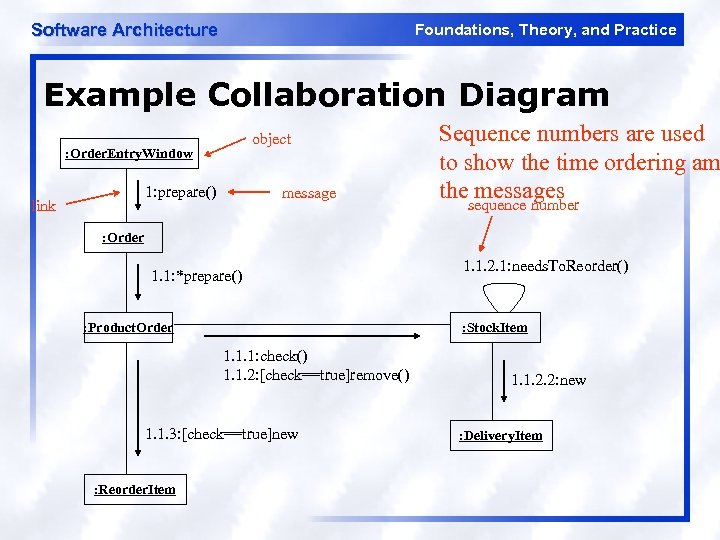
Software Architecture Foundations, Theory, and Practice Example Collaboration Diagram object : Order. Entry. Window 1: prepare() link message Sequence numbers are used to show the time ordering am thesequence number messages : Order 1. 1: *prepare() : Product. Order : Stock. Item 1. 1. 1: check() 1. 1. 2: [check==true]remove() 1. 1. 3: [check==true]new : Reorder. Item 1. 1. 2. 1: needs. To. Reorder() 1. 1. 2. 2: new : Delivery. Item
Software Architecture Foundations, Theory, and Practice State Diagrams l l l State diagrams are used to show possible states a single object can get into How object changes state in response to events u shows transitions between states Uses ideas from statecharts and adds some concepts such as internal transitions, deferred events etc. u “A Visual Formalism for Complex Systems, ” David Harel, Science of Computer Programming, 1987 u hierarchical state machines with formal semantics
Software Architecture Foundations, Theory, and Practice State Diagrams l Hierarchical grouping of states u composite states are formed by grouping other states u A composite state has a set of sub-states l Concurrent composite states can be used to express concurrency u When the system is in a concurrent composite state, it is in all of its substates at the same time u When the system is in a normal (non-concurrrent) composite state, it is in only one of its substates u If a state has no substates it is an atomic state
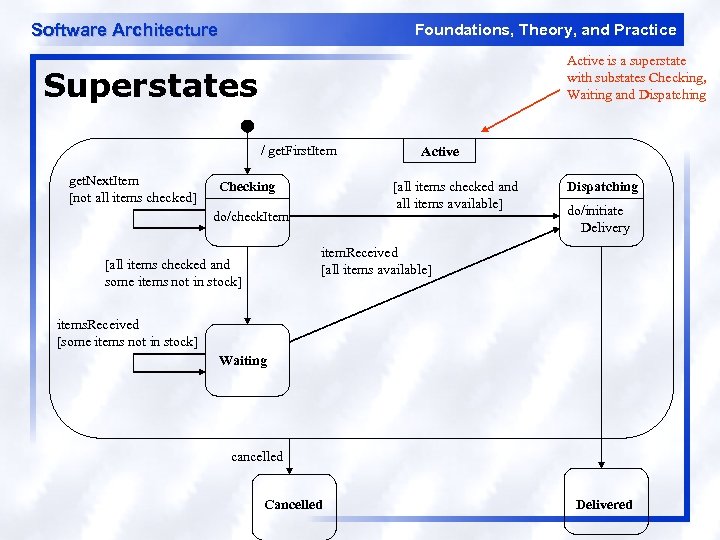
Software Architecture Foundations, Theory, and Practice Active is a superstate with substates Checking, Waiting and Dispatching Superstates / get. First. Item get. Next. Item [not all items checked] Checking Active [all items checked and all items available] do/check. Item Dispatching do/initiate Delivery item. Received [all items available] [all items checked and some items not in stock] items. Received [some items not in stock] Waiting cancelled Cancelled Delivered
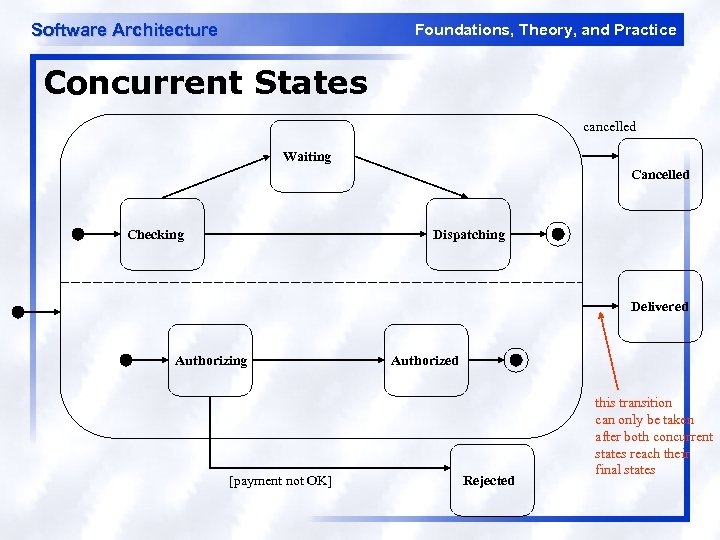
Software Architecture Foundations, Theory, and Practice Concurrent States cancelled Waiting Cancelled Checking Dispatching Delivered Authorizing [payment not OK] Authorized Rejected this transition can only be taken after both concurrent states reach their final states
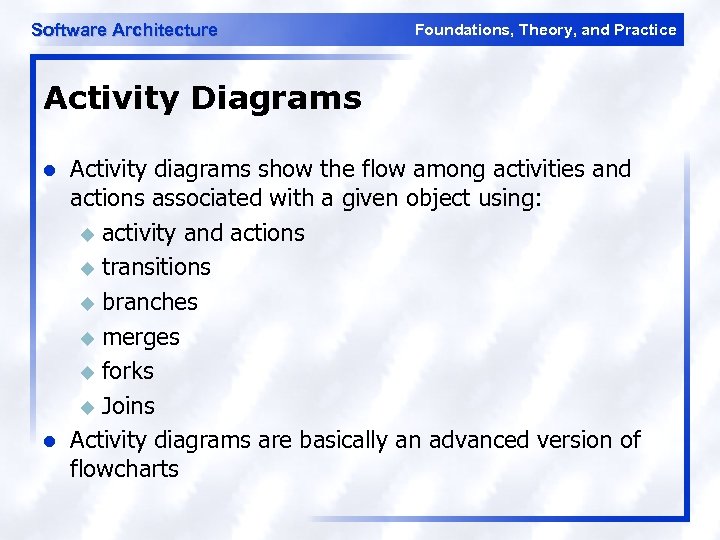
Software Architecture Foundations, Theory, and Practice Activity Diagrams l l Activity diagrams show the flow among activities and actions associated with a given object using: u activity and actions u transitions u branches u merges u forks u Joins Activity diagrams are basically an advanced version of flowcharts
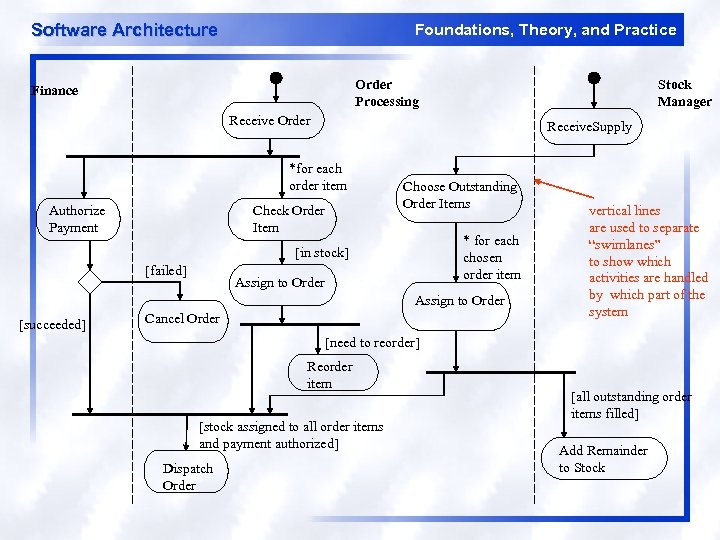
Software Architecture Foundations, Theory, and Practice Order Processing Finance Stock Manager Receive Order Receive. Supply *for each order item Authorize Payment Check Order Item Choose Outstanding Order Items * for each chosen order item [in stock] [failed] Assign to Order [succeeded] Cancel Order vertical lines are used to separate “swimlanes” to show which activities are handled by which part of the system [need to reorder] Reorder item [stock assigned to all order items and payment authorized] Dispatch Order [all outstanding order items filled] Add Remainder to Stock
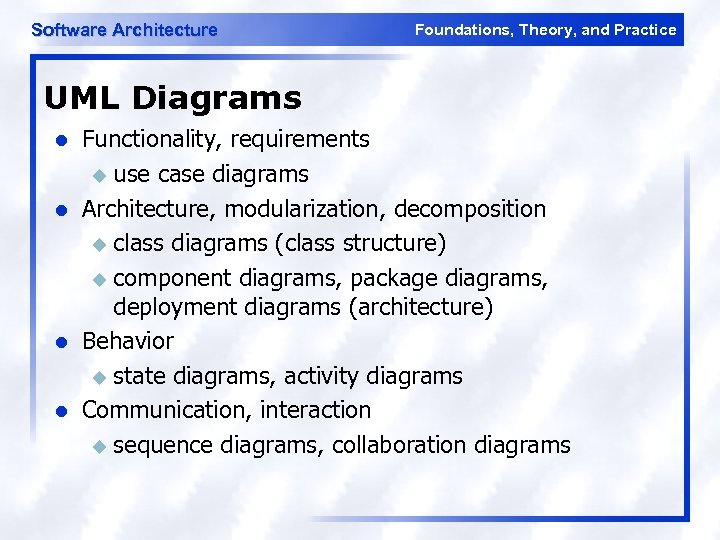
Software Architecture Foundations, Theory, and Practice UML Diagrams l l Functionality, requirements u use case diagrams Architecture, modularization, decomposition u class diagrams (class structure) u component diagrams, package diagrams, deployment diagrams (architecture) Behavior u state diagrams, activity diagrams Communication, interaction u sequence diagrams, collaboration diagrams
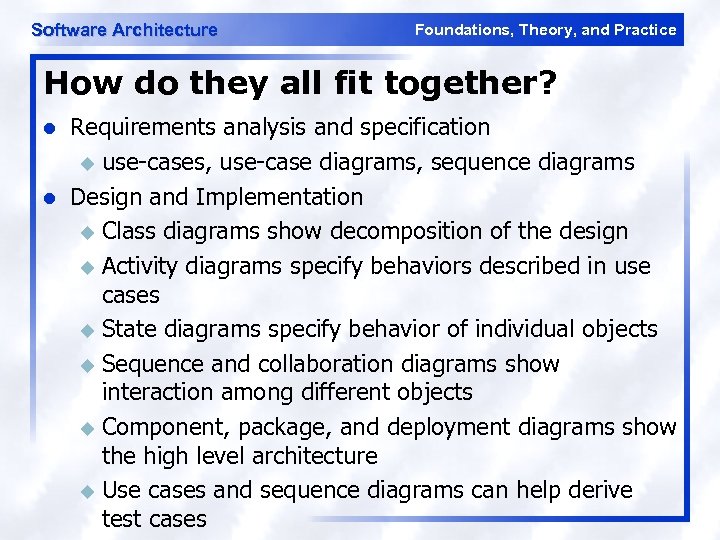
Software Architecture Foundations, Theory, and Practice How do they all fit together? l l Requirements analysis and specification u use-cases, use-case diagrams, sequence diagrams Design and Implementation u Class diagrams show decomposition of the design u Activity diagrams specify behaviors described in use cases u State diagrams specify behavior of individual objects u Sequence and collaboration diagrams show interaction among different objects u Component, package, and deployment diagrams show the high level architecture u Use cases and sequence diagrams can help derive test cases
Software Architecture Foundations, Theory, and Practice Object Constraint Language (OCL) is part of UML l OCL was developed at IBM by Jos Warmer as a language for business modeling within IBM l OCL specification is available here: http: //www. omg. org/technology/documents/formal/ocl. htm l More information: u “The Object Constraint Language: Precise Modeling with UML”, by Jos Warmer and Anneke Kleppe l
Software Architecture Foundations, Theory, and Practice Object Constraint Language (OCL) l OCL provides a way to develop more precise models using UML l What is a constraint in Object Constraint Language? u A constraint is a restriction on one or more values of (part of) an object-oriented model or system
Software Architecture Foundations, Theory, and Practice OCL Constraints l OCL constraints are declarative u They specify what must be true not what must be done l OCL constraints have no side effects u Evaluating an OCL expression does not change the state of the system l OCL constraints have formal syntax and semantics u their interpretation is unambiguous
Software Architecture Foundations, Theory, and Practice An Example l l l Loyalty programs are used by companies to offer their customers bonuses (e. g. , frequent flier miles) There may be more than one company participating in a loyalty program (“program partners”) A loyalty program customer gets a membership card Program partners provide services to customers in their loyalty programs A loyalty program account can be used to save the points accumulated by a customer. Each transaction on a loyalty program account either earns or burns some points. Loyalty programs can have multiple service levels
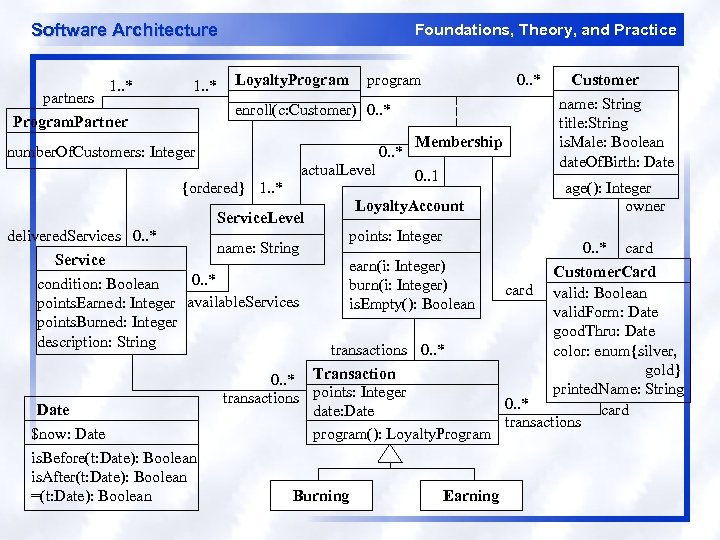
Software Architecture 1. . * partners Program. Partner Foundations, Theory, and Practice Loyalty. Program 1. . * program 0. . * enroll(c: Customer) 0. . * number. Of. Customers: Integer 0. . * actual. Level {ordered} 1. . * name: String 0. . * condition: Boolean points. Earned: Integer available. Services points. Burned: Integer description: String Date $now: Date is. Before(t: Date): Boolean is. After(t: Date): Boolean =(t: Date): Boolean 0. . 1 Loyalty. Account Service. Level delivered. Services 0. . * Service Membership points: Integer age(): Integer owner 0. . * earn(i: Integer) burn(i: Integer) is. Empty(): Boolean transactions 0. . * Transaction transactions points: Integer date: Date program(): Loyalty. Program Burning Customer name: String title: String is. Male: Boolean date. Of. Birth: Date Earning card Customer. Card card valid: Boolean valid. Form: Date good. Thru: Date color: enum{silver, gold} printed. Name: String 0. . * card transactions
Software Architecture Foundations, Theory, and Practice Types and Instances l OCL types are divided into following groups u Predefined types l Basic types: String, Integer, Real, Boolean l Collection types: Collection, Set, Bag, Sequence u User-defined model types l User defined classes such as Customer, Date, Loyalty. Program
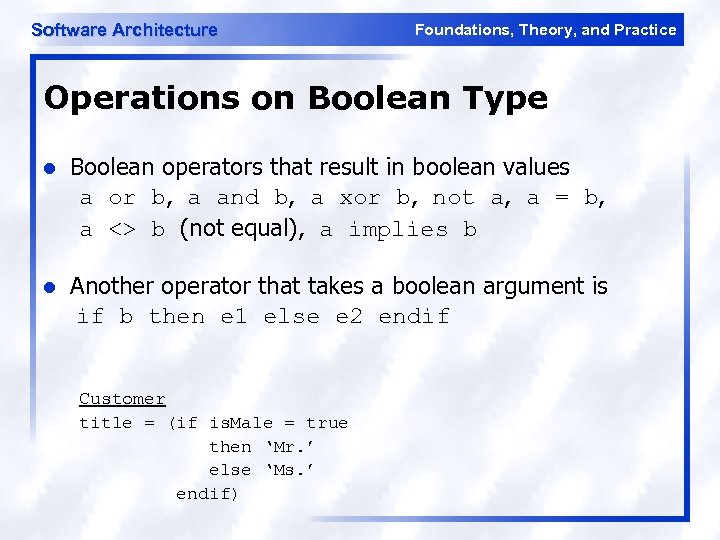
Software Architecture Foundations, Theory, and Practice Operations on Boolean Type l Boolean operators that result in boolean values a or b, a and b, a xor b, not a, a = b, a <> b (not equal), a implies b l Another operator that takes a boolean argument is if b then e 1 else e 2 endif Customer title = (if is. Male = true then ‘Mr. ’ else ‘Ms. ’ endif)
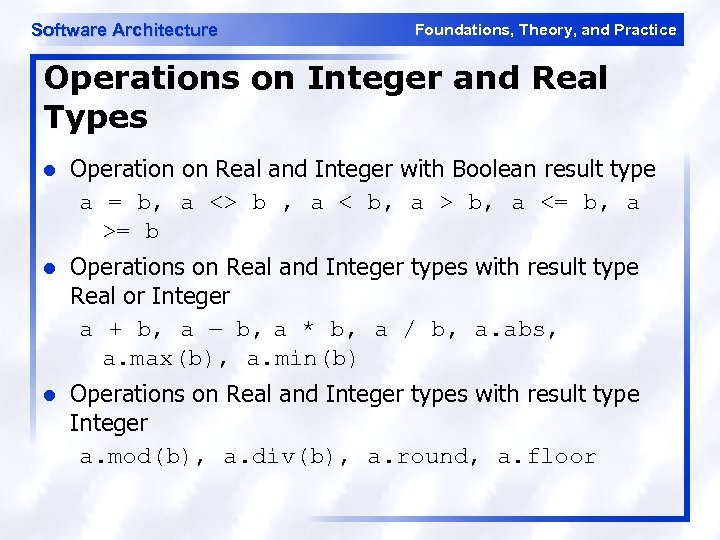
Software Architecture Foundations, Theory, and Practice Operations on Integer and Real Types l Operation on Real and Integer with Boolean result type a = b, a <> b , a < b, a > b, a <= b, a >= b l Operations on Real and Integer types with result type Real or Integer a + b, a * b, a / b, a. abs, a. max(b), a. min(b) l Operations on Real and Integer types with result type Integer a. mod(b), a. div(b), a. round, a. floor
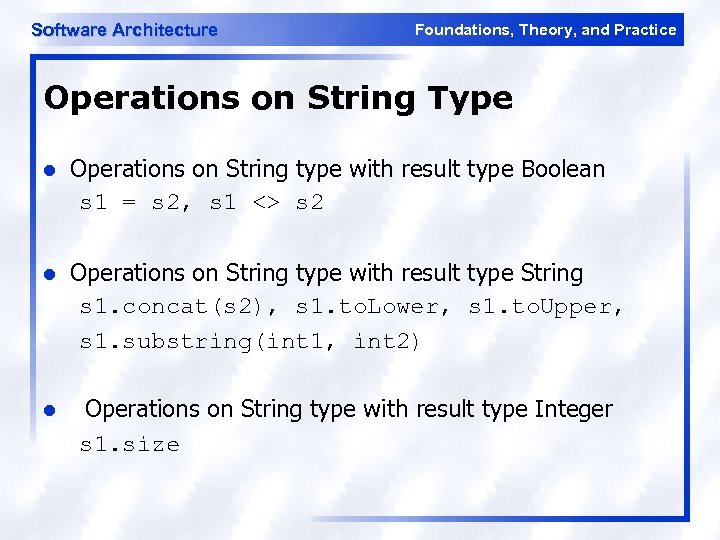
Software Architecture Foundations, Theory, and Practice Operations on String Type l Operations on String type with result type Boolean s 1 = s 2, s 1 <> s 2 l Operations on String type with result type String s 1. concat(s 2), s 1. to. Lower, s 1. to. Upper, s 1. substring(int 1, int 2) l Operations on String type with result type Integer s 1. size
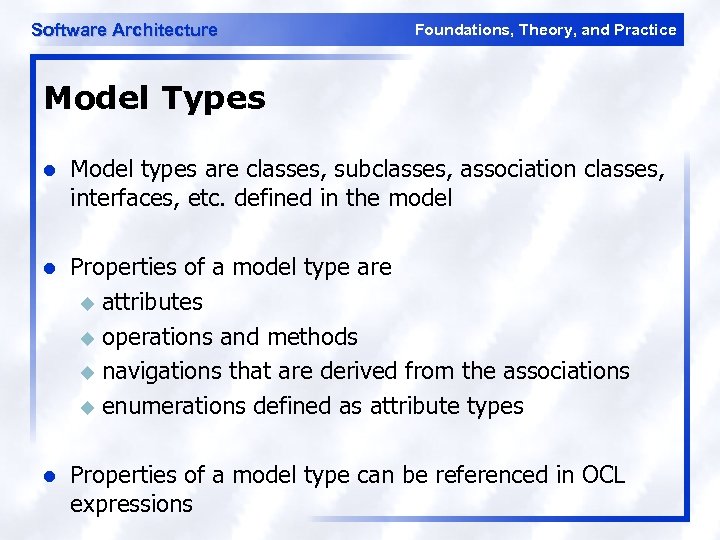
Software Architecture Foundations, Theory, and Practice Model Types l Model types are classes, subclasses, association classes, interfaces, etc. defined in the model l Properties of a model type are u attributes u operations and methods u navigations that are derived from the associations u enumerations defined as attribute types l Properties of a model type can be referenced in OCL expressions
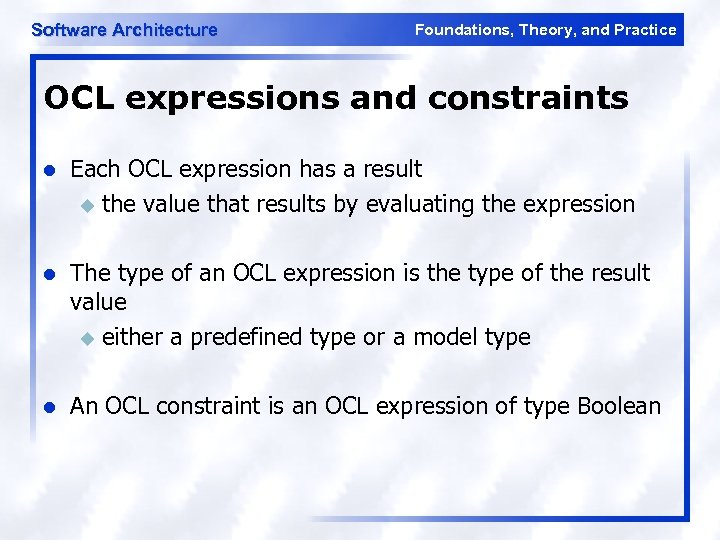
Software Architecture Foundations, Theory, and Practice OCL expressions and constraints l Each OCL expression has a result u the value that results by evaluating the expression l The type of an OCL expression is the type of the result value u either a predefined type or a model type l An OCL constraint is an OCL expression of type Boolean
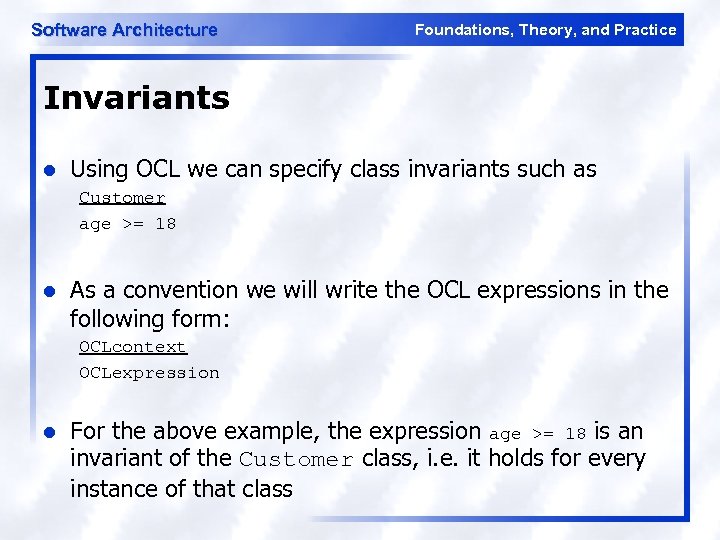
Software Architecture Foundations, Theory, and Practice Invariants l Using OCL we can specify class invariants such as Customer age >= 18 l As a convention we will write the OCL expressions in the following form: OCLcontext OCLexpression l For the above example, the expression age >= 18 is an invariant of the Customer class, i. e. it holds for every instance of that class
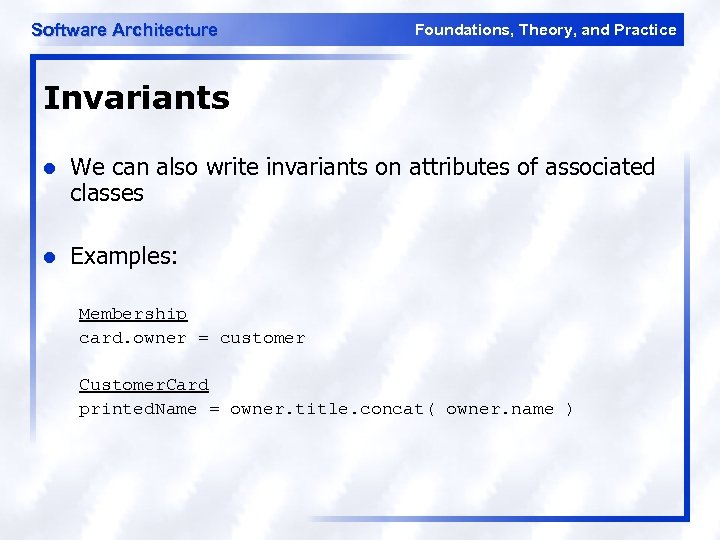
Software Architecture Foundations, Theory, and Practice Invariants l We can also write invariants on attributes of associated classes l Examples: Membership card. owner = customer Customer. Card printed. Name = owner. title. concat( owner. name )
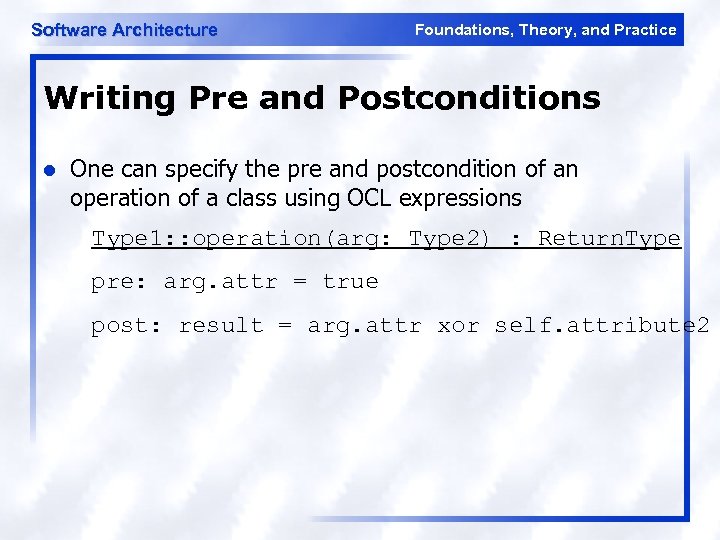
Software Architecture Foundations, Theory, and Practice Writing Pre and Postconditions l One can specify the pre and postcondition of an operation of a class using OCL expressions Type 1: : operation(arg: Type 2) : Return. Type pre: arg. attr = true post: result = arg. attr xor self. attribute 2
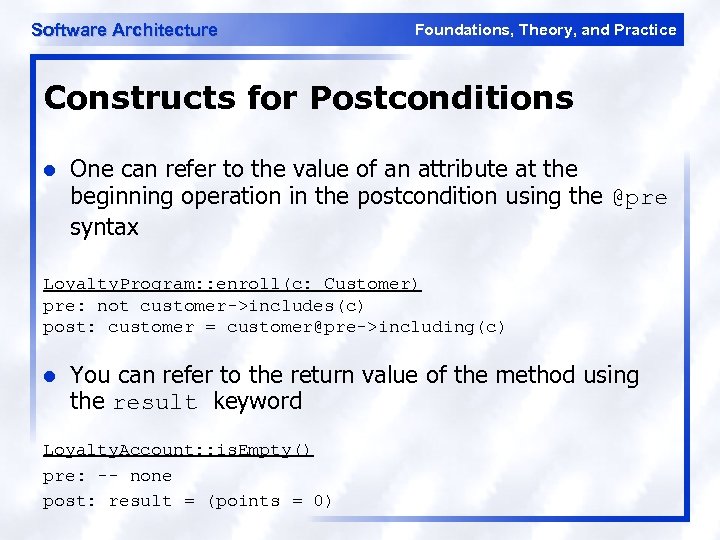
Software Architecture Foundations, Theory, and Practice Constructs for Postconditions l One can refer to the value of an attribute at the beginning operation in the postcondition using the @pre syntax Loyalty. Program: : enroll(c: Customer) pre: not customer->includes(c) post: customer = customer@pre->including(c) l You can refer to the return value of the method using the result keyword Loyalty. Account: : is. Empty() pre: -- none post: result = (points = 0)
Скачать презентацию Architectural Standards Infosys Mysore December 16 Copyright
5ee72e06a3edd2d747d82fec0e18a145.ppt