


 Скачать презентацию Architectural Principles of the Internet IPAM Tutorial March
6bf21cf357da3bb2cd94246433c160aa.ppt
- Количество слайдов: 66
 Architectural Principles of the Internet IPAM Tutorial March 12, 2002 Bob Braden USC Information Sciences Institute Marina del Rey, CA 3/12/02 IPAM -- Braden 1
 Outline • • • A brief historical overview of the Internet What is network architecture? The requirements for the Internet Architectural principles of the Internet Conclusion 3/12/02 IPAM -- Braden 2
 Internet History: The Yellow Brick Road (1) • 1969: Birth of the ARPAnet packet-switched network. • First IMP installed at UCLA • 1974: Cerf/Kahn paper on internetworking • Many elements of the final Internet protocol design • 1977: ARPA research program on internetworking • Important players included: BBN, DCEC, ISI, MIT, SRI, UCLA • 6 prototype implementations of TCP/IP 3/12/02 IPAM -- Braden 3
 The Yellow Brick Road (2) • Jan 1, 1983: Birth of the Internet • ARPAnet switched to TCP/IP protocols; Mil Std. • ~ 1985: NSFnet • Major growth engine: general academic usage • ~1989: Privatization of the Internet • People willing to pay to use it • People wanting to make money supplying services • ~1991: World-Wide Web introduced • From academic tool to popular culture 3/12/02 IPAM -- Braden 4
 The Good Witches • Do. D chose TCP/IP as Mil Std protocol ~1983 • CSNET chose TCP/IP ~1983 • ARPA directed Berkeley (BSD) Unix developers to implement TCP/IP. • Courageous technical managers in Do. D, NASA, Do. E, and NSF supported TCP/IP (FRICC) • NSF chose TCP/IP for building NSFnet 3/12/02 IPAM -- Braden 5
 The Bad Witches (1) • X. 25 • Common carrier packet switching service. • This Bad Witch captured the UK academic world ~1980. • Context: TCP/IP was tainted by the US Do. D, and in 1982 there were 600, 000 anti-nuclear demonstrators in London. • ISO Open Systems Interconnect (OSI) • • 3/12/02 A developing international standard protocol suite. A bureacratic dream and a technical nightmare. US Do. D tried to mandate OSI to replace TCP/IP at Mil Std. As late as 1993, some believed OSI would win. IPAM -- Braden 6
 More Bad Witches (2) • FAX • It seemed that FAX would kill email. • PTTs (government monopoly telcos) in Europe and Asia • They didn’t get it, but they blocked Internet progress outside the US for a long time. 3/12/02 IPAM -- Braden 7
 More Bad Witches (3) • US telco never got it. • They had built the hugely successful telephone network and could not imagine any other reality. – Very sophisticated engineering to solve one very specific and well-characterized communication problem. • They thought they were the Wizard of OZ. • ATM • The telcos [re-]invented packet switching in the form of ATM, and some thought it would rule the comm world. 3/12/02 IPAM -- Braden 8
 Why did the Internet get to Oz? • Some good luck and some clever moves. – Biggest factor: the Internet worked! • ARPAnet research community mindset: – Driven by pragmatics (instead of dogmatics) “Rough consensus and running code” – Reductionist thinking Scientific viewpint, not engineering. Led to the: Internet architecture (IA) 3/12/02 IPAM -- Braden 9
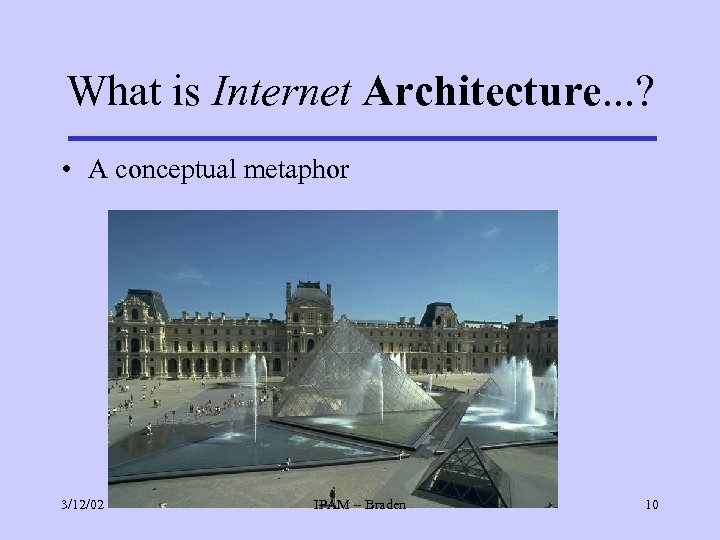 What is Internet Architecture. . . ? • A conceptual metaphor 3/12/02 IPAM -- Braden 10
 Network Architecture “A set of principles and basic mechanisms that guide network engineering. ” • Boundaries fuzzy: bounded from “above” by requirements and from “below” by engineering. • Even fuzzier: boundary between architecture and mechanism. Historically, informal architectural ideas guided design of the Internet protocols, but the architecture was formalized later. . . • “The Design Philosophy of the DARPA Internet Protocols”, David D. Clark, SIGCOMM ‘ 88, p. 106. 3/12/02 IPAM -- Braden 11
 Network Architecture • What entities are named, and how? • How do naming, addressing, and routing inter-relate? • Where & how is state installed and removed? • How are functions modularized? • How are resources allocated? • How are security boundaries drawn and enforced? 3/12/02 IPAM -- Braden 12
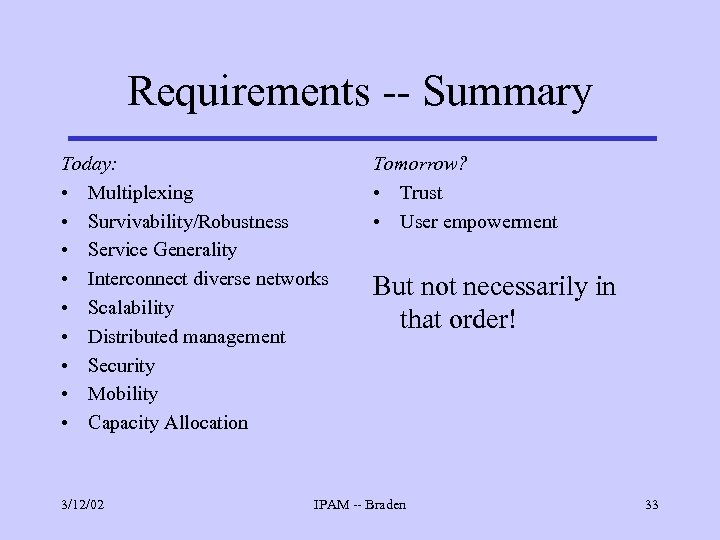
 Primary (original) Requirements • • Multiplexing Survivability (robustness) Service generality Diverse network technologies 3/12/02 IPAM -- Braden 13
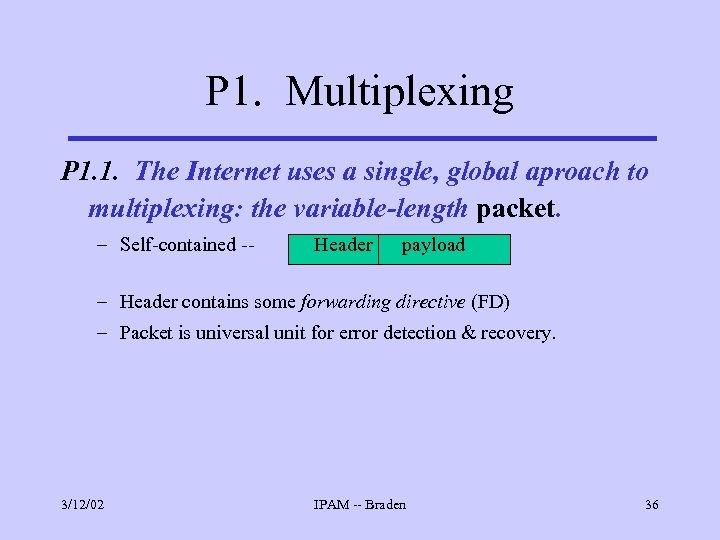
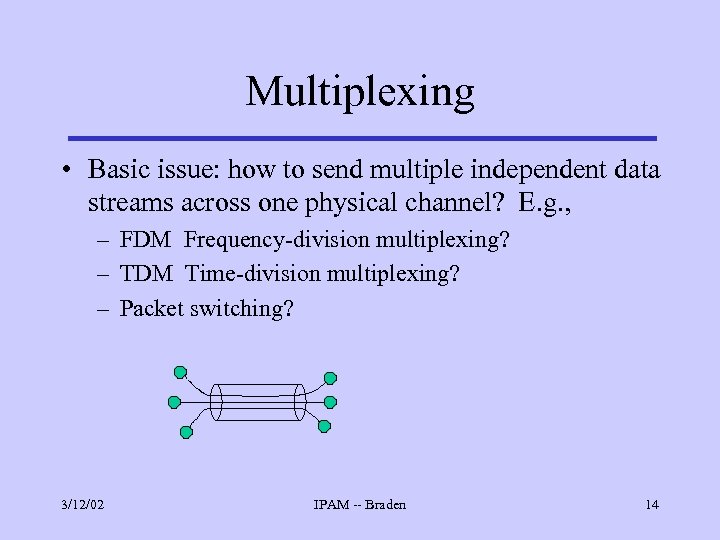 Multiplexing • Basic issue: how to send multiple independent data streams across one physical channel? E. g. , – FDM Frequency-division multiplexing? – TDM Time-division multiplexing? – Packet switching? 3/12/02 IPAM -- Braden 14
 Survivability (Robustness) • This requirement was a Big Deal for a militaryfunded effort – Very high priority requirement: messages get through no matter what, despite‘very bad’ things happening. . . – Irony: survivable protocols are a boon in peace time -we call it robustness. • Implies dynamic adaptation to outages. May also imply protocols that are in some sense “self healing”. 3/12/02 IPAM -- Braden 15
 Service Generality • Support widest possible set of applications. • Support a range of communication service models – Virtual circuit service • Reliable, ordered, full-duplex data streams – Datagram service • Unreliable, unordered (“best effort”) service – (Isochronous service -- not a requirement) 3/12/02 IPAM -- Braden 16
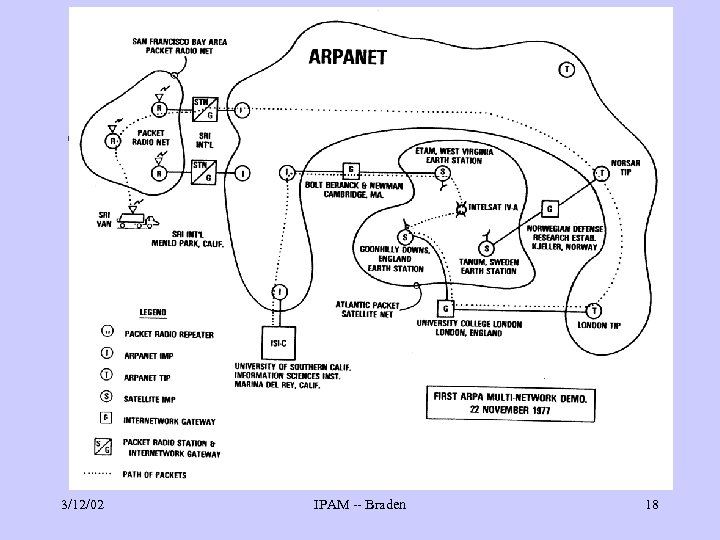
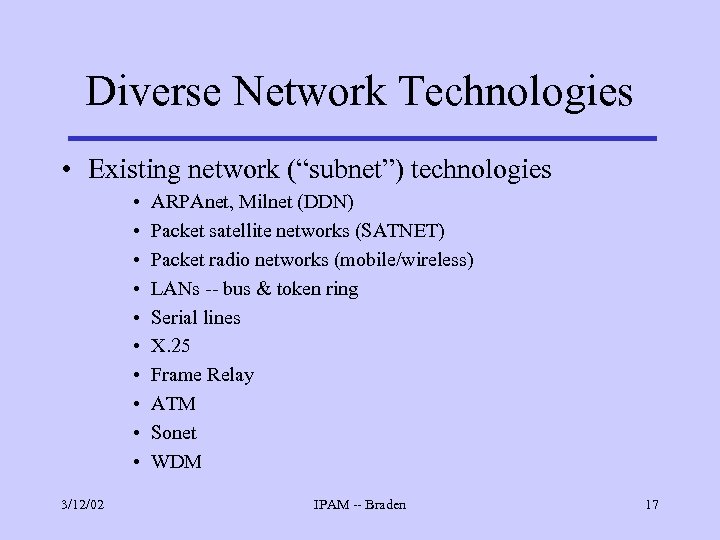 Diverse Network Technologies • Existing network (“subnet”) technologies • • • 3/12/02 ARPAnet, Milnet (DDN) Packet satellite networks (SATNET) Packet radio networks (mobile/wireless) LANs -- bus & token ring Serial lines X. 25 Frame Relay ATM Sonet WDM IPAM -- Braden 17
 3/12/02 IPAM -- Braden 18
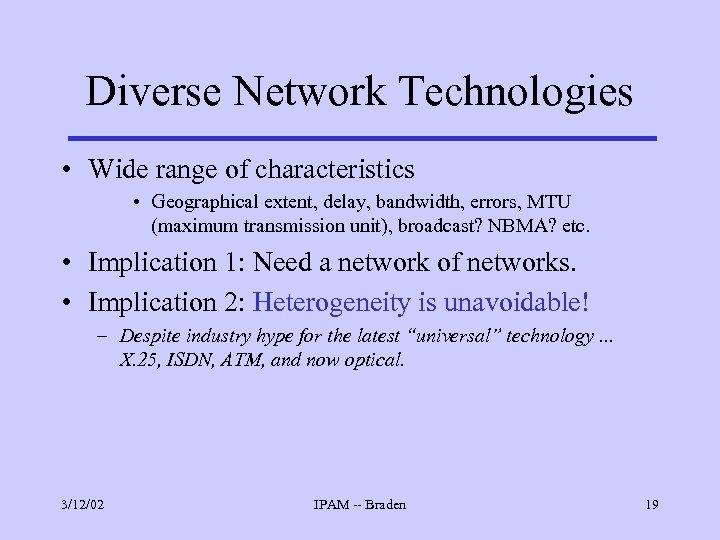 Diverse Network Technologies • Wide range of characteristics • Geographical extent, delay, bandwidth, errors, MTU (maximum transmission unit), broadcast? NBMA? etc. • Implication 1: Need a network of networks. • Implication 2: Heterogeneity is unavoidable! – Despite industry hype for the latest “universal” technology. . . X. 25, ISDN, ATM, and now optical. 3/12/02 IPAM -- Braden 19
 Secondary/Later Requirements • • • Scalability Distributed management Security Mobility Capacity allocation 3/12/02 IPAM -- Braden 20
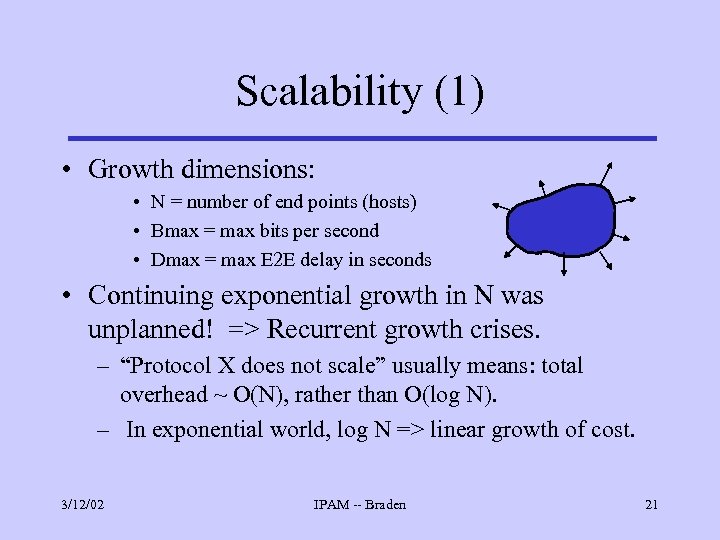 Scalability (1) • Growth dimensions: • N = number of end points (hosts) • Bmax = max bits per second • Dmax = max E 2 E delay in seconds • Continuing exponential growth in N was unplanned! => Recurrent growth crises. – “Protocol X does not scale” usually means: total overhead ~ O(N), rather than O(log N). – In exponential world, log N => linear growth of cost. 3/12/02 IPAM -- Braden 21
 Scalability (2) • Bmax, Dmax: – Rate of growth of Bmax was also a surprise, although we have handled this better than N growth. – What matters is B*D product ~ bits in flight. – Must handle dynamic ranges 0: Bmax, 0: Dmax – Handling these is a mechanism problem, not an architectural problem. 3/12/02 IPAM -- Braden 22
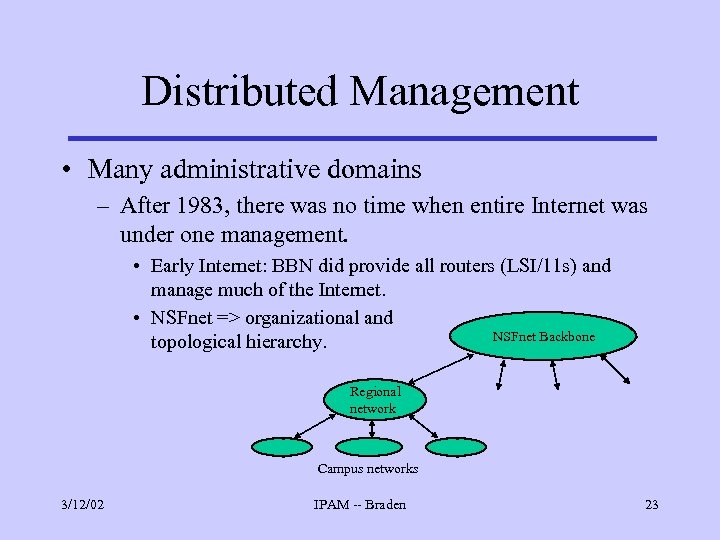 Distributed Management • Many administrative domains – After 1983, there was no time when entire Internet was under one management. • Early Internet: BBN did provide all routers (LSI/11 s) and manage much of the Internet. • NSFnet => organizational and NSFnet Backbone topological hierarchy. Regional network Campus networks 3/12/02 IPAM -- Braden 23
 Security • All the usual stuff. . . – privacy – integrity – authentication • Strangely, security was a late addition to the architecture. – Military assumed link encryption (encrypting all traffic on each circuit. ) 3/12/02 IPAM -- Braden 24
 Mobility • Mobility has been a secondary requirement – Localized solutions -- e. g. , mobile IP -- grafted onto the side of the architecture. 3/12/02 IPAM -- Braden 25
 Capacity Allocation • Fairness – Weak requirement -- fairness was a social good, but it was at most a secondary requirement. • Unfairness “Some pigs are more equal than others” – Early: Do. D -> precedence hierarchy (IPv 4 bits) – Today: ISPs want to sell different service qualtities for a price, and some users are willing to pay for better Qo. S (quality of service) 3/12/02 IPAM -- Braden 26
 Non-Requirements • • • Accountability Cost effectiveness Ease of host attachment Trust User empowerment 3/12/02 IPAM -- Braden 27
 Accountability • There has been no requirement to support usage accounting or $$ flows. • EG, a transit ISP cannot charge end user for better service. • Whether or not this is a problem depends very much on your viewpoint. – Pro: Accounting -> service differentiation -> competition -> Good Things. – Con: Some (or all? ) kinds of charging will distort usage and lead to moral decay. 3/12/02 IPAM -- Braden 28
 Ease of Host Attachment • It was tough in the early days, but really only a startup problem. • Today every system comes with TCP/IP stacks, driver software, and NIC hardware. 3/12/02 IPAM -- Braden 29
 Cost Effectiveness • Engineers tended to hate the 20 bytes of overhead for IP or 40 bytes for TCP, but. . . • The military did not care in the early days. • The academic world did not care a lot during NSFnet days, since “daddy” NSF was paying. • The miracles of silicon and glass have pretty much made this an non-issue, except in the “last mile”. 3/12/02 IPAM -- Braden 30
 Trust • Spammers, hackers, . . . If you connect to the Internet, you are exposed. – Trust was not considered a goal -- until we lost it. • Firewalls provide a (primitive) mechanism to recapture trust within ‘gated communities’, but they limit functionality. • Maybe the ability to belong to multiple trusted subcommunities should be a future requirement. 3/12/02 IPAM -- Braden 31
 User Empowerment • Competition is a great driving force. • If users could select ISP paths and if payment mechanisms exist (see accountability), then ISPs could be motivated to provide additional services • Qo. S • Multicasting • . . . • Maybe this kind of user empowerment should be a future requirement. 3/12/02 IPAM -- Braden 32
 Requirements -- Summary Today: • Multiplexing • Survivability/Robustness • Service Generality • Interconnect diverse networks • Scalability • Distributed management • Security • Mobility • Capacity Allocation 3/12/02 Tomorrow? • Trust • User empowerment But not necessarily in that order! IPAM -- Braden 33
 Internet Architectural Principles I will divide these 15 principles into • Fundamental principles • Secondary principles You may argue about this classification. . . 3/12/02 IPAM -- Braden 34
 Fundamental Principles P 1. P 2. P 3. P 4. P 5. P 6. P 7. P 8. 3/12/02 Multiplexing Transparency Universal connectivity End-to-End argument Subnet heterogeneity Common Bearer Service Forwarding context Global addressing IPAM -- Braden 35
 P 1. Multiplexing P 1. 1. The Internet uses a single, global aproach to multiplexing: the variable-length packet. – Self-contained -- Header payload – Header contains some forwarding directive (FD) – Packet is universal unit for error detection & recovery. 3/12/02 IPAM -- Braden 36
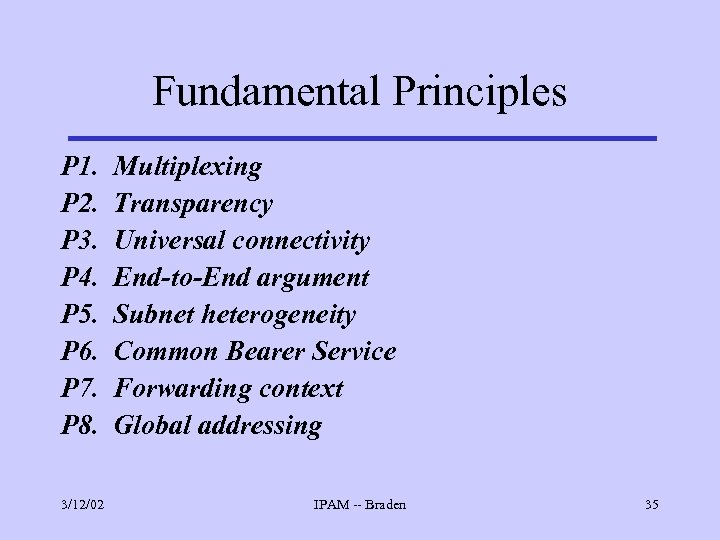
 P 2. Transparency P 2. 1. User data is delivered to the intended receiver without modification. – The “Don’t mess with my data!!” principle – A controversial issue today, as ISPs start to mess with our data -- eg web caches that attach advertisements. 3/12/02 IPAM -- Braden 37
 P 3. Connectivity P 3. 1. Any host can send packets directly to any other host (except when prohibited by policy). • I. e. , Internet communication is universal, direct and “real time”, i. e. , no indefinite delays. P 3. 2. A host attached to any subnet of the Internet is “attached to the Internet. ” 3/12/02 IPAM -- Braden 38
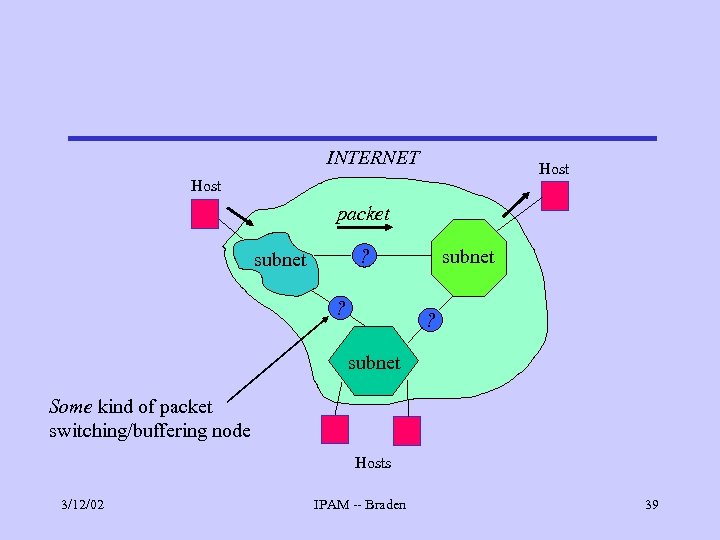 INTERNET Host packet ? subnet Some kind of packet switching/buffering node Hosts 3/12/02 IPAM -- Braden 39
 P 4. “End-to-End Arguments” (1) • The “end-to-end arguments” were presented in: – Saltzer, J. , Reed, D. , and D. Clark, “End-to-End Arguments in System Design”. 2 nd Int Conf on Dist Systems, Paris France, April 1981. • Architectural reasoning about the appropriate location for communication functions -- network vs. end nodes. • Wonderfully ambiguous, but often cited -- the closest thing to a sacred text for the Internet architecture. 3/12/02 IPAM -- Braden 40
 P 4. “End-to-End Arguments” (2) P 4. 1. The network is built with no knowledge of, or support for, any specific application or class of applications. P 4. 2. A function that can be entirely accomplished in an end node is left to that node, and the relevant communication state is kept only in that node. Hence, a crash that loses communication state will be coincident with the loss of the communicating application -- “fate-sharing”. 3/12/02 IPAM -- Braden 41
 P 4. “End-to-End Arguments” (3) • Example 1: Reliable delivery End-to-end reliability (timeout, retransmit) can be entirely accomplished by the end nodes. P 4. 2 => implement reliable delivery entirely in the end nodes (e. g. , using TCP). • Example 2: Network buffering Speed variations between end nodes can be entirely handled by end-node buffering and flow control. P 4. 2 => network has no buffering mechanism to deal with end-node speed variation. 3/12/02 IPAM -- Braden 42
 P 4. “End-to-End Arguments” (4) • Example 3: Format conversion Any required format conversion can be entirely handled by end nodes. P 4. 2 => network has no mechanism format conversion between end nodes (hosts). 3/12/02 IPAM -- Braden 43
 P 4. “End-to-End Arguments” (5) • The first academic statement of the “dumb network, smart end system” idea for computer communication. – Contrary to the telephone network: smart networks, dumb terminals. • Today the E 2 E principles P 4. 1, P 4. 2 are often broken – Firewalls, NAT boxes, web caches, web proxies, etc. do application-specific processing within the network. Hotly-debated issues within the Internet technical community. 3/12/02 IPAM -- Braden 44
 Where we are so far • We have: – – P 1. Multiplexing: Packets everywhere P 2. Transparency: ‘Don’t mess with my data’ P 3. Connectivity: Universal, direct, realtime P 4. E 2 E argument -- prefer functions in end nodes • We have not yet specified: – What state is needed forwarding packets? Is connection setup required, or is it connectionless? – How are addressing and routing performed? 3/12/02 IPAM -- Braden 45
 P 5. Subnet Heterogenity (1) P 5. 1. The Internet makes the minimum possible assumptions about subnet functionality, in order to operate over diverse subnet technologies. P 5. 2. Internet protocol designers should be willing to forego some efficiency and even functionality in order to maintain this flexibility and universality. 3/12/02 IPAM -- Braden 46
 P 5. Subnet Heterogenity (2) • Optimizations can be harmful if they reduce future adaptability. • In an exponential world, optimization is often an exercise in futility. • Note: “minimum” assumption does not mean “no assumption. ” • TCP performance requires packet loss under a few percent. • Qo. S often needs support in subnets. 3/12/02 IPAM -- Braden 47
 P 6. Common Bearer Service P 6. 1. A universal internetworking protocol IP forms a “common bearer service” end-to-end. – IP packets are forwarded E 2 E through each subnet. – Subnets are linked by IP packet switches called routers. – The service model is loosely defined -- “best effort” -to handle diverse subnet characteristics. • Packets may be dropped, duplicated, or reordered. 3/12/02 IPAM -- Braden 48
 P 7. Forwarding Context The Internet is connectionless, i. e. : P 7. 1. No setup is required before sending a packet. Packets are self-contained within the context of a global routing computation. P 7. 2. Routers contain no per-flow state. 3/12/02 IPAM -- Braden 49
 P 8. Global Addressing P 8. 1. A single global address space identifies the network attachment points of nodes. These IP addresses are carried in IP headers and used by routers for packet forwarding decisions (FDs). P 8. 2. IP addresses are also used as node identifiers (“names”). If you know the IP “name” of a host, you also know its address. 3/12/02 IPAM -- Braden 50
 Secondary Principles P 1. P 2. P 3. P 4. P 5. P 6. P 7. P 8. Multiplexing Transparency Universal connectivity End-to-End argument Subnet heterogeneity Common Bearer Service Forwarding context Global addressing 3/12/02 P 9. Routing P 10. Regions P 11. Protocol Layering P 12. Minimal Dependency P 13. Security P 14. Congestion P 15. Resource Allocation P 16. Mobility IPAM -- Braden 51
 P 9. Routing P 9. 1. The Internet performs a globally-consistent routing computation to support loop-free, hop-by -hop forwarding of packets. P 9. 2. This routing computation is distributed so there will be no single point of failure. P 9. 3. Source routing is supported as an exception to allow delivery when the routing computation does not provide an effective route. 3/12/02 IPAM -- Braden 52
 P 10. Regions P 10. 1. The Internet supports administrative regions (domains) for the purpose of routing. – A two-level hierarchical routing computation is performed, within and among regions. 3/12/02 IPAM -- Braden 53
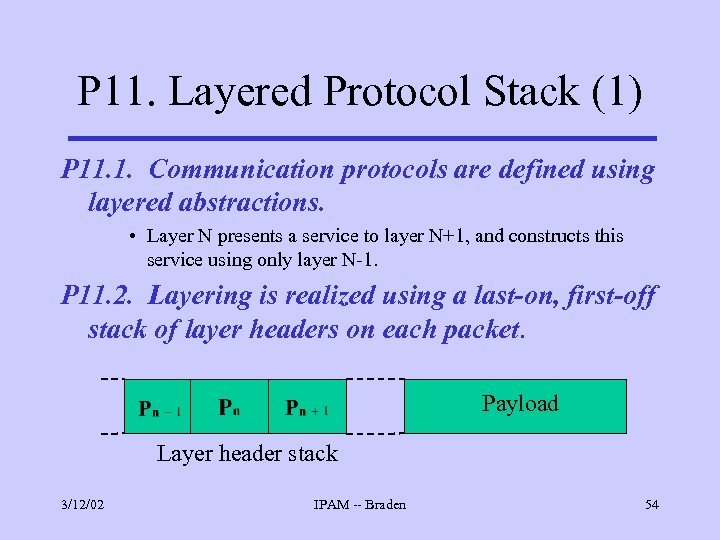 P 11. Layered Protocol Stack (1) P 11. 1. Communication protocols are defined using layered abstractions. • Layer N presents a service to layer N+1, and constructs this service using only layer N-1. P 11. 2. Layering is realized using a last-on, first-off stack of layer headers on each packet. Payload Layer header stack 3/12/02 IPAM -- Braden 54
 Layered Protocol Stack (2) • Layering provides powerful model for building complex protocol interactions -- modularity, abstraction, information hiding. • BUT the strict layering model is often violated. Thus, layer N’s service may depend upon information at layer N+1. • New functionality often requires new sub-layers 3/12/02 IPAM -- Braden 55
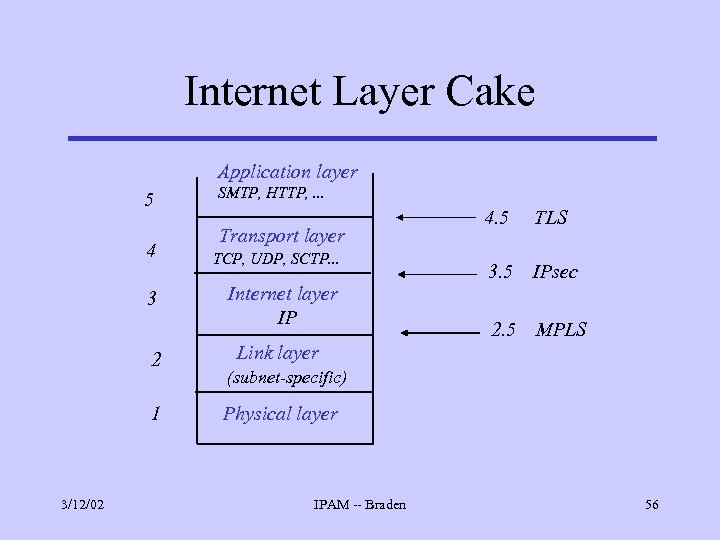 Internet Layer Cake Application layer 5 SMTP, HTTP, . . . Transport layer 4 TCP, UDP, SCTP. . . 3 Internet layer IP 2 1 3/12/02 4. 5 TLS 3. 5 IPsec 2. 5 MPLS Link layer (subnet-specific) Physical layer IPAM -- Braden 56
 P 12. Minimum Dependency P 12. 1: A minimum of network services is required for end-to-end communication. – Two Internet hosts that know each other’s IP addresses can communicate without additional network support. • I. e. , the DNS is not required => robustness, boot-strapping. – Two Internet hosts can communicate directly without an intervening router. • Symmetrical interface -- no network access protocol. 3/12/02 IPAM -- Braden 57
 P 13. Security P 13. 1. The Internet has an architected end-to-end security mechanism for integrity and privacy. P 13. 2. Internet architecture has no mechanism to constrain hosts that offer excess traffic (DDos) P 13. 3. Internet architecture has no specific mechanisms to defend its own elements from attack. 3/12/02 IPAM -- Braden 58
 P 14. Congestion (1) P 14. 1. The Internet contains sufficient buffering to allow a host to run a congestion adaptation algorithm with a round-trip of control latency. P 14. 2 The Internet provides an explicit congestion signal that can be used to drive adaptation algorithms. 3/12/02 IPAM -- Braden 59
 P 14. Congestion (2) P 14. 3 Transport protocols should be no more aggressive than TCP. However, there is no enforcement mechanism. P 14. 4. The network has no model of its own performance; a host must measure performance itself. 3/12/02 IPAM -- Braden 60
 P 15. Resource Allocation P 15. 1. The Internet provides an architected mechanism for explicit network Qo. S for individual flows (int-serv) P 15. 2. The Internet provides a mechanism to allocate network resources to aggregated flows (diff-serv). P 15. 3 The Internet provides a “virtual path” mechanism for traffic engineering (MPLS) 3/12/02 IPAM -- Braden 61
 P 16. Mobility • P 16. 1 The architecture optimizes for the stationary case; mobility support uses special case mechanisms (e. g. , mobile IP, MANET) with extra cost. 3/12/02 IPAM -- Braden 62
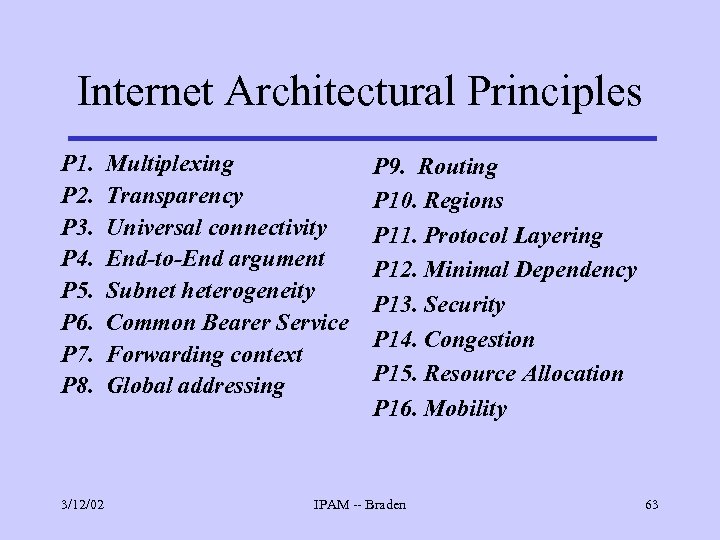 Internet Architectural Principles P 1. P 2. P 3. P 4. P 5. P 6. P 7. P 8. 3/12/02 Multiplexing Transparency Universal connectivity End-to-End argument Subnet heterogeneity Common Bearer Service Forwarding context Global addressing P 9. Routing P 10. Regions P 11. Protocol Layering P 12. Minimal Dependency P 13. Security P 14. Congestion P 15. Resource Allocation P 16. Mobility IPAM -- Braden 63
 Conclusion • We have certainly reached the emerald city, but we have not reached Kansas yet. (Remember what happen to Dorothy. . . ) • The Internet architecture is not “finished”. 3/12/02 IPAM -- Braden 64
 Conclusion Every one of the 16 architectural principle categories is problematic in some manner! (a) Being broken for commercial reasons (b) Being broken to obtain additional functionality (c) Protected against unwise optimization only by constant struggle in the IETF. (d) Represent real unmet requirements (e) Mods suggested by researchers. (f) Mods urged by mysterious government agencies • Details? Need another 2 hours! 3/12/02 IPAM -- Braden 65
 Acknowledgments • Version -1 of this presentation began from a recent note by Dave Clark (MIT): “Principles”, Jan 22, 2002, as well has his 1988 paper. It also contains ideas from John Wroclawski and Karen Sollins of MIT. And of course it benefits from thousands of conversations with many, many Internet gurus over the years. • This work was funded in part by DARPA under the NGI program. – See http: //www. isi. edu/newarch 3/12/02 IPAM -- Braden 66