


 Скачать презентацию Architectural Alignment Pascal van Eck University of Twente
6e820635dfcdc1a3173a23525b19f298.ppt
- Количество слайдов: 60
 Architectural Alignment Pascal van Eck University of Twente Information Systems Group p. vaneck@utwente. nl SIKS course “Architectures for IKS“ Vught, September 28, 2006
 Mission statement To put architecture in its organizational context, focusing on business and IT strategy © Pascal van Eck, University of Twente, 2006 2/60
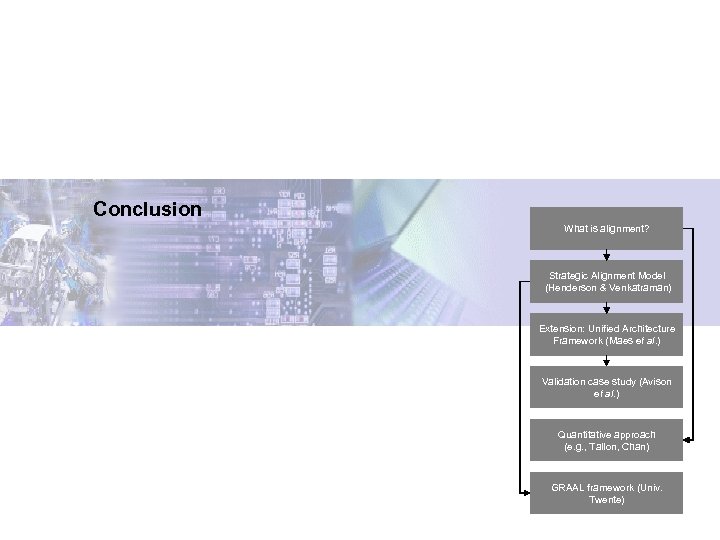
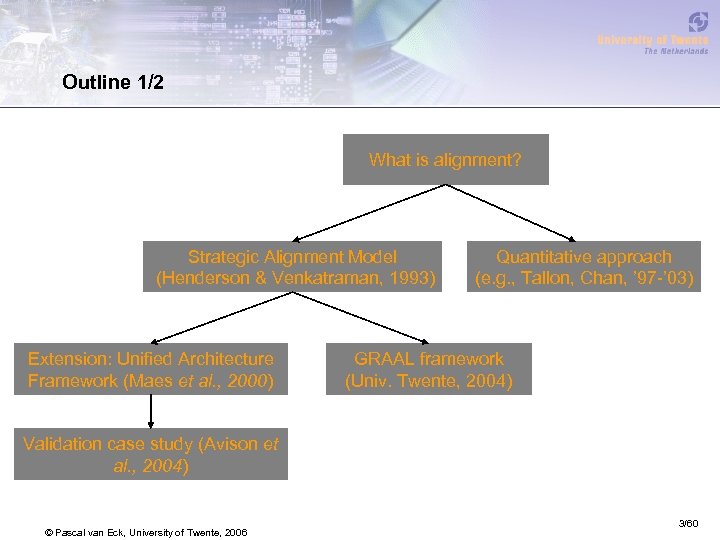 Outline 1/2 What is alignment? Strategic Alignment Model (Henderson & Venkatraman, 1993) Extension: Unified Architecture Framework (Maes et al. , 2000) Quantitative approach (e. g. , Tallon, Chan, ’ 97 -’ 03) GRAAL framework (Univ. Twente, 2004) Validation case study (Avison et al. , 2004) © Pascal van Eck, University of Twente, 2006 3/60
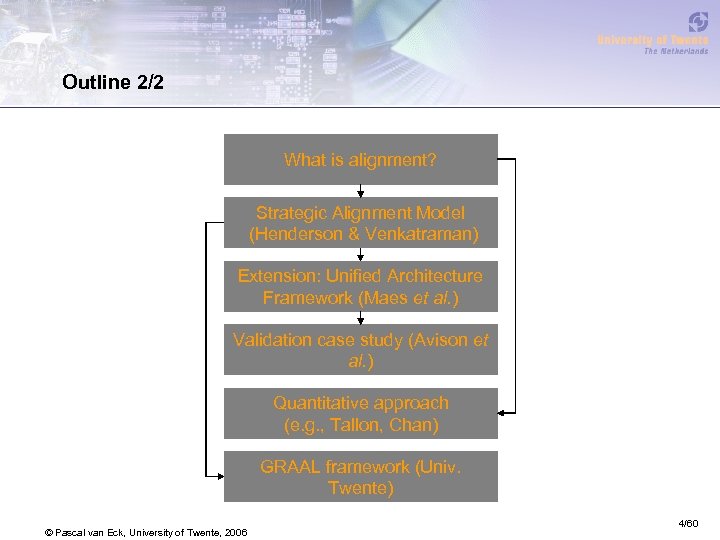 Outline 2/2 What is alignment? Strategic Alignment Model (Henderson & Venkatraman) Extension: Unified Architecture Framework (Maes et al. ) Validation case study (Avison et al. ) Quantitative approach (e. g. , Tallon, Chan) GRAAL framework (Univ. Twente) © Pascal van Eck, University of Twente, 2006 4/60
 Architecture and Alignment What is alignment? Definitions Strategic Alignment Model (Henderson & Venkatraman) Extension: Unified Architecture Framework (Maes et al. ) Validation case study (Avison et al. ) Quantitative approach (e. g. , Tallon, Chan) GRAAL framework (Univ. Twente)
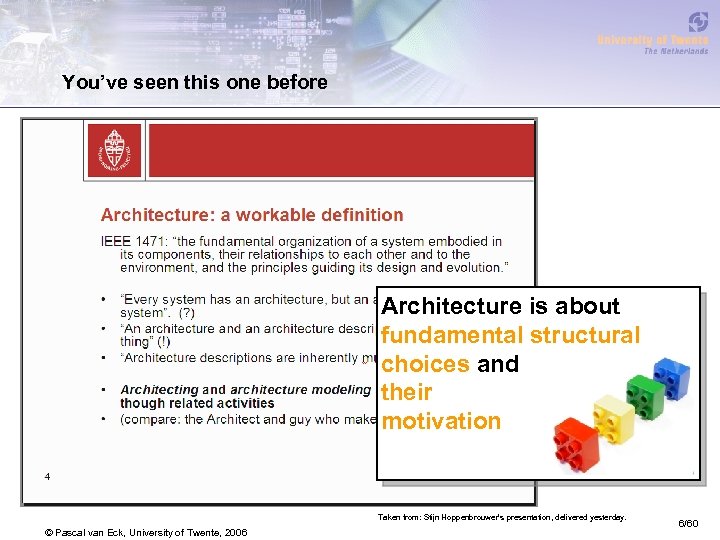 You’ve seen this one before Architecture is about fundamental structural choices and their motivation Taken from: Stijn Hoppenbrouwer’s presentation, delivered yesterday. © Pascal van Eck, University of Twente, 2006 6/60
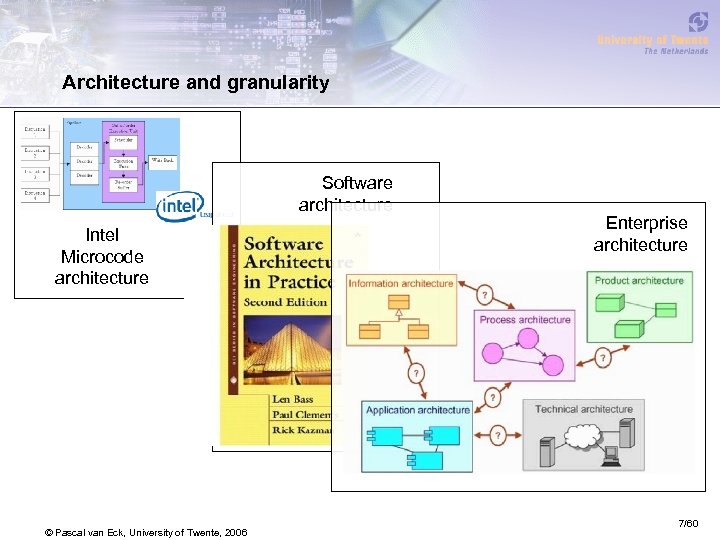 Architecture and granularity Software architecture Intel Microcode architecture © Pascal van Eck, University of Twente, 2006 Enterprise architecture 7/60
 Architecture alignment • Architecture alignment: • Allocation of IT budgets such that business functions are supported in an optimal way (outcome) • “the continuous process, …, of consciously and coherently interrelating all components of the business – IT relationship in order to contribute to the organisation’s performance over time” (process) (From Maes et al. , 2000) © Pascal van Eck, University of Twente, 2006 8/60
 Strategy, tactics and operations • Strategy: external position of the organization • Examples: Product/market combinations, make-or-buy decisions, human resource acquisition • Impact of decisions: years Tactical level: realizing the strategy by internal means • Impact of decisions: month(s) – 1 year • Example: organization structure • Operational level: day-to-day decisions • Impact of decisions: day(s) – month(s) • Example: hire temps in case of sudden increase in sales © Pascal van Eck, University of Twente, 2006 9/60
 The Strategic Alignment Model What is alignment? Strategic Alignment Model (Henderson & Venkatraman) Extension: Unified Architecture Framework (Maes et al. ) Validation case study (Avison et al. ) Henderson, & Venkatraman, (1993). Strategic alignment: Leveraging information technology for transforming organisations. IBM Systems Journal, 32(1): 472 -484. http: //researchweb. watson. ibm. com/journal/sj/382/henderson. pdf Quantitative approach (e. g. , Tallon, Chan) GRAAL framework (Univ. Twente)
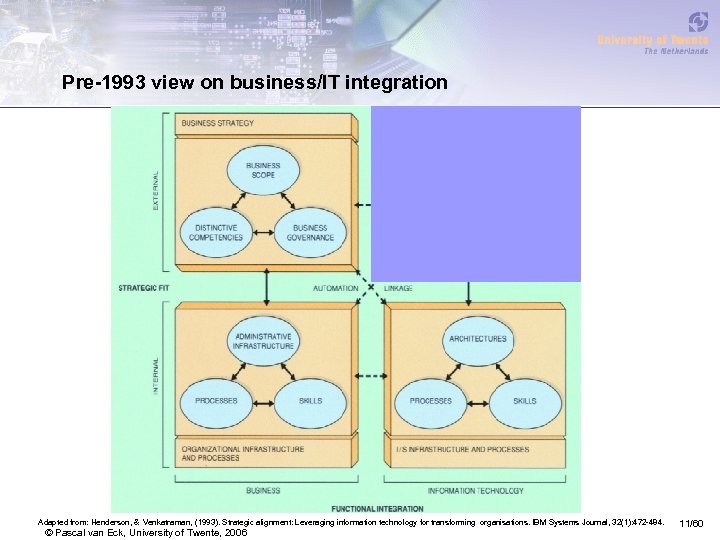 Pre-1993 view on business/IT integration Adapted from: Henderson, & Venkatraman, (1993). Strategic alignment: Leveraging information technology for transforming organisations. IBM Systems Journal, 32(1): 472 -484. © Pascal van Eck, University of Twente, 2006 11/60
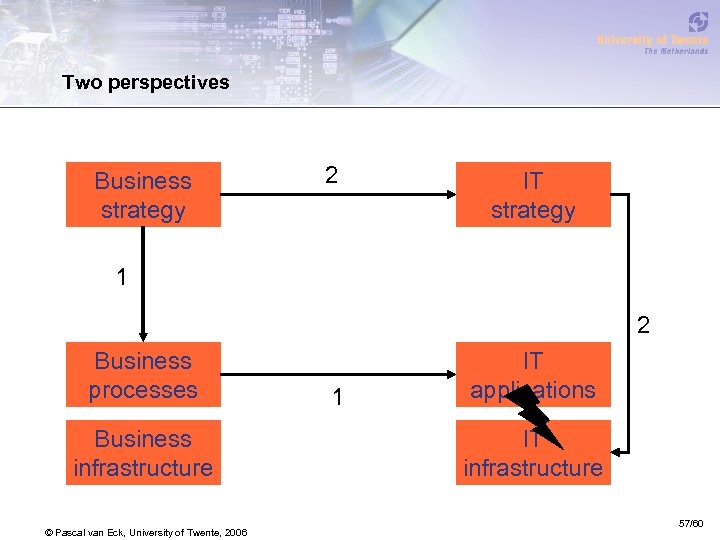
 Henderson & Venkatraman’s take home message #1 • Similar to business strategy, IT strategy has to consider both internal as well as external aspects © Pascal van Eck, University of Twente, 2006 12/60
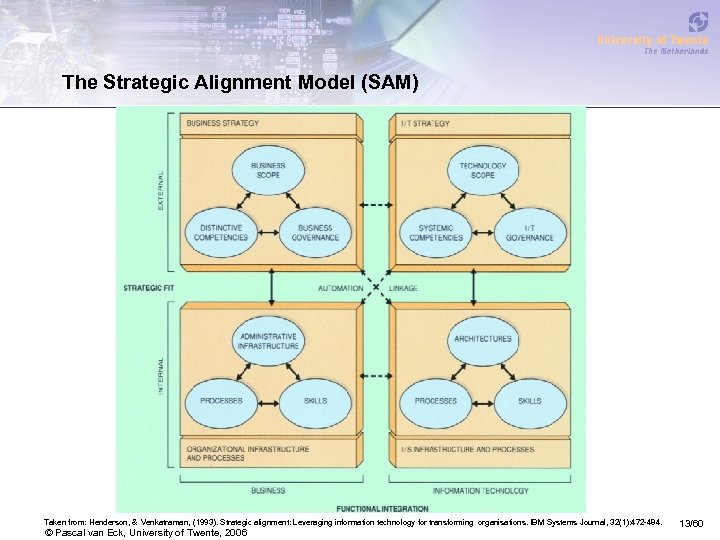 The Strategic Alignment Model (SAM) Taken from: Henderson, & Venkatraman, (1993). Strategic alignment: Leveraging information technology for transforming organisations. IBM Systems Journal, 32(1): 472 -484. © Pascal van Eck, University of Twente, 2006 13/60
 Henderson & Venkatraman’s take home message #2 • Both internal/external alignment as well as functional integration must be taken into account. Only one of them is not sufficient © Pascal van Eck, University of Twente, 2006 14/60
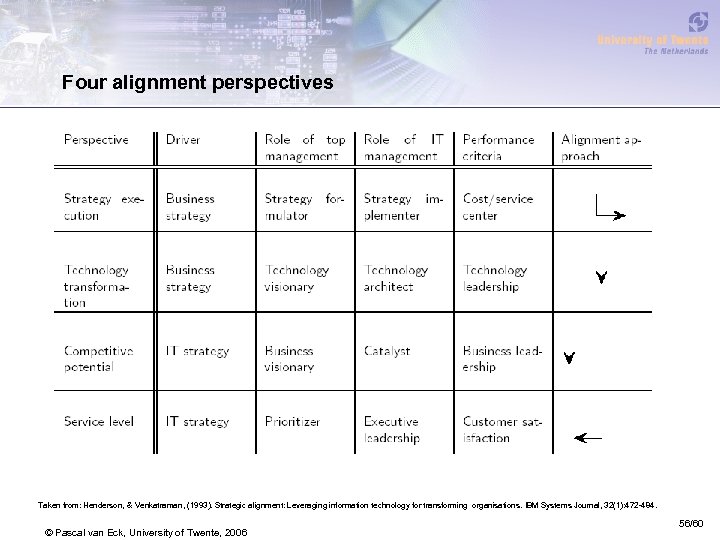
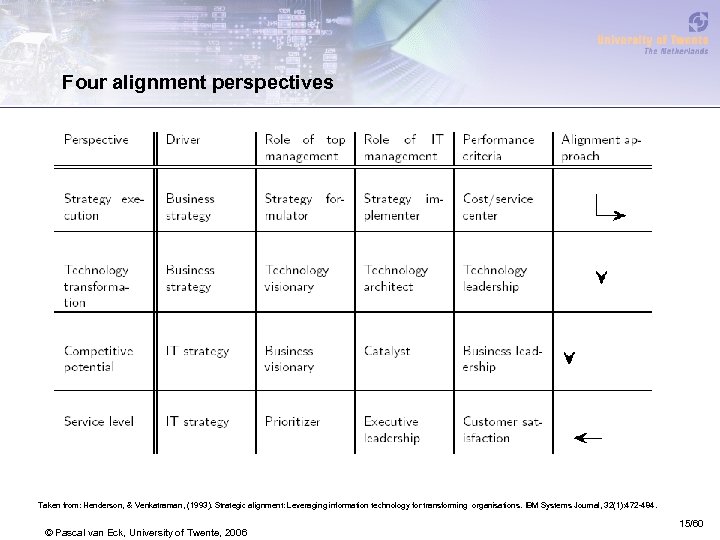 Four alignment perspectives Taken from: Henderson, & Venkatraman, (1993). Strategic alignment: Leveraging information technology for transforming organisations. IBM Systems Journal, 32(1): 472 -484. © Pascal van Eck, University of Twente, 2006 15/60
![The Unified Architecture Framework [HV 93] + [Maes 99] = GAF What is alignment?](https://present5.com/presentation/6e820635dfcdc1a3173a23525b19f298/image-16.jpg "The Unified Architecture Framework [HV 93] + [Maes 99] = GAF What is alignment?") The Unified Architecture Framework [HV 93] + [Maes 99] = GAF What is alignment? Strategic Alignment Model (Henderson & Venkatraman) GAF + IAF = UAF Extension: Unified Architecture Framework (Maes et al. ) Validation case study (Avison et al. ) Maes, R. , Rijsenbrij, D. , Truijens, O. and Goedvolk, H. (2000). Redefining business–IT alignment through a unified framework. Prima. Vera Working Paper 2000 -19, Univ. of Amsterdam. http: //imwww. fee. uva. nl/~maestro/PDF/2000 -19. pdf Quantitative approach (e. g. , Tallon, Chan) GRAAL framework (Univ. Twente)
The Unified Architecture Framework [HV 93] + [Maes 99] = GAF What is alignment? Strategic Alignment Model (Henderson & Venkatraman) GAF + IAF = UAF Extension: Unified Architecture Framework (Maes et al. ) Validation case study (Avison et al. ) Maes, R. , Rijsenbrij, D. , Truijens, O. and Goedvolk, H. (2000). Redefining business–IT alignment through a unified framework. Prima. Vera Working Paper 2000 -19, Univ. of Amsterdam. http: //imwww. fee. uva. nl/~maestro/PDF/2000 -19. pdf Quantitative approach (e. g. , Tallon, Chan) GRAAL framework (Univ. Twente)
 Maes’ (1999) extension: the Generic framework • More detail in the two H&V-dimensions • Extra row: internal -> structure + operations • “Designing and managing this organisational structure is above all an architectural issue: the combined contribution of business, information and technology architects is key to the long term health of present-day organisations, …” • Extra column: IT -> information & communication + Technology • “It is appropriate to state that the use and the internal and external sharing of information and not its provision are of strategic nature. ” © Pascal van Eck, University of Twente, 2006 17/60
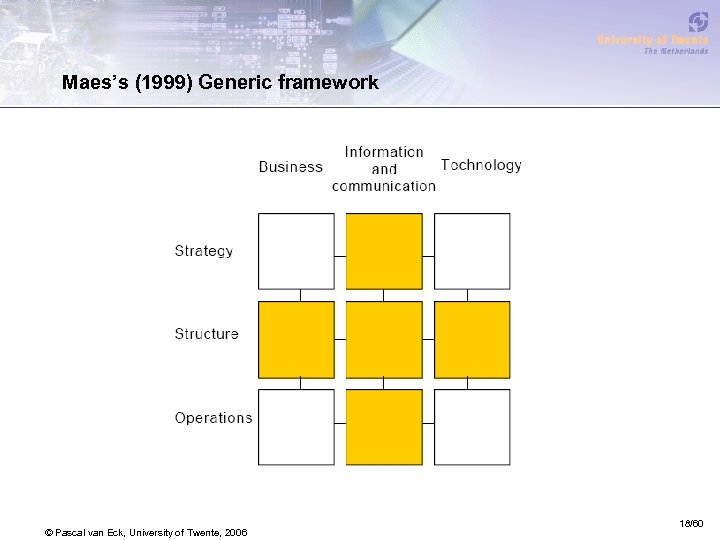 Maes’s (1999) Generic framework © Pascal van Eck, University of Twente, 2006 18/60
 Maes’ et al. ’s (2000) extensions: the Unified Framework • Cap. Gemini’s Integrated Architecture Framework (IAF) adds: • Extra column: Technology -> Information Systems + Technology infrastructure • Third dimension: five design phases • Contextual (why? ): mission & strategy • Conceptual (what? ): describes four architecture areas • Logical (how? ): operations & structures • Physical (with what? ): resources • Transformational: roll-out • Fourth dimension: specific viewpoints (e. g. , security, governance) © Pascal van Eck, University of Twente, 2006 19/60
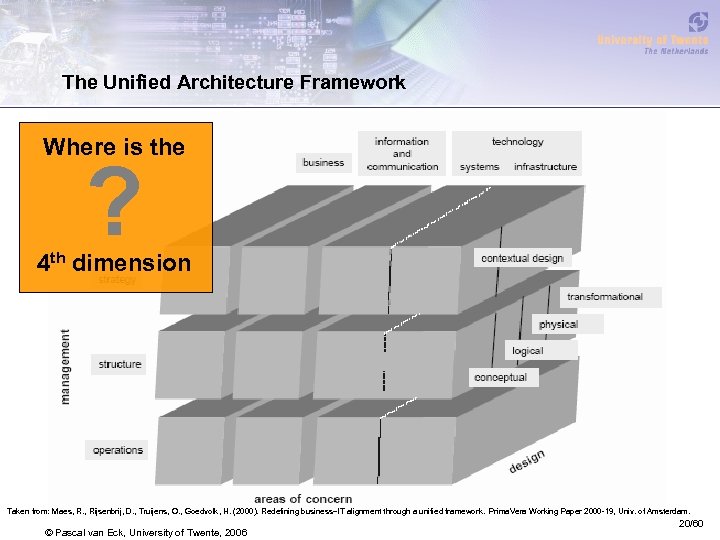 The Unified Architecture Framework Where is the ? 4 th dimension Taken from: Maes, R. , Rijsenbrij, D. , Truijens, O. , Goedvolk, H. (2000). Redefining business–IT alignment through a unified framework. Prima. Vera Working Paper 2000 -19, Univ. of Amsterdam. © Pascal van Eck, University of Twente, 2006 20/60
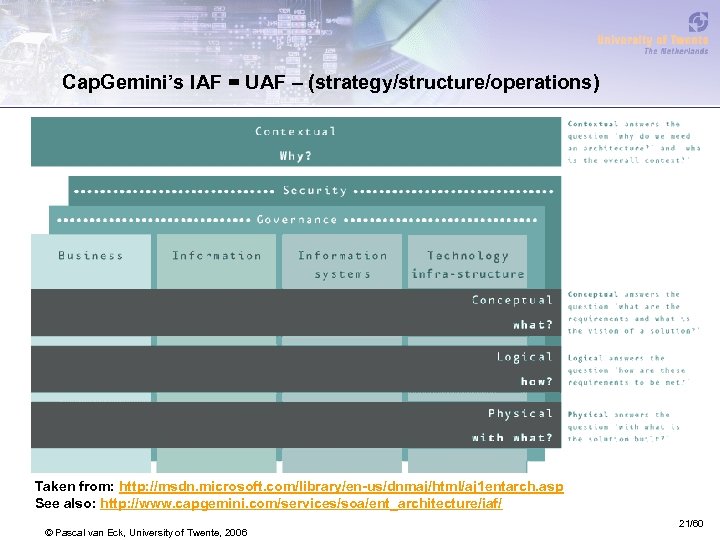 Cap. Gemini’s IAF = UAF – (strategy/structure/operations) Taken from: http: //msdn. microsoft. com/library/en-us/dnmaj/html/aj 1 entarch. asp See also: http: //www. capgemini. com/services/soa/ent_architecture/iaf/ © Pascal van Eck, University of Twente, 2006 21/60
 Validation case study What is alignment? Strategic Alignment Model (Henderson & Venkatraman) Extension: Unified Architecture Framework (Maes et al. ) Validation case study (Avison et al. ) Quantitative approach (e. g. , Tallon, Chan) Avison, D. , Jones, J. , Powell, P. , Wilson, D. (2004). Using and validating the strategic alignment model. J. Strat. Inf. Sys. 13: 223 -246. http: //dx. doi. org/10. 1016/j. jsis. 2004. 08. 002 GRAAL framework (Univ. Twente)
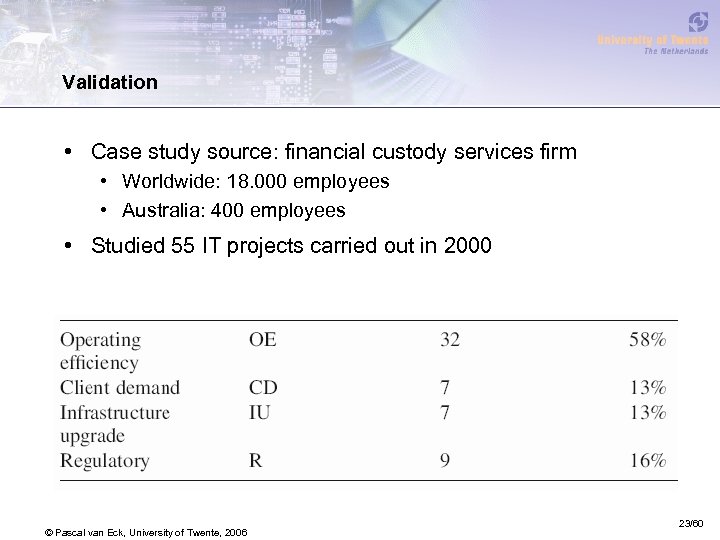 Validation • Case study source: financial custody services firm • Worldwide: 18. 000 employees • Australia: 400 employees • Studied 55 IT projects carried out in 2000 © Pascal van Eck, University of Twente, 2006 23/60
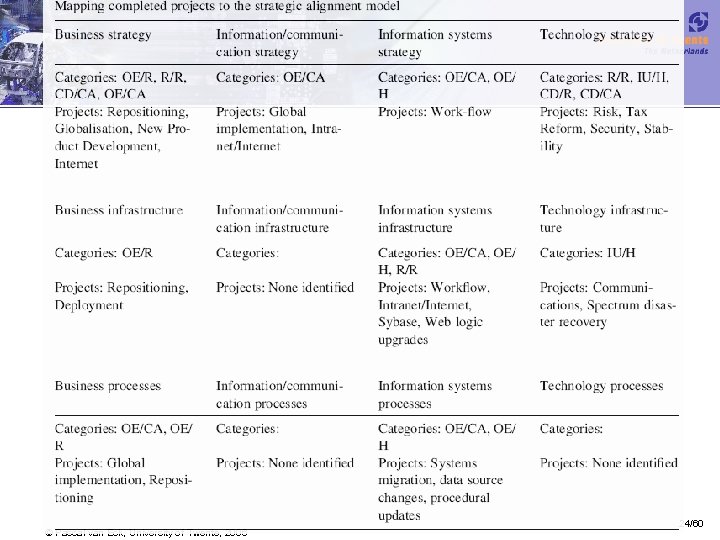 © Pascal van Eck, University of Twente, 2006 24/60
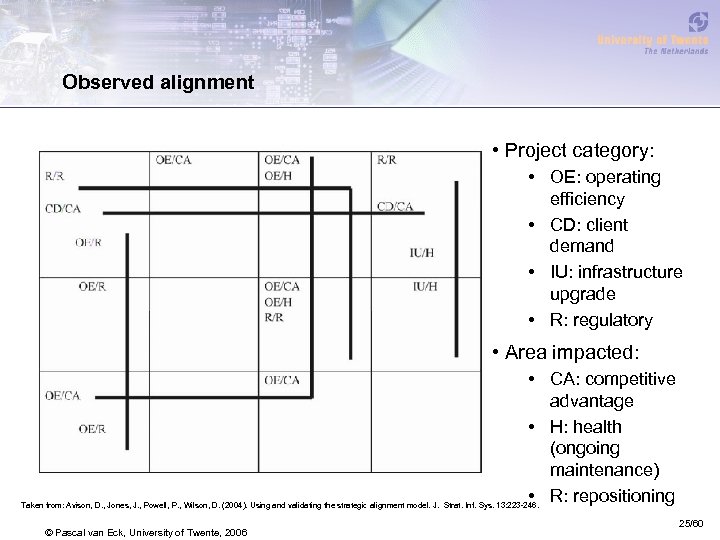 Observed alignment • Project category: • OE: operating efficiency • CD: client demand • IU: infrastructure upgrade • R: regulatory • Area impacted: • CA: competitive advantage • H: health (ongoing maintenance) • R: repositioning Taken from: Avison, D. , Jones, J. , Powell, P. , Wilson, D. (2004). Using and validating the strategic alignment model. J. Strat. Inf. Sys. 13: 223 -246. © Pascal van Eck, University of Twente, 2006 25/60
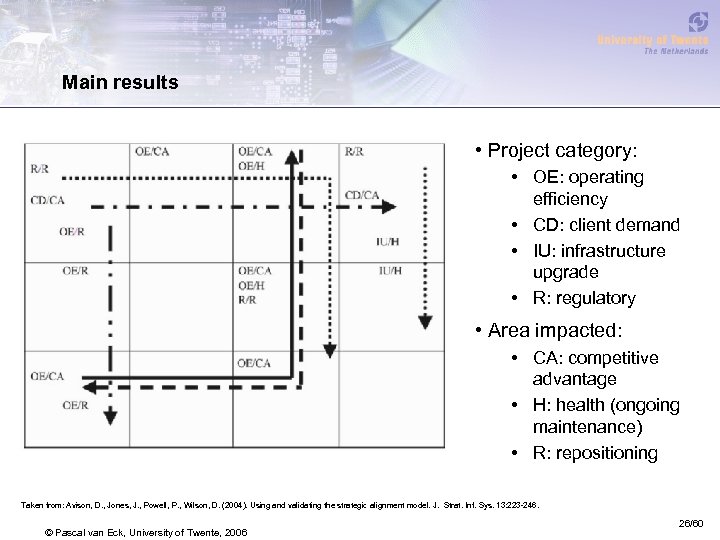 Main results • Project category: • OE: operating efficiency • CD: client demand • IU: infrastructure upgrade • R: regulatory • Area impacted: • CA: competitive advantage • H: health (ongoing maintenance) • R: repositioning Taken from: Avison, D. , Jones, J. , Powell, P. , Wilson, D. (2004). Using and validating the strategic alignment model. J. Strat. Inf. Sys. 13: 223 -246. © Pascal van Eck, University of Twente, 2006 26/60
 How to measure strategic alignment? The ‘American business What is alignment? Strategic Alignment Model (Henderson & Venkatraman) schools’ approach Extension: Unified Architecture Framework (Maes et al. ) Validation case study (Avison et al. ) Quantitative approach (e. g. , Tallon, Chan) Tallon, P. , Kraemer, K. (2003). Investigating the Relationship between Strategic Alignment and Business Value. Idea Publications, Hershy, PA, pp. 1 -22. GRAAL framework (Univ. Twente)
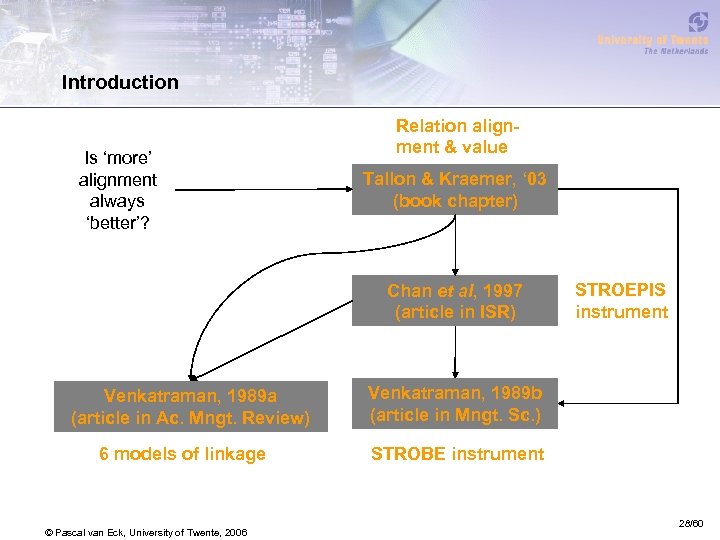 Introduction Is ‘more’ alignment always ‘better’? Relation alignment & value Tallon & Kraemer, ‘ 03 (book chapter) Chan et al, 1997 (article in ISR) Venkatraman, 1989 a (article in Ac. Mngt. Review) 6 models of linkage © Pascal van Eck, University of Twente, 2006 STROEPIS instrument Venkatraman, 1989 b (article in Mngt. Sc. ) STROBE instrument 28/60
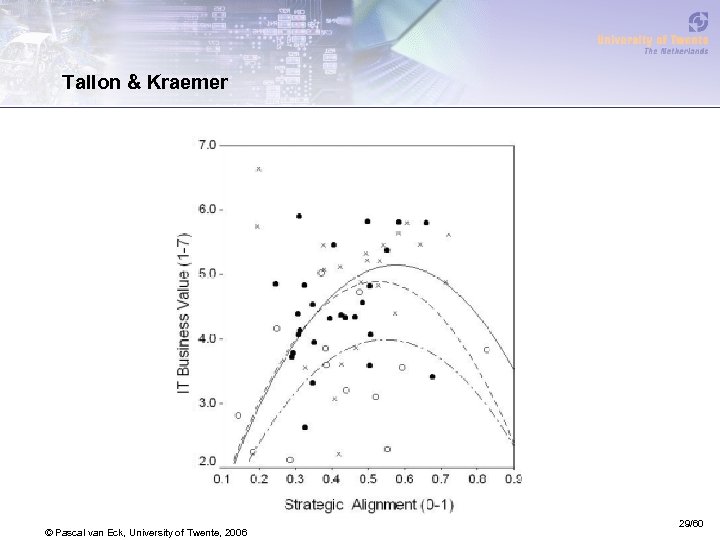 Tallon & Kraemer © Pascal van Eck, University of Twente, 2006 29/60
 Strategic alignment • Essence of the papers in my words: Strategic alignment is the extend to which the IT infrastructure of an organization supports its strategic orientation © Pascal van Eck, University of Twente, 2006 30/60
 Strategic orientation • What is it? • An attempt to operationalize the notion of strategy • How to measure it? • For instance using Venkatraman’s STROBE instrument • Reference: • Venkatraman, N. (1989 b). Strategic orientation of business enterprises: The construct, dimensionality, and measurement. Management Science, 35(8): 942 -962. © Pascal van Eck, University of Twente, 2006 31/60
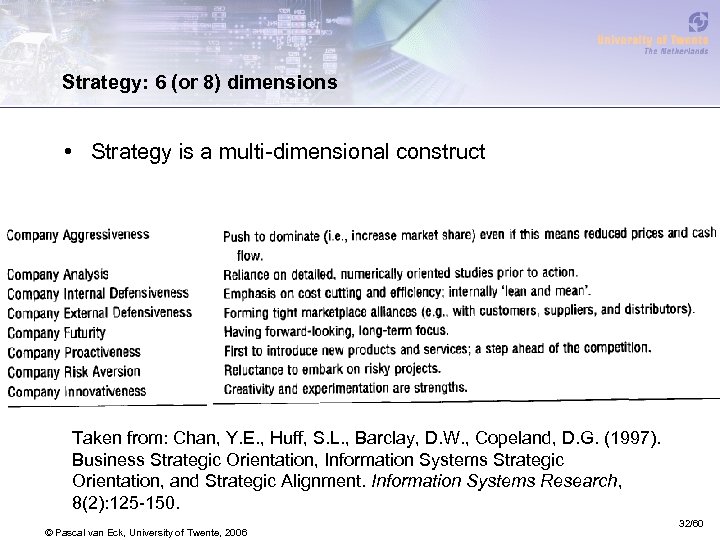 Strategy: 6 (or 8) dimensions • Strategy is a multi-dimensional construct Taken from: Chan, Y. E. , Huff, S. L. , Barclay, D. W. , Copeland, D. G. (1997). Business Strategic Orientation, Information Systems Strategic Orientation, and Strategic Alignment. Information Systems Research, 8(2): 125 -150. © Pascal van Eck, University of Twente, 2006 32/60
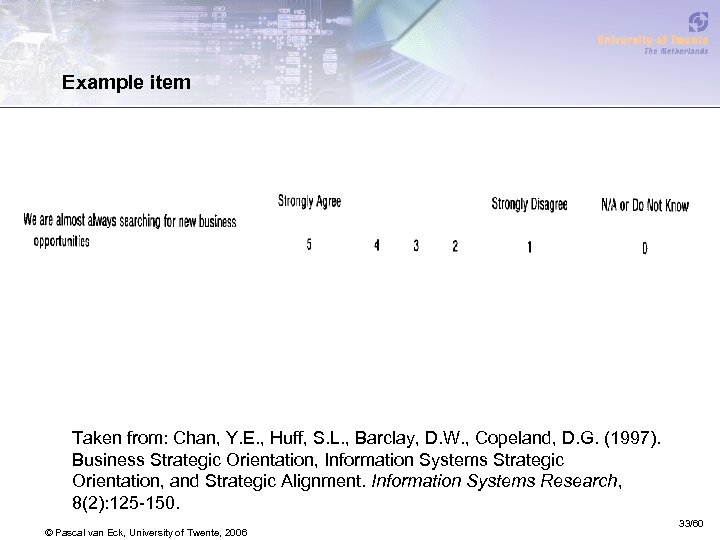 Example item Taken from: Chan, Y. E. , Huff, S. L. , Barclay, D. W. , Copeland, D. G. (1997). Business Strategic Orientation, Information Systems Strategic Orientation, and Strategic Alignment. Information Systems Research, 8(2): 125 -150. © Pascal van Eck, University of Twente, 2006 33/60
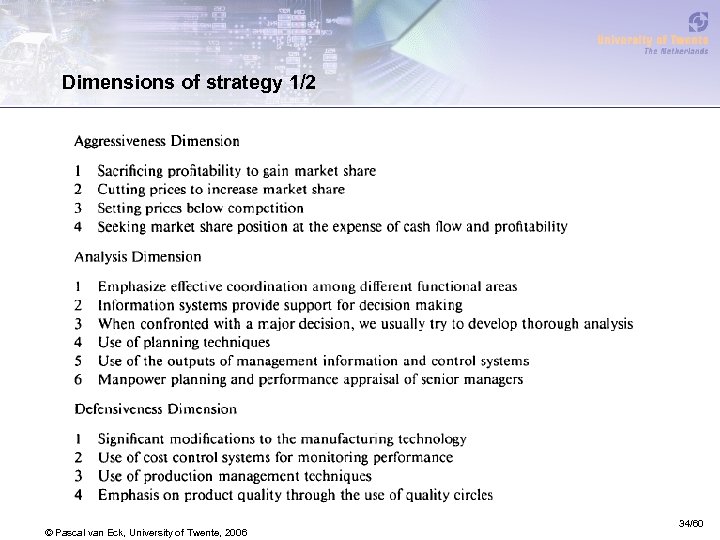 Dimensions of strategy 1/2 © Pascal van Eck, University of Twente, 2006 34/60
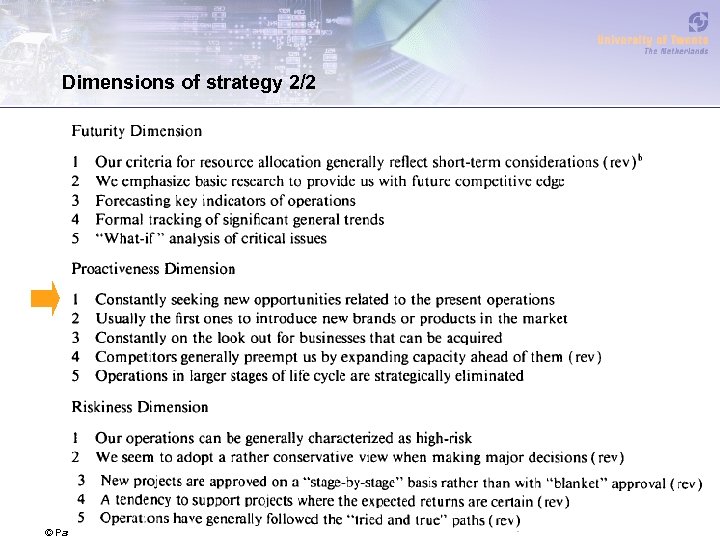 Dimensions of strategy 2/2 © Pascal van Eck, University of Twente, 2006 35/60
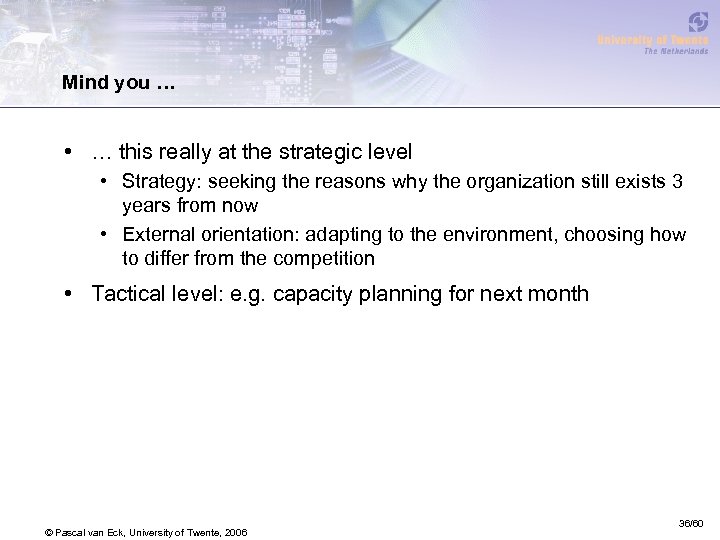 Mind you … • … this really at the strategic level • Strategy: seeking the reasons why the organization still exists 3 years from now • External orientation: adapting to the environment, choosing how to differ from the competition • Tactical level: e. g. capacity planning for next month © Pascal van Eck, University of Twente, 2006 36/60
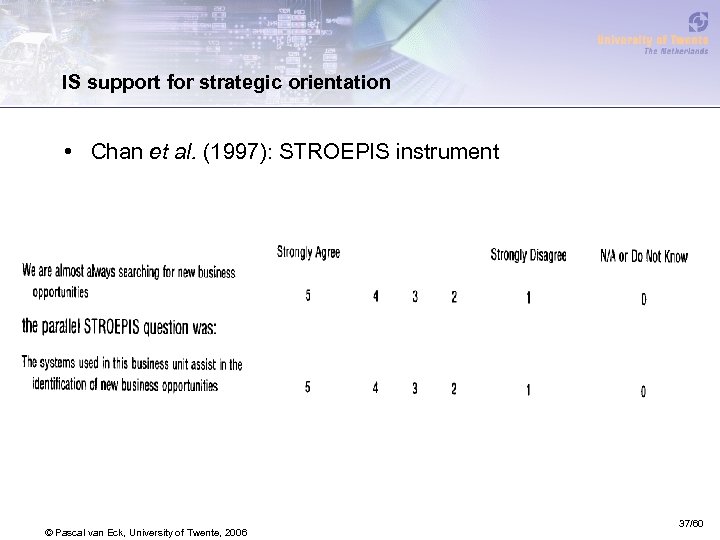 IS support for strategic orientation • Chan et al. (1997): STROEPIS instrument © Pascal van Eck, University of Twente, 2006 37/60
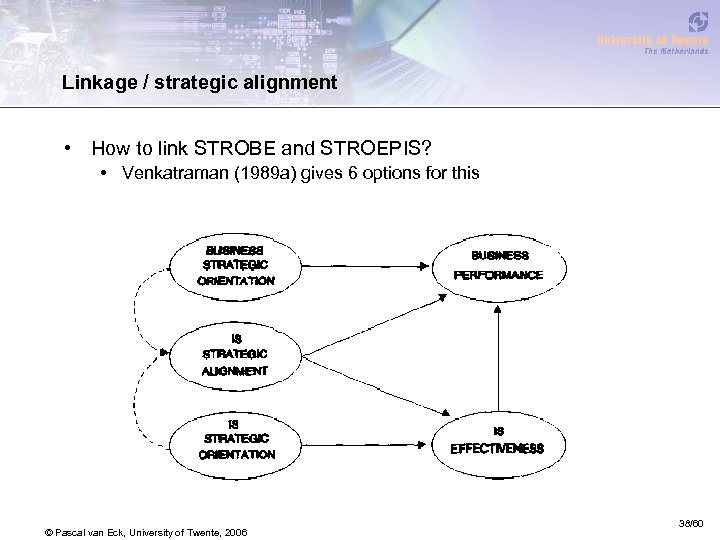 Linkage / strategic alignment • How to link STROBE and STROEPIS? • Venkatraman (1989 a) gives 6 options for this © Pascal van Eck, University of Twente, 2006 38/60
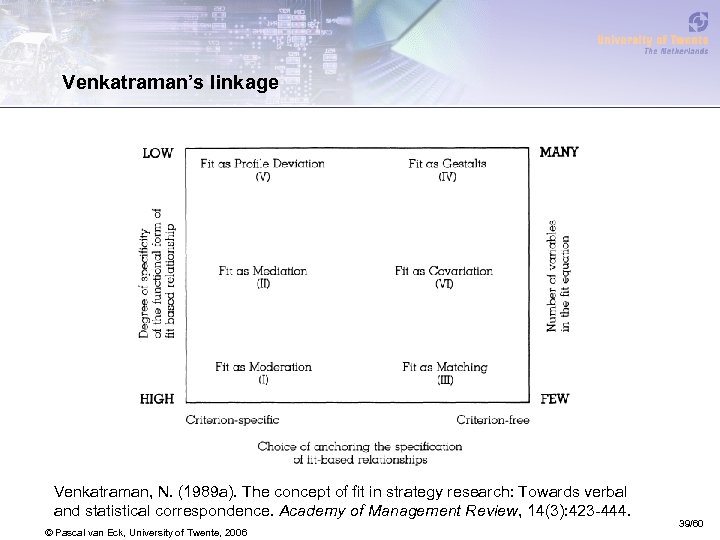 Venkatraman’s linkage Venkatraman, N. (1989 a). The concept of fit in strategy research: Towards verbal and statistical correspondence. Academy of Management Review, 14(3): 423 -444. © Pascal van Eck, University of Twente, 2006 39/60
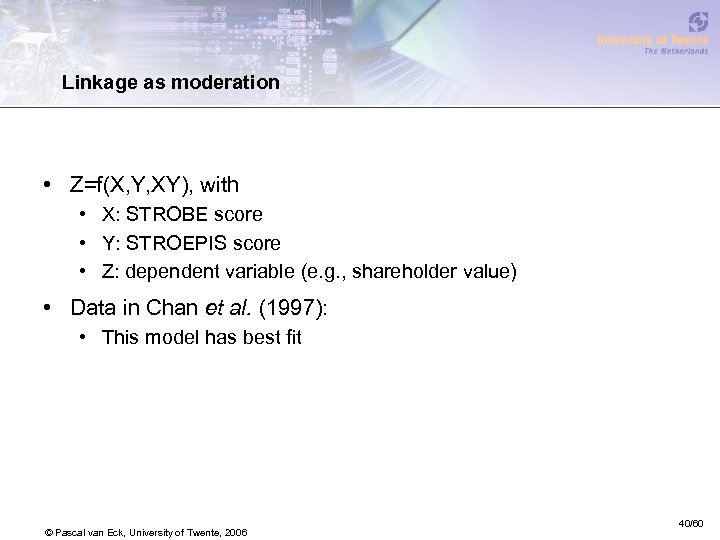 Linkage as moderation • Z=f(X, Y, XY), with • X: STROBE score • Y: STROEPIS score • Z: dependent variable (e. g. , shareholder value) • Data in Chan et al. (1997): • This model has best fit © Pascal van Eck, University of Twente, 2006 40/60
 Conclusion • Tallon & Kraemer’s book chapter • Similar approach, not enough detail • This community focuses on the strategic level exclusively • How about tactical and operational alignment? • You can only ask so much in a questionnaire © Pascal van Eck, University of Twente, 2006 41/60
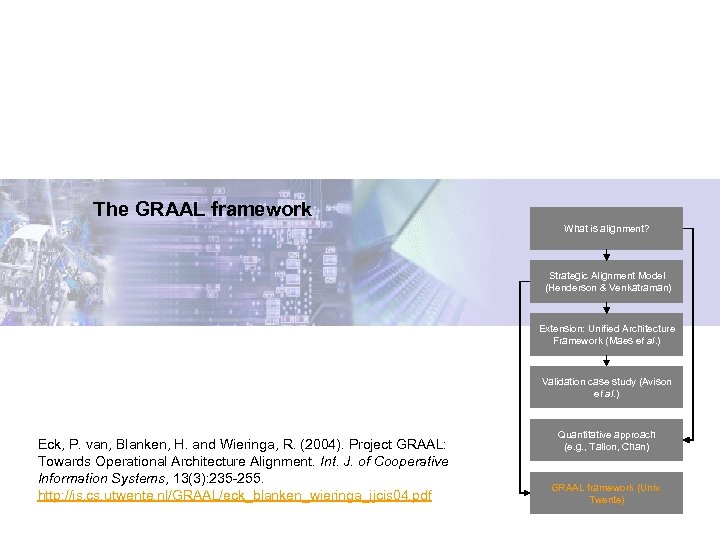 The GRAAL framework What is alignment? Strategic Alignment Model (Henderson & Venkatraman) Extension: Unified Architecture Framework (Maes et al. ) Validation case study (Avison et al. ) Eck, P. van, Blanken, H. and Wieringa, R. (2004). Project GRAAL: Towards Operational Architecture Alignment. Int. J. of Cooperative Information Systems, 13(3): 235 -255. http: //is. cs. utwente. nl/GRAAL/eck_blanken_wieringa_ijcis 04. pdf Quantitative approach (e. g. , Tallon, Chan) GRAAL framework (Univ. Twente)
 Project GRAAL • Guidelines Regarding Architecture ALignment • Goal: discovery of patterns in enterprise-level application architecture • Based on case studies in Dutch financial service organizations and large government organizations Project page: http: //graal. ewi. utwente. nl © Pascal van Eck, University of Twente, 2006 43/60
 What is a system? • A system is an assembly of components that behaves as a whole • There is synergy between components … • … and this synergy results in emergent properties • A product is a system with properties that are useful for someone • Examples • The system of law • The Dutch national soccer team uses a 3 -3 -4 system • ‘A systematic way of working’ © Pascal van Eck, University of Twente, 2006 44/60
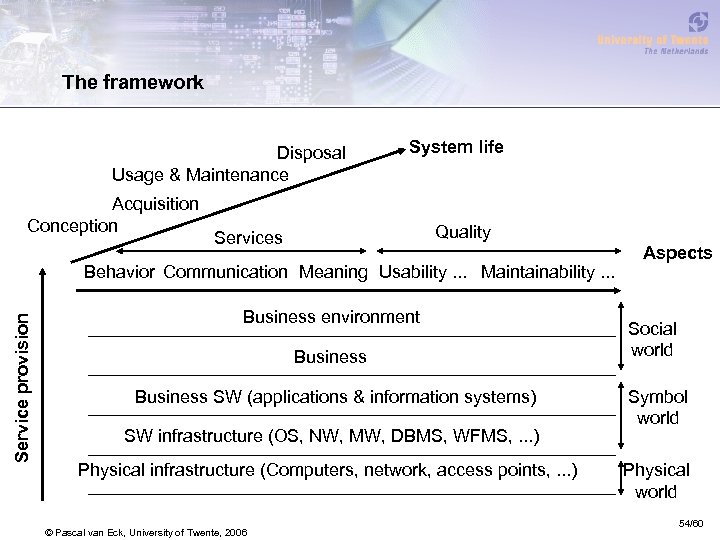
 System dimensions • System aspects: externally observable properties • Aggregation hierarchy: system composition in terms of components • System life cycle: from conception to disposal © Pascal van Eck, University of Twente, 2006 45/60
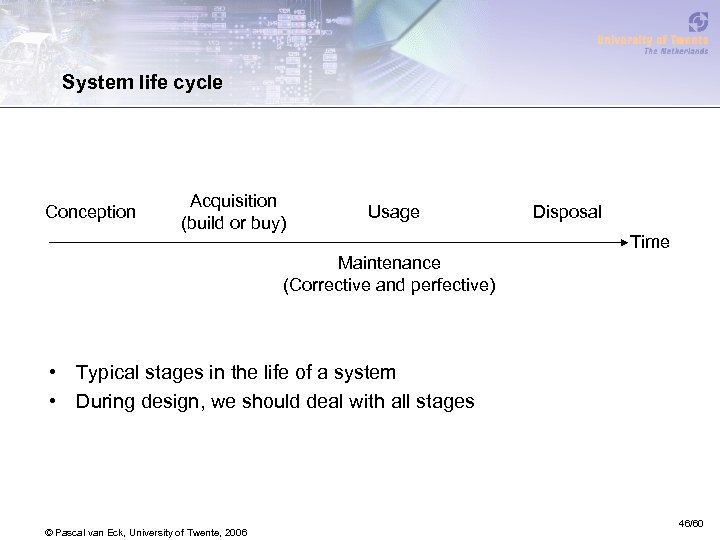 System life cycle Conception Acquisition (build or buy) Usage Disposal Time Maintenance (Corrective and perfective) • Typical stages in the life of a system • During design, we should deal with all stages © Pascal van Eck, University of Twente, 2006 46/60
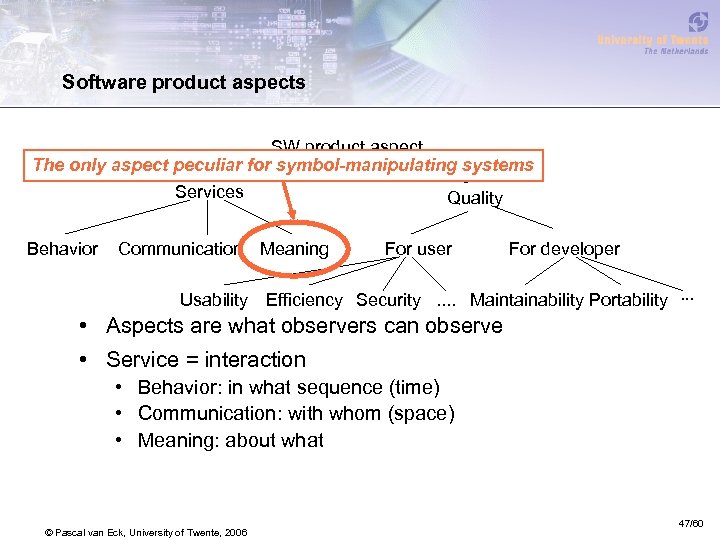 Software product aspects SW product aspect The only aspect peculiar for symbol-manipulating systems Services Behavior Communication Meaning Quality For user For developer Usability Efficiency Security. . Maintainability Portability. . . • Aspects are what observers can observe • Service = interaction • Behavior: in what sequence (time) • Communication: with whom (space) • Meaning: about what © Pascal van Eck, University of Twente, 2006 47/60
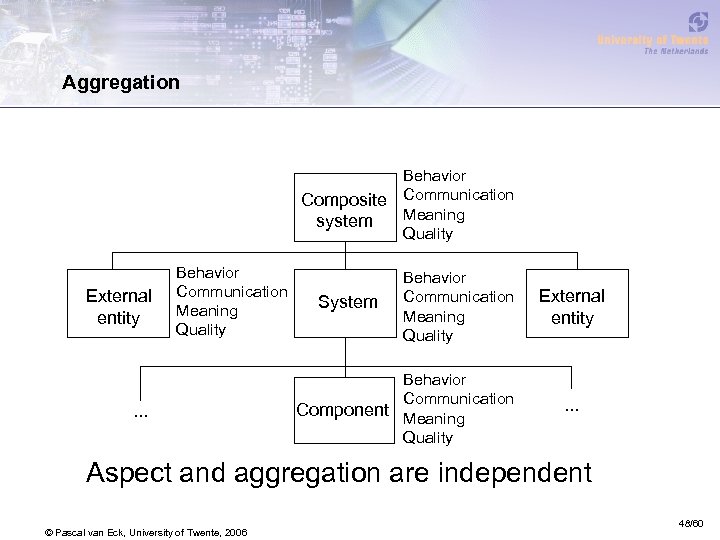 Aggregation Behavior Composite Communication Meaning system Quality External entity Behavior Communication Meaning Quality . . . System Behavior Communication Meaning Quality Behavior Communication Component Meaning Quality External entity . . . Aspect and aggregation are independent © Pascal van Eck, University of Twente, 2006 48/60
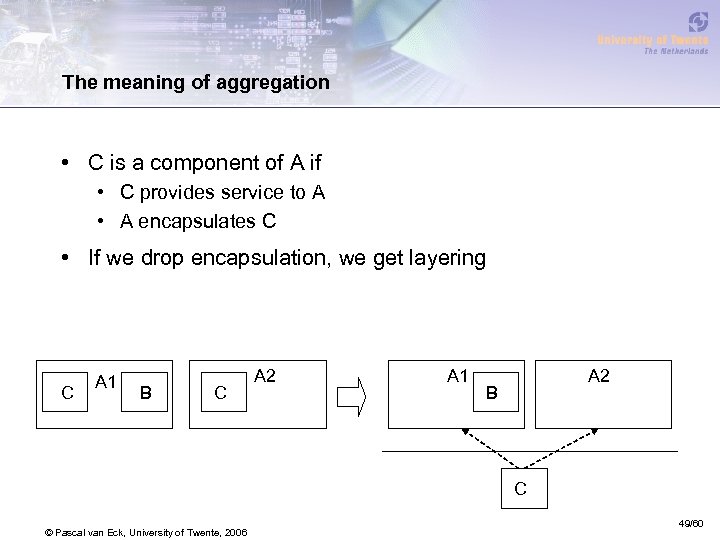 The meaning of aggregation • C is a component of A if • C provides service to A • A encapsulates C • If we drop encapsulation, we get layering C A 1 B C A 2 A 1 A 2 B C © Pascal van Eck, University of Twente, 2006 49/60
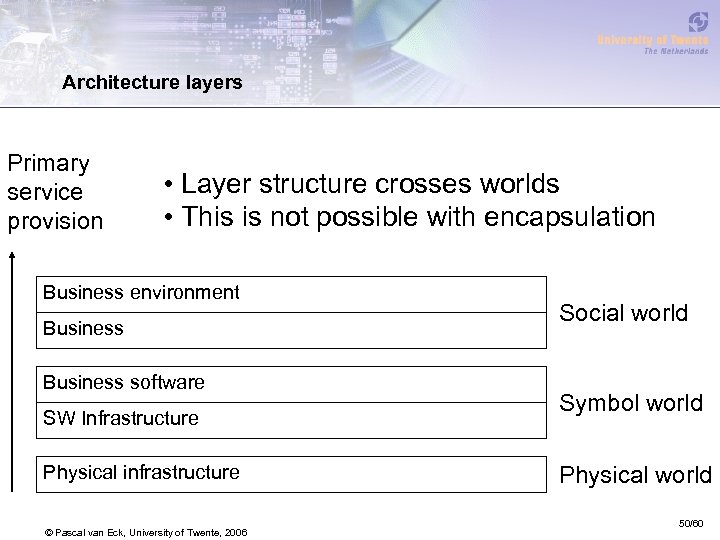 Architecture layers Primary service provision • Layer structure crosses worlds • This is not possible with encapsulation Business environment Business software SW Infrastructure Physical infrastructure © Pascal van Eck, University of Twente, 2006 Social world Symbol world Physical world 50/60
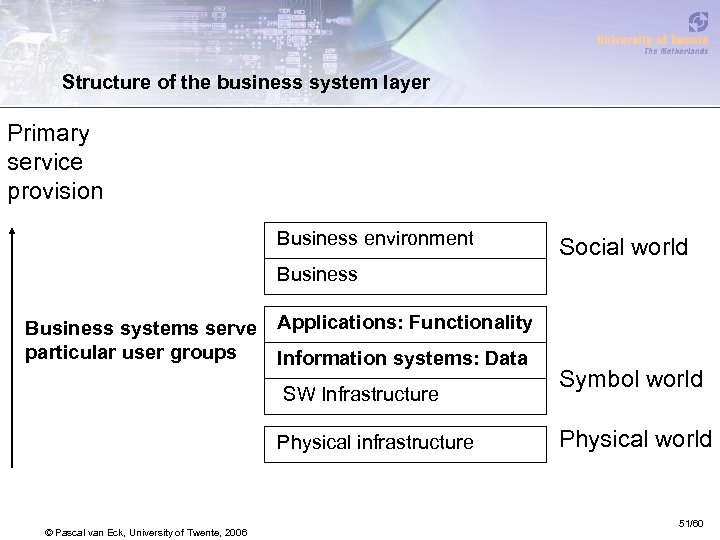 Structure of the business system layer Primary service provision Business environment Social world Business systems serve Applications: Functionality particular user groups Information systems: Data SW Infrastructure Physical infrastructure © Pascal van Eck, University of Twente, 2006 Symbol world Physical world 51/60
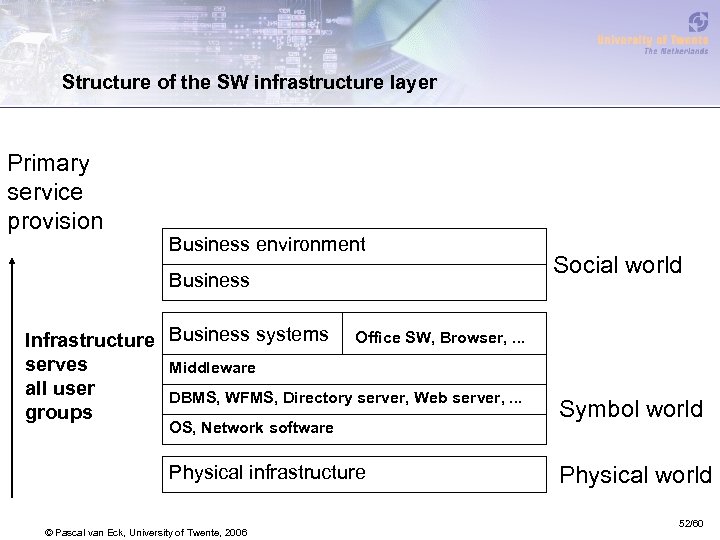 Structure of the SW infrastructure layer Primary service provision Business environment Business Infrastructure Business systems Office SW, Browser, . . . serves Middleware all user DBMS, WFMS, Directory server, Web server, . . . groups OS, Network software Physical infrastructure © Pascal van Eck, University of Twente, 2006 Social world Symbol world Physical world 52/60
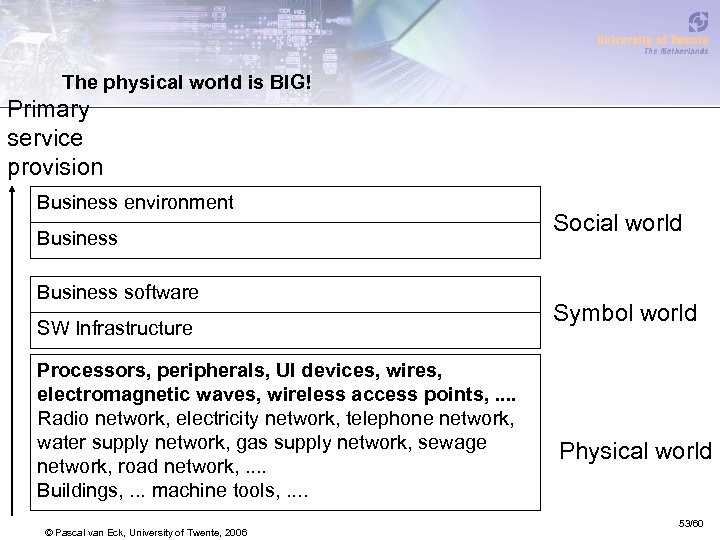 The physical world is BIG! Primary service provision Business environment Business software SW Infrastructure Processors, peripherals, UI devices, wires, electromagnetic waves, wireless access points, . . Radio network, electricity network, telephone network, water supply network, gas supply network, sewage network, road network, . . Buildings, . . . machine tools, . . © Pascal van Eck, University of Twente, 2006 Social world Symbol world Physical world 53/60
 The framework Disposal Usage & Maintenance Acquisition Conception System life Quality Services Service provision Behavior Communication Meaning Usability. . . Maintainability. . . Business environment Business SW (applications & information systems) SW infrastructure (OS, NW, MW, DBMS, WFMS, . . . ) Physical infrastructure (Computers, network, access points, . . . ) © Pascal van Eck, University of Twente, 2006 Aspects Social world Symbol world Physical world 54/60
 Documents studied © Pascal van Eck, University of Twente, 2006 55/60
 Four alignment perspectives Taken from: Henderson, & Venkatraman, (1993). Strategic alignment: Leveraging information technology for transforming organisations. IBM Systems Journal, 32(1): 472 -484. © Pascal van Eck, University of Twente, 2006 56/60
 Two perspectives Business strategy 2 IT strategy 1 2 Business processes Business infrastructure © Pascal van Eck, University of Twente, 2006 1 IT applications IT infrastructure 57/60
 Conclusion What is alignment? Strategic Alignment Model (Henderson & Venkatraman) Extension: Unified Architecture Framework (Maes et al. ) Validation case study (Avison et al. ) Quantitative approach (e. g. , Tallon, Chan) GRAAL framework (Univ. Twente)
 Some closing remarks Alignment = a struggle Practice Validation = hard Research © Pascal van Eck, University of Twente, 2006 Tools A framework = a to-do lists Alignment = requirements engineering? Relation with Computer Science 59/60
 Thanks! Pascal van Eck Department of Computer Science University of Twente P. O. Box 217 7500 AE Enschede The Netherlands p. vaneck@utwente. nl http: //www. cs. utwente. nl/~patveck © Pascal van Eck, University of Twente, 2006 60/60