 Скачать презентацию Arab Israeli Conflict 1948 -2014 History of
bc7bab980986e74a311dc302fedde2de.ppt
- Количество слайдов: 33



Arab Israeli Conflict 1948 -2014
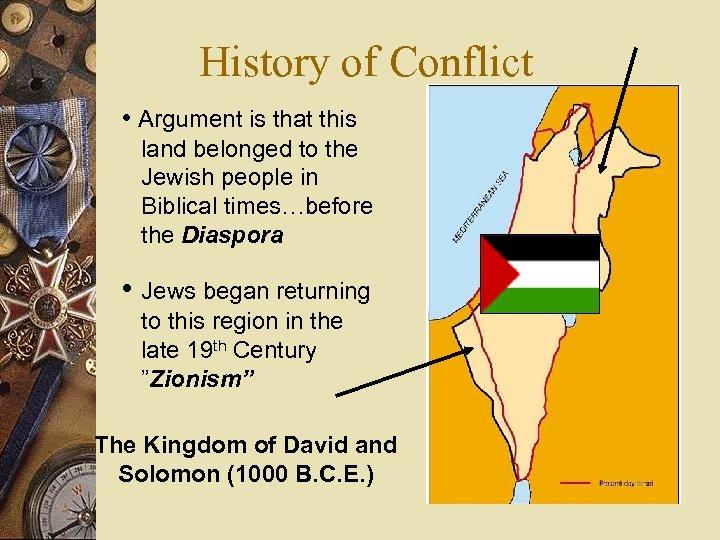
History of Conflict • Argument is that this land belonged to the Jewish people in Biblical times…before the Diaspora • Jews began returning to this region in the late 19 th Century ”Zionism” The Kingdom of David and Solomon (1000 B. C. E. )
Existence of Israel w The Jewish people believe this land is their birth right w Jewish opponents of Arab claims to the region say the Arab tribes have done little to improve the Holy Land during their occupation w 1917 – Balfour Declaration: Britain allowed a Jewish Homeland w Zionist resettlement – implication of increased Jewish migration and access to this land.
Existence of Palestine w The land had been abandoned by the Jewish people. w Arabs had controlled land since fall of Roman Empire w Fall of Ottoman Empire led to Palestinian nationalist to call for independent homeland. w Continued settlement of Jewish people in Palestinian areas creates a situation where a Palestinian state cannot become a reality.
1 st Arab Israeli War w Background of war comes from British and UN promises to set up Jewish homeland in Palestine w Partition set to go into effect on May 14, 1948 w Arabs refuse to agree to plan
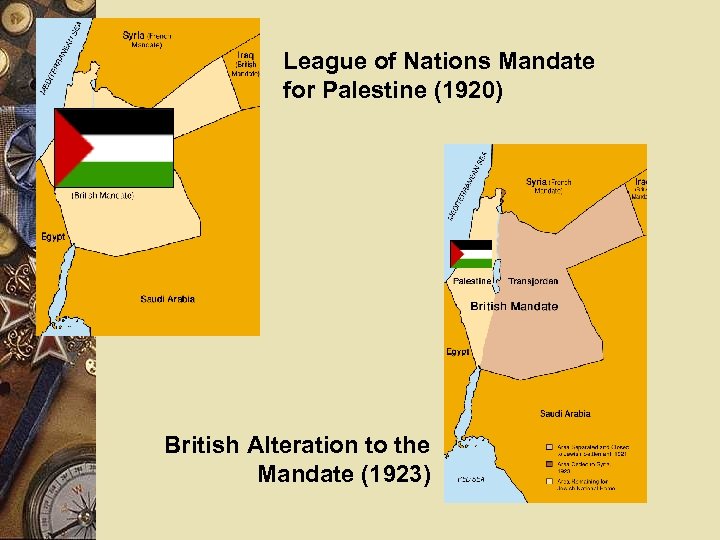
League of Nations Mandate for Palestine (1920) British Alteration to the Mandate (1923)
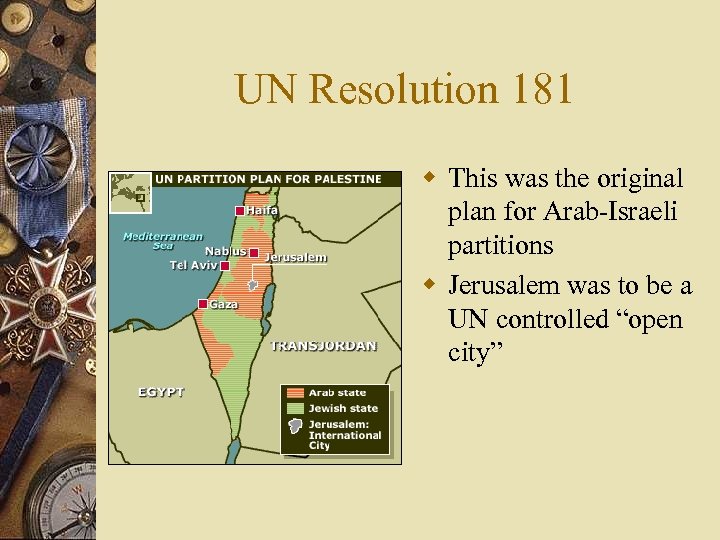
UN Resolution 181 w This was the original plan for Arab-Israeli partitions w Jerusalem was to be a UN controlled “open city”
The 1948 War w May 15, 1948 w Arabs: Egypt, Syria, Saudi Arabia, Lebanon, Jordan and Iraq w Arab states outnumber Israelis, but lack coordination w All have designs on adding territory to their nations
1948 War con’t w Fighting continued until Jan. , 1949 w Israel got all Palestine except West Bank (Jordan) and Gaza (Egypt) w Cease fire agreements drawn up between Israel and all Arab nations involved w No actual peace treaties signed
1956 Suez Crisis w Early 1950’s, Egypt begins blocking Israeli ships from passing through the Suez Canal w 1956 - Egyptian president Gamal Abdel Nasser nationalizes Suez Canal w France, Britain and Israel launch military attacks on Egypt.
1956 Suez Crisis w France and Britain gain control of Suez Canal w Israel conquers Sinai Peninsula and Gaza Strip w UN negotiates cease fire, takes control of Suez Canal w US pressures Israel to withdraw from Sinai and Gaza
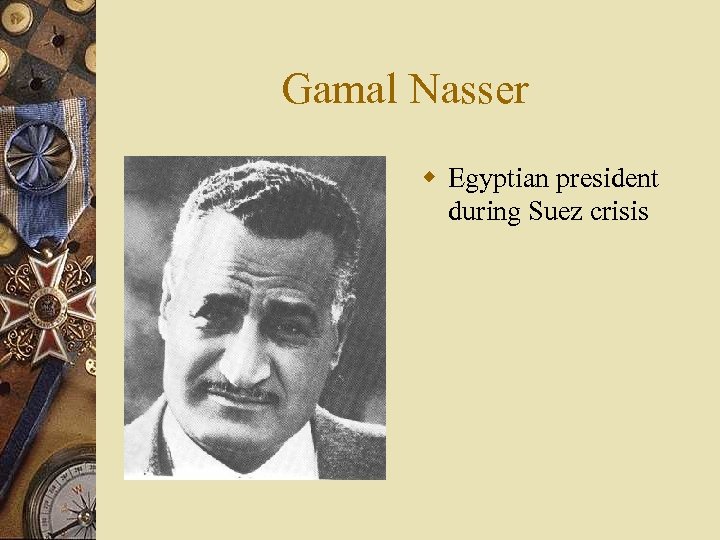
Gamal Nasser w Egyptian president during Suez crisis
Six-Day War w June 5 -10, 1967 w Israel attacked Egypt and Syria in a pre-emptive strike w By June 10, Israel had control of Sinai Peninsula, Gaza Strip and Golan Heights and West Bank w Although Israel appealed to Jordan to stay neutral, Jordan attacked Israel and lost West Bank
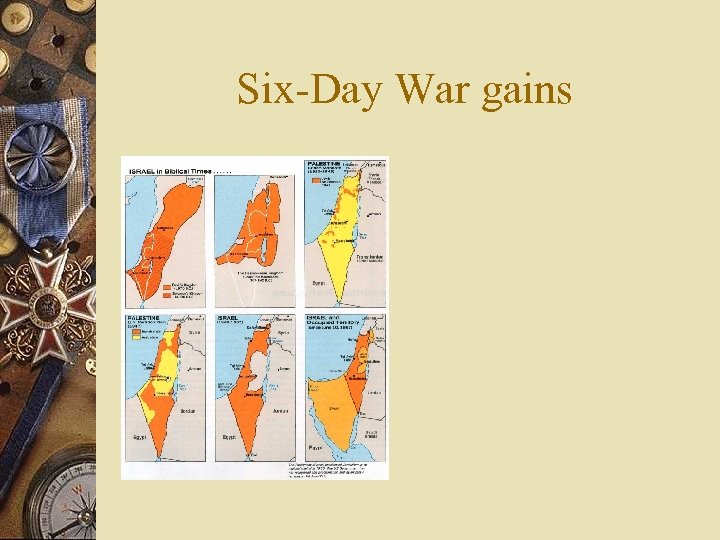
Six-Day War gains
Background of Yom Kippur War w After 6 Day War, Arab nations meet in Khartoum, Sudan w Khartoum Resolution: 3 No’s (no peace, no negotiation, no recognition of Israel) w Egypt begins random shelling and raids of Israeli positions in Sinai between 19681970.
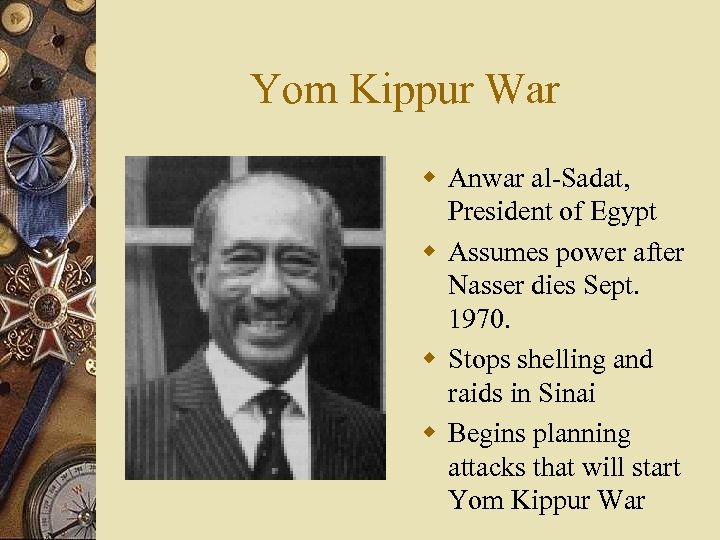
Yom Kippur War w Anwar al-Sadat, President of Egypt w Assumes power after Nasser dies Sept. 1970. w Stops shelling and raids in Sinai w Begins planning attacks that will start Yom Kippur War
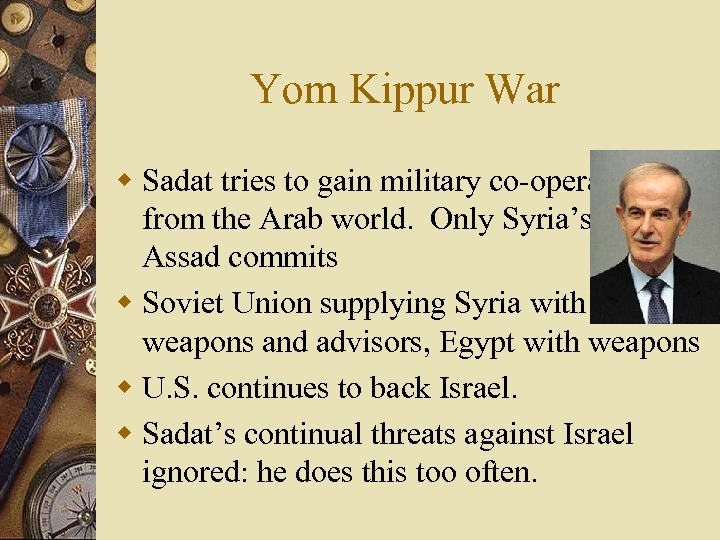
Yom Kippur War w Sadat tries to gain military co-operation from the Arab world. Only Syria’s Pres. Assad commits w Soviet Union supplying Syria with weapons and advisors, Egypt with weapons w U. S. continues to back Israel. w Sadat’s continual threats against Israel ignored: he does this too often.
Yom Kippur War w Israel warned of reality of Sadat’s war threats from multiple sources (including former enemy King Hussein of Jordan) w Ignored warnings w Egypt and Syria launch joint attack in the morning hours of Oct 6, 1973
Yom Kippur War w Egypt/Syria initially make huge gains w By Oct. 14, Israel counterattacks and reverses gains made by Syria/Egypt. w Efforts by Soviets and U. S. to resupply their allies almost leads to war between the U. S. and U. S. S. R. w By Oct. 25, cease fire negotiated. Israel reversed losses and made new gains
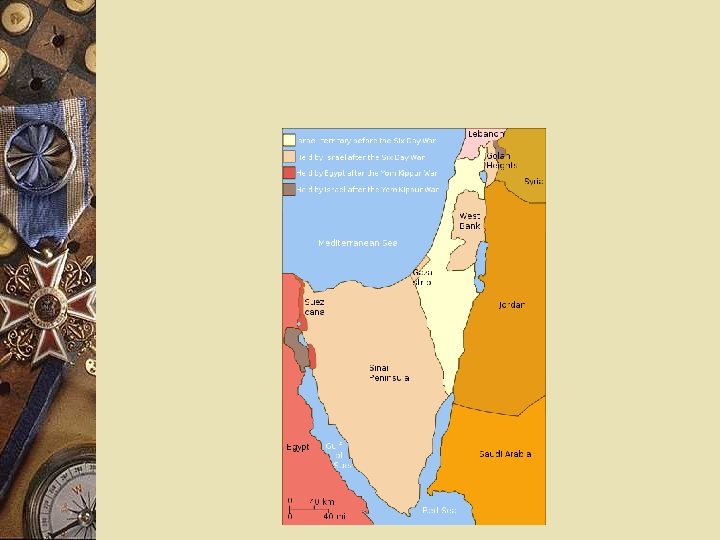
War’s Aftermath w Israel agrees to withdraw from Egypt and Syria (only 63 and 41 miles from respective capitals) w Israel agrees to pull back to Sinai and Golan Heights regions w POW’s exchanged
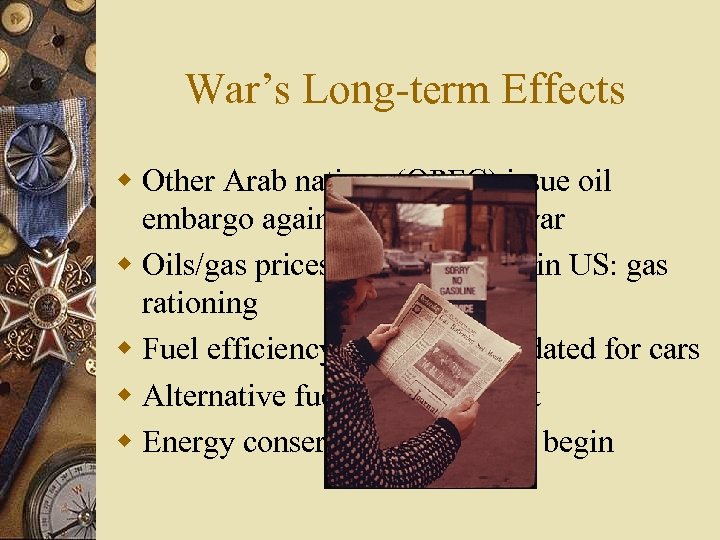
War’s Long-term Effects w Other Arab nations (OPEC) issue oil embargo against U. S. during war w Oils/gas prices jump by 300% in US: gas rationing w Fuel efficiency standards mandated for cars w Alternative fuel sources sought w Energy conservation programs begin
UN Res. 242 w Arab states agree to Israel’s right to “live within secure and recognized borders free from threats or acts of force”. w Called for Israel to withdraw from territories conquered in 1967 war. w Used as basis for all Arab-Israeli negotiations
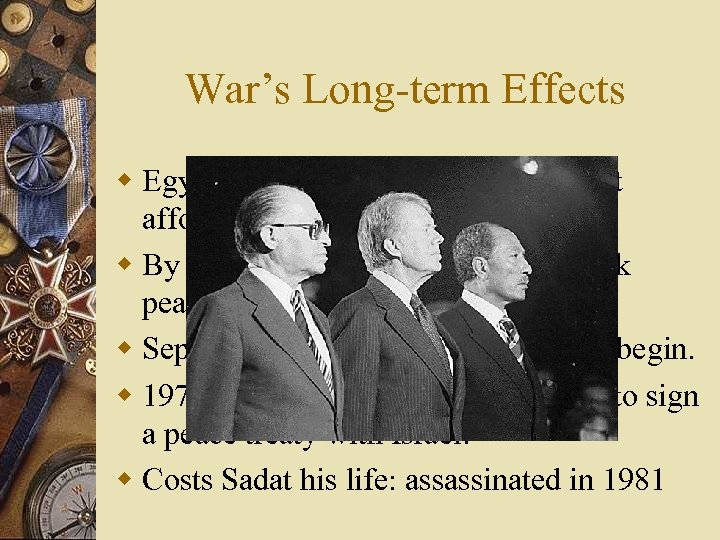
War’s Long-term Effects w Egyptian Pres. Sadat realizes he can’t afford more conflict with Israel w By 1977, Sadat says he’s ready to talk peace with Israel w Sept. 1978, Camp David Peace talks begin. w 1979: Egypt become 1 st Arab nation to sign a peace treaty with Israel. w Costs Sadat his life: assassinated in 1981
Recent Peace Plans w Oslo (1993): Set the framework for modern requirements for Palestinian state w Won Israeli PM Yitzhak Rabin and PLO leader Yasser Arafat Nobel Peace Prize w Lead to assassination of Rabin in 1995
Conflict Today w Peace process begins in earnest in 1993 at Oslo w Big disagreement over West Bank settlements and Jerusalem w Palestinian leadership split between Fatah (West Bank) and Hamas (Gaza Strip) w Current leadership: Israel: Benjamin Netanyahu, Palestine : Mahmoud Abbas
Current Peace Process w Problem (Palestinian): Conflict cause by creation of Israel w Moderate approach: Two-state system. Recognize Israel’s right to exist in exchange for Gaza Strip and West Bank w Extremists view: Destroy Israel to regain Palestinian lands
Current Peace Process w Problem (Israeli): Began in 1948 or 1967 (Six Day War) w Moderates: Give up some control of occupied territories (W. Bank, Gaza Strip, Golan Heights) in return for end to violence. w Extremists: No territory given up, or at most, Gaza Strip. Israel maintains sovereignty over all areas it occupies currently
Current Peace Process w U. S. viewpoint: Israel should give up some of land conquered in 6 Day War. w Palestinians must “actively” prevent violence against Israel w Palestinians acknowledge Israel’s right to exist w From Clinton through Obama, U. S. presidents hold view of Palestinian state out of current Palestinian territories
So what’s holding it up? w Borders/division of land w Status of Jerusalem w Israeli security concerns w Palestinian concerns about West Bank settlements w Right of return (Palestinians) w Years of longstanding negative emotions
Recent Peace Plans w Camp David Summit (2000): offered all of Gaza and 90% of West Bank as Palestinian state, but Israel keeps control of Jerusalem w Rejected by Arafat w “Road Map for Peace” (2002): Put together by U. S. , EU, UN and Russia w Palestinians stop attacks on Israelis, Israel dismantle settlements in West Bank/Gaza w So far, only Israeli pull out of Gaza (2005), but are increasing military presence in the area again
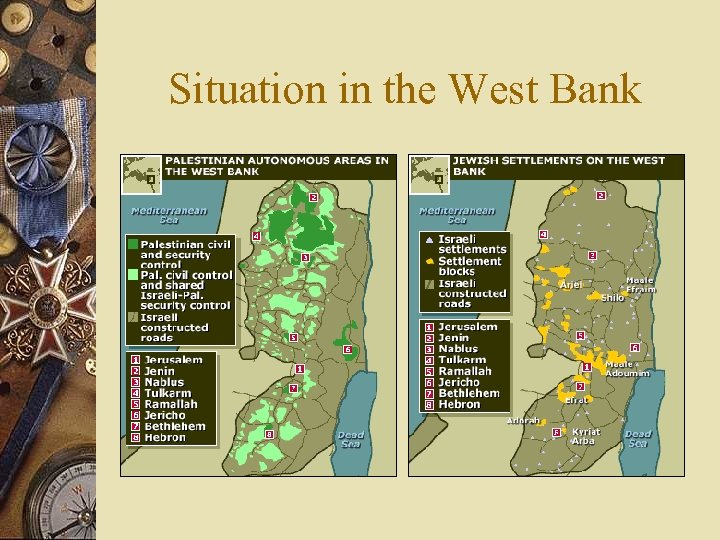
Situation in the West Bank
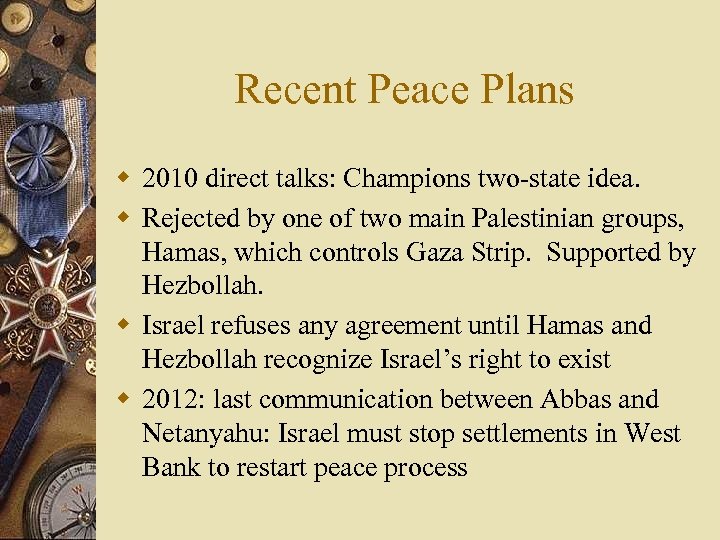
Recent Peace Plans w 2010 direct talks: Champions two-state idea. w Rejected by one of two main Palestinian groups, Hamas, which controls Gaza Strip. Supported by Hezbollah. w Israel refuses any agreement until Hamas and Hezbollah recognize Israel’s right to exist w 2012: last communication between Abbas and Netanyahu: Israel must stop settlements in West Bank to restart peace process
Скачать презентацию Arab Israeli Conflict 1948 -2014 History of
bc7bab980986e74a311dc302fedde2de.ppt