 Скачать презентацию Arab Governance Week Social Accountability in a Changing
df45543d892b88d9d36f8dfdd418f239.ppt
- Количество слайдов: 14



Arab Governance Week Social Accountability in a Changing Region Actors and Mechanisms The Integrity Toolkit for Palestinian Local Government Units. Could it be used as a Two Folded Social Accountability Tool? Ibrahim Bisharat Birzeit University November 26 -29, Cairo Empowered lives. Resilient nations.
Social Accountability in o. Pt General Introduction • 1967 -1995 The Civil Society was the main provider of service delivery and holding the Israeli Occupation accountable for the abuse of the human rights of the Palestinian people. • 1995 -2012 the political will for accountability was manifested by: 1. Horizontal accountability • Legislations of Basic Law, Elections Law, Money Laundry Law, Consumers Protection Law, Anticorruption Law, Standards and Specifications Law. • The establishment of the Human Rights Independent Commission in 1995 followed by the establishment of the State Audit and internal monitoring and complains departments in the PA institutions, and PACC in 2010 and the human rights department at the Police in 2011 2. Vertical Accountability • Holding and Monitoring PLC in 1996 and 2005, and holding Local Elections in the West Bank in 2004/2005 and 2012
Review of the Toolkit Development Empowered lives. Resilient nations. Background on the Development of the Toolkit: The toolkit was developed in 2007 -2008 in full participatory approach between UNDP/PAPP , three selected municipalities, Ministry of Local Government (Mo. LG)and Association of Palestinian Local Authorities (APLA). It was tested and piloted in 16 municipalities in 2008 and 4 municipalities in 2010. Toolkit Purposes: 1. Improving the quality of services provision of the municipalities 2. Holding the municipalities accountable to their constituencies 3. Increasing the role of the citizens in the policy making process of the municipalities 4. Increasing the municipalities transparency 5. Increasing the integrity of the municipalities

Review of the Toolkit Development Cont’d Empowered lives. Resilient nations. 1. 2. 3. 4. 5. The Structure of the Toolkit Questionnaires targeting the municipality and its employees (weight 35%), Focus group discussions of citizens, civil society organizations and contractors (weight 20%), Revision and verification of public documents and records (weight 20%), Interviews of Municipal Officials/State Audit (weight 10%), Questionnaire for citizens and public audience (weight 15%).
Review of the Toolkit Development Cont’d The toolkit aims at measuring the following: 1. The quality of performance of the LGU with reference to integrity, transparency and accountability, as well as its relations with citizens; 2. The level of responsiveness of the LGU to the needs and rights of citizens; 3. The availability of procedures and mechanisms to promote integrity and fight corruption and abuse, as well as to promote transparency; 4. The extent to which the public is able to question the LGU and evaluate its performance; 5. The degree of the compliance by the LGU with prevailing laws and regulations.
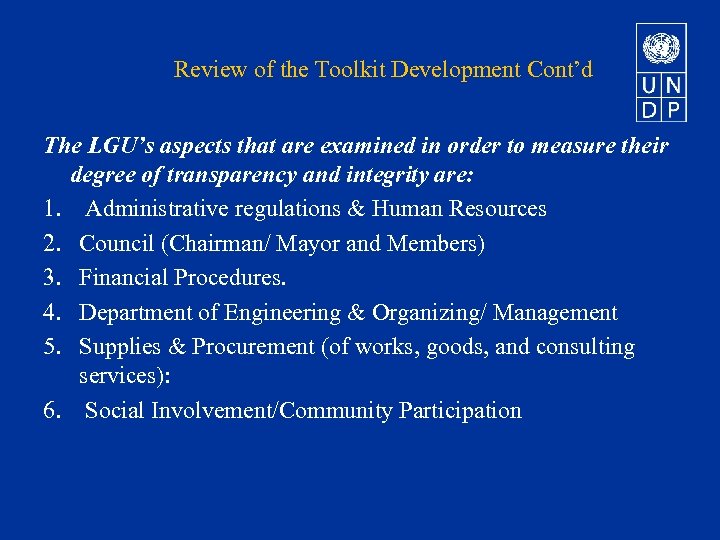
Review of the Toolkit Development Cont’d The LGU’s aspects that are examined in order to measure their degree of transparency and integrity are: 1. Administrative regulations & Human Resources 2. Council (Chairman/ Mayor and Members) 3. Financial Procedures. 4. Department of Engineering & Organizing/ Management 5. Supplies & Procurement (of works, goods, and consulting services): 6. Social Involvement/Community Participation
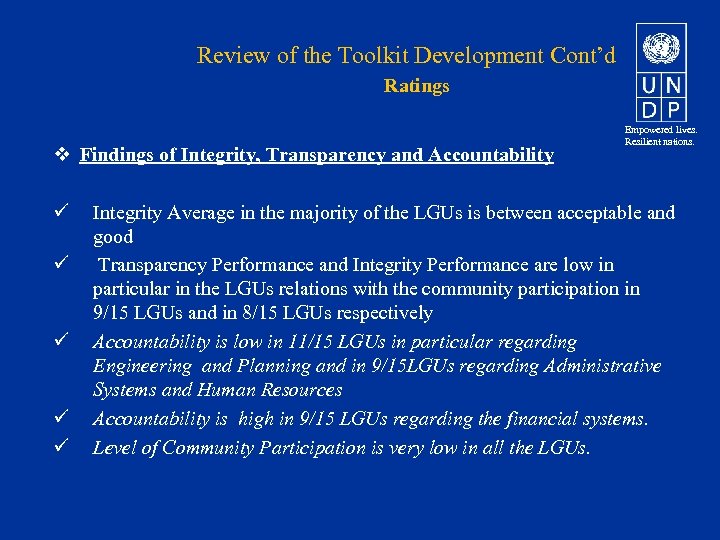
Review of the Toolkit Development Cont’d Ratings v Findings of Integrity, Transparency and Accountability ü ü ü Empowered lives. Resilient nations. Integrity Average in the majority of the LGUs is between acceptable and good Transparency Performance and Integrity Performance are low in particular in the LGUs relations with the community participation in 9/15 LGUs and in 8/15 LGUs respectively Accountability is low in 11/15 LGUs in particular regarding Engineering and Planning and in 9/15 LGUs regarding Administrative Systems and Human Resources Accountability is high in 9/15 LGUs regarding the financial systems. Level of Community Participation is very low in all the LGUs.
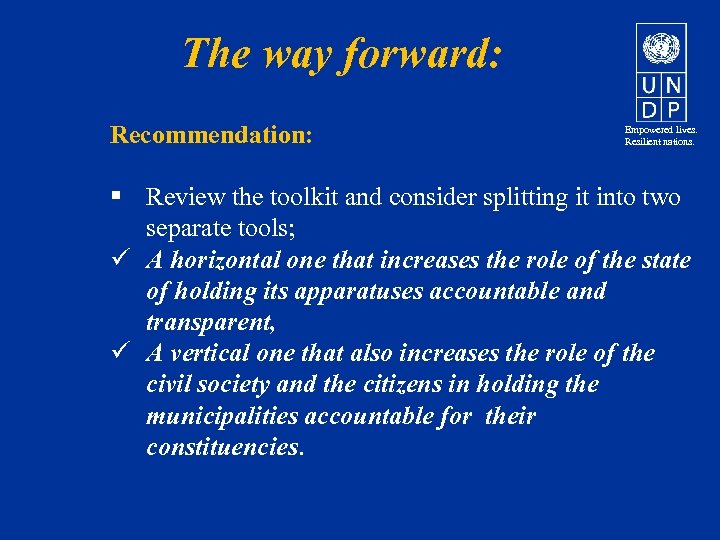
The way forward: Recommendation: Empowered lives. Resilient nations. § Review the toolkit and consider splitting it into two separate tools; ü A horizontal one that increases the role of the state of holding its apparatuses accountable and transparent, ü A vertical one that also increases the role of the civil society and the citizens in holding the municipalities accountable for their constituencies.
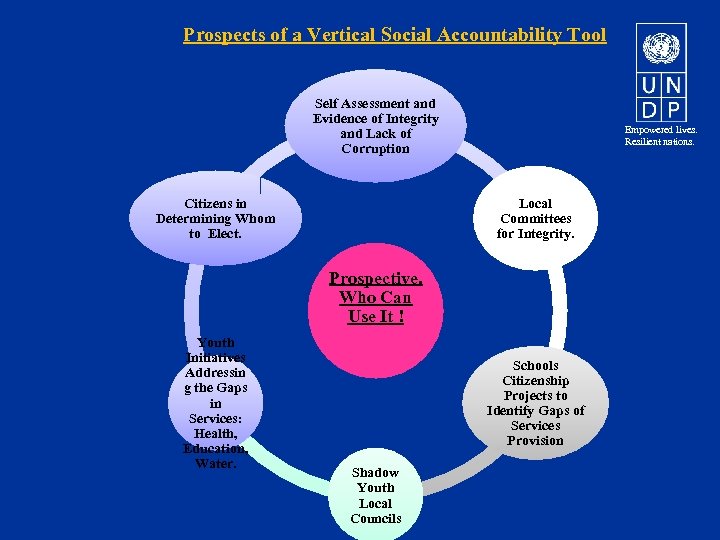
Prospects of a Vertical Social Accountability Tool Self Assessment and Evidence of Integrity and Lack of Corruption Citizens in Determining Whom to Elect. Empowered lives. Resilient nations. Local Committees for Integrity. Prospective. Who Can Use It ! Youth Initiatives Addressin g the Gaps in Services: Health, Education, Water. Schools Citizenship Projects to Identify Gaps of Services Provision Shadow Youth Local Councils
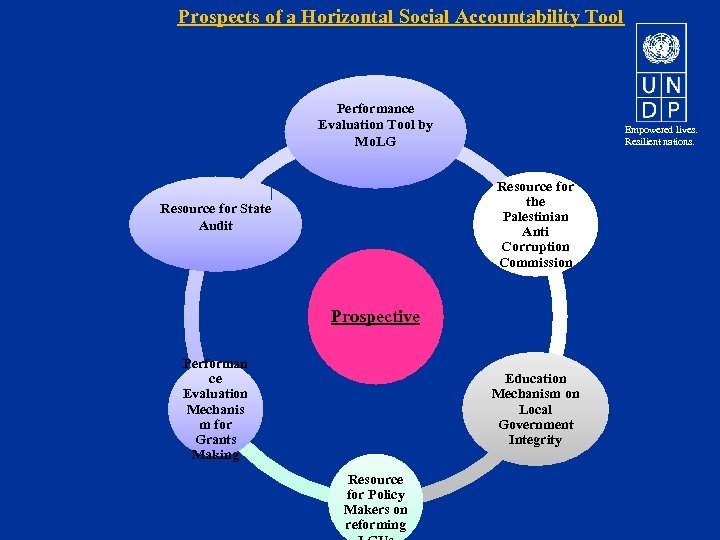
Prospects of a Horizontal Social Accountability Tool Performance Evaluation Tool by Mo. LG Empowered lives. Resilient nations. Resource for the Palestinian Anti Corruption Commission Resource for State Audit Prospective Performan ce Evaluation Mechanis m for Grants Making Education Mechanism on Local Government Integrity Resource for Policy Makers on reforming
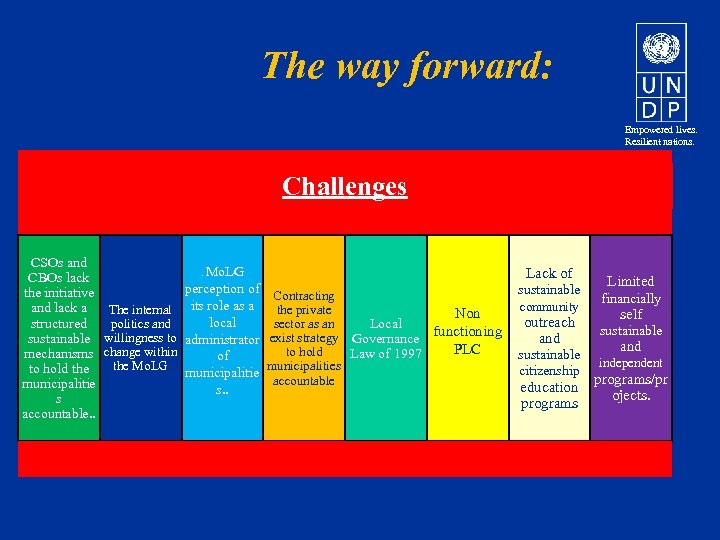
The way forward: Empowered lives. Resilient nations. Challenges CSOs and CBOs lack the initiative and lack a structured sustainable mechanisms to hold the municipalitie s accountable. . . Mo. LG The internal politics and willingness to change within the Mo. LG Lack of Limited perception of sustainable Contracting financially its role as a the private community Non self local outreach Local sector as an sustainable functioning and administrator exist strategy Governance and PLC to hold Law of 1997 sustainable of independent citizenship municipalities programs/pr accountable education s. . ojects. programs
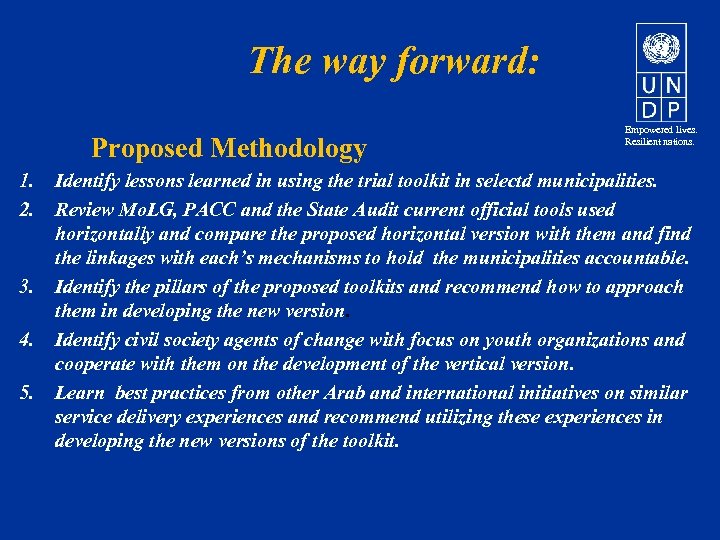
The way forward: Proposed Methodology 1. 2. 3. 4. 5. Empowered lives. Resilient nations. Identify lessons learned in using the trial toolkit in selectd municipalities. Review Mo. LG, PACC and the State Audit current official tools used horizontally and compare the proposed horizontal version with them and find the linkages with each’s mechanisms to hold the municipalities accountable. Identify the pillars of the proposed toolkits and recommend how to approach them in developing the new version. Identify civil society agents of change with focus on youth organizations and cooperate with them on the development of the vertical version. Learn best practices from other Arab and international initiatives on similar service delivery experiences and recommend utilizing these experiences in developing the new versions of the toolkit.
Questions & Answers
Empowered lives. Resilient nations.
Скачать презентацию Arab Governance Week Social Accountability in a Changing
df45543d892b88d9d36f8dfdd418f239.ppt