


 Скачать презентацию AR for Horn clause logic Introducing Unification
b904798ff46cd78a3fe14e82a94d98fc.ppt
- Количество слайдов: 27
 AR for Horn clause logic Introducing: Unification
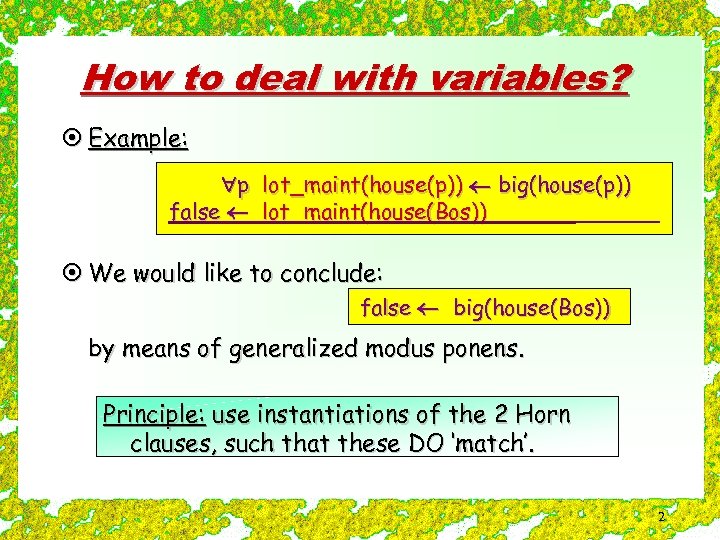 How to deal with variables? ¤ Example: p lot_maint(house(p)) big(house(p)) false lot_maint(house(Bos)) ¤ We would like to conclude: false big(house(Bos)) by means of generalized modus ponens. Principle: use instantiations of the 2 Horn clauses, such that these DO ‘match’. 2
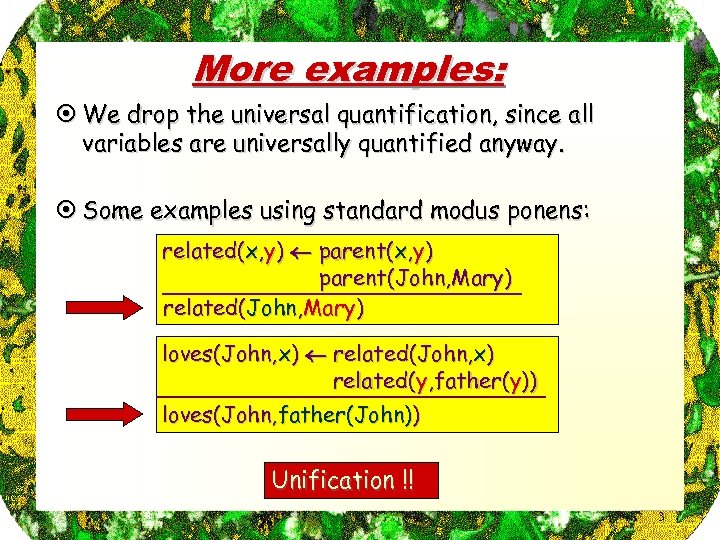 More examples: ¤ We drop the universal quantification, since all variables are universally quantified anyway. ¤ Some examples using standard modus ponens: related(x, y) parent(x, y) parent(John, Mary) related(John, Mary) loves(John, x) related(John, x) related(y, father(y)) loves(John, father(John)) Unification !! 3
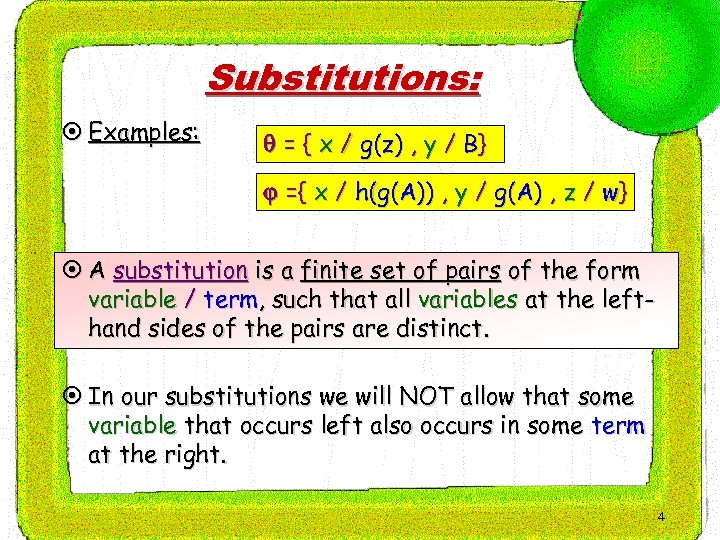 Substitutions: ¤ Examples: = { x / g(z) , y / B} ={ x / h(g(A)) , y / g(A) , z / w} ¤ A substitution is a finite set of pairs of the form variable / term, such that all variables at the lefthand sides of the pairs are distinct. ¤ In our substitutions we will NOT allow that some variable that occurs left also occurs in some term at the right. 4
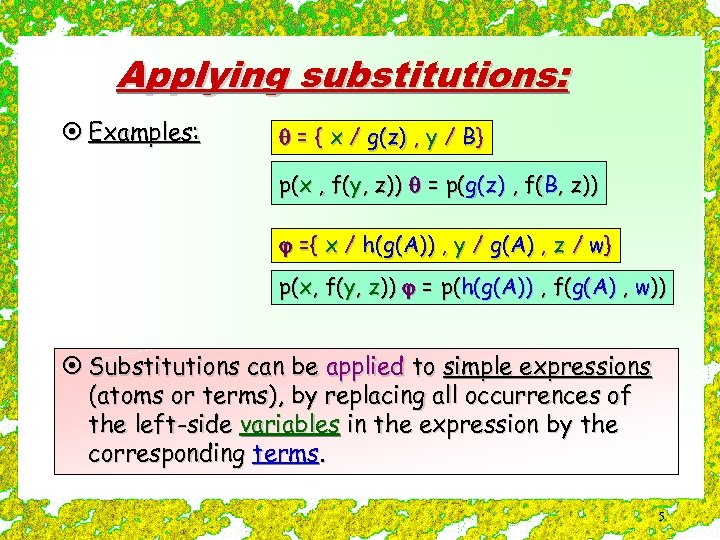 Applying substitutions: ¤ Examples: = { x / g(z) , y / B} p(x , f(y, z)) = p(g(z) , f(B, z)) ={ x / h(g(A)) , y / g(A) , z / w} p(x, f(y, z)) = p(h(g(A)) , f(g(A) , w)) ¤ Substitutions can be applied to simple expressions (atoms or terms), by replacing all occurrences of the left-side variables in the expression by the corresponding terms. 5
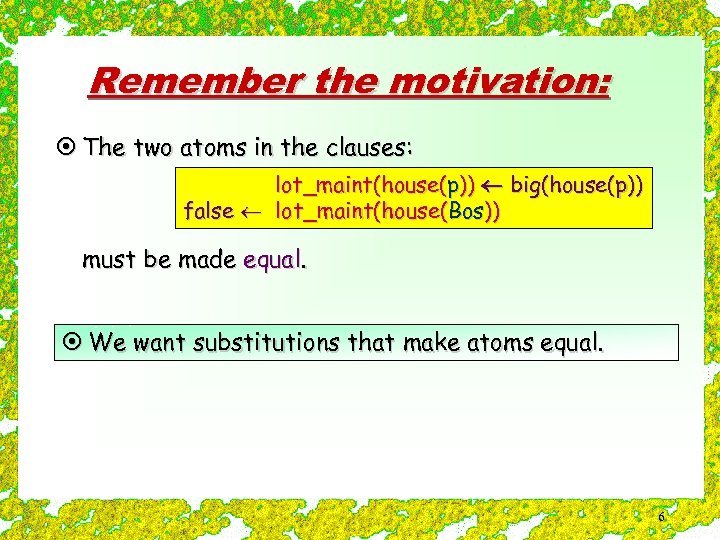 Remember the motivation: ¤ The two atoms in the clauses: lot_maint(house(p)) big(house(p)) false lot_maint(house(Bos)) must be made equal. ¤ We want substitutions that make atoms equal. 6
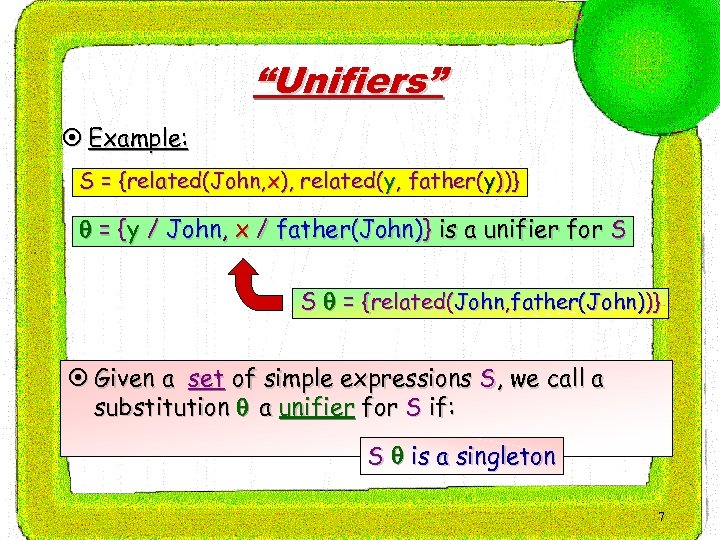 “Unifiers” ¤ Example: S = {related(John, x), related(y, father(y))} = {y / John, x / father(John)} is a unifier for S S = {related(John, father(John))} ¤ Given a set of simple expressions S, we call a substitution a unifier for S if: S is a singleton 7
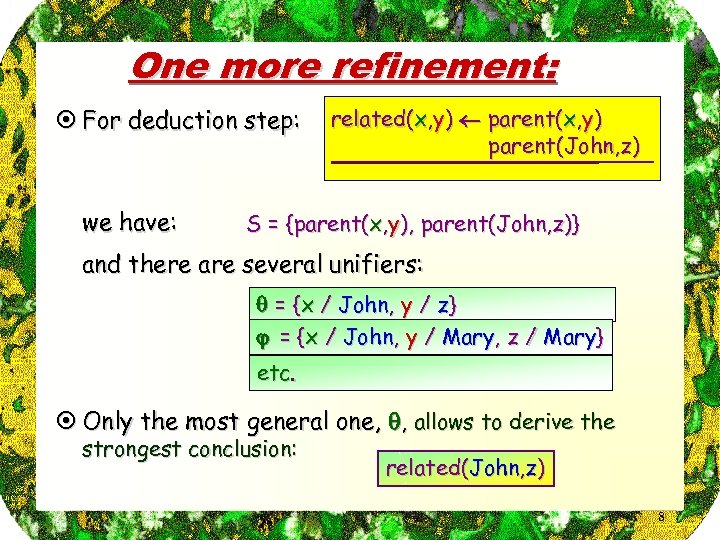 One more refinement: ¤ For deduction step: we have: related(x, y) parent(x, y) parent(John, z) S = {parent(x, y), parent(John, z)} and there are several unifiers: = {x / John, y / z} = {x / John, y / Mary, z / Mary} etc. ¤ Only the most general one, , allows to derive the strongest conclusion: related(John, z) 8
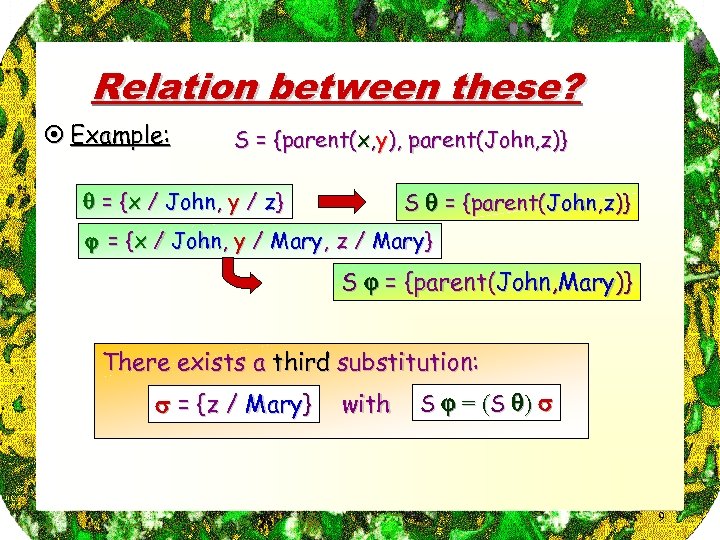 Relation between these? ¤ Example: S = {parent(x, y), parent(John, z)} = {x / John, y / z} S = {parent(John, z)} = {x / John, y / Mary, z / Mary} S = {parent(John, Mary)} There exists a third substitution: = {z / Mary} with S = (S ) 9
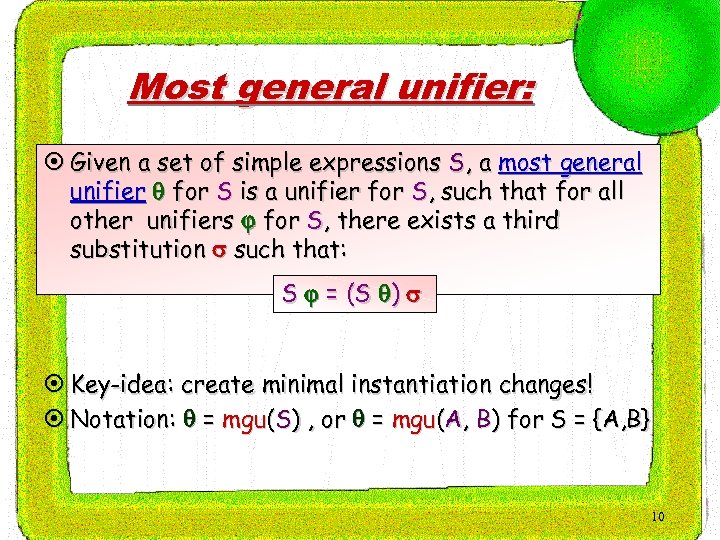 Most general unifier: ¤ Given a set of simple expressions S, a most general unifier for S is a unifier for S, such that for all other unifiers for S, there exists a third substitution such that: S = (S ) ¤ Key-idea: create minimal instantiation changes! ¤ Notation: = mgu(S) , or = mgu(A, B) for S = {A, B} 10
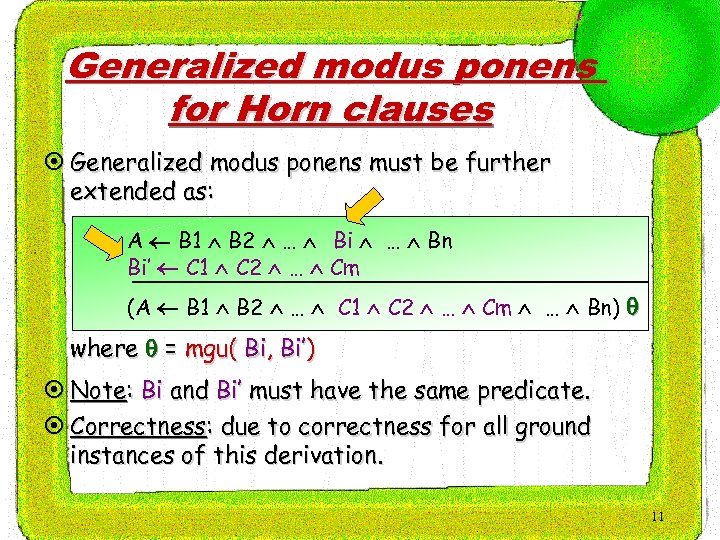 Generalized modus ponens for Horn clauses ¤ Generalized modus ponens must be further extended as: A B 1 B 2 … Bi … Bn Bi’ C 1 C 2 … Cm (A B 1 B 2 … C 1 C 2 … Cm … Bn) where = mgu( Bi, Bi’) ¤ Note: Bi and Bi’ must have the same predicate. ¤ Correctness: due to correctness for all ground instances of this derivation. 11
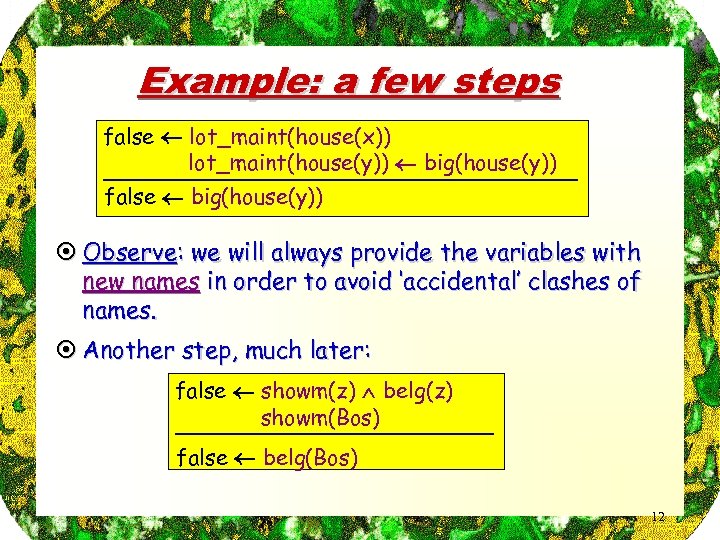 Example: a few steps false lot_maint(house(x)) lot_maint(house(y)) big(house(y)) false big(house(y)) ¤ Observe: we will always provide the variables with new names in order to avoid ‘accidental’ clashes of names. ¤ Another step, much later: false showm(z) belg(z) showm(Bos) false belg(Bos) 12
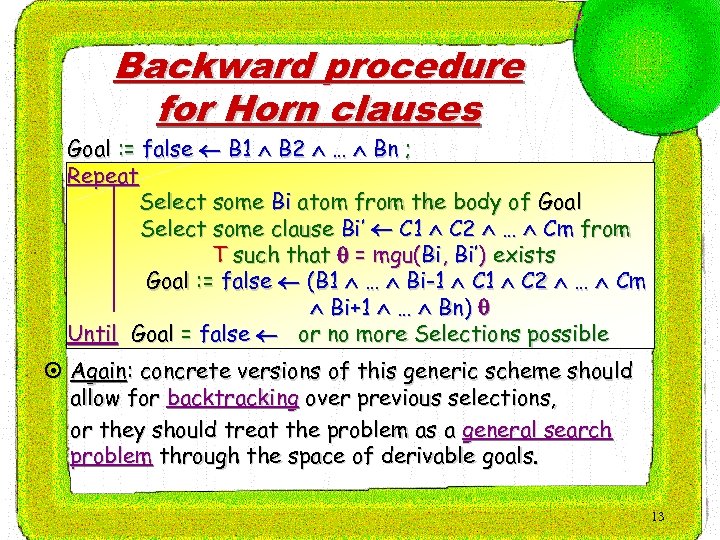 Backward procedure for Horn clauses Goal : = false B 1 B 2 … Bn ; Repeat Select some Bi atom from the body of Goal Select some clause Bi’ C 1 C 2 … Cm from T such that = mgu(Bi, Bi’) exists Goal : = false (B 1 … Bi-1 C 2 … Cm Bi+1 … Bn) Until Goal = false or no more Selections possible ¤ Again: concrete versions of this generic scheme should allow for backtracking over previous selections, or they should treat the problem as a general search problem through the space of derivable goals. 13
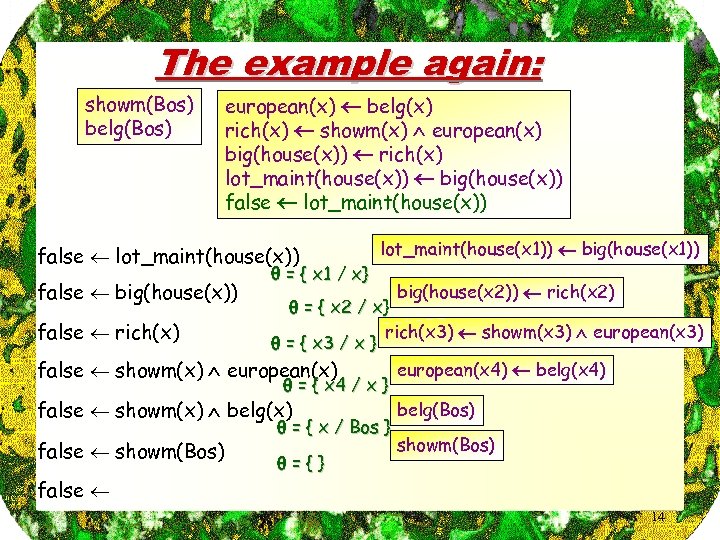 The example again: showm(Bos) belg(Bos) european(x) belg(x) rich(x) showm(x) european(x) big(house(x)) rich(x) lot_maint(house(x)) big(house(x)) false lot_maint(house(x)) false big(house(x)) false false = { x 1 / x} lot_maint(house(x 1)) big(house(x 1)) big(house(x 2)) rich(x 2) = { x 2 / x} rich(x 3) showm(x 3) european(x 3) rich(x) = { x 3 / x } european(x 4) belg(x 4) showm(x) european(x) = { x 4 / x } belg(Bos) showm(x) belg(x) = { x / Bos } showm(Bos) ={} 14
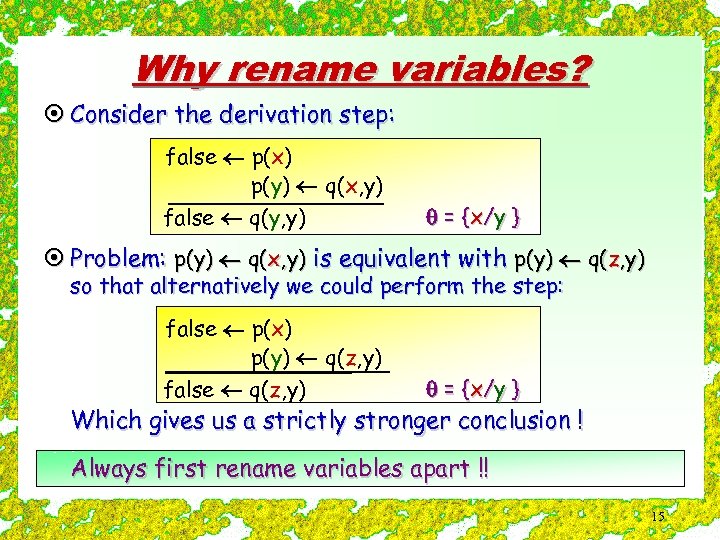 Why rename variables? ¤ Consider the derivation step: false p(x) p(y) q(x, y) false q(y, y) = { x/ y } ¤ Problem: p(y) q(x, y) is equivalent with p(y) q(z, y) so that alternatively we could perform the step: false p(x) p(y) q(z, y) false q(z, y) = { x/ y } Which gives us a strictly stronger conclusion ! Always first rename variables apart !! 15
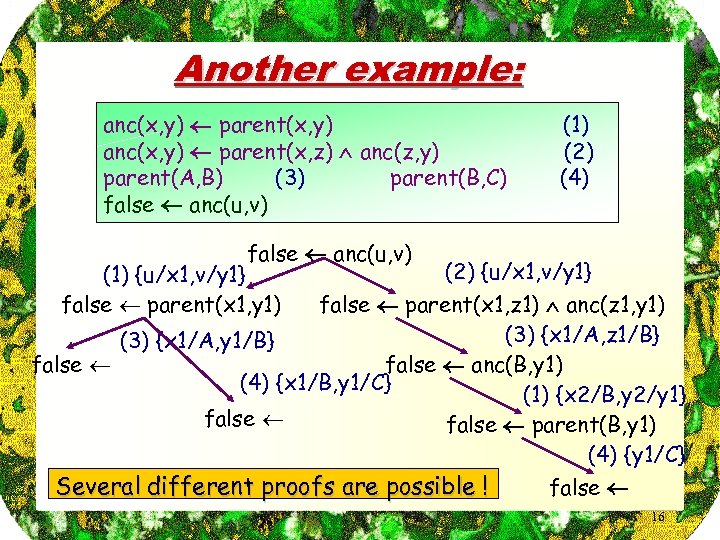 Another example: anc(x, y) parent(x, y) anc(x, y) parent(x, z) anc(z, y) parent(A, B) (3) parent(B, C) false anc(u, v) (1) {u/x 1, v/y 1} false parent(x 1, y 1) (2) (4) (2) {u/x 1, v/y 1} false parent(x 1, z 1) anc(z 1, y 1) (3) {x 1/A, z 1/B} (3) {x 1/A, y 1/B} false anc(B, y 1) (4) {x 1/B, y 1/C} (1) {x 2/B, y 2/y 1} false parent(B, y 1) (4) {y 1/C} Several different proofs are possible ! false 16
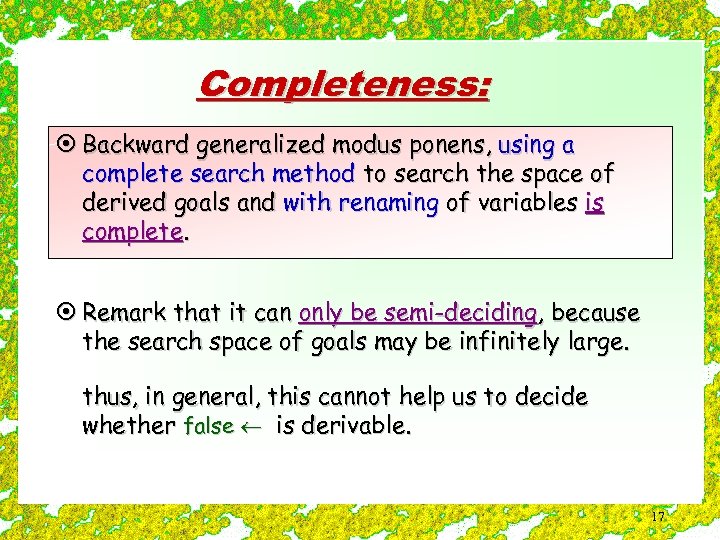 Completeness: ¤ Backward generalized modus ponens, using a complete search method to search the space of derived goals and with renaming of variables is complete. ¤ Remark that it can only be semi-deciding, because the search space of goals may be infinitely large. thus, in general, this cannot help us to decide whether false is derivable. 17
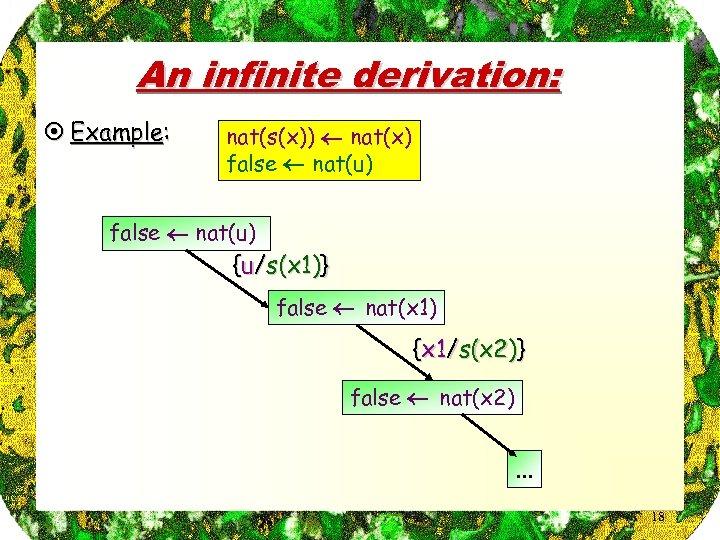 An infinite derivation: ¤ Example: nat(s(x)) nat(x) false nat(u) {u/s(x 1)} false nat(x 1) {x 1/s(x 2)} false nat(x 2) . . . 18
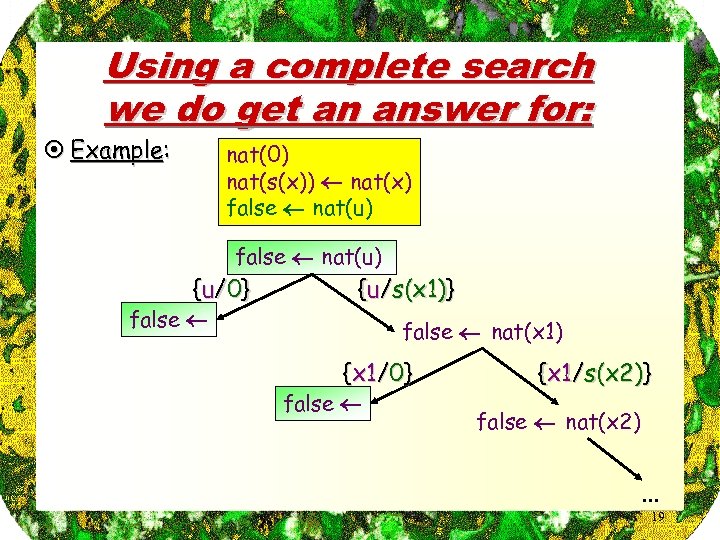 Using a complete search we do get an answer for: ¤ Example: nat(0) nat(s(x)) nat(x) false nat(u) { u/ 0 } false {u/s(x 1)} false nat(x 1) {x 1/0} false {x 1/s(x 2)} false nat(x 2) . . . 19
 Unification A basic algorithm in Automated Reasoning
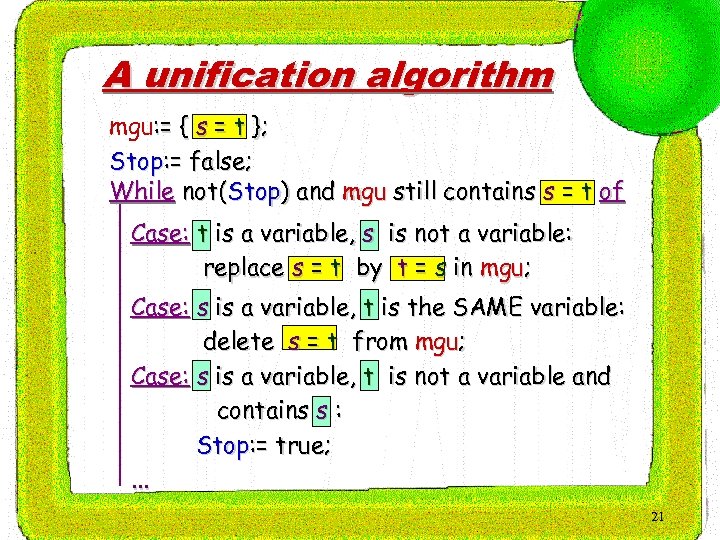 A unification algorithm mgu: = { s = t }; Stop: = false; While not(Stop) and mgu still contains s = t of Case: t is a variable, s is not a variable: replace s = t by t = s in mgu; Case: s is a variable, t is the SAME variable: delete s = t from mgu; Case: s is a variable, t is not a variable and contains s : Stop: = true; . . . 21
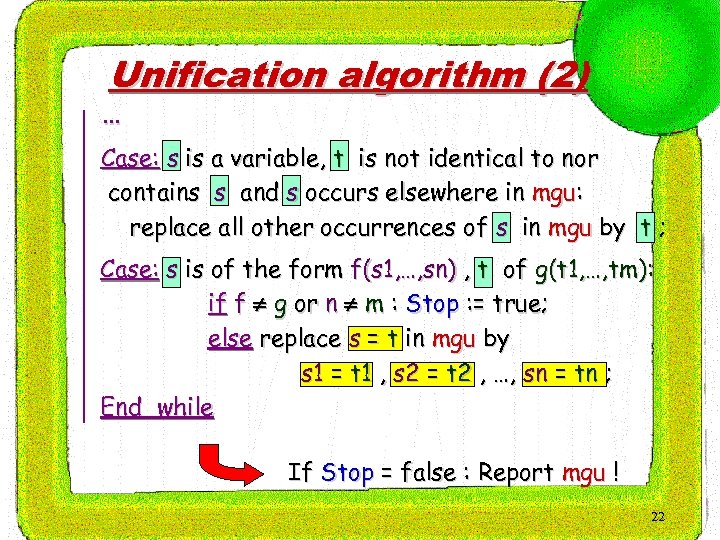 Unification algorithm (2) . . . Case: s is a variable, t is not identical to nor contains s and s occurs elsewhere in mgu: replace all other occurrences of s in mgu by t ; Case: s is of the form f(s 1, …, sn) , t of g(t 1, …, tm): if f g or n m : Stop : = true; else replace s = t in mgu by s 1 = t 1 , s 2 = t 2 , …, sn = tn ; End_while If Stop = false : Report mgu ! 22
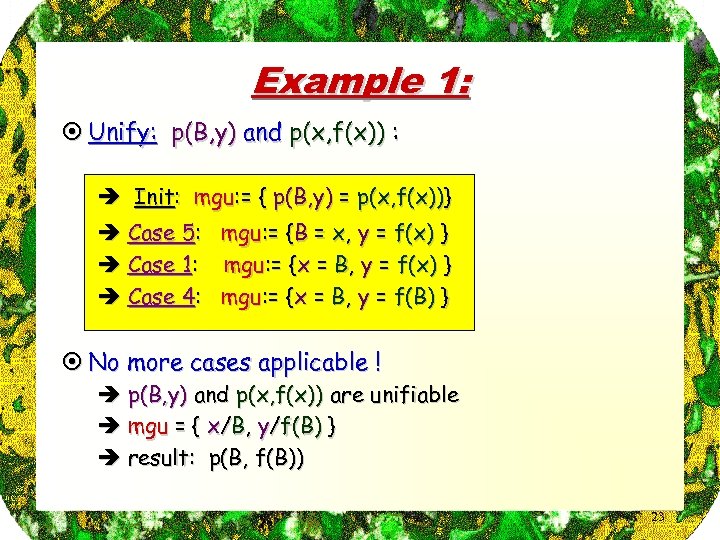 Example 1: ¤ Unify: p(B, y) and p(x, f(x)) : è Init: mgu: = { p(B, y) = p(x, f(x))} è Case 5: è Case 1: è Case 4: mgu: = {B = x, y = f(x) } mgu: = {x = B, y = f(B) } ¤ No more cases applicable ! è p(B, y) and p(x, f(x)) are unifiable è mgu = { x/B, y/f(B) } è result: p(B, f(B)) 23
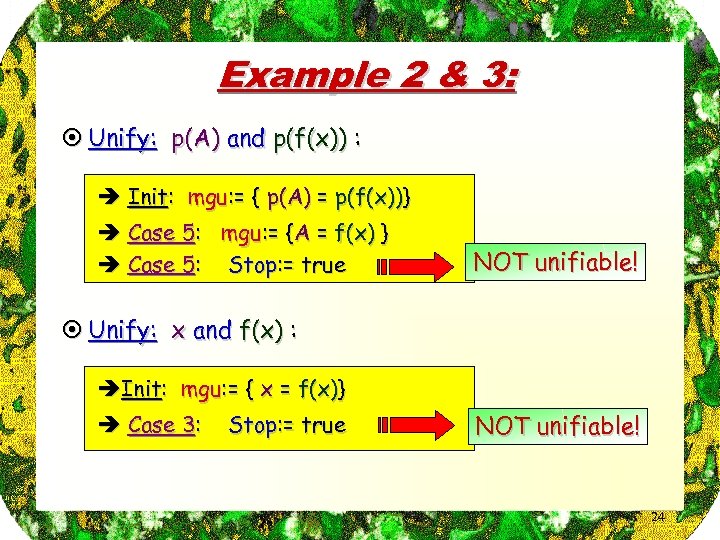 Example 2 & 3: ¤ Unify: p(A) and p(f(x)) : è Init: mgu: = { p(A) = p(f(x))} è Case 5: mgu: = {A = f(x) } è Case 5: Stop: = true NOT unifiable! ¤ Unify: x and f(x) : èInit: mgu: = { x = f(x)} è Case 3: Stop: = true NOT unifiable! 24
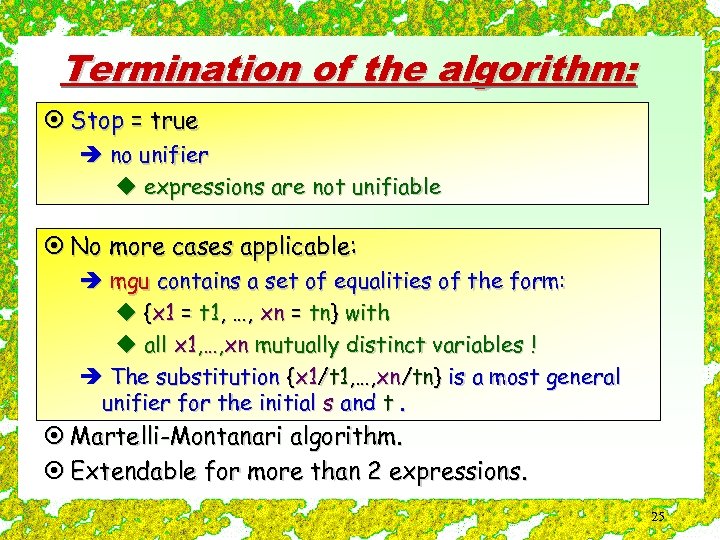 Termination of the algorithm: ¤ Stop = true è no unifier u expressions are not unifiable ¤ No more cases applicable: è mgu contains a set of equalities of the form: u {x 1 = t 1, …, xn = tn} with u all x 1, …, xn mutually distinct variables ! è The substitution {x 1/t 1, …, xn/tn} is a most general unifier for the initial s and t. ¤ Martelli-Montanari algorithm. ¤ Extendable for more than 2 expressions. 25
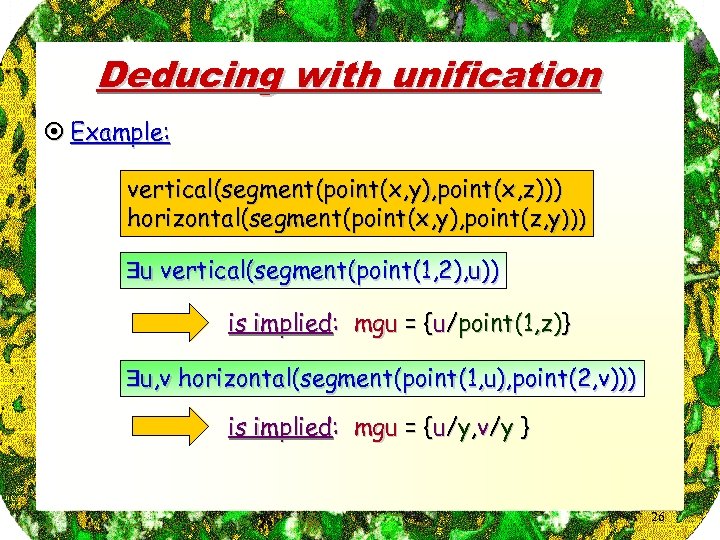 Deducing with unification ¤ Example: vertical(segment(point(x, y), point(x, z))) horizontal(segment(point(x, y), point(z, y))) u vertical(segment(point(1, 2), u)) is implied: mgu = {u/point(1, z)} u, v horizontal(segment(point(1, u), point(2, v))) is implied: mgu = {u/y, v/y } 26
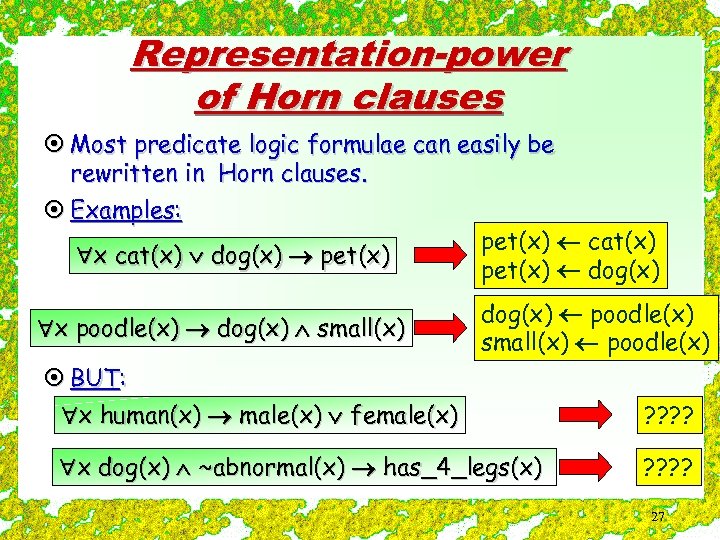 Representation-power of Horn clauses ¤ Most predicate logic formulae can easily be rewritten in Horn clauses. ¤ Examples: pet(x) cat(x) x cat(x) dog(x) pet(x) dog(x) x poodle(x) dog(x) small(x) dog(x) poodle(x) small(x) poodle(x) ¤ BUT: x human(x) male(x) female(x) x dog(x) ~abnormal(x) has_4_legs(x) ? ? ? ? 27