


 Скачать презентацию AQUATIC ECOSYSTEMS LANDSCAPE ECOLOGY RESTORATION ECOLOGY ECOSYSTEM MANAGEMENT
d8abed01f177457c59b54d8e19ddb10d.ppt
- Количество слайдов: 30
 AQUATIC ECOSYSTEMS LANDSCAPE ECOLOGY RESTORATION ECOLOGY ECOSYSTEM MANAGEMENT Chapters 8 and 10
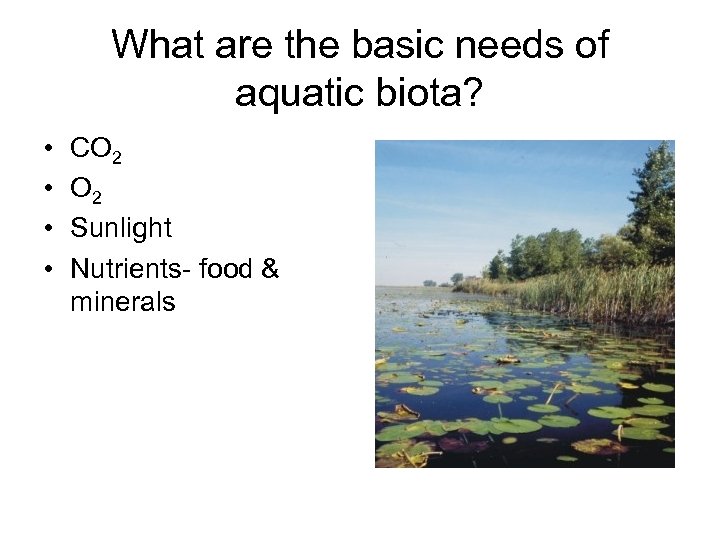 What are the basic needs of aquatic biota? • • CO 2 Sunlight Nutrients- food & minerals
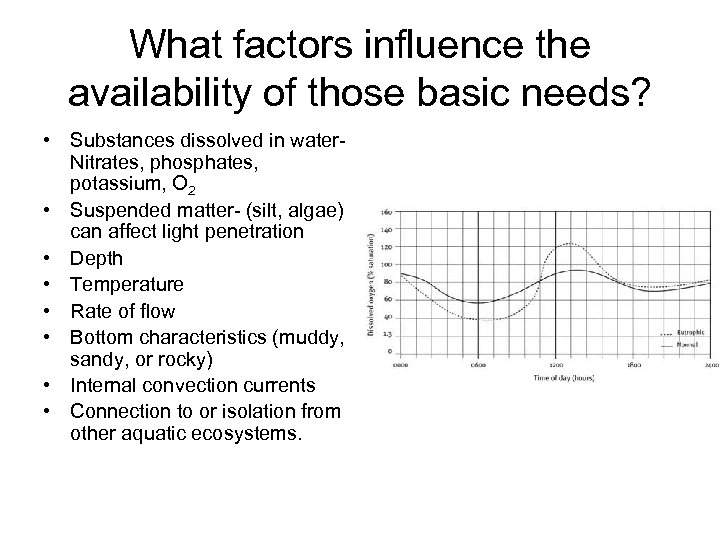 What factors influence the availability of those basic needs? • Substances dissolved in water. Nitrates, phosphates, potassium, O 2 • Suspended matter- (silt, algae) can affect light penetration • Depth • Temperature • Rate of flow • Bottom characteristics (muddy, sandy, or rocky) • Internal convection currents • Connection to or isolation from other aquatic ecosystems.
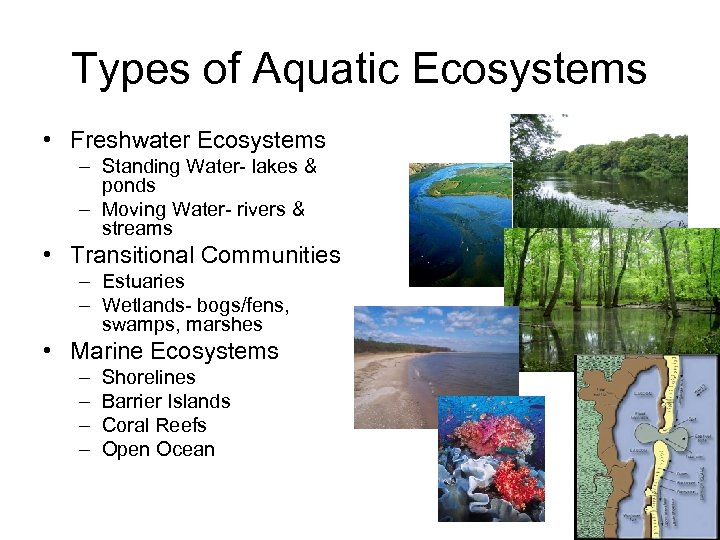 Types of Aquatic Ecosystems • Freshwater Ecosystems – Standing Water- lakes & ponds – Moving Water- rivers & streams • Transitional Communities – Estuaries – Wetlands- bogs/fens, swamps, marshes • Marine Ecosystems – – Shorelines Barrier Islands Coral Reefs Open Ocean
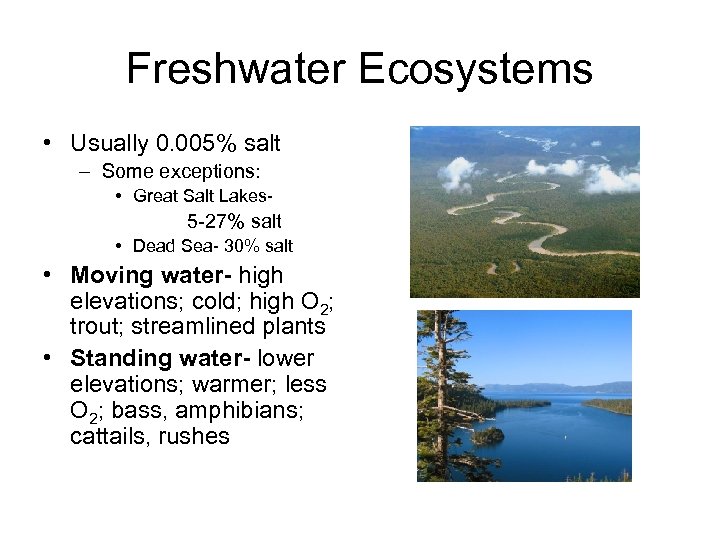 Freshwater Ecosystems • Usually 0. 005% salt – Some exceptions: • Great Salt Lakes- 5 -27% salt • Dead Sea- 30% salt • Moving water- high elevations; cold; high O 2; trout; streamlined plants • Standing water- lower elevations; warmer; less O 2; bass, amphibians; cattails, rushes
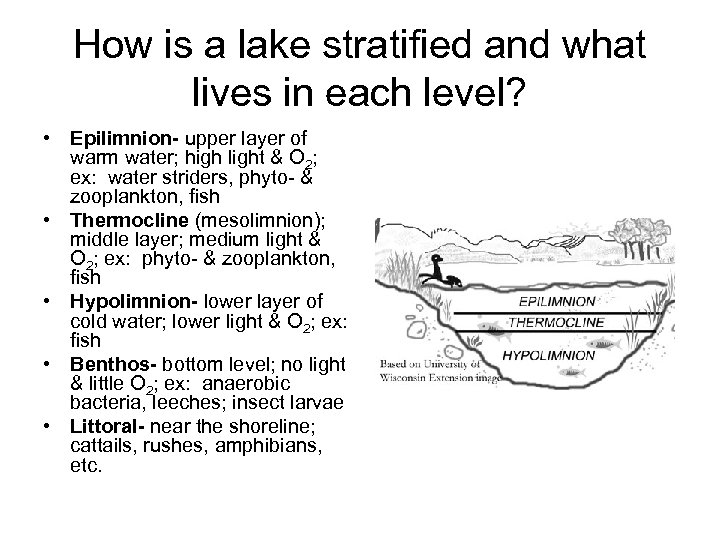 How is a lake stratified and what lives in each level? • Epilimnion- upper layer of warm water; high light & O 2; ex: water striders, phyto- & zooplankton, fish • Thermocline (mesolimnion); middle layer; medium light & O 2; ex: phyto- & zooplankton, fish • Hypolimnion- lower layer of cold water; lower light & O 2; ex: fish • Benthos- bottom level; no light & little O 2; ex: anaerobic bacteria, leeches; insect larvae • Littoral- near the shoreline; cattails, rushes, amphibians, etc.
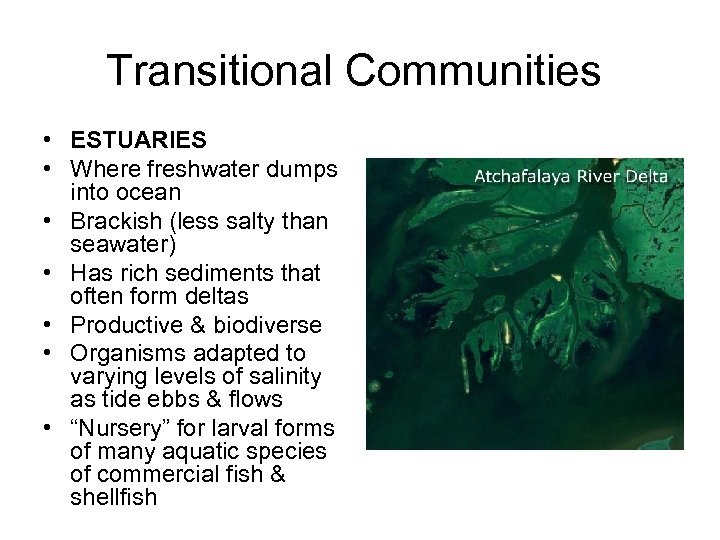 Transitional Communities • ESTUARIES • Where freshwater dumps into ocean • Brackish (less salty than seawater) • Has rich sediments that often form deltas • Productive & biodiverse • Organisms adapted to varying levels of salinity as tide ebbs & flows • “Nursery” for larval forms of many aquatic species of commercial fish & shellfish
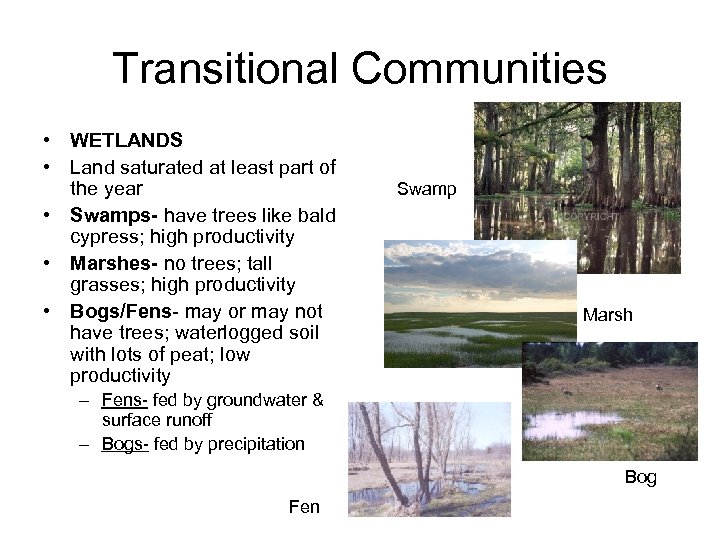 Transitional Communities • WETLANDS • Land saturated at least part of the year • Swamps- have trees like bald cypress; high productivity • Marshes- no trees; tall grasses; high productivity • Bogs/Fens- may or may not have trees; waterlogged soil with lots of peat; low productivity Swamp Marsh – Fens- fed by groundwater & surface runoff – Bogs- fed by precipitation Bog Fen
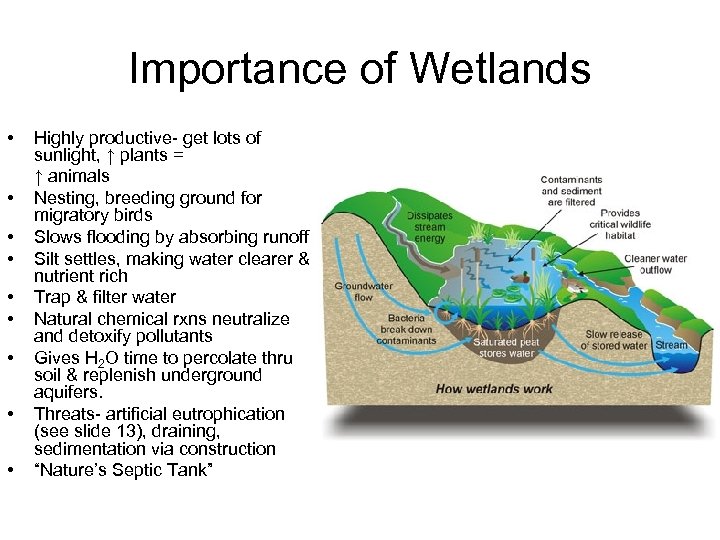 Importance of Wetlands • • • Highly productive- get lots of sunlight, ↑ plants = ↑ animals Nesting, breeding ground for migratory birds Slows flooding by absorbing runoff Silt settles, making water clearer & nutrient rich Trap & filter water Natural chemical rxns neutralize and detoxify pollutants Gives H 2 O time to percolate thru soil & replenish underground aquifers. Threats- artificial eutrophication (see slide 13), draining, sedimentation via construction “Nature’s Septic Tank”
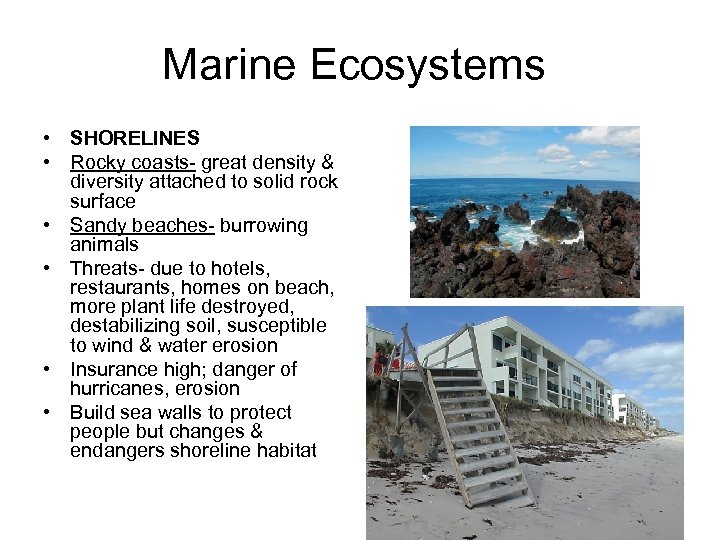 Marine Ecosystems • SHORELINES • Rocky coasts- great density & diversity attached to solid rock surface • Sandy beaches- burrowing animals • Threats- due to hotels, restaurants, homes on beach, more plant life destroyed, destabilizing soil, susceptible to wind & water erosion • Insurance high; danger of hurricanes, erosion • Build sea walls to protect people but changes & endangers shoreline habitat
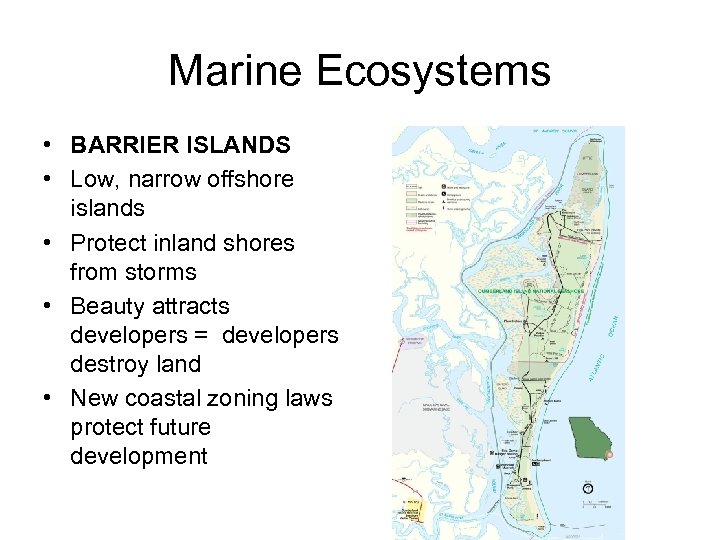 Marine Ecosystems • BARRIER ISLANDS • Low, narrow offshore islands • Protect inland shores from storms • Beauty attracts developers = developers destroy land • New coastal zoning laws protect future development
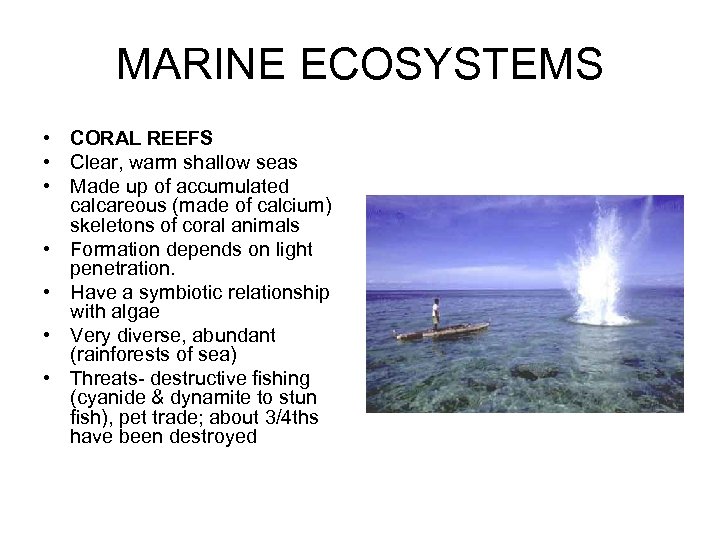 MARINE ECOSYSTEMS • CORAL REEFS • Clear, warm shallow seas • Made up of accumulated calcareous (made of calcium) skeletons of coral animals • Formation depends on light penetration. • Have a symbiotic relationship with algae • Very diverse, abundant (rainforests of sea) • Threats- destructive fishing (cyanide & dynamite to stun fish), pet trade; about 3/4 ths have been destroyed
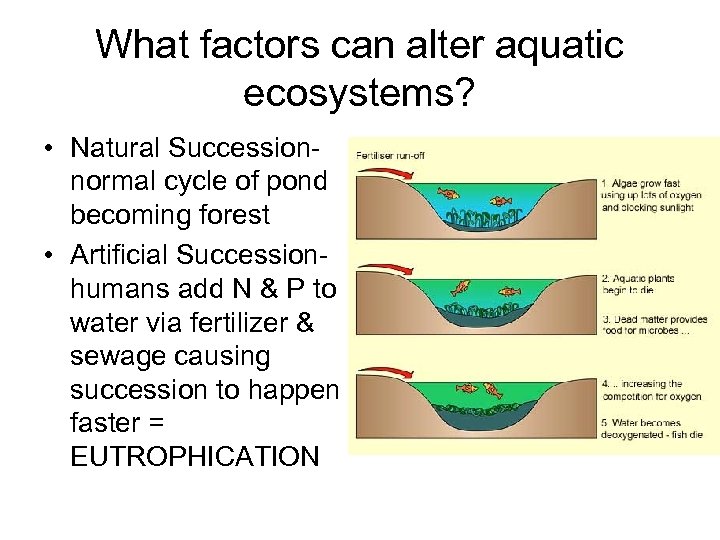 What factors can alter aquatic ecosystems? • Natural Successionnormal cycle of pond becoming forest • Artificial Successionhumans add N & P to water via fertilizer & sewage causing succession to happen faster = EUTROPHICATION
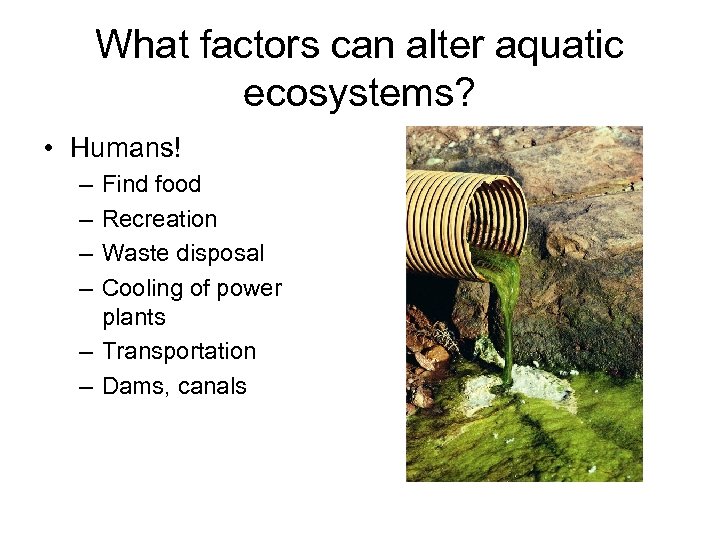 What factors can alter aquatic ecosystems? • Humans! – – Find food Recreation Waste disposal Cooling of power plants – Transportation – Dams, canals
 Biomes • Which biome has the largest total area? The smallest total area? • Which biome has the highest % of undisturbed habitat? • Which biome has the lowest % of undisturbed habitat? • Which biome has the highest % human dominated habitat? • Which biome has the lowest % human dominated habitat?
 LANDSCAPE ECOLOGY
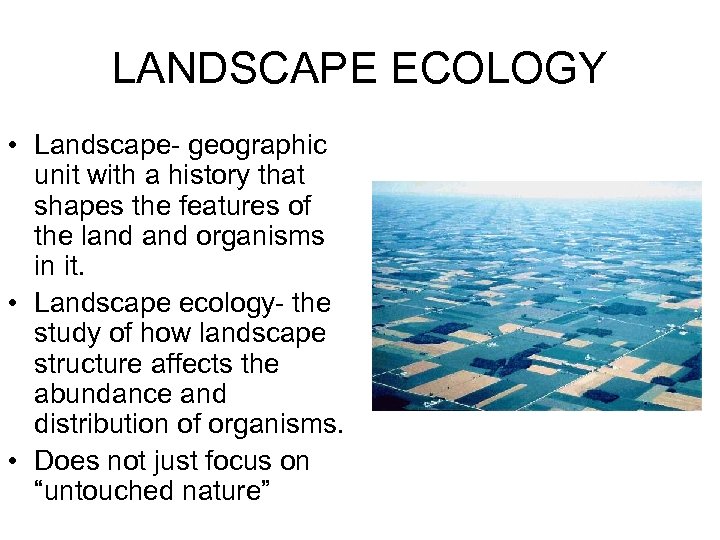 LANDSCAPE ECOLOGY • Landscape- geographic unit with a history that shapes the features of the land organisms in it. • Landscape ecology- the study of how landscape structure affects the abundance and distribution of organisms. • Does not just focus on “untouched nature”
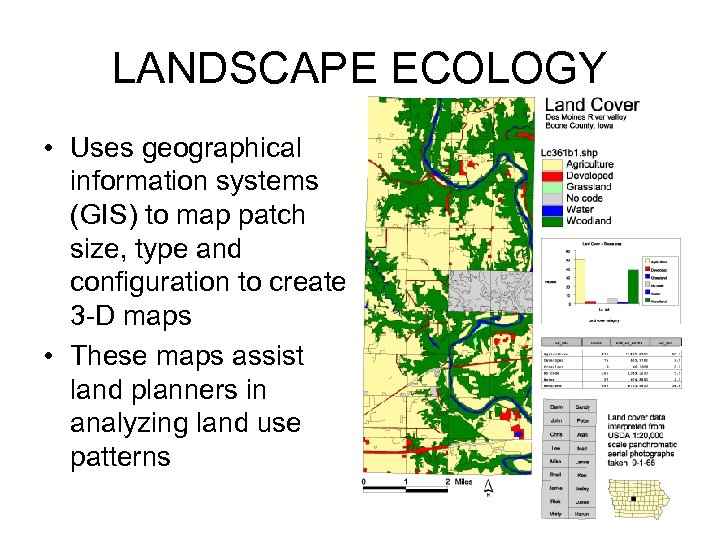 LANDSCAPE ECOLOGY • Uses geographical information systems (GIS) to map patch size, type and configuration to create 3 -D maps • These maps assist land planners in analyzing land use patterns
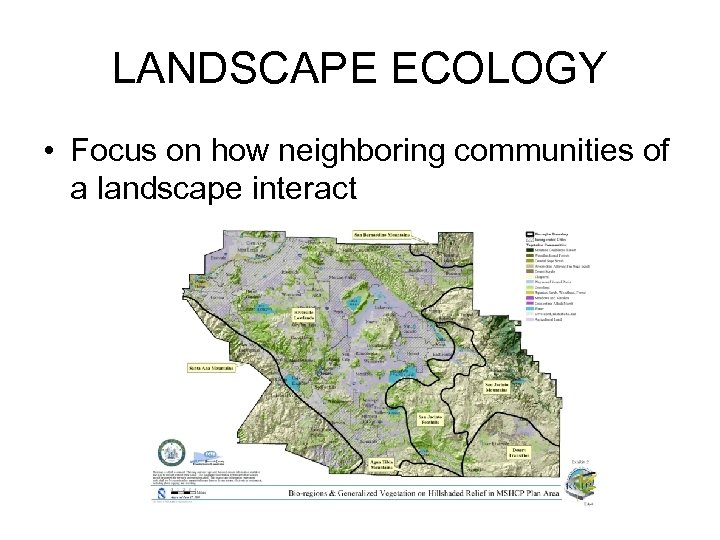 LANDSCAPE ECOLOGY • Focus on how neighboring communities of a landscape interact
 RESTORATION ECOLOGY Chapter 10
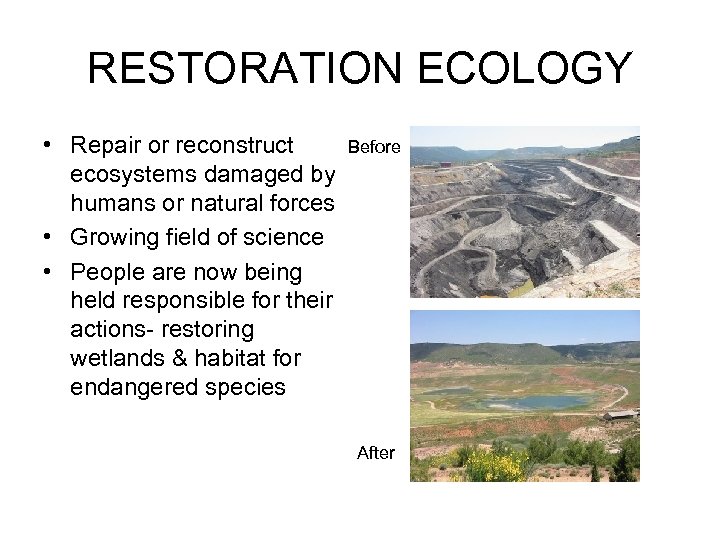 RESTORATION ECOLOGY • Repair or reconstruct ecosystems damaged by humans or natural forces • Growing field of science • People are now being held responsible for their actions- restoring wetlands & habitat for endangered species Before After
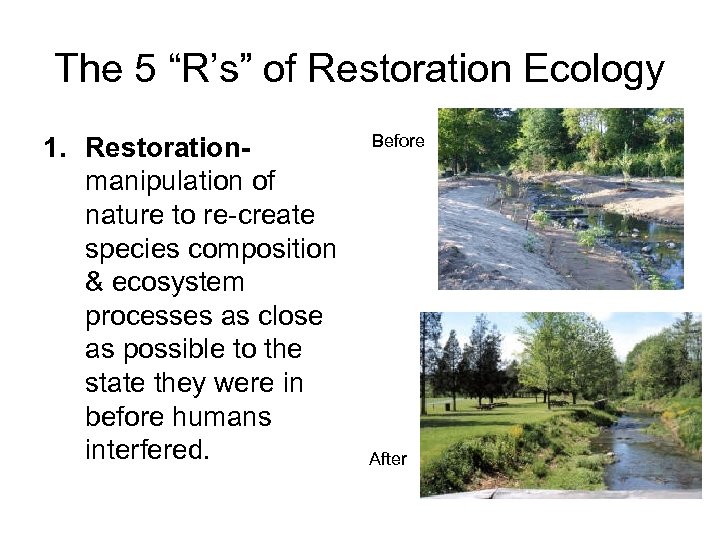 The 5 “R’s” of Restoration Ecology 1. Restorationmanipulation of nature to re-create species composition & ecosystem processes as close as possible to the state they were in before humans interfered. Before After
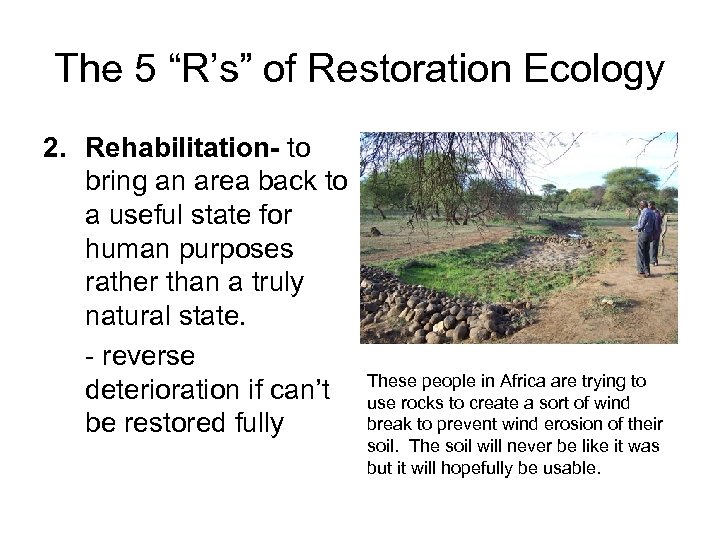 The 5 “R’s” of Restoration Ecology 2. Rehabilitation- to bring an area back to a useful state for human purposes rather than a truly natural state. - reverse deterioration if can’t be restored fully These people in Africa are trying to use rocks to create a sort of wind break to prevent wind erosion of their soil. The soil will never be like it was but it will hopefully be usable.
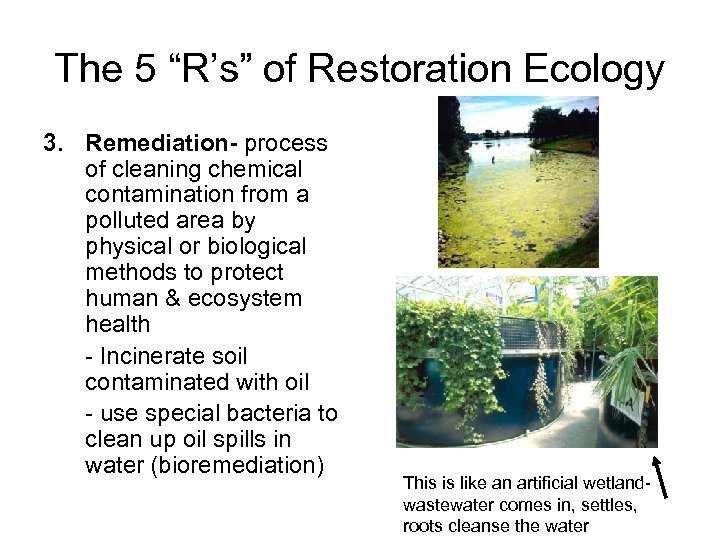 The 5 “R’s” of Restoration Ecology 3. Remediation- process of cleaning chemical contamination from a polluted area by physical or biological methods to protect human & ecosystem health - Incinerate soil contaminated with oil - use special bacteria to clean up oil spills in water (bioremediation) This is like an artificial wetlandwastewater comes in, settles, roots cleanse the water
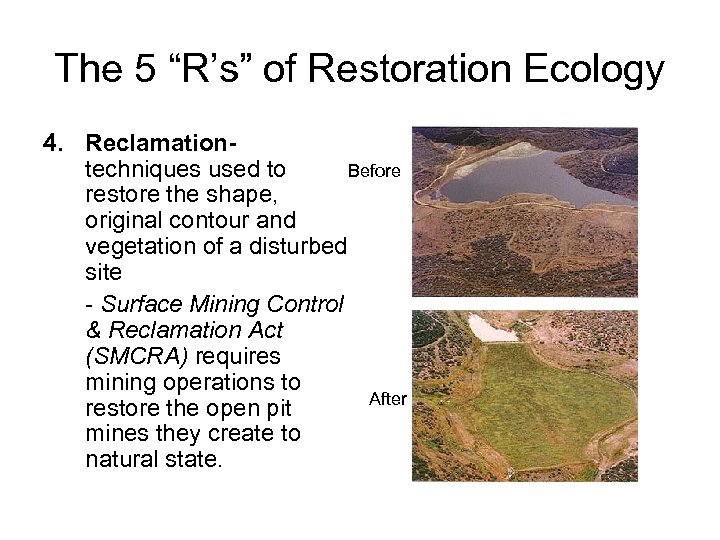 The 5 “R’s” of Restoration Ecology 4. Reclamationtechniques used to Before restore the shape, original contour and vegetation of a disturbed site - Surface Mining Control & Reclamation Act (SMCRA) requires mining operations to After restore the open pit mines they create to natural state.
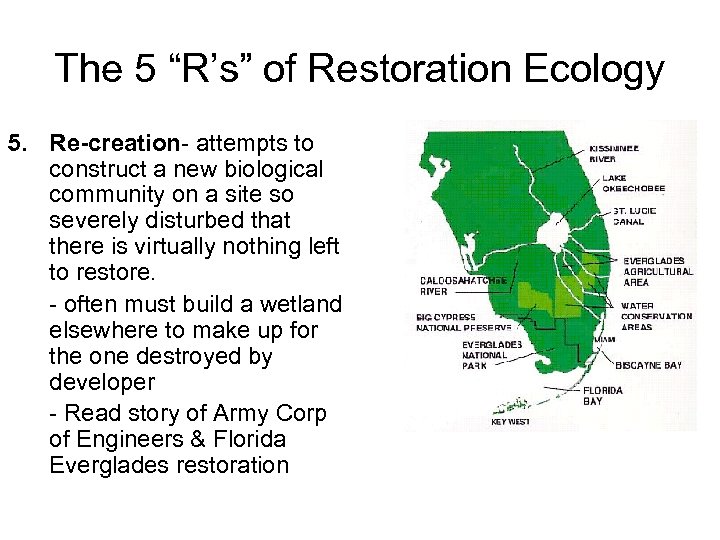 The 5 “R’s” of Restoration Ecology 5. Re-creation- attempts to construct a new biological community on a site so severely disturbed that there is virtually nothing left to restore. - often must build a wetland elsewhere to make up for the one destroyed by developer - Read story of Army Corp of Engineers & Florida Everglades restoration
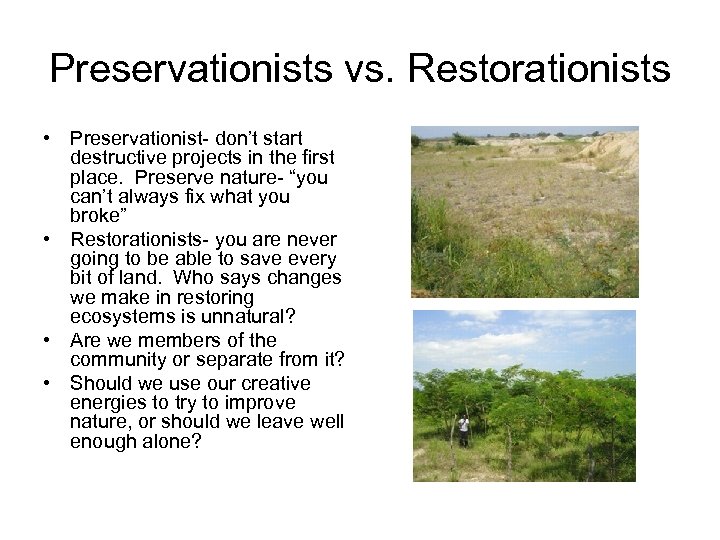 Preservationists vs. Restorationists • Preservationist- don’t start destructive projects in the first place. Preserve nature- “you can’t always fix what you broke” • Restorationists- you are never going to be able to save every bit of land. Who says changes we make in restoring ecosystems is unnatural? • Are we members of the community or separate from it? • Should we use our creative energies to try to improve nature, or should we leave well enough alone?
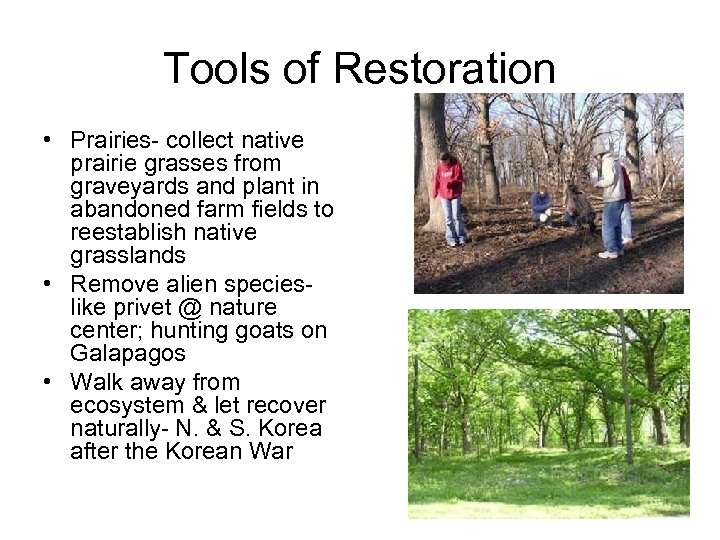 Tools of Restoration • Prairies- collect native prairie grasses from graveyards and plant in abandoned farm fields to reestablish native grasslands • Remove alien specieslike privet @ nature center; hunting goats on Galapagos • Walk away from ecosystem & let recover naturally- N. & S. Korea after the Korean War
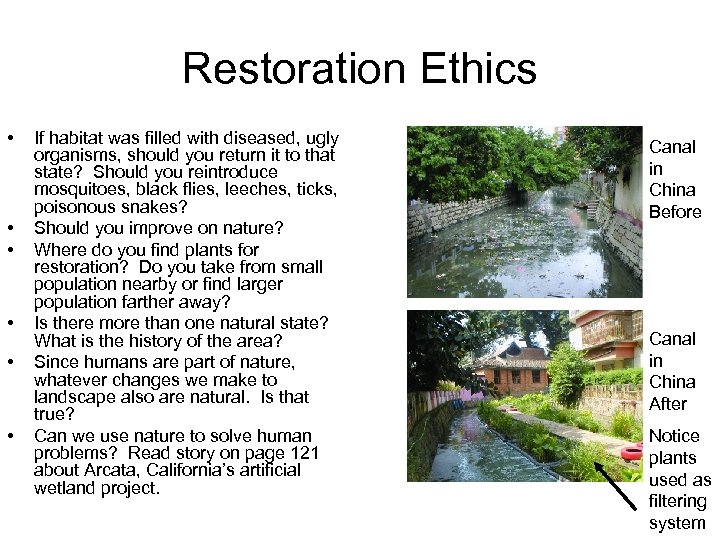 Restoration Ethics • • • If habitat was filled with diseased, ugly organisms, should you return it to that state? Should you reintroduce mosquitoes, black flies, leeches, ticks, poisonous snakes? Should you improve on nature? Where do you find plants for restoration? Do you take from small population nearby or find larger population farther away? Is there more than one natural state? What is the history of the area? Since humans are part of nature, whatever changes we make to landscape also are natural. Is that true? Can we use nature to solve human problems? Read story on page 121 about Arcata, California’s artificial wetland project. Canal in China Before Canal in China After Notice plants used as filtering system
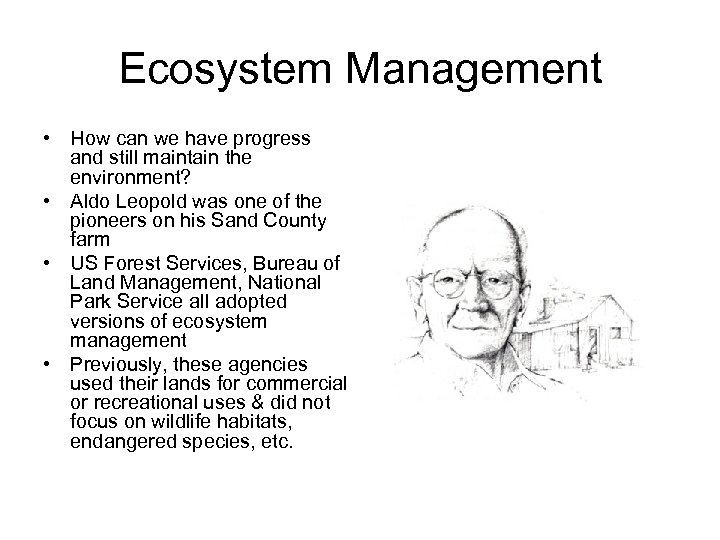 Ecosystem Management • How can we have progress and still maintain the environment? • Aldo Leopold was one of the pioneers on his Sand County farm • US Forest Services, Bureau of Land Management, National Park Service all adopted versions of ecosystem management • Previously, these agencies used their lands for commercial or recreational uses & did not focus on wildlife habitats, endangered species, etc.