


 Скачать презентацию April 2 2011 http hodf org 1
1e8f754831a4093c51ed8659f86cf05c.ppt
- Количество слайдов: 55
 April 2, 2011 http: //hodf. org 1
 Presentation Part 1 l Colossians 2: 14 -23 and Galatians 4: 1 - 4: 18. . . Pagan and Judeo-Christian -keeping Schemes April 2, 2011 http: //hodf. org Time 2
 April 2 nd 2011 l How did Paul’s communities reckon time? l In Colossians 2: 14, what does the “handwriting of ordinances” ceiro, grafon toi/j do, gmasin mean? l Some translations of 2: 16 -17 l Who is the “no one” in vv. 16 and 18? l Protestant Christian Scholarship April 2, 2011 http: //hodf. org 3
 Reckoning Time l Biblical l Pagan l None April 2, 2011 http: //hodf. org 4
 Reckoning Time l Jewish Believers after Yeshua continued to observe the Torah in it’s entirety. l New believers were considered a sect of Judaism and granted freedoms as such. l How would this play out if they didn’t follow any of the Biblical calendar? April 2, 2011 http: //hodf. org 5
![Reckoning Time l Paul in 1 Corthinians 5: 6 -8 [8] “Let us keep](https://present5.com/presentation/1e8f754831a4093c51ed8659f86cf05c/image-6.jpg "Reckoning Time l Paul in 1 Corthinians 5: 6 -8 [8] “Let us keep") Reckoning Time l Paul in 1 Corthinians 5: 6 -8 [8] “Let us keep the feast”. l Why if shadows filled? l Why if the “substance” is Christ? l Why if Christ “fulfilled” the law? l How can that verse mean “If you keep the feast, you lose your salvation? ” April 2, 2011 http: //hodf. org 6
Reckoning Time l Paul in 1 Corthinians 5: 6 -8 [8] “Let us keep the feast”. l Why if shadows filled? l Why if the “substance” is Christ? l Why if Christ “fulfilled” the law? l How can that verse mean “If you keep the feast, you lose your salvation? ” April 2, 2011 http: //hodf. org 6
 April 2 nd 2011 l How did Paul’s communities reckon time? l In Colossians 2: 14, what does the “handwriting of ordinances” ceiro, grafon toi/j do, gmasin mean? l Some translations of 2: 16 -17 l Who is the “no one” in vv. 16 and 18? l Protestant Christian Scholarship April 2, 2011 http: //hodf. org 7
 Colossians 2: 14 l In Colossians 2: 14, “handwriting” ceiro, grafon April 2, 2011 http: //hodf. org 8
![Colossians 2: 14 [Fri] strictly, a handwritten document; in legal matters a promissory note,](https://present5.com/presentation/1e8f754831a4093c51ed8659f86cf05c/image-9.jpg "Colossians 2: 14 [Fri] strictly, a handwritten document; in legal matters a promissory note,") Colossians 2: 14 [Fri] strictly, a handwritten document; in legal matters a promissory note, a record of indebtedness, bond; l fig. in Col 2. 14, not as the law itself, but as the record of charges (for breaking God's law), which stood against us and which God symbolically removed by "nailing it to the cross. ” l ceiro, grafon April 2, 2011 http: //hodf. org 9
Colossians 2: 14 [Fri] strictly, a handwritten document; in legal matters a promissory note, a record of indebtedness, bond; l fig. in Col 2. 14, not as the law itself, but as the record of charges (for breaking God's law), which stood against us and which God symbolically removed by "nailing it to the cross. ” l ceiro, grafon April 2, 2011 http: //hodf. org 9
 Colossians 2: 14 l Hymn It Is Well (1873 -1876) l My sin, oh, the bliss of this glorious thought! l My sin, not in part but the whole, l is nailed to the cross, and I bear it no more…. April 2, 2011 http: //hodf. org 10
 April 2 nd 2011 l How did Paul’s communities reckon time? l In Colossians 2: 14, what does the “handwriting of ordinances” ceiro, grafon toi/j do, gmasin mean? l Some translations of 2: 16 -17 l Who is the “no one” in vv. 16 and 18? l Protestant Christian Scholarship April 2, 2011 http: //hodf. org 11
 Colossians 2: 16 -17 NAS l Therefore let no one act as your judge in regard to food or drink or in respect to a festival or a new moon or a Sabbath day— l things which are a mere shadow of what is to come; but the substance belongs to Christ. April 2, 2011 http: //hodf. org 12
 Colossians 2: 16 -17 NIV l Therefore do not let anyone judge you by what you eat or drink, or with regard to a religious festival, a New Moon celebration or a Sabbath day. l These are a shadow of the things that were to come; the reality, however, is found in Christ April 2, 2011 http: //hodf. org 13
 Colossians 2: 16 -17 ISR l Let no one therefore judge you in eating or in drinking, or in respect of a festival or a new moon or Sabbaths – l which are a shadow of what is to come but the Body of the Messiah. April 2, 2011 http: //hodf. org 14
 Colossians 2: 16 -17 ISR l Parenthetical statement l 16 Let no one therefore judge your eating or drinking, in respect of a festival or a new moon or Sabbaths – l 17 which are a shadow of what is to come but the Body of the Messiah. April 2, 2011 http: //hodf. org 15
 Colossians 2: 16 -17 ISR l Parenthetical statement Removed l 16 Let no one therefore judge your eating or drinking, in respect of a festival or a new moon or Sabbaths – l 17 which are a shadow of what is to come but the Body of the Messiah. April 2, 2011 http: //hodf. org 16
 April 2 nd 2011 l How did Paul’s communities reckon time? l In Colossians 2: 14, what does the “handwriting of ordinances” ceiro, grafon toi/j do, gmasin mean? l Some translations of 2: 16 -17 l Who is the “no one” in vv. 16 and 18? l Protestant Christian Scholarship April 2, 2011 http: //hodf. org 17
 Who is the “no one” l V 16 “Let no one judge…” l V 18 “Let no one deprive you of the prize” l Takes delight in false humility l Takes delight in the worship of angels l Puffed up by a fleshly mind April 2, 2011 http: //hodf. org 18
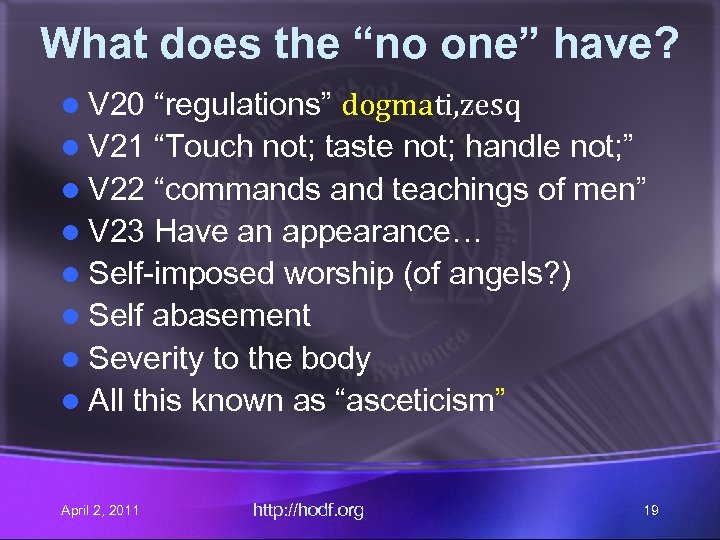 What does the “no one” have? l V 20 “regulations” dogmati, zesq l V 21 “Touch not; taste not; handle not; ” l V 22 “commands and teachings of men” l V 23 Have an appearance… l Self-imposed worship (of angels? ) l Self abasement l Severity to the body l All this known as “asceticism” April 2, 2011 http: //hodf. org 19
 April 2 nd 2011 l How did Paul’s communities reckon time? l In Colossians 2: 14, what does the “handwriting of ordinances” ceiro, grafon toi/j do, gmasin mean? l Some translations of 2: 16 -17 l Who is the “no one” in vv. 16 and 18? l Protestant Christian Scholarship April 2, 2011 http: //hodf. org 20
 Protestant Christian Scholars l Journal for the Study of the NT, Supplement Series #118, 1996, pp. 125 -127 l Author: Dr. Troy Martin, Professor of Religious Studies, Saint Xavier University l “By Philosophy and Empty Deceit" Colossians as Response to a Cynic Critique April 2, 2011 http: //hodf. org 21
 Protestant Christian Scholars l He begins by asking the following question: l "How did Paul's' communities reckon time? " April 2, 2011 http: //hodf. org 22
 Protestant Christian Scholars l "Only by avoiding time-keeping altogether or by adhering to the Jewish calendar [could] the Pauline communities escape idolatrous alternatives. April 2, 2011 http: //hodf. org 23
 Protestant Christian Scholars l Other time-keeping systems name the days and the months after pagan deities and mark out the seasons by pagan rites. " April 2, 2011 http: //hodf. org 24
 Protestant Christian Scholars l "In contrast, the Jews distinguish the seasons by festivals that obviously have no pagan connotations. They recognize the months by new moons and name these months using agricultural terms. April 2, 2011 http: //hodf. org 25
 Protestant Christian Scholars l They designate the week by Sabbaths, and beginning from the Sabbath, they number, instead of name, the days of the week one through six. l The only options available to Paul and his communities are Jewish, pagan, or no time-keeping system at all, and the evidence indicates they opt for the former. " April 2, 2011 http: //hodf. org 26
 Protestant Christian Scholars l Journal of NT Studies, #42, 1996, pp. 108 -109 l Author: Dr. Troy Martin, Professor of Religious Studies, Saint Xavier University l Pagan and Judeo-Christian Time -keeping Schemes in Galatians 4: 10 and Colossians 2: 16 April 2, 2011 http: //hodf. org 27
 Protestant Christian Scholars l "The references to time in Paul's Epistle to the Corinthians exclusively reflect the adoption of a Jewish calendar. l He builds an elaborate argument based upon the festivals of Passover and unleavened bread (1 Cor. 5: 6 -8) to exhort the Corinthians, 'Let us keep the festival' (1 Cor. 5: 8). " April 2, 2011 http: //hodf. org 28
 Protestant Christian Scholars l "Although the temporal references in Paul's letters are sparse, 1 Corinthians provides strong evidence for the Pauline adoption of the Jewish practice that marked time by festivals and Sabbaths. " April 2, 2011 http: //hodf. org 29
 Protestant Christian Scholars l Sabbath to Lord's Day: A Biblical, Historical, and Theological Investigation l Editor: Donald A. Carson, 1982 l "The Sabbath/Sunday Question and the Law in the Pauline Corpus" l Author: D. R. De Lacey April 2, 2011 http: //hodf. org 30
 Protestant Christian Scholars l "The judge is likely to be a man of ascetic tendencies who objects to the Colossians' eating and drinking. The most natural way of taking the rest of the passage is not that he also imposes a ritual of feast days, but rather that he objects to certain elements of such observation. " April 2, 2011 http: //hodf. org 31
 Protestant Christian Scholars l He concludes by saying… l "Here again (Col 2: 16), then, it seems that Paul could happily countenance Sabbathkeeping. . . " April 2, 2011 http: //hodf. org 32
 Protestant Christian Scholars l God's Festivals in Scripture and History l Author: April 2, 2011 Samuele Bacchiocchi http: //hodf. org 33
 Protestant Christian Scholars l "Presumably the 'judge, ' that is, the false teachers, wanted the community to observe these practices in a more ascetic way ('severity to the body' 2: 23, 21); to put it crudely, the false teachers wanted the Colossian believers to do less feasting and more fasting. " April 2, 2011 http: //hodf. org 34
 Protestant Christian Scholars l "By warning against the right of the false teachers to 'pass judgment' on how to observe Holy Days, Paul is challenging not the validity of the Holy Days themselves, but the authority of the false teachers to legislate on the manner of their observance. April 2, 2011 http: //hodf. org 35
 Protestant Christian Scholars l The obvious implication is that Paul in this text is expressing not a condemnation but an approbation of the mentioned practices, which included the Holy Days. ” l Approbation: an act of approving formally or officially, official approval or sanction April 2, 2011 http: //hodf. org 36
 Protestant Christian Scholars l "Paul's warning against the stringent 'regulations' of the false teachers can hardly be interpreted as a condemnation of Mosaic laws regarding food and festivals, since what the apostle condemns is not the teachings of Moses but the false teachers attempt to regulate their observance through the perversions that included a more ascetic lifestyle. " April 2, 2011 http: //hodf. org 37
 Protestant Christian Scholars l Journal of Biblical Literature, #114/2, 1995, p. 255 l Author: Dr. Troy Martin, Professor of Religious Studies, Saint Xavier University l "But Let Everyone Discern the Body of Christ (Colossians 2: 17), " April 2, 2011 http: //hodf. org 38
 Protestant Christian Scholars l "The preceding grammatical and syntactical investigation of the clause to de soma tou Christou [but the body of Christ] in Colossians 2: 17 suggests that the practices mentioned in 2: 16 are those of the Colossian Christians and not the opponents. . early Christians observe both feasts and sabbaths. " April 2, 2011 http: //hodf. org 39
 Presentation Part 2 preview l Colossians 2: 14 -23 and Galatians 4: 1 - 4: 18. . . Pagan and Judeo-Christian -keeping Schemes April 2, 2011 http: //hodf. org Time 40
 Galatians 4: 9 -11 ISR l 9 But now after you have known Elohim, or rather are known by Elohim, how do you turn again to the weak and poor elementary matters, to which you wish to be enslaved again? April 2, 2011 http: //hodf. org 41
 Galatians 4: 9 -11 ISR l 10 You observe days and months and seasons and years. l 11 I fear for you, lest by any means I have laboured for you in vain. April 2, 2011 http: //hodf. org 42
 Dr. Troy Martin l "As the immediate context clearly states, Paul is worried that he has labored for the Galatians in vain since they have returned to their former pagan life as evidenced by their renewed preconversion reckoning of time. April 2, 2011 http: //hodf. org 43
 Dr. Troy Martin l Because of its association with idolatry and false deities, marking time according to this pagan scheme is tantamount to rejecting Paul's Gospel and the one and only true God it proclaims (4: 8 -9). April 2, 2011 http: //hodf. org 44
 Dr. Troy Martin l Galatians 4: 10, therefore, stipulates that when the Galatians accepted Paul's Gospel with its aversion to idolatry (4: 8), they discarded their pagan method of reckoning time. . April 2, 2011 http: //hodf. org 45
 Dr. Troy Martin l. A comparison of these lists demonstrates that the Gentile conversion to Paul's gospel involves rejection of idolatrous pagan temporal schemes in favor of the Jewish liturgical calendar. " April 2, 2011 http: //hodf. org 46
 Conclusion l By applying a fresh reading to who is saying what in Colossians 2: 14 -23 and by looking at the underlying Greek vocabulary Paul chose, and finally by not changing verb tenses or adding words to the text because of an agenda to teach the reader that the festivals have been done away with provides a clear understanding about what was going on there. April 2, 2011 http: //hodf. org 47
 Colossians 2: 14 -23 l 14 having blotted out the certificate of debt against us – the list of violations which stood against us. And he has taken it out of the way, having nailed it to the stake. April 2, 2011 http: //hodf. org 48
 Colossians 2: 14 -23 l 15 Having stripped the principalities and the authorities, he made a public display of them, having prevailed over them in it. April 2, 2011 http: //hodf. org 49
 Colossians 2: 14 -23 l 16 Let no one therefore judge your eating or drinking, in respect of a festival or a new moon or Sabbaths – l 17 which are a shadow of what is to come but the Body of the Messiah. April 2, 2011 http: //hodf. org 50
 Colossians 2: 14 -23 l 18 Let no one deprive you of the prize, one who takes delight in false humility and the worship of angels, taking his stand on what he has not seen, puffed up by his fleshly mind, April 2, 2011 http: //hodf. org 51
 Colossians 2: 14 -23 l 19 and not holding fast to the Head, from whom all the Body – nourished and knit together by joints and ligaments – grows with the growth of Elohim. April 2, 2011 http: //hodf. org 52
 Colossians 2: 14 -23 l 20 If, then, you died with Messiah from the elementary matters of the world, why, as though living in the world, do you subject yourselves to regulations: l 21 “Do not touch, do not taste, do not handle” – l 22 which are all to perish with use – according to the commands and teachings of men? April 2, 2011 http: //hodf. org 53
 Colossians 2: 14 -23 l 23 These indeed have an appearance of wisdom in self-imposed worship, humiliation and harsh treatment of the body – of no value at all, only for satisfaction of the flesh. April 2, 2011 http: //hodf. org 54
 April 2, 2011 September 28, 2010 http: //hodf. org http: //hodsbs. org 55