 Скачать презентацию Approximating Buy-at-Bulk and Shallow-Light k-Steiner Trees Mohammad T
8f131a370c0cbbbbade4b6f84d16b1ea.ppt
- Количество слайдов: 21



Approximating Buy-at-Bulk and Shallow-Light k-Steiner Trees Mohammad T. Hajiaghayi (CMU) Guy Kortsarz (Rutgers) Mohammad R. Salavatipour (U. Alberta) Presented by: Zeev Nutov
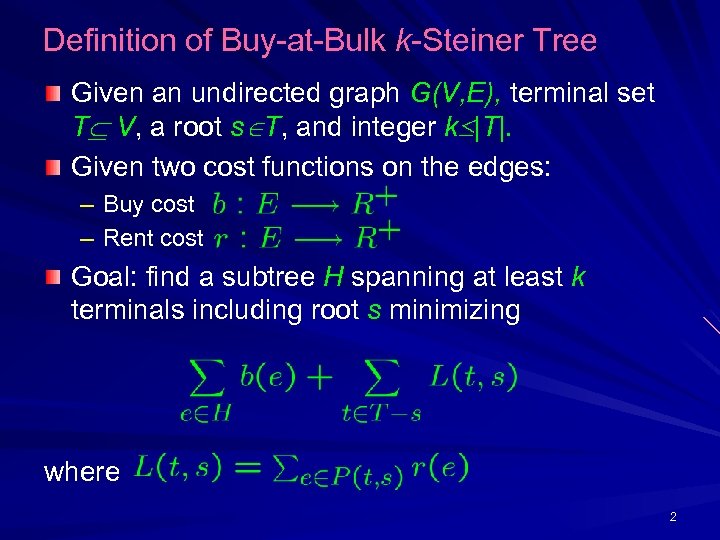
Definition of Buy-at-Bulk k-Steiner Tree Given an undirected graph G(V, E), terminal set T V, a root s T, and integer k |T|. Given two cost functions on the edges: – Buy cost – Rent cost Goal: find a subtree H spanning at least k terminals including root s minimizing where 2
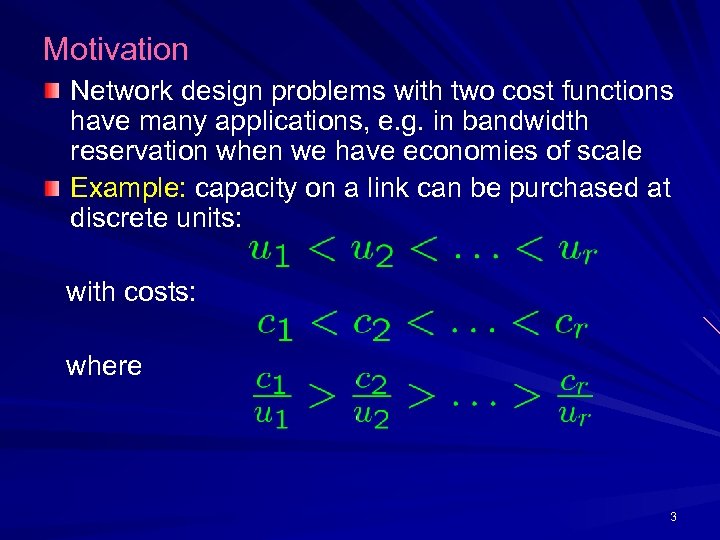
Motivation Network design problems with two cost functions have many applications, e. g. in bandwidth reservation when we have economies of scale Example: capacity on a link can be purchased at discrete units: with costs: where 3
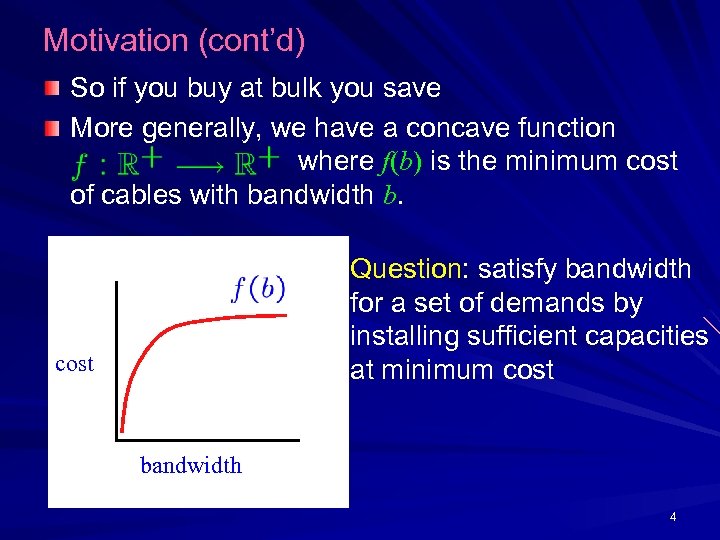
Motivation (cont’d) So if you buy at bulk you save More generally, we have a concave function where f(b) is the minimum cost of cables with bandwidth b. Question: satisfy bandwidth for a set of demands by installing sufficient capacities at minimum cost bandwidth 4
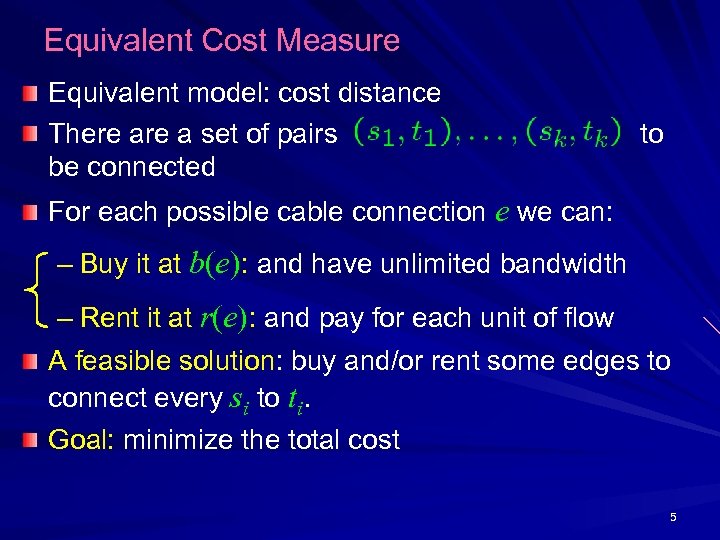
Equivalent Cost Measure Equivalent model: cost distance There a set of pairs be connected to For each possible cable connection e we can: – Buy it at b(e): and have unlimited bandwidth – Rent it at r(e): and pay for each unit of flow A feasible solution: buy and/or rent some edges to connect every si to ti. Goal: minimize the total cost 5
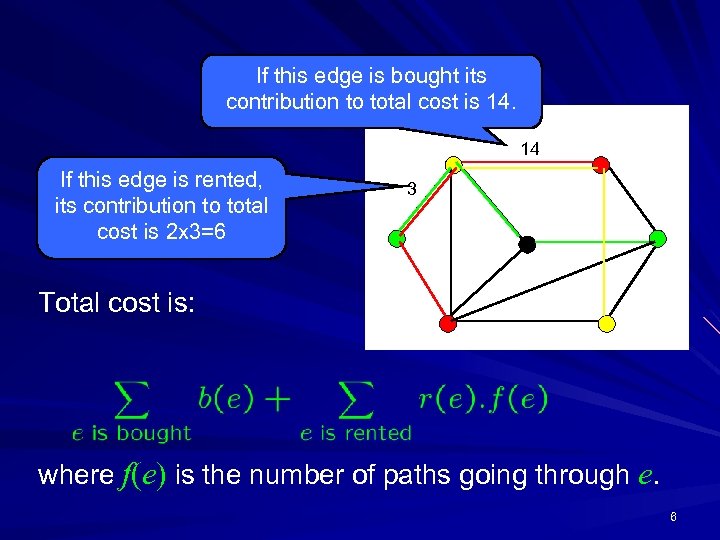
If this edge is bought its contribution to total cost is 14. 14 If this edge is rented, its contribution to total cost is 2 x 3=6 3 10 Total cost is: where f(e) is the number of paths going through e. 6
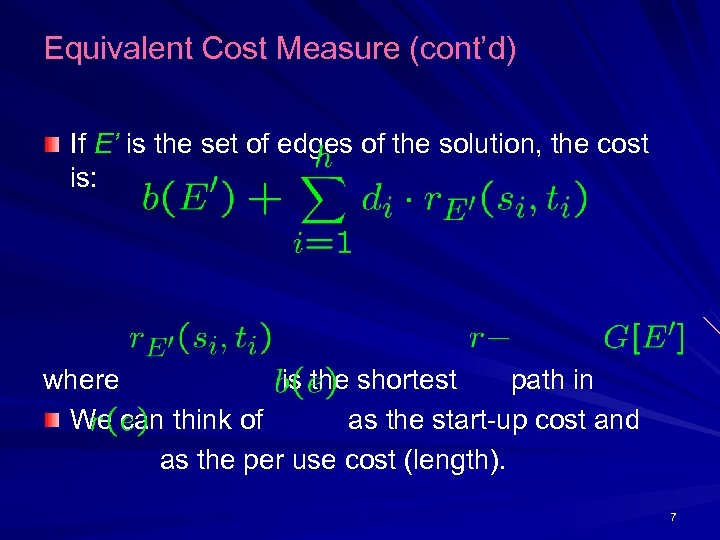
Equivalent Cost Measure (cont’d) If E’ is the set of edges of the solution, the cost is: where is the shortest path in We can think of as the start-up cost and as the per use cost (length). 7
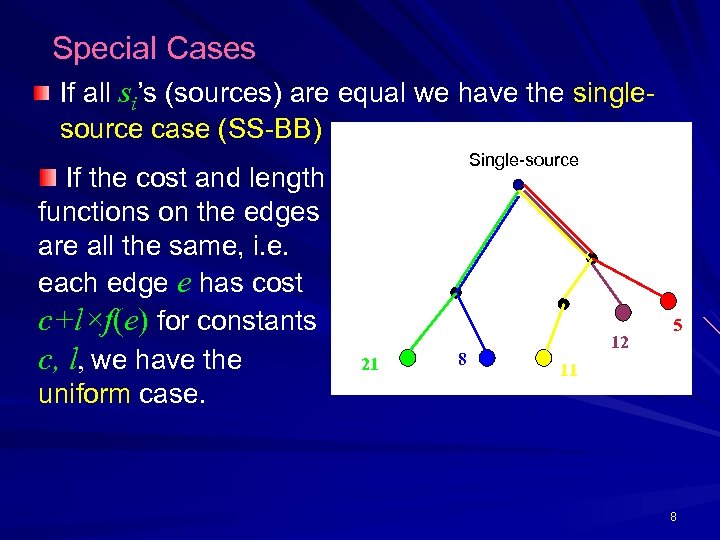
Special Cases If all si’s (sources) are equal we have the singlesource case (SS-BB) If the cost and length functions on the edges are all the same, i. e. each edge e has cost c+l×f(e) for constants c, l, we have the uniform case. Single-source 21 8 12 5 11 8
![Known Results for Buy-at-Bulk Problems Formally introduced by Salman et al. [SCRS’ 97] O(log](https://present5.com/presentation/8f131a370c0cbbbbade4b6f84d16b1ea/image-9.jpg "Known Results for Buy-at-Bulk Problems Formally introduced by Salman et al. [SCRS’ 97] O(log")
Known Results for Buy-at-Bulk Problems Formally introduced by Salman et al. [SCRS’ 97] O(log n) approximation for the uniform case [AA’ 97, Bartal’ 98, FRT’ 03] O(log n) approx for the single-sink case [MMP’ 00] Hardness of Ω(log n) for the single-sink case [CGNS’ 05] and Ω(log 1/2 - n) in general [Andrews’ 04], unless NP ZPTIME(npolylog(n)) Constant approx for several special cases: [AKR’ 91, GW’ 95, KM’ 00, KGR’ 02, KGPR’ 02, GKR’ 03] Recently we gave an O(log 4 n) approximation for the multicommodity case [HKS’ 06, CHKS’ 06]. 9
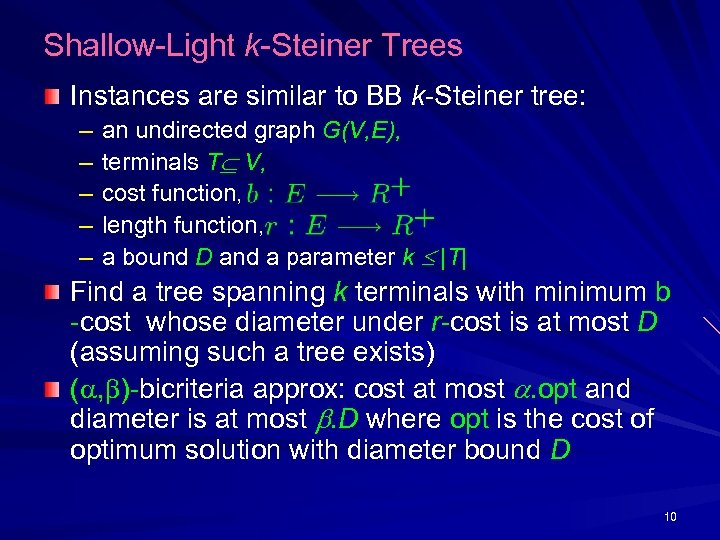
Shallow-Light k-Steiner Trees Instances are similar to BB k-Steiner tree: – – – an undirected graph G(V, E), terminals T V, cost function, length function, a bound D and a parameter k |T| Find a tree spanning k terminals with minimum b -cost whose diameter under r-cost is at most D (assuming such a tree exists) ( , )-bicriteria approx: cost at most . opt and diameter is at most . D where opt is the cost of optimum solution with diameter bound D 10
Our Results: Theorem 1: Given an instance of shallow-light k -Steiner tree with bound D, we find a (k/8)Steiner tree with diameter O(log n. D) and cost O(log 3 n. opt). Corollary: we get an (O(log 2 n), O(log 3 n))-bicriteria approx for shallow-light k-Steiner tree Theorem 2: There is an O(log 4 n)-approximation for buy-at-bulk k-Steiner tree. Note: BB k-Steiner generalizes k-MST and k-Steiner (when r=0). Shallow-light k-Steiner generalizes shallow-light Steiner (when k=|T| ) and k-MST (when D=1). 11
How to Reduce BB to Shallow-Light Let G be an instance of BB and assume we know the value of OPT (e. g. by guessing). Lemma: If there is an ( , )-bicriteria algorithm A for shallow-light k-Steiner that finds a (k/8)Steiner tree, then there is an O(( + ) log n) approx for BB k-Steiner. Proof: First, we can ignore every vertex with r-distance >OPT from the root. Then we run the following algorithm. 12
How to Reduce BB to Shallow-Light (cont’d) While k>0 repeat the following: 1. Run the ( , )-approx alg A for (k/2)-Steiner tree with diameter bound D=4 OPT/k 2. Decrease k by the number of terminals covered in the new solution; mark all these terminals as Steiner nodes; goto 1 The union of the solutions found is returned. Consider some iteration and let k’ be the number of unspanned terminals and H* be an optimal solution for BB k’-Steiner. 13
How to Reduce BB to Shallow-Light (cont’d) Iteratively remove leaves (terminals) with r-distance > 2 OPT/k’ from H*. We delete at most k’/2 terminals and r-diameter is at most 4. OPT/k’ Using alg A we find a (k’/16)-Steiner tree with diameter bound 4. OPT/k’. This adds at most k’. . 2 OPT/k’=2. OPT to the rent cost; buy cost is at most . OPT So we have covered a constant fraction of k’ at cost at most O(( + ). OPT). A standard set-cover analysis shows the total cost is in O(( + ). OPT. log n). 14
Overview of Algorithm for Shallow-Light k-Steiner First we compute a completion graph Gc of G : for every pair u, v V, compute (approximately) the minimum b-cost u, v-path with r-cost at most 2 D. It is easy to show: Lemma: if there is a bicriteria solution of cost X and diameter Y in Gc then we can find a solution of cost X and diameter Y in G. So it is enough to work with Gc. Also, we can easily transform the un-rooted case and the rooted case to each other. 15
Overview of Algorithm … (cont’d) We maintain a collection of trees At the beginning every terminal is a tree of one node We design a test that can fail or succeed If the test succeds two trees are merged Else some terminals are temporarily deleted 16
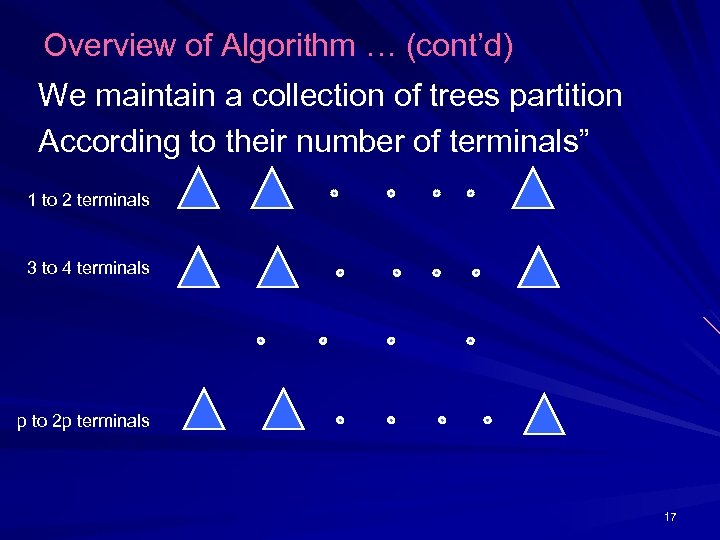
Overview of Algorithm … (cont’d) We maintain a collection of trees partition According to their number of terminals” 1 to 2 terminals 3 to 4 terminals p to 2 p terminals 17
The Test Pick a cluster of p to 2 p terminals that contains ``many” roots Every root is a terminal A terminals is a TRUE terminal if belongs to the optimum The test: does the collection of roots contain many terminals? 18
The Main Argument If the test succeeds then two trees are contracted together at a low price If it fails all roots in the cluster are removed We loose “many” terminals But only “few” true terminals Hence eventually a tree will reach size k/8 19
Conclusion and Open Problems We obtain O(log 4 n) approximation algorithm for buy-at-bulk k-steiner trees. The current lower bound is only Ω(log n). Main open problem: Can we improve the upper bound significantly or at least the lower bound to Ω(log n)? 20

Thank you. 21
Скачать презентацию Approximating Buy-at-Bulk and Shallow-Light k-Steiner Trees Mohammad T
8f131a370c0cbbbbade4b6f84d16b1ea.ppt