


 Скачать презентацию Appropriate Evaluation and Treatment of UTI in the
367eb7695d6fac391c2217d1c601ace5.ppt
- Количество слайдов: 44
 Appropriate Evaluation and Treatment of UTI in the Elderly: Walking the Talk Marcia Astuto, RN Nurse educator / Infection control nurse William B. Rice Eventide Home MAstuto@eventidehome. org Susanne Salem-Schatz, Sc. D. Program Director Appropriate Evaluation and Treatment of UTI in the Elderly MA Coalition for the Prevention of Medical Errors sss@hcqi. com 1
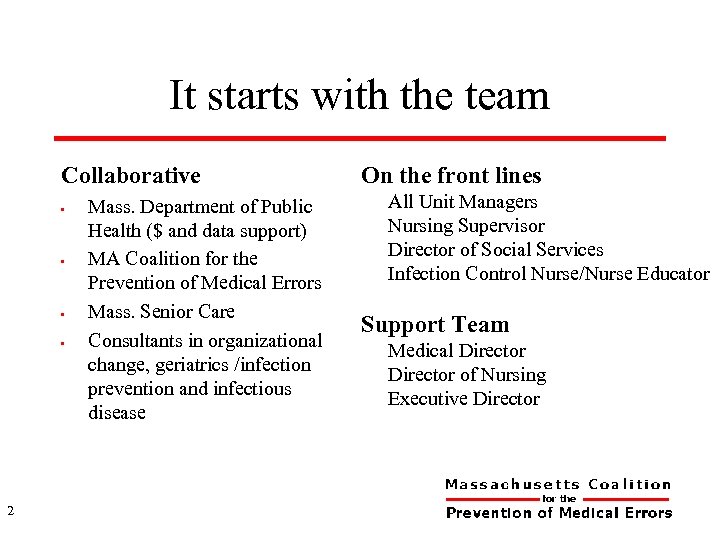 It starts with the team Collaborative • • 2 Mass. Department of Public Health ($ and data support) MA Coalition for the Prevention of Medical Errors Mass. Senior Care Consultants in organizational change, geriatrics /infection prevention and infectious disease On the front lines All Unit Managers Nursing Supervisor Director of Social Services Infection Control Nurse/Nurse Educator Support Team Medical Director of Nursing Executive Director
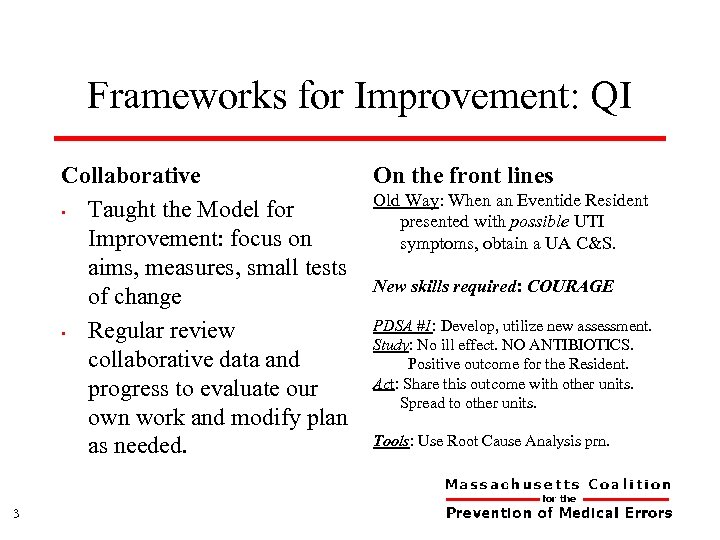 Frameworks for Improvement: QI Collaborative • Taught the Model for Improvement: focus on aims, measures, small tests of change • Regular review collaborative data and progress to evaluate our own work and modify plan as needed. 3 On the front lines Old Way: When an Eventide Resident presented with possible UTI symptoms, obtain a UA C&S. New skills required: COURAGE PDSA #1: Develop, utilize new assessment. Study: No ill effect. NO ANTIBIOTICS. Positive outcome for the Resident. Act: Share this outcome with other units. Spread to other units. Tools: Use Root Cause Analysis prn.
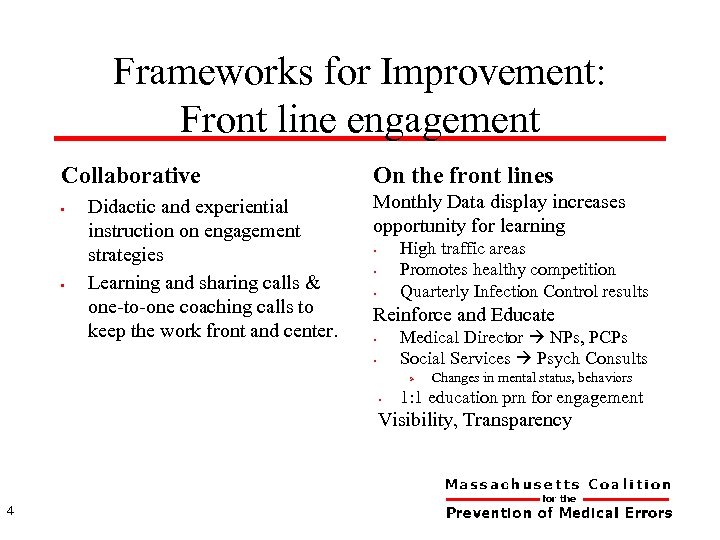 Frameworks for Improvement: Front line engagement Collaborative • • Didactic and experiential instruction on engagement strategies Learning and sharing calls & one-to-one coaching calls to keep the work front and center. On the front lines Monthly Data display increases opportunity for learning High traffic areas Promotes healthy competition Quarterly Infection Control results • • • Reinforce and Educate Medical Director NPs, PCPs Social Services Psych Consults • • Ø • Changes in mental status, behaviors 1: 1 education prn for engagement Visibility, Transparency 4
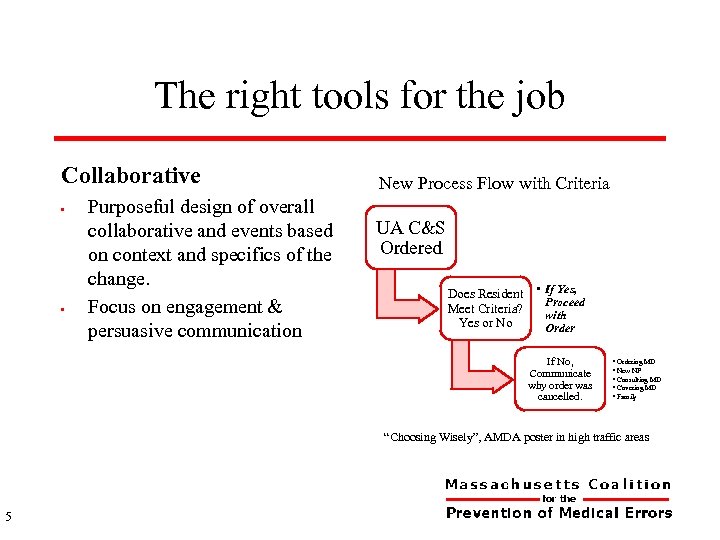 The right tools for the job Collaborative • • Purposeful design of overall collaborative and events based on context and specifics of the change. Focus on engagement & persuasive communication New Process Flow with Criteria UA C&S Ordered Does Resident Meet Criteria? Yes or No • If Yes, Proceed with Order If No, Communicate why order was cancelled. • Ordering MD • New NP • Consulting MD • Covering MD • Family “Choosing Wisely”, AMDA poster in high traffic areas 5
 Make the right thing the easy thing Collaborative • • • Created multiple and redundant opportunities for learning Created tools to facilitate practice change using principles of behavior change Target nursing practice, prescriber decision making, resident/family awareness On the front lines 1. 2. 3. ABC Tool has become protocol ; Introduced at Staff Orientation New Resident Admission is a time of significant adjustment Admission Packet has 100 pages Decision made to delay teaching of evidence-based UTI materials until later in Resident’s 1 st week: • • 1: 1 teaching by Infection Control Nurse Enables deeper engagement Include families as appropriate Further follow-up as needed (e. g. , Medical Director reinforces Protocol ) 6
 more tools at www. macoalition. org/uti-elderly-tools
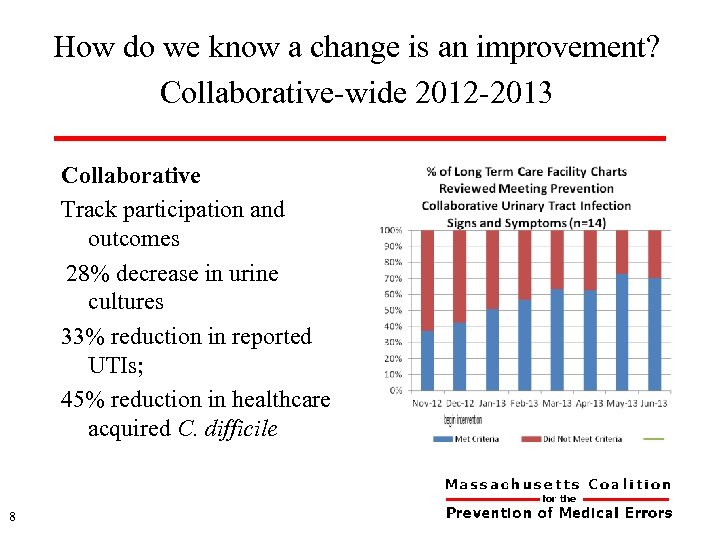 How do we know a change is an improvement? Collaborative-wide 2012 -2013 Collaborative Track participation and outcomes 28% decrease in urine cultures 33% reduction in reported UTIs; 45% reduction in healthcare acquired C. difficile 8
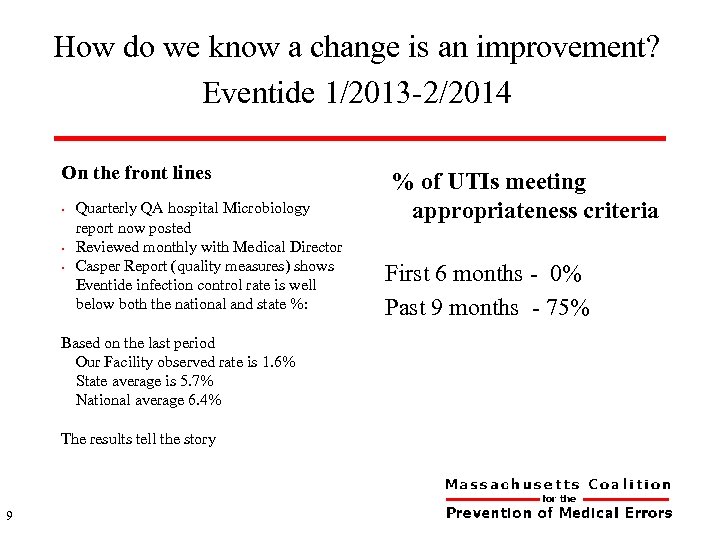 How do we know a change is an improvement? Eventide 1/2013 -2/2014 On the front lines • • • Quarterly QA hospital Microbiology report now posted Reviewed monthly with Medical Director Casper Report (quality measures) shows Eventide infection control rate is well below both the national and state %: Based on the last period Our Facility observed rate is 1. 6% State average is 5. 7% National average 6. 4% The results tell the story 9 % of UTIs meeting appropriateness criteria First 6 months - 0% Past 9 months - 75%
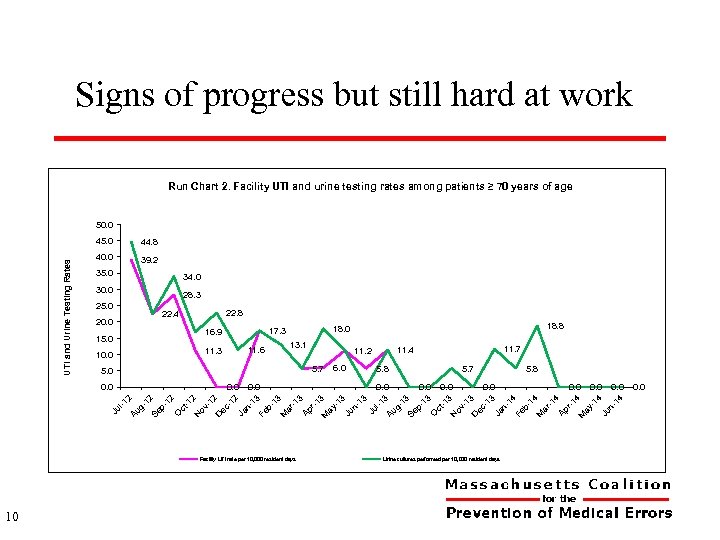 Signs of progress but still hard at work Run Chart 2. Facility UTI and urine testing rates among patients ≥ 70 years of age 50. 0 44. 8 40. 0 39. 2 35. 0 34. 0 30. 0 28. 3 22. 8 M n- 14 0. 0 Ju -1 4 0. 0 ay 4 4 r-1 Ap -1 4 ar -1 M n- Urine cultures performed per 10, 000 resident days Fe b -1 3 14 0. 0 Ja ov -1 3 0. 0 ec 3 -1 N 13 0. 0 ct p- 3 13 Se g- l-1 0. 0 Au 3 13 Ju n- ay M r-1 3 3 Ap -1 3 ar -1 M 13 Fe b 2 5. 8 5. 7 0. 0 Facility UTI rate per 10, 000 resident days 10 5. 8 0. 0 n- -1 2 -1 D ov ec 2 -1 N ct 12 O p- Se g- l-1 Au Ju 12 0. 0 6. 0 O 5. 7 5. 0 11. 7 11. 4 11. 2 D 13. 1 11. 6 11. 3 10. 0 18. 8 18. 0 17. 3 16. 9 15. 0 -1 22. 4 20. 0 Ju 25. 0 Ja UTI and Urine Testing Rates 45. 0 0. 0
 AMBULATORY MEDICATION RECONCILIATION AND SAFETY CONCERNS Massachusetts Coalition for the Prevention of Medical Errors 2014 Patient Safety Forum April 7, 2014 Christopher M. Coley, MD Patricia C. Mc. Carthy, PA, MHA Massachusetts General Hospital v 7. 0
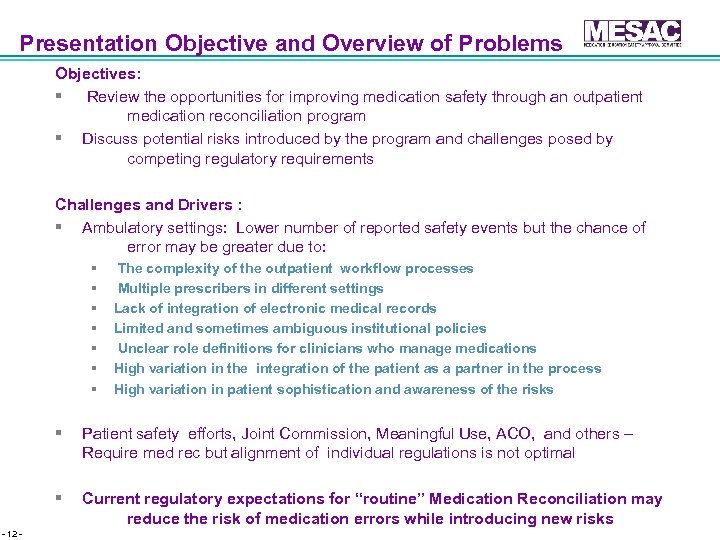 Presentation Objective and Overview of Problems Objectives: § Review the opportunities for improving medication safety through an outpatient medication reconciliation program § Discuss potential risks introduced by the program and challenges posed by competing regulatory requirements Challenges and Drivers : § Ambulatory settings: Lower number of reported safety events but the chance of error may be greater due to: § § § § The complexity of the outpatient workflow processes Multiple prescribers in different settings Lack of integration of electronic medical records Limited and sometimes ambiguous institutional policies Unclear role definitions for clinicians who manage medications High variation in the integration of the patient as a partner in the process High variation in patient sophistication and awareness of the risks § § - 12 - Patient safety efforts, Joint Commission, Meaningful Use, ACO, and others – Require med rec but alignment of individual regulations is not optimal Current regulatory expectations for “routine” Medication Reconciliation may reduce the risk of medication errors while introducing new risks
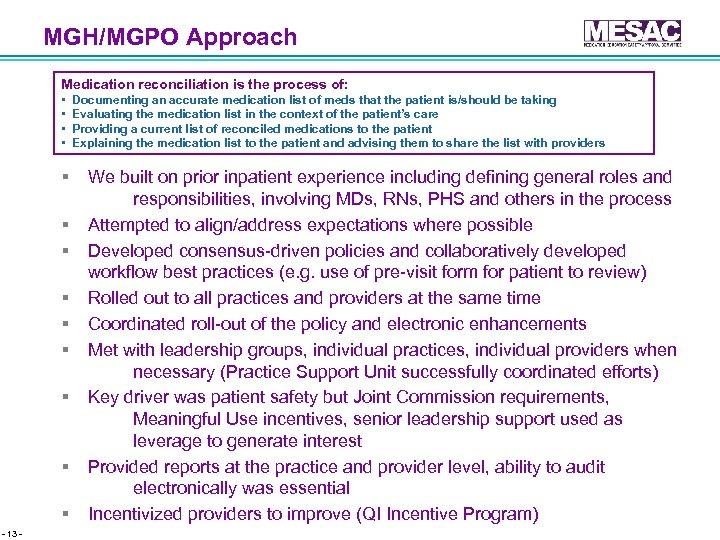 MGH/MGPO Approach Medication reconciliation is the process of: • • § § § § § - 13 - Documenting an accurate medication list of meds that the patient is/should be taking Evaluating the medication list in the context of the patient’s care Providing a current list of reconciled medications to the patient Explaining the medication list to the patient and advising them to share the list with providers We built on prior inpatient experience including defining general roles and responsibilities, involving MDs, RNs, PHS and others in the process Attempted to align/address expectations where possible Developed consensus-driven policies and collaboratively developed workflow best practices (e. g. use of pre-visit form for patient to review) Rolled out to all practices and providers at the same time Coordinated roll-out of the policy and electronic enhancements Met with leadership groups, individual practices, individual providers when necessary (Practice Support Unit successfully coordinated efforts) Key driver was patient safety but Joint Commission requirements, Meaningful Use incentives, senior leadership support used as leverage to generate interest Provided reports at the practice and provider level, ability to audit electronically was essential Incentivized providers to improve (QI Incentive Program)
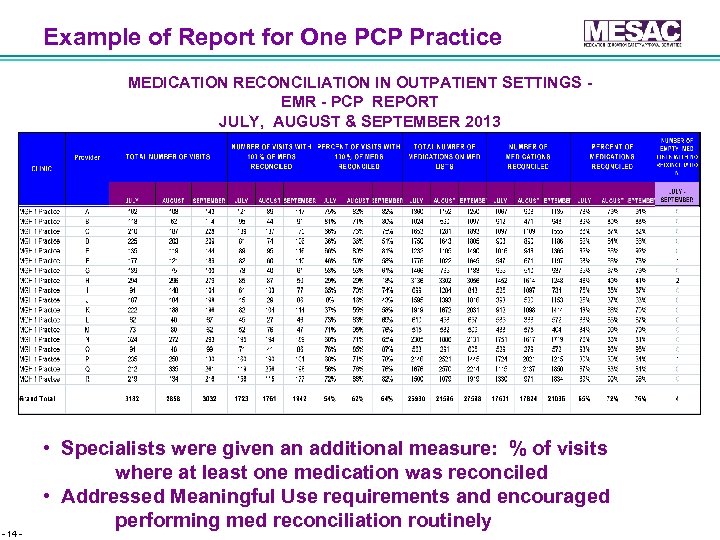 Example of Report for One PCP Practice MEDICATION RECONCILIATION IN OUTPATIENT SETTINGS EMR - PCP REPORT JULY, AUGUST & SEPTEMBER 2013 - 14 - • Specialists were given an additional measure: % of visits where at least one medication was reconciled • Addressed Meaningful Use requirements and encouraged performing med reconciliation routinely
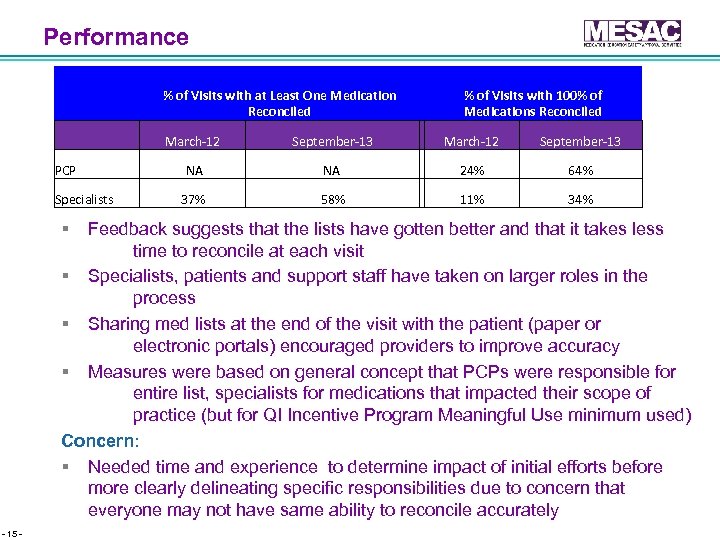 Performance % of Visits with at Least One Medication Reconciled March-12 September-13 PCP NA NA 24% 64% Specialists 37% 58% 11% 34% § % of Visits with 100% of Medications Reconciled Feedback suggests that the lists have gotten better and that it takes less time to reconcile at each visit § Specialists, patients and support staff have taken on larger roles in the process § Sharing med lists at the end of the visit with the patient (paper or electronic portals) encouraged providers to improve accuracy § Measures were based on general concept that PCPs were responsible for entire list, specialists for medications that impacted their scope of practice (but for QI Incentive Program Meaningful Use minimum used) Concern: § Needed time and experience to determine impact of initial efforts before more clearly delineating specific responsibilities due to concern that everyone may not have same ability to reconcile accurately - 15 -
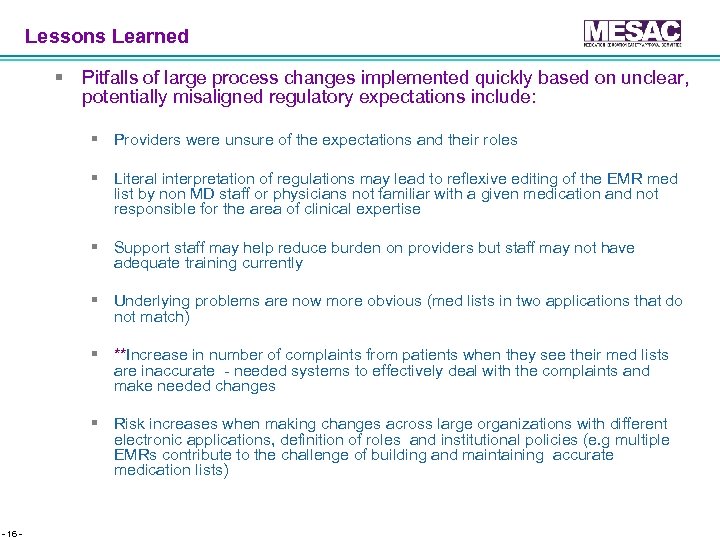 Lessons Learned § Pitfalls of large process changes implemented quickly based on unclear, potentially misaligned regulatory expectations include: § Providers were unsure of the expectations and their roles § Literal interpretation of regulations may lead to reflexive editing of the EMR med list by non MD staff or physicians not familiar with a given medication and not responsible for the area of clinical expertise § Support staff may help reduce burden on providers but staff may not have adequate training currently § Underlying problems are now more obvious (med lists in two applications that do not match) § **Increase in number of complaints from patients when they see their med lists are inaccurate - needed systems to effectively deal with the complaints and make needed changes § Risk increases when making changes across large organizations with different electronic applications, definition of roles and institutional policies (e. g multiple EMRs contribute to the challenge of building and maintaining accurate medication lists) - 16 -
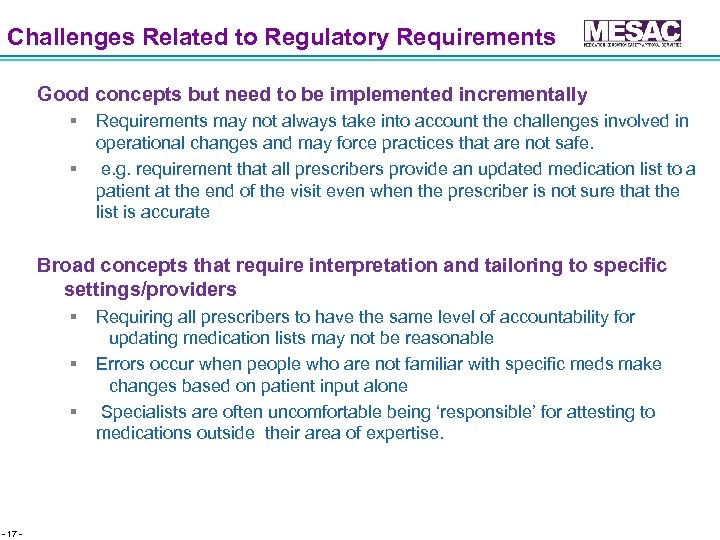 Challenges Related to Regulatory Requirements Good concepts but need to be implemented incrementally § § Requirements may not always take into account the challenges involved in operational changes and may force practices that are not safe. e. g. requirement that all prescribers provide an updated medication list to a patient at the end of the visit even when the prescriber is not sure that the list is accurate Broad concepts that require interpretation and tailoring to specific settings/providers § § § - 17 - Requiring all prescribers to have the same level of accountability for updating medication lists may not be reasonable Errors occur when people who are not familiar with specific meds make changes based on patient input alone Specialists are often uncomfortable being ‘responsible’ for attesting to medications outside their area of expertise.
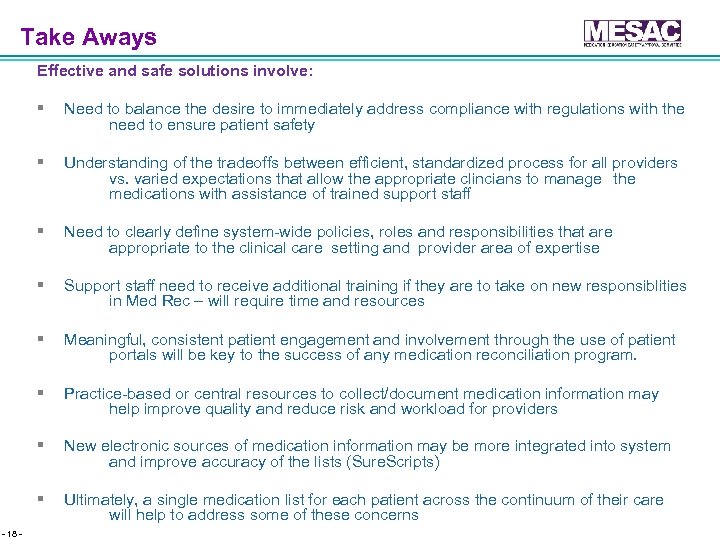 Take Aways Effective and safe solutions involve: § § Understanding of the tradeoffs between efficient, standardized process for all providers vs. varied expectations that allow the appropriate clincians to manage the medications with assistance of trained support staff § Need to clearly define system-wide policies, roles and responsibilities that are appropriate to the clinical care setting and provider area of expertise § Support staff need to receive additional training if they are to take on new responsiblities in Med Rec – will require time and resources § Meaningful, consistent patient engagement and involvement through the use of patient portals will be key to the success of any medication reconciliation program. § Practice-based or central resources to collect/document medication information may help improve quality and reduce risk and workload for providers § New electronic sources of medication information may be more integrated into system and improve accuracy of the lists (Sure. Scripts) § - 18 - Need to balance the desire to immediately address compliance with regulations with the need to ensure patient safety Ultimately, a single medication list for each patient across the continuum of their care will help to address some of these concerns
 Partnering with Patients: Leveraging Transparency to Improve Safety The Patient TIPS and Open. Notes Reporting Tool models Sigall K. Bell, MD Arnold P. Gold Professorship, Beth Israel Deaconess Medical Center Director, Patient Safety and Quality Initiatives, Institute for Professionalism and Ethical Practice, Boston Children’s Hospital Harvard Medical School With generous support from: The Schwartz Center CRICO/RMF
 Leveraging transparency to improve patient safety § Patient Teachers in Patient Safety § Open. Notes Patient Reporting Tool “Nothing about me without me”
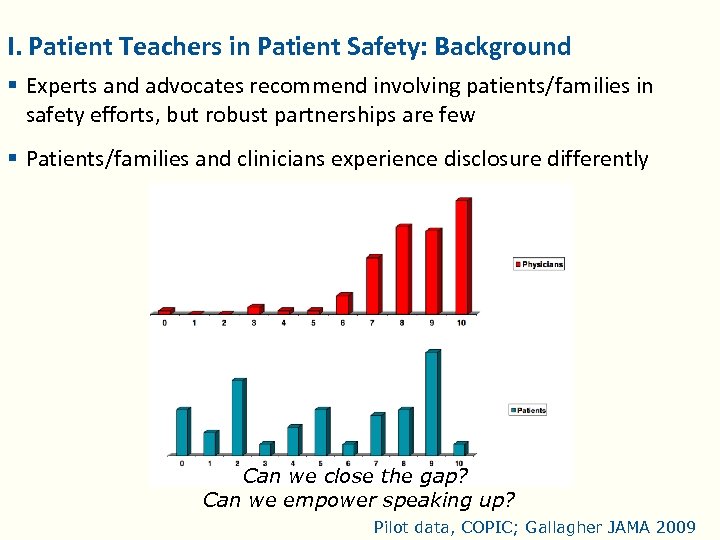 I. Patient Teachers in Patient Safety: Background § Experts and advocates recommend involving patients/families in safety efforts, but robust partnerships are few § Patients/families and clinicians experience disclosure differently Can we close the gap? Can we empower speaking up? Pilot data, COPIC; Gallagher JAMA 2009
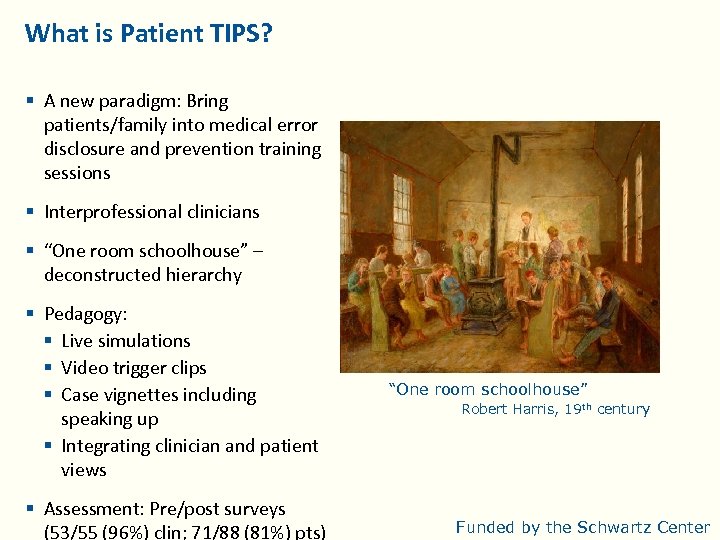 What is Patient TIPS? § A new paradigm: Bring patients/family into medical error disclosure and prevention training sessions § Interprofessional clinicians § “One room schoolhouse” – deconstructed hierarchy § Pedagogy: § Live simulations § Video trigger clips § Case vignettes including speaking up § Integrating clinician and patient views § Assessment: Pre/post surveys (53/55 (96%) clin; 71/88 (81%) pts) “One room schoolhouse” Robert Harris, 19 th century Funded by the Schwartz Center
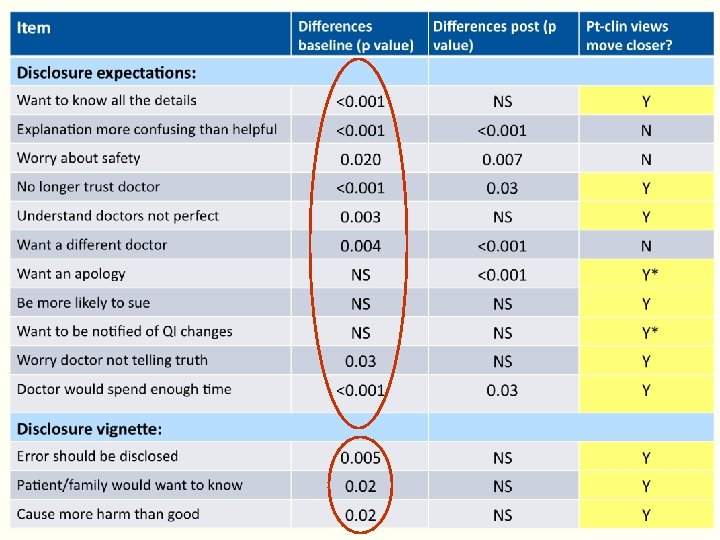
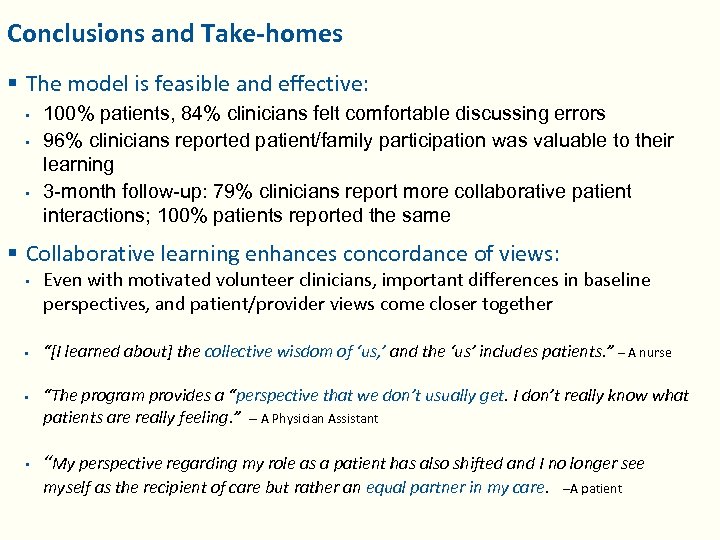 Conclusions and Take-homes § The model is feasible and effective: • • • 100% patients, 84% clinicians felt comfortable discussing errors 96% clinicians reported patient/family participation was valuable to their learning 3 -month follow-up: 79% clinicians report more collaborative patient interactions; 100% patients reported the same § Collaborative learning enhances concordance of views: • • Even with motivated volunteer clinicians, important differences in baseline perspectives, and patient/provider views come closer together “[I learned about] the collective wisdom of ‘us, ’ and the ‘us’ includes patients. ” – A nurse “The program provides a “perspective that we don’t usually get. I don’t really know what patients are really feeling. ” -- A Physician Assistant “My perspective regarding my role as a patient has also shifted and I no longer see myself as the recipient of care but rather an equal partner in my care. –A patient
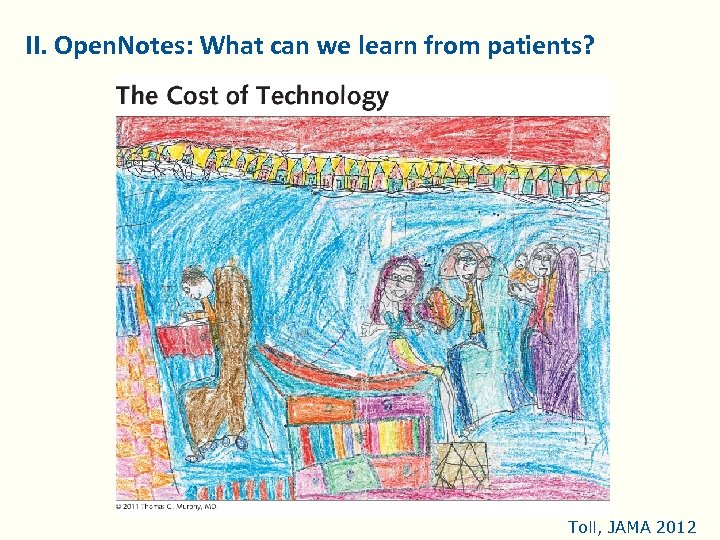 II. Open. Notes: What can we learn from patients? Toll, JAMA 2012
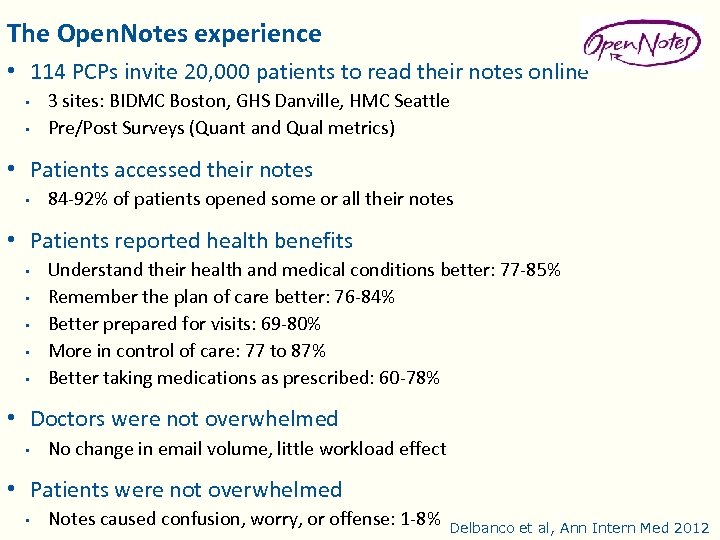 The Open. Notes experience • 114 PCPs invite 20, 000 patients to read their notes online • • 3 sites: BIDMC Boston, GHS Danville, HMC Seattle Pre/Post Surveys (Quant and Qual metrics) • Patients accessed their notes • 84 -92% of patients opened some or all their notes • Patients reported health benefits • • • Understand their health and medical conditions better: 77 -85% Remember the plan of care better: 76 -84% Better prepared for visits: 69 -80% More in control of care: 77 to 87% Better taking medications as prescribed: 60 -78% • Doctors were not overwhelmed • No change in email volume, little workload effect • Patients were not overwhelmed • Notes caused confusion, worry, or offense: 1 -8% Delbanco et al, Ann Intern Med 2012
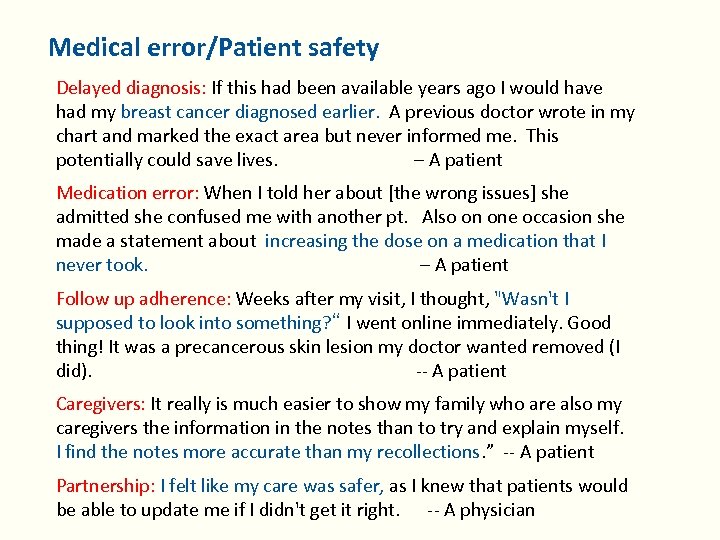 27 Medical error/Patient safety Delayed diagnosis: If this had been available years ago I would have had my breast cancer diagnosed earlier. A previous doctor wrote in my chart and marked the exact area but never informed me. This potentially could save lives. – A patient Medication error: When I told her about [the wrong issues] she admitted she confused me with another pt. Also on one occasion she made a statement about increasing the dose on a medication that I never took. – A patient Follow up adherence: Weeks after my visit, I thought, "Wasn't I supposed to look into something? “ I went online immediately. Good thing! It was a precancerous skin lesion my doctor wanted removed (I did). -- A patient Caregivers: It really is much easier to show my family who are also my caregivers the information in the notes than to try and explain myself. I find the notes more accurate than my recollections. ” -- A patient Partnership: I felt like my care was safer, as I knew that patients would be able to update me if I didn't get it right. -- A physician
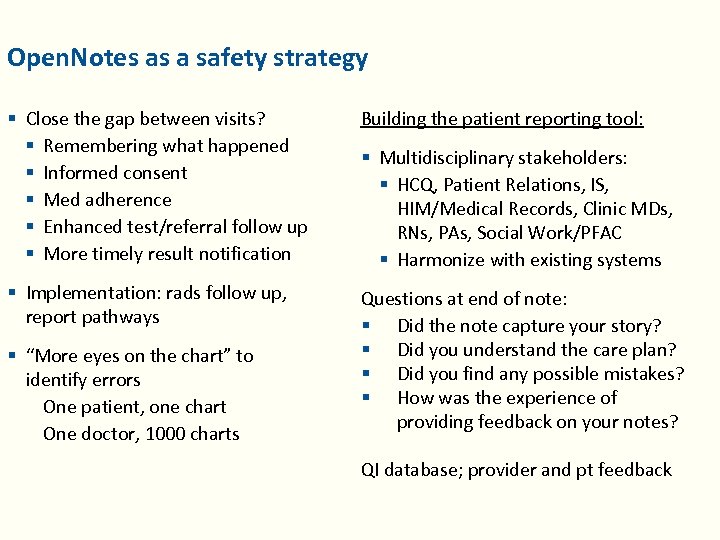 Open. Notes as a safety strategy § Close the gap between visits? § Remembering what happened § Informed consent § Med adherence § Enhanced test/referral follow up § More timely result notification Building the patient reporting tool: § Implementation: rads follow up, report pathways Questions at end of note: § Did the note capture your story? § Did you understand the care plan? § Did you find any possible mistakes? § How was the experience of providing feedback on your notes? § “More eyes on the chart” to identify errors One patient, one chart One doctor, 1000 charts § Multidisciplinary stakeholders: § HCQ, Patient Relations, IS, HIM/Medical Records, Clinic MDs, RNs, PAs, Social Work/PFAC § Harmonize with existing systems QI database; provider and pt feedback
 Acknowledgement Patient TIPS Team: § William Martinez § David Browning § Pam Varrin § Barbara Sarnoff Lee § Elana Premack Sandler § BIDMC and CHA PFAC Advisors § IPEP faculty; Allyson Mc. Crary § With generous support from the Schwartz Center MCPME: § Paula Griswold § Beth Capstick § Emily Biocchi Open. Notes Team § Roanne Mejilla § Mary Barry § Pat Folcarelli § Claire Gerstein § Amy B. Goldman § Heidi Jay § Susan E. Johnson § Gila Kriegel § Julia Lindenberg § Larry Markson § Elana Premack Sandler § Kenneth Sands § Barbara Sarnoff § Jan Walker § Norma Wells § Gail Wood § With generous support from CRICO
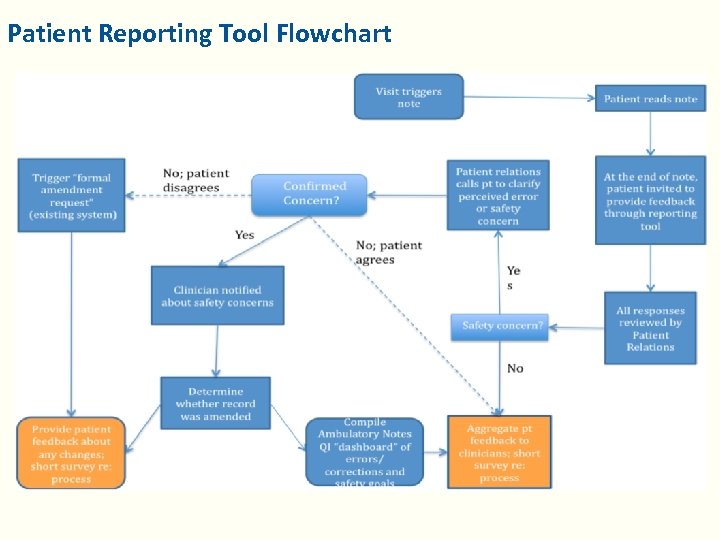 Patient Reporting Tool Flowchart
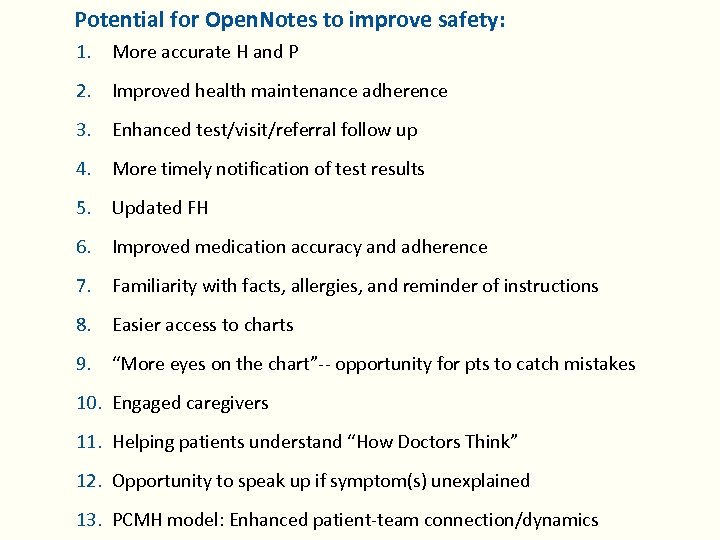 Potential for Open. Notes to improve safety: 1. More accurate H and P 2. Improved health maintenance adherence 3. Enhanced test/visit/referral follow up 4. More timely notification of test results 5. Updated FH 6. Improved medication accuracy and adherence 7. Familiarity with facts, allergies, and reminder of instructions 8. Easier access to charts 9. “More eyes on the chart”-- opportunity for pts to catch mistakes 10. Engaged caregivers 11. Helping patients understand “How Doctors Think” 12. Opportunity to speak up if symptom(s) unexplained 13. PCMH model: Enhanced patient-team connection/dynamics
 Pioneering Effective Patient Safety Strategies in the Ambulatory Setting David Kornoelje, MHA Clinical Safety and Risk Management Specialist Atrius Health 32
 Learning Objectives • Recognize barriers for reporting safety events in the ambulatory setting. • Identify interventions for educating staff on what to report and the importance of why to report safety events. • Understand the importance for leadership support. • Identify a mechanism for closing the loop and engaging staff in safety discussions. 33
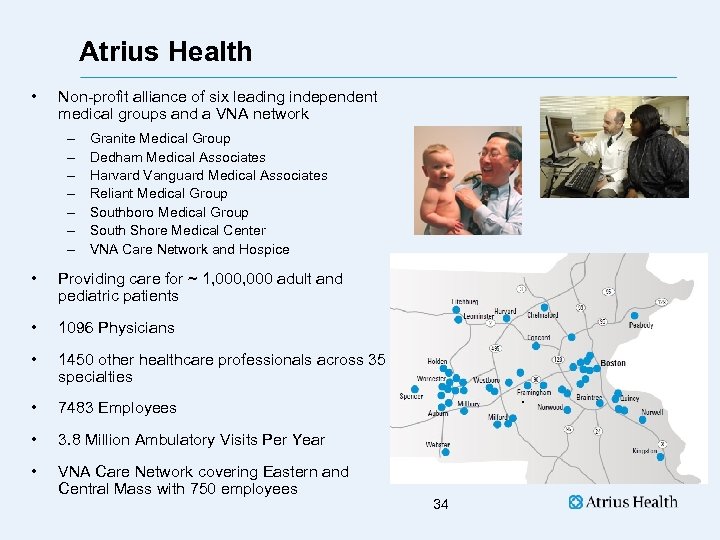 Atrius Health • Non-profit alliance of six leading independent medical groups and a VNA network – – – – Granite Medical Group Dedham Medical Associates Harvard Vanguard Medical Associates Reliant Medical Group Southboro Medical Group South Shore Medical Center VNA Care Network and Hospice • Providing care for ~ 1, 000 adult and pediatric patients • 1096 Physicians • 1450 other healthcare professionals across 35 specialties • 7483 Employees • 3. 8 Million Ambulatory Visits Per Year • VNA Care Network covering Eastern and Central Mass with 750 employees . 34
 Safety Culture Climate at Atrius Health Group • Reporting of safety events were low and sporadic – Data suggested only 5 people were carrying the load of reporting, which included 2 physicians and 3 managers – Learning and improving safety was difficult • Identified barriers for reporting – – Staff unfamiliar with what to report Staff perceived reporting to be punitive Physicians saw reporting to be too time consuming The infamous “black hole” • Review process – All safety events were reviewed by only the COO – Minimal events discussed at Safety and Quality Committee 35
 Concept of a Pilot • Pilot was conceptualized to target the top 4 identified barriers at the Atrius Health Group of culture, fear factors, closing the loop, and what to report. • Design of pilot had to be strategically planned for buy-in on all fronts and approval by Atrius Health Group executive leadership. • Meetings with Atrius Health CMO and COO determined pilot area and duration of pilot (4 months to span from September 2013 to December 2013). 36
 Objectives of Pilot • Increase the number of events reported • Increase the number of individual staff reporting safety events • Increase the spread of the types of roles of reporters • Implement a local reviewer to review all safety events originating in the area • Conduct weekly “safety rounds” open to all staff to discuss improvements made or trends identified as a result of safety events being reported. 37
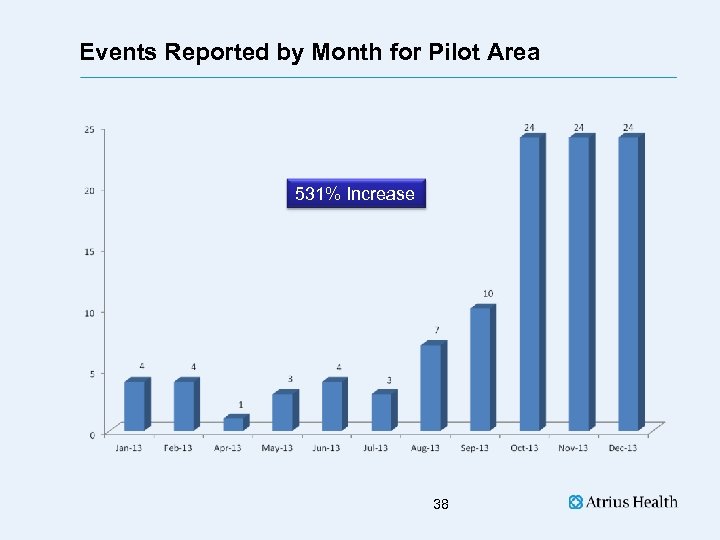 Events Reported by Month for Pilot Area 531% Increase 38
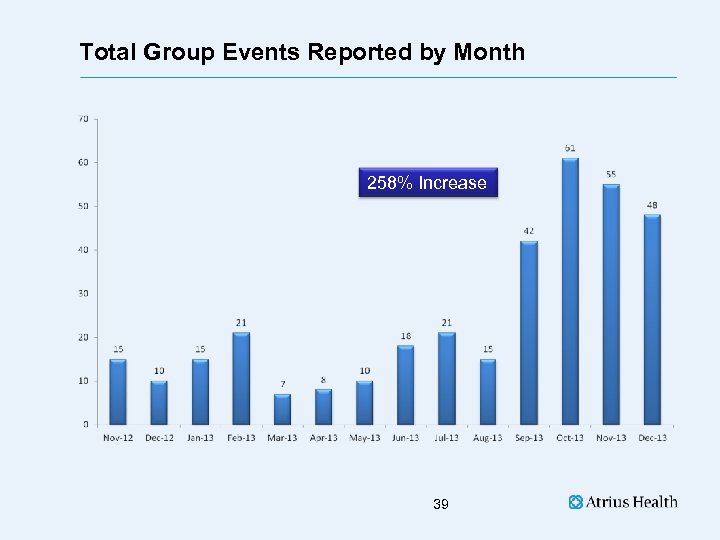 Total Group Events Reported by Month 258% Increase 39
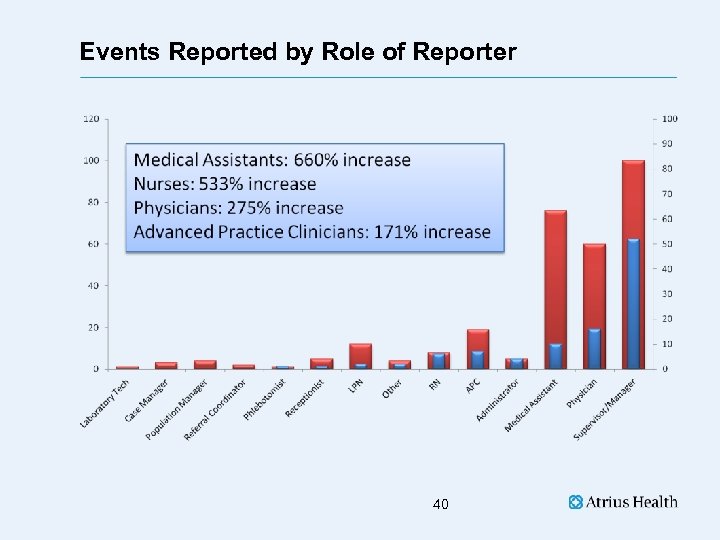 Events Reported by Role of Reporter 40
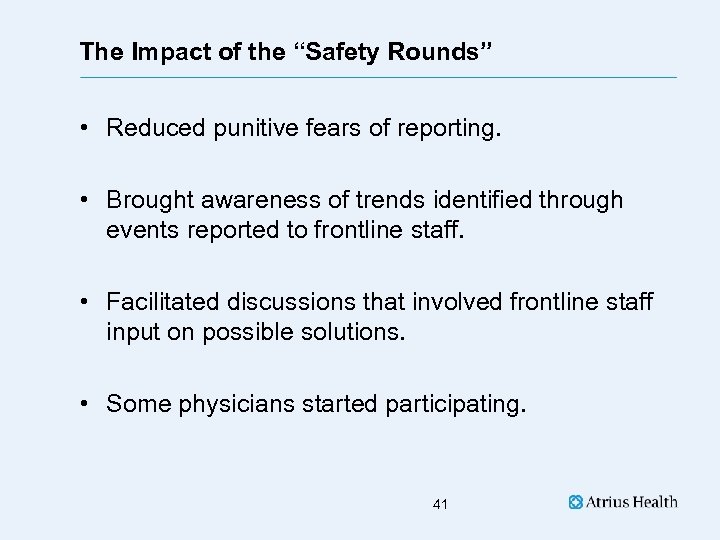 The Impact of the “Safety Rounds” • Reduced punitive fears of reporting. • Brought awareness of trends identified through events reported to frontline staff. • Facilitated discussions that involved frontline staff input on possible solutions. • Some physicians started participating. 41
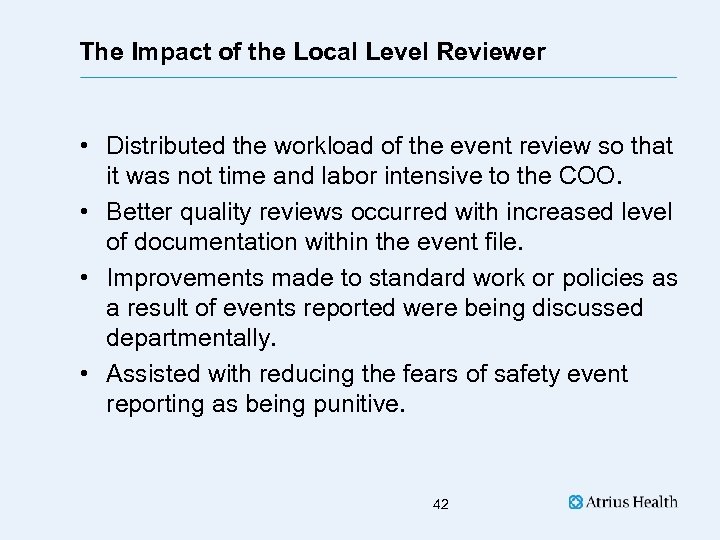 The Impact of the Local Level Reviewer • Distributed the workload of the event review so that it was not time and labor intensive to the COO. • Better quality reviews occurred with increased level of documentation within the event file. • Improvements made to standard work or policies as a result of events reported were being discussed departmentally. • Assisted with reducing the fears of safety event reporting as being punitive. 42
 Overall Impact of the Pilot on the Group • Executive leadership now supporting the rollout of “safety rounds” and local level reviewers in each clinical area. • Staff are feeling safer to report as evidenced by peer -to-peer encouragement to report. • Physicians are becoming more actively involved in safety event reporting and discussions. • Safety and Quality committee is becoming more structured with their agenda based on the level of meaningful safety events being reported. 43
 Q & A / Discussion