


 Скачать презентацию Approaches to managing invasive agricultural and forestry pests
b6596aa384ed98ae5b7385c075128cb9.ppt
- Количество слайдов: 14
 Approaches to managing invasive agricultural and forestry pests in Northern Ireland Archie K. Murchie, Sam Clawson & Stephen Jess
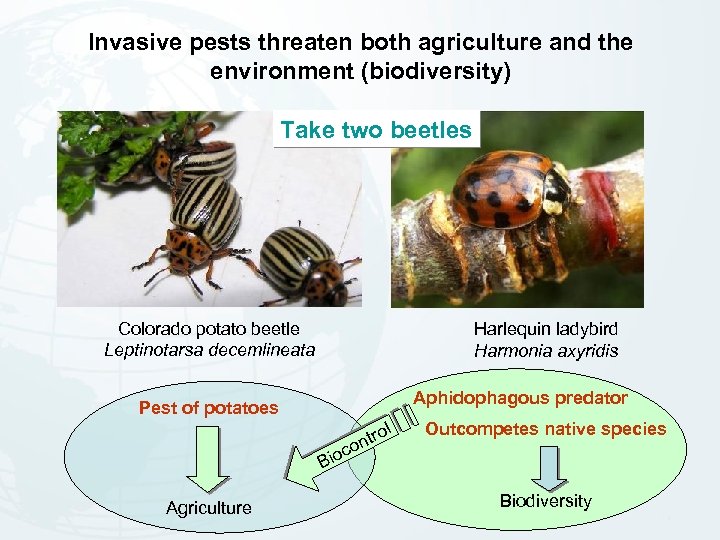 Invasive pests threaten both agriculture and the environment (biodiversity) Take two beetles Colorado potato beetle Leptinotarsa decemlineata Harlequin ladybird Harmonia axyridis Aphidophagous predator Pest of potatoes l o ntr o ioc B Agriculture Outcompetes native species Biodiversity
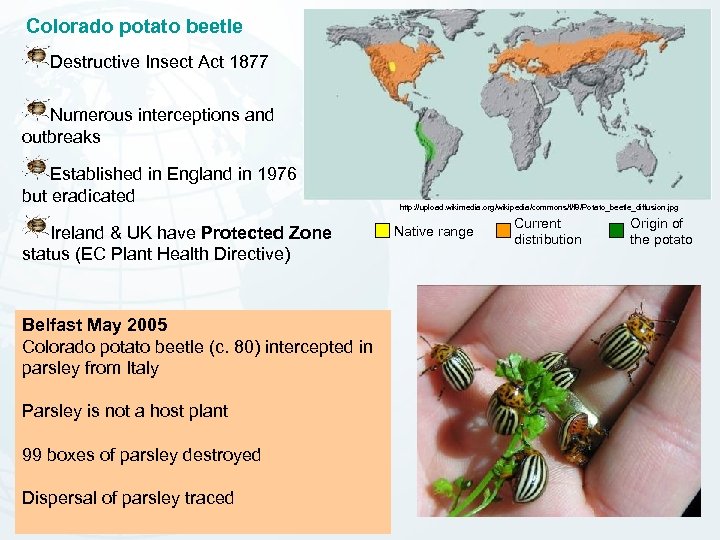 Colorado potato beetle Destructive Insect Act 1877 Numerous interceptions and outbreaks Established in England in 1976 but eradicated Ireland & UK have Protected Zone status (EC Plant Health Directive) Belfast May 2005 Colorado potato beetle (c. 80) intercepted in parsley from Italy Parsley is not a host plant 99 boxes of parsley destroyed Dispersal of parsley traced http: //upload. wikimedia. org/wikipedia/commons/f/f 8/Potato_beetle_diffusion. jpg Native range Current distribution Origin of the potato
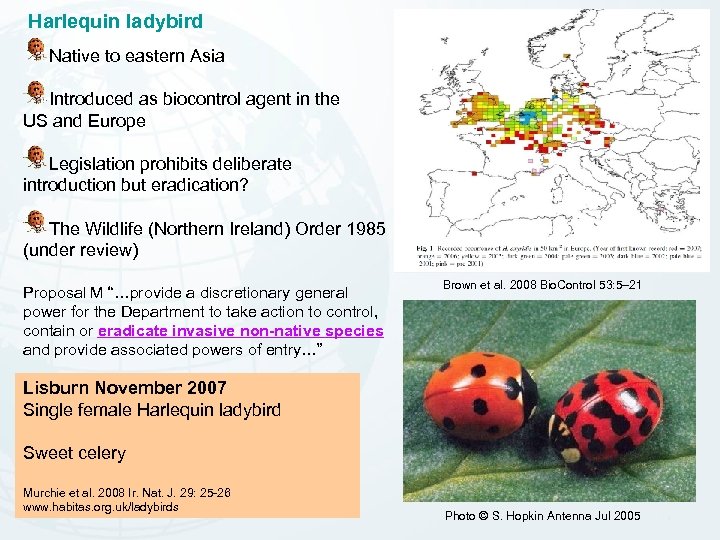 Harlequin ladybird Native to eastern Asia Introduced as biocontrol agent in the US and Europe Legislation prohibits deliberate introduction but eradication? The Wildlife (Northern Ireland) Order 1985 (under review) Proposal M “…provide a discretionary general power for the Department to take action to control, contain or eradicate invasive non-native species and provide associated powers of entry…” Brown et al. 2008 Bio. Control 53: 5– 21 Lisburn November 2007 Single female Harlequin ladybird Sweet celery Murchie et al. 2008 Ir. Nat. J. 29: 25 -26 www. habitas. org. uk/ladybirds Photo © S. Hopkin Antenna Jul 2005
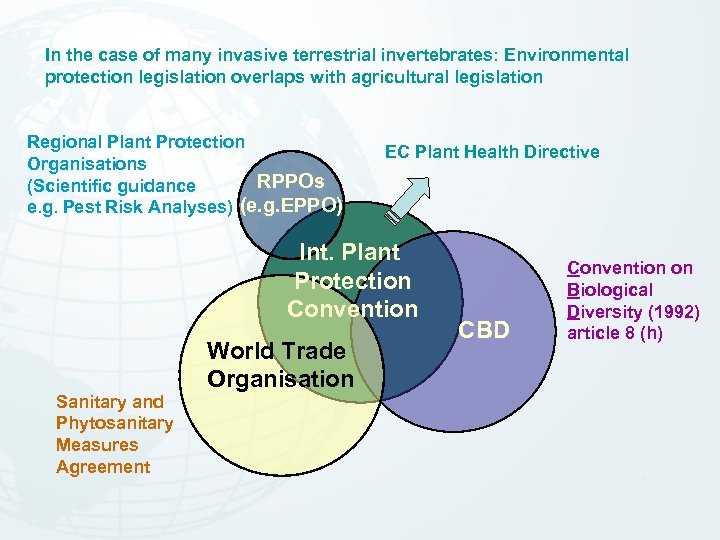 In the case of many invasive terrestrial invertebrates: Environmental protection legislation overlaps with agricultural legislation Regional Plant Protection Organisations RPPOs (Scientific guidance e. g. Pest Risk Analyses) (e. g. EPPO) EC Plant Health Directive Int. Plant Protection Convention Sanitary and Phytosanitary Measures Agreement World Trade Organisation CBD Convention on Biological Diversity (1992) article 8 (h)
 EC Plant Health Directive (2000/29/EC) provides legislative framework for Plant Health in the European Community Enacted in NI by The Plant Health Order (Northern Ireland) 2006 (www. opsi. gov. uk/sr/sr 2006/20060082. htm#33) The Plant Health (Wood and Bark) Order (Northern Ireland) 2006 The Bee Diseases and Pests Control Order (Northern Ireland) 2007 • List of pests and diseases & plant material • “…any plant pest normally present in Northern Ireland in respect of which there is, in the opinion of the inspector, an imminent danger of its spreading or being spread in Northern Ireland. ”
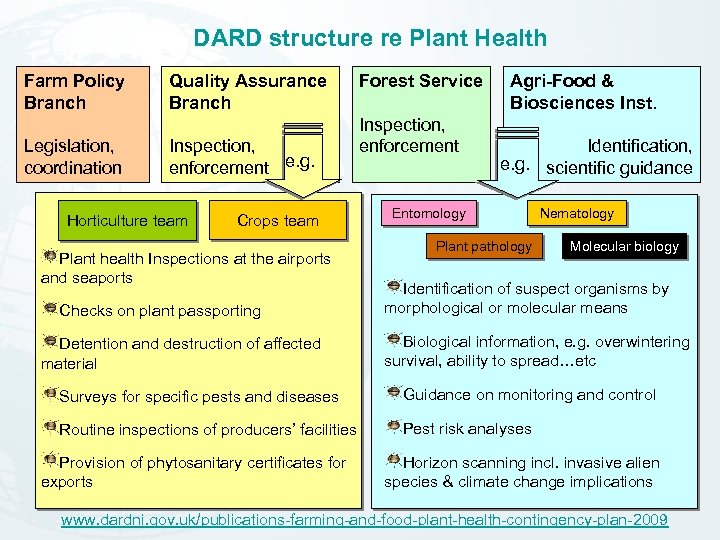 DARD structure re Plant Health Farm Policy Branch Legislation, coordination Quality Assurance Branch Inspection, enforcement e. g. Horticulture team Crops team Plant health Inspections at the airports and seaports Checks on plant passporting Detention and destruction of affected material Forest Service Inspection, enforcement Agri-Food & Biosciences Inst. Identification, e. g. scientific guidance Entomology Plant pathology Nematology Molecular biology Identification of suspect organisms by morphological or molecular means Biological information, e. g. overwintering survival, ability to spread…etc Surveys for specific pests and diseases Guidance on monitoring and control Routine inspections of producers’ facilities Pest risk analyses Provision of phytosanitary certificates for exports Horizon scanning incl. invasive alien species & climate change implications www. dardni. gov. uk/publications-farming-and-food-plant-health-contingency-plan-2009
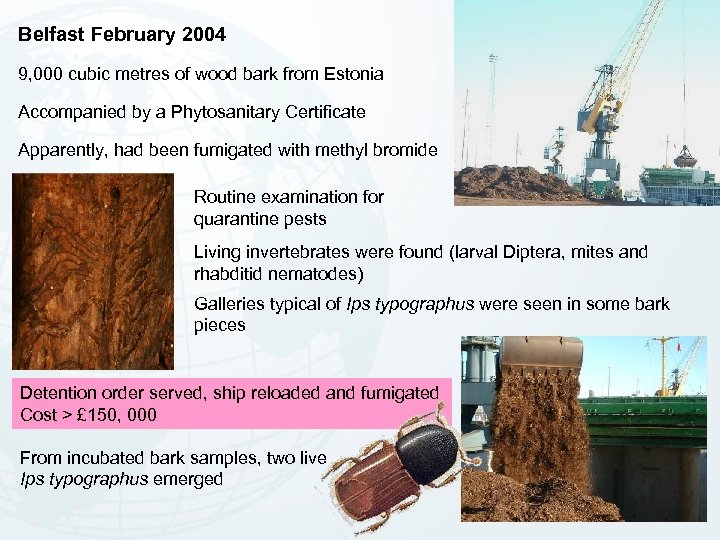 Belfast February 2004 9, 000 cubic metres of wood bark from Estonia Accompanied by a Phytosanitary Certificate Apparently, had been fumigated with methyl bromide Routine examination for quarantine pests Living invertebrates were found (larval Diptera, mites and rhabditid nematodes) Galleries typical of Ips typographus were seen in some bark pieces Detention order served, ship reloaded and fumigated Cost > £ 150, 000 From incubated bark samples, two live Ips typographus emerged
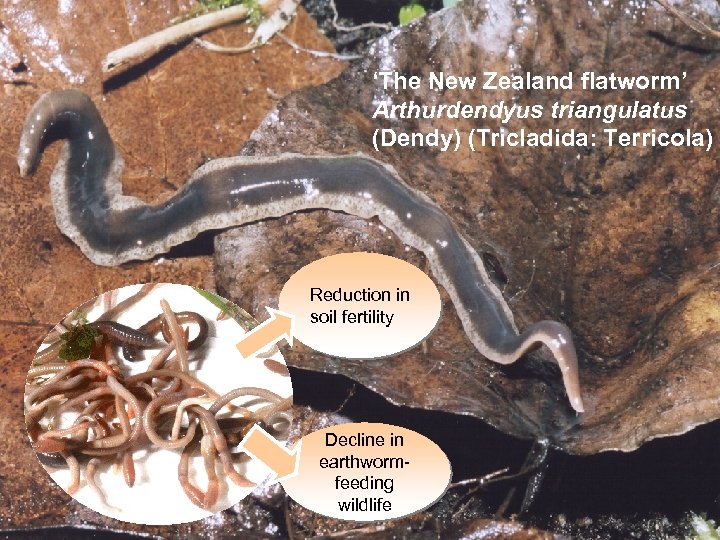 ‘The New Zealand flatworm’ Arthurdendyus triangulatus (Dendy) (Tricladida: Terricola) Reduction in soil fertility Decline in earthwormfeeding wildlife
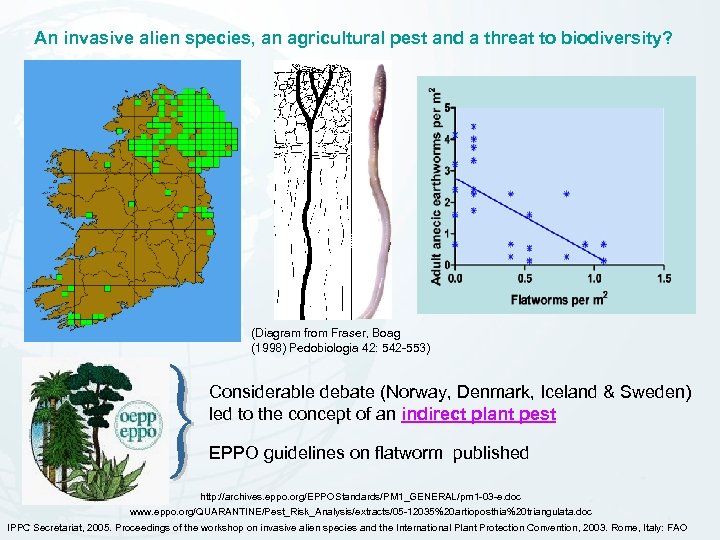 An invasive alien species, an agricultural pest and a threat to biodiversity? (Diagram from Fraser, Boag (1998) Pedobiologia 42: 542 -553) Considerable debate (Norway, Denmark, Iceland & Sweden) led to the concept of an indirect plant pest EPPO guidelines on flatworm published http: //archives. eppo. org/EPPOStandards/PM 1_GENERAL/pm 1 -03 -e. doc www. eppo. org/QUARANTINE/Pest_Risk_Analysis/extracts/05 -12035%20 artioposthia%20 triangulata. doc IPPC Secretariat, 2005. Proceedings of the workshop on invasive alien species and the International Plant Protection Convention, 2003. Rome, Italy: FAO
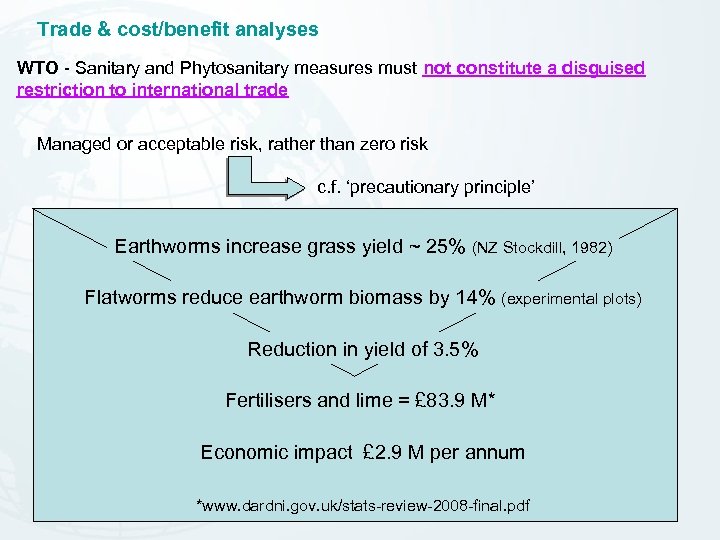 Trade & cost/benefit analyses WTO - Sanitary and Phytosanitary measures must not constitute a disguised restriction to international trade Managed or acceptable risk, rather than zero risk c. f. ‘precautionary principle’ Earthworms increase grass yield ~ 25% (NZ Stockdill, 1982) Flatworms reduce earthworm biomass by 14% (experimental plots) Reduction in yield of 3. 5% Fertilisers and lime = £ 83. 9 M* Economic impact £ 2. 9 M per annum *www. dardni. gov. uk/stats-review-2008 -final. pdf
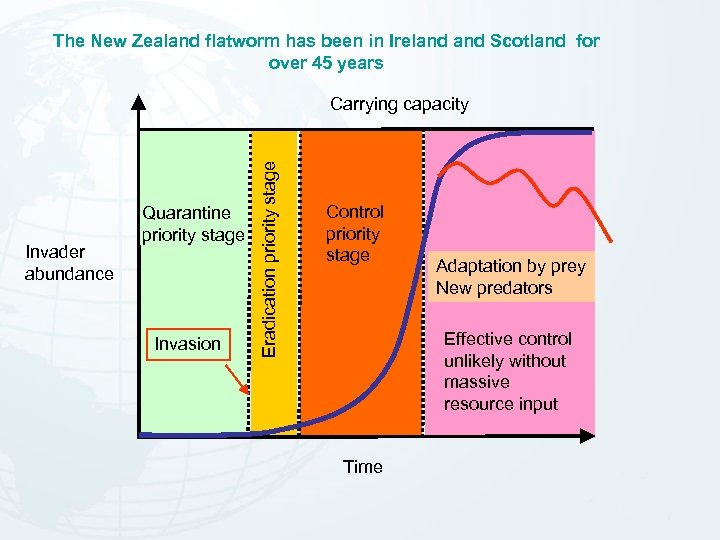 The New Zealand flatworm has been in Ireland Scotland for over 45 years Invader abundance Quarantine priority stage Invasion Eradication priority stage Carrying capacity Control priority stage Adaptation by prey New predators Effective control unlikely without massive resource input Time
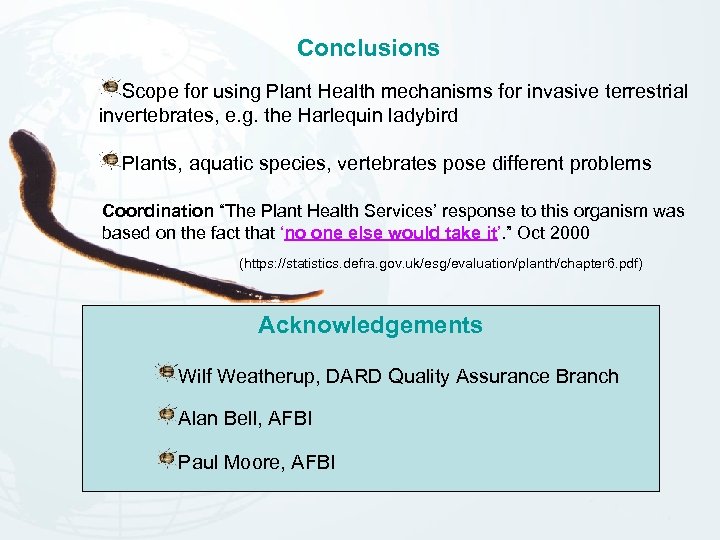 Conclusions Scope for using Plant Health mechanisms for invasive terrestrial invertebrates, e. g. the Harlequin ladybird Plants, aquatic species, vertebrates pose different problems Coordination “The Plant Health Services’ response to this organism was based on the fact that ‘no one else would take it’. ” Oct 2000 (https: //statistics. defra. gov. uk/esg/evaluation/planth/chapter 6. pdf) Acknowledgements Wilf Weatherup, DARD Quality Assurance Branch Alan Bell, AFBI Paul Moore, AFBI
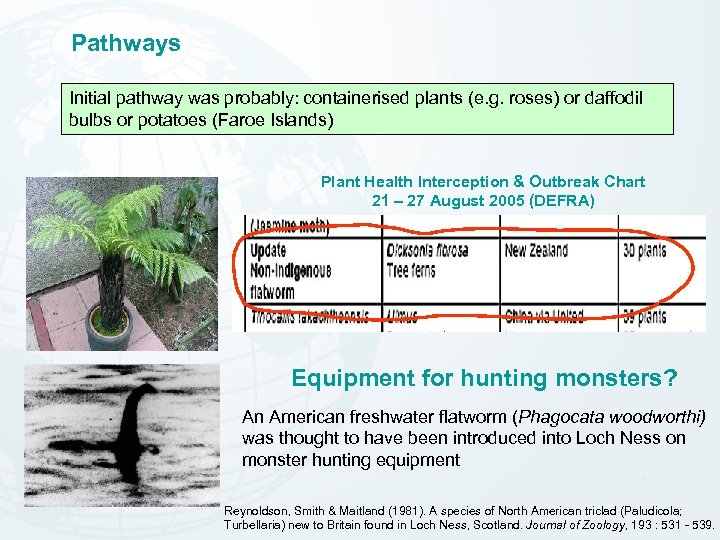 Pathways Initial pathway was probably: containerised plants (e. g. roses) or daffodil bulbs or potatoes (Faroe Islands) Plant Health Interception & Outbreak Chart 21 – 27 August 2005 (DEFRA) Equipment for hunting monsters? An American freshwater flatworm (Phagocata woodworthi) was thought to have been introduced into Loch Ness on monster hunting equipment Reynoldson, Smith & Maitland (1981). A species of North American triclad (Paludicola; Turbellaria) new to Britain found in Loch Ness, Scotland. Journal of Zoology, 193 : 531 - 539.